

The Electric Field and Waves Instruments on the Radiation Belt Storm Probes Mission
Open accessThe DOI matches its Crossref record; 46 of the 47 references it cites were found in a registry or an index.
Abstract
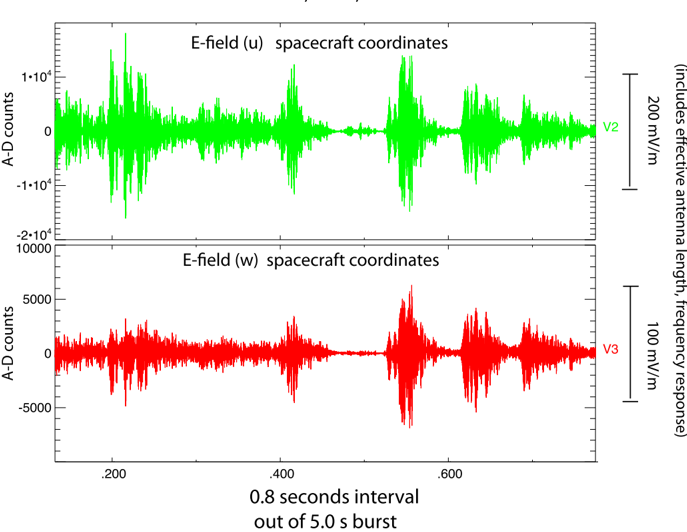
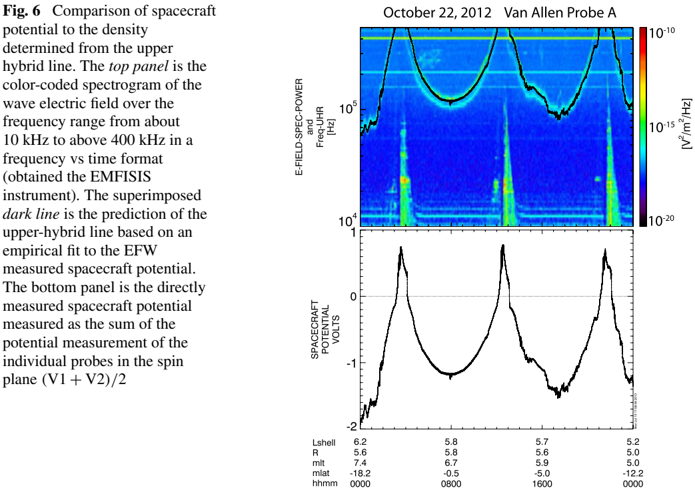
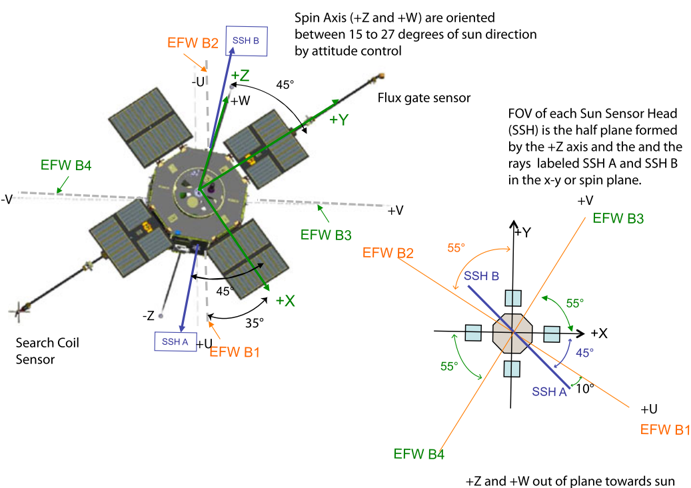
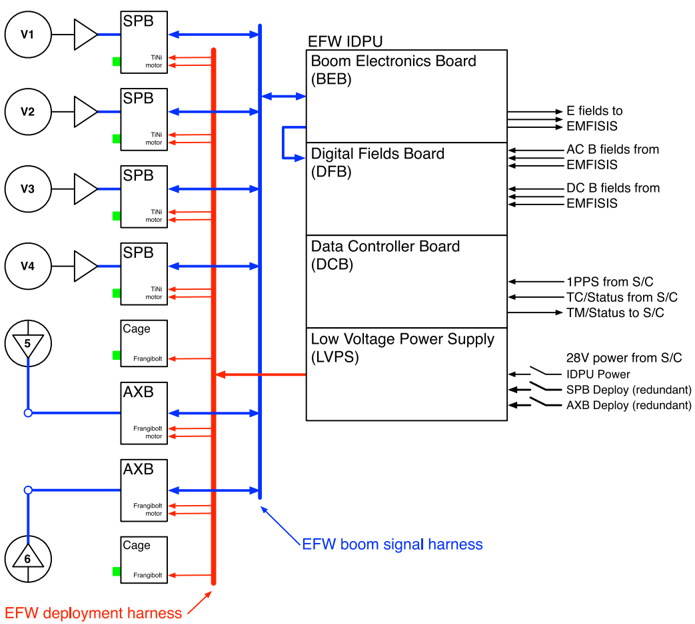
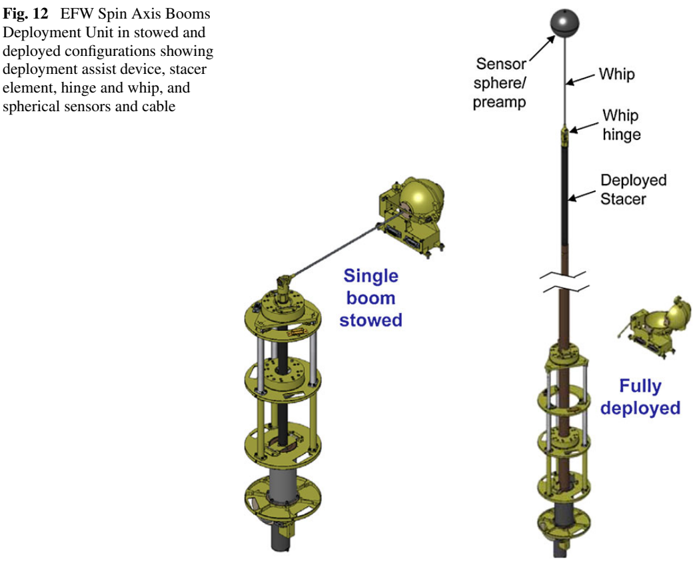
The Electric Fields and Waves (EFW) Instruments on the two Radiation Belt Storm Probe (RBSP) spacecraft (recently renamed the Van Allen Probes) are designed to measure three dimensional quasi-static and low frequency electric fields and waves associated with the major mechanisms responsible for the acceleration of energetic charged particles in the inner magnetosphere of the Earth. For this measurement, the instrument uses two pairs of spherical double probe sensors at the ends of orthogonal centripetally deployed booms in the spin plane with tip-to-tip separations of 100 meters. The third component of the electric field is measured by two spherical sensors separated by ∼15 m, deployed at the ends of two stacer booms oppositely directed along the spin axis of the spacecraft. The instrument provides a continuous stream of measurements over the entire orbit of the low frequency electric field vector at 32 samples/s in a survey mode. This survey mode also includes measurements of spacecraft potential to provide information on thermal electron plasma variations and structure. Survey mode spectral information allows the continuous evaluation of the peak value and spectral power in electric, magnetic and density fluctuations from several Hz to 6.5 kHz. On-board cross-spectral data allows the calculation of field-aligned wave Poynting flux along the magnetic field. For higher frequency waveform information, two different programmable burst memories are used with nominal sampling rates of 512 samples/s and 16 k samples/s. The EFW burst modes provide targeted measurements over brief time intervals of 3-d electric fields, 3-d wave magnetic fields (from the EMFISIS magnetic search coil sensors), and spacecraft potential. In the burst modes all six sensor-spacecraft potential measurements are telemetered enabling interferometric timing of small-scale plasma structures. In the first burst mode, the instrument stores all or a substantial fraction of the high frequency measurements in a 32 gigabyte burst memory. The sub-intervals to be downloaded are uplinked by ground command after inspection of instrument survey data and other information available on the ground. The second burst mode involves autonomous storing and playback of data controlled by flight software algorithms, which assess the “highest quality” events on the basis of instrument measurements and information from other instruments available on orbit. The EFW instrument provides 3-d wave electric field signals with a frequency response up to 400 kHz to the EMFISIS instrument for analysis and telemetry (Kletzing et al. Space Sci. Rev. 2013 ).
Overview
The claims and statistics of this paper haven’t been checked yet.
Free: it reads the open-access text and checks the first 5 claims that cite a source we can check. Create a free account to check every claim.
Integrity signals
Registry
Cites
Statistics
Figures
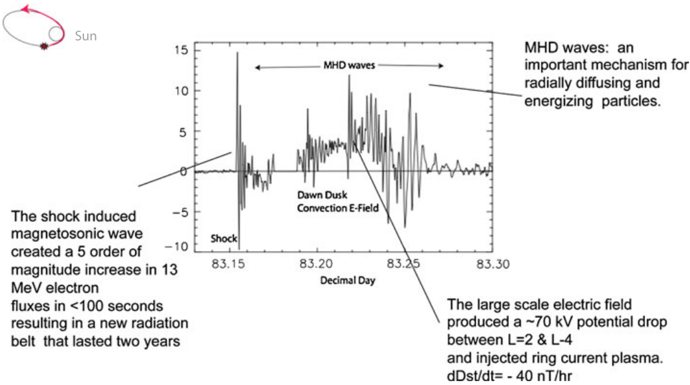
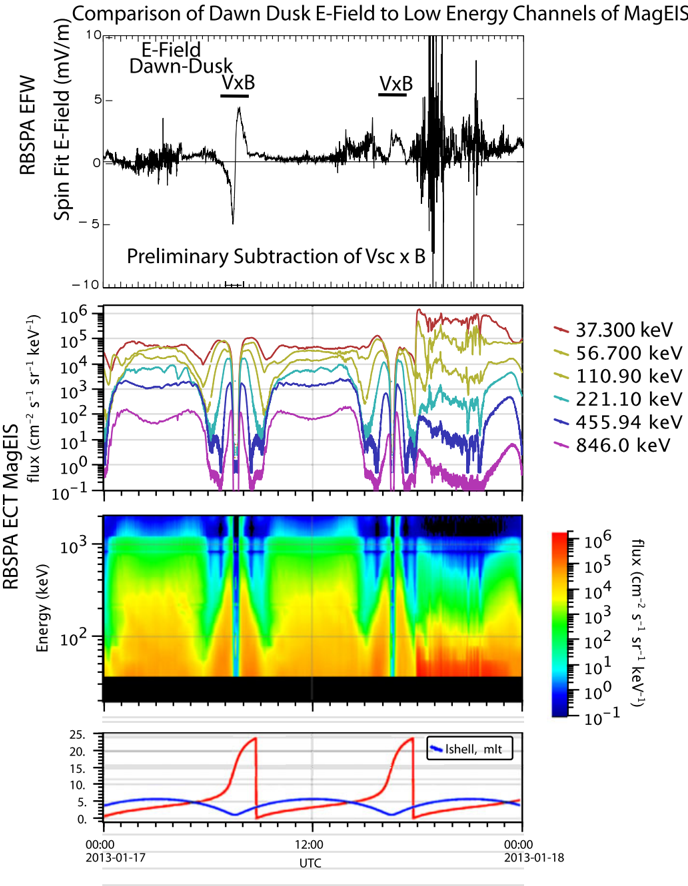
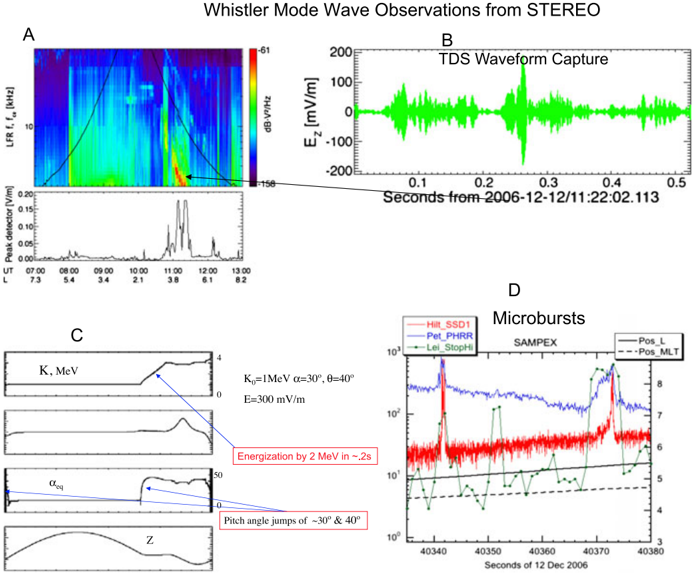
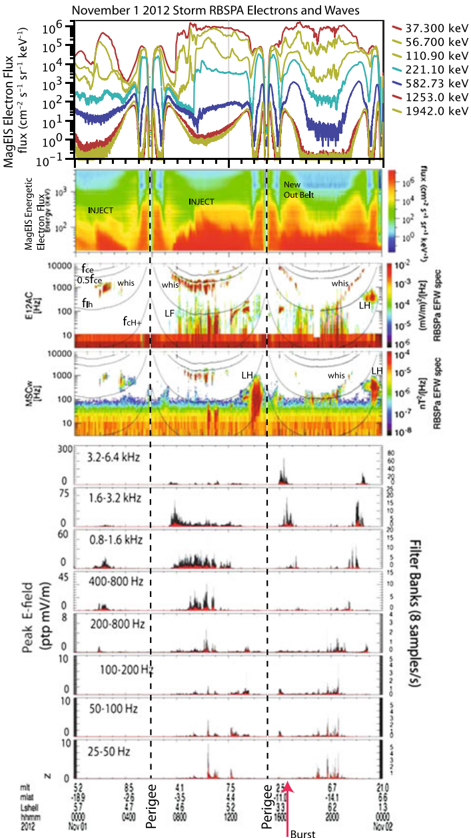

Verification
Claims the paper makes
The claims and statistics of this paper haven’t been checked yet.
Free: it reads the open-access text and checks the first 5 claims that cite a source we can check. Create a free account to check every claim.
Claims other papers make about this one
Each is checked against this paper’s own text: does it say what the citing paper says it does?
The source backs part of the claim, not all of it — or backs it for a different population, condition or comparison.
In the citing paper
“The advanced nature of sensors ensures accurate and timely data collection which, in turn, ensures that the cloud server can obtain the latest data in a timely manner [56].”
From Reform of Electrical Engineering Undergraduate Teaching and the Curriculum System in the Context of the Energy Internet (2023) · cites this paper as [56]
Experimental — accuracy not yet measured
Self-check
Percentages, sums and reported differences re-computed from the paper’s own numbers.
The self-check needs the paper’s full text.
Citations
Cites
The Electric and Magnetic Field Instrument Suite and Integrated Science (EMFISIS) on RBSP
Kletzing, C. A., Kurth, W. S., Acuna, M., MacDowall, R. J., Torbert, R. B., Averkamp, T., Bodet, D., Bounds, S. R., Chutter, M., Connerney, J., et al. (2013) · Space Science Reviews · doi:10.1007/s11214-013-9993-6 · Cited by 1,128
Self-citationHorne, R. B., & Thorne, R. M. (1998) · Geophysical Research Letters · doi:10.1029/98gl01002 · Cited by 633
The Electric Field Instrument (EFI) for THEMIS
Bonnell, J. W., Mozer, F. S., Delory, G. T., Hull, A. J., Ergun, R. E., Cully, C. M., Angelopoulos, V., & Harvey, P. R. (2008) · Space Science Reviews · doi:10.1007/s11214-008-9469-2 · Cited by 469
Self-citationLi, X., Roth, I., Temerin, M., Wygant, J. R., Hudson, M. K., & Blake, J. B. (1993) · Geophysical Research Letters · doi:10.1029/93gl02701 · Cited by 449
Self-citationSpatio‐temporal structure of storm‐time chorus
Santolík, O., Gurnett, D. A., Pickett, J. S., Parrot, M., & Cornilleau‐Wehrlin, N. (2003) · Journal of Geophysical Research: Space Physics · doi:10.1029/2002ja009791 · Cited by 425
Injection of electrons and protons with energies of tens of MeV into L < 3 on 24 March 1991
Blake, J. B., Kolasinski, W. A., Fillius, R. W., & Mullen, E. G. (1992) · Geophysical Research Letters · doi:10.1029/92gl00624 · Cited by 409
THE ELECTRIC FIELD AND WAVE EXPERIMENT FOR THE CLUSTER MISSION
Gustafsson, G., BostrÖM, R., Holback, B., Holmgren, G., Lundgren, A., Stasiewicz, K., ÅHLÉN, L., Mozer, F. S., Pankow, D., Harvey, P., et al. (1997) · Space Science Reviews · doi:10.1023/a:1004975108657 · Cited by 336
Self-citationDiscovery of very large amplitude whistler‐mode waves in Earth's radiation belts
Cattell, C., Wygant, J. R., Goetz, K., Kersten, K., Kellogg, P. J., von Rosenvinge, T., Bale, S. D., Roth, I., Temerin, M., Hudson, M. K., et al. (2008) · Geophysical Research Letters · doi:10.1029/2007gl032009 · Cited by 286
Self-citationO'Brien, T. P., Lorentzen, K. R., Mann, I. R., Meredith, N. P., Blake, J. B., Fennell, J. F., Looper, M. D., Milling, D. K., & Anderson, R. R. (2003) · Journal of Geophysical Research: Space Physics · doi:10.1029/2002ja009784 · Cited by 284
Self-citationLi, X., Baker, D. N., Temerin, M., Reeves, G. D., & Belian, R. D. (1998) · Geophysical Research Letters · doi:10.1029/1998gl900001 · Cited by 230
Self-citation
Research works printed but not linked: 1
- W.I. Axford, Flow of mass and energy in the Solar system, physics of solar planetary environments, in Pro- ceeding of the International Symposium on Solar-Terrestrial Physics, vol. 1 June 7-18 American Geo- physical Union (1976), pp. 270-283
Cited by
Items 501–524 of 524
Chen, X., Lu, X., Zong, Q., Zhang, H., Liu, Y., & Zhou, X. (2024) · Frontiers in Astronomy and Space Sciences · doi:10.3389/fspas.2024.1520141
Broadband Kinetic Alfvén Waves and the Pitch Angle Distribution of Relativistic Electrons
Barik, K. C., & Chaston, C. C. (2025) · Geophysical Research Letters · doi:10.1029/2025gl115046
Self-citationZhou, X., Gao, X., Lu, Q., Hajra, R., & Ma, J. (2025) · Journal of Geophysical Research Space Physics · doi:10.1029/2024ja033701
Cold proton heating by high-frequency EMIC wavesPreprint
Usanova, M., Liu, X., Chen, L., & Ergun, R. E. (2025) · doi:10.22541/essoar.176158441.19945413/v1
Self-citationGeneration of oppositely propagating Alfvén waves by a substorm-injected proton cloud
Smotrova, E. E., Mikhailova, O. S., Mager, P. N., & Rubtsov, A. V. (2025) · Advances in Space Research · doi:10.1016/j.asr.2025.10.084
Charged Particles in Magnetic Fields from Strongly Coupled Plasmas to Whistler-Mode Chorus Waves
Vidal, K. R. (2024) · Iowa Research Online (The University of Iowa) · doi:10.25820/etd.007390
The implications and characteristics of diffuse-like but dynamic aurora
Troyer, R. (2023) · Iowa Research Online (The University of Iowa) · doi:10.25820/etd.007178
Advancement of Space Plasma Measurements With Novel Langmuir Probe Technologies
Samaniego, J. I. (2020) · CU Scholar (University of Colorado Boulder)
Gamayunov, K. V., Kim, H., & Shin, Y. M. (2025) · Journal of Geophysical Research Space Physics · doi:10.1029/2025ja034105
Near-Equatorial Resonator for He$$^{+}$$ Band Ion-Ion Hybrid Pc1 Waves in the Magnetosphere
Mikhailova, O. S., & Mager, P. N. (2026) · Springer proceedings in earth and environmental sciences · doi:10.1007/978-3-031-92928-1_38
Elliott, S. S., Colpitts, C. A., Seebaluck, K., Cattell, C. A., Wygant, J. R., & Singh, A. (2026) · Frontiers in Astronomy and Space Sciences · doi:10.3389/fspas.2026.1781474
Self-citation脈動オーロラ主脈動とコーラスバーストの周期性に関する統計的比較
川村, 勇. (2018) · Institutional Repositories DataBase (IRDB)
An Analysis of the Anomalous Response of the Van Allen Probes EFW Instrument
Greene, K., Bonnell, J. W., Goodrich, K. A., Bowman, J. L., Tejero, E., Hartley, D. P., & Amatucci, W. E. (2026) · Journal of Geophysical Research Space Physics · doi:10.1029/2026ja035217
Self-citationLocal Evolution of a Prenoon Drainage Plume
Kang, S. B., Fok, M., Ferradas, C. P., Glocer, A., Pandya, M., & Huba, J. D. (2026) · Geophysical Research Letters · doi:10.1029/2025gl121414
Prompt Modulation of Plasmaspheric Hiss by Solar Wind Dynamic Pressure Pulses
Jin, Y., Qiu, J., Liu, N., Gao, Z., He, Z., Zhang, S., Yang, C. W., He, Q., Chen, X., Liu, S., et al. (2026) · Journal of Geophysical Research Space Physics · doi:10.1029/2026ja035494
Fundamental Poloidal Wave Event Extending From Midnight to Dawn
Takahashi, K. I., Hartinger, M. D., & Koga, K. (2026) · Journal of Geophysical Research Space Physics · doi:10.1029/2026ja035482
Multi‐Spacecraft Observations of a Fundamental Toroidal ULF Wave Event
Wang, Z., Liu, W., Zhang, D., Yan, L., Sarris, T. E., Li, X., Miyoshi, Y., Matsuoka, A., Kasaba, Y., Kasahara, Y., et al. (2026) · Journal of Geophysical Research Space Physics · doi:10.1029/2026ja035508
Self-citationResearch on Precise Analysis and Location of Server Memory Faults
Zhang, X. (2026) · International Core Journal of Engineering · doi:10.6919/icje.202603_12(3).0024
Chu, X., Tang, C. L., & Su, Z. (2026) · Journal of Geophysical Research Space Physics · doi:10.1029/2026ja035142
Correlation Between High-Latitude Chorus Waves and Pulsating Aurora in the Same Hemisphere
Hill, S. (2026) · URSI Radio Science Letters · doi:10.46620/26-0126
Davis, L., Cattell, C. A., Wilson, L. B., III, Cohen, Z. A., Breneman, A. W., & Hanson, E. (2021) · Zenodo (CERN European Organization for Nuclear Research) · doi:10.5281/zenodo.4625197
Self-citationVan Allen Probes Observations of a Fundamental Poloidal Wave in the Plasmasphere
Takahashi, K. I., Yamakawa, T., Gkioulidou, M., Mitchell, D. G., & Manweiler, J. W. (2026) · Journal of Geophysical Research Space Physics · doi:10.1029/2026ja035534
Ma, Q., Chu, X., Ma, D., Huang, S., Li, W., Bortnik, J., & Shen, X.-C. (2023) · doi:10.3389/fspas.2023.1232702.s001
Metadata
- Authors
- Wygant, J. R., Bonnell, J. W., Goetz, K., Ergun, R. E., Mozer, F. S., Bale, S. D., Ludlam, M., Turin, P., Harvey, P. R., Hochmann, R., Harps, K., Dalton, G., McCauley, J., Rachelson, W., Gordon, D., Donakowski, B., Shultz, C., Smith, C., Diaz-Aguado, M., Fischer, J., Heavner, S., Berg, P., Malsapina, D. M., Bolton, M. K., Hudson, M., Strangeway, R. J., Baker, D. N., Li, X., Albert, J., Foster, J. C., Chaston, C. C., Mann, I., Donovan, E., Cully, C. M., Cattell, C. A., Krasnoselskikh, V., Kersten, K., Brenneman, A., & Tao, J. B.
- Affiliations
- University of Minnesota (US)
- Space Sciences Laboratory (US)
- University of Colorado Boulder (US)
- Dartmouth College (US)
- University of California, Los Angeles (US)
- Kirtland Air Force Base (US)
- Massachusetts Institute of Technology (US)
- University of Alberta (CA)
- University of Calgary (CA)
- Laboratoire de Physique et Chimie de l’Environnement et de l’Espace (FR)
- Corresponding author
- Wygant, J. R.
- ORCID
- Venue
- Space Science Reviews
- Published
- 2013-10-11
- Volume
- 179
- Issue
- 1-4
- Pages
- 183-220
- ISSN
- 0038-6308 (ISSN-L)
- 1572-9672
- OpenAlex
- W2001053108
- Cited by
- 489
- References
- 46
- Citations by year
- 2026: 4 · 2025: 21 · 2024: 24 · 2023: 37 · 2022: 37 · 2021: 59 · 2020: 47 · 2019: 38 · 2018: 44 · 2017: 54 · 2016: 49 · 2015: 49 · 2014: 22 · 2013: 4
- FWCI
- 22.28
- Type
- journal article
- Language
- en
- Open access
- hybrid
- doi.org
- Locations
- Space Science Reviews (publishedVersion, cc-by)
- HAL (submittedVersion, cc-by-nc)
- DSpace@MIT (Massachusetts Institute of Technology) (submittedVersion, cc-by-nc)
- Funders
- National Aeronautics and Space Administration (NAS5-01072, 967399)
- Johns Hopkins University (967399, 922613)
- Topics
- Physical Sciences › Earth and Planetary Sciences › Space and Planetary Science › Ionosphere and magnetosphere dynamics
- Physical Sciences › Engineering › Electrical and Electronic Engineering › Low-Pressure Plasma Processing and Diagnostics
- Physical Sciences › Physics and Astronomy › Astronomy and Astrophysics › Solar and Space Plasma Dynamics
- Keywords
- Radiation Belt Storm Probes, Van Allen Probes, low-frequency electric field, plasma waves, energetic particle acceleration, inner magnetosphere, spacecraft potential, Poynting flux, plasma fluctuations
About these checks
Registry, retraction, Cites and statistics results are computed, not judged, with one exception: a printed reference that no index lists is read once by a model before it counts as a citation error. Claims are extracted by a model and kept only when their quote appears verbatim in the text; each cited source is then checked, with a model’s help, for whether it says what the claim relies on. Those verdicts can be wrong — read the claim’s quote and the cited source before relying on one.
Statistics and arithmetic are recomputed, not judged.
Confidence bands are shown only for fields calibrated on our annotated test set. None is calibrated yet, so no band is shown.
What counts as a claim ›How we measure confidence ›How we check this ›
Are you an author, or do you see a problem with this page? Request a review
Data sources
Bibliographic data: Semantic Scholar, OpenAlex, Crossref.
Contains information from the Semantic Scholar Academic Graph Datasets, made available under the ODC Attribution License (ODC-BY 1.0).
Semantic Scholar’s data is described in: Kinney, R., et al. (2023). The Semantic Scholar Open Data Platform. arXiv:2301.10140.
