

How to measure the status quo bias? A review of current literature
Open accessThe DOI matches its Crossref record; 161 of the 161 references it cites were found in a registry or an index; 10 of the 63 sources its claims cite were checked for support.
Abstract
The Status Quo Bias (SQB) describes an individual's preference to avoid changes and maintain the current situation. In today’s world, technological advances require nearly constant change within organizations. Thus, SQB can become an issue when it hinders progress. Therefore, it is crucial to understand how this effect can be reliably measured and, even more importantly, what countermeasures to employ. Prior research has focused more on individual measuring approaches and less on countermeasures. As researchers across different research fields have studied this bias, we conduct a literature review spanning different scholarly fields. This broader research focus allows us to identify four measurement approaches and 13 countermeasures along the three aspects of cognitive misperception, rational decision making, and psychological commitment of SQB. Our overview consolidates existing knowledge and will hopefully be the starting point for researchers to start combating this bias where needed. Successful and proven countermeasures can, for example, increase the acceptance and adoption of digital innovations and technology in general and thereby allow organizations to capitalize on their investments.
Overview
CoChat Summary
TL;DR
This literature review synthesizes research on status quo bias (SQB) across fields, identifying four measurement approaches and countermeasures grouped by cognitive misperception, rational decision-making, and psychological commitment. It finds that no measurement approach fulfills all quality criteria and that most countermeasures remain untested.
Key findings
- Four measurement approaches were identified: econometric measurement based on behavioral outcomes; medical/neurophysiological measurement (e.g., subthalamic nucleus activity, fMRI, fNIRS, transcranial magnetic stimulation); measurement through multiple constructs; and direct measurement with several items.
- The abstract reports 13 countermeasures, while the findings/discussion report 15 aggregated countermeasures. These are grouped as: cognitive misperception (4: manipulate the default, rephrase the problem, get an outside opinion, change the structure of decisions); rational decision-making (5: tell success stories, reduce perceived change, use mental simulation, use financial incentives, increase perceived value of change); and psychological commitment (6: provide additional resources, train users sufficiently, address sunk costs, use social feedback, activate change agents, change social norms).
- Only four publications tested countermeasure effectiveness: Lorenc et al. (2013) with 150 individuals (19 [13%] tried to switch, 16 [11%] booked advisor appointments, 76% did not react); Heidenreich and Kraemer (2016) with 679 individuals (mental simulation and benefit comparison reduced passive innovation resistance); Shealy et al. (2019) (modified points plus feasibility example achieved 79% vs. 56% in the control group; a second test yielded 76%); and Hu and Shealy (2020) with 20 students (an official resolution lowered perceived risk and increased greener choices).
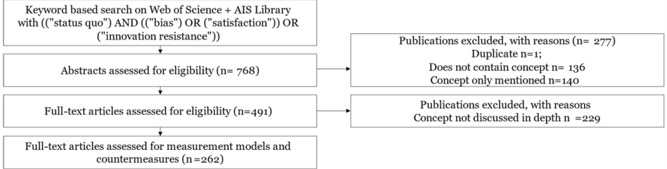
- The review analyzed 262 publications in depth from an initial 768. Fields included Business and Economics (112), Information Systems (80), Psychology and Medicine (24), Politics and Law (21), Energy and Sustainability (17), Education and Teaching (5), and Ethics (3). Most frequent methods were surveys (141), theoretical works (51), and experiments (36). Most frequent constructs included satisfaction (30), uncertainty cost (28), control (27), and inertia (20); loss aversion (96), transaction cost (49), and sunk cost (40) were the most prominent specific concepts.
Methods
- Literature review following Watson and Webster (2002) and Tranfield et al. (2003), using a keyword search on Web of Science and the AIS library: `(('status quo') AND (('bias') OR ('satisfaction')) OR ('innovation resistance'))`. Selection criteria were accessibility, universality, publication-quality, and relevance.
- From 768 initial publications, exclusions removed 1 duplicate, 136 without SQB or related concept, 140 mentioning it only in passing, and 229 not elaborating in depth, leaving 262 for detailed analysis.
- The analysis categorized measurement constructs and countermeasures along Samuelson and Zeckhauser’s (1988) three SQB aspects: cognitive misperception, rational decision-making, and psychological commitment. It also assessed unit of analysis and research methods.
Limitations
- Stated by the paper: the keyword-based search in two databases might have overlooked other publications; abstract-based identification of in-depth SQB discussions might not have done all publications justice; and the assignment of constructs and countermeasures to the three SQB aspects was done to the authors’ best knowledge but might not reflect all contributions.
- Evident from the text: most countermeasures are suggestions and have not been tested in practice, and the exact combination of countermeasures still requires further research. The review also states that none of the four measurement approaches fulfills all quality criteria (reliability, validity, generalizability, explainability).
- Evident inconsistency: the abstract reports 13 countermeasures, while the findings and discussion report 15 aggregated countermeasures.
Model-written summary. Check it against the paper before relying on it.
Integrity signals
Registry
Cites
Statistics
Figures
Verification
Claims the paper makes
10 Valid · 4 Not valid · 51 Not checked · 95 Own results and interpretations
The cited sources support only part of this claim — read each source’s verdict below.
In the paper
“In this regard, Lorenc et al. (2013) showed that SQB is one of the reasons for 'fuel poverty', e.g., income weak individuals spending too much of their already low income on unfavorable energy tariffs and not switching to a different tariff.”
What the sources say
- Partly supportedcites Lorenc et al. (2013) matched to “Tackling fuel poverty through facilitating energy tariff switching: a participatory action research study in vulnerable groups” (2013) sourceExperimental — accuracy not yet measured
The Discussion identifies status quo bias—preferring the current option—as an important factor in vulnerable consumers’ tariff-switching decisions. The Introduction links limited switching to missed potential savings, but the Conclusion only expresses hope that addressing tariff switching will reduce fuel poverty; the study does not establish that status quo bias causes fuel poverty. (LLM, conf=0.84)
boostedstates a cause- Asserted: passes — The authors put it forward as true.
- Checkable: passes — It can be checked against evidence.
- Load-bearing: unclear — It is unclear whether the paper’s conclusions depend on it.
- Based: passes — The paper gives a reason why it holds.
- Partly supported
Every source the paper cites for this claim was checked and supports it.
In the paper
“Similarly, the choice of health insurance plans can be influenced towards a specific beneficial option (Krieger and Felder 2013).”
What the sources say
- Supportedcites Krieger and Felder 2013 matched to “Can Decision Biases Improve Insurance Outcomes? An Experiment on Status Quo Bias in Health Insurance Choice” (2013) source
The Conclusions state that the decision environment can be changed to favor welfare-enhancing health-insurance choices, specifically by making co-insurance the default. The authors ground this proposal in their laboratory finding of status quo bias (Results and Discussion, §3.2), while noting that real-world confirmation is still needed. (LLM, conf=0.90)
plainstates a possible cause- Asserted: passes — The authors put it forward as true.
- Checkable: passes — It can be checked against evidence.
- Load-bearing: unclear — It is unclear whether the paper’s conclusions depend on it.
- Based: passes — The paper gives a reason why it holds.
- Supported
Every source the paper cites for this claim was checked and supports it.
In the paper
“The approach by Lorenc et al. (2013) tested the effectiveness of an intervention to motivate energy tariff switching.”
What the sources say
- Supportedcites Lorenc et al. (2013) matched to “Tackling fuel poverty through facilitating energy tariff switching: a participatory action research study in vulnerable groups” (2013) source
The Abstract states that the study examined the impact of a tariff-switching intervention on vulnerable participants’ likelihood of switching and their success in doing so. The methods passage ('Exclusion criteria were') describes providing advice and materials, then interviewing participants about the intervention at least a week later. This supports the citing sentence’s description of what Lorenc et al. tested. (LLM, conf=0.94)
plainstates a causen = 150- Asserted: passes — The authors put it forward as true.
- Checkable: passes — It can be checked against evidence.
- Load-bearing: passes — The paper’s conclusions depend on it.
- Based: passes — The paper gives a reason why it holds.
- Supported
Every source the paper cites for this claim was checked and supports it.
In the paper
“As the example of Lorenc et al. (2013) shows, it is not enough to give individuals more information on their energy tariffs and thereby address the rational decision-making aspect.”
What the sources say
- Supportedcites Lorenc et al. (2013) matched to “Tackling fuel poverty through facilitating energy tariff switching: a participatory action research study in vulnerable groups” (2013) source
The Non-switchers section reports that lack of knowledge was the main barrier before the intervention, but afterward participants still cited hassle, apathy, fear and scepticism. The Discussion says personalised one-on-one advice and follow-up were likely key to the project's success. Together, these passages support the point that tariff information alone is insufficient. (LLM, conf=0.91)
plain- Asserted: passes — The authors put it forward as true.
- Checkable: passes — It can be checked against evidence.
- Load-bearing: passes — The paper’s conclusions depend on it.
- Based: passes — The paper gives a reason why it holds.
- Supported
A result the paper states — it cites no source for it, so there is none to check. The quote shows it is in the paper.
In the paper
“To date, an overview of these different approaches is still missing.”
plain- Asserted: passes — The authors put it forward as true.
- Checkable: passes — It can be checked against evidence.
- Load-bearing: passes — The paper’s conclusions depend on it.
- Based: unclear — It is unclear why the paper says it holds.
54 more claims
Create a free account to see all 160 claims and every source verdict.
- Probably not a substantial claim. 81
- It may state two separate claims as one. 28
Self-check
Percentages, sums and reported differences re-computed from the paper’s own numbers.
Each contradiction between two passages listed here was confirmed by an independent check.
Rated minor: it would not touch a result — a value no result rests on, a p-value that stays on the same side of the significance level, or a conflict that is clerical, resolved elsewhere in the paper, or outside its own findings.
In the paper
§ 3.1 Data collection
“Following the recommendations by Watson and Webster (2002) and Tranfield et al. (2003)”
§ References
“- Webster J, Watson RT (2002) Analyzing the past to prepare for the future: writing a literature review. MIS Quart 26(2):13-23”
Rated minor: it would not touch a result — a value no result rests on, a p-value that stays on the same side of the significance level, or a conflict that is clerical, resolved elsewhere in the paper, or outside its own findings.
In the paper
§ Abstract
“This broader research focus allows us to identify four measurement approaches and 13 countermeasures along the three aspects of cognitive misperception, rational decision making, and psychological commitment of SQB.”
§ 5 Discussion
“We identified four approaches to measuring SQB and fifteen countermeasures.”
Rated minor: it would not touch a result — a value no result rests on, a p-value that stays on the same side of the significance level, or a conflict that is clerical, resolved elsewhere in the paper, or outside its own findings.
In the paper
§ 4.2 Measures to counter SQB
“we grouped countermeasures mentioned in the different publications by the three explanation approaches loss aversion, rational decision making, and cognitive misperception (Samuelson and Zeckhauser 1988).”
§ 4.2 Measures to counter SQB
“Finally, there are six measures mentioned in the literature to counter psychological commitment:”
Cited works that were retracted
Works this paper cites that were later retracted, from the retraction notices publishers deposit. Major when the notice came out before this paper was published.
Rated major: it would touch a result — a value a result rests on, reported and recomputed p-values on opposite sides of the significance level, two passages that conflict with no sign which is right, or a cited work retracted before this paper was published.
In the paper
“Soh PY, Heng HB, Selvachandran G, Le Anh Q, Chau HTM, Le Son H et al (2020) Perception, acceptance and willingness of older adults in Malaysia towards online shopping: a study using the UTAUT and IRT models. J Ambient Intell Humaniz Comput. https://doi.org/10.1007/s12652-020-01718-4”
Cited work 10.1007/s12652-020-01718-4 · retracted 2020-01-17 · notice 10.1007/s12652-020-01718-4 · this paper published 2022-08-01
Citations
Cites
1 retracted
Soh, P. Y., Heng, H. B., Selvachandran, G., Anh, L. Q., Chau, H. T. M., Sơn, L. H., Abdel-Baset, M., Manogaran, G., & Varatharajan, R. (2020) · Journal of Ambient Intelligence and Humanized Computing · doi:10.1007/s12652-020-01718-4 · Cited by 112
RetractedProspect Theory: An Analysis of Decision under Risk
Kahneman, D., & Tversky, A. (1979) · Econometrica · doi:10.2307/1914185 · Cited by 48,524
Tversky, A., & Kahneman, D. (1974) · Science · doi:10.1126/science.185.4157.1124 · Cited by 28,810 · cited 2×
“Tversky and Kahneman (1974) were able to show that their assessment depended on how available information about such an event was for the participants (availability heuristic).”
A BEHAVIORAL MODEL OF RATIONAL CHOICE
Simon, H. A. (1955) · The Quarterly Journal of Economics · doi:10.2307/1884852 · Cited by 15,877
Tranfield, D., Denyer, D., & Smart, P. (2003) · British Journal of Management · doi:10.1111/1467-8551.00375 · Cited by 15,386
Analyzing the Past to Prepare for the Future: Writing a Literature Review
Webster, J., & Watson, R. T. (2002) · MIS Quarterly · doi:10.2307/4132319 · Cited by 7,449 · cited 1×
“Following the recommendations by Watson and Webster (2002) and Tranfield et al. (2003), we did not limit the literature search to specific journals to holistically understand current research on SQB.”
MethodStatus quo bias in decision making
Samuelson, W., & Zeckhauser, R. (1988) · Journal of Risk and Uncertainty · doi:10.1007/bf00055564 · Cited by 5,897
Anomalies: The Endowment Effect, Loss Aversion, and Status Quo Bias
Kahneman, D., Knetsch, J. L., & Thaler, R. H. (1991) · Journal of Economic Perspectives · doi:10.1257/jep.5.1.193 · Cited by 5,019 · cited 1×
“Prior research identified the overlap of loss aversion with SQB (Kahneman et al. 1991).”
BackgroundThe Nature of Theory in Information Systems1
Gregor, S. (2006) · MIS Quarterly · doi:10.2307/25148742 · Cited by 3,306 · cited 2×
“The aim of any theory development should therefore be at least towards a theory of explana‑ tion (Gregor 2006).”
BackgroundMethodArkes, H. R., & Blumer, C. (1985) · Organizational Behavior and Human Decision Processes · doi:10.1016/0749-5978(85)90049-4 · Cited by 2,573 · cited 1×
“Individuals tend to justify this behavior as not wanting to appear wasteful (Arkes and Blumer 1985).”
Background
Research works printed but not linked: 12
- Benson B (2019) Why are we yelling? The art of productive disagreement. Penguin Publishing Group, New York
- Chatfield A, Reddick C (2019) Blockchain investment decision making in central banks: a status quo bias theory perspective. In: Americas conference on information systems (AMCIS) proceedings. Cancún, México
- Cheng X, Fu S, Yin G (2016) Does subsidy work? An investigation of post-adoption switching on carhailing apps. J Electron Commer Res 18:317-329
- Heidt M, Sonnenschein R, Loske A (2017) Never change a running system? How status quo-thinking can inhibit software as a service adoption in organizations. In: European conference on information systems (ECIS) proceedings. Guimarães, Portugal, pp 1902-1918
- Henkel C, Seidler A-R, Kranz J, Fiedler M (2019) How to nudge pro-environmental behaviour: an experimental study. In: European conference on information systems (ECIS) proceedings. Stockholm & Uppsala, Sweden
- Hsieh P-J, Lai H-M, Ye Y-S (2014) Patients' acceptance and resistance toward the health Cloud: an integration of technology acceptance and status quo bias perspectives. In: Pacific Asia conference on information systems (PACIS) proceedings. Chengdu, China
- Kim H-W, Perera N (2008) Software continuance from the switching costs perspective: a case of web browser. In: Pacific Asia conference on information systems (PACIS) proceedings, Suzhou, China.
- Klöcker P, Bernnat R, Veit D (2014): Implementation through force or measure? How institutional pressures shape national ehealth implementation programs. In: European conference on information systems (ECIS) proceedings, Tel Aviv, Israel
- Korobkin R (1998) Status quo bias andcontract default rules. Cornell Law Rev 83:608
- Li Z, Cheng Y (2014) From free to fee: exploring the antecedents of consumer intention to switch to paid online content. J Electron Commer Res 15(4):281-299
- Ram S (1987) A model of innovation resistance. Adv Consum Res 14(1):208–212
- Zhang Kem ZK, Gong X, Zhao SJ, Lee MKO (2016) Are you afraid of transiting from web to mobile payment? The bias and moderating role of inertia. In: Pacific Asia conference on information systems (PACIS) proceedings, Chiayi City, Taiwan
Cited by
Time for a change! Uprooting users embedded in the status quo from habitual decision-making
Sun, X., Guo, B., Yang, Y., & Pan, Y. (2024) · Decision Support Systems · doi:10.1016/j.dss.2024.114371 · Cited by 112
Loh, X.-M., Lee, V., Leong, L.-Y., Aw, E. C., Cham, T., Tang, Y.-C., & Hew, J.-J. (2023) · Journal of Business Research · doi:10.1016/j.jbusres.2023.113726 · Cited by 74
Weber, S., Wyszynski, M., Godefroid, M., Plattfaut, R., & Niehaves, B. (2024) · Computational and Structural Biotechnology Journal · doi:10.1016/j.csbj.2024.02.009 · Cited by 60
Self-citationAnguiano, T. D., & Esteban, L. P. (2023) · Management Review Quarterly · doi:10.1007/s11301-023-00328-6 · Cited by 43
Half dead or more alive than ever? New, old, and (increasingly) redundant literature review formats
Block, J., Brändle, L., Limbach, P., Röth, T., & Sabel, C. A. (2025) · Management Review Quarterly · doi:10.1007/s11301-025-00513-9 · Cited by 36
Palmucci, D. N., & Ferraris, A. (2023) · Frontiers in Psychology · doi:10.3389/fpsyg.2023.1130059 · Cited by 38
Identifying key barriers to nonprofit organizations' adoption of technology innovations
Godefroid, M., Plattfaut, R., & Niehaves, B. (2023) · Nonprofit Management and Leadership · doi:10.1002/nml.21609 · Cited by 52
Self-citationLe, H., Shen, Y., Li, Z., Xia, M., Tang, L., Li, X., Jia, J., Wang, Q., Gašević, D., & Fan, Y. (2025) · British Journal of Educational Technology · doi:10.1111/bjet.13614 · Cited by 48
Afzal, M. Y., & Panagiotopoulos, P. (2024) · Government Information Quarterly · doi:10.1016/j.giq.2024.101977 · Cited by 53
Persson, M. (2023) · Journal of European Public Policy · doi:10.1080/13501763.2023.2177323 · Cited by 28
Manipulation: Its Nature, Mechanisms, and Moral Status
Noggle, R. (2025) · doi:10.1093/9780198924920.001.0001 · Cited by 26
Beheshti, M., Mladenović, D., Sadraei, R., & Zareravasan, A. (2024) · International Journal of Contemporary Hospitality Management · doi:10.1108/ijchm-09-2023-1487 · Cited by 18
The application of AI in digital HRM – an experiment on human decision-making in personnel selection
Malin, C. D., Fleiß, J., Seeber, I., Kubicek, B., Kupfer, C., & Thalmann, S. (2024) · Business Process Management Journal · doi:10.1108/bpmj-11-2023-0884 · Cited by 45
How Public Officials Perceive Algorithmic Discretion: A Study of Status Quo Bias in Policing
Afzal, M., & Panagiotopoulos, P. (2025) · Public Administration Review · doi:10.1111/puar.13957 · Cited by 16
Self-service technology recovery: the importance of psychological need support
Keating, B. W., & Aslan, M. (2023) · Journal of service management · doi:10.1108/josm-12-2021-0464 · Cited by 16
Xi, Y. (2024) · International Journal of Human-Computer Interaction · doi:10.1080/10447318.2024.2405786 · Cited by 18
Palmucci, D. N. (2023) · EuroMed Journal of Business · doi:10.1108/emjb-11-2022-0208 · Cited by 20
Artificial Intelligence in Scientific Writing: A Deuteragonistic Role?
Wohlfarth, B., Streit, S. R., & Guttormsen, S. (2023) · Cureus · doi:10.7759/cureus.45513 · Cited by 14
To change or not to change? – Status quo bias and happiness
Barokas, G., Ling, H. H., Sherman, A., & Shavit, T. (2024) · Journal of Economic Behavior & Organization · doi:10.1016/j.jebo.2024.06.017 · Cited by 9
Goetting, K., Liebe, U., & Becker, S. (2025) · Climate Policy · doi:10.1080/14693062.2025.2539140 · Cited by 15
Chen, B., & Xiao, J. (2025) · Frontiers in Sustainable Food Systems · doi:10.3389/fsufs.2025.1676462 · Cited by 14
Teleworking antecedents: an exploration into availability bias as an impediment
Godefroid, M., Borghoff, V., Plattfaut, R., & Niehaves, B. (2024) · Information Systems and e-Business Management · doi:10.1007/s10257-023-00652-0 · Cited by 8
Self-citationAsking fintech voice Chatbots: Explaining consumer switching intention by status quo bias theory
Huang, S. Y. B. (2025) · Journal of Retailing and Consumer Services · doi:10.1016/j.jretconser.2025.104457 · Cited by 16
Huster, S., Heck, R., Rudi, A., Rosenberg, S., & Schultmann, F. (2025) · Journal of Environmental Management · doi:10.1016/j.jenvman.2025.125783 · Cited by 7
Mutambik, I. (2024) · Journal of theoretical and applied electronic commerce research · doi:10.3390/jtaer19030121 · Cited by 15
Why Investors Resist: A Psychological Perspective on Adoption Resistance to Financial Robo-Advisors
Goswami, D., & Verma, B. (2025) · Journal of Internet Commerce · doi:10.1080/15332861.2025.2566660 · Cited by 8
How Cognitive Bias Prevents Serendipity in New Product Development (and What to Do About It)
Trott, P., Ellwood, P., & Baxter, D. (2024) · IEEE Transactions on Engineering Management · doi:10.1109/tem.2024.3407515 · Cited by 9
Implications of behavioural economics for the pro-competitive regulation of digital platforms
Fletcher, A., & Vasas, Z. (2024) · Oxford Review of Economic Policy · doi:10.1093/oxrep/grae044 · Cited by 7
Vigolo, V., Galimberti, A., Cobelli, N., & Baroni, B. N. (2025) · Technological Forecasting and Social Change · doi:10.1016/j.techfore.2025.124288 · Cited by 9
Inhibitors and Enablers of Peer-To-Peer Mobile Payment Usage Intention
Nguyen, T., Thu, N. T. H., & Ha, Q.-A. (2025) · Journal of Computer Information Systems · doi:10.1080/08874417.2024.2445013 · Cited by 5
Theoretical Perspectives on the Impact of Generative AI on the Tourism Sector: A Literature Review
Srivastava, G., Bag, S., Ramudu, P. J., Shrivastav, S. K., Pueschel, J., & Benabdellah, A. C. (2025) · Journal of Global Information Management · doi:10.4018/jgim.388177 · Cited by 11
Khatun, M. A., Masud, M. R., & Kotani, K. (2025) · Climate · doi:10.3390/cli13050098 · Cited by 4
Increasing RPA Adoption: An Experiment on Countermeasures for Status Quo Bias
Godefroid, M., Plattfaut, R., & Niehaves, B. (2023) · Lecture notes in computer science · doi:10.1007/978-3-031-41620-0_19 · Cited by 4
Self-citationFinTech and branch network expansion: evidence from China’s banking industry
Zhang, X., & Li, Z. (2025) · Applied Economics · doi:10.1080/00036846.2025.2476213 · Cited by 4
Avoiding critical entrepreneurial cognitive errors through linear/nonlinear thinking style balance
Groves, K. S., & Vance, C. M. (2024) · Journal of Small Business Management · doi:10.1080/00472778.2024.2363837 · Cited by 6
Godefroid, M., Gan, Y., Hüls, G., Plattfaut, R., & Niehaves, B. (2024) · Journal of Decision System · doi:10.1080/12460125.2024.2410515 · Cited by 5
Self-citationThe decision-making process of presenteeism – a diary study
Whysall, Z., Karanika‐Murray, M., Chen, H., & Hewitt, M. (2025) · European Journal of Work and Organizational Psychology · doi:10.1080/1359432x.2025.2570419 · Cited by 5
Understanding Farmer Behaviour for Successful Climate Change Mitigation in Voluntary Initiatives
Tarruella, M., Huber, R., Benni, N. E., Mack, G., Schäfer, D., & Finger, R. (2025) · Australian Journal of Agricultural and Resource Economics · doi:10.1111/1467-8489.70046 · Cited by 10
From ‘exceptionalism’ to authors’ rights: Fairer publishing policies for more impactful science
da Silva, J. A. T., Yamada, Y., Türp, J. C., & Daly, T. P. (2025) · Ethics Medicine and Public Health · doi:10.1016/j.jemep.2025.101219 · Cited by 6
Geslin, E. (2025) · Multimedia · doi:10.3390/multimedia1010004 · Cited by 4
Sharmila Devi, R., & Perumandla, S. (2023) · Frontiers in Sustainable Cities · doi:10.3389/frsc.2023.1295357 · Cited by 4
Adoption of Stock Investment Apps: Explaining the Effect of Sunk Cost, Inertia, and Perceived Need
Adam, M. K., Ikhsan, R. B., & Yuniarty, Y. (2023) · International Conference on Business and Industrial Research (ICBIR) · doi:10.1109/icbir57571.2023.10147523 · Cited by 3
Faroque, A. R., Shimul, A. S., Xu, H., Kuivalainen, O., Murshed, F., & Sundqvist, S. (2025) · International Business Review · doi:10.1016/j.ibusrev.2025.102428 · Cited by 5
Kurapov, A., Balashevych, O., Tsurikova, H., & Dubynskyi, O. (2022) · PsyArXiv (OSF Preprints) · doi:10.31234/osf.io/4stfr · Cited by 5
Palmucci, D. N., Ključnikov, A., & Ferraris, A. (2024) · Journal of Intellectual Capital · doi:10.1108/jic-07-2024-0199 · Cited by 6
McLaren, T. A. S., Fein, E. C., Ireland, M. J., & Malhotra, A. (2025) · Journal of Organizational Change Management · doi:10.1108/jocm-06-2024-0306 · Cited by 8
Fusdahl, P., Borda, M. G., Baldera, J. P., Aarsland, D., Khachaturian, A. S., & Braut, G. S. (2024) · Frontiers in Medicine · doi:10.3389/fmed.2024.1472479 · Cited by 2
Choi, Y., Washburn, M., Hwang, S. J., & de Ven, A. V. (2024) · SAM Advanced Management Journal · doi:10.1108/samamj-05-2024-0014 · Cited by 2
Hasan, S., & Ghosh, R. (2024) · World sustainability series · doi:10.1007/978-3-031-65972-0_12 · Cited by 6
The Implementation of Generative AI at SME’s: Perspectives & Evidences Using Status Quo Bias
Oberoi, S. S., Chakraborty, D., & Joshi, Y. (2026) · Journal of Business-to-Business Marketing · doi:10.1080/1051712x.2026.2646533 · Cited by 3
AI and Human Resources: Ethical Concerns and Potential Spots of Biases
Jalan, S., & Jena, L. K. (2025) · Emerald Group Publishing Limited eBooks · doi:10.1108/978-1-83662-982-520251003 · Cited by 3
Shipola, J., & Mwanza, B. G. (2025) · African Journal of Management and Business Research · doi:10.62154/ajmbr.2024.017.010527 · Cited by 3
Méthodes de recherche en management
Angot, J., & Milano, P. (2025) · Dunod eBooks · doi:10.3917/dunod.thiet.2025.01.0202 · Cited by 1
Abosamaha, A. J., Ahmad, W., & Herzallah, F. A. T. (2025) · Studies in systems, decision and control · doi:10.1007/978-3-031-87550-2_31 · Cited by 1
Long, Z., Axsen, J., Gauer, V. H., & Niet, T. (2025) · Energy Research & Social Science · doi:10.1016/j.erss.2025.104297 · Cited by 3
Bastian, B., Frederiks, A. J., & Englis, B. G. (2026) · Journal of Business Venturing Insights · doi:10.1016/j.jbvi.2026.e00604 · Cited by 2
Status Quo Bias and EV Adoption: A Prospect Theory Perspective from a Developing Country Context
Theekshana, D., Gamage, K. A. A., Herath, R., Kavirathna, C., Jayasinghe, S., & Weerakkody, W. A. S. (2026) · World Electric Vehicle Journal · doi:10.3390/wevj17040187 · Cited by 1
Li, H., Li, R., Yang, Z., & Jin, L. (2025) · Psychology and Marketing · doi:10.1002/mar.22209 · Cited by 3
Guo, F. (2024) · Scientific and Social Research · doi:10.26689/ssr.v6i2.6120 · Cited by 1
Impact of framing (gain vs. loss) on status quo choice: the moderating effect of gender
Toumia, O., & Harbi, S. E. (2026) · DECISION · doi:10.1007/s40622-026-00471-5 · Cited by 1
Zubler, M. E., François, P. A., & Plattfaut, R. (2025) · Business & Information Systems Engineering · doi:10.1007/s12599-025-00962-2 · Cited by 3
Self-citationde Medeiros, M. O., Carvalho, V., da Silva, W. S., Turet, J., & Monte, M. B. D. S. (2025) · SSRN Electronic Journal · doi:10.2139/ssrn.5956903
A Unified Account of Manipulation
Noggle, R. (2025) · Oxford University Press eBooks · doi:10.1093/9780198924920.003.0004
Min, Z., Li, S., Zhao, X., et al. (2026) · JMIR Public Health and Surveillance · doi:10.2196/88806
The Impact of Behavioural Biases in Personal Banking: A Study on Sri Lankan Customers
Bandara, V. D. (2026) · International Journal of Latest Technology in Engineering Management & Applied Science · doi:10.51583/ijltemas.2026.150300018
Information search and decision-making in credit acquisition
Alves, F., Prado, P. H. M., Schiessl, D., & Lea, S. E. G. (2024) · CBR - Consumer Behavior Review · doi:10.51359/2526-7884.2024.260695 · Cited by 1
The Mistake Account: Definitions and Defense
Noggle, R. (2025) · Oxford University Press eBooks · doi:10.1093/9780198924920.003.0006
Neto, O. P. R. (2026) · Research Square · doi:10.21203/rs.3.rs-11167188/v1
Ordinary Influences: Applying the Mistake Account
Noggle, R. (2025) · Oxford University Press eBooks · doi:10.1093/9780198924920.003.0011
Advancing Climate and Equity Goals in Regional Transportation Planning: Learning from California
Sciara, G.-C., butler, T. L., & Chiu, P. (2026) · Journal of the American Planning Association · doi:10.1080/01944363.2026.2691739
Noggle, R. (2025) · Oxford University Press eBooks · doi:10.1093/9780198924920.003.0001
Impact of behavioral biases and social factors on financial satisfaction: a moderated-mediated model
Khalid, I., & Riaz, A. (2026) · Journal of economic and administrative sciences. · doi:10.1108/jeas-06-2024-0198 · Cited by 1
Faroque, A. R., Shimul, A. S., Xu, J., et al. (2024) · SSRN Electronic Journal · doi:10.2139/ssrn.4815566
Involvement and Decisions of Young Professionals on Stock Investments
Medalla, M. N., Nacua, V. B., Tabuelog, E. J., Jortil, M., Niere, M. I. E., Macaurao, H., Sejuela, J., Gaviola, S. M., Gonzales, S. C., Jumao-as, R. R., et al. (2025) · International Journal of Multidisciplinary Applied Business and Education Research · doi:10.11594/ijmaber.06.09.31 · Cited by 1
van der MERWE, S., & Chabata, T. T. (2025) · Modern Management Review · doi:10.7862/rz.2025.mmr.22
Shakhina, N., Skotida, P., Krishnan-Barman, S., Wessel, M., Brickwedde, E. M. Z., House, T., & Gill, R. (2025) · Behavioural Public Policy · doi:10.1017/bpp.2025.10016
Blocking the Poor: Status Quo Bias in Policy Congruence
Persson, M., & Sundell, A. (2025) · Policy Studies Journal · doi:10.1111/psj.70083
Noggle, R. (2025) · Oxford University Press eBooks · doi:10.1093/9780198924920.003.0009
Research on the Status Quo Bias in Energy Consumption: Evidence from China
Dang, X. (2023) · Advances in Economics Management and Political Sciences · doi:10.54254/2754-1169/28/20231328
An Analysis of Status Quo Bias and Its Applications in Behavioral Economics
Jin, W. (2023) · Advances in Economics Management and Political Sciences · doi:10.54254/2754-1169/40/20232017
Adalid, A. M., Moreno, D. C., Iglesias, I. M. R., Pérez, R. L., & Tolosa, I. J. (2026) · International Entrepreneurship and Management Journal · doi:10.1007/s11365-026-01193-x · Cited by 3
Perspective, Intent, and Manipulation
Noggle, R. (2025) · Oxford University Press eBooks · doi:10.1093/9780198924920.003.0005
Psychological counsellors awareness of cognitive biases: a qualitative study based on vignettes
Güç, Z., & Özdemir, A. (2026) · British Journal of Guidance and Counselling · doi:10.1080/03069885.2026.2623164 · Cited by 1
Exploring the Impact of Cognitive Biases on StockInvestment Choices: A Scale DevelopmentPerspective
Shukla, S., & Shukla, S. K. (2025) · European Journal of Business Management and Research · doi:10.24018/ejbmr.2025.10.4.2749 · Cited by 1
Thirteen Forms of Ordinary Manipulation
Noggle, R. (2025) · Oxford University Press eBooks · doi:10.1093/9780198924920.003.0002
Jin, Y. (2025) · Advances in Economics Management and Political Sciences · doi:10.54254/2754-1169/2025.19640
Exotic Influences and Problem Cases
Noggle, R. (2025) · Oxford University Press eBooks · doi:10.1093/9780198924920.003.0010
The Psychology of Manipulation
Noggle, R. (2025) · Oxford University Press eBooks · doi:10.1093/9780198924920.003.0008
Exploring “buy online and pick-up in-store” (BOPIS) service rejection in grocery retail
Ramolobeli, T., & Nel, J. (2025) · European Business Review · doi:10.1108/ebr-02-2025-0045
Greene, M., van Riel, A. C. R., Bloemer, J. M. M., & Streukens, S. (2026) · Sustainability · doi:10.3390/su18157717
Shimizu, T., Futami, K., Terada, T., & Tsukamoto, M. (2023) · Lecture notes on data engineering and communications technologies · doi:10.1007/978-3-031-40978-3_28
Noggle, R. (2025) · Oxford University Press eBooks · doi:10.1093/9780198924920.003.0007
Metadata
- Authors
- Godefroid, M.-E., Plattfaut, R., & Niehaves, B.
- Affiliations
- University of Siegen (DE)
- South Westphalia University of Applied Sciences (DE)
- Corresponding author
- Godefroid, Marie-E.
- Venue
- Management Review Quarterly
- Published
- 2022-08-01
- Volume
- 73
- Issue
- 4
- Pages
- 1667-1711
- ISSN
- 2198-1620 (ISSN-L)
- 2198-1639
- OpenAlex
- W4289334175
- Cited by
- 101
- References
- 156
- Citations by year
- 2026: 14 · 2025: 49 · 2024: 21 · 2023: 15 · 2022: 1
- FWCI
- 13.32
- Type
- journal article
- Language
- en
- Open access
- hybrid
- doi.org
- Licence
- cc-by
- creativecommons.org/licenses/by/4.0 (tdm)
- creativecommons.org/licenses/by/4.0 (vor)
- Locations
- Management Review Quarterly (publishedVersion, cc-by)
- RePEc: Research Papers in Economics (submittedVersion)
- Econstor (Econstor) (submittedVersion, cc-by)
- Funders
- Universität Siegen
- Topics
- Social Sciences › Decision Sciences › General Decision Sciences › Decision-Making and Behavioral Economics
- Physical Sciences › Environmental Science › Management, Monitoring, Policy and Law › Innovation, Sustainability, Human-Machine Systems
- Social Sciences › Decision Sciences › Management Science and Operations Research › Innovation Diffusion and Forecasting
- Keywords
- status quo bias, measurement methods, countermeasures, rational decision-making, psychological commitment, resistance to change, digital innovation adoption, technology adoption
About these checks
Registry, retraction, Cites and statistics results are computed, not judged, with one exception: a printed reference that no index lists is read once by a model before it counts as a citation error. Claims are extracted by a model and kept only when their quote appears verbatim in the text; each cited source is then checked, with a model’s help, for whether it says what the claim relies on. Those verdicts can be wrong — read the claim’s quote and the cited source before relying on one.
The claim verdicts this report counts are experimental: their accuracy is not yet measured.
A language model drew the claims from the paper on 2026-09-30, under version 3 of the claim definition (model deepseek-v4.1-flash, prompt extract-v3).
A second model labelled each claim on 2026-09-30 (model jev-1.13-20260917, definition revision gold-guideline-v0.2).
Cited sources are checked with a language model’s help (gpt-6-sol).
Statistics and arithmetic are recomputed, not judged.
Confidence bands are shown only for fields calibrated on our annotated test set. None is calibrated yet, so no band is shown.
What counts as a claim ›How we measure confidence ›How we check this ›
Are you an author, or do you see a problem with this page? Request a review
Data sources
Bibliographic data: Semantic Scholar, OpenAlex, Crossref.
Contains information from the Semantic Scholar Academic Graph Datasets, made available under the ODC Attribution License (ODC-BY 1.0).
Semantic Scholar’s data is described in: Kinney, R., et al. (2023). The Semantic Scholar Open Data Platform. arXiv:2301.10140.
