

The DOI matches its Crossref record; 36 of the 36 references it cites were found in a registry or an index.
Polysomnography in stable COPD under non-invasive ventilation to reduce patient-ventilator asynchrony and morning breathlessness
Open accessAbstract
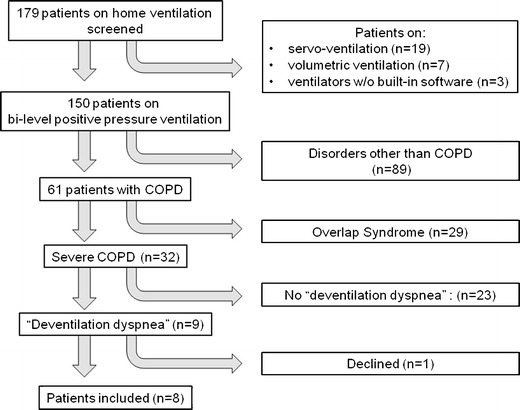
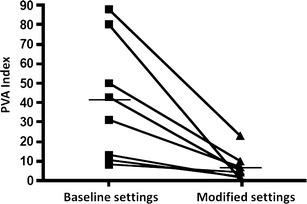
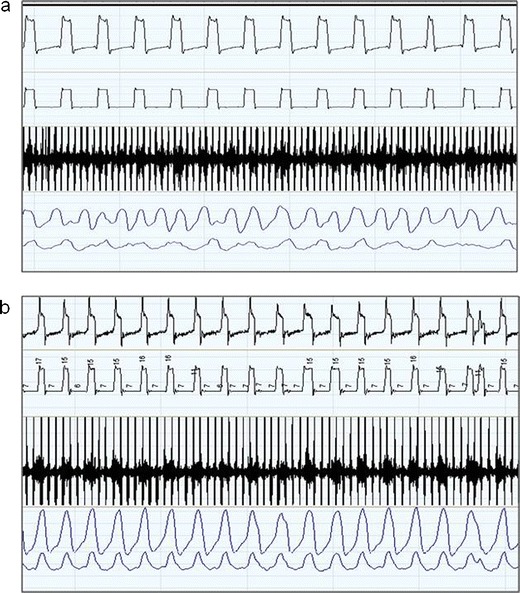
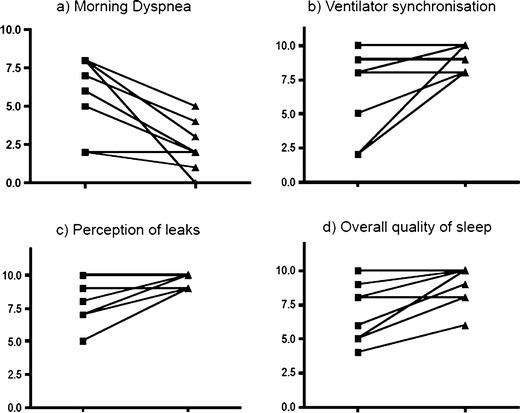
BACKGROUND: Stable severe chronic obstructive pulmonary disease (COPD) patients with chronic hypercapnic respiratory failure treated by nocturnal bi-level positive pressure non-invasive ventilation (NIV) may experience severe morning deventilation dyspnea. We hypothesised that in these patients, progressive hyperinflation, resulting from inappropriate ventilator settings, leads to patient-ventilator asynchrony (PVA) with a high rate of unrewarded inspiratory efforts and morning discomfort. METHODS: Polysomnography (PSG), diaphragm electromyogram and transcutaneous capnography (PtcCO(2)) under NIV during two consecutive nights using baseline ventilator settings on the first night, then, during the second night, adjustment of ventilator parameters under PSG with assessment of impact of settings changes on sleep, patient-ventilator synchronisation, morning arterial blood gases and morning dyspnea. RESULTS: Eight patients (61 ± 8 years, FEV(1) 30 ± 8% predicted, residual volume 210 ± 30% predicted) were included. In all patients, pressure support was decreased during setting adjustments, as well as tidal volume, while respiratory rate increased without any deleterious effect on nocturnal PtcCO(2) or morning PaCO(2). PVA index, initially high (40 ± 30%) during the baseline night, decreased significantly after adjusting ventilator settings (p = 0.0009), as well as subjective perception of PVA leaks, and morning dyspnea while quality of sleep improved. CONCLUSION: The subgroup of COPD patients treated by home NIV, who present marked deventilation dyspnea and unrewarded efforts may benefit from adjustment of ventilator settings under PSG or polygraphy.
Overview
The claims and statistics of this paper haven’t been checked yet.
Run the check — free, no account needed. It reads the open-access text and checks the sources it cites.
Integrity signals
Registry
Cites
Statistics
Figures
Verification
Claims the paper makes
The claims and statistics of this paper haven’t been checked yet.
Run the check — free, no account needed. It reads the open-access text and checks the sources it cites.
Claims other papers make about this one
Each is checked against this paper’s own text: does it say what the citing paper says it does?
The source backs part of the claim, not all of it — or backs it for a different population, condition or comparison.
In the citing paper
“Nevertheless, only a few studies have paid attention to adherence to NIV in COPD people, and most of them have focused only on early NIV failure (33,34) or on the quantification of adherence (35).”
From Promoting Acceptance and Adherence to Noninvasive Ventilation in Chronic Obstructive Pulmonary Disease: A Randomized Controlled Trial. (2022) · cites this paper as [34]
Experimental — accuracy not yet measuredThe source backs part of the claim, not all of it — or backs it for a different population, condition or comparison.
In the citing paper
“Ventilator settings are not easy to adjust and they influence sleep quality, which has spill-over effects on daytime life [34, 35].”
From A psychological intervention to promote acceptance and adherence to non-invasive ventilation in people with chronic obstructive pulmonary disease: study protocol of a randomised controlled trial. (2017) · cites this paper as [35]
Experimental — accuracy not yet measured
Self-check
Percentages, sums and reported differences re-computed from the paper’s own numbers.
The self-check needs the paper’s full text.
Citations
Cites
Vestbo, J., Hurd, S. S., Agustí, A. G., Jones, P. W., Vogelmeier, C., Anzueto, A., Barnes, P. J., Fabbri, L. M., Martinez, F. J., Nishimura, M., et al. (2013) · American Journal of Respiratory and Critical Care Medicine · doi:10.1164/rccm.201204-0596pp · Cited by 15,983
Rabe, K. F., Hurd, S., Anzueto, A., Barnes, P. J., Buist, S. A., Calverley, P., Fukuchi, Y., Jenkins, C., Rodriguez-Roisin, R., van Weel, C., et al. (2007) · American Journal of Respiratory and Critical Care Medicine · doi:10.1164/rccm.200703-456so · Cited by 4,925
McNicholas, W. T., Strohl, K. P., White, D. P., Levy, P. A., Schmidt, W., Wheatley, J. R., Redline, S. S., Carley, D. W., Buysse, D. J., Young, T. B., et al. (1999) · PubMed · Cited by 3,665
Rabe, K. F. (2007) · American Journal of Respiratory and Critical Care Medicine · Cited by 2,567
Patient-ventilator asynchrony during assisted mechanical ventilation
Thille, A. W., Rodríguez, P., Cabello, B., Lellouche, F., & Brochard, L. J. (2006) · Intensive Care Medicine · doi:10.1007/s00134-006-0301-8 · Cited by 919 · cited 2×
“We hypothesised that in these patients, inappropriate ventilator settings may lead to dynamic hyperinflation, increased intrinsic PEEP, resulting in unrewarded inspiratory efforts [13, 14] and morning discomfort when interrupting NIV [15].”
BackgroundPatterns of home mechanical ventilation use in Europe: results from the Eurovent survey
Lloyd-Owen, S. J., Donaldson, G. C., Ambrosino, N., Escarabill, J., Farré, R., Fauroux, B., Robert, D., Schönhofer, B., Simonds, A. K., & Wedzicha, J. A. (2005) · European Respiratory Journal · doi:10.1183/09031936.05.00066704 · Cited by 623 · cited 2×
“Despite the lack of evidence to support its use in chronic obstructive pulmonary disease (COPD), noninvasive ventilation (NIV) is widely prescribed in this indication in Europe [1].”
BackgroundO'Donnell, D. E., & Webb, K. A. (1993) · American Review of Respiratory Disease · doi:10.1164/ajrccm/148.5.1351 · Cited by 543
Jones, D. J., Paul, E. A., Jones, P., & Wedzicha, J. A. (1995) · American Journal of Respiratory and Critical Care Medicine · doi:10.1164/ajrccm.152.2.7633704 · Cited by 477 · cited 1×
“improvements in health-related quality of life [3, 5, 6], hospital admissions [7, 8], dyspnea [6] and quality of sleep [5].”
BackgroundClini, E. M., Sturani, C., Rossi, A., Viaggi, S., Corrado, A., Donner, C. F., & Ambrosino, N. (2002) · European Respiratory Journal · doi:10.1183/09031936.02.02162001 · Cited by 443 · cited 1×
“improvements in health-related quality of life [3, 5, 6], hospital admissions [7, 8], dyspnea [6] and quality of sleep [5].”
BackgroundNasal Intermittent Positive Pressure Ventilation
Léger, P., Bedicam, J. M., Cornette, A., Reybet-Degat, O., Langevin, B., Robert, D., Polu, J. M., & Jeannin, L. (1994) · CHEST Journal · doi:10.1378/chest.105.1.100 · Cited by 435
Comparison of Assisted Ventilator Modes on Triggering, Patient Effort, and Dyspnea
Leung, P., Jubran, A., & Tobin, M. J. (1997) · American Journal of Respiratory and Critical Care Medicine · doi:10.1164/ajrccm.155.6.9196100 · Cited by 423 · cited 1×
“In selected subjects with severe COPD and static hyperinflation, excessive pressure support might lead to dynamic hyperinflation and increased PEEPi [31] which are major determinants of unrewarded efforts [21].”
BackgroundNocturnal non-invasive nasal ventilation in stable hypercapnic COPD: a randomised controlled trial
McEvoy, R. D., Pierce, R. J., Hillman, D. R., Esterman, A., Ellis, E., CATCHESIDE, P. G., O’Donoghue, F. J., Barnes, D. J., Grunstein, R. R., & on behalf of the Australian trial of non-invasive Ventilation in Chronic Airflow Limitation (AVCAL) Study Group (2009) · Thorax · doi:10.1136/thx.2008.108274 · Cited by 414 · cited 2×
“Although impact on survival remains controversial [2–4], most authors will agree that there appears to be a group of COPD patients who clearly benefit from NIV.”
BackgroundCasanova, C., Celli, B. R., Tost, L., Soriano, E., Abreu, J. A., Velasco, V., & Santolaria, F. (2000) · CHEST Journal · doi:10.1378/chest.118.6.1582 · Cited by 348 · cited 2×
“Although impact on survival remains controversial [2–4], most authors will agree that there appears to be a group of COPD patients who clearly benefit from NIV.”
BackgroundPatient-Ventilator Trigger Asynchrony in Prolonged Mechanical Ventilation
Chao, D. C., Scheinhorn, D. J., & Stearn-Hassenpflug, M. (1997) · CHEST Journal · doi:10.1378/chest.112.6.1592 · Cited by 324
Dreher, M., Storre, J. H., Schmoor, C., & Windisch, W. (2010) · Thorax · doi:10.1136/thx.2009.124263 · Cited by 305
Thille, A. W., Cabello, B., Galia, F., Lyazidi, A., & Brochard, L. J. (2008) · Intensive Care Medicine · doi:10.1007/s00134-008-1121-9 · Cited by 287 · cited 3×
“On the other hand, inappropriately high pressure support may have in certain patients a negative impact on lung mechanics and increase unrewarded efforts and patient–ventilator asynchrony [26].”
BackgroundMethodChanging Patterns in Long-term Noninvasive Ventilation
Janssens, J.-P., Derivaz, S., Breitenstein, E., de Muralt, B., Fitting, J.-W., Chevrolet, J.-C., & Rochat, T. (2003) · CHEST Journal · doi:10.1378/chest.123.1.67 · Cited by 274
Self-citationJanssens, J.-P., Borel, J., Pépin, J., & on behalf of the SomnoNIV Group (2010) · Thorax · doi:10.1136/thx.2010.139782 · Cited by 249 · cited 11×
“Monitoring pulse oximetry (SpO2) and transcutaneous capnography (PtcCO2) alone do not explore this aspect of therapy adequately.”
BackgroundInfluentialSelf-citationImpact of Expiratory Trigger Setting on Delayed Cycling and Inspiratory Muscle Workload
Tassaux, D., Gainnier, M., Battisti, A., & Jolliet, P. (2005) · American Journal of Respiratory and Critical Care Medicine · doi:10.1164/rccm.200407-880oc · Cited by 191 · cited 1×
“Our approach was as follows: in case of unrewarded inspiratory efforts, we first reduced pressure support, then, if necessary, we increased expiratory positive airway pressure (EPAP) [15] and set expiratory trigger at a higher percentage of peak inspiratory flow to avoid delayed cycling [26, 27] under close monitoring…”
MethodHigh-intensity non-invasive positive pressure ventilation for stable hypercapnic COPD
Windisch, W., Haenel, M., Storre, J. H., & Dreher, M. (2009) · International Journal of Medical Sciences · doi:10.7150/ijms.6.72 · Cited by 181
Janssens, J.-P., Metzger, M., & Sforza, É. (2008) · Respiratory Medicine · doi:10.1016/j.rmed.2008.03.013 · Cited by 176 · cited 1×
“After both nights, to evaluate patient comfort and patients’ perception of patient–ventilator synchronisation, airflow, leaks and noise of ventilator, an eight-item visual analogue scale (VAS) was administered the morning following each sleep study [25].”
MethodSelf-citationGonzalez‐Bermejo, J., Perrin, C., Janssens, J.-P., Pépin, J., Mroue, G., Léger, P., Langevin, B., Rouault, S., Rabec, C. A., Rodenstein, D. O., et al. (2010) · Thorax · doi:10.1136/thx.2010.142653 · Cited by 175
Self-citationWindisch, W., Kostić, S., Dreher, M., Virchow, J. C., Jr., & Sorichter, S. (2005) · CHEST Journal · doi:10.1378/chest.128.2.657 · Cited by 170
Leak compensation in positive pressure ventilators: a lung model study
Mehta, S., McCool, F. D., & Hill, N. S. (2001) · European Respiratory Journal · doi:10.1183/09031936.01.17202590 · Cited by 148 · cited 1×
“If auto-triggering was identified, mask fit was adapted to prevent air leaks and inspiratory trigger sensitivity was reduced [28].”
BackgroundVitacca, M., Bianchi, L. N. C., Zanotti, E., Vianello, A., Barbano, L., Porta, R., & Clini, E. M. (2004) · CHEST Journal · doi:10.1378/chest.126.3.851 · Cited by 134 · cited 1×
“[22].”
Fanfulla, F., Taurino, A. E., Lupo, N. D., Trentin, R., D’Ambrosio, C. M., & Nava, S. (2007) · Respiratory Medicine · doi:10.1016/j.rmed.2007.02.026 · Cited by 133 · cited 2×
“For instance, it is now established that patient–ventilator asynchrony (PVA) is frequent in patients undergoing chronic NIV who are considered effectively treated [10, 11].”
BackgroundResultMonitoring of Noninvasive Ventilation by Built-in Software of Home Bilevel Ventilators
Contal, O., Vignaux, L., Combescure, C., Pépin, J., Jolliet, P., & Janssens, J.-P. (2011) · CHEST Journal · doi:10.1378/chest.11-0485 · Cited by 129
Self-citationEffects of noninvasive ventilation on lung hyperinflation in stable hypercapnic COPD
Orlando Díaz, P., Bégin, P., Torrealba, B., Jover, E., & Lisboa, C. (2002) · European Respiratory Journal · doi:10.1183/09031936.02.00034402 · Cited by 126 · cited 1×
“have shown that efficient NIV may decrease residual volume, functional residual capacity and total lung capacity when compared to sham NIV [33].”
BackgroundRabec, C. A., Georges, M., Kabeya, N., Baudouin, N., Massin, F., Reybet-Degat, O., & Camus, P. (2009) · European Respiratory Journal · doi:10.1183/09031936.00170508 · Cited by 109 · cited 1×
“Estimation of leaks and VT by ventilator software of VPAP III and VPAP IV ventilators (ResMed, Sydney, Australia) has been shown to be reliable in two recent independent studies [23, 24].”
ResultGuo, Y. F., Sforza, É., & Janssens, J.-P. (2007) · CHEST Journal · doi:10.1378/chest.06-1705 · Cited by 104
Self-citationThe Appropriate Setting of Noninvasive Pressure Support Ventilation in Stable COPD Patients
Vitacca, M., Nava, S., Confalonieri, M., Bianchi, L. N. C., Porta, R., Clini, E. M., & Ambrosino, N. (2000) · CHEST Journal · doi:10.1378/chest.118.5.1286 · Cited by 97 · cited 2×
“We hypothesised that in these patients, inappropriate ventilator settings may lead to dynamic hyperinflation, increased intrinsic PEEP, resulting in unrewarded inspiratory efforts [13, 14] and morning discomfort when interrupting NIV [15].”
BackgroundResultClinical review: Patient-ventilator interaction in chronic obstructive pulmonary disease
Jolliet, P., & Tassaux, D. (2006) · Critical Care · doi:10.1186/cc5073 · Cited by 49 · cited 5×
“The major change performed in order to decrease unrewarded inspiratory efforts detected on PSG, was a decrease in pressure support in all cases ([IPAP–EPAP] baseline, 13.6±1.8 cm H2O; adjusted, 10.3±1.7 cm H2O; p=.0005).”
BackgroundMethodInfluentialStoohs, R. A., Blum, H.-C., Knaack, L., Butsch-von-der-Heydt, B., & Guilleminault, C. (2005) · SLEEP · doi:10.1093/sleep/28.3.321 · Cited by 35 · cited 1×
“Surface diaphragm EMG was recorded using silver electrodes in all subjects only to monitor inspiratory effort [19] and facilitate detection of ineffective inspiratory efforts.”
Method[Electromyography of the diaphragm in man].
Delhez, L. (1970) · PubMed · Cited by 6
Cited by
Sorted by citations
Ergan, B., Oczkowski, S. J. W., Rochwerg, B. N., Carlucci, A., Chatwin, M., Clini, E. M., Elliott, M., Gonzalez‐Bermejo, J., Hart, N., Luján, M., et al. (2019) · European Respiratory Journal · doi:10.1183/13993003.01003-2019 · Cited by 308
Self-citationMurphy, P. B., Brignall, Moxham, J., Polkey, M. I., Davidson, & Hart, N. (2012) · International Journal of COPD · doi:10.2147/copd.s36151 · Cited by 112
Long-term survival following initiation of home non-invasive ventilation: a European study
Patout, M., Lhuillier, E., Kaltsakas, G., Benattia, A., Dupuis, J., Arbane, G., Declercq, P.-L., Ramsay, M., Marino, P. S., Molano, L.-C., et al. (2020) · Thorax · doi:10.1136/thoraxjnl-2019-214204 · Cited by 99
“…settings may also contribute to improve adherence, 36 although such approach may need to be limited to a well-defined subgroup of patients, 37 as the use of polysomnography during NIV set-up remains controversial 38 and the lack of clear clinical efficacy is further impaired by practical…”
Long‐term adherence with non‐invasive ventilation improves prognosis in obese COPD patients
Borel, J., Pepin, J., Pison, C., Vesin, A., Gonzalez‐Bermejo, J., Court‐Fortune, I., & Timsit, J. (2014) · Respirology · doi:10.1111/resp.12327 · Cited by 83
Ramsay, M., Mandal, S., Suh, E., Steier, J. S., Douiri, A., Murphy, P. B., Polkey, M. I., Simonds, A. K., & Hart, N. (2015) · Thorax · doi:10.1136/thoraxjnl-2015-206944 · Cited by 74
Metadata
- Authors
- Adler, D., Perrig, S., Takahashi, H., Espa, F., Rodenstein, D., Pépin, J. L., & Janssens, J.-P.
- Affiliations
- University Hospital of Geneva (CH)
- Cliniques Universitaires Saint-Luc (BE)
- Inserm (FR)
- Corresponding author
- Adler, Dan
- Venue
- Sleep and Breathing
- Published
- 2011-11-04
- Volume
- 16
- Issue
- 4
- Pages
- 1081-1090
- ISSN
- 1520-9512 (ISSN-L)
- 1522-1709
- PMC
- PMC3497941
- OpenAlex
- W2034389724
- Cited by
- 104
- References
- 36
- Citations by year
- 2026: 9 · 2025: 6 · 2024: 6 · 2023: 6 · 2022: 5 · 2021: 7 · 2020: 8 · 2019: 10 · 2018: 14 · 2017: 6 · 2016: 2 · 2015: 8 · 2014: 10 · 2013: 5 · 2012: 2
- FWCI
- 4.62
- Type
- journal article
- Language
- en
- Open access
- hybrid
- doi.org
- Licence
- Locations
- Sleep And Breathing (publishedVersion, cc-by-nc)
- PubMed Central (publishedVersion, cc-by-nc)
- PubMed (publishedVersion)
- Archive ouverte UNIGE (University of Geneva) (publishedVersion, other-oa)
- reroDoc Digital Library (submittedVersion)
- Digital Access to Libraries (submittedVersion, other-oa)
- Archive ouverte UNIGE (University of Geneva) (submittedVersion, cc-by)
- Topics
- Health Sciences › Medicine › Pulmonary and Respiratory Medicine › Respiratory Support and Mechanisms
- Health Sciences › Medicine › Physiology (medical) › Obstructive Sleep Apnea Research
- Health Sciences › Medicine › Pulmonary and Respiratory Medicine › Chronic Obstructive Pulmonary Disease (COPD) Research
- Keywords
- chronic obstructive pulmonary disease, non-invasive ventilation, patient-ventilator asynchrony, hypercapnic respiratory failure, pressure support ventilation, diaphragm electromyography, sleep quality, hyperinflation
- MeSH terms
- Aged, Blood Gas Monitoring, Transcutaneous, Circadian Rhythm, Dyspnea, Equipment Failure, Female, Humans, Male, Middle Aged, Oxygen, Software, Switzerland, Therapy, Computer-Assisted, Wakefulness, Polysomnography, Pulmonary Disease, Chronic Obstructive, Continuous Positive Airway Pressure
About these checks
Registry, retraction, Cites and statistics results are computed, not judged, with one exception: a printed reference that no index lists is read once by a model before it counts as a citation error. Claims are extracted by a model and kept only when their quote appears verbatim in the text; each cited source is then checked, with a model’s help, for whether it says what the claim relies on. Those verdicts can be wrong — read the claim’s quote and the cited source before relying on one.
Statistics and arithmetic are recomputed, not judged.
Confidence bands are shown only for fields calibrated on our annotated test set. None is calibrated yet, so no band is shown.
What counts as a claim ›How we measure confidence ›How we check this ›
Are you an author, or do you see a problem with this page? Request a review
