

Economics of carbon dioxide capture and utilization—a supply and demand perspective
Open accessThe DOI matches its Crossref record; 29 of the 29 references it cites were found in a registry or an index.
Abstract
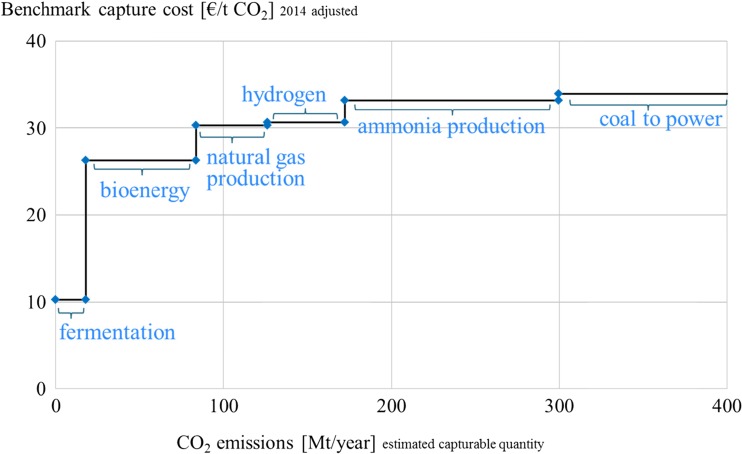
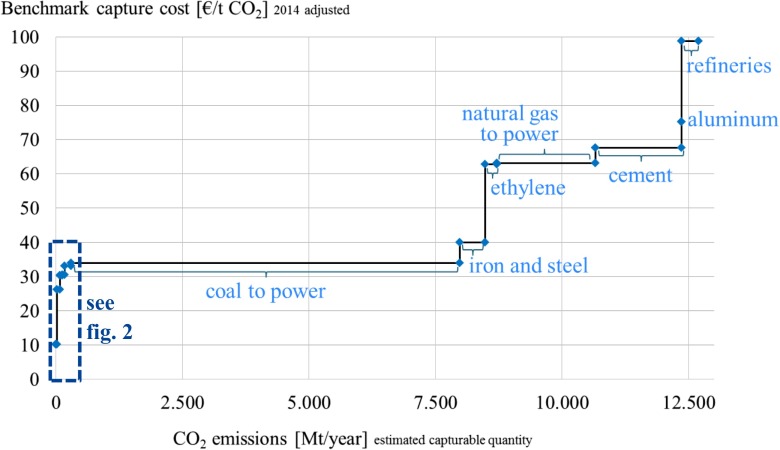
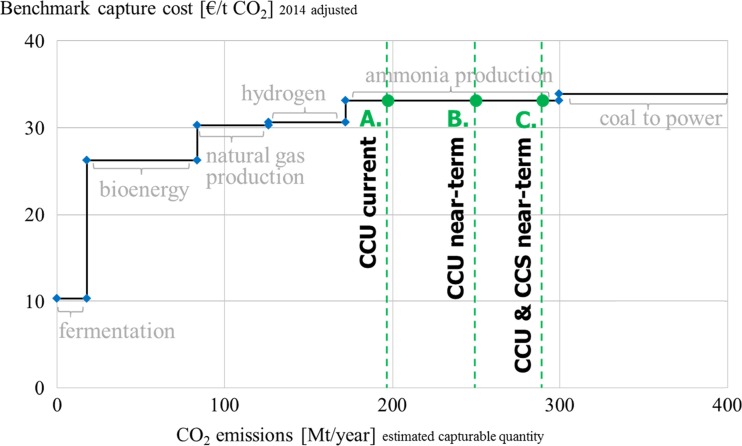
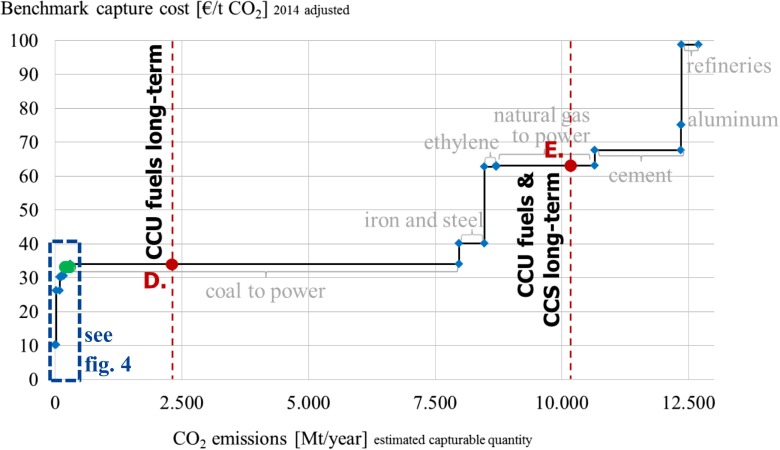
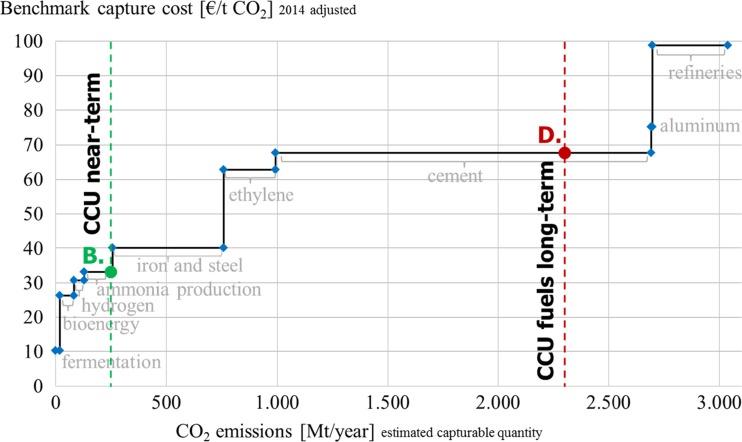
Lately, the technical research on carbon dioxide capture and utilization (CCU) has achieved important breakthroughs. While single CO2-based innovations are entering the markets, the possible economic effects of a large-scale CO2 utilization still remain unclear to policy makers and the public. Hence, this paper reviews the literature on CCU and provides insights on the motivations and potential of making use of recovered CO2 emissions as a commodity in the industrial production of materials and fuels. By analyzing data on current global CO2 supply from industrial sources, best practice benchmark capture costs and the demand potential of CO2 utilization and storage scenarios with comparative statics, conclusions can be drawn on the role of different CO2 sources. For near-term scenarios the demand for the commodity CO2 can be covered from industrial processes, that emit CO2 at a high purity and low benchmark capture cost of approximately 33 €/t. In the long-term, with synthetic fuel production and large-scale CO2 utilization, CO2 is likely to be available from a variety of processes at benchmark costs of approx. 65 €/t. Even if fossil-fired power generation is phased out, the CO2 emissions of current industrial processes would suffice for ambitious CCU demand scenarios. At current economic conditions, the business case for CO2 utilization is technology specific and depends on whether efficiency gains or substitution of volatile priced raw materials can be achieved. Overall, it is argued that CCU should be advanced complementary to mitigation technologies and can unfold its potential in creating local circular economy solutions.
Overview
The claims and statistics of this paper haven’t been checked yet.
Free: it reads the open-access text and checks the first 5 claims that cite a source we can check. Create a free account to check every claim.
Integrity signals
Registry
Cites
Statistics
Figures

Verification
Claims the paper makes
The claims and statistics of this paper haven’t been checked yet.
Free: it reads the open-access text and checks the first 5 claims that cite a source we can check. Create a free account to check every claim.
Claims other papers make about this one
Each is checked against this paper’s own text: does it say what the citing paper says it does?
The source backs part of the claim, not all of it — or backs it for a different population, condition or comparison.
In the citing paper
“In the short term, the creation of products from concentrated CO 2 , as in step L (albeit, CO 2 conversion is not a necessary requirement for utilization), could leverage the industrial capture of flue gases following the extraction and combustion of fossil fuels (KC) 27 .”
From The technological and economic prospects for CO2 utilization and removal (2019) · cites this paper as [27]
Experimental — accuracy not yet measured
Self-check
Percentages, sums and reported differences re-computed from the paper’s own numbers.
The self-check needs the paper’s full text.
Citations
Cites
The teraton challenge. A review of fixation and transformation of carbon dioxide
Mikkelsen, M., Jørgensen, M., & Krebs, F. C. (2010) · Energy Environ. Sci. · doi:10.1039/b912904a · Cited by 2,157 · cited 2×
“In the best case Brecycling of CO2 from anthropogenic sources provides a renewable, inexhaustible carbon source and could allow the continued use of derived carbon fuels in an environmentally friendly, carbon neutral way^ (Mikkelsen et al. 2010).”
BackgroundCO2 emissions from fuel combustion: highlights
Eng, P. (2009) · Cited by 1,609
Natural Gas Processing with Membranes: An Overview
Baker, R. W., & Lokhandwala, K. (2008) · Industrial & Engineering Chemistry Research · doi:10.1021/ie071083w · Cited by 1,381 · cited 1×
“While raw natural gas can contain CO2 in different concentrations depending on the respective source, the processing of the gas to achieve pipeline quality often includes carbon dioxide separation (Baker and Lokhandwala 2008).”
BackgroundLe Quéré, C., Moriarty, R., Andrew, R. M., Peters, G. P., Ciais, P., Friedlingstein, P., Jones, S. D., Sitch, S., Tans, P., Arneth, A., et al. (2015) · Earth System Science Data · doi:10.5194/essd-7-47-2015 · Cited by 755
MUELLERLANGER, F., TZIMAS, E., KALTSCHMITT, M., & PETEVES, S. (2007) · International Journal of Hydrogen Energy · doi:10.1016/j.ijhydene.2007.05.027 · Cited by 590
The changing paradigm in CO2 utilization
Aresta, M., Dibenedetto, A., & Angelini, A. (2013) · Journal of CO2 Utilization · doi:10.1016/j.jcou.2013.08.001 · Cited by 482 · cited 6×
“The conversion of CO2 with a catalyst evolved in the 1970s, when chemical engineers first succeeded in developing catalysis processes inspired by nature’s CO2 conversion cycles (Aresta and Dibenedetto 2010; Aresta et al. 2013).”
BackgroundMethodInfluentialThe urgency of the development of CO 2 capture from ambient air
Lackner, K. S., Brennan, S., Matter, J. M., Park, A.-H. A., Wright, A., & van der Zwaan, B. (2012) · Proceedings of the National Academy of Sciences · doi:10.1073/pnas.1108765109 · Cited by 449
Life-cycle assessment of carbon dioxide capture and utilization: avoiding the pitfalls
von der Assen, N., Jung, J., & Bardow, A. (2013) · Energy & Environmental Science · doi:10.1039/c3ee41151f · Cited by 447 · cited 1×
“Since the utilized CO2 in most cases is reemitted at a later point in time a simple aggregation of the used volumes of CO2 is not an indicator of ecologic performance (von der Assen et al. 2013).”
Backgroundvon der Assen, N., & Bardow, A. (2014) · Green Chem. · doi:10.1039/c4gc00513a · Cited by 399 · cited 1×
“A recent example illustrates how for polyols used for the production of foams up to 3 t of CO2 emissions can be avoided per tonne of CO2 used compared to a conventional production process (von der Assen and Bardow 2014).”
BackgroundGreenhouse gas emissions in Norway: do carbon taxes work?
Bruvoll, A., & Larsen, B. M. (2004) · Energy Policy · doi:10.1016/s0301-4215(03)00151-4 · Cited by 364 · cited 1×
“…example, the relatively old as well as high Norwegian carbon tax, especially for offshore petroleum businesses of up to 69 €/t CO2 in 2014 (World Bank 2014) has led to several investments by the affected players into CCS (de Coninck and Benson 2014) and energy efficiency (Bruvoll and Larsen 2004).”
BackgroundState and Trends of Carbon Pricing 2014
Bank, W. (2014) · World Bank, Washington, DC eBooks · doi:10.1596/978-1-4648-0268-3 · Cited by 281
Carbon dioxide capture and storage: issues and prospects
de Coninck, H., & Benson, S. M. (2014) · Annual Review of Environment and Resources · doi:10.1146/annurev-environ-032112-095222 · Cited by 268 · cited 3×
“10– 30 % of the output energy (de Coninck and Benson 2014; Finkenrath 2011).”
BackgroundCorrelating the chemical engineering plant cost index with macro-economic indicators
Mignard, D. (2014) · Chemical Engineering Research and Design · doi:10.1016/j.cherd.2013.07.022 · Cited by 263 · cited 2×
“Eng. 2015a; Jenkins 2015; Mignard 2014).”
BackgroundCost and Performance of Carbon Dioxide Capture from Power Generation
(2011) · IEA Energy Papers · doi:10.1787/5kgggn8wk05l-en · Cited by 243
Möllersten, K., Yan, J., & R. Moreira, J. (2003) · Biomass and Bioenergy · doi:10.1016/s0961-9534(03)00013-8 · Cited by 232 · cited 1×
“Furthermore, a larger plant size can lower the investment and operating costs per captured tonne of CO2 through economies of scale (Faulstich et al. 2009; Möllersten et al. 2003).”
BackgroundCO2 Capture and Storage: A Key Carbon Abatement Option
Ben-Naceur, K. (2008) · Cited by 228
Wilcox, J. (2012) · Springer eBooks · doi:10.1007/978-1-4614-2215-0 · Cited by 193
CO2 capture for refineries, a practical approach
van Straelen, J., Geuzebroek, F., Goodchild, N., Protopapas, G., & Mahony, L. (2009) · International journal of greenhouse gas control · doi:10.1016/j.ijggc.2009.09.022 · Cited by 155
Quéré, C. L., Moriarty, R., Andrew, R. M., Peters, G. P., Ciais, P., Friedlingstein, P., Stephen D., J., Sitch, S. A., Tans, P. P., Arneth, A., et al. (2015) · Repository for Publications and Research Data (ETH Zurich) · doi:10.3929/ethz-b-000094279 · Cited by 118
Global carbon budget 2014Preprint
Quéré, C. L., Moriarty, R., Andrew, R. M., et al. (2014) · doi:10.5194/essdd-7-521-2014 · Cited by 112
Kuramochi, T., Ramírez, A., Turkenburg, W., & Faaij, A. (2011) · Energy Procedia · doi:10.1016/j.egypro.2011.02.079 · Cited by 51
Quadrelli, E. A., & Centi, G. (2011) · ChemSusChem · doi:10.1002/cssc.201100518 · Cited by 48 · cited 1×
“…estimated 20 Mt of CO2 and the aggregated demand for CO2 amounts to 250 Mt p.a. Similar demand scenarios of mixed CCU material and fuel activities have also been projected in the range of 250–350 Mt by Quadrelli and Centi (2011) and 300– 400 Mt by Aresta and Dibenedetto (2010) for the medium-term.”
BackgroundBringezu, S. (2014) · Journal of Industrial Ecology · doi:10.1111/jiec.12099 · Cited by 45 · cited 1×
“For example, half of the total CO2 emissions from waste incineration in Germany would sufficiently supply CO2 as a carbon source for the domestic polymer consumption (Bringezu 2014).”
BackgroundIndustrial utilization of carbon dioxide (CO2)
Aresta, M., & Dibenedetto, A. (2010) · Elsevier eBooks · doi:10.1533/9781845699581.4.377 · Cited by 42 · cited 8×
“The conversion of CO2 with a catalyst evolved in the 1970s, when chemical engineers first succeeded in developing catalysis processes inspired by nature’s CO2 conversion cycles (Aresta and Dibenedetto 2010; Aresta et al. 2013).”
BackgroundInfluentialEnergy-efficient distributed carbon capture in hydrogen production from natural gas
Kurokawa, H., Shirasaki, Y., & Yasuda, I. (2011) · Energy Procedia · doi:10.1016/j.egypro.2011.01.104 · Cited by 35
Jilvero, H., Mathisen, A., Eldrup, N. H., Normann, F., Johnsson, F., Müller, G. I., & Melaaen, M. C. (2014) · Energy Procedia · doi:10.1016/j.egypro.2014.11.695 · Cited by 28
Environmental Assessment of CO2 Capture and Utilisation
von der Assen, N. V., Lafuente, A. M. L., Peters, M., & Bardow, A. (2015) · Elsevier eBooks · doi:10.1016/b978-0-444-62746-9.00004-9 · Cited by 25 · cited 2×
“Each CO2 utilization process has a different environmental impact which needs to be determined in a life cycle assessment (von der Assen et al. 2015).”
BackgroundEnergieagentur, I. (2009) · Energy Technology Analysis · doi:10.1787/19901356 · Cited by 4
Feeding a Gas Turbine with Aluminum Plant Exhaust for Increased CO2 Concentration in Capture Plant
Jordal, K., Anantharaman, R., Genrup, M., Aarhaug, T. A., Bakken, J., Lilliestråle, A., Mejdell, T., & Holt, N. J. (2014) · Energy Procedia · doi:10.1016/j.egypro.2015.03.055 · Cited by 1
Research works printed but not linked: 7
- Bogner J Metz B Davidson OR Bosch PR Dave R Meyer LA Waste management Climate Change 2007: Mitigation 2007 Cambridge Cambridge University Press 585 618
- California Carbon Dashboard Carbon price. California Carbon Dashboard 2015
- Carbon Visuals CCS: a 2 degree solution: a film by carbon visuals—methodology 2014
- Faulstich M Leipprand A Eggenstein U Bilitewski B Urban AI Faulstich M Relevance of CCS technology for waste incineration Thermic waste treatment 2009 Kassel Kassel University Press 73 86
- IEA (2013) Technology roadmap: Carbon capture and storage—2013 edition. OECD/ IEA. http://www.iea.org/publications/freepublications/publication/technologyroadmapcarboncaptureandstorage.pdf. Accessed May 27, 2015
- Metz B, Davidson O, De Coninck H, Loos M, Meyer L (2005) IPCC special report on carbon dioxide capture and storage. Cambridge University Press. http://www.ipcc.ch/pdf/special-reports/srccs/srccs_wholereport.pdf. Accessed February 11, 2015
- Pfeifer H Fischedick M Görner K Thomeczek M Iron and steel industry CO2: Capture, storage, utilization: Holistic evaluation for the energy sector and industry 2015 Berlin Springer 375 384
Cited by
Carbon capture and storage (CCS): the way forward
Bui, M., Adjiman, C. S., Bardow, A., Anthony, E. J., Boston, A., Brown, S., Fennell, P. S., Fuss, S., Galindo, A., Hackett, L. A., et al. (2018) · Energy & Environmental Science · doi:10.1039/c7ee02342a · Cited by 4,374
The technological and economic prospects for CO2 utilization and removal
Hepburn, C., Adlen, E., Beddington, J., Carter, E. A., Fuss, S., Mac Dowell, N., Minx, J. C., Smith, P., & Williams, C. K. (2019) · Nature · doi:10.1038/s41586-019-1681-6 · Cited by 2,523
New Trends in Olefin Production
Amghizar, I., Vandewalle, L. A., Van Geem, K. M., & Marin, G. B. (2017) · Engineering · doi:10.1016/j.eng.2017.02.006 · Cited by 835
Accelerating the discovery of materials for clean energy in the era of smart automation
Tabor, D. P., Roch, L. M., Saikin, S. K., Kreisbeck, C., Sheberla, D., Montoya, J. H., Dwaraknath, S., Aykol, M., Ortiz, C., Tribukait, H., et al. (2018) · Nature Reviews Materials · doi:10.1038/s41578-018-0005-z · Cited by 776
Ma, M., Clark, E. L., Therkildsen, K. T., Dalsgaard, S., Chorkendorff, I., & Seger, B. (2020) · Energy & Environmental Science · doi:10.1039/d0ee00047g · Cited by 516
Metadata
- Authors
- Naims, H.
- Affiliations
- Research Institute for Sustainability at GFZ (DE)
- Corresponding author
- Naims, Henriette
- ORCID
- Naims, Henriette
- Venue
- Environmental Science and Pollution Research
- Published
- 2016-05-18
- Volume
- 23
- Issue
- 22
- Pages
- 22226-22241
- ISSN
- 0944-1344 (ISSN-L)
- 1614-7499
- PMC
- PMC5101260
- OpenAlex
- W2400312588
- Semantic Scholar
- b29791261a6c8171f61bdbb128a51d698cbcbb97
- Cited by
- 221
- References
- 29
- Citations by year
- 2026: 6 · 2025: 19 · 2024: 15 · 2023: 24 · 2022: 34 · 2021: 23 · 2020: 35 · 2019: 34 · 2018: 13 · 2017: 17 · 2016: 1
- FWCI
- 19.27
- Type
- journal article
- Language
- en
- Open access
- hybrid
- doi.org
- Locations
- Environmental Science and Pollution Research (publishedVersion, cc-by)
- PubMed Central (publishedVersion, cc-by)
- PubMed (publishedVersion)
- Publication Database GFZ (GFZ German Research Centre for Geosciences) (submittedVersion)
- Publication Database IASS (Institute for Advanced Sustainability Studies (IASS)) (submittedVersion, other-oa)
- Funders
- Covestro
- Topics
- Physical Sciences › Chemical Engineering › Filtration and Separation › Carbon Dioxide Capture Technologies
- Social Sciences › Economics, Econometrics and Finance › Economics and Econometrics › Climate Change Policy and Economics
- Physical Sciences › Environmental Science › Environmental Engineering › CO2 Sequestration and Geologic Interactions
- Keywords
- CO2 capture cost, synthetic fuels, CO2 utilization, industrial CO2 emissions, CO2 sequestration, circular economy, climate change mitigation
- MeSH terms
- Air Pollutants, Carbon Dioxide, Conservation of Natural Resources, Industry, Government Regulation, Green Chemistry Technology, Climate Change, Renewable Energy
About these checks
Registry, retraction, Cites and statistics results are computed, not judged, with one exception: a printed reference that no index lists is read once by a model before it counts as a citation error. Claims are extracted by a model and kept only when their quote appears verbatim in the text; each cited source is then checked, with a model’s help, for whether it says what the claim relies on. Those verdicts can be wrong — read the claim’s quote and the cited source before relying on one.
Statistics and arithmetic are recomputed, not judged.
Confidence bands are shown only for fields calibrated on our annotated test set. None is calibrated yet, so no band is shown.
What counts as a claim ›How we measure confidence ›How we check this ›
Are you an author, or do you see a problem with this page? Request a review
Data sources
Bibliographic data: Semantic Scholar, OpenAlex, Crossref.
Contains information from the Semantic Scholar Academic Graph Datasets, made available under the ODC Attribution License (ODC-BY 1.0).
Semantic Scholar’s data is described in: Kinney, R., et al. (2023). The Semantic Scholar Open Data Platform. arXiv:2301.10140.
