

Physical activity reduces the risk of pneumonia: systematic review and meta-analysis of 10 prospective studies involving 1,044,492 participants
Open accessThe DOI matches its Crossref record; 59 of the 59 references it cites were found in a registry or an index.
Abstract
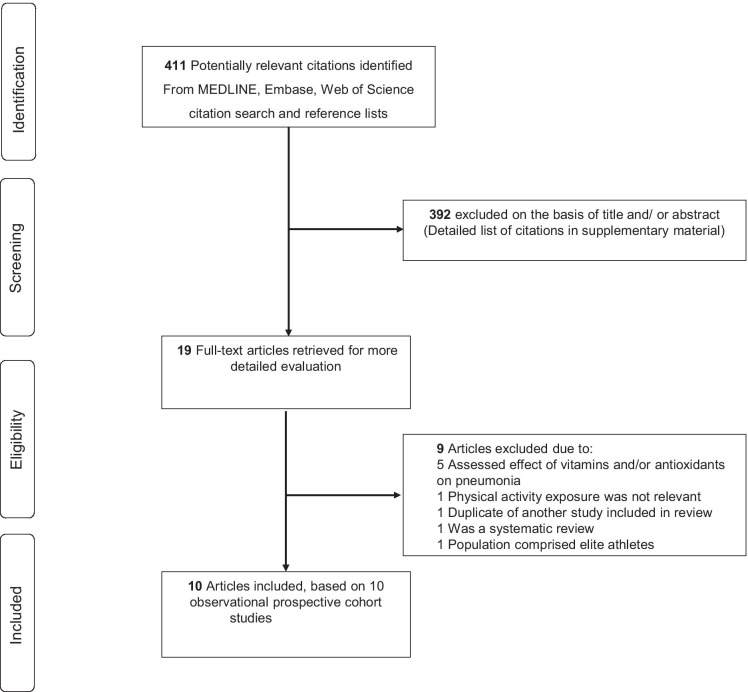
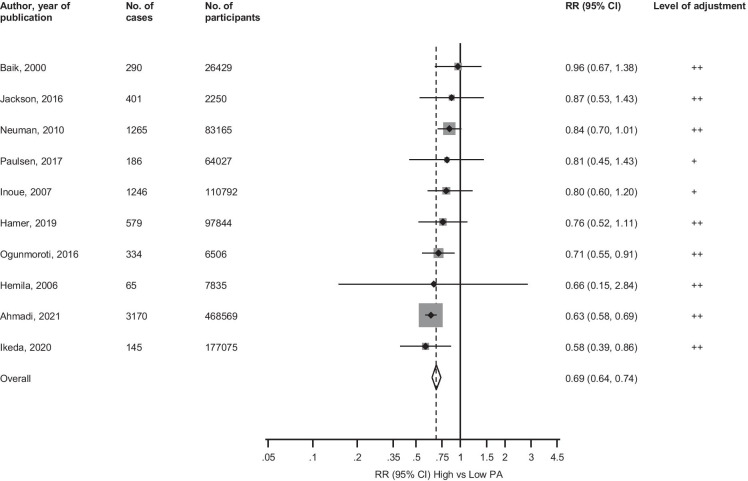
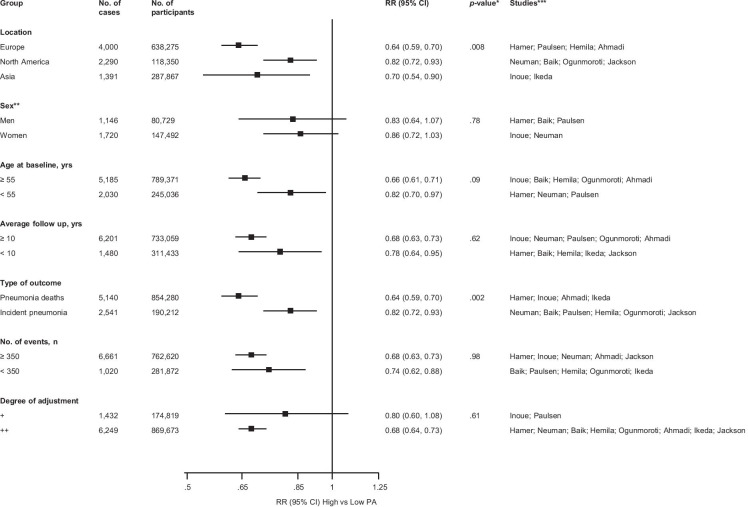
The beneficial effects of regular physical activity in promoting health and preventing chronic diseases are well documented. The relationship between regular physical activity and the risk of pneumonia is uncertain. We aimed to evaluate the magnitude and specificity of the prospective association between regular physical activity and the risk of pneumonia using a systematic review and meta-analysis of published observational cohort studies in general populations. Relevant studies with at least 1 year of follow-up were sought from inception until 15 September 2021 in MEDLINE, Embase, Web of Science, and manual search of relevant articles. Relative risks (RRs) with 95% confidence intervals (CIs) for the maximum versus the minimal amount of physical activity groups were pooled using fixed effects meta-analysis. The quality of the evidence was evaluated using the GRADE tool. A total of 10 prospective cohort studies comprising 1,044,492 participants and 7681 events were eligible. The pooled multivariable-adjusted RR (95% CI) of pneumonia comparing the most versus the least physically active groups was 0.69 (0.64–0.74). This association was significantly modified by type of outcome ( p- value for meta-regression = .002): 0.82 (0.72–0.93) for incident pneumonia and 0.64 (0.59–0.70) for pneumonia-related mortality. There was no evidence of heterogeneity and publication bias. The GRADE quality of the evidence ranged from moderate to low. Aggregate analysis of 10 cohort studies shows that regular physical activity is associated with lowered risk of incident pneumonia and pneumonia-related mortality in the general population. Physical activity types that are attractive to and feasible for high-risk populations need to be identified and encouraged. Systematic review registration: PROSPERO 2021: CRD42021277514.
Overview
The claims and statistics of this paper haven’t been checked yet.
Free: it reads the open-access text and checks the first 5 claims that cite a source we can check. Create a free account to check every claim.
Integrity signals
Registry
Cites
Statistics
Figures
Verification
Claims the paper makes
The claims and statistics of this paper haven’t been checked yet.
Free: it reads the open-access text and checks the first 5 claims that cite a source we can check. Create a free account to check every claim.
Claims other papers make about this one
Each is checked against this paper’s own text: does it say what the citing paper says it does?
The cited source says what the claim attributes to it.
In the citing paper
“Physical activity and exercise benefits apply to conditions characterized by very distinct pathophysiology, such as Alzheimer’s disease [629], cancer [628], heart disease [630], and pneumonia/other infections [631,632].”
From Global consensus on optimal exercise recommendations for enhancing healthy longevity in older adults (ICFSR) (2025) · cites this paper as [632]
Self-check
Percentages, sums and reported differences re-computed from the paper’s own numbers.
The self-check needs the paper’s full text.
Citations
Cites
Preferred Reporting Items for Systematic Reviews and Meta-Analyses: the PRISMA statement
Moher, D., Liberati, A., Tetzlaff, J., Altman, D. G., & for the PRISMA Group (2009) · BMJ · doi:10.1136/bmj.b2535 · Cited by 83,823
Preferred Reporting Items for Systematic Reviews and Meta-Analyses: The PRISMA Statement
Moher, D., Liberati, A., Tetzlaff, J., Altman, D. G., & The PRISMA Group (2009) · PLoS Medicine · doi:10.1371/journal.pmed.1000097 · Cited by 64,042 · cited 1×
“The review was conducted according to PRISMA and MOOSE guidelines [17, 18] (Electronic Supplementary Materials 1–2) (Fig.”
Measuring inconsistency in meta-analyses
Higgins, J. P. T., Thompson, S. G., Deeks, J. J., & Altman, D. G. (2003) · BMJ · doi:10.1136/bmj.327.7414.557 · Cited by 63,139
Bias in meta-analysis detected by a simple, graphical test
Egger, M., Smith, G. D., Schneider, M., & Minder, C. (1997) · BMJ · doi:10.1136/bmj.315.7109.629 · Cited by 56,722 · cited 1×
“To explore for small study effects, we visually inspected constructed Begg’s funnel plots [30] and performed Egger’s regression symmetry test [31].”
MethodPreferred reporting items for systematic reviews and meta-analyses: the PRISMA Statement.
(2009) · PubMed Central · Cited by 44,859
Quantifying heterogeneity in a meta‐analysis
Higgins, J. P. T., & Thompson, S. G. (2002) · Statistics in Medicine · doi:10.1002/sim.1186 · Cited by 36,763 · cited 1×
“Standard chi-square tests and the I2 statistic were used to quantify the extent of statistical heterogeneity across studies [27, 28].”
MethodRayyan-a web and mobile app for systematic reviews.
Ouzzani, M., Hammady, H., Fedorowicz, Z., & Elmagarmid, A. (2016) · Systematic Reviews · doi:10.1186/s13643-016-0384-4 · Cited by 26,092 · cited 1×
“Screening was conducted using Rayyan, a free online bibliographic tool that helps expedite the initial screening of abstracts and titles using a process of semi-automation while incorporating a high level of usability.[19] This was then followed by full-text evaluation of the selected titles and abstracts.”
MethodDermyshi, E., Wang, Y., Yan, C., Hong, W., Qiu, G., Gong, X., & Zhang, T. (2017) · Neonatology · doi:10.1159/000454668 · Cited by 24,451
Meta-analysis of Observational Studies in Epidemiology<SUBTITLE>A Proposal for Reporting</SUBTITLE>
Stroup, D. F. (2000) · JAMA · doi:10.1001/jama.283.15.2008 · Cited by 20,623
ROBINS-I: a tool for assessing risk of bias in non-randomised studies of interventions
Sterne, J. A., Hernán, M. A., Reeves, B. C., Savović, J., Berkman, N. D., Viswanathan, M., Henry, D., Altman, D. G., Ansari, M. T., Boutron, I., et al. (2016) · BMJ · doi:10.1136/bmj.i4919 · Cited by 20,329 · cited 1×
“The Cochrane Risk of Bias in Non-randomised Studies–of Interventions (ROBINS-I) tool was used to assess the risk of bias within individual observational studies [20].”
Method
Cited by
Izquierdo, M., de Souto Barreto, P., Arai, H., Bischoff-Ferrari, H. A., Cadore, E. L., Cesari, M., Chen, L.-K., Coen, P. M., Courneya, K. S., Duque, G., et al. (2025) · The Journal of nutrition, health and aging · doi:10.1016/j.jnha.2024.100401 · Cited by 273
Objectively Assessed Cardiorespiratory Fitness and All-Cause Mortality Risk
Laukkanen, J. A., Isiozor, N. M., & Kunutsor, S. K. (2022) · Mayo Clinic Proceedings · doi:10.1016/j.mayocp.2022.02.029 · Cited by 214
Self-citationThe multifaceted benefits of walking for healthy aging: from Blue Zones to molecular mechanisms
Ungvari, Z., Fazekas-Pongor, V., Csiszar, A., & Kunutsor, S. K. (2023) · GeroScience · doi:10.1007/s11357-023-00873-8 · Cited by 163
Self-citationPhysical activity lowers the risk for acute respiratory infections: Time for recognition
Nieman, D. C., & Sakaguchi, C. A. (2022) · Journal of sport and health science/Journal of Sport and Health Science · doi:10.1016/j.jshs.2022.08.002 · Cited by 67
“14,32 44 A review of 10 prospective cohort studies with over one million participants concluded that the risk for pneumonia (incidence and mortality) was 31% lower when comparing the most and least physically active groups.(32) These findings have been extended to those with diabetes(9) and CVD.”
BackgroundSeidu, S., Abdool, M., Almaqhawi, A., Wilkinson, T. J., Kunutsor, S. K., Khunti, K., & Yates, T. E. (2023) · European Journal of Epidemiology · doi:10.1007/s10654-022-00961-7 · Cited by 62
Self-citationWatts, E., Saint-Maurice, P., Doherty, A., Fensom, G., Freeman, J. R., Gorzelitz, J., Jin, D., McClain, K., Papier, K., Patel, S., et al. (2023) · JAMA Network Open · doi:10.1001/jamanetworkopen.2022.56186 · Cited by 32
Fekete, M., Csípő, T., Fazekas‐Pongor, V., Bálint, M., Csizmadia, Z., Tarantini, S., & Varga, J. T. (2023) · Nutrients · doi:10.3390/nu15183902 · Cited by 42
“Furthermore, even with a normal BMI, lean muscle (fat-free mass) is reduced, which negatively affects respiratory muscle function in COPD [12,13].”
BackgroundRyrsø, C. K., Hegelund, M. H., Dungu, A. M., Faurholt‐Jepsen, D., Pedersen, B. K., Ritz, C., Krogh‐Madsen, R., & Lindegaard, B. (2022) · Journal of Clinical Medicine · doi:10.3390/jcm11216326 · Cited by 19
“Despite the mounting evidence linking physical inactivity to an increased risk of mortality [30], this is the first study demonstrating an association between low physical activity level and increased risk of readmission and mortality after hospitalization with CAP.”
BackgroundLim, Y., Kim, H. J., Yoon, S. S., Lee, S. J., Lee, M. H., Park, H., Park, S. J., Jeong, S., & Han, H. W. (2023) · Journal of Korean Medical Science · doi:10.3346/jkms.2023.38.e176 · Cited by 13
Agustiningsih, D., & Wibawa, T. (2024) · Sports Medicine and Health Science · doi:10.1016/j.smhs.2024.01.004 · Cited by 16
“90 A daily walking habit of > 1 h per day has been shown to decrease the mortality rate of pneumonia in the elderly.”
BackgroundPrepandemic Physical Activity and Risk of COVID-19 Diagnosis and Hospitalization in Older Adults
Muñoz‐Vergara, D., Wayne, P. M., Kim, E.-J., Lee, I.-M. M., Buring, J. E., Manson, J. E., & Sesso, H. D. (2024) · JAMA Network Open · doi:10.1001/jamanetworkopen.2023.55808 · Cited by 7
Kunutsor, S. K., & Laukkanen, J. A. (2023) · GeroScience · doi:10.1007/s11357-023-00801-w · Cited by 7
“To enable a consistent approach to the meta-analysis and enhance comparison, reported study-specific risk estimates were all transformed to per 1 SD increase and extreme tertiles of HDL-C using standard statistical methods, which have been described previously [7, 8, 24-26].”
MethodSelf-citationLu, S., Shuai, Z., & Lu, Y. (2024) · Medicine · doi:10.1097/md.0000000000038220 · Cited by 5
“Kunutsor et al [25] reported that regular PA was associated with a lower risk of incident pneumonia and pneumonia-related mortality in the general population.”
BackgroundMethodLiu, J., Guo, Z., & Lu, S. (2023) · Preventive Medicine Reports · doi:10.1016/j.pmedr.2023.102130 · Cited by 7
Jiang, Q., Zhang, X., Yu, X., Liu, Y., Pan, W., & Xue, J. (2025) · Medicine · doi:10.1097/md.0000000000044280 · Cited by 5
“[30] Age-related inequalities highlight the vulnerability of children under 5 and adults over 65.”
Cardiorespiratory fitness, atrial fibrillation and stroke: a review of the evidence in 2024
Kunutsor, S. K., Kurl, S., & Laukkanen, J. A. (2024) · Expert Review of Cardiovascular Therapy · doi:10.1080/14779072.2024.2409440 · Cited by 6
“The role of physical activity in preventing adverse atherosclerotic vascular outcomes is well-established [6–14], in addition to its protective role on non-vascular outcomes [8,15–17].”
Self-citationKunutsor, S. K., Kaur, K., & Laukkanen, J. A. (2025) · Clinical Medicine Insights Cardiology · doi:10.1177/11795468251391010 · Cited by 3
Self-citationCauses of COVID-19 Outbreaks During Sports and Exercise: A Systematic Review
Machida, M., Dai, K., Nakamura, I., & Inoue, S. (2024) · Sports Medicine · doi:10.1007/s40279-024-02153-7 · Cited by 2
“Physical activity is beneficial for preventing non-communicable and infectious diseases, such as pneumonia [1–3].”
Hu, Y., Sun, Q., Han, Y., Yu, C., Yu, C., Sun, D., Pang, Y., Pei, P., Yang, L., Chen, Y., et al. (2024) · Chinese Medical Journal · doi:10.1097/cm9.0000000000003160 · Cited by 1
“[39] However, most of the included studies in this meta-analysis were conducted in developed countries and focused on leisure-related physical activity.”
Krzykawski, K., Maciejczyk, T., Mól, P., Sadowski, J., Zabawa, B., Dołęga, J., Papież, Ł. S., Hudzińska, P., Sieńko, A., & Łabuś, M. (2024) · Quality in Sport · doi:10.12775/qs.2024.36.56515 · Cited by 2
Associations of physical activity and quality of life in parapneumonic effusion patients
López, P., Fitzgerald, D. B., McVeigh, J. A., Badiei, A., Muruganandan, S., Newton, R. U., Straker, L. M., Lee, G., & Peddle‐McIntyre, C. J. (2023) · ERJ Open Research · doi:10.1183/23120541.00209-2023 · Cited by 1
“A previous meta-analysis comprising more than one million participants showed that regular physical activity was associated with a ∼ 20% reduced risk of pneumonia and ∼ 35% reduced risk of pneumonia-related mortality [50].”
Combining thalassotherapy and exercise for people with respiratory diseases
Polastri, M., Paganelli, G. M., & Prediletto, I. (2022) · International Journal of Therapy and Rehabilitation · doi:10.12968/ijtr.2022.0071 · Cited by 2
Patterns of physical activity and SARS-CoV-2 severe pneumonia: A case–control study
Cardoso, F. J., de Araújo, C. A. F. L., da Silva, J. R., Guimarães, A., Taveiro, M. R. V., & Alves, J. G. B. (2023) · Medicina Clínica · doi:10.1016/j.medcli.2023.04.031 · Cited by 2
Patterns of physical activity and SARS-CoV-2 severe pneumonia: A case–control study
Cardoso, F. J., de Araújo, C. A. F. L., da Silva, J. R., Guimarães, A., Taveiro, M. R. V., & Alves, J. G. B. (2023) · Medicina Clínica (English Edition) · doi:10.1016/j.medcle.2023.04.032
Murata, F., Maeda, M., Ono, R., & Fukuda, H. (2024) · Vaccine · doi:10.1016/j.vaccine.2024.01.060
Burden of Pneumonia in Older Adults and the Role of Immunization
Cillóniz, C., Videla, A. J., & Guglielmi, R. (2026) · Journal of Gerontology and Geriatrics · doi:10.3390/jgg74030033
Metadata
- Authors
- Kunutsor, S. K., Seidu, S., & Laukkanen, J. A.
- Affiliations
- University of Leicester (GB)
- University of Eastern Finland (FI)
- Corresponding author
- Kunutsor, Setor K.
- Venue
- GeroScience
- Published
- 2021-11-25
- Volume
- 44
- Issue
- 1
- Pages
- 519-532
- ISSN
- 2152-4041 (ISSN-L)
- 2509-2715
- 2509-2723
- PMC
- PMC8811019
- OpenAlex
- W3217306179
- Cited by
- 26
- References
- 59
- Citations by year
- 2026: 1 · 2025: 2 · 2024: 9 · 2023: 10 · 2022: 4
- FWCI
- 0.77
- Type
- journal article
- Language
- en
- Open access
- hybrid
- doi.org
- Licence
- cc-by
- creativecommons.org/licenses/by/4.0 (tdm)
- creativecommons.org/licenses/by/4.0 (vor)
- Locations
- GeroScience (publishedVersion, cc-by)
- PubMed Central (publishedVersion, cc-by)
- PubMed (publishedVersion)
- Explore Bristol Research (publishedVersion, cc-by)
- Jyväskylä University Digital Archive (University of Jyväskylä) (submittedVersion, cc-by)
- Bristol Research (University of Bristol) (submittedVersion, cc-by)
- Figshare (submittedVersion, cc-by)
- Funders
- National Institute for Health Research (BRC-1215-20011)
- Topics
- Health Sciences › Medicine › Public Health, Environmental and Occupational Health › Physical Activity and Health
- Health Sciences › Medicine › Epidemiology › Pneumonia and Respiratory Infections
- Health Sciences › Medicine › Physiology (medical) › Cardiovascular and exercise physiology
- Keywords
- physical activity, pneumonia, pneumonia risk, pneumonia mortality, chronic disease prevention, general population
- MeSH terms
- Humans, Pneumonia, Prospective Studies, Risk Factors, Cohort Studies, Exercise
About these checks
Registry, retraction, Cites and statistics results are computed, not judged, with one exception: a printed reference that no index lists is read once by a model before it counts as a citation error. Claims are extracted by a model and kept only when their quote appears verbatim in the text; each cited source is then checked, with a model’s help, for whether it says what the claim relies on. Those verdicts can be wrong — read the claim’s quote and the cited source before relying on one.
Statistics and arithmetic are recomputed, not judged.
Confidence bands are shown only for fields calibrated on our annotated test set. None is calibrated yet, so no band is shown.
What counts as a claim ›How we measure confidence ›How we check this ›
Are you an author, or do you see a problem with this page? Request a review
Data sources
Bibliographic data: Semantic Scholar, OpenAlex, Crossref.
Contains information from the Semantic Scholar Academic Graph Datasets, made available under the ODC Attribution License (ODC-BY 1.0).
Semantic Scholar’s data is described in: Kinney, R., et al. (2023). The Semantic Scholar Open Data Platform. arXiv:2301.10140.
