

Supporting school teachers’ rapid engagement with online education
Open accessThe DOI matches its Crossref record; 5 of the 5 references it cites were found in a registry or an index.
Abstract
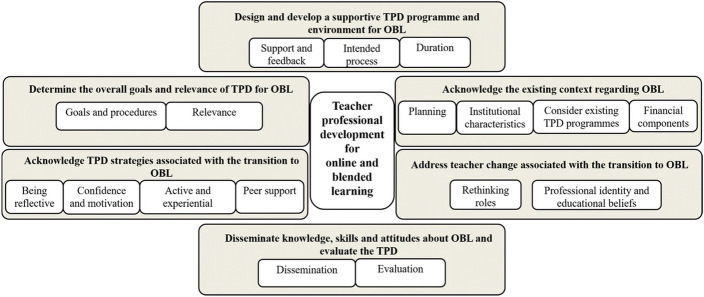
In response to Philipsen et al.'s (Educ Technol Res Dev 67:1145–1174, 2019) article titled “Improving teacher professional development [TPD] for online and blended learning [OBL]: a systematic meta-aggregative review”, we apply their proposed framework of important components of TPD for OBL to the support we provided to primary and secondary teachers as they engaged with online education during the COVID-19 pandemic. We reflect on observations of particular challenges for school teachers and the reasons behind them. While this framework is a useful reflection tool to guide professional learning for teachers beyond the emergency situations, we found that it is biased towards TPD for OBL in higher education settings. Thus, we suggest future work to differentiate educational levels in order to account for operational differences.
Overview
The claims and statistics of this paper haven’t been checked yet.
Free: it reads the open-access text and checks the first 5 claims that cite a source we can check. Create a free account to check every claim.
Integrity signals
Registry
Cites
Statistics
Figures
Verification
Claims the paper makes
The claims and statistics of this paper haven’t been checked yet.
Free: it reads the open-access text and checks the first 5 claims that cite a source we can check. Create a free account to check every claim.
Claims other papers make about this one
Each is checked against this paper’s own text: does it say what the citing paper says it does?
The source backs part of the claim, not all of it — or backs it for a different population, condition or comparison.
In the citing paper
“Vibrant digital teacher communities foster expansive learning by enabling peer mentoring, collective problemsolving, and sharing innovative teaching practices for educators' professional development (Abaci et al., 2021).”
From Transforming Online Teacher Training Through Expansive Learning: A Case Study Applying Cultural-Historical Activity Theory and the Change Laboratory Method (2025) · cites this paper as Abaci et al., 2021
Experimental — accuracy not yet measured
Self-check
Percentages, sums and reported differences re-computed from the paper’s own numbers.
The self-check needs the paper’s full text.
Citations
Cites
The Difference between Emergency Remote Teaching and Online Learning
Hodges, C. B., Moore, S., Lockee, B. B., Trust, T., & Bond, M. A. (2024) · Handbook of Research in Online Learning · doi:10.1163/9789004702813_021 · Cited by 6,253
Desimone, L. M. (2009) · Educational Researcher · doi:10.3102/0013189x08331140 · Cited by 4,862 · cited 1×
“…Edinburgh EH8 8AQ, UK 2 School of Informatics, University of Edinburgh, Informatics Forum, Edinburgh EH8 9AB, UK 1 3 (OBL), based on a well-defined theoretical model (Desimone 2009) and “unequivocal and credible” qualitative data from a review of 15 published studies (Philipsen et al.”
BackgroundPhilipsen, B., Tondeur, J., Pareja Roblin, N., Vanslambrouck, S., & Zhu, C. (2019) · Educational Technology Research and Development · doi:10.1007/s11423-019-09645-8 · Cited by 391
Teaching, technology, and teacher education during the covid-19 pandemic: Stories from the field
Ko, P., Wang, Y., & Law, N. (2020) · Cited by 320
The Nature of Parental Interactions in an Online Charter School
Borup, J., Graham, C. R., & Davies, R. S. (2013) · American Journal of Distance Education · doi:10.1080/08923647.2013.754271 · Cited by 76
Cited by
Λαμπρόπουλος, Γ., & Sidiropoulos, A. (2024) · Education Sciences · doi:10.3390/educsci14040367 · Cited by 346
Jevsikova, T., Stupurienė, G., Stumbrienė, D., Juškevičienė, A., & Dagienė, V. (2021) · Informatica · doi:10.15388/21-infor459 · Cited by 71
Νικολοπούλου, Κ., & Kousloglou, M. (2022) · Education Sciences · doi:10.3390/educsci12030216 · Cited by 64
Digital learning and the ESL online classroom in higher education: teachers’ perspectives
Lo, N. (2023) · Asian-Pacific Journal of Second and Foreign Language Education · doi:10.1186/s40862-023-00198-1 · Cited by 59
A Distinctive Method of Online Interactive Learning in STEM Education
Abouhashem, A., Abdou, R. M., Bhadra, J., Santhosh, M. E., Ahmad, Z., & Al-Thani, N. J. (2021) · Sustainability · doi:10.3390/su132413909 · Cited by 37
Sun, T., & Yoon, M. (2025) · Frontiers in Psychology · doi:10.3389/fpsyg.2025.1693375 · Cited by 50
COVID-19 Inspired a STEM-Based Virtual Learning Model for Middle Schools—A Case Study of Qatar
Abouhashem, A., Abdou, R. M., Bhadra, J., Siby, N., Ahmad, Z., & Al-Thani, N. J. (2021) · Sustainability · doi:10.3390/su13052799 · Cited by 23
Blended learning for teacher training: benefits, challenges, and recommendations
Мінтій, І. С. (2023) · Educational Dimension · doi:10.31812/ed.581 · Cited by 34
Goyal, H., Garg, G., Mordia, P., Ramachandran, V., Kumar, D., & Challa, J. S. (2025) · Scientific Reports · doi:10.1038/s41598-025-18047-1 · Cited by 32
Impact of Living Conditions on Online Education: Evidence from China
Gu, J. (2022) · Sustainability · doi:10.3390/su14063231 · Cited by 24
Shohel, M. M. C., Ashrafuzzaman, Azim, F., Naomee, I., Rahman, M. S., & Siddik, M. A. B. (2021) · Advances in mobile and distance learning book series · doi:10.4018/978-1-7998-6829-3.ch012 · Cited by 21
Teacher workload and the organisation of work: a research agenda for a post-pandemic future
Gavin, M., & McGrath‐Champ, S. (2024) · Labour & Industry a journal of the social and economic relations of work · doi:10.1080/10301763.2024.2357891 · Cited by 34
Food consumption changes among teachers during the COVID-19 pandemic
Durães, S. A., Pena, G. D. G., Nobre, L. N., Bicalho, A. H., Silva, R. R. V., Haikal, D. S., Rodrigues, C. A. O., Silveira, M. F., Brito, M. F. S. F., Bastos, V. F., et al. (2021) · Obesity Medicine · doi:10.1016/j.obmed.2021.100366 · Cited by 17
The Impact of COVID-19 Pandemic on Primary, Secondary, and K-12 Education: A Systematic Review
Λαμπρόπουλος, Γ., & Admiraal, W. (2023) · International Journal on Studies in Education · doi:10.46328/ijonse.161 · Cited by 16
Chen, K.-Z., Tseng, J.-Y., & Oakley, B. (2025) · The Asia-Pacific Education Researcher · doi:10.1007/s40299-024-00954-y · Cited by 5
“Vibrant digital teacher communities foster expansive learning by enabling peer mentoring, collective problem-solving, and sharing innovative teaching practices for educators’ professional development (Abaci et al., 2021).”
Penman, F. R., & Redder, B. (2023) · Early Years Journal of International Research and Development · doi:10.1080/09575146.2023.2230379 · Cited by 4
Antón‐Sancho, Á., Vergara, D., Λαμπρόπουλος, Γ., & Fernández‐Arias, P. (2023) · Electronics · doi:10.3390/electronics12193989 · Cited by 7
Learning Experiences of Teachers Attending Online Webinars
Tarusan, S., Naparan, G. B., & Celesio, G. (2022) · Journal of Preschool and Elementary School Education/Multidisciplinary Journal of School Education · doi:10.35765/mjse.2022.1122.12 · Cited by 7
Research on Online Supporting Education Based on the Model of Urban and Rural Interactive Classrooms
Zhang, W., Zhao, J. Z., & Kou, C. (2022) · International Conference on Information and Education Technology (ICIET) · doi:10.1109/iciet55102.2022.9778978 · Cited by 2
Abdul-Majied, S., & Figaro-Henry, S. (2023) · Journal of Early Childhood Research · doi:10.1177/1476718x231195705 · Cited by 3
Λαμπρόπουλος, Γ., & Admiraal, W. (2024) · Open Education Studies · doi:10.1515/edu-2022-0215 · Cited by 3
Kennedy, A. (2022) · The International Journal for Research in Education · doi:10.36771/ijre.46.2.22-pp126-166 · Cited by 5
Sriwijaya, U., Mutmainnah, M. L., Silvhiany, S., Sriwijaya, U., Eryansyah, E., & Sriwijaya, U. (2022) · Voices of English Language Education Society · doi:10.29408/veles.v6i2.6242 · Cited by 3
Redefiniendo las modalidades docentes a raíz de la crisis por la COVID-19
García‐Peñalvo, F. J. (2021) · Universidad Nacional Abierta y a Distancia eBooks · doi:10.22490/9789586518260.4.4 · Cited by 5
Phetsombat, P., & Thanvisitthpon, N. T. (2025) · Evaluation and Program Planning · doi:10.1016/j.evalprogplan.2025.102663 · Cited by 4
Ayun, Q., Taufik, T., & Ruhaena, L. (2025) · The Open Psychology Journal · doi:10.2174/0118743501401728251104101925 · Cited by 1
Practices and Strategies for Teacher Professional Development in Education 4.0
GROSU, A., & Ceobanu, C. (2025) · Educatia 21 · doi:10.24193/ed21.2025.32.01 · Cited by 1
Романова, А., Братко, М., & Sumbaieva, L. (2026) · Clinical and Preventive Medicine · doi:10.31612/2616-4868.1.2026.16 · Cited by 1
Vergara, D., del Bosque, A., Fernández-Arias, P., Λαμπρόπουλος, Γ., & Antón‐Sancho, Á. (2026) · Education Sciences · doi:10.3390/educsci16040579 · Cited by 3
Shamir‐Inbal, T., Avidov‐Ungar, O., Hadad, S., & Blau, I. (2024) · Research and Practice in Technology Enhanced Learning · doi:10.58459/rptel.2025.20021 · Cited by 4
Czech University Language Teachers’ Perspectives On The 2020 Pandemic
Pavlisová, H. (2021) · European Proceedings of International Conference on Education and Educational Psychology · doi:10.15405/epiceepsy.21101.10
Mutluer, Ö., & Bavlı, B. (2022) · Journal of Qualitative Research in Education · doi:10.14689/enad.30.3 · Cited by 3
Baltacı, Z., & Uçan, S. (2022) · Sakarya University Journal of Education · doi:10.19126/suje.1028020 · Cited by 4
Yiapanas, G., Constantinou, M., & Marcoulli, E. (2022) · Advances in business strategy and competitive advantage book series · doi:10.4018/978-1-6684-6762-6.ch016 · Cited by 1
Application of secondary education sports lessons with blended teaching method
Marshalkhan, A., Bakytzhan, E., Bakytzhan, J., Ospankulov, Y. E., Ulmeken, T., & Aliya, Y. (2022) · World Journal on Educational Technology Current Issues · doi:10.18844/wjet.v14i1.6722
Transformation of Learning Input Factors in the New Normal Era Post-COVID-19
Fikri, R., Istikomah, I., & Fahyuni, E. F. (2022) · KnE Social Sciences · doi:10.18502/kss.v7i10.11254
Qualitative Analysis of Psychological Framework of Online Classes during Covid-19 using NVIVO
Bhatt, V., Narula, S., Gupta, D. B., Sharma, S., & Sabharwal, D. (2023) · Journal of Engineering Education/Journal of engineering education transformations/Journal of engineering education transformation · doi:10.16920/jeet/2023/v36i4/23114 · Cited by 2
Requirements and Challenges Brought Due to Pandemic in Academia
Sinha, A. (2024) · Springer eBooks · doi:10.1007/978-3-031-37974-1_2
Figueroa-Céspedes, I., Fica-Pinol, E., Yáñez-Urbina, C., Zapata, P. C., & Aldunate, A. M. (2024) · Revista Brasileira de Educação · doi:10.1590/s1413-24782024290051
Eating Behaviour of University Professors during COVID-19 Pandemic
Baldo, K., Sandri, G., Dalmolin, C., Wendt, G. W., Vieira, A. P., Ferreto, L. E. D., da Silva, D. R. P., & Benvegnú, D. M. (2026) · Psychology · doi:10.4236/psych.2026.174027
Saludadez, J. A., Jeotee, K., & Piamonte, D. L. M. (2026) · ASEAN Journal of Open and Distance Learning · doi:10.64233/pusd7533
Metadata
- Authors
- Abaci, S., Robertson, J., Linklater, H., & McNeill, F.
- Affiliations
- University of Edinburgh (GB)
- Venue
- Educational Technology Research and Development
- Published
- 2020-10-08
- Volume
- 69
- Issue
- 1
- Pages
- 29-34
- ISSN
- 1042-1629 (ISSN-L)
- 1556-6501
- PMC
- PMC7543955
- OpenAlex
- W3092229722
- Cited by
- 41
- References
- 5
- Citations by year
- 2026: 4 · 2025: 5 · 2024: 7 · 2023: 7 · 2022: 11 · 2021: 7
- FWCI
- 9.47
- Type
- journal article
- Language
- en
- Open access
- hybrid
- doi.org
- Licence
- cc-by
- creativecommons.org/licenses/by/4.0 (tdm)
- creativecommons.org/licenses/by/4.0 (vor)
- Locations
- Educational Technology Research and Development (publishedVersion, cc-by)
- PubMed Central (publishedVersion, cc-by)
- PubMed (publishedVersion)
- Edinburgh Research Explorer (University of Edinburgh) (submittedVersion, cc-by)
- Funders
- University of Edinburgh
- Topics
- Social Sciences › Education › Education during COVID-19 pandemic
- Social Sciences › Education › Online and Blended Learning
- Social Sciences › Education › Teacher Education and Leadership Studies
- Keywords
- teacher professional development, online learning, blended learning, COVID-19 pandemic, school teachers, K-12 education, teacher support, professional learning, emergency remote teaching, comparative higher education
About these checks
Registry, retraction, Cites and statistics results are computed, not judged, with one exception: a printed reference that no index lists is read once by a model before it counts as a citation error. Claims are extracted by a model and kept only when their quote appears verbatim in the text; each cited source is then checked, with a model’s help, for whether it says what the claim relies on. Those verdicts can be wrong — read the claim’s quote and the cited source before relying on one.
Statistics and arithmetic are recomputed, not judged.
Confidence bands are shown only for fields calibrated on our annotated test set. None is calibrated yet, so no band is shown.
What counts as a claim ›How we measure confidence ›How we check this ›
Are you an author, or do you see a problem with this page? Request a review
Data sources
Bibliographic data: Semantic Scholar, OpenAlex, Crossref.
Contains information from the Semantic Scholar Academic Graph Datasets, made available under the ODC Attribution License (ODC-BY 1.0).
Semantic Scholar’s data is described in: Kinney, R., et al. (2023). The Semantic Scholar Open Data Platform. arXiv:2301.10140.
