

Akzeptanz und Nutzung von E-Mental-Health-Angeboten unter Studierenden: Sekundäranalyse eines Experiments
Open accessThe DOI matches its Crossref record; 30 of the 30 references it cites were found in a registry or an index.
Abstract
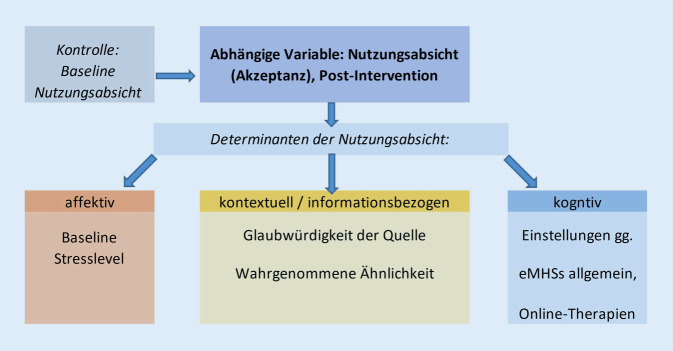
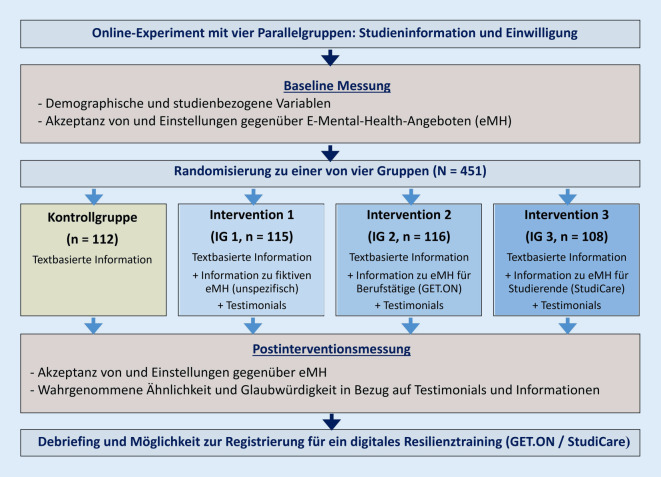
Zusammenfassung Zielsetzung Trotz der Effektivität verschiedener E‑Mental-Health-Interventionen wurden bislang verhältnismäßig geringe Nutzungsraten, selbst unter Digital Natives wie Studierenden, identifiziert. Ziel dieser Studie ist daher, das Verhältnis der generellen Akzeptanz, dem konkreten Interesse und der tatsächlichen Registrierung für ausgewählte, zielgruppenspezifische E‑Mental-Health-Programme zu untersuchen. Methodik Wir führten eine Sekundäranalyse einer in ein Online-Experiment eingebetteten Befragungsstudie mit n = 451 Studierenden (89 % Fernstudierende) zu Informationseffekten auf die Akzeptanz von E‑Mental-Health-Angeboten mit Untersuchung der Nutzungsabsicht sowie des Interesses im Verhältnis zu objektiven Daten, d. h. Registrierungen für ausgewählte E‑Mental-Health-Angebote zur Stressprävention und Gesundheitsförderung, durch. Ergebnisse Eine hierarchische Regressionsanalyse ergab das Stresslevel, wahrgenommene Ähnlichkeit mit Informationsquellen und Einstellungen als Determinanten der Nutzungsabsicht (R2 = 0,49). Aktuelles Interesse an der Teilnahme an einem bestimmten E‑Mental-Health-Angebot berichtete weniger als ein Drittel der Stichprobe (31 %). Überdies war die Intentions-Verhaltens-Lücke bei der Follow-up-Messung (n/N in %) beim Programm für Berufstätige geringer (85 % registriert) als für das Programm für Studierende (69 % registriert; insgesamt: 77 %). Schlussfolgerung Über drei Viertel der interessierten Studierenden haben sich für ein Programm registriert, was für die Bereitstellung einfacher, direkter Zugangsoptionen spricht. Zukünftige Studien sollten die Determinanten der Nutzung sowie Adhärenz bei E‑Mental-Health-Angeboten in Abhängigkeit von der Akzeptanz für verschiedene Subgruppen von Studierenden zur Entwicklung passgenauer Akzeptanzförderungsmaßnahmen genauer untersuchen.
Overview
The claims and statistics of this paper haven’t been checked yet.
Free: it reads the open-access text and checks the first 5 claims that cite a source we can check. Create a free account to check every claim.
Integrity signals
Registry
Cites
Statistics
Figures
Verification
Claims the paper makes
The claims and statistics of this paper haven’t been checked yet.
Free: it reads the open-access text and checks the first 5 claims that cite a source we can check. Create a free account to check every claim.
Claims other papers make about this one
Each is checked against this paper’s own text: does it say what the citing paper says it does?
The source backs part of the claim, not all of it — or backs it for a different population, condition or comparison.
In the citing paper
“Interestingly, most students who were offered an intervention shortly after exposure to an AFI signed up for it (61).”
From Mental health services for German university students: acceptance of intervention targets and preference for delivery modes (2024) · cites this paper as [61]
Experimental — accuracy not yet measuredThe cited source says what the claim attributes to it.
In the citing paper
“In another survey, students received different informational materials on a digital resilience training. Here, the intention to use services was associated with a higher level of stress and self-identification with testimonials.”
From Mental health services for German university students: acceptance of intervention targets and preference for delivery modes (2024) · cites this paper as [61]
Self-check
Percentages, sums and reported differences re-computed from the paper’s own numbers.
The self-check needs the paper’s full text.
Citations
Cites
User Acceptance of Information Technology: Toward A Unified View1
Venkatesh, V., Morris, M. G., Davis, G. B., & Davis, F. D. (2003) · MIS Quarterly · doi:10.2307/30036540 · Cited by 45,035
Carlbring, P., Andersson, G., Cuijpers, P., Riper, H., & Hedman-Lagerlöf, E. (2018) · Cognitive Behaviour Therapy · doi:10.1080/16506073.2017.1401115 · Cited by 1,232
Klein, E. M., Brähler, E., Dreier, M., Reinecke, L., Müller, K. W., Schmutzer, G., Wölfling, K., & Beutel, M. E. (2016) · BMC Psychiatry · doi:10.1186/s12888-016-0875-9 · Cited by 716
Fleming, T., Bavin, L., Lucassen, M., Stasiak, K., Hopkins, S., & Merry, S. (2018) · Journal of Medical Internet Research · doi:10.2196/jmir.9275 · Cited by 670
Impact of narratives on persuasion in health communication: a meta-analysis
Shen, F., Sheer, V. C., & Li, R. (2015) · Journal of Advertising · doi:10.1080/00913367.2015.1018467 · Cited by 574
Identification as a Mechanism of Narrative Persuasion
de Graaf, A., Hoeken, H., Sanders, J., & Beentjes, J. W. J. (2012) · Communication Research · doi:10.1177/0093650211408594 · Cited by 506
Dadaczynski, K., Okan, O., Messer, M., Leung, A. Y. M., Rosário, R., Darlington, E., & Rathmann, K. (2021) · Journal of Medical Internet Research · doi:10.2196/24097 · Cited by 390
Ebert, D. D., Berking, M., Cuijpers, P., Lehr, D., Pörtner, M., & Baumeister, H. (2015) · Journal of Affective Disorders · doi:10.1016/j.jad.2015.01.056 · Cited by 268
Self-citationBekker, H. L., Winterbottom, A. E., Butow, P., Dillard, A. J., Feldman-Stewart, D., Fowler, F. J., Jibaja-Weiss, M. L., Shaffer, V. A., & Volk, R. J. (2013) · BMC Medical Informatics and Decision Making · doi:10.1186/1472-6947-13-s2-s9 · Cited by 184 · cited 1×
“Bislang erbrachten Studien zu Testimonials,die sichhäufigaufhypothetische somatische Behandlungs- oder Screening-Entscheidungen beziehen, jedoch inkonsistente Befunde [6, 28].”
BackgroundOn the Usefulness of Narratives: An Interdisciplinary Review and Theoretical Model
Shaffer, V. A., Focella, E. S., Hathaway, A., Scherer, L. D., & Zikmund‐Fisher, B. J. (2018) · Annals of Behavioral Medicine · doi:10.1093/abm/kax008 · Cited by 180 · cited 4×
“längere und auf die Zielgruppe zugeschnittene Statements, höhere wahrgenommene Ähnlichkeit sowie Vertrauens- und Glaubwürdigkeit [16, 27, 28].”
BackgroundInfluential
Cited by
Kählke, F., Hasking, P., Küchler, A.-M., & Baumeister, H. (2024) · Frontiers in Digital Health · doi:10.3389/fdgth.2024.1284661 · Cited by 18
Fritz, B., Eppelmann, L., Edelmann, A., Rohrmann, S., & Wessa, M. (2025) · BMC Psychology · doi:10.1186/s40359-025-02954-z · Cited by 15
“In addition to symptoms of mental disorders (e.g. depression, anxiety or obsessive–compulsive disorders), general mental stress burden as shown by, e.g., restlessness, nervousness and exhaustion could affect the PU or the use of digital mental health technologies [43, 44].”
Grüneberg, C., Bäuerle, A., Karunakaran, S., Darici, D., Dörrie, N., Teufel, M., Benson, S., & Robitzsch, A. (2024) · JMIR Medical Education · doi:10.2196/58183 · Cited by 11
Apolinário-Hagen, J., Schobel, J., Helten, A.-K., Sahan, F., Pryss, R. C., & John, D. T. (2026) · Frontiers in Psychology · doi:10.3389/fpsyg.2025.1629265 · Cited by 4
Self-citationWitte, N. A. J. D., Buelens, F., Apolinário-Hagen, J., & Daele, T. V. (2025) · Clinical Psychology in Europe · doi:10.32872/cpe.16235 · Cited by 3
Self-citation
Metadata
- Authors
- Apolinário-Hagen, J., Harrer, M., Salewski, C., Lehr, D., & Ebert, D. D.
- Affiliations
- Heinrich Heine University Düsseldorf (DE)
- Friedrich-Alexander-Universität Erlangen-Nürnberg (DE)
- FernUniversität in Hagen (DE)
- Leuphana University of Lüneburg (DE)
- Technical University of Munich (DE)
- Corresponding author
- Apolinário-Hagen, Jennifer
- Venue
- Prävention und Gesundheitsförderung
- Published
- 2022-04-25
- Volume
- 18
- Issue
- 2
- Pages
- 196-203
- ISSN
- 1861-6755 (ISSN-L)
- 1861-6763
- PMC
- PMC9037969
- OpenAlex
- W4224327178
- Cited by
- 9
- References
- 30
- Citations by year
- 2026: 4 · 2025: 3 · 2024: 2
- FWCI
- 1.10
- Type
- journal article
- Language
- de
- Open access
- hybrid
- doi.org
- Licence
- cc-by
- creativecommons.org/licenses/by/4.0 (tdm)
- creativecommons.org/licenses/by/4.0 (vor)
- Locations
- Prävention und Gesundheitsförderung (publishedVersion, cc-by)
- PubMed Central (publishedVersion, cc-by)
- PubMed (publishedVersion)
- Multilingual Matters (Channel View Publications) (publishedVersion, cc-by)
- mediaTUM (Technical University of Munich) (submittedVersion)
- mediaTUM (Technical University of Munich) (submittedVersion, other-oa)
- mediaTUM – the media and publications repository of the Technical University Munich (Technical University Munich) (submittedVersion, other-oa)
- Funders
- Heinrich-Heine-Universität Düsseldorf
- Topics
- Social Sciences › Psychology › Applied Psychology › Digital Mental Health Interventions
- Health Sciences › Medicine › Psychiatry and Mental health › Mental Health Treatment and Access
- Health Sciences › Health Professions › Health Information Management › Health, Technology, Consumer Behavior
- Keywords
- student mental health, acceptance, intention to use, intention-behavior gap, stress prevention, health promotion, attitudes, digital natives, distance learners, program registration
About these checks
Registry, retraction, Cites and statistics results are computed, not judged, with one exception: a printed reference that no index lists is read once by a model before it counts as a citation error. Claims are extracted by a model and kept only when their quote appears verbatim in the text; each cited source is then checked, with a model’s help, for whether it says what the claim relies on. Those verdicts can be wrong — read the claim’s quote and the cited source before relying on one.
Statistics and arithmetic are recomputed, not judged.
Confidence bands are shown only for fields calibrated on our annotated test set. None is calibrated yet, so no band is shown.
What counts as a claim ›How we measure confidence ›How we check this ›
Are you an author, or do you see a problem with this page? Request a review
How to cite
Cite CoChat for the checks on this page, and the paper for its own findings.
- This page
- CoChat. (2026). Citation check: Akzeptanz und Nutzung von E-Mental-Health-Angeboten unter Studierenden: Sekundäranalyse eines Experiments. https://app.cochat.ai/papers/10.1007/s11553-022-00945-1
- The paper
- Apolinário-Hagen, J., Harrer, M., Salewski, C., Lehr, D., & Ebert, D. D. (2023). Akzeptanz und Nutzung von E-Mental-Health-Angeboten unter Studierenden: Sekundäranalyse eines Experiments. Prävention und Gesundheitsförderung. https://doi.org/10.1007/s11553-022-00945-1
Data sources
Bibliographic data: Semantic Scholar, OpenAlex, Crossref.
Contains information from the Semantic Scholar Academic Graph Datasets, made available under the ODC Attribution License (ODC-BY 1.0).
Semantic Scholar’s data is described in: Kinney, R., et al. (2023). The Semantic Scholar Open Data Platform. arXiv:2301.10140.
