

Definitions of Long-Term Weight Regain and Their Associations with Clinical Outcomes
Open accessThe DOI matches its Crossref record; 43 of the 43 references it cites were found in a registry or an index.
Abstract
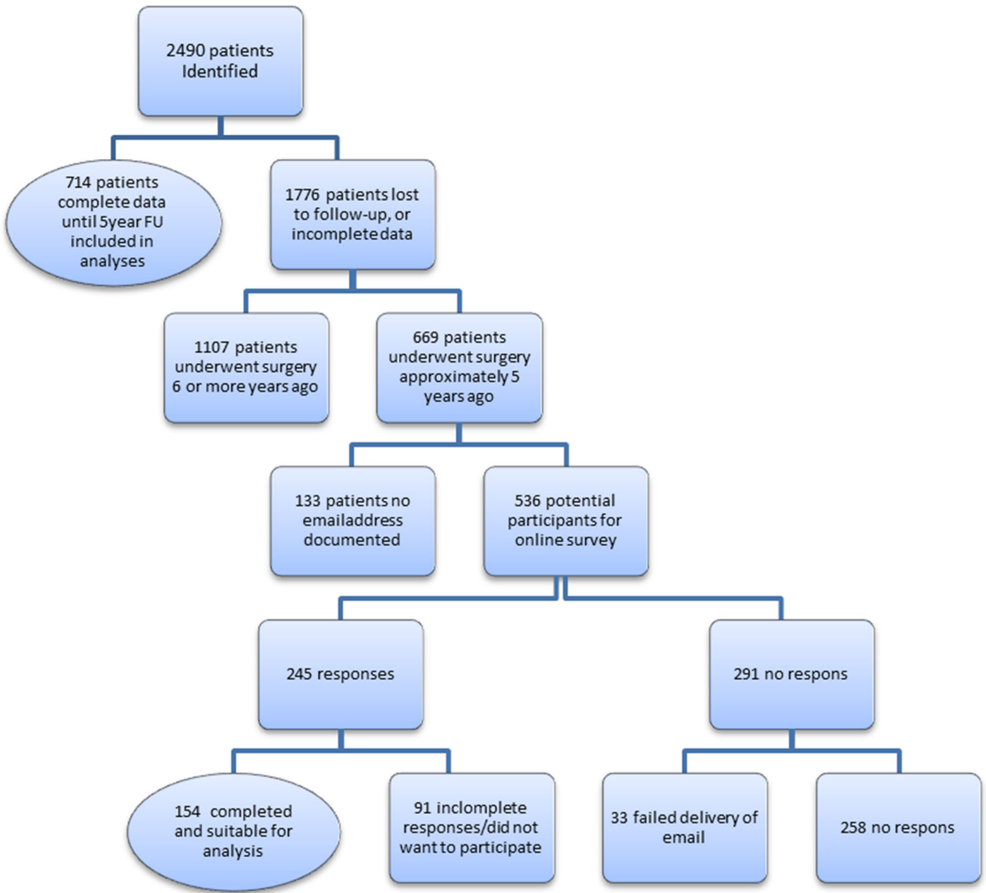
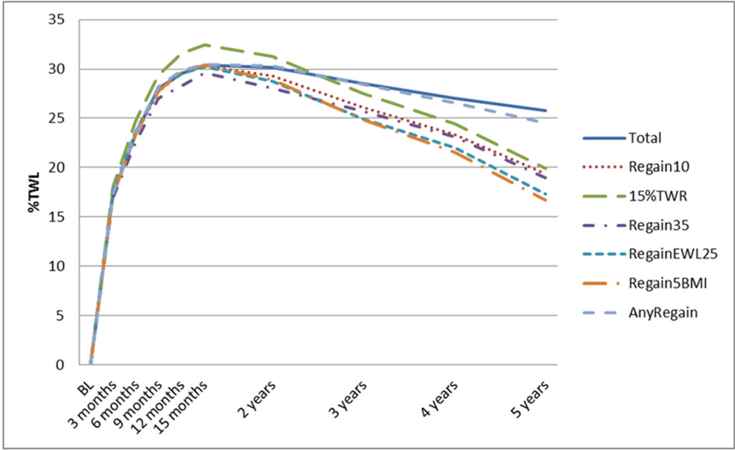
Introduction: The prevalence and clinical significance of weight regain after bariatric surgery remains largely unclear due to the lack of a standardized definition of significant weight regain. The development of a clinically relevant definition of weight regain requires a better understanding of its clinical significance. Objectives: To assess rates of weight regain 5 years after Roux-en-Y gastric bypass (RYGB) and sleeve gastrectomy (SG), applying six definitions and investigating their association with clinical outcomes. Methods: Patients were followed up until 5 years after surgery and weight regain was calculated. Regression techniques were used to assess the association of weight regain with health-related quality of life (HRQoL) and the presence of comorbidities. Results: A total of 868 patients participated in the study, with a mean age of 46.6 (± 10.4) years, of which 79% were female. The average preoperative BMI was 44.8 (± 5.9) kg/m 2 and the total maximum weight loss was 32% (± 8%). Eighty-seven percent experienced any regain. Significant weight regain rates ranged from 16 to 37% depending on the definition. Three weight regain definitions were associated with deterioration in physical HRQoL ( p < 0.05), while associations between definitions of weight regain and the presence of comorbidities 5 years after surgery were not significant. Conclusion: These results indicate that identifying one single categorical definition of clinically significant weight regain is difficult. Additional research into the clinical significance of weight regain is needed to inform the development of a standardized definition that includes all dimensions of surgery success: weight, HRQoL, and comorbidity remission.
Overview
The claims and statistics of this paper haven’t been checked yet.
Free: it reads the open-access text and checks the first 5 claims that cite a source we can check. Create a free account to check every claim.
Integrity signals
Registry
Cites
Statistics
Figures
Verification
Claims the paper makes
The claims and statistics of this paper haven’t been checked yet.
Free: it reads the open-access text and checks the first 5 claims that cite a source we can check. Create a free account to check every claim.
Claims other papers make about this one
Each is checked against this paper’s own text: does it say what the citing paper says it does?
The source backs part of the claim, not all of it — or backs it for a different population, condition or comparison.
In the citing paper
“up to one-third of people experience inadequate Weight loss or significant weight regain within 2–5 years [193].”
From Precision obesity medicine: A phenotype-guided framework for pharmacologic therapy across the lifespan (2025) · cites this paper as [193]
Experimental — accuracy not yet measuredThe source backs part of the claim, not all of it — or backs it for a different population, condition or comparison.
In the citing paper
“other studies e.g. from Sweden [6] and the Netherlands [4] report that 20 to 24% of patients have regained more than 15% of their body weight 5 years after RYGB or sleeve gastrectomy.”
From Patients' Experiences of Weight Regain After Bariatric Surgery (2022) · cites this paper as [4]
Experimental — accuracy not yet measuredThe cited source says what the claim attributes to it.
In the citing paper
“Most patients regain some weight after their lowest weight has been reached [4].”
From Patients' Experiences of Weight Regain After Bariatric Surgery (2022) · cites this paper as [4]
In the citing paper
“between one to two in five patients (16–37%) experience significant weight regain”
In the citing paper
“Others observed a 16–37% WR five years after BS, where the three WR definitions examined were found to be associated with deterioration in quality of life; however, no associations were found with other comorbidities [23].”
Self-check
Percentages, sums and reported differences re-computed from the paper’s own numbers.
The self-check needs the paper’s full text.
Citations
Cites
Sjöström, L. (2013) · Journal of Internal Medicine · doi:10.1111/joim.12012 · Cited by 1,835 · cited 2×
“The key studies focusing on long-term outcomes after bariatric surgery show that patients generally regain 5 to 10% of their total weight loss (%TWL) within the first decade [2, 6, 12].”
BackgroundMechanick, J. I., Youdim, A., Jones, D. B., Garvey, W. T., Hurley, D. L., McMahon, M. M., Heinberg, L. J., Kushner, R., Adams, T. D., Shikora, S., et al. (2013) · Obesity · doi:10.1002/oby.20461 · Cited by 1,650
Gloy, V. L., Briel, M., Bhatt, D. L., Kashyap, S. R., Schauer, P. R., Mingrone, G., Bucher, H. C., & Nordmann, A. J. (2013) · BMJ · doi:10.1136/bmj.f5934 · Cited by 1,351
Weight and Metabolic Outcomes 12 Years after Gastric Bypass
Adams, T. D., Davidson, L. E., Litwin, S. E., Kim, J., Kolotkin, R. L., Nanjee, M. N., Gutierrez, J. M., Frogley, S. J., Ibele, A. R., Brinton, E. A., et al. (2017) · New England Journal of Medicine · doi:10.1056/nejmoa1700459 · Cited by 956 · cited 12×
“In a systematic review among 16 studies, weight regain rates ranged from 19 to 87% for patients who underwent RYGB and sleeve gastrectomy (SG), while a systematic review among 21 studies found weight regain rates after SG ranged from 6 to 76% over variable follow-up periods ranging from 2 to 6 years [4, 5].”
BackgroundInfluentialStandardized outcomes reporting in metabolic and bariatric surgery
Brethauer, S. A., Kim, J., el Chaar, M., Papasavas, P., Eisenberg, D., Rogers, A., Ballem, N., Kligman, M., & Kothari, S. (2015) · Surgery for Obesity and Related Diseases · doi:10.1016/j.soard.2015.02.003 · Cited by 944
Karlsson, J., Taft, C., Rydén, A., Sjöström, L., & Sullivan, M. (2007) · International Journal of Obesity · doi:10.1038/sj.ijo.0803573 · Cited by 869
Long-term Follow-up After Bariatric Surgery: A Systematic Review
Puzziferri, N., Roshek, T. B., Mayo, H. G., Gallagher, R., Belle, S. H., & Livingston, E. H. (2014) · JAMA · doi:10.1001/jama.2014.10706 · Cited by 819 · cited 1×
“This is a known problem in most studies of bariatric surgery, with mean compliance at longterm follow-up low [43].”
BackgroundInterdisciplinary European Guidelines on Metabolic and Bariatric Surgery
on behalf of International Federation for the Surgery of Obesity and Metabolic Disorders—European Chapter (IFSO-EC) and European Association for the Study of Obesity (EASO), Fried, M., Yumuk, V., Oppert, J. M., Scopinaro, N., Torres, A., Weiner, R., Yashkov, Y., & Frühbeck, G. (2014) · Obesity Surgery · doi:10.1007/s11695-013-1079-8 · Cited by 753
Courcoulas, A. P., King, W. C., Belle, S. H., Berk, P., Flum, D. R., Garcia, L., Gourash, W., Horlick, M., Mitchell, J. E., Pomp, A., et al. (2018) · JAMA Surgery · doi:10.1001/jamasurg.2017.5025 · Cited by 699 · cited 13×
“However, different weight loss trajectories were observed and a subgroup of patients regains a significant amount of weight and experiences associated problems [12].”
BackgroundInfluentialLong-term Weight Regain after Gastric Bypass: A 5-year Prospective Study
Magro, D. O., Geloneze, B., Delfini, R., Pareja, B. C., Callejas, F., & Pareja, J. C. (2008) · Obesity Surgery · doi:10.1007/s11695-007-9265-1 · Cited by 677
Weight Recidivism Post-Bariatric Surgery: A Systematic Review
Karmali, S., Brar, B., Shi, X., Sharma, A. M., de Gara, C., & Birch, D. W. (2013) · Obesity Surgery · doi:10.1007/s11695-013-1070-4 · Cited by 574
Zee, K. I., Sanderman, R., Heyink, J. W., & Haes, H. (1996) · International Journal of Behavioral Medicine · doi:10.1207/s15327558ijbm0302_2 · Cited by 547
Behavioral predictors of weight regain after bariatric surgery
Odom, J., Zalesin, K. C., Washington, T. L., Miller, W. W., Hakmeh, B., Zaremba, D. L., Altattan, M., Balasubramaniam, M., Gibbs, D. S., Krause, K. R., et al. (2010) · Obesity Surgery · doi:10.1007/s11695-009-9895-6 · Cited by 483
King, W. C., Hinerman, A. S., Belle, S. H., Wahed, A. S., & Courcoulas, A. P. (2018) · JAMA · doi:10.1001/jama.2018.14433 · Cited by 414
Weight Regain Following Sleeve Gastrectomy—a Systematic Review
Lauti, M., Kularatna, M., Hill, A. G., & MacCormick, A. D. (2016) · Obesity Surgery · doi:10.1007/s11695-016-2152-x · Cited by 412
Trends in weight regain following roux-en-Y gastric bypass (RYGB) bariatric surgery
Cooper, T. C., Simmons, E. B., Webb, K., Burns, J. L., & Kushner, R. F. (2015) · Obesity Surgery · doi:10.1007/s11695-014-1560-z · Cited by 305
Freire, R. H., Borges, M. C., Alvarez-Leite, J. I., & Correia, M. I. T. D. (2012) · Nutrition · doi:10.1016/j.nut.2011.01.011 · Cited by 252
The impact of bariatric surgery on quality of life: a systematic review and meta‐analysis
Lindekilde, N., Gladstone, B. P., Lübeck, M., Nielsen, J., Clausen, L., Vach, W., & Jones, A. (2015) · Obesity Reviews · doi:10.1111/obr.12294 · Cited by 205
Total Weight Loss as the Outcome Measure of Choice After Roux-en-Y Gastric Bypass
Corcelles, R., Boules, M., Froylich, D., Hag, A., Daigle, C. R., Aminian, A., Brethauer, S. A., Burguera, B., & Schauer, P. R. (2016) · Obesity Surgery · doi:10.1007/s11695-015-2022-y · Cited by 170
Impact of routine and long-term follow-up on weight loss after laparoscopic gastric bypass
Gould, J. C., Beverstein, G., Reinhardt, S., & Garren, M. J. (2007) · Surgery for Obesity and Related Diseases · doi:10.1016/j.soard.2007.07.005 · Cited by 137
Predictors of weight regain in patients who underwent Roux-en-Y gastric bypass surgery
Shantavasinkul, P. C., Omotosho, P. A., Corsino, L., Portenier, D. D., & Torquati, A. (2016) · Surgery for Obesity and Related Diseases · doi:10.1016/j.soard.2016.08.028 · Cited by 137
Patient experiences of outcomes of bariatric surgery: a systematic review and qualitative synthesis
Coulman, K. D., MacKichan, F., Blazeby, J. M., & Owen‐Smith, A. (2017) · Obesity Reviews · doi:10.1111/obr.12518 · Cited by 133
Predictors of Lowest Weight and Long-Term Weight Regain Among Roux-en-Y Gastric Bypass Patients
Yanos, B. R., Saules, K. K., Schuh, L. M., & Sogg, S. (2014) · Obesity Surgery · doi:10.1007/s11695-014-1536-z · Cited by 131
van de Laar, A. W. J. M., de Caluwé, L., & Dillemans, B. (2010) · Obesity Surgery · doi:10.1007/s11695-010-0347-0 · Cited by 122
Weight regain after bariatric surgery—how should it be defined?
Nedelcu, M., Khwaja, H. A., & Rogula, T. G. (2016) · Surgery for Obesity and Related Diseases · doi:10.1016/j.soard.2016.04.028 · Cited by 121 · cited 2×
“as collected in a social media poll among International Bariatric Club (IBC) surgeons [10, 22].”
BackgroundQuality of Life, Body Image and Sexual Functioning in Bariatric Surgery Patients
Sarwer, D. B., & Steffen, K. J. (2015) · European Eating Disorders Review · doi:10.1002/erv.2412 · Cited by 120
Definition determines weight regain outcomes after sleeve gastrectomy
Lauti, M., Lemanu, D. P., Zeng, I. S. L., Su’a, B., Hill, A. G., & MacCormick, A. D. (2017) · Surgery for Obesity and Related Diseases · doi:10.1016/j.soard.2017.02.029 · Cited by 120
Project HELP: a Remotely Delivered Behavioral Intervention for Weight Regain after Bariatric Surgery
Bradley, L. E., Forman, E. M., Kerrigan, S. G., Goldstein, S. P., Butryn, M. L., Thomas, J. G., Herbert, J. D., & Sarwer, D. B. (2017) · Obesity Surgery · doi:10.1007/s11695-016-2337-3 · Cited by 118
van de Laar, A. W. J. M., van Rijswijk, A. S., Kakar, H., & Bruin, S. (2018) · Obesity Surgery · doi:10.1007/s11695-018-3173-4 · Cited by 111
Amundsen, T., Strømmen, M., & Martins, C. (2017) · Obesity Surgery · doi:10.1007/s11695-016-2475-7 · Cited by 109
Coulman, K. D., Hopkins, J. C. A., Brookes, S. T., Chalmers, K. A., Main, B., Owen‐Smith, A., Andrews, R. C., Byrne, J. P., Donovan, J., Mazza, G., et al. (2016) · PLoS Medicine · doi:10.1371/journal.pmed.1002187 · Cited by 106
da Silva, F. B. L., Gomes, D. L., & de Carvalho, K. M. B. (2016) · Nutrition · doi:10.1016/j.nut.2016.01.018 · Cited by 100
Stop Regain: A Pilot Psychological Intervention for Bariatric Patients Experiencing Weight Regain
Himes, S. M., Grothe, K. B., Clark, M. M., Swain, J. M., Collazo–Clavell, M. L., & Sarr, M. G. (2015) · Obesity Surgery · doi:10.1007/s11695-015-1611-0 · Cited by 97
Tettero, O. M., Aronson, T., Wolf, R. J., Nuijten, M. A. H., Hopman, M. T. E., & Janssen, I. M. C. (2018) · Obesity Surgery · doi:10.1007/s11695-018-3439-x · Cited by 86
Self-citationNeto, R. M. L., Herbella, F. A. M., Tauil, R. D. M., Silva, F. S., & de Lima, S. E. (2012) · Obesity Surgery · doi:10.1007/s11695-012-0731-z · Cited by 77
Bradley, L. E., Forman, E. M., Kerrigan, S. G., Butryn, M. L., Herbert, J. D., & Sarwer, D. B. (2016) · Obesity Surgery · doi:10.1007/s11695-016-2125-0 · Cited by 66
On behalf of the By-Band-Sleeve Trial Management Group, Coulman, K. D., Howes, N., Hopkins, J. C. A., Whale, K., Chalmers, K. A., BROOKES, S. T., Nicholson, A., Savović, J., Ferguson, Y., et al. (2016) · Obesity Surgery · doi:10.1007/s11695-016-2186-0 · Cited by 63
Kolotkin, R. L., Kim, J., Davidson, L. E., Crosby, R. D., Hunt, S. C., & Adams, T. D. (2018) · Surgery for Obesity and Related Diseases · doi:10.1016/j.soard.2018.04.019 · Cited by 56
Improvement of Health-Related Quality of Life After Roux-en-Y Gastric Bypass Related to Weight Loss
Monpellier, V. M., Antoniou, E. E., Aarts, E. O., Janssen, I. M. C., & Jansen, A. T. M. (2016) · Obesity Surgery · doi:10.1007/s11695-016-2468-6 · Cited by 37
Self-citationIs it time to abandon excess weight loss in reporting surgical weight loss?
Karmali, S., Birch, D. W., & Sharma, A. M. (2009) · Surgery for Obesity and Related Diseases · doi:10.1016/j.soard.2009.04.014 · Cited by 31
Development and Evaluation of the Quality of Life for Obesity Surgery (QOLOS) Questionnaire
Müller, A., Crosby, R. D., Selle, J., Osterhues, A., Köhler, H., Mall, J. W., Meyer, T., & de Zwaan, M. (2017) · Obesity Surgery · doi:10.1007/s11695-017-2864-6 · Cited by 30
Lent, M. R., Hu, Y., Benotti, P. N., Petrick, A. T., Wood, G. C., Still, C. D., & Kirchner, H. L. (2018) · Surgery for Obesity and Related Diseases · doi:10.1016/j.soard.2018.07.023 · Cited by 27
Amer, R. A., Khalifa, K. A., Alajlan, S. A., & Ansari, A. A. (2018) · Obesity Surgery · doi:10.1007/s11695-018-3199-7 · Cited by 18
Cited by
El Ansari, W., & Elhag, W. (2021) · Obesity Surgery · doi:10.1007/s11695-020-05160-5 · Cited by 482
“Inconsistent reporting + + + + + + Small sample sizes, patient recall to estimate nadir weight, loss to follow-up, and variability of follow-up times [8, 23] Lack of standardization + + + NA Varied definitions, consensus statements, and guidelines of WR [8, 23] Clinical significance + + Relationships between different…”
BackgroundFactors associated with weight regain post-bariatric surgery: a systematic review
Athanasiadis, D. I., Martin, A., Kapsampelis, P., Monfared, S., & Stefanidis, D. (2021) · Surgical Endoscopy · doi:10.1007/s00464-021-08329-w · Cited by 333
“has identified that almost 87% of patients regained at least some weight 5 years postoperatively [54].”
BackgroundJensen, A. B., Renström, F., Aczél, S., Folie, P., Biraima-Steinemann, M., Beuschlein, F., & Bilz, S. (2023) · Obesity Surgery · doi:10.1007/s11695-023-06484-8 · Cited by 161
“1 3 reducing the long-term benefits of the procedure [2, 3].”
BackgroundApproach to the Patient: Management of the Post–Bariatric Surgery Patient With Weight Regain
Istfan, N. W., Lipartia, M., Anderson, W. A., Hess, D. T., & Apovian, C. M. (2021) · The Journal of Clinical Endocrinology & Metabolism · doi:10.1210/clinem/dgaa702 · Cited by 83
Majid, S. F., Davis, M. J., Ajmal, S., Podkameni, D., Jain-Spangler, K., Guerron, A. D., King, N., Voellinger, D. C., Northup, C. J., Kennedy, C., et al. (2022) · Surgery for Obesity and Related Diseases · doi:10.1016/j.soard.2022.04.012 · Cited by 97
Metadata
- Authors
- Voorwinde, V., Steenhuis, I. H. M., Janssen, I. M. C., Monpellier, V. M., & van Stralen, M. M.
- Affiliations
- Amsterdam Public Health (NL)
- Nederlandse Obesitas Kliniek (NL)
- Corresponding author
- Voorwinde, Vera
- ORCID
- Venue
- Obesity Surgery
- Published
- 2019-11-01
- Volume
- 30
- Issue
- 2
- Pages
- 527-536
- ISSN
- 0960-8923 (ISSN-L)
- 1708-0428
- OpenAlex
- W2985496635
- Semantic Scholar
- d818ef75c49438d0c5a739183a6b20f5310498f2
- Cited by
- 174
- References
- 43
- Citations by year
- 2026: 22 · 2025: 24 · 2024: 31 · 2023: 40 · 2022: 24 · 2021: 28 · 2020: 5
- FWCI
- 13.60
- Type
- journal article
- Language
- en
- Open access
- hybrid
- doi.org
- Licence
- cc-by
- creativecommons.org/licenses/by/4.0 (tdm)
- creativecommons.org/licenses/by/4.0 (vor)
- Locations
- Obesity Surgery (publishedVersion, cc-by)
- PubMed (publishedVersion)
- VU Research Portal (publishedVersion, other-oa)
- Data Archiving and Networked Services (DANS) (submittedVersion, other-oa)
- Funders
- NWO-SSH (451-16-018)
- Topics
- Health Sciences › Medicine › Surgery › Bariatric Surgery and Outcomes
- Health Sciences › Medicine › Surgery › Body Contouring and Surgery
- Health Sciences › Medicine › Public Health, Environmental and Occupational Health › Obesity and Health Practices
- Keywords
- weight regain, bariatric surgery
- MeSH terms
- Adult, Female, Follow-Up Studies, Gastrectomy, Humans, Male, Middle Aged, Obesity, Morbid, Prognosis, Quality of Life, Gastric Bypass, Weight Gain, Weight Loss, Comorbidity, Treatment Outcome
About these checks
Registry, retraction, Cites and statistics results are computed, not judged, with one exception: a printed reference that no index lists is read once by a model before it counts as a citation error. Claims are extracted by a model and kept only when their quote appears verbatim in the text; each cited source is then checked, with a model’s help, for whether it says what the claim relies on. Those verdicts can be wrong — read the claim’s quote and the cited source before relying on one.
Statistics and arithmetic are recomputed, not judged.
Confidence bands are shown only for fields calibrated on our annotated test set. None is calibrated yet, so no band is shown.
What counts as a claim ›How we measure confidence ›How we check this ›
Are you an author, or do you see a problem with this page? Request a review
Data sources
Bibliographic data: Semantic Scholar, OpenAlex, Crossref.
Contains information from the Semantic Scholar Academic Graph Datasets, made available under the ODC Attribution License (ODC-BY 1.0).
Semantic Scholar’s data is described in: Kinney, R., et al. (2023). The Semantic Scholar Open Data Platform. arXiv:2301.10140.
