

Rate and Determinants of Excessive Fat-Free Mass Loss After Bariatric Surgery
Open accessThe DOI matches its Crossref record; 29 of the 29 references it cites were found in a registry or an index.
Abstract
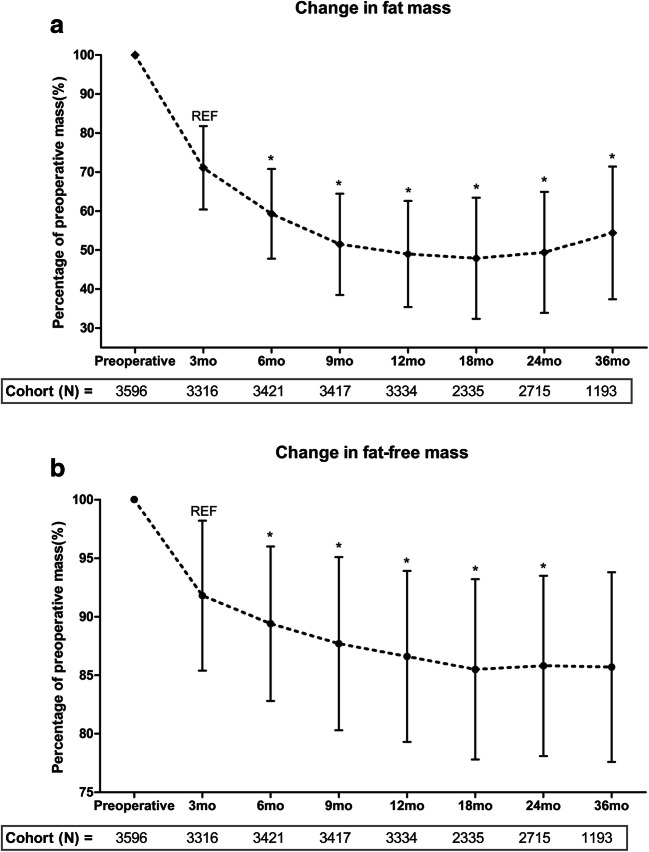
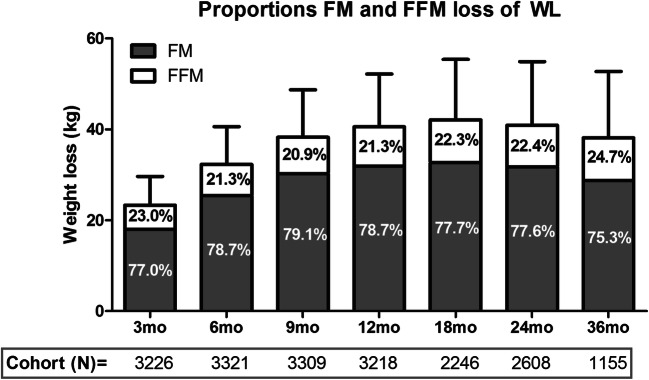
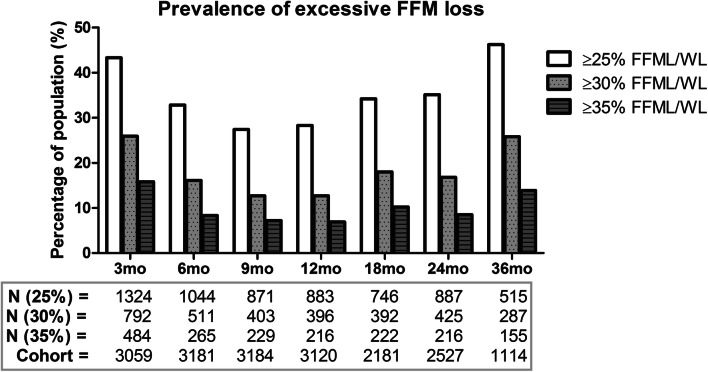
Purpose: Fat-free mass (FFM) loss is a concerning aspect of bariatric surgery, but little is known about its time-course and factors related with excessive FFM loss. This study examined (i) the progress of FFM loss up to 3 years post-bariatric surgery and (ii) the prevalence and determinants of excessive FFM loss. Materials and Methods: A total of 3596 patients (20% males, 43.5 ± 11.1 years old, BMI = 44.2 ± 5.5 kg/m 2 ) underwent sleeve gastrectomy (SG) or Roux-en-Y gastric bypass (RYGB) surgery. Bioelectrical impedance analysis was performed preoperatively and 3, 6, 9, 12, 18, 24 and 36 months post-surgery. Changes in body composition were assessed by mixed model analysis. Prevalence of excessive FFM loss (based on three different cutoff values: ≥ 25%, ≥ 30% and ≥ 35% FFM loss/weight loss (= %FFML/WL)) was estimated and its determinants were assessed by linear regression analysis. Results: Highest rates of FFM loss were found at 3 and 6 months post-surgery, reflecting 57% and 73% of peak FFM loss, respectively. Prevalence of excessive FFM loss ranged from 14 to 46% at 36 months post-surgery, with an older age ( β = 0.14, 95%CI = 0.10–0.18, P < .001), being male ( β = 3.99, 95%CI = 2.86–5.12, P < .001), higher BMI ( β = 0.13, 95%CI = 0.05–0.20, P = .002) and SG ( β = 2.56, 95%CI = 1.36–3.76, P < .001) as determinants for a greater %FFML/WL. Conclusion: Patients lost most FFM within 3 to 6 months post-surgery. Prevalence of excessive FFM loss was high, emphasizing the need for more vigorous approaches to counteract FFM loss. Furthermore, future studies should assess habitual physical activity and dietary intake shortly after surgery in relation to FFM loss.
Overview
The claims and statistics of this paper haven’t been checked yet.
Free: it reads the open-access text and checks the first 5 claims that cite a source we can check. Create a free account to check every claim.
Integrity signals
Registry
Cites
Statistics
Figures
Verification
Claims the paper makes
The claims and statistics of this paper haven’t been checked yet.
Free: it reads the open-access text and checks the first 5 claims that cite a source we can check. Create a free account to check every claim.
Claims other papers make about this one
Each is checked against this paper’s own text: does it say what the citing paper says it does?
In the citing paper
“In a study of 3596 patients (20% males, mean age 43.5 years) receiving sleeve gastrectomy or Roux-en-Y gastric bypass surgery followed for 3-years it was found that the highest rate of loss in FFM occurred at 3- and 6-months (57% and 78% of peak loss) post-surgery, with higher preoperative BMI one of the key factors associated with greater FFM loss [11]”
From Weighing the risk of GLP-1 treatment in older adults: Should we be concerned about sarcopenic obesity? (2025) · cites this paper as [11]
Self-check
Percentages, sums and reported differences re-computed from the paper’s own numbers.
The self-check needs the paper’s full text.
Citations
Cites
Sjöström, L. (2013) · Journal of Internal Medicine · doi:10.1111/joim.12012 · Cited by 1,835 · cited 1×
“Bariatric surgery is considered the most effective strategy in patients with morbid obesity to achieve long-lasting weight loss, improve quality of life and reduce comorbidities [1, 2].”
BackgroundThe underappreciated role of muscle in health and disease
Wolfe, R. R. (2006) · The American Journal of Clinical Nutrition · doi:10.1093/ajcn/84.3.475 · Cited by 1,537
Gloy, V. L., Briel, M., Bhatt, D. L., Kashyap, S. R., Schauer, P. R., Mingrone, G., Bucher, H. C., & Nordmann, A. J. (2013) · BMJ · doi:10.1136/bmj.f5934 · Cited by 1,351 · cited 1×
“Bariatric surgery is considered the most effective strategy in patients with morbid obesity to achieve long-lasting weight loss, improve quality of life and reduce comorbidities [1, 2].”
BackgroundMuscle type and fiber type specificity in muscle wasting
Ciciliot, S., Rossi, A. C., Dyar, K. A., Blaauw, B., & Schiaffino, S. (2013) · The International Journal of Biochemistry & Cell Biology · doi:10.1016/j.biocel.2013.05.016 · Cited by 623
Cunningham, J. (1991) · The American Journal of Clinical Nutrition · doi:10.1093/ajcn/54.6.963 · Cited by 607
Breen, L., & Phillips, S. M. (2011) · Nutrition & Metabolism · doi:10.1186/1743-7075-8-68 · Cited by 576
Changes in fat-free mass during significant weight loss: a systematic review
Chaston, T. B., Dixon, J. B., & O'Brien, P. E. (2007) · International Journal of Obesity · doi:10.1038/sj.ijo.0803483 · Cited by 493
Nair (2005) · doi:10.1093/ajcn/81.5.953 · Cited by 469
Nutritional deficiencies after bariatric surgery
Bal, B. S., Finelli, F. C., Shope, T. R., & Koch, T. R. (2012) · Nature Reviews Endocrinology · doi:10.1038/nrendo.2012.48 · Cited by 418
Heymsfield, S. B., Gonzalez, M. C. C., Shen, W., Redman, L., & Thomas, D. (2014) · Obesity Reviews · doi:10.1111/obr.12143 · Cited by 350
Cited by
Nuijten, M. A. H., Eijsvogels, T. M. H., Monpellier, V. M., Janssen, I. M. C., Hazebroek, E. J., & Hopman, M. T. E. (2022) · Obesity Reviews · doi:10.1111/obr.13370 · Cited by 236
“This weight loss does not only exclusively consists of fat mass loss but also includes loss of muscle mass.(2,3) Muscle mass can be expressed by various terms, such as fat-free mass (FFM), lean body mass (LBM), and skeletal muscle mass (SMM).”
BackgroundSelf-citationBennett, J. P., & Lim, S. K. (2025) · Journal of Obesity & Metabolic Syndrome · doi:10.7570/jomes25010 · Cited by 72
“68,69 Comprehensive risk models can also benefit from understanding how individuals who lose a greater proportion of FFM, compared to FM, differ in their long-term health outcomes.”
Nutritional Management in Bariatric Surgery Patients
Deledda, A., Pintus, S., Loviselli, A., Fosci, M., Fantola, G., & Velluzzi, F. (2021) · International Journal of Environmental Research and Public Health · doi:10.3390/ijerph182212049 · Cited by 55
Baad, V. M. A., Bezerra, L. R., de Holanda, N. C. P., dos Santos, A. C. O., da Silva, A. A. M., Bandeira, F., & Cavalcante, T. C. F. (2022) · Obesity Surgery · doi:10.1007/s11695-022-06335-y · Cited by 40
“Both techniques, despite anatomical and functional changes, according to more recent studies, lead to loss of muscle mass in a similar way, especially in the first 12 months after surgery [26, 27].”
BackgroundRomeijn, M. M., Holthuijsen, D. D. B., Kolen, A. M., Janssen, L., Schep, G., van Dielen, F. M. H., & Leclercq, W. K. G. (2021) · Nutrition Journal · doi:10.1186/s12937-021-00688-3 · Cited by 40
“Within the first year after laparoscopic Roux-en-Y gastric bypass (RYGB), patients lose about 22% of their LBM [9, 10].”
Background
Metadata
- Authors
- Nuijten, M. A. H., Monpellier, V. M., Eijsvogels, T. M. H., Janssen, I. M. C., Hazebroek, E. J., & Hopman, M. T. E.
- Affiliations
- Radboud University Medical Center (NL)
- Nederlandse Obesitas Kliniek (NL)
- Rijnstate Hospital (NL)
- Corresponding author
- Hopman, Maria T. E.
- ORCID
- Venue
- Obesity Surgery
- Published
- 2020-05-15
- Volume
- 30
- Issue
- 8
- Pages
- 3119-3126
- ISSN
- 0960-8923 (ISSN-L)
- 1708-0428
- PMC
- PMC7305251
- OpenAlex
- W3024815245
- Cited by
- 87
- References
- 29
- Citations by year
- 2026: 15 · 2025: 23 · 2024: 19 · 2023: 6 · 2022: 7 · 2021: 12 · 2020: 4
- FWCI
- 6.85
- Type
- journal article
- Language
- en
- Open access
- hybrid
- doi.org
- Licence
- cc-by
- creativecommons.org/licenses/by/4.0 (tdm)
- creativecommons.org/licenses/by/4.0 (vor)
- Locations
- Obesity Surgery (publishedVersion, cc-by)
- PubMed Central (publishedVersion, cc-by)
- PubMed (publishedVersion)
- Radboud Repository (Radboud University) (submittedVersion, other-oa)
- Radboud Repository (Radboud University) (submittedVersion)
- Funders
- Radboud University Medical Center
- Topics
- Health Sciences › Medicine › Surgery › Bariatric Surgery and Outcomes
- Health Sciences › Medicine › Surgery › Body Contouring and Surgery
- Health Sciences › Medicine › Physiology (medical) › Body Composition Measurement Techniques
- Keywords
- fat-free mass loss, bariatric surgery
- MeSH terms
- Adult, Aged, Female, Gastrectomy, Humans, Male, Middle Aged, Obesity, Morbid, Gastric Bypass, Weight Loss, Body Mass Index, Bariatric Surgery
About these checks
Registry, retraction, Cites and statistics results are computed, not judged, with one exception: a printed reference that no index lists is read once by a model before it counts as a citation error. Claims are extracted by a model and kept only when their quote appears verbatim in the text; each cited source is then checked, with a model’s help, for whether it says what the claim relies on. Those verdicts can be wrong — read the claim’s quote and the cited source before relying on one.
Statistics and arithmetic are recomputed, not judged.
Confidence bands are shown only for fields calibrated on our annotated test set. None is calibrated yet, so no band is shown.
What counts as a claim ›How we measure confidence ›How we check this ›
Are you an author, or do you see a problem with this page? Request a review
Data sources
Bibliographic data: Semantic Scholar, OpenAlex, Crossref.
Contains information from the Semantic Scholar Academic Graph Datasets, made available under the ODC Attribution License (ODC-BY 1.0).
Semantic Scholar’s data is described in: Kinney, R., et al. (2023). The Semantic Scholar Open Data Platform. arXiv:2301.10140.
