

The DOI matches its Crossref record.
Ligand Binding of PR-10 Proteins with a Particular Focus on the Bet v 1 Allergen Family
Abstract
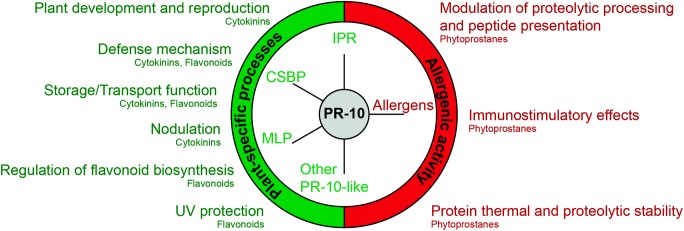
Purpose of Review: Pathogenesis-related class 10 (PR-10) proteins are highly conserved plant proteins, which are induced in response to abiotic and biotic stress factors. To date, no unique biological function could be assigned to them. Rather a more general role of PR-10 in plant development and defense mechanisms has been proposed. In addition, some PR-10 proteins act as allergens by triggering allergic symptoms in sensitized individuals. Regardless of the diversity of reported activities, all PR-10 proteins share a common fold characterized by a solvent-accessible hydrophobic cavity, which serves as a binding site for a myriad of small-molecule ligands, mostly phytohormones and flavonoids. Recent Findings: Most of available data relate to the ligand binding activity of allergenic PR-10, particularly for those belonging to Bet v 1 family of allergens. Bet v 1 and its homologues were shown to bind flavonoids with high affinity, but the specificity appears to differ between homologues from different species. The flavonoid Q3O-(Glc)-Gal was shown to specifically bind to hazelnut Cor a 1 but not to Bet v 1. Similarly, Q3OS bound only to the major isoform Bet v 1.0101 and not to other closely related isoforms. In contrast, Bet v 1 and hazelnut Cor a 1 showed very similar binding behavior towards other flavonoids such as quercetin, genistein, apigenin, daidzein, and resveratrol. Summary: Recent research findings highlighted the importance of more precise knowledge of ligand binding for understanding the functional diversification of PR-10 proteins.
Overview
The claims and statistics of this paper haven’t been checked yet.
Run the check — free, no account needed. It reads the open-access text and checks the sources it cites.
Integrity signals
Registry
Cites
Statistics
Figures
Verification
Claims the paper makes
The claims and statistics of this paper haven’t been checked yet.
Run the check — free, no account needed. It reads the open-access text and checks the sources it cites.
Claims other papers make about this one
Each is checked against this paper’s own text: does it say what the citing paper says it does?
In the citing paper
“PR-10 proteins are characterized by their small molecular size (17-18 kDa) and structural features, including a hydrophobic cavity that binds small ligands [128,129].”
From Pollen–Food Allergy Syndrome: Allergens, Clinical Insights, Diagnostic and Therapeutic Challenges (2024) · cites this paper as [128]
Self-check
Percentages, sums and reported differences re-computed from the paper’s own numbers.
The self-check needs the paper’s full text.
Citations
Cites
No references could be resolved yet.
Research works printed but not linked: 56
- Fernandes H, Michalska K, Sikorski M, Jaskolski M. Structural and functional aspects of PR-10 proteins. FEBS J. 2013;280(5):1169–99. https://doi.org/10.1111/febs.12114. · DOI
- Flores T, Alape-Giron A, Flores-Diaz M, Flores HE. Ocatin. A novel tuber storage protein from the andean tuber crop oca with antibacterial and antifungal activities. Plant Physiol. 2002;128(4):1291–302. https://doi.org/10.1104/pp.010541. · DOI
- Ukaji N, Kuwabara C, Takezawa D, Arakawa K, Fujikawa S. Accumulation of pathogenesis-related (PR) 10/Bet v 1 protein homologues in mulberry (Morus bombycis Koidz.) tree during winter. Plant Cell Environ. 2004;27(9):1112–21. https://doi.org/10.1111/j.1365-3040.2004.01216.x. · DOI
- Seutter von Loetzen C, Hoffmann T, Hartl MJ, Schweimer K, Schwab W, Rosch P, et al. Secret of the major birch pollen allergen Bet v 1: identification of the physiological ligand. Biochem J. 2014;457(3):379–90. https://doi.org/10.1042/bj20130413. · DOI
- Radauer C, Lackner P, Breiteneder H. The Bet v 1 fold: an ancient, versatile scaffold for binding of large, hydrophobic ligands. BMC Evol Biol. 2008;8:286. https://doi.org/10.1186/1471-2148-8-286. · DOI
- •• Soh WT, Aglas L, Mueller GA, Gilles S, Weiss R, Scheiblhofer S, et al. Multiple roles of Bet v 1 ligands in allergen stabilization and modulation of endosomal protease activity. 2019;74(12):2382–93 The study showed that pollen-derived phytoprostanes bind to Bet v 1 inhibit lysosomal cysteine cathepsin and affects the allergen processing and presentation to T cells. · DOI
- •• Jacob T, von Loetzen CS, Reuter A, Lacher U, Schiller D, Schobert R, et al. Identification of a natural ligand of the hazel allergen Cor a 1. Sci Rep. 2019;9(1):8714. https://doi.org/10.1038/s41598-019-44999-2The study identified the flavonoid Q3O-(Glc)-Gal as a natural ligand of Cor a 1 and showed that Bet v 1 and Cor a 1 exhibit highly selective binding to their respective ligands. · DOI
- Moraes AH, Asam C, Almeida FCL, Wallner M, Ferreira F, Valente AP. Structural basis for cross-reactivity and conformation fluctuation of the major beech pollen allergen Fag s 1. Sci Rep. 2018;8(1):10512. https://doi.org/10.1038/s41598-018-28358-1. · DOI
- Zubini P, Zambelli B, Musiani F, Ciurli S, Bertolini P, Baraldi E. The RNA hydrolysis and the cytokinin binding activities of PR-10 proteins are differently performed by two isoforms of the Pru p 1 peach major allergen and are possibly functionally related. Plant Physiol. 2009;150(3):1235–47. https://doi.org/10.1104/pp.109.139543. · DOI
- Casanal A, Zander U, Munoz C, Dupeux F, Luque I, Botella MA, et al. The strawberry pathogenesis-related 10 (PR-10) Fra a proteins control flavonoid biosynthesis by binding to metabolic intermediates. J Biol Chem. 2013;288(49):35322–32. https://doi.org/10.1074/jbc.M113.501528. · DOI
- McBride JK, Cheng H, Maleki SJ, Hurlburt BKJF. Purification and characterization of pathogenesis related class 10 panallergens. 2019;8(12):609. · DOI
- Koistinen KM, Soininen P, Venalainen TA, Hayrinen J, Laatikainen R, Perakyla M, et al. Birch PR-10c interacts with several biologically important ligands. Phytochemistry. 2005;66(21):2524–33. https://doi.org/10.1016/j.phytochem.2005.09.007. · DOI
- Ruszkowski M, Szpotkowski K, Sikorski M, Jaskolski M. The landscape of cytokinin binding by a plant nodulin. Acta Crystallogr D Biol Crystallogr. 2013;69(Pt 12):2365–80. https://doi.org/10.1107/s0907444913021975. · DOI
- Neudecker P, Schweimer K, Nerkamp J, Scheurer S, Vieths S, Sticht H, et al. Allergic cross-reactivity made visible: solution structure of the major cherry allergen Pru av 1. J Biol Chem. 2001;276(25):22756–63. https://doi.org/10.1074/jbc.M101657200. · DOI
- Biesiadka J, Bujacz G, Sikorski MM, Jaskolski M. Crystal structures of two homologous pathogenesis-related proteins from yellow lupine. J Mol Biol. 2002;319(5):1223–34. · DOI
- Fernandes H, Bujacz A, Bujacz G, Jelen F, Jasinski M, Kachlicki P, et al. Cytokinin-induced structural adaptability of a Lupinus luteus PR-10 protein. FEBS J. 2009;276(6):1596–609. https://doi.org/10.1111/j.1742-4658.2009.06892.x. · DOI
- Gonneau M, Pagant S, Brun F, Laloue M. Photoaffinity labelling with the cytokinin agonist azido-CPPU of a 34 kDa peptide of the intracellular pathogenesis-related protein family in the moss Physcomitrella patens. Plant Mol Biol. 2001;46(5):539–48. https://doi.org/10.1023/a:1010693213437. · DOI
- Pasternak O, Bujacz GD, Fujimoto Y, Hashimoto Y, Jelen F, Otlewski J, et al. Crystal structure of Vigna radiata cytokinin-specific binding protein in complex with zeatin. Plant Cell. 2006;18(10):2622–34. https://doi.org/10.1105/tpc.105.037119. · DOI
- Fujimoto Y, Nagata R, Fukasawa H, Yano K, Azuma M, Iida A, et al. Purification and cDNA cloning of cytokinin-specific binding protein from mung bean (Vigna radiata). Eur J Biochem. 1998;258(2):794–802. https://doi.org/10.1046/j.1432-1327.1998.2580794.x. · DOI
- Ilari A, Franceschini S, Bonamore A, Arenghi F, Botta B, Macone A, et al. Structural basis of enzymatic (S)-norcoclaurine biosynthesis. J Biol Chem. 2009;284(2):897–904. https://doi.org/10.1074/jbc.M803738200. · DOI
- Sliwiak J, Dauter Z, Jaskolski M. Crystal structure of Hyp-1, a Hypericum perforatum PR-10 protein, in complex with melatonin. Front Plant Sci. 2016;7:668. https://doi.org/10.3389/fpls.2016.00668. · DOI
- Fernandes H, Pasternak O, Bujacz G, Bujacz A, Sikorski MM, Jaskolski M. Lupinus luteus pathogenesis-related protein as a reservoir for cytokinin. J Mol Biol. 2008;378(5):1040–51. https://doi.org/10.1016/j.jmb.2008.03.027. · DOI
- Mogensen JE, Wimmer R, Larsen JN, Spangfort MD, Otzen DE. The major birch allergen, Bet v 1, shows affinity for a broad spectrum of physiological ligands. J Biol Chem. 2002;277(26):23684–92. · DOI
- •• Sliwiak J, Sikorski M, Jaskolski M. PR-10 proteins as potential mediators of melatonin-cytokinin cross-talk in plants: crystallographic studies of LlPR-10.2B isoform from yellow lupine. FEBS J. 2018;285(10):1907–22. https://doi.org/10.1111/febs.14455The study identified melatonin, which can act as both a phytohormone and antioxidant, as a novel PR-10 ligand. · DOI
- Wu F, Yan M, Li Y, Chang S, Song X, Zhou Z, et al. cDNA cloning, expression, and mutagenesis of a PR-10 protein SPE-16 from the seeds of Pachyrrhizus erosus. Biochem Biophys Res Commun. 2003;312(3):761–6. https://doi.org/10.1016/j.bbrc.2003.10.181. · DOI
- Bantignies B, Seguin J, Muzac I, Dedaldechamp F, Gulick P, Ibrahim R. Direct evidence for ribonucleolytic activity of a PR-10-like protein from white lupin roots. Plant Mol Biol. 2000;42(6):871–81. https://doi.org/10.1023/a:1006475303115. · DOI
- Park CJ, Kim KJ, Shin R, Park JM, Shin YC, Paek KH. Pathogenesis-related protein 10 isolated from hot pepper functions as a ribonuclease in an antiviral pathway. Plant J. 2004;37(2):186–98. https://doi.org/10.1046/j.1365-313x.2003.01951.x. · DOI
- Moiseyev GP, Beintema JJ, Fedoreyeva LI, Yakovlev GI. High sequence similarity between a ribonuclease from ginseng calluses and fungus-elicited proteins from parsley indicates that intracellular pathogenesis-related proteins are ribonucleases. Planta. 1994;193(3):470–2. https://doi.org/10.1007/bf00201828. · DOI
- Chadha P, Das RH. A pathogenesis related protein, AhPR10 from peanut: an insight of its mode of antifungal activity. Planta. 2006;225(1):213–22. https://doi.org/10.1007/s00425-006-0344-7. · DOI
- Zhou X-J, Lu S, Xu Y-H, Wang J-W, Chen X-Y. A cotton cDNA (GaPR-10) encoding a pathogenesis-related 10 protein with in vitro ribonuclease activity. Plant Sci. 2002;162(4):629–36. https://doi.org/10.1016/S0168-9452(02)00002-X. · DOI
- Ruszkowski M, Sliwiak J, Ciesielska A, Barciszewski J, Sikorski M, Jaskolski M. Specific binding of gibberellic acid by cytokinin-specific binding proteins: a new aspect of plant hormone-binding proteins with the PR-10 fold. Acta Crystallogr D Biol Crystallogr. 2014;70(Pt 7):2032–41. https://doi.org/10.1107/s1399004714010578. · DOI
- Munoz C, Hoffmann T, Escobar NM, Ludemann F, Botella MA, Valpuesta V, et al. The strawberry fruit Fra a allergen functions in flavonoid biosynthesis. Mol Plant. 2010;3(1):113–24. https://doi.org/10.1093/mp/ssp087. · DOI
- von Loetzen CS, Jacob T, Hartl-Spiegelhauer O, Vogel L, Schiller D, Spörlein-Güttler C, et al. Ligand recognition of the major birch pollen allergen bet v 1 is isoform dependent. 2015;10(6). · DOI
- Lebel S, Schellenbaum P, Walter B, Maillot P. Characterisation of the Vitis viniferaPR10 multigene family. BMC Plant Biol. 2010;10(1):184. https://doi.org/10.1186/1471-2229-10-184. · DOI
- Blankestijn MA, Knulst AC, Knol EF, Le TM, Rockmann H, Otten HG, et al. Sensitization to PR-10 proteins is indicative of distinctive sensitization patterns in adults with a suspected food allergy. Clin Transl Allergy. 2017;7:42. https://doi.org/10.1186/s13601-017-0177-4. · DOI
- Biedermann T, Winther L, Till SJ, Panzner P, Knulst A, Valovirta E. Birch pollen allergy in Europe. Allergy. 2019;74(7):1237–48. https://doi.org/10.1111/all.13758. · DOI · Paper page
- Kim JH, Kim SH, Park HW, Cho SH, Chang YS. Oral allergy syndrome in birch pollen-sensitized patients from a Korean University Hospital. J Korean Med Sci. 2018;33(33):e218. https://doi.org/10.3346/jkms.2018.33.e218. · DOI
- Miller WL. Steroidogenic acute regulatory protein (StAR), a novel mitochondrial cholesterol transporter. Biochim Biophys Acta. 2007;1771(6):663–76. https://doi.org/10.1016/j.bbalip.2007.02.012. · DOI
- Agarwal P, Agarwal PK. Pathogenesis related-10 proteins are small, structurally similar but with diverse role in stress signaling. Mol Biol Rep. 2014;41(2):599–611. https://doi.org/10.1007/s11033-013-2897-4. · DOI
- Kundu S, Roy D. Structural study of biologically significant ligands with major birch pollen allergen Betv1 by docking and molecular dynamics simulation. Bioinformation. 2010;4(7):326–30. https://doi.org/10.6026/97320630004326. · DOI
- Marković-Housley Z, Degano M, Lamba D, von Roepenack-Lahaye E, Clemens S, Susani M, et al. Crystal structure of a hypoallergenic isoform of the major birch pollen allergen Bet v 1 and its likely biological function as a plant steroid carrier. J Mol Biol. 2003;325(1):123–33. · DOI
- Kofler S, Asam C, Eckhard U, Wallner M, Ferreira F, Brandstetter H. Crystallographically mapped ligand binding differs in high and low IgE binding isoforms of birch pollen allergen bet v 1. J Mol Biol. 2012;422(1):109–23. · DOI
- Nony E, Bouley J, Le Mignon M, Lemoine P, Jain K, Horiot S, et al. Development and evaluation of a sublingual tablet based on recombinant Bet v 1 in birch pollen-allergic patients. Allergy. 2015;70(7):795–804. https://doi.org/10.1111/all.12622. · DOI
- Grutsch S, Fuchs JE, Freier R, Kofler S, Bibi M, Asam C, et al. Ligand binding modulates the structural dynamics and compactness of the major birch pollen allergen. 2014;107(12):2972–81. · DOI
- Swoboda I, Jilek A, Ferreira F, Engel E, Hoffmann-Sommergruber K, Scheiner O, et al. Isoforms of Bet v 1, the major birch pollen allergen, analyzed by liquid chromatography, mass spectrometry, and cDNA cloning. J Biol Chem. 1995;270(6):2607–13. · DOI
- Ferreira F, Hirtenlehner K, Jilek A, Godnik-Cvar J, Breiteneder H, Grimm R, et al. Dissection of immunoglobulin E and T lymphocyte reactivity of isoforms of the major birch pollen allergen Bet v 1: potential use of hypoallergenic isoforms for immunotherapy. J Exp Med. 1996;183(2):599–609. · DOI
- Gilles S, Mariani V, Bryce M, Mueller MJ, Ring J, Jakob T, et al. Pollen-derived E1-phytoprostanes signal via PPAR-γ and NF-κB-dependent mechanisms. J Immunol. 2009;182(11):6653–8. · DOI
- Traidl-Hoffmann C, Mariani V, Hochrein H, Karg K, Wagner H, Ring J, et al. Pollen-associated phytoprostanes inhibit dendritic cell interleukin-12 production and augment T helper type 2 cell polarization. J Exp Med. 2005;201(4):627–36. · DOI
- Cho EA, Song HK, Lee SH, Chung BH, Lim HM, Lee MK. Differential in vitro and cellular effects of iron chelators for hypoxia inducible factor hydroxylases. J Cell Biochem. 2013;114(4):864–73. · DOI
- Roth-Walter F, Gomez-Casado C, Pacios LF, Mothes-Luksch N, Roth GA, Singer J, et al. Bet v 1 from birch pollen is a lipocalin-like protein acting as allergen only when devoid of iron by promoting Th2 lymphocytes. J Biol Chem. 2014;289(25):17416–21. · DOI
- Hara H, Seregin SS, Yang D, Fukase K, Chamaillard M, Alnemri ES, et al. The NLRP6 inflammasome recognizes lipoteichoic acid and regulates gram-positive pathogen infection. 2018;175(6):1651–64. e14. · DOI
- Bublin M, Eiwegger T, Breiteneder H. Do lipids influence the allergic sensitization process? J Allergy Clin Immunol. 2014;134(3):521–9. · DOI
- Asam C, Batista A, Moraes A, de Paula V, Almeida F, Aglas L, et al. Bet v 1–a Trojan horse for small ligands boosting allergic sensitization? 2014;44(8):1083–93. · DOI
- Freier R, Dall E, Brandstetter H. Protease recognition sites in Bet v 1a are cryptic, explaining its slow processing relevant to its allergenicity. 2015;5(1):1–9. · DOI
- Grutsch S, Fuchs JE, Ahammer L, Kamenik AS, Liedl KR, Tollinger M. Conformational flexibility differentiates naturally occurring Bet v 1 isoforms. Int J Mol Sci. 2017;18(6). https://doi.org/10.3390/ijms18061192. · DOI
- Machado Y, Freier R, Scheiblhofer S, Thalhamer T, Mayr M, Briza P, et al. Fold stability during endolysosomal acidification is a key factor for allergenicity and immunogenicity of the major birch pollen allergen. 2016;137(5):1525–34. · DOI
Cited by
Sorted by citations
Pollen–Food Allergy Syndrome: Allergens, Clinical Insights, Diagnostic and Therapeutic Challenges
Haidar, L., Bănărescu, C. F., Uța, C., Moldovan, S. I., Zimbru, E.-L., Zimbru, R.-I., Ciurariu, E., Georgescu, M., & Panaitescu, C. (2024) · Applied Sciences · doi:10.3390/app15010066 · Cited by 21
Metadata
- Authors
- Aglas, L., Soh, W. T., Kraiem, A., Wenger, M., Brandstetter, H., & Ferreira, F.
- Venue
- Current Allergy and Asthma Reports
- Published
- 2020-05-19
- Volume
- 20
- Issue
- 7
- ISSN
- 1529-7322
- 1534-6315
- PMC
- PMC7237532
- Cited by
- 56
- References
- 0
- Language
- en
- Funders
- Austrian Science Fund (P27589, P32189, W1213)
- Salzburg priority program “Allergy-Cancer-BioNano Research Centre
- Doctoral School Program “Biomolecules” of the University of Salzburg
About these checks
Registry, retraction, Cites and statistics results are computed, not judged, with one exception: a printed reference that no index lists is read once by a model before it counts as a citation error. Claims are extracted by a model and kept only when their quote appears verbatim in the text; each cited source is then checked, with a model’s help, for whether it says what the claim relies on. Those verdicts can be wrong — read the claim’s quote and the cited source before relying on one.
Statistics and arithmetic are recomputed, not judged.
Confidence bands are shown only for fields calibrated on our annotated test set. None is calibrated yet, so no band is shown.
What counts as a claim ›How we measure confidence ›How we check this ›
Are you an author, or do you see a problem with this page? Request a review
