

The DOI matches its Crossref record; 265 of the 266 references it cites were found in a registry or an index, and 1 are not checked yet; none of the 338 sources its claims cite is checked for support yet.
Pollen–Food Allergy Syndrome: Allergens, Clinical Insights, Diagnostic and Therapeutic Challenges
Open accessAbstract
Pollen–food allergy syndrome (PFAS), also known as oral allergy syndrome, is a common condition affecting individuals sensitized to pollens such as birch, ragweed, and grass. This syndrome arises from immunological cross-reactivity between pollen allergens and structurally similar proteins found in various fruits, vegetables, and nuts. Although typically presenting with mild oral and pharyngeal symptoms, PFAS can occasionally result in severe allergic reactions, underscoring its clinical significance. This review explores the pathophysiology of PFAS, highlighting the molecular mechanisms underlying cross-reactivity and examining the main protein families involved, including those contributing to variations in symptom severity. Current diagnostic approaches, including skin prick testing, specific immunoglobulin E measurements, and component-resolved diagnostics, are discussed. Emerging diagnostic tools and biomarkers with potential to enhance accuracy are also examined. Therapeutic strategies for PFAS primarily focus on symptom management and avoidance of trigger foods. However, novel approaches such as allergen immunotherapy and biologics targeting key immune pathways are gaining traction as potential interventions for more severe or refractory cases. By addressing the diagnostic and therapeutic challenges of PFAS, this paper aims to provide clinicians and researchers with a comprehensive understanding of this condition, fostering improved patient care and the development of innovative treatment strategies.
Checked 2026-11-12 · 1 reference not checked yet
Overview
AI snapshot
Written from the paper’s full text.
TL;DR
Pollen-food allergy syndrome (PFAS) arises from IgE cross-reactivity between pollen allergens and structurally similar plant-food proteins, typically causing mild oral symptoms but occasionally systemic reactions. This narrative review synthesizes PFAS epidemiology, allergenic protein families, diagnostic approaches, and management, including allergen immunotherapy and biologics.
Key findings
- PFAS is estimated to affect 5–8% of the general population and up to 50–70% of pollen-sensitized individuals; systemic reactions are estimated in 2–10% of cases, with severe outcomes such as hypotension or respiratory distress in 1–2%.
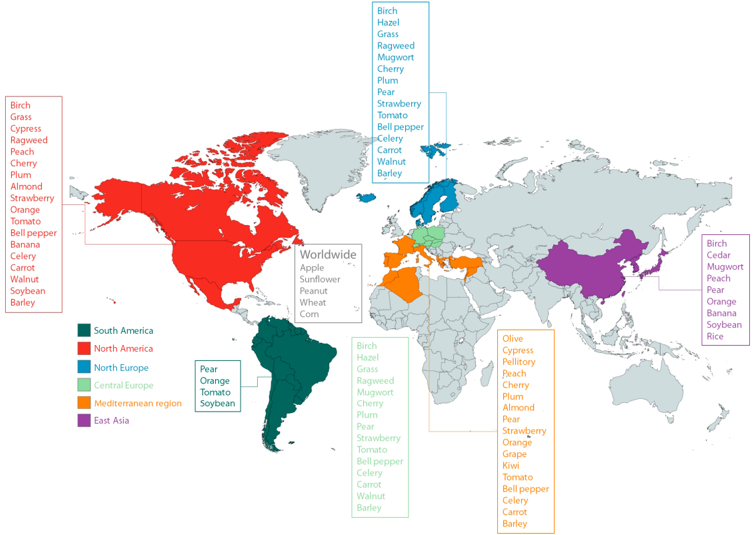
- Regional pollen-food patterns are driven by specific panallergens: birch PR-10 (Bet v 1) dominates in Northern/Central Europe, where birch sensitization affects 8–16% of the general population and PR-10-mediated PFAS may affect >75% of birch-allergic patients; LTPs such as Pru p 3 are major in Mediterranean regions, with up to 30% sensitization; profilin-related PFAS can affect up to 30% of profilin-sensitized patients; a Japanese study found 65% of fruit-allergic patients sensitized to GRPs.
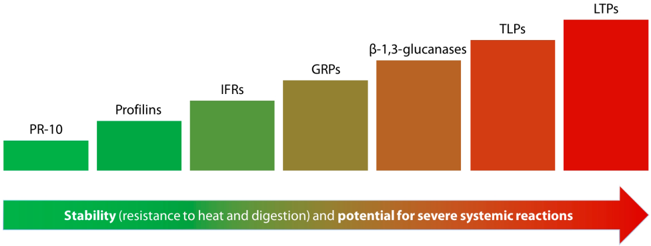
- Protein stability shapes severity: labile PR-10 proteins and profilins usually cause localized oral symptoms that resolve with cooking, while stable LTPs, GRPs, and TLPs can trigger systemic reactions even after cooking.
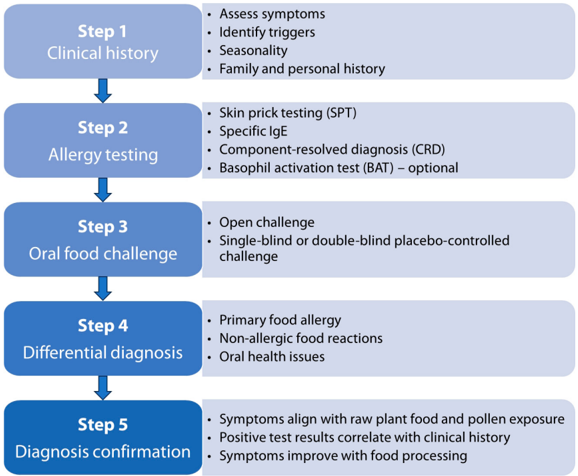
- Diagnosis combines history, skin prick testing (including prick-to-prick with fresh foods), specific IgE, component-resolved diagnostics (ImmunoCAP, ISAC, ALEX), basophil activation test, and oral food challenge; management centers on selective avoidance, antihistamines, corticosteroids, epinephrine for at-risk patients, and allergen immunotherapy.
Methods
- Narrative review; no primary data collection, systematic search strategy, or meta-analysis is described.
- Synthesizes published literature on PFAS pathophysiology, epidemiology, protein families, diagnosis, and management; Table 1 and Figure 3 draw on the WHO/IUIS Allergen Nomenclature Database and the Global Biodiversity Information Facility.
- Main analysis is qualitative synthesis across clinical, molecular, and therapeutic topics, with diagnostic and management comparisons presented in tables and figures.
Limitations
- The paper states that precise global PFAS prevalence is difficult to determine due to geographic variability, small study sizes, methodological differences, and population differences; PFAS remains underdiagnosed and underreported, especially where advanced diagnostics are limited.
- The paper notes diagnostic limitations: commercial food extracts may lack heat-labile proteins and cause false negatives on SPT; BAT requires specialized equipment, has 10–15% nonresponders, depends on fresh blood, and lacks full standardization; OFC is resource-intensive and carries some risk of unexpected systemic reactions.
- Evident from the text: as a narrative review without a described systematic search or quality appraisal, it may be subject to selection bias and cannot provide primary estimates of prevalence, diagnostic accuracy, or treatment effect.
Model-written summary. Check it against the paper before relying on it.
Integrity signals
Registry
Cites
Statistics
Figures
Verification
Claims the paper makes
180 Check pending · 74 Own interpretation · 49 No full text of the sources · 33 Not checked yet · 6 No basis given
In the paper
“Similarly, exercise can amplify the severity of allergic reactions by increasing gastrointestinal permeability and altering blood flow dynamics, particularly to the digestive system.”
§ Pollen-Food Allergy Syndrome: Allergens, Clinical Insights, Diagnostic and Therapeutic Challenges > 4. PFAS Pathogenesis
What the sources say
- Check pendingcites [35] Shin, 2021, Food Allergies and Food-Induced Anaphylaxis: Role of Cofactors, Clin. Exp. Pediatr. source
plainstates a cause- Asserted: passes — The authors put it forward as true.
- Checkable: passes — It can be checked against evidence.
- Load-bearing: unclear — It is unclear whether the paper’s conclusions depend on it.
- Based: passes — The paper gives a reason why it holds.
A conclusion the paper draws from its own results — it cites no other source for it, so there is none to check. The quote shows it is in the paper.
In the paper
“PFAS is more frequently observed in regions where certain pollens, such as birch, ragweed, or grass pollens, are highly prevalent.”
§ Pollen-Food Allergy Syndrome: Allergens, Clinical Insights, Diagnostic and Therapeutic Challenges > 3. PFAS Epidemiology
plainstates an association- Asserted: passes — The authors put it forward as true.
- Checkable: passes — It can be checked against evidence.
- Load-bearing: unclear — It is unclear whether the paper’s conclusions depend on it.
- Based: passes — The paper gives a reason why it holds.
A claim is checked only against the cited paper’s full text, never its abstract, and none is available for its sources.
In the paper
“For example, birch pollen-related PFAS is more common in Northern and Central Europe [31,47].”
§ Pollen-Food Allergy Syndrome: Allergens, Clinical Insights, Diagnostic and Therapeutic Challenges > 3. PFAS Epidemiology
What the sources say
- Not checked — no full text of the sourcecites [31] Kato, Y., Morikawa, T., and Fujieda, S. (2024). Comprehensive Review of Pollen-Food Allergy Syndrome: Pathogenesis, Epidemiology, and Treatment Approaches. Allergol. Int. source
- Not checked — no full text of the sourcecites [47] Biedermann, 2019, Birch Pollen Allergy in Europe, Allergy source
plainstates an association- Asserted: passes — The authors put it forward as true.
- Checkable: passes — It can be checked against evidence.
- Load-bearing: unclear — It is unclear whether the paper’s conclusions depend on it.
- Based: passes — The paper gives a reason why it holds.
In the paper
“Individuals with disrupted microbial diversity or dysbiosis may exhibit heightened allergic reactions due to altered immune regulation.”
§ Pollen-Food Allergy Syndrome: Allergens, Clinical Insights, Diagnostic and Therapeutic Challenges > 4. PFAS Pathogenesis
What the sources say
- Not checked yetcites [75] Silva, Y.P., Bernardi, A., and Frozza, R.L. (2020). The Role of Short-Chain Fatty Acids From Gut Microbiota in Gut-Brain Communication. Front. Endocrinol., 11. source
- Check pendingcites [76] Huang, 2023, Short-Chain Fatty Acids Ameliorate Allergic Airway Inflammation via Sequential Induction of PMN-MDSCs and Treg Cells, J. Allergy Clin. Immunol. Glob. source
hedgedstates a possible cause- Asserted: passes — The authors put it forward as true.
- Checkable: passes — It can be checked against evidence.
- Load-bearing: unclear — It is unclear whether the paper’s conclusions depend on it.
- Based: passes — The paper gives a reason why it holds.
In the paper
“Alcohol, for example, is known to affect the permeability of the gastrointestinal lining, allowing allergens to cross into the bloodstream more readily [80].”
§ Pollen-Food Allergy Syndrome: Allergens, Clinical Insights, Diagnostic and Therapeutic Challenges > 4. PFAS Pathogenesis
What the sources say
- Not checked — no full text of the sourcecites [80] Samadi, 2018, The Role of Gastrointestinal Permeability in Food Allergy, Ann. Allergy Asthma Immunol. source
boostedstates a cause- Asserted: passes — The authors put it forward as true.
- Checkable: passes — It can be checked against evidence.
- Load-bearing: unclear — It is unclear whether the paper’s conclusions depend on it.
- Based: passes — The paper gives a reason why it holds.
In the paper
“They are primarily responsible for localized allergic reactions, which typically manifest as itching or swelling in the mouth and throat after consuming raw plant-based foods.”
§ Pollen-Food Allergy Syndrome: Allergens, Clinical Insights, Diagnostic and Therapeutic Challenges > 2. Food Allergens
What the sources say
- Check pendingcites [42] Popescu, 2015, Cross-Reactivity between Aeroallergens and Food Allergens, World J. Methodol. source
plainstates a cause- Asserted: passes — The authors put it forward as true.
- Checkable: passes — It can be checked against evidence.
- Load-bearing: passes — The paper’s conclusions depend on it.
- Based: passes — The paper gives a reason why it holds.
In the paper
“In contrast, ragweed pollen-related PFAS is more dominant in North America, Central and Eastern Europe, and Japan [49].”
§ Pollen-Food Allergy Syndrome: Allergens, Clinical Insights, Diagnostic and Therapeutic Challenges > 3. PFAS Epidemiology
What the sources say
- Check pendingcites [49] Hwang, 2022, Relationship among Airborne Pollen, Sensitization, and Pollen Food Allergy Syndrome in Asian Allergic Children, PeerJ source
plainstates an association- Asserted: passes — The authors put it forward as true.
- Checkable: passes — It can be checked against evidence.
- Load-bearing: unclear — It is unclear whether the paper’s conclusions depend on it.
- Based: passes — The paper gives a reason why it holds.
In the paper
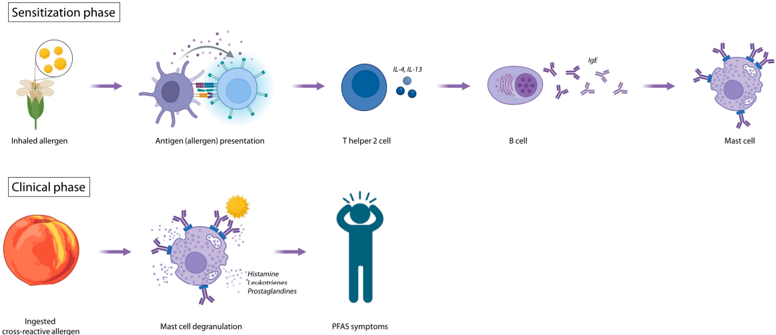
“This syndrome arises from immunological cross-reactivity between pollen allergens and structurally similar proteins found in various fruits, vegetables, and nuts.”
§ Pollen-Food Allergy Syndrome: Allergens, Clinical Insights, Diagnostic and Therapeutic Challenges > Abstract
What the sources say
- Not checked — no full text of the sourcecites [31] Kato, Y., Morikawa, T., and Fujieda, S. (2024). Comprehensive Review of Pollen-Food Allergy Syndrome: Pathogenesis, Epidemiology, and Treatment Approaches. Allergol. Int. source
plainstates a cause- Asserted: passes — The authors put it forward as true.
- Checkable: passes — It can be checked against evidence.
- Load-bearing: passes — The paper’s conclusions depend on it.
- Based: passes — The paper gives a reason why it holds.
In the paper
“One critical factor is the concentration of the allergen in the food, as higher levels of allergenic proteins are more likely to elicit a stronger immune response.”
§ Pollen-Food Allergy Syndrome: Allergens, Clinical Insights, Diagnostic and Therapeutic Challenges > 4. PFAS Pathogenesis
What the sources say
- Check pendingcites [78] Dubois, 2018, How Does Dose Impact on the Severity of Food-Induced Allergic Reactions, and Can This Improve Risk Assessment for Allergenic Foods?: Report from an ILSI Europe Food Allergy Task Force Expert Group and Workshop, Allergy source
hedgedstates a cause- Asserted: passes — The authors put it forward as true.
- Checkable: passes — It can be checked against evidence.
- Load-bearing: unclear — It is unclear whether the paper’s conclusions depend on it.
- Based: passes — The paper gives a reason why it holds.
In the paper
“PFAS tends to be more prevalent in adults and adolescents than in young children [60]”
§ Pollen-Food Allergy Syndrome: Allergens, Clinical Insights, Diagnostic and Therapeutic Challenges > 3. PFAS Epidemiology
What the sources say
- Check pendingcites [60] Sicherer, 2020, Food Allergy from Infancy Through Adulthood, J. Allergy Clin. Immunol. Pract. source
hedgedstates an association- Asserted: passes — The authors put it forward as true.
- Checkable: passes — It can be checked against evidence.
- Load-bearing: unclear — It is unclear whether the paper’s conclusions depend on it.
- Based: passes — The paper gives a reason why it holds.
- It may state two separate claims as one. 93
- Probably not a substantial claim. 60
In the paper
“Heat treatment, for instance, can denature some proteins, reducing their allergenic potential, while others, like profilins, are highly heat-labile and lose their IgE-binding capacity when cooked [74].”
§ Pollen-Food Allergy Syndrome: Allergens, Clinical Insights, Diagnostic and Therapeutic Challenges > 4. PFAS Pathogenesis
What the sources say
- Check pendingcites [74] Verhoeckx, 2015, Food Processing and Allergenicity, Food Chem. Toxicol. source
plainstates a cause- Asserted: passes — The authors put it forward as true.
- Checkable: passes — It can be checked against evidence.
- Load-bearing: unclear — It is unclear whether the paper’s conclusions depend on it.
- Based: passes — The paper gives a reason why it holds.
It may state two separate claims as one.
In the paper
“PFAS has been shown to disproportionately affect urban populations, likely due to increased exposure to airborne allergens and reduced microbial diversity associated with urban living [28].”
§ Pollen-Food Allergy Syndrome: Allergens, Clinical Insights, Diagnostic and Therapeutic Challenges > 3. PFAS Epidemiology
What the sources say
- Check pendingcites [28] Wong, G.W.-K. (2024). Food Allergies around the World. Front. Nutr., 11. source
hedgedstates a possible cause- Asserted: passes — The authors put it forward as true.
- Checkable: passes — It can be checked against evidence.
- Load-bearing: unclear — It is unclear whether the paper’s conclusions depend on it.
- Based: passes — The paper gives a reason why it holds.
It may state two separate claims as one.
In the paper
“While precise global prevalence rates for PFAS are difficult to determine due to geographical variability, it is estimated to affect 5-8% of the general population and up to 50-70% of individuals with pollen sensitization [33,44,45].”
§ Pollen-Food Allergy Syndrome: Allergens, Clinical Insights, Diagnostic and Therapeutic Challenges > 3. PFAS Epidemiology
What the sources say
- Check pendingcites [33] Carlson, 2019, Pollen Food Allergy Syndrome (PFAS): A Review of Current Available Literature, Ann. Allergy Asthma Immunol. source
- Not checked — no full text of the sourcecites [44] Poncet, 2020, Update on Pollen-Food Allergy Syndrome, Expert Rev. Clin. Immunol. source
- Not checked yetcites [45] Karakaya, 2023, Prevalence and Clinical Features of Pollen-Food Allergy Syndrome in Adults with Seasonal Allergic Rhinitis, Eur. Rev. Med. Pharmacol. Sci.
hedgedstates an association- Asserted: passes — The authors put it forward as true.
- Checkable: passes — It can be checked against evidence.
- Load-bearing: fails — The paper’s conclusions may not depend on it.
- Based: passes — The paper gives a reason why it holds.
Probably not a substantial claim. The paper’s conclusions may not depend on it. It may state two separate claims as one.
In the paper
“The labile nature of class II allergens means that they generally lose their allergenicity when foods are cooked or processed, reducing the risk of severe systemic reactions in most cases [42].”
§ Pollen-Food Allergy Syndrome: Allergens, Clinical Insights, Diagnostic and Therapeutic Challenges > 2. Food Allergens
What the sources say
- Check pendingcites [42] Popescu, 2015, Cross-Reactivity between Aeroallergens and Food Allergens, World J. Methodol. source
plainstates a cause- Asserted: passes — The authors put it forward as true.
- Checkable: passes — It can be checked against evidence.
- Load-bearing: unclear — It is unclear whether the paper’s conclusions depend on it.
- Based: passes — The paper gives a reason why it holds.
It may state two separate claims as one.
In the paper
“Birch pollen contains the major allergen Bet v 1, a PR-10 protein known for its strong crossreactivity with homologous proteins in many plant-based foods, such as apples, pears, cherries, carrots, and celery [48].”
§ Pollen-Food Allergy Syndrome: Allergens, Clinical Insights, Diagnostic and Therapeutic Challenges > 3. PFAS Epidemiology
What the sources say
- Check pendingcites [48] Breiteneder, H., and Kraft, D. (2023). The History and Science of the Major Birch Pollen Allergen Bet v 1. Biomolecules, 13. source
boostedstates an association- Asserted: passes — The authors put it forward as true.
- Checkable: passes — It can be checked against evidence.
- Load-bearing: unclear — It is unclear whether the paper’s conclusions depend on it.
- Based: passes — The paper gives a reason why it holds.
It may state two separate claims as one.
In the paper
“These allergens are capable of sensitizing individuals through the gastrointestinal tract and are often associated with systemic and severe allergic reactions, including anaphylaxis.”
§ Pollen-Food Allergy Syndrome: Allergens, Clinical Insights, Diagnostic and Therapeutic Challenges > 2. Food Allergens
What the sources say
- Check pendingcites [41] Koidl, 2023, Allergen Stability in Food Allergy: A Clinician’s Perspective, Curr. Allergy Asthma Rep. source
plainstates an association- Asserted: passes — The authors put it forward as true.
- Checkable: passes — It can be checked against evidence.
- Load-bearing: unclear — It is unclear whether the paper’s conclusions depend on it.
- Based: passes — The paper gives a reason why it holds.
It may state two separate claims as one.
In the paper
“The allergen Gly m 4, a PR-10 protein in soy, cross-reacts with birch and other pollens, making soy a frequent cause of PFAS in these regions.”
§ Pollen-Food Allergy Syndrome: Allergens, Clinical Insights, Diagnostic and Therapeutic Challenges > 3. PFAS Epidemiology
What the sources say
- Check pendingcites [56] Sasaki, 2020, The Prevalence of Oral Symptoms Caused by Rosaceae Fruits and Soybean Consumption in Children; a Japanese Population-Based Survey, Allergol. Int. source
plainstates a cause- Asserted: passes — The authors put it forward as true.
- Checkable: passes — It can be checked against evidence.
- Load-bearing: unclear — It is unclear whether the paper’s conclusions depend on it.
- Based: passes — The paper gives a reason why it holds.
It may state two separate claims as one.
In the paper
“In Mediterranean countries, LTPs play a significant role in PFAS, with peaches (which contain the Pru p 3 LTP) being a major trigger, alongside other fruits like apricots, plums, and nectarines, which are staples of the local diet [54,55].”
§ Pollen-Food Allergy Syndrome: Allergens, Clinical Insights, Diagnostic and Therapeutic Challenges > 3. PFAS Epidemiology
What the sources say
- Check pendingcites [54] Barni, S., Caimmi, D., Chiera, F., Comberiati, P., Mastrorilli, C., Pelosi, U., Paravati, F., Marseglia, G.L., and Arasi, S. (2022). Phenotypes and Endotypes of Peach Allergy: What Is New?. Nutrients, 14. source
- Check pendingcites [55] Krikeerati, T., Rodsaward, P., Nawiboonwong, J., Pinyopornpanish, K., Phusawang, S., and Sompornrattanaphan, M. (2023). Revisiting Fruit Allergy: Prevalence across the Globe, Diagnosis, and Current Management. Foods, 12. source
plainstates an association- Asserted: passes — The authors put it forward as true.
- Checkable: passes — It can be checked against evidence.
- Load-bearing: unclear — It is unclear whether the paper’s conclusions depend on it.
- Based: passes — The paper gives a reason why it holds.
It may state two separate claims as one.
In the paper
“In contrast, class II allergens are heat-and digestion-labile proteins that are often homologous to pollen allergens.”
§ Pollen-Food Allergy Syndrome: Allergens, Clinical Insights, Diagnostic and Therapeutic Challenges > 2. Food Allergens
What the sources say
- Check pendingcites [42] Popescu, 2015, Cross-Reactivity between Aeroallergens and Food Allergens, World J. Methodol. source
plainstates an association- Asserted: passes — The authors put it forward as true.
- Checkable: passes — It can be checked against evidence.
- Load-bearing: passes — The paper’s conclusions depend on it.
- Based: passes — The paper gives a reason why it holds.
It may state two separate claims as one.
In the paper
“NSAIDs, by inhibiting prostaglandin synthesis, can enhance mast cell degranulation and reduce the body's ability to counteract inflammatory responses [82].”
§ Pollen-Food Allergy Syndrome: Allergens, Clinical Insights, Diagnostic and Therapeutic Challenges > 4. PFAS Pathogenesis
What the sources say
- Not checked — no full text of the sourcecites [82] Cardona, 2012, Co-Factor-Enhanced Food Allergy, Allergy source
plainstates a cause- Asserted: passes — The authors put it forward as true.
- Checkable: passes — It can be checked against evidence.
- Load-bearing: unclear — It is unclear whether the paper’s conclusions depend on it.
- Based: passes — The paper gives a reason why it holds.
It may state two separate claims as one.
In the paper
“Although typically presenting with mild oral and pharyngeal symptoms, PFAS can occasionally result in severe allergic reactions, underscoring its clinical significance.”
§ Pollen-Food Allergy Syndrome: Allergens, Clinical Insights, Diagnostic and Therapeutic Challenges > Abstract
What the sources say
- Check pendingcites [33] Carlson, 2019, Pollen Food Allergy Syndrome (PFAS): A Review of Current Available Literature, Ann. Allergy Asthma Immunol. source
plain- Asserted: passes — The authors put it forward as true.
- Checkable: passes — It can be checked against evidence.
- Load-bearing: unclear — It is unclear whether the paper’s conclusions depend on it.
- Based: passes — The paper gives a reason why it holds.
It may state two separate claims as one.
In the paper
“In Mexico, pineapples are a notable PFAS trigger, likely related to the local dietary prominence of this fruit and its cross-reactivity with pollens such as oak and ash [57].”
§ Pollen-Food Allergy Syndrome: Allergens, Clinical Insights, Diagnostic and Therapeutic Challenges > 3. PFAS Epidemiology
What the sources say
- Check pendingcites [57] Mastrorilli, C., Cardinale, F., Giannetti, A., and Caffarelli, C. (2019). Pollen-Food Allergy Syndrome: A Not so Rare Disease in Childhood. Medicina, 55. source
hedgedstates a possible cause- Asserted: passes — The authors put it forward as true.
- Checkable: passes — It can be checked against evidence.
- Load-bearing: unclear — It is unclear whether the paper’s conclusions depend on it.
- Based: passes — The paper gives a reason why it holds.
It may state two separate claims as one.
In the paper
“Class I allergens are typically heat-and digestion-stable proteins found in foods such as nuts, shellfish, and eggs.”
§ Pollen-Food Allergy Syndrome: Allergens, Clinical Insights, Diagnostic and Therapeutic Challenges > 2. Food Allergens
What the sources say
plain- Asserted: passes — The authors put it forward as true.
- Checkable: passes — It can be checked against evidence.
- Load-bearing: fails — The paper’s conclusions may not depend on it.
- Based: passes — The paper gives a reason why it holds.
Probably not a substantial claim. The paper’s conclusions may not depend on it.
In the paper
“Although most cases involve mild symptoms localized to the oral cavity, severe systemic reactions, including anaphylaxis, are reported in a small but significant subset of patients [62,63], underscoring the importance of early diagnosis and management.”
§ Pollen-Food Allergy Syndrome: Allergens, Clinical Insights, Diagnostic and Therapeutic Challenges > 3. PFAS Epidemiology
What the sources say
- Not checked — no full text of the sourcecites [62] Skypala, 2020, Can Patients with Oral Allergy Syndrome Be at Risk of Anaphylaxis?, Curr. Opin. Allergy Clin. Immunol. source
- Check pendingcites [63] Kim, 2019, Clinical Manifestations and Risk Factors of Anaphylaxis in Pollen-Food Allergy Syndrome, Yonsei Med. J. source
plain- Asserted: passes — The authors put it forward as true.
- Checkable: passes — It can be checked against evidence.
- Load-bearing: passes — The paper’s conclusions depend on it.
- Based: passes — The paper gives a reason why it holds.
It may state two separate claims as one.
A statement the paper makes itself — it cites no source for it, so there is none to check. The quote shows it is in the paper.
In the paper
“LTPs are a family of small (9-10 kDa), highly stable proteins, part of the prolamin superfamily, and involved in plant defense and lipid transport.”
§ Pollen-Food Allergy Syndrome: Allergens, Clinical Insights, Diagnostic and Therapeutic Challenges > 6.3. Lipid Transfer Proteins (LTPs)
plain- Asserted: passes — The authors put it forward as true.
- Checkable: passes — It can be checked against evidence.
- Load-bearing: passes — The paper’s conclusions depend on it.
- Based: passes — The paper gives a reason why it holds.
Probably not a substantial claim. It may state two separate claims as one.
In the paper
“Laryngospasm and dysphonia are less common but can occur when swelling affects the laryngeal structures [33].”
§ Pollen-Food Allergy Syndrome: Allergens, Clinical Insights, Diagnostic and Therapeutic Challenges > 5. PFAS Symptoms and Effect on Quality of Life
What the sources say
- Check pendingcites [33] Carlson, 2019, Pollen Food Allergy Syndrome (PFAS): A Review of Current Available Literature, Ann. Allergy Asthma Immunol. source
plainstates a possible cause- Asserted: passes — The authors put it forward as true.
- Checkable: passes — It can be checked against evidence.
- Load-bearing: unclear — It is unclear whether the paper’s conclusions depend on it.
- Based: passes — The paper gives a reason why it holds.
It may state two separate claims as one.
In the paper
“These proteins are part of the pathogenesis-related protein class 10 family, which plays a defensive role in plants, helping them respond to environmental stressors such as pathogens, pests, and physical damage [123-125].”
§ Pollen-Food Allergy Syndrome: Allergens, Clinical Insights, Diagnostic and Therapeutic Challenges > 6.1. Pathogenesis-Related Protein Group 10 (PR-10 Proteins)
What the sources say
- Not checked — no full text of the sourcecites [123] Islam, 2023, Pathogenesis-Related Proteins (PRs) Countering Environmental Stress in Plants: A Review, S. Afr. J. Bot. source
- Not checked — no full text of the sourcecites [124] Zribi, 2021, Pathogenesis Related Proteins (PRs): From Cellular Mechanisms to Plant Defense, Curr. Protein Pept. Sci. source
- Check pendingcites [125] Dos Santos, C., and Franco, O.L. (2023). Pathogenesis-Related Proteins (PRs) with Enzyme Activity Activating Plant Defense Responses. Plants, 12. source
plainstates a cause- Asserted: passes — The authors put it forward as true.
- Checkable: passes — It can be checked against evidence.
- Load-bearing: fails — The paper’s conclusions may not depend on it.
- Based: passes — The paper gives a reason why it holds.
Probably not a substantial claim. The paper’s conclusions may not depend on it.
In the paper
“These more serious presentations are often linked to heat-stable allergens, such as those found in nuts, LTPs, and GRPs, or when cofactors like NSAIDs or physical activity lower the reaction threshold [54,94,96].”
§ Pollen-Food Allergy Syndrome: Allergens, Clinical Insights, Diagnostic and Therapeutic Challenges > 5. PFAS Symptoms and Effect on Quality of Life
What the sources say
- Check pendingcites [54] Barni, S., Caimmi, D., Chiera, F., Comberiati, P., Mastrorilli, C., Pelosi, U., Paravati, F., Marseglia, G.L., and Arasi, S. (2022). Phenotypes and Endotypes of Peach Allergy: What Is New?. Nutrients, 14. source
- Check pendingcites [94] Varshney, 2020, Clinical Manifestations of Immunoglobulin E-Mediated Food Allergy, Including Pollen-Food Allergy Syndrome, J. Food Allergy source
- Not checked yetcites [96] Lloyd, 2022, Pollen-Food Allergy Syndrome (PFAS), Curr. Allergy Clin. Immunol.
plainstates an association- Asserted: passes — The authors put it forward as true.
- Checkable: passes — It can be checked against evidence.
- Load-bearing: unclear — It is unclear whether the paper’s conclusions depend on it.
- Based: passes — The paper gives a reason why it holds.
It may state two separate claims as one.
In the paper
“PR-10 proteins are characterized by their small molecular size (17-18 kDa) and structural features, including a hydrophobic cavity that binds small ligands [128,129].”
§ Pollen-Food Allergy Syndrome: Allergens, Clinical Insights, Diagnostic and Therapeutic Challenges > 6.1. Pathogenesis-Related Protein Group 10 (PR-10 Proteins)
What the sources say
- Check pendingcites [128] Aglas, 2020, Ligand Binding of PR-10 Proteins with a Particular Focus on the Bet v 1 Allergen Family, Curr. Allergy Asthma Rep. source
- Check pendingcites [129] Führer, S., Unterhauser, J., Zeindl, R., Eidelpes, R., Fernández-Quintero, M.L., Liedl, K.R., and Tollinger, M. (2022). The Structural Flexibility of PR-10 Food Allergens. Int. J. Mol. Sci., 23. source
plain- Asserted: passes — The authors put it forward as true.
- Checkable: passes — It can be checked against evidence.
- Load-bearing: passes — The paper’s conclusions depend on it.
- Based: passes — The paper gives a reason why it holds.
It may state two separate claims as one.
A statement the paper makes itself — it cites no source for it, so there is none to check. The quote shows it is in the paper.
In the paper
“Although PFAS symptoms are generally mild and self-limiting, they can significantly impact the quality of life for affected individuals.”
§ Pollen-Food Allergy Syndrome: Allergens, Clinical Insights, Diagnostic and Therapeutic Challenges > 5. PFAS Symptoms and Effect on Quality of Life
plainstates a cause- Asserted: passes — The authors put it forward as true.
- Checkable: passes — It can be checked against evidence.
- Load-bearing: unclear — It is unclear whether the paper’s conclusions depend on it.
- Based: passes — The paper gives a reason why it holds.
It may state two separate claims as one.
In the paper
“PFAS symptoms typically appear within minutes of consuming fresh fruits, vegetables, nuts, legumes, or seeds and range from mild, localized reactions to rare but potentially severe systemic manifestations [44].”
§ Pollen-Food Allergy Syndrome: Allergens, Clinical Insights, Diagnostic and Therapeutic Challenges > 5. PFAS Symptoms and Effect on Quality of Life
What the sources say
- Not checked — no full text of the sourcecites [44] Poncet, 2020, Update on Pollen-Food Allergy Syndrome, Expert Rev. Clin. Immunol. source
plainstates a cause- Asserted: passes — The authors put it forward as true.
- Checkable: passes — It can be checked against evidence.
- Load-bearing: unclear — It is unclear whether the paper’s conclusions depend on it.
- Based: passes — The paper gives a reason why it holds.
It may state two separate claims as one.
In the paper
“In Mediterranean countries, LTPs are the most significant cause of food allergies and PFAS, with a high prevalence (up to 30%) of sensitization to Pru p 3, the peach LTP that serves as the archetype of this allergen family [54,143,146,147].”
§ Pollen-Food Allergy Syndrome: Allergens, Clinical Insights, Diagnostic and Therapeutic Challenges > 6.3. Lipid Transfer Proteins (LTPs)
What the sources say
- Check pendingcites [54] Barni, S., Caimmi, D., Chiera, F., Comberiati, P., Mastrorilli, C., Pelosi, U., Paravati, F., Marseglia, G.L., and Arasi, S. (2022). Phenotypes and Endotypes of Peach Allergy: What Is New?. Nutrients, 14. source
- Check pendingcites [143] D’Aiuto, V., Mormile, I., Granata, F., Napolitano, F., Lamagna, L., Della Casa, F., de Paulis, A., and Rossi, F.W. (2024). Worldwide Heterogeneity of Food Allergy: Focus on Peach Allergy in Southern Italy. J. Clin. Med., 13. source
- Check pendingcites [146] Lyons, 2019, Food Allergy in Adults: Substantial Variation in Prevalence and Causative Foods Across Europe, J. Allergy Clin. Immunol. Pract. source
- Not checked — no full text of the sourcecites [147] Aruanno, 2020, LTP Allergy/Sensitization in a Pediatric Population, Allergol. Immunopathol. source
plainstates a cause- Asserted: passes — The authors put it forward as true.
- Checkable: passes — It can be checked against evidence.
- Load-bearing: unclear — It is unclear whether the paper’s conclusions depend on it.
- Based: passes — The paper gives a reason why it holds.
It may state two separate claims as one.
In the paper
“Profilins are a family of small proteins, typically 12-15 kDa in size, with a highly conserved three-dimensional structure [131].”
§ Pollen-Food Allergy Syndrome: Allergens, Clinical Insights, Diagnostic and Therapeutic Challenges > 6.2. Profilins
What the sources say
- Check pendingcites [131] Kapingidza, 2019, Comparative Structural and Thermal Stability Studies of Cuc m 2.0101, Art v 4.0101 and Other Allergenic Profilins, Mol. Immunol. source
plain- Asserted: passes — The authors put it forward as true.
- Checkable: passes — It can be checked against evidence.
- Load-bearing: unclear — It is unclear whether the paper’s conclusions depend on it.
- Based: passes — The paper gives a reason why it holds.
It may state two separate claims as one.
In the paper
“Sensitization to birch pollen affects approximately 8% to 16% of the general population in Europe, with higher rates reported in countries with dense birch forests, such as Scandinavia and parts of Central Europe [126], but also China [127].”
§ Pollen-Food Allergy Syndrome: Allergens, Clinical Insights, Diagnostic and Therapeutic Challenges > 6.1. Pathogenesis-Related Protein Group 10 (PR-10 Proteins)
What the sources say
- Not checked — no full text of the sourcecites [126] Li, 2022, Birch Pollen Allergens, Curr. Protein Pept. Sci. source
- Check pendingcites [127] Wang, 2023, Profiles of Birch Allergen Component Sensitization and Its Association with Pollen Food Allergy Syndrome in Northern China, J. Asthma Allergy source
plainstates an association- Asserted: passes — The authors put it forward as true.
- Checkable: passes — It can be checked against evidence.
- Load-bearing: fails — The paper’s conclusions may not depend on it.
- Based: passes — The paper gives a reason why it holds.
Probably not a substantial claim. The paper’s conclusions may not depend on it. It may state two separate claims as one.
In the paper
“While PFAS predominantly affects the oropharynx, it can occasionally extend to other systems.”
§ Pollen-Food Allergy Syndrome: Allergens, Clinical Insights, Diagnostic and Therapeutic Challenges > 5. PFAS Symptoms and Effect on Quality of Life
What the sources say
- Check pendingcites [94] Varshney, 2020, Clinical Manifestations of Immunoglobulin E-Mediated Food Allergy, Including Pollen-Food Allergy Syndrome, J. Food Allergy source
plain- Asserted: passes — The authors put it forward as true.
- Checkable: passes — It can be checked against evidence.
- Load-bearing: unclear — It is unclear whether the paper’s conclusions depend on it.
- Based: passes — The paper gives a reason why it holds.
It may state two separate claims as one.
In the paper
“These proteins are regulated by gibberellins, a class of plant hormones involved in growth and development [155].”
§ Pollen-Food Allergy Syndrome: Allergens, Clinical Insights, Diagnostic and Therapeutic Challenges > 6.4. Gibberellin-Regulated Proteins (GRPs)
What the sources say
- Check pendingcites [155] Ritonga, F.N., Zhou, D., Zhang, Y., Song, R., Li, C., Li, J., and Gao, J. (2023). The Roles of Gibberellins in Regulating Leaf Development. Plants, 12. source
plainstates a cause- Asserted: passes — The authors put it forward as true.
- Checkable: passes — It can be checked against evidence.
- Load-bearing: fails — The paper’s conclusions may not depend on it.
- Based: passes — The paper gives a reason why it holds.
Probably not a substantial claim. The paper’s conclusions may not depend on it.
In the paper
“They interact with actin monomers (G-actin) and polyproline sequences, regulating the assembly of actin filaments [132].”
§ Pollen-Food Allergy Syndrome: Allergens, Clinical Insights, Diagnostic and Therapeutic Challenges > 6.2. Profilins
What the sources say
- Check pendingcites [132] García-Ramírez, B., Mares-Mejía, I., Rodríguez-Hernández, A., Cano-Sánchez, P., Torres-Larios, A., Ortega, E., and Rodríguez-Romero, A. (2022). A Native IgE in Complex with Profilin Provides Insights into Allergen Recognition and Cross-Reactivity. Commun. Biol., 5. source
plainstates a cause- Asserted: passes — The authors put it forward as true.
- Checkable: passes — It can be checked against evidence.
- Load-bearing: fails — The paper’s conclusions may not depend on it.
- Based: passes — The paper gives a reason why it holds.
Probably not a substantial claim. The paper’s conclusions may not depend on it.
In the paper
“Nuts are another major source of LTP allergens, with hazelnut (Cor a 8) and walnut (Jug r 3) often associated with systemic reactions due to their heat-stable properties [142].”
§ Pollen-Food Allergy Syndrome: Allergens, Clinical Insights, Diagnostic and Therapeutic Challenges > 6.3. Lipid Transfer Proteins (LTPs)
What the sources say
- Check pendingcites [142] Deng, 2019, Mugwort Pollen-Related Food Allergy: Lipid Transfer Protein Sensitization and Correlation with the Severity of Allergic Reactions in a Chinese Population, Allergy Asthma Immunol. Res. source
plainstates an association- Asserted: passes — The authors put it forward as true.
- Checkable: passes — It can be checked against evidence.
- Load-bearing: unclear — It is unclear whether the paper’s conclusions depend on it.
- Based: passes — The paper gives a reason why it holds.
It may state two separate claims as one.
In the paper
“Fear of reactions may lead to the avoidance of specific foods, potentially resulting in nutritional deficiencies or a restricted diet [58].”
§ Pollen-Food Allergy Syndrome: Allergens, Clinical Insights, Diagnostic and Therapeutic Challenges > 5. PFAS Symptoms and Effect on Quality of Life
What the sources say
- Check pendingcites [58] Gargano, D., Appanna, R., Santonicola, A., De Bartolomeis, F., Stellato, C., Cianferoni, A., Casolaro, V., and Iovino, P. (2021). Food Allergy and Intolerance: A Narrative Review on Nutritional Concerns. Nutrients, 13. source
hedgedstates a possible cause- Asserted: passes — The authors put it forward as true.
- Checkable: passes — It can be checked against evidence.
- Load-bearing: unclear — It is unclear whether the paper’s conclusions depend on it.
- Based: passes — The paper gives a reason why it holds.
It may state two separate claims as one.
A conclusion the paper draws from its own results — it cites no other source for it, so there is none to check. The quote shows it is in the paper.
In the paper
“Unlike other panallergens such as PR-10 proteins or profilins, this stability allows LTPs to retain their allergenic properties even after cooking or digestion, significantly increasing their potential to cause severe allergic reactions.”
§ Pollen-Food Allergy Syndrome: Allergens, Clinical Insights, Diagnostic and Therapeutic Challenges > 6.3. Lipid Transfer Proteins (LTPs)
plainstates a cause- Asserted: passes — The authors put it forward as true.
- Checkable: passes — It can be checked against evidence.
- Load-bearing: passes — The paper’s conclusions depend on it.
- Based: passes — The paper gives a reason why it holds.
It may state two separate claims as one.
In the paper
“These symptoms are more likely when larger quantities of the triggering food are consumed or when cofactors such as exercise or alcohol are present, which can amplify the allergic response [95].”
§ Pollen-Food Allergy Syndrome: Allergens, Clinical Insights, Diagnostic and Therapeutic Challenges > 5. PFAS Symptoms and Effect on Quality of Life
What the sources say
- Check pendingcites [95] Kanikowska, A., Janisz, S., Mańkowska-Wierzbicka, D., Gabryel, M., Dobrowolska, A., and Eder, P. (2022). Management of Adult Patients with Gastrointestinal Symptoms from Food Hypersensitivity—Narrative Review. J. Clin. Med., 11. source
hedgedstates a possible cause- Asserted: passes — The authors put it forward as true.
- Checkable: passes — It can be checked against evidence.
- Load-bearing: unclear — It is unclear whether the paper’s conclusions depend on it.
- Based: passes — The paper gives a reason why it holds.
It may state two separate claims as one.
A conclusion the paper draws from its own results — it cites no other source for it, so there is none to check. The quote shows it is in the paper.
In the paper
“The allergens involved in PFAS are typically labile, losing their allergenicity with heat or enzymatic digestion, which explains the mild symptoms in most cases.”
§ Pollen-Food Allergy Syndrome: Allergens, Clinical Insights, Diagnostic and Therapeutic Challenges > 1. Introduction
plainstates a cause- Asserted: passes — The authors put it forward as true.
- Checkable: passes — It can be checked against evidence.
- Load-bearing: passes — The paper’s conclusions depend on it.
- Based: passes — The paper gives a reason why it holds.
It may state two separate claims as one.
In the paper
“Misdiagnosing these patients as having PFAS may result in inadequate management, including failure to prescribe life-saving epinephrine auto-injectors, thereby increasing the risk of severe outcomes [34].”
§ Pollen-Food Allergy Syndrome: Allergens, Clinical Insights, Diagnostic and Therapeutic Challenges > 1. Introduction
What the sources say
- Check pendingcites [34] Chong, 2020, Reaction Phenotypes in IgE-Mediated Food Allergy and Anaphylaxis, Ann. Allergy Asthma Immunol. source
hedgedstates a possible cause- Asserted: passes — The authors put it forward as true.
- Checkable: passes — It can be checked against evidence.
- Load-bearing: passes — The paper’s conclusions depend on it.
- Based: passes — The paper gives a reason why it holds.
It may state two separate claims as one.
In the paper
“Bird-egg syndrome predominantly affects individuals who have been sensitized to bird allergens, often through inhalation of feather dust or exposure to bird droppings, followed by allergic reactions to egg yolk proteins.”
§ Pollen-Food Allergy Syndrome: Allergens, Clinical Insights, Diagnostic and Therapeutic Challenges > 4. PFAS Pathogenesis
What the sources say
- Not checked — no full text of the sourcecites [92] Mandallaz, 2009, Bird-Egg Syndrome: Cross-Reactivity between Bird Antigens and Egg-Yolk Livetins in IgE-Mediated Hypersensitivity, Int. Arch. Allergy Appl. Immunol. source
plainstates a cause- Asserted: passes — The authors put it forward as true.
- Checkable: passes — It can be checked against evidence.
- Load-bearing: unclear — It is unclear whether the paper’s conclusions depend on it.
- Based: passes — The paper gives a reason why it holds.
It may state two separate claims as one.
In the paper
“Key panallergen families involved in PFAS include pathogenesis-related protein class 10 (PR-10) proteins, profilins, lipid transfer proteins (LTPs), and gibberellinregulated proteins (GRPs), each contributing to distinct patterns of cross-reactivity [31].”
§ Pollen-Food Allergy Syndrome: Allergens, Clinical Insights, Diagnostic and Therapeutic Challenges > 1. Introduction
What the sources say
- Not checked — no full text of the sourcecites [31] Kato, Y., Morikawa, T., and Fujieda, S. (2024). Comprehensive Review of Pollen-Food Allergy Syndrome: Pathogenesis, Epidemiology, and Treatment Approaches. Allergol. Int. source
plainstates a cause- Asserted: passes — The authors put it forward as true.
- Checkable: passes — It can be checked against evidence.
- Load-bearing: unclear — It is unclear whether the paper’s conclusions depend on it.
- Based: passes — The paper gives a reason why it holds.
It may state two separate claims as one.
None of the sources cited for this claim have been checked yet.
In the paper
“For example, individuals sensitized to birch pollen are more likely to react to apples and carrots, while those with ragweed sensitization may react to melons or bananas.”
§ Pollen-Food Allergy Syndrome: Allergens, Clinical Insights, Diagnostic and Therapeutic Challenges > 5. PFAS Symptoms and Effect on Quality of Life
hedgedstates an association- Asserted: passes — The authors put it forward as true.
- Checkable: passes — It can be checked against evidence.
- Load-bearing: unclear — It is unclear whether the paper’s conclusions depend on it.
- Based: passes — The paper gives a reason why it holds.
It may state two separate claims as one.
In the paper
“This cycle of anxiety and hyperawareness not only affects the individual but also their relationships and ability to enjoy everyday activities [106,113].”
§ Pollen-Food Allergy Syndrome: Allergens, Clinical Insights, Diagnostic and Therapeutic Challenges > 5. PFAS Symptoms and Effect on Quality of Life
What the sources say
- Check pendingcites [106] Sampige, R., and Frankel, L.A. (2023). The Relationship between Children’s Food Allergies and Family Mealtimes: A Systematic Review. J. Child Health Care. source
- Not checked — no full text of the sourcecites [113] Rocheleau, 2021, Bullying Victimization among Children with Food Allergies and Parental Mental Health, J. Fam. Issues source
plainstates a cause- Asserted: passes — The authors put it forward as true.
- Checkable: passes — It can be checked against evidence.
- Load-bearing: unclear — It is unclear whether the paper’s conclusions depend on it.
- Based: passes — The paper gives a reason why it holds.
It may state two separate claims as one.
A statement the paper makes itself — it cites no source for it, so there is none to check. The quote shows it is in the paper.
In the paper
“This stability arises from four conserved disulfide bridges that create a rigid tertiary structure, making LTPs resistant to heat, enzymatic digestion, and acidic conditions.”
§ Pollen-Food Allergy Syndrome: Allergens, Clinical Insights, Diagnostic and Therapeutic Challenges > 6.3. Lipid Transfer Proteins (LTPs)
plainstates a cause- Asserted: passes — The authors put it forward as true.
- Checkable: passes — It can be checked against evidence.
- Load-bearing: passes — The paper’s conclusions depend on it.
- Based: passes — The paper gives a reason why it holds.
It may state two separate claims as one.
A statement the paper makes itself — it cites no source for it, so there is none to check. The quote shows it is in the paper.
In the paper
“In contrast, GRP-related allergies are less frequently reported in Northern and Central Europe, where exposure to cypress pollen is lower, and other allergenic families, such as PR-10 proteins and profilins, dominate.”
§ Pollen-Food Allergy Syndrome: Allergens, Clinical Insights, Diagnostic and Therapeutic Challenges > 6.4. Gibberellin-Regulated Proteins (GRPs)
plainstates a cause- Asserted: passes — The authors put it forward as true.
- Checkable: passes — It can be checked against evidence.
- Load-bearing: unclear — It is unclear whether the paper’s conclusions depend on it.
- Based: passes — The paper gives a reason why it holds.
It may state two separate claims as one.
In the paper
“Therefore, in plants, profilins are essential for cell growth, division, and response to environmental stimuli [44].”
§ Pollen-Food Allergy Syndrome: Allergens, Clinical Insights, Diagnostic and Therapeutic Challenges > 6.2. Profilins
What the sources say
- Not checked — no full text of the sourcecites [44] Poncet, 2020, Update on Pollen-Food Allergy Syndrome, Expert Rev. Clin. Immunol. source
plainstates a cause- Asserted: passes — The authors put it forward as true.
- Checkable: passes — It can be checked against evidence.
- Load-bearing: fails — The paper’s conclusions may not depend on it.
- Based: passes — The paper gives a reason why it holds.
Probably not a substantial claim. The paper’s conclusions may not depend on it.
In the paper
“The fear of public symptoms, such as swelling, difficulty breathing, or hives, can discourage individuals from participating in social or professional activities, leading to isolation and a reduced quality of life [102-105].”
§ Pollen-Food Allergy Syndrome: Allergens, Clinical Insights, Diagnostic and Therapeutic Challenges > 5. PFAS Symptoms and Effect on Quality of Life
What the sources say
- Check pendingcites [102] Jonsson, M., Ekström, S., Protudjer, J.L.P., Bergström, A., and Kull, I. (2021). Living with Food Hypersensitivity as an Adolescent Impairs Health Related Quality of Life Irrespective of Disease Severity: Results from a Population-Based Birth Cohort. Nutrients, 13. source
- Check pendingcites [103] Protudjer, 2021, High Anxiety and Health-Related Quality of Life in Families with Children with Food Allergy during Coronavirus Disease 2019, Ann. Allergy Asthma Immunol. source
- Check pendingcites [104] Greiwe, 2023, Quality of Life and Psychological Issues Associated with Food Allergy, J. Food Allergy source
- Check pendingcites [105] Kachru, 2020, Psychosocial Issues and Quality of Life Associated with Food Allergy, J. Food Allergy source
plainstates a cause- Asserted: passes — The authors put it forward as true.
- Checkable: passes — It can be checked against evidence.
- Load-bearing: unclear — It is unclear whether the paper’s conclusions depend on it.
- Based: passes — The paper gives a reason why it holds.
It may state two separate claims as one.
A statement the paper makes itself — it cites no source for it, so there is none to check. The quote shows it is in the paper.
In the paper
“A key distinction is that MAT uses patient serum or plasma to sensitize the mast cells, enabling retrospective testing of stored samples, unlike BAT, which requires fresh blood.”
§ Pollen-Food Allergy Syndrome: Allergens, Clinical Insights, Diagnostic and Therapeutic Challenges > 7.5.1. Mast Cell Activation Test (MAT)
plainstates a cause- Asserted: passes — The authors put it forward as true.
- Checkable: passes — It can be checked against evidence.
- Load-bearing: unclear — It is unclear whether the paper’s conclusions depend on it.
- Based: passes — The paper gives a reason why it holds.
It may state two separate claims as one.
In the paper
“Furthermore, BAT depends on fresh blood samples, as basophils are short-lived, presenting logistical challenges in sample collection and processing [210].”
§ Pollen-Food Allergy Syndrome: Allergens, Clinical Insights, Diagnostic and Therapeutic Challenges > 7.3. Basophil Activation Test (BAT)
What the sources say
- Check pendingcites [210] Bourgoin, 2024, Possible Alternative Strategies to Implement Basophil Activation Testing in Multicentric Studies, Cytom. Part B Clin. Cytom. source
plainstates a cause- Asserted: passes — The authors put it forward as true.
- Checkable: passes — It can be checked against evidence.
- Load-bearing: unclear — It is unclear whether the paper’s conclusions depend on it.
- Based: passes — The paper gives a reason why it holds.
It may state two separate claims as one.
In the paper
“These variables introduce noise into microbiome studies, complicating the interpretation of findings and reducing reproducibility across populations and settings [238].”
§ Pollen-Food Allergy Syndrome: Allergens, Clinical Insights, Diagnostic and Therapeutic Challenges > 7.5.5. Microbiome Analysis
What the sources say
- Check pendingcites [238] Ahn, 2021, Environmental Influences on the Human Microbiome and Implications for Noncommunicable Disease, Annu. Rev. Public Health source
plainstates a cause- Asserted: passes — The authors put it forward as true.
- Checkable: passes — It can be checked against evidence.
- Load-bearing: passes — The paper’s conclusions depend on it.
- Based: passes — The paper gives a reason why it holds.
It may state two separate claims as one.
In the paper
“Symptoms are often seasonal, coinciding with the pollination periods of tree or grass species that express TLP, and are exacerbated by co-factors like exercise or alcohol consumption [171].”
§ Pollen-Food Allergy Syndrome: Allergens, Clinical Insights, Diagnostic and Therapeutic Challenges > 6.5. Thaumatin-like Proteins (TLPs)
What the sources say
- Check pendingcites [171] Barre, 2023, Structural Basis for the IgE-Binding Cross-Reacting Epitopic Peptides of Cup s 3, a PR-5 Thaumatin-like Protein Allergen from Common Cypress (Cupressus sempervirens) Pollen, Allergies source
plainstates an association- Asserted: passes — The authors put it forward as true.
- Checkable: passes — It can be checked against evidence.
- Load-bearing: unclear — It is unclear whether the paper’s conclusions depend on it.
- Based: passes — The paper gives a reason why it holds.
It may state two separate claims as one.
In the paper
“Until then, microbiome analysis is better suited as an adjunct to traditional diagnostic methods, providing complementary insights rather than serving as a stand-alone tool [217].”
§ Pollen-Food Allergy Syndrome: Allergens, Clinical Insights, Diagnostic and Therapeutic Challenges > 7.5.5. Microbiome Analysis
What the sources say
- Check pendingcites [217] Wong, D.S.H., and Santos, A.F. (2024). The Future of Food Allergy Diagnosis. Front. Allergy, 5. source
plain- Asserted: passes — The authors put it forward as true.
- Checkable: passes — It can be checked against evidence.
- Load-bearing: passes — The paper’s conclusions depend on it.
- Based: passes — The paper gives a reason why it holds.
Probably not a substantial claim.
None of the sources cited for this claim have been checked yet.
In the paper
“It requires specialized equipment, such as flow cytometers, and trained personnel, making it technically complex and less accessible than standard tests like ImmunoCAP or skin prick testing.”
§ Pollen-Food Allergy Syndrome: Allergens, Clinical Insights, Diagnostic and Therapeutic Challenges > 7.3. Basophil Activation Test (BAT)
plainstates a cause- Asserted: passes — The authors put it forward as true.
- Checkable: passes — It can be checked against evidence.
- Load-bearing: unclear — It is unclear whether the paper’s conclusions depend on it.
- Based: passes — The paper gives a reason why it holds.
It may state two separate claims as one.
A statement the paper makes itself — it cites no source for it, so there is none to check. The quote shows it is in the paper.
In the paper
“A positive challenge occurs when symptoms are reproduced, confirming PFAS to the specific food.”
§ Pollen-Food Allergy Syndrome: Allergens, Clinical Insights, Diagnostic and Therapeutic Challenges > 7.4. Oral Food Challenge (OFC)
plainstates a cause- Asserted: passes — The authors put it forward as true.
- Checkable: passes — It can be checked against evidence.
- Load-bearing: passes — The paper’s conclusions depend on it.
- Based: passes — The paper gives a reason why it holds.
Probably not a substantial claim.
In the paper
“IgG 4 is thought to act as a “blocking antibody” [221], competing with IgE for allergen binding and neutralizing allergens before they trigger an immune response.”
§ Pollen-Food Allergy Syndrome: Allergens, Clinical Insights, Diagnostic and Therapeutic Challenges > 7.5.2. Allergen-Specific IgG 4 and IgA
What the sources say
- Check pendingcites [221] Rispens, 2023, The Unique Properties of IgG4 and Its Roles in Health and Disease, Nat. Rev. Immunol. source
hedgedstates a possible cause- Asserted: passes — The authors put it forward as true.
- Checkable: passes — It can be checked against evidence.
- Load-bearing: unclear — It is unclear whether the paper’s conclusions depend on it.
- Based: passes — The paper gives a reason why it holds.
It may state two separate claims as one.
In the paper
“The European Academy of Allergy and Clinical Immunology (EAACI) strongly recommends skin prick testing and/or serum-specific IgE measurement as first-line diagnostic tools for patients with a history suggestive of IgE-mediated food allergy [98].”
§ Pollen-Food Allergy Syndrome: Allergens, Clinical Insights, Diagnostic and Therapeutic Challenges > 7.1. Skin Prick Testing (SPT)
What the sources say
- Check pendingcites [98] Santos, 2023, EAACI Guidelines on the Management of IgE-mediated Food Allergy, Allergy source
boosted- Asserted: passes — The authors put it forward as true.
- Checkable: passes — It can be checked against evidence.
- Load-bearing: fails — The paper’s conclusions may not depend on it.
- Based: passes — The paper gives a reason why it holds.
Probably not a substantial claim. The paper’s conclusions may not depend on it.
In the paper
“These enzymes play a critical role in the biosynthesis of isoflavonoids and related compounds, which are vital secondary metabolites in plants [185].”
§ Pollen-Food Allergy Syndrome: Allergens, Clinical Insights, Diagnostic and Therapeutic Challenges > 6.7. Isoflavonoid Reductases (IFRs)
What the sources say
- Check pendingcites [185] Moummou, H., Kallberg, Y., Tonfack, L.B., Persson, B., and van der Rest, B. (2012). The Plant Short-Chain Dehydrogenase (SDR) Superfamily: Genome-Wide Inventory and Diversification Patterns. BMC Plant Biol., 12. source
plainstates a cause- Asserted: passes — The authors put it forward as true.
- Checkable: passes — It can be checked against evidence.
- Load-bearing: fails — The paper’s conclusions may not depend on it.
- Based: passes — The paper gives a reason why it holds.
Probably not a substantial claim. The paper’s conclusions may not depend on it.
In the paper
“Conversely, IgE glycosylation has been linked to allergen potency, but its role in distinguishing allergic from tolerant individuals remains unclear [231].”
§ Pollen-Food Allergy Syndrome: Allergens, Clinical Insights, Diagnostic and Therapeutic Challenges > 7.5.4. Glycosylation Analysis
What the sources say
- Check pendingcites [231] Shade, 2020, Sialylation of Immunoglobulin E Is a Determinant of Allergic Pathogenicity, Nature source
plain- Asserted: passes — The authors put it forward as true.
- Checkable: passes — It can be checked against evidence.
- Load-bearing: fails — The paper’s conclusions may not depend on it.
- Based: passes — The paper gives a reason why it holds.
Probably not a substantial claim. The paper’s conclusions may not depend on it.
In the paper
“ImmunoCAP (Thermo Fisher Scientific, Uppsala, Sweden) is a singleplex diagnostic assay that tests for specific IgE to a single allergen or allergenic component per test [199].”
§ Pollen-Food Allergy Syndrome: Allergens, Clinical Insights, Diagnostic and Therapeutic Challenges > 7.2. Component-Resolved Diagnostics (CRD)
What the sources say
- Not checked — no full text of the sourcecites [199] Hamsten, 2017, ImmunoCAP Assays: Pros and Cons in Allergology, J. Allergy Clin. Immunol. source
plain- Asserted: passes — The authors put it forward as true.
- Checkable: passes — It can be checked against evidence.
- Load-bearing: fails — The paper’s conclusions may not depend on it.
- Based: passes — The paper gives a reason why it holds.
Probably not a substantial claim. The paper’s conclusions may not depend on it.
In the paper
“β-1,3-glucanases are hydrolytic enzymes that catalyze the breakdown of β-1,3-glucan, a polysaccharide component of fungal cell walls and other structural carbohydrates [175].”
§ Pollen-Food Allergy Syndrome: Allergens, Clinical Insights, Diagnostic and Therapeutic Challenges > 6.5. Thaumatin-like Proteins (TLPs)
What the sources say
- Check pendingcites [175] Perrot, T., Pauly, M., and Ramírez, V. (2022). Emerging Roles of β-Glucanases in Plant Development and Adaptative Responses. Plants, 11. source
plainstates a cause- Asserted: passes — The authors put it forward as true.
- Checkable: passes — It can be checked against evidence.
- Load-bearing: fails — The paper’s conclusions may not depend on it.
- Based: passes — The paper gives a reason why it holds.
Probably not a substantial claim. The paper’s conclusions may not depend on it.
None of the sources cited for this claim have been checked yet.
In the paper
“The Basophil Activation Test (BAT) is an advanced in vitro diagnostic tool used to assess allergic reactions mediated by IgE.”
§ Pollen-Food Allergy Syndrome: Allergens, Clinical Insights, Diagnostic and Therapeutic Challenges > 7.3. Basophil Activation Test (BAT)
plain- Asserted: passes — The authors put it forward as true.
- Checkable: passes — It can be checked against evidence.
- Load-bearing: fails — The paper’s conclusions may not depend on it.
- Based: passes — The paper gives a reason why it holds.
Probably not a substantial claim. The paper’s conclusions may not depend on it.
A conclusion the paper draws from its own results — it cites no other source for it, so there is none to check. The quote shows it is in the paper.
In the paper
“This approach is highly reliable for confirming PFAS and distinguishing it from primary food allergies.”
§ Pollen-Food Allergy Syndrome: Allergens, Clinical Insights, Diagnostic and Therapeutic Challenges > 7.4. Oral Food Challenge (OFC)
boostedstates a cause- Asserted: passes — The authors put it forward as true.
- Checkable: passes — It can be checked against evidence.
- Load-bearing: unclear — It is unclear whether the paper’s conclusions depend on it.
- Based: passes — The paper gives a reason why it holds.
It may state two separate claims as one.
In the paper
“The prevalence of sensitization to β-1,3-glucanases varies geographically and depends on regional flora [178].”
§ Pollen-Food Allergy Syndrome: Allergens, Clinical Insights, Diagnostic and Therapeutic Challenges > 6.5. Thaumatin-like Proteins (TLPs)
What the sources say
- Check pendingcites [178] Pablos, 2016, Pollen Allergens for Molecular Diagnosis, Curr. Allergy Asthma Rep. source
plainstates an association- Asserted: passes — The authors put it forward as true.
- Checkable: passes — It can be checked against evidence.
- Load-bearing: unclear — It is unclear whether the paper’s conclusions depend on it.
- Based: passes — The paper gives a reason why it holds.
It may state two separate claims as one.
None of the sources cited for this claim have been checked yet.
In the paper
“The gut microbiome plays a pivotal role in immune system development and regulation, with microbial metabolites like short-chain fatty acids (e.g., butyrate) shown to promote regulatory T-cell (Treg) differentiation and tolerance [232,233].”
§ Pollen-Food Allergy Syndrome: Allergens, Clinical Insights, Diagnostic and Therapeutic Challenges > 7.5.5. Microbiome Analysis
What the sources say
plainstates a cause- Asserted: passes — The authors put it forward as true.
- Checkable: passes — It can be checked against evidence.
- Load-bearing: unclear — It is unclear whether the paper’s conclusions depend on it.
- Based: passes — The paper gives a reason why it holds.
It may state two separate claims as one.
A statement the paper makes itself — it cites no source for it, so there is none to check. The quote shows it is in the paper.
In the paper
“β-1,3-glucanases belong to the PR-2 protein family and are induced in response to biotic stresses such as fungal infections.”
§ Pollen-Food Allergy Syndrome: Allergens, Clinical Insights, Diagnostic and Therapeutic Challenges > 6.5. Thaumatin-like Proteins (TLPs)
plainstates a cause- Asserted: passes — The authors put it forward as true.
- Checkable: passes — It can be checked against evidence.
- Load-bearing: fails — The paper’s conclusions may not depend on it.
- Based: passes — The paper gives a reason why it holds.
Probably not a substantial claim. The paper’s conclusions may not depend on it. It may state two separate claims as one.
A statement the paper makes itself — it cites no source for it, so there is none to check. The quote shows it is in the paper.
In the paper
“These symptoms typically include oral itching, mild swelling, and discomfort, characteristic of oral allergy syndrome, and are usually localized without systemic involvement.”
§ Pollen-Food Allergy Syndrome: Allergens, Clinical Insights, Diagnostic and Therapeutic Challenges > 7.4. Oral Food Challenge (OFC)
plainstates a cause- Asserted: passes — The authors put it forward as true.
- Checkable: passes — It can be checked against evidence.
- Load-bearing: unclear — It is unclear whether the paper’s conclusions depend on it.
- Based: passes — The paper gives a reason why it holds.
It may state two separate claims as one.
A conclusion the paper draws from its own results — it cites no other source for it, so there is none to check. The quote shows it is in the paper.
In the paper
“The geographic variability of GRP sensitization reflects the regional distribution of cypress trees and the consumption patterns of GRP-containing foods.”
§ Pollen-Food Allergy Syndrome: Allergens, Clinical Insights, Diagnostic and Therapeutic Challenges > 6.4. Gibberellin-Regulated Proteins (GRPs)
plainstates a cause- Asserted: passes — The authors put it forward as true.
- Checkable: passes — It can be checked against evidence.
- Load-bearing: unclear — It is unclear whether the paper’s conclusions depend on it.
- Based: passes — The paper gives a reason why it holds.
It may state two separate claims as one.
In the paper
“Unlike ISAC, ALEX includes cross-reactivity inhibition, which minimizes false positives from panallergens like profilins and CCDs (cross-reactive carbohydrate determinants) [201].”
§ Pollen-Food Allergy Syndrome: Allergens, Clinical Insights, Diagnostic and Therapeutic Challenges > 7.2. Component-Resolved Diagnostics (CRD)
What the sources say
- Check pendingcites [201] Nösslinger, H., Mair, E., Oostingh, G.J., Ahlgrimm-Siess, V., Ringauf, A., and Lang, R. (2024). Multiplex Assays in Allergy Diagnosis: Allergy Explorer 2 versus ImmunoCAP ISAC E112i. Diagnostics, 14. source
plainstates a cause- Asserted: passes — The authors put it forward as true.
- Checkable: passes — It can be checked against evidence.
- Load-bearing: unclear — It is unclear whether the paper’s conclusions depend on it.
- Based: passes — The paper gives a reason why it holds.
It may state two separate claims as one.
In the paper
“Isoflavonoid reductases (IFRs) are a group of enzymes belonging to the short-chain dehydrogenase/reductase (SDR) family [184].”
§ Pollen-Food Allergy Syndrome: Allergens, Clinical Insights, Diagnostic and Therapeutic Challenges > 6.7. Isoflavonoid Reductases (IFRs)
What the sources say
- Check pendingcites [184] Bhinija, 2022, A Short-Chain Dehydrogenase/Reductase (SDR) Detection for the Isoflavone Reductase Gene in Bulbophyllum and Other Orchids, S. Afr. J. Bot. source
plain- Asserted: passes — The authors put it forward as true.
- Checkable: passes — It can be checked against evidence.
- Load-bearing: fails — The paper’s conclusions may not depend on it.
- Based: passes — The paper gives a reason why it holds.
Probably not a substantial claim. The paper’s conclusions may not depend on it.
In the paper
“Increased levels of allergen-specific IgG 4 observed during successful OIT indicate a shift toward tolerance, with patients often experiencing reduced symptoms or complete desensitization [222,223].”
§ Pollen-Food Allergy Syndrome: Allergens, Clinical Insights, Diagnostic and Therapeutic Challenges > 7.5.2. Allergen-Specific IgG 4 and IgA
What the sources say
- Check pendingcites [222] Qin, L., Tang, L.-F., Cheng, L., and Wang, H.-Y. (2022). The Clinical Significance of Allergen-Specific IgG4 in Allergic Diseases. Front. Immunol., 13. source
- Check pendingcites [223] Barshow, 2021, Mechanisms of Oral Immunotherapy, Clin. Exp. Allergy J. Br. Soc. Allergy Clin. Immunol. source
hedgedstates a cause- Asserted: passes — The authors put it forward as true.
- Checkable: passes — It can be checked against evidence.
- Load-bearing: unclear — It is unclear whether the paper’s conclusions depend on it.
- Based: passes — The paper gives a reason why it holds.
It may state two separate claims as one.
In the paper
“A negative SPT or specific IgE result is typically associated with high sensitivity and strong negative predictive value (NPV), making these tests essential tools for ruling out food allergies [98].”
§ Pollen-Food Allergy Syndrome: Allergens, Clinical Insights, Diagnostic and Therapeutic Challenges > Geographic variability
What the sources say
- Check pendingcites [98] Santos, 2023, EAACI Guidelines on the Management of IgE-mediated Food Allergy, Allergy source
boostedstates an association- Asserted: passes — The authors put it forward as true.
- Checkable: passes — It can be checked against evidence.
- Load-bearing: unclear — It is unclear whether the paper’s conclusions depend on it.
- Based: passes — The paper gives a reason why it holds.
It may state two separate claims as one.
In the paper
“For example, peanut-specific IgE tests have been found to have higher specificity in younger children, whereas Ara h 2-specific IgE tests are more accurate in adults [197].”
§ Pollen-Food Allergy Syndrome: Allergens, Clinical Insights, Diagnostic and Therapeutic Challenges > Geographic variability
What the sources say
- Check pendingcites [197] Riggioni, 2024, Systematic Review and Meta-Analyses on the Accuracy of Diagnostic Tests for IgE-Mediated Food Allergy, Allergy source
plainstates an association- Asserted: passes — The authors put it forward as true.
- Checkable: passes — It can be checked against evidence.
- Load-bearing: unclear — It is unclear whether the paper’s conclusions depend on it.
- Based: passes — The paper gives a reason why it holds.
It may state two separate claims as one.
In the paper
“AI has demonstrated remarkable accuracy in identifying food allergies and predicting tolerance, making it a valuable tool for improving diagnostic precision and patient outcomes [241].”
§ Pollen-Food Allergy Syndrome: Allergens, Clinical Insights, Diagnostic and Therapeutic Challenges > 7.5.6. Artificial Intelligence (AI)
What the sources say
- Not checked — no full text of the sourcecites [241] Kuniyoshi, 2021, Machine Learning Approach and Oral Food Challenge with Heated Egg, Pediatr. Allergy Immunol. source
boostedstates a cause- Asserted: passes — The authors put it forward as true.
- Checkable: passes — It can be checked against evidence.
- Load-bearing: unclear — It is unclear whether the paper’s conclusions depend on it.
- Based: passes — The paper gives a reason why it holds.
It may state two separate claims as one.
In the paper
“While these reactions are typically mild and self-limiting, the heat and digestion stability of GRPs can lead to systemic symptoms, including gastrointestinal distress (nausea, vomiting, and abdominal pain), urticaria, and, in rare cases, anaphylaxis [158,163].”
§ Pollen-Food Allergy Syndrome: Allergens, Clinical Insights, Diagnostic and Therapeutic Challenges > 6.4. Gibberellin-Regulated Proteins (GRPs)
What the sources say
- Check pendingcites [158] Inomata, 2020, Gibberellin-Regulated Protein Allergy: Clinical Features and Cross-Reactivity, Allergol. Int. source
- Not checked — no full text of the sourcecites [163] Biagioni, 2021, Allergy to Gibberellin-Regulated Proteins (Peamaclein) in Children, Int. Arch. Allergy Immunol. source
plainstates a cause- Asserted: passes — The authors put it forward as true.
- Checkable: passes — It can be checked against evidence.
- Load-bearing: unclear — It is unclear whether the paper’s conclusions depend on it.
- Based: passes — The paper gives a reason why it holds.
It may state two separate claims as one.
In the paper
“ImmunoCAP is highly sensitive and specific, making it ideal for targeted testing and long-term monitoring of IgE levels [200].”
§ Pollen-Food Allergy Syndrome: Allergens, Clinical Insights, Diagnostic and Therapeutic Challenges > 7.2. Component-Resolved Diagnostics (CRD)
What the sources say
- Not checked yetcites [200] Popescu, 2018, Precision Medicine Allergy Immunoassay Methods for Assessing Immunoglobulin E Sensitization to Aeroallergen Molecules, World J. Methodol. source
plainstates a cause- Asserted: passes — The authors put it forward as true.
- Checkable: passes — It can be checked against evidence.
- Load-bearing: unclear — It is unclear whether the paper’s conclusions depend on it.
- Based: passes — The paper gives a reason why it holds.
It may state two separate claims as one.
None of the sources cited for this claim have been checked yet.
In the paper
“Elevated sIgA levels have been linked to protective effects against food allergy development and improved outcomes in OIT.”
§ Pollen-Food Allergy Syndrome: Allergens, Clinical Insights, Diagnostic and Therapeutic Challenges > 7.5.2. Allergen-Specific IgG 4 and IgA
plainstates an association- Asserted: passes — The authors put it forward as true.
- Checkable: passes — It can be checked against evidence.
- Load-bearing: unclear — It is unclear whether the paper’s conclusions depend on it.
- Based: passes — The paper gives a reason why it holds.
It may state two separate claims as one.
In the paper
“This feature enhances specificity and makes ALEX particularly valuable for distinguishing primary sensitizations from cross-reactivity [203].”
§ Pollen-Food Allergy Syndrome: Allergens, Clinical Insights, Diagnostic and Therapeutic Challenges > 7.2. Component-Resolved Diagnostics (CRD)
What the sources say
- Check pendingcites [203] Chen, 2022, Cross-Reacting Carbohydrate Determinants Inhibitor Can Improve the Diagnostic Accuracy in Pollen and Food Allergy, J. Asthma Allergy source
plainstates a cause- Asserted: passes — The authors put it forward as true.
- Checkable: passes — It can be checked against evidence.
- Load-bearing: unclear — It is unclear whether the paper’s conclusions depend on it.
- Based: passes — The paper gives a reason why it holds.
It may state two separate claims as one.
In the paper
“However, challenges include difficulty in isolating mast cells, high variability of primary cells, and lower sensitivity than BAT, making MAT particularly useful only as a secondary diagnostic option for basophil non-responders [197,217,219,220].”
§ Pollen-Food Allergy Syndrome: Allergens, Clinical Insights, Diagnostic and Therapeutic Challenges > 7.5.1. Mast Cell Activation Test (MAT)
What the sources say
- Check pendingcites [197] Riggioni, 2024, Systematic Review and Meta-Analyses on the Accuracy of Diagnostic Tests for IgE-Mediated Food Allergy, Allergy source
- Check pendingcites [217] Wong, D.S.H., and Santos, A.F. (2024). The Future of Food Allergy Diagnosis. Front. Allergy, 5. source
- Check pendingcites [219] Ebo, 2024, Mast Cell versus Basophil Activation Test in Allergy: Current Status, Clin. Exp. Allergy J. Br. Soc. Allergy Clin. Immunol. source
- Check pendingcites [220] Ricci, 2024, BAT and MAT for Diagnosis of Peanut Allergy: A Systematic Review and Meta-Analysis, Pediatr. Allergy Immunol. source
plainstates a cause- Asserted: passes — The authors put it forward as true.
- Checkable: passes — It can be checked against evidence.
- Load-bearing: unclear — It is unclear whether the paper’s conclusions depend on it.
- Based: passes — The paper gives a reason why it holds.
It may state two separate claims as one.
A conclusion the paper draws from its own results — it cites no other source for it, so there is none to check. The quote shows it is in the paper.
In the paper
“These findings highlight the potential for microbiome analysis to identify biomarkers of food allergy and possibly stratify patients based on disease severity or reaction thresholds.”
§ Pollen-Food Allergy Syndrome: Allergens, Clinical Insights, Diagnostic and Therapeutic Challenges > 7.5.5. Microbiome Analysis
hedgedstates a possible cause- Asserted: passes — The authors put it forward as true.
- Checkable: passes — It can be checked against evidence.
- Load-bearing: passes — The paper’s conclusions depend on it.
- Based: passes — The paper gives a reason why it holds.
It may state two separate claims as one.
A statement the paper makes itself — it cites no source for it, so there is none to check. The quote shows it is in the paper.
In the paper
“ALEX (Allergy Xplorer, MacroArray Diagnostics GmbH (MADx), Vienna, Austria) is another multiplex diagnostic platform that tests for IgE against more than 300 allergens, combining whole allergen extracts and molecular components.”
§ Pollen-Food Allergy Syndrome: Allergens, Clinical Insights, Diagnostic and Therapeutic Challenges > 7.2. Component-Resolved Diagnostics (CRD)
plain- Asserted: passes — The authors put it forward as true.
- Checkable: passes — It can be checked against evidence.
- Load-bearing: unclear — It is unclear whether the paper’s conclusions depend on it.
- Based: passes — The paper gives a reason why it holds.
It may state two separate claims as one.
In the paper
“ISAC (Immuno Solid-Phase Allergen Chip; ThermoFisher Scientific, Waltham, MA, USA) is a multiplex diagnostic platform that tests for IgE to over 100 allergenic components simultaneously [201].”
§ Pollen-Food Allergy Syndrome: Allergens, Clinical Insights, Diagnostic and Therapeutic Challenges > 7.2. Component-Resolved Diagnostics (CRD)
What the sources say
- Check pendingcites [201] Nösslinger, H., Mair, E., Oostingh, G.J., Ahlgrimm-Siess, V., Ringauf, A., and Lang, R. (2024). Multiplex Assays in Allergy Diagnosis: Allergy Explorer 2 versus ImmunoCAP ISAC E112i. Diagnostics, 14. source
plain- Asserted: passes — The authors put it forward as true.
- Checkable: passes — It can be checked against evidence.
- Load-bearing: fails — The paper’s conclusions may not depend on it.
- Based: passes — The paper gives a reason why it holds.
Probably not a substantial claim. The paper’s conclusions may not depend on it.
A statement the paper makes itself — it cites no source for it, so there is none to check. The quote shows it is in the paper.
In the paper
“Thaumatin-like proteins (TLPs) are a family of pathogenesis-related (PR) proteins involved in plant defense mechanisms.”
§ Pollen-Food Allergy Syndrome: Allergens, Clinical Insights, Diagnostic and Therapeutic Challenges > 6.5. Thaumatin-like Proteins (TLPs)
plain- Asserted: passes — The authors put it forward as true.
- Checkable: passes — It can be checked against evidence.
- Load-bearing: fails — The paper’s conclusions may not depend on it.
- Based: passes — The paper gives a reason why it holds.
Probably not a substantial claim. The paper’s conclusions may not depend on it.
In the paper
“Strong basophil activation in response to stable allergens like LTPs (e.g., Pru p 3 in peach) correlates with a higher risk of severe systemic reactions, while weaker activation to labile proteins like PR-10 typically reflects mild, localized symptoms [206].”
§ Pollen-Food Allergy Syndrome: Allergens, Clinical Insights, Diagnostic and Therapeutic Challenges > 7.3. Basophil Activation Test (BAT)
What the sources say
- Check pendingcites [206] Eberlein, B. (2020). Basophil Activation as Marker of Clinically Relevant Allergy and Therapy Outcome. Front. Immunol., 11. source
plainstates an association- Asserted: passes — The authors put it forward as true.
- Checkable: passes — It can be checked against evidence.
- Load-bearing: passes — The paper’s conclusions depend on it.
- Based: passes — The paper gives a reason why it holds.
It may state two separate claims as one.
A statement the paper makes itself — it cites no source for it, so there is none to check. The quote shows it is in the paper.
In the paper
“BBEA offers advantages in phenotypic stratification and severity prediction, but its reliance on precise prior knowledge of allergen epitopes and its limitation to sequential (not conformational) epitopes constrain its broader applicability.”
§ Pollen-Food Allergy Syndrome: Allergens, Clinical Insights, Diagnostic and Therapeutic Challenges > 7.5.3. Bead-Based Epitope Assays (BBEA)
plainstates a cause- Asserted: passes — The authors put it forward as true.
- Checkable: passes — It can be checked against evidence.
- Load-bearing: passes — The paper’s conclusions depend on it.
- Based: passes — The paper gives a reason why it holds.
It may state two separate claims as one.
A statement the paper makes itself — it cites no source for it, so there is none to check. The quote shows it is in the paper.
In the paper
“Requiring only a small amount of serum, ISAC provides a semi-quantitative profile of sensitizations, making it particularly useful for patients with polysensitization or unclear allergic triggers.”
§ Pollen-Food Allergy Syndrome: Allergens, Clinical Insights, Diagnostic and Therapeutic Challenges > 7.2. Component-Resolved Diagnostics (CRD)
plainstates an association- Asserted: passes — The authors put it forward as true.
- Checkable: passes — It can be checked against evidence.
- Load-bearing: unclear — It is unclear whether the paper’s conclusions depend on it.
- Based: passes — The paper gives a reason why it holds.
It may state two separate claims as one.
In the paper
“TLPs are small proteins, typically ranging between 20 and 30 kDa, characterized by a conserved structure that includes 16 conserved cysteine residues forming eight disulfide bridges [166].”
§ Pollen-Food Allergy Syndrome: Allergens, Clinical Insights, Diagnostic and Therapeutic Challenges > 6.5. Thaumatin-like Proteins (TLPs)
What the sources say
- Check pendingcites [166] Sharma, A., Sharma, H., Rajput, R., Pandey, A., and Upadhyay, S.K. (2021). Molecular Characterization Revealed the Role of Thaumatin-Like Proteins of Bread Wheat in Stress Response. Front. Plant Sci., 12. source
plain- Asserted: passes — The authors put it forward as true.
- Checkable: passes — It can be checked against evidence.
- Load-bearing: unclear — It is unclear whether the paper’s conclusions depend on it.
- Based: passes — The paper gives a reason why it holds.
It may state two separate claims as one.
A statement the paper makes itself — it cites no source for it, so there is none to check. The quote shows it is in the paper.
In the paper
“This stance reflects the fact that elevated IgG 4 levels are not specific to allergic conditions and may also be seen in individuals with frequent allergen exposure or tolerance.”
§ Pollen-Food Allergy Syndrome: Allergens, Clinical Insights, Diagnostic and Therapeutic Challenges > 7.5.2. Allergen-Specific IgG 4 and IgA
hedged- Asserted: passes — The authors put it forward as true.
- Checkable: passes — It can be checked against evidence.
- Load-bearing: passes — The paper’s conclusions depend on it.
- Based: passes — The paper gives a reason why it holds.
It may state two separate claims as one.
In the paper
“TLPs are often classified as PR-5 proteins [168] and play a critical role in protecting plants during stress conditions like infection, drought, or cold [169].”
§ Pollen-Food Allergy Syndrome: Allergens, Clinical Insights, Diagnostic and Therapeutic Challenges > 6.5. Thaumatin-like Proteins (TLPs)
What the sources say
plainstates a cause- Asserted: passes — The authors put it forward as true.
- Checkable: passes — It can be checked against evidence.
- Load-bearing: fails — The paper’s conclusions may not depend on it.
- Based: passes — The paper gives a reason why it holds.
Probably not a substantial claim. The paper’s conclusions may not depend on it. It may state two separate claims as one.
In the paper
“AI, on the other hand, excels at identifying hidden patterns, integrating data from diverse sources, and making predictions that go beyond conventional approaches [240].”
§ Pollen-Food Allergy Syndrome: Allergens, Clinical Insights, Diagnostic and Therapeutic Challenges > 7.5.6. Artificial Intelligence (AI)
What the sources say
- Check pendingcites [240] MacMath, 2023, Artificial Intelligence: Exploring the Future of Innovation in Allergy Immunology, Curr. Allergy Asthma Rep. source
plain- Asserted: passes — The authors put it forward as true.
- Checkable: passes — It can be checked against evidence.
- Load-bearing: fails — The paper’s conclusions may not depend on it.
- Based: passes — The paper gives a reason why it holds.
Probably not a substantial claim. The paper’s conclusions may not depend on it. It may state two separate claims as one.
A statement the paper makes itself — it cites no source for it, so there is none to check. The quote shows it is in the paper.
In the paper
“This platform provides quantitative results expressed in kU/L, allowing clinicians to assess the degree of sensitization and its clinical significance.”
§ Pollen-Food Allergy Syndrome: Allergens, Clinical Insights, Diagnostic and Therapeutic Challenges > 7.2. Component-Resolved Diagnostics (CRD)
plain- Asserted: passes — The authors put it forward as true.
- Checkable: passes — It can be checked against evidence.
- Load-bearing: fails — The paper’s conclusions may not depend on it.
- Based: passes — The paper gives a reason why it holds.
Probably not a substantial claim. The paper’s conclusions may not depend on it. It may state two separate claims as one.
In the paper
“Therefore, despite the potential role of IgG 4 in immunological tolerance and OIT response, EAACI does not recommend IgG 4 testing for the diagnosis of food allergy [228].”
§ Pollen-Food Allergy Syndrome: Allergens, Clinical Insights, Diagnostic and Therapeutic Challenges > 7.5.2. Allergen-Specific IgG 4 and IgA
What the sources say
- Not checked — no full text of the sourcecites [228] Stapel, 2008, Testing for IgG4 against Foods Is Not Recommended as a Diagnostic Tool: EAACI Task Force Report, Allergy source
plain- Asserted: passes — The authors put it forward as true.
- Checkable: passes — It can be checked against evidence.
- Load-bearing: fails — The paper’s conclusions may not depend on it.
- Based: passes — The paper gives a reason why it holds.
Probably not a substantial claim. The paper’s conclusions may not depend on it.
In the paper
“The Mediterranean region sees significant sensitization to olive and ash pollens, with related reactions to persimmon, citrus fruits, and tomatoes [100].”
§ Pollen-Food Allergy Syndrome: Allergens, Clinical Insights, Diagnostic and Therapeutic Challenges > 6.7. Isoflavonoid Reductases (IFRs)
What the sources say
- Not checked — no full text of the sourcecites [100] Andersen, 2011, Identification of European Allergy Patterns to the Allergen Families PR-10, LTP, and Profilin from Rosaceae Fruits, Clin. Rev. Allergy Immunol. source
plainstates an association- Asserted: passes — The authors put it forward as true.
- Checkable: passes — It can be checked against evidence.
- Load-bearing: unclear — It is unclear whether the paper’s conclusions depend on it.
- Based: passes — The paper gives a reason why it holds.
It may state two separate claims as one.
A conclusion the paper draws from its own results — it cites no other source for it, so there is none to check. The quote shows it is in the paper.
In the paper
“By identifying the precise protein responsible for sensitization, CRD provides greater diagnostic accuracy, enabling personalized management strategies for patients.”
§ Pollen-Food Allergy Syndrome: Allergens, Clinical Insights, Diagnostic and Therapeutic Challenges > 7.2. Component-Resolved Diagnostics (CRD)
plainstates a cause- Asserted: passes — The authors put it forward as true.
- Checkable: passes — It can be checked against evidence.
- Load-bearing: passes — The paper’s conclusions depend on it.
- Based: passes — The paper gives a reason why it holds.
It may state two separate claims as one.
In the paper
“BAT offers greater specificity and higher negative predictive values compared to prick tests and specific IgE measurements, without compromising sensitivity or positive predictive values [194,207].”
§ Pollen-Food Allergy Syndrome: Allergens, Clinical Insights, Diagnostic and Therapeutic Challenges > 7.3. Basophil Activation Test (BAT)
What the sources say
plainstates an association- Asserted: passes — The authors put it forward as true.
- Checkable: passes — It can be checked against evidence.
- Load-bearing: passes — The paper’s conclusions depend on it.
- Based: passes — The paper gives a reason why it holds.
It may state two separate claims as one.
In the paper
“This method complements testing with commercial extracts and improves diagnostic accuracy, especially in cases where patients report symptoms but commercial extracts yield negative results [187].”
§ Pollen-Food Allergy Syndrome: Allergens, Clinical Insights, Diagnostic and Therapeutic Challenges > 7.1. Skin Prick Testing (SPT)
What the sources say
- Check pendingcites [187] Terlouw, 2024, Comparison of Skin Prick Test and Prick-to-Prick Test with Fruits and Vegetables in the Diagnosis of Food Allergy, Clin. Transl. Allergy source
plainstates a cause- Asserted: passes — The authors put it forward as true.
- Checkable: passes — It can be checked against evidence.
- Load-bearing: passes — The paper’s conclusions depend on it.
- Based: passes — The paper gives a reason why it holds.
It may state two separate claims as one.
In the paper
“Isoflavonoids contribute to plant defense by acting as phytoalexins, antimicrobial compounds synthesized in response to pathogen attack [184].”
§ Pollen-Food Allergy Syndrome: Allergens, Clinical Insights, Diagnostic and Therapeutic Challenges > 6.7. Isoflavonoid Reductases (IFRs)
What the sources say
- Check pendingcites [184] Bhinija, 2022, A Short-Chain Dehydrogenase/Reductase (SDR) Detection for the Isoflavone Reductase Gene in Bulbophyllum and Other Orchids, S. Afr. J. Bot. source
plainstates a cause- Asserted: passes — The authors put it forward as true.
- Checkable: passes — It can be checked against evidence.
- Load-bearing: fails — The paper’s conclusions may not depend on it.
- Based: passes — The paper gives a reason why it holds.
Probably not a substantial claim. The paper’s conclusions may not depend on it.
A statement the paper makes itself — it cites no source for it, so there is none to check. The quote shows it is in the paper.
In the paper
“Additionally, the interdependent mechanisms between microbiota, host immune responses, and external factors are not yet fully understood, further limiting the clinical utility of microbiome analysis.”
§ Pollen-Food Allergy Syndrome: Allergens, Clinical Insights, Diagnostic and Therapeutic Challenges > 7.5.5. Microbiome Analysis
plainstates a cause- Asserted: passes — The authors put it forward as true.
- Checkable: passes — It can be checked against evidence.
- Load-bearing: passes — The paper’s conclusions depend on it.
- Based: passes — The paper gives a reason why it holds.
It may state two separate claims as one.
A claim is checked only against the cited paper’s full text, never its abstract, and none is available for its sources.
In the paper
“OIT can complement pollen-specific AIT by directly targeting problematic foods, expanding dietary options and improving quality of life [97,271].”
§ Pollen-Food Allergy Syndrome: Allergens, Clinical Insights, Diagnostic and Therapeutic Challenges > 8.3. Allergen Immunotherapy (AIT)
What the sources say
- Not checked — no full text of the sourcecites [97] Giovannini, 2024, Diagnosis and Management of Pollen Food Allergy Syndrome to Nuts, J. Allergy Clin. Immunol. Pract. source
- Not checked — no full text of the sourcecites [271] Block, 2021, Non-Daily OIT Dose Frequency May Be Safe and Effective, J. Allergy Clin. Immunol. source
plainstates a cause- Asserted: passes — The authors put it forward as true.
- Checkable: passes — It can be checked against evidence.
- Load-bearing: passes — The paper’s conclusions depend on it.
- Based: passes — The paper gives a reason why it holds.
It may state two separate claims as one.
In the paper
“This predictive capability reduces trial and error in treatment, improving safety and efficiency [240].”
§ Pollen-Food Allergy Syndrome: Allergens, Clinical Insights, Diagnostic and Therapeutic Challenges > 7.5.6. Artificial Intelligence (AI)
What the sources say
- Check pendingcites [240] MacMath, 2023, Artificial Intelligence: Exploring the Future of Innovation in Allergy Immunology, Curr. Allergy Asthma Rep. source
plainstates a cause- Asserted: passes — The authors put it forward as true.
- Checkable: passes — It can be checked against evidence.
- Load-bearing: passes — The paper’s conclusions depend on it.
- Based: passes — The paper gives a reason why it holds.
It may state two separate claims as one.
None of the sources cited for this claim have been checked yet.
In the paper
“Peach (Prunus persica (L.) Batsch) | Rosaceae | Pru p 1 | Pru p 4 | Pru p 3 | Pru p 7 | Pru p 2 | - | -”
§ Pollen-Food Allergy Syndrome: Allergens, Clinical Insights, Diagnostic and Therapeutic Challenges > 9. Conclusions
What the sources say
- Not checked yetcites [121] (2024, November 20). WHO/IUIS Allergen Nomenclature Sub-Committee. Available online: http://www.allergen.org/.
- Not checked yetcites [122] (2024, November 20). Global Biodiversity Information Facility. Available online: https://www.gbif.org.
plain- Asserted: passes — The authors put it forward as true.
- Checkable: passes — It can be checked against evidence.
- Load-bearing: fails — The paper’s conclusions may not depend on it.
- Based: passes — The paper gives a reason why it holds.
Probably not a substantial claim. The paper’s conclusions may not depend on it.
A conclusion the paper draws from its own results — it cites no other source for it, so there is none to check. The quote shows it is in the paper.
In the paper
“Pharmacological treatments, including antihistamines and corticosteroids, play a crucial role in alleviating symptoms, while biologics like omalizumab hold promise for refractory or severe cases.”
§ Pollen-Food Allergy Syndrome: Allergens, Clinical Insights, Diagnostic and Therapeutic Challenges > 9. Conclusions
plainstates a cause- Asserted: passes — The authors put it forward as true.
- Checkable: passes — It can be checked against evidence.
- Load-bearing: passes — The paper’s conclusions depend on it.
- Based: fails — The paper may give no reason why it holds.
Probably not a substantial claim. The paper may give no reason why it holds. It may state two separate claims as one.
The paper states this without a source or data behind it here, so there is nothing to check it against. The quote shows it is in the paper.
In the paper
“Advances in CRD have enhanced the precision of PFAS diagnosis, enabling clinicians to provide clearer guidance on safe food consumption.”
§ Pollen-Food Allergy Syndrome: Allergens, Clinical Insights, Diagnostic and Therapeutic Challenges > 8. PFAS Management
plainstates a cause- Asserted: passes — The authors put it forward as true.
- Checkable: passes — It can be checked against evidence.
- Load-bearing: fails — The paper’s conclusions may not depend on it.
- Based: fails — The paper may give no reason why it holds.
Probably not a substantial claim. The paper’s conclusions may not depend on it. The paper may give no reason why it holds.
The paper states this without a source or data behind it here, so there is nothing to check it against. The quote shows it is in the paper.
In the paper
“Cultural and social factors further complicate food avoidance, as certain foods central to cultural traditions or social gatherings may be difficult to avoid or substitute.”
§ Pollen-Food Allergy Syndrome: Allergens, Clinical Insights, Diagnostic and Therapeutic Challenges > 8.1. Food Avoidance
hedgedstates a possible cause- Asserted: passes — The authors put it forward as true.
- Checkable: passes — It can be checked against evidence.
- Load-bearing: fails — The paper’s conclusions may not depend on it.
- Based: fails — The paper may give no reason why it holds.
Probably not a substantial claim. The paper’s conclusions may not depend on it. The paper may give no reason why it holds.
In the paper
“Approaches to food avoidance in PFAS involve tailoring strategies to the nature of the allergens and the patient's specific sensitivities [44,96,133,188].”
§ Pollen-Food Allergy Syndrome: Allergens, Clinical Insights, Diagnostic and Therapeutic Challenges > 8.1. Food Avoidance
What the sources say
- Not checked — no full text of the sourcecites [44] Poncet, 2020, Update on Pollen-Food Allergy Syndrome, Expert Rev. Clin. Immunol. source
- Not checked yetcites [96] Lloyd, 2022, Pollen-Food Allergy Syndrome (PFAS), Curr. Allergy Clin. Immunol.
- Check pendingcites [133] Hauser, 2010, Panallergens and Their Impact on the Allergic Patient, Allergy Asthma Clin. Immunol. source
- Check pendingcites [188] Muraro, 2014, EAACI Food Allergy and Anaphylaxis Guidelines: Diagnosis and Management of Food Allergy, Allergy source
plain- Asserted: passes — The authors put it forward as true.
- Checkable: passes — It can be checked against evidence.
- Load-bearing: fails — The paper’s conclusions may not depend on it.
- Based: passes — The paper gives a reason why it holds.
Probably not a substantial claim. The paper’s conclusions may not depend on it.
A conclusion the paper draws from its own results — it cites no other source for it, so there is none to check. The quote shows it is in the paper.
In the paper
“Additionally, pharmacological treatments do not address the underlying sensitization or cross-reactivity driving PFAS, limiting their role to symptomatic relief.”
§ Pollen-Food Allergy Syndrome: Allergens, Clinical Insights, Diagnostic and Therapeutic Challenges > 8.2. Pharmacological Treatment
plainstates a cause- Asserted: passes — The authors put it forward as true.
- Checkable: passes — It can be checked against evidence.
- Load-bearing: passes — The paper’s conclusions depend on it.
- Based: passes — The paper gives a reason why it holds.
It may state two separate claims as one.
A statement the paper makes itself — it cites no source for it, so there is none to check. The quote shows it is in the paper.
In the paper
“Food avoidance is essential in managing food allergies, including PFAS.”
§ Pollen-Food Allergy Syndrome: Allergens, Clinical Insights, Diagnostic and Therapeutic Challenges > 8.1. Food Avoidance
plainstates a cause- Asserted: passes — The authors put it forward as true.
- Checkable: passes — It can be checked against evidence.
- Load-bearing: passes — The paper’s conclusions depend on it.
- Based: fails — The paper may give no reason why it holds.
Probably not a substantial claim. The paper may give no reason why it holds.
The paper states this without a source or data behind it here, so there is nothing to check it against. The quote shows it is in the paper.
In the paper
“Labile proteins like PR-10 and profilins primarily cause localized oral symptoms, while stable proteins such as LTPs are more likely to induce systemic reactions.”
§ Pollen-Food Allergy Syndrome: Allergens, Clinical Insights, Diagnostic and Therapeutic Challenges > 9. Conclusions
hedgedstates a cause- Asserted: passes — The authors put it forward as true.
- Checkable: passes — It can be checked against evidence.
- Load-bearing: passes — The paper’s conclusions depend on it.
- Based: fails — The paper may give no reason why it holds.
Probably not a substantial claim. The paper may give no reason why it holds. It may state two separate claims as one.
In the paper
“Multiplex assay testing IgE to > 100 allergenic components on a microarray chip.”
§ Pollen-Food Allergy Syndrome: Allergens, Clinical Insights, Diagnostic and Therapeutic Challenges > 9. Conclusions
What the sources say
- Check pendingcites [98] Santos, 2023, EAACI Guidelines on the Management of IgE-mediated Food Allergy, Allergy source
- Not checked — no full text of the sourcecites [119] Panaitescu, 2022, Precision Medicine in the Allergy Clinic: The Application of Component Resolved Diagnosis, Expert Rev. Clin. Immunol. source
- Check pendingcites [138] Ansotegui, 2020, A WAO—ARIA—GA2LEN Consensus Document on Molecular-Based Allergy Diagnosis (PAMD@): Update 2020, World Allergy Organ. J. source
- Check pendingcites [190] Ansotegui, 2020, IgE Allergy Diagnostics and Other Relevant Tests in Allergy, a World Allergy Organization Position Paper, World Allergy Organ. J. source
- Check pendingcites [202] Lis, 2023, Selected Technical Aspects of Molecular Allergy Diagnostics, Curr. Issues Mol. Biol. source
- Check pendingcites [205] Luengo, 2022, Molecular Allergy Diagnosis in Clinical Practice: Frequently Asked Questions, J. Investig. Allergol. Clin. Immunol source
plain- Asserted: passes — The authors put it forward as true.
- Checkable: passes — It can be checked against evidence.
- Load-bearing: fails — The paper’s conclusions may not depend on it.
- Based: passes — The paper gives a reason why it holds.
Probably not a substantial claim. The paper’s conclusions may not depend on it.
A conclusion the paper draws from its own results — it cites no other source for it, so there is none to check. The quote shows it is in the paper.
In the paper
“Education and counseling play an equally critical role, empowering patients to navigate their condition confidently and avoid unnecessary dietary restrictions that may lead to nutritional deficiencies or reduced quality of life.”
§ Pollen-Food Allergy Syndrome: Allergens, Clinical Insights, Diagnostic and Therapeutic Challenges > 8. PFAS Management
boostedstates a cause- Asserted: passes — The authors put it forward as true.
- Checkable: passes — It can be checked against evidence.
- Load-bearing: passes — The paper’s conclusions depend on it.
- Based: passes — The paper gives a reason why it holds.
Probably not a substantial claim.
In the paper
“Singleplex assay that measures IgE to one allergen or component per test.”
§ Pollen-Food Allergy Syndrome: Allergens, Clinical Insights, Diagnostic and Therapeutic Challenges > 9. Conclusions
What the sources say
- Check pendingcites [98] Santos, 2023, EAACI Guidelines on the Management of IgE-mediated Food Allergy, Allergy source
- Not checked — no full text of the sourcecites [119] Panaitescu, 2022, Precision Medicine in the Allergy Clinic: The Application of Component Resolved Diagnosis, Expert Rev. Clin. Immunol. source
- Check pendingcites [138] Ansotegui, 2020, A WAO—ARIA—GA2LEN Consensus Document on Molecular-Based Allergy Diagnosis (PAMD@): Update 2020, World Allergy Organ. J. source
- Check pendingcites [190] Ansotegui, 2020, IgE Allergy Diagnostics and Other Relevant Tests in Allergy, a World Allergy Organization Position Paper, World Allergy Organ. J. source
- Check pendingcites [202] Lis, 2023, Selected Technical Aspects of Molecular Allergy Diagnostics, Curr. Issues Mol. Biol. source
- Check pendingcites [205] Luengo, 2022, Molecular Allergy Diagnosis in Clinical Practice: Frequently Asked Questions, J. Investig. Allergol. Clin. Immunol source
plain- Asserted: passes — The authors put it forward as true.
- Checkable: passes — It can be checked against evidence.
- Load-bearing: fails — The paper’s conclusions may not depend on it.
- Based: passes — The paper gives a reason why it holds.
Probably not a substantial claim. The paper’s conclusions may not depend on it.
In the paper
“High-quality data sets are essential for training robust models, yet data variability, limited sample sizes, and incomplete records can hinder performance [244].”
§ Pollen-Food Allergy Syndrome: Allergens, Clinical Insights, Diagnostic and Therapeutic Challenges > 7.5.6. Artificial Intelligence (AI)
What the sources say
- Not checked yetcites [244] Chen, P., Wu, L., and Wang, L. (2023). AI Fairness in Data Management and Analytics: A Review on Challenges, Methodologies and Applications. Appl. Sci., 13. source
plainstates a possible cause- Asserted: passes — The authors put it forward as true.
- Checkable: passes — It can be checked against evidence.
- Load-bearing: unclear — It is unclear whether the paper’s conclusions depend on it.
- Based: passes — The paper gives a reason why it holds.
It may state two separate claims as one.
The paper states this without a source or data behind it here, so there is nothing to check it against. The quote shows it is in the paper.
In the paper
“Additionally, AI models require interpretability to ensure clinicians understand the reasoning behind predictions, fostering trust and reliability in clinical practice.”
§ Pollen-Food Allergy Syndrome: Allergens, Clinical Insights, Diagnostic and Therapeutic Challenges > 7.5.6. Artificial Intelligence (AI)
plainstates a cause- Asserted: passes — The authors put it forward as true.
- Checkable: fails — It may be too vague to check against evidence.
- Load-bearing: fails — The paper’s conclusions may not depend on it.
- Based: fails — The paper may give no reason why it holds.
Probably not a substantial claim. It may be too vague to check against evidence. The paper’s conclusions may not depend on it. The paper may give no reason why it holds.
A statement the paper makes itself — it cites no source for it, so there is none to check. The quote shows it is in the paper.
In the paper
“Management of PFAS focuses on accurate diagnosis, symptom relief, and risk reduction.”
§ Pollen-Food Allergy Syndrome: Allergens, Clinical Insights, Diagnostic and Therapeutic Challenges > 8. PFAS Management
plain- Asserted: passes — The authors put it forward as true.
- Checkable: passes — It can be checked against evidence.
- Load-bearing: passes — The paper’s conclusions depend on it.
- Based: passes — The paper gives a reason why it holds.
Probably not a substantial claim.
None of the sources cited for this claim have been checked yet.
In the paper
“Apple (Malus domestica (Suckow) Borkh.) | Rosaceae | Mal d 1 | Mal d 4 | Mal d 3 | - | Mal d 2 | - | -”
§ Pollen-Food Allergy Syndrome: Allergens, Clinical Insights, Diagnostic and Therapeutic Challenges > 9. Conclusions
What the sources say
- Not checked yetcites [121] (2024, November 20). WHO/IUIS Allergen Nomenclature Sub-Committee. Available online: http://www.allergen.org/.
- Not checked yetcites [122] (2024, November 20). Global Biodiversity Information Facility. Available online: https://www.gbif.org.
plain- Asserted: passes — The authors put it forward as true.
- Checkable: passes — It can be checked against evidence.
- Load-bearing: fails — The paper’s conclusions may not depend on it.
- Based: passes — The paper gives a reason why it holds.
Probably not a substantial claim. The paper’s conclusions may not depend on it.
A conclusion the paper draws from its own results — it cites no other source for it, so there is none to check. The quote shows it is in the paper.
In the paper
“AIT, particularly targeting primary pollen sensitizations, has emerged as an effective method to reduce both respiratory and food-related symptoms, offering hope for patients with significant dietary restrictions or persistent symptoms.”
§ Pollen-Food Allergy Syndrome: Allergens, Clinical Insights, Diagnostic and Therapeutic Challenges > 9. Conclusions
plainstates a cause- Asserted: passes — The authors put it forward as true.
- Checkable: passes — It can be checked against evidence.
- Load-bearing: passes — The paper’s conclusions depend on it.
- Based: fails — The paper may give no reason why it holds.
Probably not a substantial claim. The paper may give no reason why it holds. It may state two separate claims as one.
In the paper
“This stratification not only aids in diagnosis but also informs personalized treatment plans, such as selecting candidates for AIT or tailoring dietary recommendations [243].”
§ Pollen-Food Allergy Syndrome: Allergens, Clinical Insights, Diagnostic and Therapeutic Challenges > 7.5.6. Artificial Intelligence (AI)
What the sources say
- Check pendingcites [243] Cafarotti, 2023, Management of IgE-Mediated Food Allergy in the 21st Century, Clin. Exp. Allergy J. Br. Soc. Allergy Clin. Immunol. source
plainstates a cause- Asserted: passes — The authors put it forward as true.
- Checkable: passes — It can be checked against evidence.
- Load-bearing: passes — The paper’s conclusions depend on it.
- Based: passes — The paper gives a reason why it holds.
It may state two separate claims as one.
In the paper
“Levocetirizine | Second | Oral | 1 h | 24 h | Very Low | PFAS, chronic urticaria, allergic rhinitis”
§ Pollen-Food Allergy Syndrome: Allergens, Clinical Insights, Diagnostic and Therapeutic Challenges > 9. Conclusions
What the sources say
- Not checked yetcites [249] Brunton, L.L., Knollmann, B.C., and Hilal-Dandan, R. (2018). Goodman & Gilman’s the Pharmacological Basis of Therapeutics, McGraw Hill Medical.
plain- Asserted: passes — The authors put it forward as true.
- Checkable: passes — It can be checked against evidence.
- Load-bearing: fails — The paper’s conclusions may not depend on it.
- Based: passes — The paper gives a reason why it holds.
Probably not a substantial claim. The paper’s conclusions may not depend on it.
A conclusion the paper draws from its own results — it cites no other source for it, so there is none to check. The quote shows it is in the paper.
In the paper
“Additionally, introducing AIT for pollen allergies may reduce cross-reactivity over time, further alleviating the need for strict avoidance.”
§ Pollen-Food Allergy Syndrome: Allergens, Clinical Insights, Diagnostic and Therapeutic Challenges > 8.1. Food Avoidance
hedgedstates a possible cause- Asserted: passes — The authors put it forward as true.
- Checkable: passes — It can be checked against evidence.
- Load-bearing: fails — The paper’s conclusions may not depend on it.
- Based: fails — The paper may give no reason why it holds.
Probably not a substantial claim. The paper’s conclusions may not depend on it. The paper may give no reason why it holds.
In the paper
“It works by gradually desensitizing the immune system to specific allergens, altering the underlying immune response and inducing long-term tolerance [260].”
§ Pollen-Food Allergy Syndrome: Allergens, Clinical Insights, Diagnostic and Therapeutic Challenges > 8.3. Allergen Immunotherapy (AIT)
What the sources say
- Check pendingcites [260] Akdis, 2020, EAACI Allergen Immunotherapy User’s Guide, Pediatr. Allergy Immunol. source
plainstates a cause- Asserted: passes — The authors put it forward as true.
- Checkable: passes — It can be checked against evidence.
- Load-bearing: passes — The paper’s conclusions depend on it.
- Based: passes — The paper gives a reason why it holds.
It may state two separate claims as one.
A conclusion the paper draws from its own results — it cites no other source for it, so there is none to check. The quote shows it is in the paper.
In the paper
“Therefore, the ultimate goal of food avoidance in PFAS is not complete elimination of foods but rather symptom management with minimal impact on quality of life.”
§ Pollen-Food Allergy Syndrome: Allergens, Clinical Insights, Diagnostic and Therapeutic Challenges > 8.1. Food Avoidance
plain- Asserted: passes — The authors put it forward as true.
- Checkable: passes — It can be checked against evidence.
- Load-bearing: passes — The paper’s conclusions depend on it.
- Based: passes — The paper gives a reason why it holds.
Probably not a substantial claim.
In the paper
“Antihistamines primarily act as H1 receptor inverse agonists to block the effects of histamine at H1 receptors.”
§ Pollen-Food Allergy Syndrome: Allergens, Clinical Insights, Diagnostic and Therapeutic Challenges > 8.2. Pharmacological Treatment
What the sources say
- Check pendingcites [248] Church, 2011, Pharmacology of Antihistamines, World Allergy Organ. J. source
plainstates a cause- Asserted: passes — The authors put it forward as true.
- Checkable: passes — It can be checked against evidence.
- Load-bearing: fails — The paper’s conclusions may not depend on it.
- Based: passes — The paper gives a reason why it holds.
Probably not a substantial claim. The paper’s conclusions may not depend on it.
In the paper
“Unlike traditional antagonists, which simply block a receptor from being activated by an agonist, an inverse agonist actively reduces the receptor's intrinsic activity even in the absence of a natural ligand (like histamine) [248].”
§ Pollen-Food Allergy Syndrome: Allergens, Clinical Insights, Diagnostic and Therapeutic Challenges > 8.2. Pharmacological Treatment
What the sources say
- Check pendingcites [248] Church, 2011, Pharmacology of Antihistamines, World Allergy Organ. J. source
plainstates a cause- Asserted: passes — The authors put it forward as true.
- Checkable: passes — It can be checked against evidence.
- Load-bearing: fails — The paper’s conclusions may not depend on it.
- Based: passes — The paper gives a reason why it holds.
Probably not a substantial claim. The paper’s conclusions may not depend on it.
A statement the paper makes itself — it cites no source for it, so there is none to check. The quote shows it is in the paper.
In the paper
“Food avoidance in PFAS presents several challenges, with over-avoidance being a common issue.”
§ Pollen-Food Allergy Syndrome: Allergens, Clinical Insights, Diagnostic and Therapeutic Challenges > 8.1. Food Avoidance
plain- Asserted: passes — The authors put it forward as true.
- Checkable: passes — It can be checked against evidence.
- Load-bearing: unclear — It is unclear whether the paper’s conclusions depend on it.
- Based: passes — The paper gives a reason why it holds.
It may state two separate claims as one.
A conclusion the paper draws from its own results — it cites no other source for it, so there is none to check. The quote shows it is in the paper.
In the paper
“This makes the approach to avoidance in PFAS more nuanced, balancing the prevention of symptoms with maintaining a diverse and nutritionally adequate diet.”
§ Pollen-Food Allergy Syndrome: Allergens, Clinical Insights, Diagnostic and Therapeutic Challenges > 8.1. Food Avoidance
plain- Asserted: passes — The authors put it forward as true.
- Checkable: passes — It can be checked against evidence.
- Load-bearing: fails — The paper’s conclusions may not depend on it.
- Based: passes — The paper gives a reason why it holds.
Probably not a substantial claim. The paper’s conclusions may not depend on it.
- Rests on an assumption: PFAS often involves heat-labile allergens such as PR-10 proteins and profilins, which are denatured by cooking.
In the paper
“However, challenges include the risk of allergic reactions during desensitization, the long-term commitment required for maintenance, and variable efficacy in PFAS-specific cases [60].”
§ Pollen-Food Allergy Syndrome: Allergens, Clinical Insights, Diagnostic and Therapeutic Challenges > 8.3. Allergen Immunotherapy (AIT)
What the sources say
- Check pendingcites [60] Sicherer, 2020, Food Allergy from Infancy Through Adulthood, J. Allergy Clin. Immunol. Pract. source
plainstates a cause- Asserted: passes — The authors put it forward as true.
- Checkable: passes — It can be checked against evidence.
- Load-bearing: passes — The paper’s conclusions depend on it.
- Based: passes — The paper gives a reason why it holds.
It may state two separate claims as one.
In the paper
“Non-sedating second-generation antihistamines, such as loratadine, cetirizine, or fexofenadine, are preferred due to their favorable side effect profiles [31].”
§ Pollen-Food Allergy Syndrome: Allergens, Clinical Insights, Diagnostic and Therapeutic Challenges > 8.2. Pharmacological Treatment
What the sources say
- Not checked — no full text of the sourcecites [31] Kato, Y., Morikawa, T., and Fujieda, S. (2024). Comprehensive Review of Pollen-Food Allergy Syndrome: Pathogenesis, Epidemiology, and Treatment Approaches. Allergol. Int. source
plainstates a cause- Asserted: passes — The authors put it forward as true.
- Checkable: passes — It can be checked against evidence.
- Load-bearing: fails — The paper’s conclusions may not depend on it.
- Based: passes — The paper gives a reason why it holds.
Probably not a substantial claim. The paper’s conclusions may not depend on it.
In the paper
“AIT promotes the development of regulatory T cells (Tregs), which suppress allergic inflammation by releasing anti-inflammatory cytokines such as IL-10 and TGF-β.”
§ Pollen-Food Allergy Syndrome: Allergens, Clinical Insights, Diagnostic and Therapeutic Challenges > 8.3. Allergen Immunotherapy (AIT)
What the sources say
- Check pendingcites [260] Akdis, 2020, EAACI Allergen Immunotherapy User’s Guide, Pediatr. Allergy Immunol. source
plainstates a cause- Asserted: passes — The authors put it forward as true.
- Checkable: passes — It can be checked against evidence.
- Load-bearing: unclear — It is unclear whether the paper’s conclusions depend on it.
- Based: passes — The paper gives a reason why it holds.
It may state two separate claims as one.
A conclusion the paper draws from its own results — it cites no other source for it, so there is none to check. The quote shows it is in the paper.
In the paper
“Despite these advancements, challenges persist.Over-avoidance of foods, the variability of patient responses to treatment, and the need for long-term adherence to therapies such as AIT highlight the importance of patient education and individualized care.”
§ Pollen-Food Allergy Syndrome: Allergens, Clinical Insights, Diagnostic and Therapeutic Challenges > 9. Conclusions
plain- Asserted: passes — The authors put it forward as true.
- Checkable: passes — It can be checked against evidence.
- Load-bearing: passes — The paper’s conclusions depend on it.
- Based: passes — The paper gives a reason why it holds.
Probably not a substantial claim. It may state two separate claims as one.
A statement the paper makes itself — it cites no source for it, so there is none to check. The quote shows it is in the paper.
In the paper
“Pharmacological treatment for PFAS primarily aims to manage symptoms and improve quality of life, particularly for patients experiencing frequent or severe reactions.”
§ Pollen-Food Allergy Syndrome: Allergens, Clinical Insights, Diagnostic and Therapeutic Challenges > 8.2. Pharmacological Treatment
plainstates a cause- Asserted: passes — The authors put it forward as true.
- Checkable: passes — It can be checked against evidence.
- Load-bearing: fails — The paper’s conclusions may not depend on it.
- Based: passes — The paper gives a reason why it holds.
Probably not a substantial claim. The paper’s conclusions may not depend on it.
In the paper
“Fexofenadine | Second | Oral | 1 h | 24 h | None | PFAS, seasonal allergic rhinitis”
§ Pollen-Food Allergy Syndrome: Allergens, Clinical Insights, Diagnostic and Therapeutic Challenges > 9. Conclusions
What the sources say
- Not checked yetcites [249] Brunton, L.L., Knollmann, B.C., and Hilal-Dandan, R. (2018). Goodman & Gilman’s the Pharmacological Basis of Therapeutics, McGraw Hill Medical.
plain- Asserted: passes — The authors put it forward as true.
- Checkable: passes — It can be checked against evidence.
- Load-bearing: fails — The paper’s conclusions may not depend on it.
- Based: passes — The paper gives a reason why it holds.
Probably not a substantial claim. The paper’s conclusions may not depend on it.
A conclusion the paper draws from its own results — it cites no other source for it, so there is none to check. The quote shows it is in the paper.
In the paper
“The management of PFAS requires a multifaceted approach.”
§ Pollen-Food Allergy Syndrome: Allergens, Clinical Insights, Diagnostic and Therapeutic Challenges > 9. Conclusions
plain- Asserted: passes — The authors put it forward as true.
- Checkable: fails — It may be too vague to check against evidence.
- Load-bearing: passes — The paper’s conclusions depend on it.
- Based: passes — The paper gives a reason why it holds.
Probably not a substantial claim. It may be too vague to check against evidence.
A conclusion the paper draws from its own results — it cites no other source for it, so there is none to check. The quote shows it is in the paper.
In the paper
“Managing PFAS requires a comprehensive and personalized approach, as this condition arises from complex cross-reactive mechanisms between pollen and food allergens.”
§ Pollen-Food Allergy Syndrome: Allergens, Clinical Insights, Diagnostic and Therapeutic Challenges > 8. PFAS Management
plainstates a cause- Asserted: passes — The authors put it forward as true.
- Checkable: passes — It can be checked against evidence.
- Load-bearing: passes — The paper’s conclusions depend on it.
- Based: passes — The paper gives a reason why it holds.
Probably not a substantial claim. It may state two separate claims as one.
In the paper
“It has also been shown that fruit peels contain a higher concentration of allergens that the pulp, so peeled fruit may be tolerated [245].”
§ Pollen-Food Allergy Syndrome: Allergens, Clinical Insights, Diagnostic and Therapeutic Challenges > 8.1. Food Avoidance
What the sources say
- Not checked — no full text of the sourcecites [245] Cuevas, 1999, Peels of Rosaceae Fruits Have a Higher Allergenicity than Pulps, Clin. Exp. Allergy J. Br. Soc. Allergy Clin. Immunol. source
hedgedstates a possible cause- Asserted: passes — The authors put it forward as true.
- Checkable: passes — It can be checked against evidence.
- Load-bearing: unclear — It is unclear whether the paper’s conclusions depend on it.
- Based: passes — The paper gives a reason why it holds.
It may state two separate claims as one.
The paper states this without a source or data behind it here, so there is nothing to check it against. The quote shows it is in the paper.
In the paper
“The implicated allergens in PFAS belong to well-defined protein families, including PR-10 proteins, profilins, LTPs, TLPs, and IFRs.”
§ Pollen-Food Allergy Syndrome: Allergens, Clinical Insights, Diagnostic and Therapeutic Challenges > 9. Conclusions
plain- Asserted: passes — The authors put it forward as true.
- Checkable: passes — It can be checked against evidence.
- Load-bearing: passes — The paper’s conclusions depend on it.
- Based: fails — The paper may give no reason why it holds.
Probably not a substantial claim. The paper may give no reason why it holds.
In the paper
“Cetirizine | Second | Oral | 1 h | 24 h | Low | PFAS, allergic rhinitis, urticaria”
§ Pollen-Food Allergy Syndrome: Allergens, Clinical Insights, Diagnostic and Therapeutic Challenges > 9. Conclusions
What the sources say
- Not checked yetcites [249] Brunton, L.L., Knollmann, B.C., and Hilal-Dandan, R. (2018). Goodman & Gilman’s the Pharmacological Basis of Therapeutics, McGraw Hill Medical.
plain- Asserted: passes — The authors put it forward as true.
- Checkable: passes — It can be checked against evidence.
- Load-bearing: fails — The paper’s conclusions may not depend on it.
- Based: passes — The paper gives a reason why it holds.
Probably not a substantial claim. The paper’s conclusions may not depend on it.
A conclusion the paper draws from its own results — it cites no other source for it, so there is none to check. The quote shows it is in the paper.
In the paper
“Food avoidance remains an essential component of care, with emphasis on selective avoidance strategies that balance symptom prevention with the maintenance of nutritional adequacy and quality of life.”
§ Pollen-Food Allergy Syndrome: Allergens, Clinical Insights, Diagnostic and Therapeutic Challenges > 9. Conclusions
plainstates a cause- Asserted: passes — The authors put it forward as true.
- Checkable: fails — It may be too vague to check against evidence.
- Load-bearing: passes — The paper’s conclusions depend on it.
- Based: fails — The paper may give no reason why it holds.
Probably not a substantial claim. It may be too vague to check against evidence. The paper may give no reason why it holds.
In the paper
“These formulations are generally well-tolerated, with minimal systemic absorption when used as directed, making them a suitable option for managing localized symptoms such as oral itching, burning, or swelling [250].”
§ Pollen-Food Allergy Syndrome: Allergens, Clinical Insights, Diagnostic and Therapeutic Challenges > 8.2. Pharmacological Treatment
What the sources say
- Check pendingcites [250] Yuliana, 2024, A Rare Case of Allergic Stomatitis Due to the Consumption of Boiled Cassava, J. Asthma Allergy source
plainstates a cause- Asserted: passes — The authors put it forward as true.
- Checkable: passes — It can be checked against evidence.
- Load-bearing: unclear — It is unclear whether the paper’s conclusions depend on it.
- Based: passes — The paper gives a reason why it holds.
It may state two separate claims as one.
In the paper
“AIT induces a class-switch in antibody production from allergen-specific IgE to IgG 4 , a blocking antibody that prevents allergen-IgE binding, shifting the balance from a Th2-dominant response, characterized by IgE production, to a Th1-dominant response and Treg activation.”
§ Pollen-Food Allergy Syndrome: Allergens, Clinical Insights, Diagnostic and Therapeutic Challenges > 8.3. Allergen Immunotherapy (AIT)
What the sources say
- Check pendingcites [261] Imam, 2022, Mechanisms and Biomarkers of Successful Allergen-Specific Immunotherapy, Asia Pac. Allergy source
- Not checked yetcites [262] Sokolowska, 2020, Mechanisms of Subcutaneous and Sublingual Aeroallergen Immunotherapy: What Is New?, Immunol. Allergy Clin.
plainstates a cause- Asserted: passes — The authors put it forward as true.
- Checkable: passes — It can be checked against evidence.
- Load-bearing: passes — The paper’s conclusions depend on it.
- Based: passes — The paper gives a reason why it holds.
It may state two separate claims as one.
None of the sources cited for this claim have been checked yet.
In the paper
“Birch pollen (Betula pendula Roth) | Betulaceae | Bet v 1 | Bet v 2 | - | - | - | - | Bet v 6”
§ Pollen-Food Allergy Syndrome: Allergens, Clinical Insights, Diagnostic and Therapeutic Challenges > 9. Conclusions
What the sources say
- Not checked yetcites [121] (2024, November 20). WHO/IUIS Allergen Nomenclature Sub-Committee. Available online: http://www.allergen.org/.
- Not checked yetcites [122] (2024, November 20). Global Biodiversity Information Facility. Available online: https://www.gbif.org.
plain- Asserted: passes — The authors put it forward as true.
- Checkable: passes — It can be checked against evidence.
- Load-bearing: fails — The paper’s conclusions may not depend on it.
- Based: passes — The paper gives a reason why it holds.
Probably not a substantial claim. The paper’s conclusions may not depend on it.
A conclusion the paper draws from its own results — it cites no other source for it, so there is none to check. The quote shows it is in the paper.
In the paper
“Furthermore, emerging technologies, such as epitope mapping, microbiome analysis, and artificial intelligence, are reshaping our understanding of PFAS, offering opportunities for more precise diagnostics and personalized interventions.”
§ Pollen-Food Allergy Syndrome: Allergens, Clinical Insights, Diagnostic and Therapeutic Challenges > 9. Conclusions
plainstates a cause- Asserted: passes — The authors put it forward as true.
- Checkable: passes — It can be checked against evidence.
- Load-bearing: fails — The paper’s conclusions may not depend on it.
- Based: fails — The paper may give no reason why it holds.
Probably not a substantial claim. The paper’s conclusions may not depend on it. The paper may give no reason why it holds.
In the paper
“Another study demonstrated the effectiveness of SCIT with Japanese cedar pollen extract in patients allergic to Japanese cedar pollen and tomatoes.This treatment improved symptoms of both Japanese cedar pollen and tomato allergies.The beneficial effects were associated with a significant reduction in basophil activation [267].”
§ Pollen-Food Allergy Syndrome: Allergens, Clinical Insights, Diagnostic and Therapeutic Challenges > 8.3. Allergen Immunotherapy (AIT)
What the sources say
- Not checked — no full text of the sourcecites [267] Inuo, 2015, Japanese Cedar Pollen-Based Subcutaneous Immunotherapy Decreases Tomato Fruit-Specific Basophil Activation, Int. Arch. Allergy Immunol. source
boostedstates a cause- Asserted: passes — The authors put it forward as true.
- Checkable: passes — It can be checked against evidence.
- Load-bearing: passes — The paper’s conclusions depend on it.
- Based: passes — The paper gives a reason why it holds.
It may state two separate claims as one.
A conclusion the paper draws from its own results — it cites no other source for it, so there is none to check. The quote shows it is in the paper.
In the paper
“The variability in symptom severity and the broad range of implicated allergens necessitate tailored strategies to ensure effective management and improve patients' quality of life.”
§ Pollen-Food Allergy Syndrome: Allergens, Clinical Insights, Diagnostic and Therapeutic Challenges > 8. PFAS Management
plainstates a cause- Asserted: passes — The authors put it forward as true.
- Checkable: fails — It may be too vague to check against evidence.
- Load-bearing: passes — The paper’s conclusions depend on it.
- Based: passes — The paper gives a reason why it holds.
Probably not a substantial claim. It may be too vague to check against evidence.
- Rests on an assumption: PFAS symptoms are typically mild and localized, but some patients may experience more severe reactions, particularly those sensitized to stable allergens like LTPs.
In the paper
“Loratadine | Second | Oral | 1-3 h | 24 h | Minimal | PFAS, allergic rhinitis”
§ Pollen-Food Allergy Syndrome: Allergens, Clinical Insights, Diagnostic and Therapeutic Challenges > 9. Conclusions
What the sources say
- Not checked yetcites [249] Brunton, L.L., Knollmann, B.C., and Hilal-Dandan, R. (2018). Goodman & Gilman’s the Pharmacological Basis of Therapeutics, McGraw Hill Medical.
plain- Asserted: passes — The authors put it forward as true.
- Checkable: passes — It can be checked against evidence.
- Load-bearing: fails — The paper’s conclusions may not depend on it.
- Based: passes — The paper gives a reason why it holds.
Probably not a substantial claim. The paper’s conclusions may not depend on it.
In the paper
“Desloratadine | Second | Oral | 1-3 h | 24 h | Minimal | PFAS, chronic idiopathic urticaria”
§ Pollen-Food Allergy Syndrome: Allergens, Clinical Insights, Diagnostic and Therapeutic Challenges > 9. Conclusions
What the sources say
- Not checked yetcites [249] Brunton, L.L., Knollmann, B.C., and Hilal-Dandan, R. (2018). Goodman & Gilman’s the Pharmacological Basis of Therapeutics, McGraw Hill Medical.
plain- Asserted: passes — The authors put it forward as true.
- Checkable: passes — It can be checked against evidence.
- Load-bearing: fails — The paper’s conclusions may not depend on it.
- Based: passes — The paper gives a reason why it holds.
Probably not a substantial claim. The paper’s conclusions may not depend on it.
A conclusion the paper draws from its own results — it cites no other source for it, so there is none to check. The quote shows it is in the paper.
In the paper
“While its symptoms are typically mild and localized, PFAS poses significant challenges for diagnosis and management due to the diverse range of implicated allergens and varying clinical presentations.”
§ Pollen-Food Allergy Syndrome: Allergens, Clinical Insights, Diagnostic and Therapeutic Challenges > 9. Conclusions
plainstates a cause- Asserted: passes — The authors put it forward as true.
- Checkable: passes — It can be checked against evidence.
- Load-bearing: passes — The paper’s conclusions depend on it.
- Based: passes — The paper gives a reason why it holds.
It may state two separate claims as one.
- Rests on an assumption: PFAS symptoms are typically mild and localized, but some patients may experience more severe reactions, particularly those sensitized to stable allergens like LTPs.
A statement the paper makes itself — it cites no source for it, so there is none to check. The quote shows it is in the paper.
In the paper
“Patients may unnecessarily eliminate large food groups out of fear of symptoms, which can lead to nutritional deficiencies, particularly in vitamins and minerals like vitamin C and fiber that are abundant in fruits and vegetables.”
§ Pollen-Food Allergy Syndrome: Allergens, Clinical Insights, Diagnostic and Therapeutic Challenges > 8.1. Food Avoidance
hedgedstates a cause- Asserted: passes — The authors put it forward as true.
- Checkable: passes — It can be checked against evidence.
- Load-bearing: unclear — It is unclear whether the paper’s conclusions depend on it.
- Based: passes — The paper gives a reason why it holds.
It may state two separate claims as one.
In the paper
“Allergen Immunotherapy (AIT) is a well-established treatment for allergic conditions such as allergic rhinitis, asthma, and insect venom allergies [258,259].”
§ Pollen-Food Allergy Syndrome: Allergens, Clinical Insights, Diagnostic and Therapeutic Challenges > 8.3. Allergen Immunotherapy (AIT)
What the sources say
boostedstates a cause- Asserted: passes — The authors put it forward as true.
- Checkable: passes — It can be checked against evidence.
- Load-bearing: fails — The paper’s conclusions may not depend on it.
- Based: passes — The paper gives a reason why it holds.
Probably not a substantial claim. The paper’s conclusions may not depend on it.
The paper relies on this without support.
BBEA has high sensitivity and specificity, particularly for well-characterized allergies like peanut.
“Sensitivity and specificity are high, particularly for well-characterized allergies like peanut.”
The paper relies on this without support.
Glycosylation of allergens and IgE may influence cross-reactivity and allergy severity.
“Glycosylation of allergens and IgE may influence cross-reactivity and allergy severity.”
The paper relies on this without support.
PFAS symptoms are typically mild and localized, but some patients may experience more severe reactions, particularly those sensitized to stable allergens like LTPs.
“While PFAS symptoms are typically mild and localized, some patients may experience more severe reactions, particularly those sensitized to stable allergens like LTPs.”
The paper relies on this without support.
PFAS often involves heat-labile allergens such as PR-10 proteins and profilins, which are denatured by cooking.
“However, unlike other food allergies, PFAS often involves heat-labile allergens such as PR-10 proteins and profilins, which are denatured by cooking.”
The paper relies on this without support.
Oral antihistamines are the mainstay of pharmacological management in PFAS, similar to their role in other allergic conditions.
“Oral antihistamines are the mainstay of pharmacological management in PFAS, similar to their role in other allergic conditions.”
The paper relies on this without support.
Systemic corticosteroids are rarely required in the management of PFAS because symptoms are typically mild, transient, and limited to the oral cavity.
“Systemic corticosteroids, on the other hand, are rarely required in the management of PFAS because the symptoms are typically mild, transient, and limited to the oral cavity.”
Self-check
Percentages, sums and reported differences re-computed from the paper’s own numbers.
Each contradiction between two passages listed here was confirmed by an independent check.
Rated minor: it would not touch a result — a value no result rests on, a p-value that stays on the same side of the significance level, or a conflict that is clerical, resolved elsewhere in the paper, or outside its own findings.
In the paper
§ Pollen-Food Allergy Syndrome: Allergens, Clinical Insights, Diagnostic and Therapeutic Challenges > 6.5. Thaumatin-like Proteins (TLPs)
“In vegetables, TLP allergens such as Sola l 2 in tomatoes, Cap a 1 in pepper, and Api g TLP in celery have been reported [117].”
§ Pollen-Food Allergy Syndrome: Allergens, Clinical Insights, Diagnostic and Therapeutic Challenges > 9. Conclusions
“| Celery (Apium graveolens L.) | Apiaceae | Api g 1 | Api g 4 | Api g 2 | - | - | - | - |”
Rated minor: it would not touch a result — a value no result rests on, a p-value that stays on the same side of the significance level, or a conflict that is clerical, resolved elsewhere in the paper, or outside its own findings.
In the paper
§ Pollen-Food Allergy Syndrome: Allergens, Clinical Insights, Diagnostic and Therapeutic Challenges > 6.5. Thaumatin-like Proteins (TLPs)
“In foods, β-1,3-glucanases are represented by Mus a 5 from banana, Act d 3 from kiwi, and Sol t 3 from tomato, among others [44,181].”
§ Pollen-Food Allergy Syndrome: Allergens, Clinical Insights, Diagnostic and Therapeutic Challenges > 9. Conclusions
“| Kiwi (Actinidia deliciosa (A.Chev.) C.F.Liang and A.R.Ferguson) | Actinidiaceae | Act d 8, Act d 11 | Act d 9 | Act d 10 | - | Act d 2 | - | - |”
Rated minor: it would not touch a result — a value no result rests on, a p-value that stays on the same side of the significance level, or a conflict that is clerical, resolved elsewhere in the paper, or outside its own findings.
In the paper
§ Pollen-Food Allergy Syndrome: Allergens, Clinical Insights, Diagnostic and Therapeutic Challenges > 2. Food Allergens
“In contrast, class II allergens are heat-and digestion-labile proteins that are often homologous to pollen allergens.These allergens, such as PR-10 proteins, profilins, and lipid transfer proteins (LTPs), are the ones commonly implicated in PFAS.”
§ Pollen-Food Allergy Syndrome: Allergens, Clinical Insights, Diagnostic and Therapeutic Challenges > 6.3. Lipid Transfer Proteins (LTPs)
“LTPs are a family of small (9-10 kDa), highly stable proteins, part of the prolamin superfamily, and involved in plant defense and lipid transport.This stability arises from four conserved disulfide bridges that create a rigid tertiary structure, making LTPs resistant to heat, enzymatic digestion, and acidic conditions.”
Rated minor: it would not touch a result — a value no result rests on, a p-value that stays on the same side of the significance level, or a conflict that is clerical, resolved elsewhere in the paper, or outside its own findings.
In the paper
§ Pollen-Food Allergy Syndrome: Allergens, Clinical Insights, Diagnostic and Therapeutic Challenges > 6.2. Profilins
“Other food profilins include Ara h 5 in peanuts, Cor a 2 in hazelnuts, Cuc m 2 in melons, Mus a 1 in bananas, Api g 4 in celery, and Sola l 2 in tomatoes [31,44].”
§ Pollen-Food Allergy Syndrome: Allergens, Clinical Insights, Diagnostic and Therapeutic Challenges > 6.5. Thaumatin-like Proteins (TLPs)
“In vegetables, TLP allergens such as Sola l 2 in tomatoes, Cap a 1 in pepper, and Api g TLP in celery have been reported [117].”
Rated minor: it would not touch a result — a value no result rests on, a p-value that stays on the same side of the significance level, or a conflict that is clerical, resolved elsewhere in the paper, or outside its own findings.
In the paper
§ Pollen-Food Allergy Syndrome: Allergens, Clinical Insights, Diagnostic and Therapeutic Challenges > 6.5. Thaumatin-like Proteins (TLPs)
“Notable examples from pollens include Phl p 2 from timothy grass and Cyn d 2 from Bermuda grass, as well as tree pollen allergens like Ole e 9 from olive, Hev b 2 from the rubber, Bet v 2 from birch, Fra e 9 from ash, and Cup a 2 from Arizona cypress.”
§ Pollen-Food Allergy Syndrome: Allergens, Clinical Insights, Diagnostic and Therapeutic Challenges > 6.2. Profilins
“Profilins from pollens such as Bet v 2 from birch, Phl p 12 from grass pollen, and Amb a 8 from ragweed pollen play a crucial role as primary sensitizers in individuals who develop PFAS [136].”
Citations
Cites
Microbiota in health and diseases
Hou, K., Wu, Z.-X., Chen, X.-Y., Wang, J.-Q., Zhang, D., Xiao, C., Zhu, D., Koya, J. B., Wei, L., Li, J., et al. (2022) · Signal Transduction and Targeted Therapy · doi:10.1038/s41392-022-00974-4 · Cited by 3,171
The Role of Short-Chain Fatty Acids From Gut Microbiota in Gut-Brain Communication
Silva, Y. P., Bernardi, A., & Frozza, R. L. (2020) · Frontiers in Endocrinology · doi:10.3389/fendo.2020.00025 · Cited by 3,043
EAACI Food Allergy and Anaphylaxis Guidelines: Diagnosis and Management of Food Allergy
Muraro, A., Werfel, T., Hoffmann-Sommergruber, K., Roberts, G., Beyer, K., Bindslev-Jensen, C., Cardona, V., Dubois, A., duToit, G., Eigenmann, P., et al. (2014) · Allergy · doi:10.1111/all.12429 · Cited by 1,116
Prevalence and rate of diagnosis of allergic rhinitis in Europe
Bauchau, V., & Durham, S. R. (2004) · European Respiratory Journal · doi:10.1183/09031936.04.00013904 · Cited by 1,022
Bousquet, J., Antó, J. M., Bachert, C., Baiardini, I., Bosnic-Anticevich, S. Z., Canonica, G. W., Melén, E., Palomares, Ó., Scadding, G. K., Togias, A. G., et al. (2020) · Nature Reviews Disease Primers · doi:10.1038/s41572-020-00227-0 · Cited by 1,018
The microbiota regulates type 2 immunity through RORγt + T cells
Ohnmacht, C., Park, J.-H., Cording, S., Wing, J. B., Atarashi, K., Obata, Y., Gaboriau-Routhiau, V., Marques, R., Dulauroy, S., Fedoseeva, M., et al. (2015) · Science · doi:10.1126/science.aac4263 · Cited by 863
The Global Biodiversity Information Facility
Lane, M. A. (2003) · Bulletin of the American Society for Information Science and Technology · doi:10.1002/bult.301 · Cited by 762
Gut microbiota-derived short-chain Fatty acids, T cells, and inflammation
Kim, C. H., Park, J., & Kim, M. (2014) · Immune Network · doi:10.4110/in.2014.14.6.277 · Cited by 704
EAACI Guidelines on Allergen Immunotherapy: Allergic Rhinoconjunctivitis
Roberts, G., Pfaar, O., Akdis, C. A., Ansotegui, I. J., Durham, S. R., Gerth van Wijk, R., Halken, S., Larenas‐Linnemann, D., Pawankar, R., Pitsios, C., et al. (2018) · Allergy · doi:10.1111/all.13317 · Cited by 702
The Skin Prick Test—European Standards
Heinzerling, L., Mari, A., Bergmann, K., Bresciani, M., Burbach, G., Darsow, U., Durham, S., Fokkens, W., Gjomarkaj, M., Haahtela, T., et al. (2013) · Clinical and Translational Allergy · doi:10.1186/2045-7022-3-3 · Cited by 681
Research works printed but not linked: 5
- Lloyd, 2022, Pollen-Food Allergy Syndrome (PFAS), Curr. Allergy Clin. Immunol., 35, 213
- Neto, 2021, Identification of a Thaumatin-like Protein as a New Allergen in Persimmon (Diospyros kaki) with Cross-Reactivity with Banana (Musa acuminata), Arq. Asma Alerg. Imunol., 5, 203
- Brunton, L.L., Knollmann, B.C., and Hilal-Dandan, R. (2018). Goodman & Gilman’s the Pharmacological Basis of Therapeutics, McGraw Hill Medical.
- Weir, A., and Argáez, C. (2020). Epinephrine Auto-Injectors for Anaphylaxis: A Review of the Clinical Effectiveness, Cost-Effectiveness, and Guidelines, Canadian Agency for Drugs and Technologies in Health.
- Sokolowska, 2020, Mechanisms of Subcutaneous and Sublingual Aeroallergen Immunotherapy: What Is New?, Immunol. Allergy Clin., 40, 1
Cited by
Sorted by citations
Update on HDM Allergy: Principal Changes over the Years
Jurkiewicz, K., Jutel, M., & Smolińska, S. (2025) · International Journal of Molecular Sciences · doi:10.3390/ijms26125660 · Cited by 20
Lai, X., Li, Y., Lan, W., Zhao, L., Wang, K., Hu, Z., & Liu, X. (2025) · Food Chemistry · doi:10.1016/j.foodchem.2025.146333 · Cited by 19
Haidar, L., Bănărescu, C. F., Uța, C., Zimbru, E.-L., Zimbru, R.-I., Tîrziu, A., Pătrașcu, R., Serb, A. F., Georgescu, M., Nistor, D., et al. (2025) · Biomedicines · doi:10.3390/biomedicines13082014 · Cited by 16
Self-citationDigital health tools in the management of allergic rhinitis: a systematic review
Alotaibi, A. D., AlQahtani, A. S., Alateeq, M. F., Saleem, M., & Khan, M. S. (2025) · European Archives of Oto-Rhino-Laryngology · doi:10.1007/s00405-025-09526-2 · Cited by 7
Kosztulska, B., Grześk-Kaczyńska, M., Rydzyńska, M., Bartuzi, Z., & Ukleja-Sokołowska, N. (2025) · International Journal of Molecular Sciences · doi:10.3390/ijms262110401 · Cited by 6
Metadata
- Authors
- Haidar, L., Bănărescu, C. F., Uța, C., Moldovan, S. I., Zimbru, E.-L., Zimbru, R.-I., Ciurariu, E., Georgescu, M., & Panaitescu, C.
- Affiliations
- Victor Babeș University of Medicine and Pharmacy Timișoara (RO)
- Spitalul Clinic Judeţean de Urgenţă "Pius Brînzeu" Timişoara (RO)
- Corresponding author
- Bănărescu, Camelia Felicia
- ORCID
- Venue
- Applied Sciences
- Publisher
- MDPI AG
- Published
- 2024-12-25
- Volume
- 15
- Issue
- 1
- Pages
- 66
- ISSN
- 2076-3417 (ISSN-L)
- OpenAlex
- W4405792446
- Semantic Scholar
- 3c030dd05329668e3299495c6bc90db8e4116d4b
- Cited by
- 21
- References
- 265
- Citations by year
- 2026: 10 · 2025: 11
- FWCI
- 6.31
- Type
- journal article
- Language
- en
- Open access
- gold
- doi.org
- Licence
- Locations
- Applied Sciences (publishedVersion, cc-by)
- DOAJ (DOAJ: Directory of Open Access Journals) (submittedVersion)
- Topics
- Health Sciences › Medicine › Immunology and Allergy › Food Allergy and Anaphylaxis Research
- Health Sciences › Medicine › Immunology and Allergy › Allergic Rhinitis and Sensitization
- Health Sciences › Medicine › Pharmacology (medical) › Drug-Induced Adverse Reactions
- Keywords
- oral allergy syndrome, pollen allergens, allergen cross-reactivity, birch pollen, ragweed pollen, grass pollen, component-resolved diagnosis, skin prick test, specific IgE, biomarkers, allergen immunotherapy, biologics, food allergy, symptom severity
About these checks
Registry, retraction, Cites and statistics results are computed, not judged, with one exception: a printed reference that no index lists is read once by a model before it counts as a citation error. Claims are extracted by a model and kept only when their quote appears verbatim in the text; each cited source is then checked, with a model’s help, for whether it says what the claim relies on. Those verdicts can be wrong — read the claim’s quote and the cited source before relying on one.
A language model drew the claims from the paper on 2026-11-12, under version 3 of the claim definition (model deepseek-v4.1-flash, prompt extract-v3).
A second model labelled each claim on 2026-11-12 (model jev-1.13-20260917, definition revision gold-guideline-v0.2).
Statistics and arithmetic are recomputed, not judged.
Confidence bands are shown only for fields calibrated on our annotated test set. None is calibrated yet, so no band is shown.
What counts as a claim ›How we measure confidence ›How we check this ›
Are you an author, or do you see a problem with this page? Request a review
How to cite
Cite CoChat for the checks on this page, and the paper for its own findings.
- This page
- CoChat. (2026). Citation check: Pollen–Food Allergy Syndrome: Allergens, Clinical Insights, Diagnostic and Therapeutic Challenges. https://app.cochat.ai/papers/10.3390/app15010066
- The paper
- Haidar, L., Bănărescu, C. F., Uța, C., Moldovan, S. I., Zimbru, E.-L., Zimbru, R.-I., Ciurariu, E., Georgescu, M., & Panaitescu, C. (2024). Pollen–Food Allergy Syndrome: Allergens, Clinical Insights, Diagnostic and Therapeutic Challenges. Applied Sciences. https://doi.org/10.3390/app15010066
