

Bempedoic Acid (ETC-1002): an Investigational Inhibitor of ATP Citrate Lyase
Open accessThe DOI matches its Crossref record; 28 of the 28 references it cites were found in a registry or an index.
Abstract
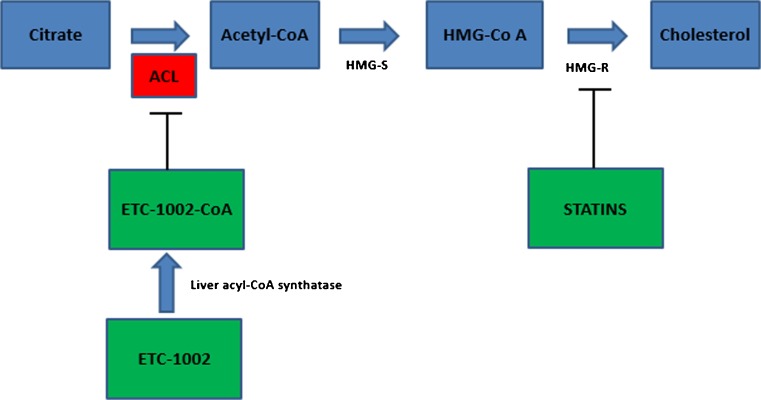
Bempedoic acid (ETC-1002), a novel therapeutic approach for low-density lipoprotein cholesterol (LDL-C) lowering, inhibits ATP citrate lyase (ACL), an enzyme involved in fatty acid and cholesterol synthesis. Although rodent studies suggested potential effects of ACL inhibition on both fatty acid and cholesterol synthesis, studies in humans show an effect only on cholesterol synthesis. In phase 2 studies, ETC-1002 reduced LDL-C as monotherapy, combined with ezetimibe, and added to statin therapy, with LDL-C lowering most pronounced when ETC-1002 was combined with ezetimibe in patients who cannot tolerate statins. Whether clinically relevant favorable effects on other cardiometabolic risk factors such as hyperglycemia and insulin resistance occur in humans is unknown and requires further investigation. Promising phase 2 results have led to the design of a large phase 3 program to gain more information on efficacy and safety of ETC-1002 in combination with statins and when added to ezetimibe in statin-intolerant patients.
Overview
The claims and statistics of this paper haven’t been checked yet.
Free: it reads the open-access text and checks the first 5 claims that cite a source we can check. Create a free account to check every claim.
Integrity signals
Registry
Cites
Statistics
Figures
Verification
Claims the paper makes
The claims and statistics of this paper haven’t been checked yet.
Free: it reads the open-access text and checks the first 5 claims that cite a source we can check. Create a free account to check every claim.
Claims other papers make about this one
Each is checked against this paper’s own text: does it say what the citing paper says it does?
The cited source says what the claim attributes to it.
In the citing paper
“Bempedoic acid inhibits adenosine triphosphate (ATP)-citrate lyase and thereby cholesterol biosynthesis [126].”
From Established and Emerging Lipid-Lowering Drugs for Primary and Secondary Cardiovascular Prevention (2023) · cites this paper as [126]
Self-check
Percentages, sums and reported differences re-computed from the paper’s own numbers.
The self-check needs the paper’s full text.
Citations
Cites
Schwartz, G. G. (2001) · JAMA · doi:10.1001/jama.285.13.1711 · Cited by 2,499
de Lemos, J. A., Blazing, M. A., Wiviott, S. D., Lewis, E. F., Fox, K. A. A., White, H. D., Rouleau, J.-L., Pedersen, T. R., Gardner, L. H., Mukherjee, R., et al. (2004) · JAMA · doi:10.1001/jama.292.11.1307 · Cited by 1,333
De novo lipogenesis in health and disease
Ameer, F., Scandiuzzi, L., Hasnain, S., Kalbacher, H., & Zaidi, N. (2014) · Metabolism · doi:10.1016/j.metabol.2014.04.003 · Cited by 611
Statin use and risk of diabetes mellitus in postmenopausal women in the Women's Health Initiative
Culver, A. L. (2012) · Archives of Internal Medicine · doi:10.1001/archinternmed.2011.625 · Cited by 444
Wiviott, S. D., Cannon, C. P., Morrow, D. A., Ray, K. K., Pfeffer, M. A., & Braunwald, E. (2005) · Journal of the American College of Cardiology · doi:10.1016/j.jacc.2005.04.064 · Cited by 340 · cited 3×
“ing efficacy of ETC-1002 versus ezetimibe, and assess safety and tolerability, including muscle-related adverse events, in patients with or without statin intolerance, defined as inability to tolerate two or more statins because of muscle pain, weakness, or cramping that began or increased during statin therapy and re…”
MethodInfluentialThe broad spectrum of statin myopathy: from myalgia to rhabdomyolysis
Harper, C. R., & Jacobson, T. A. (2007) · Current Opinion in Lipidology · doi:10.1097/mol.0b013e32825a6773 · Cited by 246
Pinkosky, S. L., Filippov, S., Srivastava, R. A. K., Hanselman, J. C., Bradshaw, C. D., Hurley, T. R., Cramer, C. T., Spahr, M. A., Brant, A. F., Houghton, J. L., et al. (2013) · Journal of Lipid Research · doi:10.1194/jlr.m030528 · Cited by 239
Acute coronary syndromes: morbidity, mortality, and pharmacoeconomic burden.
Kolansky, D. M. (2009) · PubMed · Cited by 187
Ballantyne, C. M., Davidson, M. H., MacDougall, D. E., Bays, H. E., DiCarlo, L. A., Rosenberg, N. L., Margulies, J., & Newton, R. S. (2013) · Journal of the American College of Cardiology · doi:10.1016/j.jacc.2013.05.050 · Cited by 175
Self-citationGutierrez, M. J., Rosenberg, N. L., MacDougall, D. E., Hanselman, J. C., Margulies, J. R., Strange, P., Milad, M. A., McBride, S. J., & Newton, R. S. (2014) · Arteriosclerosis, Thrombosis, and Vascular Biology · doi:10.1161/atvbaha.113.302677 · Cited by 170
Use of ETC-1002 to treat hypercholesterolemia in patients with statin intolerance
Thompson, P. D., Rubino, J., Janik, M. J., MacDougall, D. E., McBride, S. J., Margulies, J. R., & Newton, R. S. (2015) · Journal of Clinical Lipidology · doi:10.1016/j.jacl.2015.03.003 · Cited by 159
The role of ATP citrate-lyase in the metabolic regulation of plasma lipids
PEARCE, N. J., YATES, J. W., BERKHOUT, T. A., JACKSON, B., TEW, D., BOYD, H., CAMILLERI, P., SWEENEY, P., GRIBBLE, A. D., SHAW, A., et al. (1998) · Biochemical Journal · doi:10.1042/bj3340113 · Cited by 142
Thompson, P. D., MacDougall, D. E., Newton, R. S., Margulies, J. R., Hanselman, J. C., Orloff, D. G., McKenney, J. M., & Ballantyne, C. M. (2016) · Journal of Clinical Lipidology · doi:10.1016/j.jacl.2015.12.025 · Cited by 142
Self-citationFilippov, S., Pinkosky, S. L., Lister, R. J., Pawloski, C., Hanselman, J. C., Cramer, C. T., Srivastava, R. A. K., Hurley, T. R., Bradshaw, C. D., Spahr, M. A., et al. (2013) · Journal of Lipid Research · doi:10.1194/jlr.m035212 · Cited by 90
Berkhout, T. A., Havekes, L. M., Pearce, N. J., & Groot, P. H. E. (1990) · Biochemical Journal · doi:10.1042/bj2720181 · Cited by 78
Wang, Q., Li, S., Jiang, L., Zhou, Y., Li, Z., Shao, M., Li, W., & Liu, Y. (2010) · Journal of Lipid Research · doi:10.1194/jlr.m003335 · Cited by 67
Alberton, M., Wu, P., Druyts, E., Briel, M., & Mills, E. J. (2012) · QJM: An International Journal of Medicine · doi:10.1093/qjmed/hcr158 · Cited by 66
Virani, S. S., Woodard, L. D., Akeroyd, J. M., Ramsey, D. J., Ballantyne, C. M., & Petersen, L. A. (2014) · Clinical Cardiology · doi:10.1002/clc.22343 · Cited by 62
Self-citationHypolipidemic activity of (−)‐hydroxycitrate
Sullivan, A. C., Triscari, J., Hamilton, J. G., & Ontko, J. A. (1977) · Lipids · doi:10.1007/bf02532964 · Cited by 53
Adenosine triphosphate citrate lyase: Emerging target in the treatment of dyslipidemia
Lemus, H. N., & Mendivil, C. O. (2015) · Journal of clinical lipidology · doi:10.1016/j.jacl.2015.01.002 · Cited by 50
Wong, N. D., Chuang, J., Zhao, Y., & Rosenblit, P. D. (2015) · Journal of Clinical Lipidology · doi:10.1016/j.jacl.2015.05.003 · Cited by 39
The role of ATP citrate lyase in the transfer of acetyl groups in rat liver
Daikuhara, Y., Tsunemi, T., & Takeda, Y. (1968) · Biochimica et Biophysica Acta (BBA) - General Subjects · doi:10.1016/0304-4165(68)90071-8 · Cited by 38
Statin use and risk of diabetes mellitus in postmenopausal women
Katsiki, N., & Banach, M. (2012) · Clinical Lipidology · doi:10.2217/clp.12.28 · Cited by 34
Gao, F., Zhou, Y. J., Hu, D. Y., Zhao, Y. X., Liu, Y. Y., Wang, Z. J., Yang, S. W., & Liu, X. (2013) · PLoS ONE · doi:10.1371/journal.pone.0047681 · Cited by 30
Gilpin, V. L. (2012) · Journal of Vascular Nursing · doi:10.1016/j.jvn.2012.03.004 · Cited by 21
Plasma cholesterol levels in suckling and weaned kittens, puppies, and guinea pigs
Hamilton, R. M. G., & Carroll, K. K. (1977) · Lipids · doi:10.1007/bf02533284 · Cited by 15
ATP-citrate Lyase: A Potential Target for Hypolipidemic Intervention
Groot, P. H. E., Pearce, N., & Gribble, A. D. (2003) · Current Medicinal Chemistry - Immunology Endocrine & Metabolic Agents · doi:10.2174/1568013033483357 · Cited by 14
Ballantyne, C. M., MacDougall, D. E., Margulies, J. R., Robinson, P. L., Hanselman, J. C., & Lalwani, N. D. (2015) · Circulation · doi:10.1161/circ.132.suppl_3.17499 · Cited by 4
Self-citation
Cited by
Reprogramming of fatty acid metabolism in cancer
Koundouros, N., & Poulogiannis, G. (2020) · British Journal of Cancer · doi:10.1038/s41416-019-0650-z · Cited by 1,614
Lipid metabolism in cancer: New perspectives and emerging mechanisms
Broadfield, L. A., Pane, A. A., Talebi, A., Swinnen, J. V., & Fendt, S.-M. (2021) · Developmental Cell · doi:10.1016/j.devcel.2021.04.013 · Cited by 758
Granchi, C. (2018) · European Journal of Medicinal Chemistry · doi:10.1016/j.ejmech.2018.09.001 · Cited by 245
Established and Emerging Lipid-Lowering Drugs for Primary and Secondary Cardiovascular Prevention
Michaeli, D. T., Michaeli, J. C., Albers, S., Boch, T., & Michaeli, T. (2023) · American Journal of Cardiovascular Drugs · doi:10.1007/s40256-023-00594-5 · Cited by 109
“Bempedoic acid inhibits adenosine triphosphate (ATP)-citrate lyase and thereby cholesterol biosynthesis [126].”
BackgroundMetabolic Routes in Inflammation: The Citrate Pathway and its Potential as Therapeutic Target
Infantino, V., Pierri, C. L., & Iacobazzi, V. (2018) · Current Medicinal Chemistry · doi:10.2174/0929867325666180510124558 · Cited by 101
Metadata
- Authors
- Bilen, O., & Ballantyne, C. M.
- Affiliations
- Houston Methodist (US)
- Corresponding author
- Ballantyne, Christie M.
- Venue
- Current Atherosclerosis Reports
- Published
- 2016-09-23
- Volume
- 18
- Issue
- 10
- Pages
- 61-61
- ISSN
- 1523-3804 (ISSN-L)
- 1534-6242
- PMC
- PMC5035316
- OpenAlex
- W2521647868
- Semantic Scholar
- d783981a9d00e0e4bbb6266bb8b28549d026a834
- Cited by
- 119
- References
- 28
- Citations by year
- 2026: 7 · 2025: 15 · 2024: 17 · 2023: 12 · 2022: 13 · 2021: 18 · 2020: 10 · 2019: 14 · 2018: 8 · 2017: 5
- FWCI
- 1.85
- Type
- journal article
- Language
- en
- Open access
- hybrid
- doi.org
- Locations
- Current Atherosclerosis Reports (publishedVersion, cc-by)
- Europe PMC (PubMed Central) (publishedVersion, cc-by)
- PubMed Central (publishedVersion, cc-by)
- PubMed (publishedVersion)
- Topics
- Health Sciences › Medicine › Cardiology and Cardiovascular Medicine › Lipoproteins and Cardiovascular Health
- Life Sciences › Biochemistry, Genetics and Molecular Biology › Biochemistry › Cholesterol and Lipid Metabolism
- Life Sciences › Biochemistry, Genetics and Molecular Biology › Cancer Research › Cancer, Lipids, and Metabolism
- Keywords
- bempedoic acid, ATP-citrate lyase inhibition, LDL cholesterol lowering, statin intolerance, cholesterol biosynthesis, fatty acid synthesis, hypertriglyceridemia, insulin resistance, cardiometabolic risk factors
- MeSH terms
- Ezetimibe, Anticholesteremic Agents, ATP Citrate (pro-S)-Lyase, Dicarboxylic Acids, Drug Therapy, Combination, Fatty Acids, Humans, Hypercholesterolemia, Cholesterol, LDL, Hydroxymethylglutaryl-CoA Reductase Inhibitors
About these checks
Registry, retraction, Cites and statistics results are computed, not judged, with one exception: a printed reference that no index lists is read once by a model before it counts as a citation error. Claims are extracted by a model and kept only when their quote appears verbatim in the text; each cited source is then checked, with a model’s help, for whether it says what the claim relies on. Those verdicts can be wrong — read the claim’s quote and the cited source before relying on one.
Statistics and arithmetic are recomputed, not judged.
Confidence bands are shown only for fields calibrated on our annotated test set. None is calibrated yet, so no band is shown.
What counts as a claim ›How we measure confidence ›How we check this ›
Are you an author, or do you see a problem with this page? Request a review
Data sources
Bibliographic data: Semantic Scholar, OpenAlex, Crossref.
Contains information from the Semantic Scholar Academic Graph Datasets, made available under the ODC Attribution License (ODC-BY 1.0).
Semantic Scholar’s data is described in: Kinney, R., et al. (2023). The Semantic Scholar Open Data Platform. arXiv:2301.10140.
