

Digital Management of Early-Onset Type 2 Diabetes: Empowerment, Challenges, and Future Outlook
Open accessThe DOI matches its Crossref record; 81 of the 81 references it cites were found in a registry or an index; 3 of the 113 sources its claims cite were checked for support.
Abstract
Purpose of Review: Early-onset type 2 diabetes (EOT2D), defined as a diabetes diagnosis before 40 years of age, is rising globally and associated with an aggressive disease course and early complications. This review examines the role of digital health technologies (DHT) in addressing the unique clinical and life-course challenges of EOT2D. Recent Findings: DHT, including continuous glucose monitoring, mobile health applications, digital therapeutics, telemedicine, remote patient monitoring, wearable devices, and artificial intelligence–based analytics, have demonstrated modest improvements in glycemic control, weight management, and patient engagement in people with type 2 diabetes. However, evidence in adults with EOT2D remains limited. Compared with usual-onset T2D, people with EOT2D may derive particular benefits due to higher digital literacy, greater lifestyle variability, and longer anticipated disease duration. Summary: Although DHT shows promise for improving empowerment and care integration in EOT2D, important gaps persist, including a lack of EOT2D-specific trials, digital divide–related inequities, interoperability challenges, and reimbursement barriers. Future research should prioritize tailored interventions and hybrid care models to optimize long-term outcomes in this high-risk population.
Overview
CoChat Summary
TL;DR
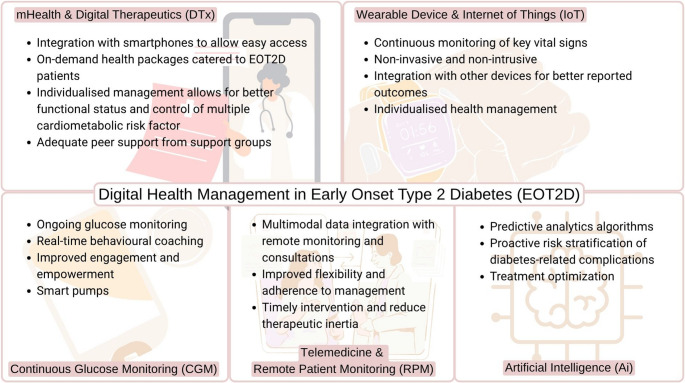
This narrative review examines digital health technologies (DHT) for early-onset type 2 diabetes (EOT2D), defined as diagnosis before age 40, and argues they may improve empowerment and care integration while evidence specific to EOT2D remains limited. It reviews CGM, wearables/IoT, mHealth/digital therapeutics, telemedicine/remote monitoring, and AI, and calls for tailored trials and hybrid care models.
Key findings
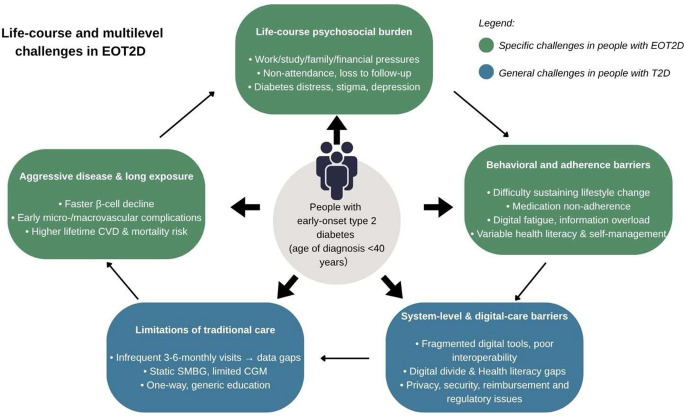
- EOT2D is aggressive: compared with usual-onset T2D, people with EOT2D have 0.5–1.0% higher HbA1c at diagnosis, greater obesity and hypertension burden, and a 2–3-fold higher risk of microvascular and macrovascular complications at any given age; each 10-year earlier diagnosis confers 20–30% higher relative risk of major vascular events and death. Global incidence of T2D among ages 10–24 rose from 56 per 100,000 in 1990 to 123.9 per 100,000 in 2021, with nearly 80% of EOT2D cases in low- and middle-income countries.
- CGM evidence in general T2D is modest: a 2024 meta-analysis of 12 RCTs reported 0.3%–0.4% HbA1c reduction and 6% improvement in time-in-range. In EOT2D/youth studies, a 12-week pilot RCT (n=28) found feasible/acceptable CGM use but no short-term HbA1c benefit and common skin issues; a 12-month cohort of publicly insured youth (n=30) found CGM use declined, HbA1c remained high, and TIR fell over time.
- mHealth/DTx and remote monitoring show promise but are not EOT2D-specific: a 2024 systematic review of 28 digital interventions (23 RCTs) in adults with T2D found improvements in HbA1c, diet, and physical activity; the Virta remote care model achieved mean HbA1c reduction of 1.3% (7.6% to 6.3%) and 12% weight loss at 1 year, sustained at 2 years, but the population was not restricted to EOT2D. A 2022 meta-analysis of 20 RCTs found RPM lowered HbA1c by 0.4% over 6 months, and a large RPM program reported 63% of participants with poor baseline control reached target glucose or HbA1c.
- AI and wearables are promising but understudied in EOT2D: wearable interventions in adults with T2D increase daily steps and often improve systolic blood pressure and weight, with small favorable glycemic effects; multimodal deep learning models can forecast interstitial glucose 15–60 min ahead. However, there is a lack of interventional wearable/IoT studies specifically in EOT2D and no robust hard-endpoint data; TODAY/TODAY2 showed up to 60% of youth-onset participants developed at least one microvascular complication by mean diabetes duration of 13 years.
Methods
- Narrative review of DHT for EOT2D; the authors searched PubMed covering the past five years (2021–2025) using keywords such as “type 2 diabetes,” “digital therapies,” “mobile applications,” “mobile health,” “telemedicine,” and “self-management,” prioritizing studies that described structured digital interventions and reported clinical or patient-relevant outcomes.
- Synthesizes evidence across five DHT categories: continuous glucose monitoring, wearable devices and IoT, mHealth applications and digital therapeutics, telemedicine and remote patient monitoring, and artificial intelligence/predictive modeling; includes Table 1 of clinical studies and two figures.
- No new primary data are presented; evidence includes randomized trials, meta-analyses, cohort studies, qualitative studies, and reviews, with many studies conducted in general T2D or prediabetes rather than EOT2D.
Limitations
- The paper states that evidence in adults with EOT2D remains limited, EOT2D-specific trials are lacking, CGM studies in EOT2D have small sample sizes, and there are no robust data on hard clinical endpoints such as hospitalization, cardiovascular-kidney events, or mortality in this population.
- The paper also states implementation barriers: digital divide–related inequities, poor interoperability and lack of unified data standards, insufficient integration with electronic health records, reimbursement and regulatory uncertainty, and attenuation of intervention effectiveness over time.
- Evident from the text: as a narrative review, it does not report a systematic search protocol, PRISMA flow, or formal quality/risk-of-bias appraisal; many cited studies are in general T2D, prediabetes, or non-EOT2D populations, and some key evidence is non-randomized or pilot/feasibility in design.
Model-written summary. Check it against the paper before relying on it.
Integrity signals
Registry
Cites
Statistics
Figures
Verification
Claims the paper makes
3 Valid · 3 Not valid · 65 Not checked · 25 Own results and interpretations
The cited sources support only part of this claim — read each source’s verdict below.
In the paper
“People with T2D who experience greater lifestyle variability and a higher risk of nocturnal hypoglycemia and hypoglycemia unawareness will likely benefit from CGM [21].”
§ Digital Management of Early-Onset Type 2 Diabetes: Empowerment, Challenges, and Future Outlook > Introduction > Continuous Glucose Monitoring (CGM)
What the sources say
- Partly supportedcites [21] Jackson MA, Ahmann A, Shah VN. Type 2 Diabetes and the Use of Real-Time Continuous Glucose Monitoring. Diabetes Technol Ther. 2021;23(S1):S27–34. 33534631 PMC7957379 sourceExperimental — accuracy not yet measured
The 'Effect of rtCGM on hypoglycemia' section states directly that 'T2D patients with hypoglycemia unawareness or with a greater percentage of hypoglycemia at baseline are likely to benefit from rtCGM,' which supports the unawareness/high-hypoglycemia-risk half of the claim (hedged the same way). The 'Other considerations and future directions' section likewise limits probable benefit/cost-effectiveness to a subset with 'significant hypoglycemia or high glycemic variability' — glycemic, not lifestyle, variability. Our copy contains no statement that patients with greater lifestyle variability benefit (its lifestyle section covers rtCGM as an education/behavior-change tool only) and no mention of nocturnal hypoglycemia as a benefit criterion (the term appears only in a cited reference title), so those two qualifiers are not supported by this source. (LLM, conf=0.78)
hedgedstates a possible cause- Asserted: passes — The authors put it forward as true.
- Checkable: passes — It can be checked against evidence.
- Load-bearing: unclear — It is unclear whether the paper’s conclusions depend on it.
- Based: passes — The paper gives a reason why it holds.
- Partly supported
The cited sources support only part of this claim — read each source’s verdict below.
In the paper
“People with EOT2D frequently face socioeconomic, work, study, and family pressures that make it challenging to prioritize regular physical activity [29].”
§ Digital Management of Early-Onset Type 2 Diabetes: Empowerment, Challenges, and Future Outlook > Introduction > Wearable Devices and the Internet of Things (IoT)
What the sources say
- Partly supportedcites [29] Chua REC, Lau Y, Ang WW, Boey A, Lau ST. Effectiveness of wearable technology-based physical activity interventions for adults with type 2 diabetes mellitus: A systematic review and meta-regression. J Diabetes. 2024;16(10):e70002. 39364789 PMC11450597 sourceExperimental — accuracy not yet measured
The INTRODUCTION of our copy supports only the general half of the claim: it states that although PA is crucial in DM self-management, 'patients still struggle with adhering to regular exercise routines due to various reasons'. However, the reasons it lists are a perception that diet and medication adherence matter more (ref 6), the effort required to change lifestyle habits (ref 7), and lack of motivation (ref 8) — it never mentions socioeconomic, work, study, or family pressures ('socioeconomic' appears only as 'increased socioeconomic costs' of T2DM). Searches for barriers (work/study/family obligations, time constraints, socioeconomic status) returned no supporting passage. The population is also mismatched: this review covers adults ≥18 with T2DM (mean ages 44.2–68.7 years), not early-onset T2D specifically, and only notes in Future research that trials could test short-duration interventions in young adults. (LLM, conf=0.72)
plainstates a cause- Asserted: passes — The authors put it forward as true.
- Checkable: passes — It can be checked against evidence.
- Load-bearing: passes — The paper’s conclusions depend on it.
- Based: passes — The paper gives a reason why it holds.
- Partly supported
The cited sources support only part of this claim — read each source’s verdict below.
In the paper
“However, because this younger population is highly digitally connected, they are uniquely receptive to smartphone‑based support [29].”
§ Digital Management of Early-Onset Type 2 Diabetes: Empowerment, Challenges, and Future Outlook > Introduction > Wearable Devices and the Internet of Things (IoT)
What the sources say
- Partly supportedcites [29] Chua REC, Lau Y, Ang WW, Boey A, Lau ST. Effectiveness of wearable technology-based physical activity interventions for adults with type 2 diabetes mellitus: A systematic review and meta-regression. J Diabetes. 2024;16(10):e70002. 39364789 PMC11450597 sourceExperimental — accuracy not yet measured
The only passage in our copy touching young adults' responsiveness to technology is the Discussion ('Function and duration of intervention'), which reports significantly larger SBP effect sizes in younger than older adults and offers as a possibility ('One possibility is...') that young adults engage regularly because they are familiar with wearable functions, with older adults' non-adherence to wearable technology as an alternative explanation. That supports the direction of the claim (younger adults with T2DM respond better to technology-delivered PA support) but not its specific content: our copy nowhere describes this population as 'highly digitally connected', nowhere says they are 'uniquely receptive', and the modality discussed is wearable technology (pedometers, accelerometers, smartwatches, activity trackers), not smartphone-based support; the 'Future research' section likewise only recommends short-duration monitoring-only WT-BPAI in young adults. The source's statement is also explicitly speculative, whereas the citing sentence presents it as fact. (LLM, conf=0.70)
plainstates a cause- Asserted: passes — The authors put it forward as true.
- Checkable: passes — It can be checked against evidence.
- Load-bearing: passes — The paper’s conclusions depend on it.
- Based: passes — The paper gives a reason why it holds.
- Partly supported
A result the paper states — it cites no source for it, so there is none to check. The quote shows it is in the paper.
In the paper
“However, evidence in adults with EOT2D remains limited.”
- Also stated in: § mHealth Applications and Digital Therapeutics (DTx) · plain
“Direct evidence for mHealth and DTx specifically in people with EOT2D remains limited, as the majority of digital nutrition and lifestyle programs were evaluated in general adults with T2D rather than in those with EOT2D or in head‑to‑head comparisons with usual‑onset T2D.”
§ Digital Management of Early-Onset Type 2 Diabetes: Empowerment, Challenges, and Future Outlook > Abstract > Recent Findings
plain- Asserted: passes — The authors put it forward as true.
- Checkable: passes — It can be checked against evidence.
- Load-bearing: passes — The paper’s conclusions depend on it.
- Based: passes — The paper gives a reason why it holds.
- Also stated in: § mHealth Applications and Digital Therapeutics (DTx) · plain
A result the paper states — it cites no source for it, so there is none to check. The quote shows it is in the paper.
In the paper
“Direct evidence for mHealth and DTx specifically in people with EOT2D remains limited, as the majority of digital nutrition and lifestyle programs were evaluated in general adults with T2D rather than in those with EOT2D or in head‑to‑head comparisons with usual‑onset T2D.”
§ Digital Management of Early-Onset Type 2 Diabetes: Empowerment, Challenges, and Future Outlook > Introduction > mHealth Applications and Digital Therapeutics (DTx)
plain- Asserted: passes — The authors put it forward as true.
- Checkable: passes — It can be checked against evidence.
- Load-bearing: passes — The paper’s conclusions depend on it.
- Based: passes — The paper gives a reason why it holds.
36 more claims
Create a free account to see all 96 claims and to verify the 109 references still open.
- It may state two separate claims as one. 43
- Probably not a substantial claim. 16
Self-check
Percentages, sums and reported differences re-computed from the paper’s own numbers.
Each contradiction between two passages listed here was confirmed by an independent check.
Rated minor: it would not touch a result — a value no result rests on, a p-value that stays on the same side of the significance level, or a conflict that is clerical, resolved elsewhere in the paper, or outside its own findings.
In the paper
§ Digital Management of Early-Onset Type 2 Diabetes: Empowerment, Challenges, and Future Outlook > Introduction > DHT: Types and Functions
“Khavere et al., 2025 [31]”
§ Digital Management of Early-Onset Type 2 Diabetes: Empowerment, Challenges, and Future Outlook > References
“31. Kerr D, Ahn D, Waki K, Wang J, Breznen B, Klonoff DC. Digital Interventions for Self-Management of Type 2 Diabetes Mellitus: Systematic Literature Review and Meta-Analysis.”
Rated minor: it would not touch a result — a value no result rests on, a p-value that stays on the same side of the significance level, or a conflict that is clerical, resolved elsewhere in the paper, or outside its own findings.
In the paper
§ Digital Management of Early-Onset Type 2 Diabetes: Empowerment, Challenges, and Future Outlook > Introduction > DHT: Types and Functions
“Kerr et al., 2024 [37]”
§ Digital Management of Early-Onset Type 2 Diabetes: Empowerment, Challenges, and Future Outlook > References
“37. Khavere S, Hadjiconstantinou M, Miksza J, Hagan J, Salisu-Olatunji S, Naderpour S, et al. Effectiveness of self-management interventions on Type 2 diabetes among young adults (18–45 years): A systematic review and meta-analysis.”
Citations
Cites
Ong, K. L., Stafford, L. K., McLaughlin, S. A., Boyko, E. J., Vollset, S. E., Smith, A. E., Dalton, B. E., Duprey, J., Cruz, J. A., Hagins, H., et al. (2023) · The Lancet · doi:10.1016/s0140-6736(23)01301-6 · Cited by 6,146
Personalized nutrition by prediction of glycemic responses
Zeevi, D., Korem, T., Zmora, N., Israeli, D., Rothschild, D., Weinberger, A., Ben-Yacov, O., Lador, D., Avnit-Sagi, T., Lotan-Pompan, M., et al. (2015) · Cell · doi:10.1016/j.cell.2015.11.001 · Cited by 2,929 · cited 1×
“These can enhance empowerment and self-efficacy in people with T2D [ 52, 53].”
Greenhalgh, T., Wherton, J., Papoutsi, C., Lynch, J., Hughes, G., A'Court, C., Hinder, S., Fahy, N., Procter, R., & Shaw, S. (2017) · Journal of Medical Internet Research · doi:10.2196/jmir.8775 · Cited by 2,887
The global spread of type 2 diabetes mellitus in children and adolescents
Pinhas-Hamiel, O., & Zeitler, P. (2005) · The Journal of Pediatrics · doi:10.1016/j.jpeds.2004.12.042 · Cited by 652 · cited 1×
“1) [8].”
Long-term complications in youth-onset type 2 diabetes
TODAY Study Group (2021) · New England Journal of Medicine · doi:10.1056/nejmoa2100165 · Cited by 546 · cited 1×
“…that by a mean diabetes duration of 13 years (early adulthood), up to 60% of participants develop at least one microvascular complication, and many have multiple complications, underscoring the need for early, intensive, and precisely targeted intervention in this vulnerable group [55, 57 – 59].”
Hallberg, S. J., McKenzie, A. L., Williams, P. T., Bhanpuri, N. H., Peters, A. L., Campbell, W. W., Hazbun, T. L., Volk, B. M., McCarter, J. P., Phinney, S. D., et al. (2018) · Diabetes Therapy · doi:10.1007/s13300-018-0373-9 · Cited by 406
IDF Diabetes Atlas 11th edition 2025: global prevalence and projections for 2050
Duncan, B. B., Magliano, D. J., & Boyko, E. J. (2025) · Nephrology Dialysis Transplantation · doi:10.1093/ndt/gfaf177 · Cited by 401
Nanayakkara, N., Curtis, A. J., Heritier, S., Gadowski, A. M., Pavkov, M. E., Kenealy, T., Owens, D. R., Thomas, R. L., Song, S., Wong, J., et al. (2021) · Diabetologia · doi:10.1007/s00125-020-05319-w · Cited by 393
Hall, C. S., Fottrell, E., Wilkinson, S., & Byass, P. (2014) · Global Health Action · doi:10.3402/gha.v7.25606 · Cited by 384 · cited 1×
“…real-world implementation studies will need to look into people with EOT2D with deliberate assessment of complication incidence, quality of life, mental health, work productivity, and reproductive health, and with subgroup analyses comparing EOT2D and usual-onset T2D, whenever feasible [71 – 73].”
Arslanian, S., Bacha, F., Grey, M., Marcus, M. D., White, N. H., & Zeitler, P. (2018) · Diabetes Care · doi:10.2337/dci18-0052 · Cited by 349 · cited 1×
“Clinical studies indicate that metformin monotherapy as first-line treatment often fails to sustain glycemic control in EOT2D, necessitating earlier combination therapy and intensive interventions [7].”
Research works printed but not linked: 1
- Berthoumieux A, Linke SE, Merry M, Megliola A, Juusola J, Napoleone J. Long-term results of a digital diabetes self-management and education support program among adults with type 2 diabetes: A retrospective cohort study. Sci Diabetes Self-Management Care. 2024;50(1):19–31. 38240247 · DOI · Paper page
Cited by
Still being checked.
Metadata
- Authors
- Guo, L.-J., Low, K.-S., Tae, S.-K., & Lim, L.-L.
- Affiliations
- University of Malaya (MY)
- Baker Heart and Diabetes Institute (AU)
- Corresponding author
- Tae, Sok-Kun
- Lim, Lee-Ling
- Venue
- Current Diabetes Reports
- Published
- 2026-07-10
- Volume
- 26
- Issue
- 1
- Pages
- 20
- ISSN
- 1534-4827 (ISSN-L)
- 1539-0829
- PMC
- PMC13354610
- OpenAlex
- W7167899948
- Cited by
- 0
- References
- 81
- FWCI
- 0.00
- Type
- journal article
- Language
- en
- Open access
- hybrid
- doi.org
- Licence
- cc-by
- creativecommons.org/licenses/by/4.0 (tdm)
- creativecommons.org/licenses/by/4.0 (vor)
- Locations
- Current Diabetes Reports (publishedVersion, cc-by)
- PubMed Central (publishedVersion, cc-by)
- PubMed (publishedVersion)
- Funders
- Universiti Malaya
- Topics
- Health Sciences › Health Professions › General Health Professions › Mobile Health and mHealth Applications
- Health Sciences › Medicine › Endocrinology, Diabetes and Metabolism › Diabetes Management and Research
- Health Sciences › Medicine › Endocrinology, Diabetes and Metabolism › Diabetes Management and Education
- Keywords
- early-onset type 2 diabetes, digital health technologies, continuous glucose monitoring, mobile health apps, digital therapeutics, telemedicine, remote patient monitoring, wearable devices, artificial intelligence, glycemic control, weight management, patient empowerment, digital divide, interoperability, reimbursement barriers, hybrid care model, digital literacy
- MeSH terms
- Continuous Glucose Monitoring, Digital Health, Remote Patient Monitoring, Diabetes Mellitus, Type 2, Humans, Blood Glucose Self-Monitoring, Telemedicine, Age of Onset
About these checks
Registry, retraction, Cites and statistics results are computed, not judged, with one exception: a printed reference that no index lists is read once by a model before it counts as a citation error. Claims are extracted by a model and kept only when their quote appears verbatim in the text; each cited source is then checked, with a model’s help, for whether it says what the claim relies on. Those verdicts can be wrong — read the claim’s quote and the cited source before relying on one.
The claim verdicts this report counts are experimental: their accuracy is not yet measured.
A language model drew the claims from the paper on 2026-11-20, under version 3 of the claim definition (model deepseek-v4.1-flash, prompt extract-v3).
A second model labelled each claim on 2026-11-20 (model jev-1.13-20260917, definition revision gold-guideline-v0.2).
Cited sources are checked with a language model’s help (qwen3.8-omni-flash).
Statistics and arithmetic are recomputed, not judged.
Confidence bands are shown only for fields calibrated on our annotated test set. None is calibrated yet, so no band is shown.
What counts as a claim ›How we measure confidence ›How we check this ›
Are you an author, or do you see a problem with this page? Request a review
Data sources
Bibliographic data: Semantic Scholar, OpenAlex, Crossref.
Contains information from the Semantic Scholar Academic Graph Datasets, made available under the ODC Attribution License (ODC-BY 1.0).
Semantic Scholar’s data is described in: Kinney, R., et al. (2023). The Semantic Scholar Open Data Platform. arXiv:2301.10140.
