

Mitochondrial Dysfunction in Parkinson’s Disease: New Mechanistic Insights and Therapeutic Perspectives
Open accessThe DOI matches its Crossref record; 107 of the 107 references it cites were found in a registry or an index.
Abstract
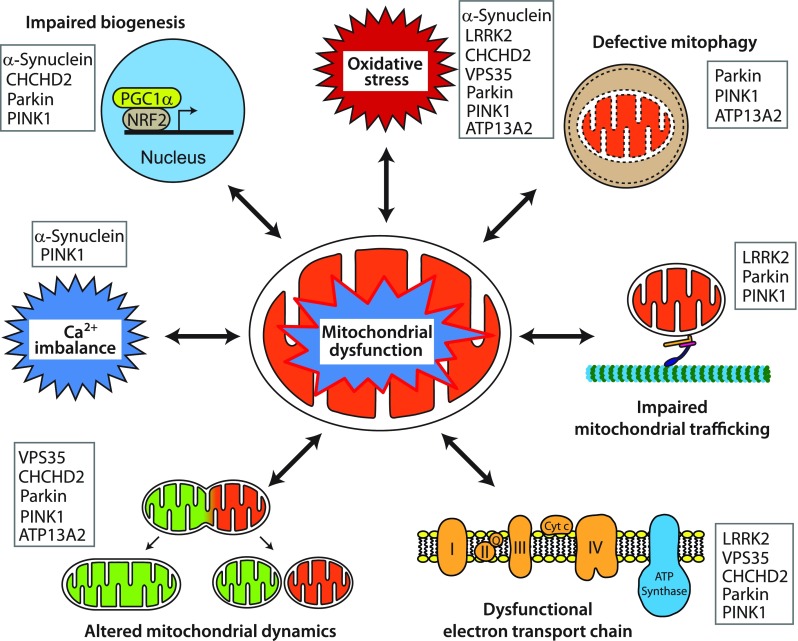
PURPOSE OF REVIEW: Parkinson's disease (PD) is a complex neurodegenerative disorder, the aetiology of which is still largely unknown. Overwhelming evidence indicates that mitochondrial dysfunction is a central factor in PD pathophysiology. Here we review recent developments around mitochondrial dysfunction in familial and sporadic PD, with a brief overview of emerging therapies targeting mitochondrial dysfunction. RECENT FINDINGS: Increasing evidence supports the critical role for mitochondrial dysfunction in the development of sporadic PD, while the involvement of familial PD-related genes in the regulation of mitochondrial biology has been expanded by the discovery of new mitochondria-associated disease loci and the identification of their novel functions. Recent research has expanded knowledge on the mechanistic details underlying mitochondrial dysfunction in PD, with the discovery of new therapeutic targets providing invaluable insights into the essential role of mitochondria in PD pathogenesis and unique opportunities for drug development.
Overview
The claims and statistics of this paper haven’t been checked yet.
Free: it reads the open-access text and checks the first 5 claims that cite a source we can check. Create a free account to check every claim.
Integrity signals
Registry
Cites
Statistics
Figures
Verification
Claims the paper makes
The claims and statistics of this paper haven’t been checked yet.
Free: it reads the open-access text and checks the first 5 claims that cite a source we can check. Create a free account to check every claim.
Claims other papers make about this one
Each is checked against this paper’s own text: does it say what the citing paper says it does?
In the citing paper
“Different mutations in the genes involved in familial PD are associated with pathways of mitochondrial dysfunction, while some of these compromised pathways have been established as important factors in the pathophysiology of sporadic PD [261].”
From Ageing, Cellular Senescence and Neurodegenerative Disease (2018) · cites this paper as [261]
In the citing paper
“Several lines of evidence indicate that mitochondrial dysfunction plays a central role in the pathophysiology of PD.”
From Ageing, Cellular Senescence and Neurodegenerative Disease (2018) · cites this paper as [261]
Self-check
Percentages, sums and reported differences re-computed from the paper’s own numbers.
The self-check needs the paper’s full text.
Citations
Cites
Mutation in the α-Synuclein Gene Identified in Families with Parkinson's Disease
Polymeropoulos, M. H., Lavedan, C., Leroy, E., Ide, S. E., Dehejia, A., Dutra, A., Pike, B., Root, H., Rubenstein, J., Boyer, R., et al. (1997) · Science · doi:10.1126/science.276.5321.2045 · Cited by 8,240
Mutations in the parkin gene cause autosomal recessive juvenile parkinsonism
Kitada, T., Asakawa, S., Hattori, N., Matsumine, H., Yamamura, Y., Minoshima, S., Yokochi, M., Mizuno, Y., & Shimizu, N. (1998) · Nature · doi:10.1038/33416 · Cited by 5,227
Hereditary Early-Onset Parkinson's Disease Caused by Mutations in PINK1
Valente, E. M., Abou-Sleiman, P. M., Caputo, V., Muqit, M. M. K., Harvey, K., Gispert, S., Ali, Z., Del Turco, D., Bentivoglio, A. R., Healy, D. G., et al. (2004) · Science · doi:10.1126/science.1096284 · Cited by 3,481
PINK1/Parkin-mediated mitophagy is dependent on VDAC1 and p62/SQSTM1
Geisler, S., Holmström, K. M., Skujat, D., Fiesel, F. C., Rothfuss, O. C., Kahle, P. J., & Springer, W. (2010) · Nature Cell Biology · doi:10.1038/ncb2012 · Cited by 2,835
The ubiquitin kinase PINK1 recruits autophagy receptors to induce mitophagy
Lazarou, M., Sliter, D. A., Kane, L. A., Sarraf, S. A., Wang, C., Burman, J. L., Sideris, D. P., Fogel, A. I., & Youle, R. J. (2015) · Nature · doi:10.1038/nature14893 · Cited by 2,774
The Roles of PINK1, Parkin, and Mitochondrial Fidelity in Parkinson’s Disease
Pickrell, A. M., & Youle, R. J. (2015) · Neuron · doi:10.1016/j.neuron.2014.12.007 · Cited by 2,310
Ubiquitin is phosphorylated by PINK1 to activate parkin
Koyano, F., Okatsu, K., Kosako, H., Tamura, Y., Go, E., Kimura, M., Kimura, Y., Tsuchiya, H., Yoshihara, H., Hirokawa, T., et al. (2014) · Nature · doi:10.1038/nature13392 · Cited by 1,477
PINK1 phosphorylates ubiquitin to activate Parkin E3 ubiquitin ligase activity
Kane, L. A., Lazarou, M., Fogel, A. I., Li, Y., Yamano, K., Sarraf, S. A., Banerjee, S., & Youle, R. J. (2014) · Journal of Cell Biology · doi:10.1083/jcb.201402104 · Cited by 1,298
PINK1 and Parkin Target Miro for Phosphorylation and Degradation to Arrest Mitochondrial Motility
Wang, X., Winter, D., Ashrafi, G., Schlehe, J., Wong, Y. L., Selkoe, D., Rice, S., Steen, J., LaVoie, M. J., & Schwarz, T. L. (2011) · Cell · doi:10.1016/j.cell.2011.10.018 · Cited by 1,171
Landscape of the PARKIN-dependent ubiquitylome in response to mitochondrial depolarization
Sarraf, S. A., Raman, M., Guarani-Pereira, V., Sowa, M. E., Huttlin, E. L., Gygi, S. P., & Harper, J. W. (2013) · Nature · doi:10.1038/nature12043 · Cited by 1,010
Cited by
Items 501–535 of 535
Bi, D., Huang, J., Zhu, N., Cao, J., Wu, Y. L., Yao, L., Ding, X., Wu, J., Cao, X., & Xu, X. (2025) · Journal of Agriculture and Food Research · doi:10.1016/j.jafr.2025.101994
Brain cholesterol metabolites cause significant neurodegeneration in human iPSC-derived neuronsPreprint
Feng, Y., Mazumder, B., Konno, T., Hui, E., Brockhoff, M., Davì, V., Lü, M., Ward, E., Stephens, A. D., Dai, W., et al. (2025) · bioRxiv (Cold Spring Harbor Laboratory) · doi:10.1101/2025.06.10.656594 · Cited by 1
“Similar mechanisms have been implicated in PD and AD through PINK1/LRRK2 mutations 63 and altered Drp1 activity 64 .”
«Brain—gut—microbiome» axis in patients with Parkinson’s disease
Жукова, Н. Г., Sayfitdinkhuzhaev, Z. F., Israilova, G. M., Bustonov, O. Y., Nasriddinova, N. A., Gaponova, O. V., Zhukova, I. A., & Masenko, A. Y. (2025) · S S Korsakov Journal of Neurology and Psychiatry · doi:10.17116/jnevro202512511218 · Cited by 1
Wang, V., Tseng, K.-Y., Kuo, T.-T., Huang, E. Y., Lan, K.-L., Chen, Z.-R., Ma, K.-H., Greig, N. H., Jung, J. H., Choi, H.-I., et al. (2024) · Figshare · doi:10.6084/m9.figshare.26707895
Lin, F., Shi, Y., Song, W., Weng, Y., Zou, X., Chen, X., Zheng, J., Chen, K., Ye, Q., Wu, X., et al. (2024) · Figshare · doi:10.6084/m9.figshare.26759525
Lin, F., Shi, Y., Song, W., Weng, Y., Zou, X., Chen, X., Zheng, J., Chen, K., Ye, Q., Wu, X., et al. (2024) · Figshare · doi:10.6084/m9.figshare.26759534
Lin, F., Shi, Y., Song, W., Weng, Y., Zou, X., Chen, X., Zheng, J., Chen, K., Ye, Q., Wu, X., et al. (2024) · Figshare · doi:10.6084/m9.figshare.26759528
Zanon, A., Guida, M., Lavdas, A. Α., Corti, C., Castelo Rueda, M. P., Negro, A., Pramstaller, P. P., Domingues, F. S., Hicks, A. A., & Pichler, I. (2024) · Figshare · doi:10.6084/m9.figshare.26668194
Lin, F., Shi, Y., Song, W., Weng, Y., Zou, X., Chen, X., Zheng, J., Chen, K., Ye, Q., Wu, X., et al. (2024) · Figshare · doi:10.6084/m9.figshare.26759531
The role of alternative splicing and long non-coding RNAs in parkinson’s disease
Kavanagh, T. (2018) · UNSWorks (University of New South Wales, Sydney, Australia) · doi:10.26190/unsworks/3687
The Genetic Landscape of Neurodegenerative and Cerebrovascular Disease Phenotypes.
Dilliott, A. A. (2021) · Scholarship@Western (Western University)
Malattia di Parkinson e asse intestino-cervello: nuove prospettive sul microbiota intestinale
TUFILLI, V. (2024) · Electronic Theses and Dissertations Repository (University of Pisa)
Picón, M. L. (2020) · Corpus Université Laval (Université Laval)
Leikas, J. V. (2021) · UEF eRepo (University of Eastern Finland) · Cited by 2
Proteina a-sinucleina como alvo terapeutico no tratamento da doença de Parkinson
Caldeira, M. A. B. (2020) · Portuguese National Funding Agency for Science, Research and Technology (RCAAP Project by FCT) · Cited by 1
Multimodal-MRI cognitive and motor components of Parkinson's Disease mild cognitive impairment
Ferrer Gallardo, V. J. (2024) · Communities in ADDI (University of the Basque Country)
Rashid Abdu Rahim López, R. (2024) · RODIN (Universidad de Cádiz)
Natural Product Assembly in Nanoformulation: Importance in Neurodegenerative Diseases
Verma, K., Singh, R., Jain, S., & Sharma, S. (2026) · Springer eBooks · doi:10.1007/978-981-95-5088-3_6
PHB2 forms a mitochondrial calcium channel that drives Parkinson’s diseasePreprint
Zhou, S., Li, Y., Yang, F., Yang, J., Liu, Y., Wang, Y., Bai, D., Gao, Y., Jiao, Z., Tang, H., et al. (2026) · Research Square · doi:10.21203/rs.3.rs-8380581/v1
The Brain–Gut–Microbiome Axis in Patients with Parkinson’s Disease
Жукова, Н. Г., Sayfitdinkhuzhaev, Z. F., Israilova, G. M., Bustonov, O. Y., Nasriddinova, N. A., Gaponova, O. V., Zhukova, I. A., & Masenko, A. Y. (2026) · Neuroscience and Behavioral Physiology · doi:10.1007/s11055-026-01998-x
Pant, C., Alli, V. J., Sukumar, G., Mohapatra, A., Jadav, S. S., Pabbaraja, S., & Kalivendi, S. V. (2026) · Methods in enzymology on CD-ROM/Methods in enzymology · doi:10.1016/bs.mie.2026.06.011
Adjunctive EGb 761 treatment in patients with Parkinson’s disease: a case series
Krasnienkov, D., Карабань, И. Н., Barsukov, O., Korcheva, V., Karasevych, N., Melnyk, N. A., Khodakovskaya, M., Papurina, T., Falarin, B., Kukharskyy, V., et al. (2026) · Frontiers in Aging Neuroscience · doi:10.3389/fnagi.2026.1767148
“…and lipoxidation end products (AGEs/ALEs) (Zgutka et al., 2023; Sharma et al., 2020; Li et al., 2012; Perrone et al., 2020; D’Cunha et al., 2022), mitochondrial dysfunction (Park et al., 2018; Tresse et al., 2023; Lin et al., 2012), telomere shortening (Li et al., 2019; Ciacka et al., 2020).”
Zanon, A., Kerschbamer, E., Riekschnitz, D. A., Gilmozzi, V., Laurenti, G., Lang, M., Grünewald, A., Seibler, P., Pramstaller, P. P., Hicks, A. A., et al. (2026) · Communications Biology · doi:10.1038/s42003-026-10703-0
Sayfitdinkhuzhaev, Z. F., Жукова, Н. Г., Nasyrova, R. F., Gaponova, O. V., Zhukova, I. A., Masenko, A. Y., & Baydanova, A. N. (2026) · Neuroscience and Behavioral Physiology · doi:10.1007/s11055-026-02032-w
“…in its pathogenesis; to date, the most strongly evidenced roles are played by pathological aggregation of α -synuclein [2], neuroin fl ammation [3], mitochondrial dysfunction [4], dysregulation of the microbiome–gut–brain axis [5], oxidative stress [6], and glutamate-mediated excitotoxicity [7].”
Paul, S., Roy, A., Bhattacharya, P., Boruah, D. C., & Borah, A. (2026) · Current Pharmacology Reports · doi:10.1007/s40495-026-00474-x
“However, reports also suggest that stabilizing mitochondrial membrane integrity, enhancing mitophagic clearance, and restoring bioenergetic balance could be achieved by phytotherapy [76 ].”
Moghadasi, M., Abdollahi, S., Edalatmanesh, M. A., Motl, R. W., Najafi, P., & Salehi, O. (2026) · Neurological Research · doi:10.1080/01616412.2026.2721323
Wang, J., Hu, Y., Wang, B., Liu, Q., Zhang, Y.-D., Zheng, K.-M., Xiao, N., Li, L.-X., & Jiang, B. (2026) · Frontiers in Immunology · doi:10.3389/fimmu.2026.1813166
“While the exact cause of PD remains obscure, some studies have proposed close links among genetic factors, environmental factors, diet, age, and reactive oxygen stress (ROS) (5 – 7).”
Milky, B., Adams, R., Mazzachi, P., Ali, A. A., Illeperuma, I., Sargeant, T. J., & Bardy, C. (2026) · Research Square · doi:10.21203/rs.3.rs-10696877/v1
Kim, S., Noh, S. G., Ji, M., Chen, K., Kuchel, G. A., Al‐Naggar, I. M., & Kwon, O. S. (2026) · GeroScience · doi:10.1007/s11357-026-02515-1
Cultural and regional considerations in Parkinson’s pharmacotherapy
Memudu, A. E., Nwanama, K. E., Adewumi, E. A., Olukade, B. A., Alex, G. S., Ajagbe͓, A. O., Funsho, I. I., & Oparaji, K. C. (2026) · Elsevier eBooks · doi:10.1016/b978-0-443-27702-3.00010-8
Оксидативний стрес у контексті етіології та патогенезу хвороби Паркінсону
Midlovets, K. K., & Красненков, Д. С. (2024) · Problems of ageing and longevity (Ukraine)
Photobiomodulation in Parkinson’s disease: From pathogenesis to intervention
Shao, J., Deng, Q., & Yang, L. (2026) · Experimental Neurology · doi:10.1016/j.expneurol.2026.116088
BindingDB (2026) · UC San Diego · doi:10.7270/q2wm1kc7
Metadata
- Authors
- Park, J.-S., Davis, R. L., & Sue, C. M.
- Affiliations
- The University of Sydney (AU)
- Corresponding author
- Sue, Carolyn M.
- Venue
- Current Neurology and Neuroscience Reports
- Published
- 2018-04-03
- Volume
- 18
- Issue
- 5
- Pages
- 21-21
- ISSN
- 1528-4042 (ISSN-L)
- 1534-6293
- PMC
- PMC5882770
- OpenAlex
- W2796389302
- Cited by
- 516
- References
- 107
- Citations by year
- 2026: 22 · 2025: 41 · 2024: 80 · 2023: 72 · 2022: 86 · 2021: 84 · 2020: 86 · 2019: 35 · 2018: 10
- FWCI
- 8.48
- Type
- journal article
- Language
- en
- Open access
- hybrid
- doi.org
- Licence
- cc-by
- creativecommons.org/licenses/by/4.0 (tdm)
- Locations
- Current Neurology and Neuroscience Reports (publishedVersion, cc-by)
- PubMed Central (publishedVersion, cc-by)
- PubMed (publishedVersion)
- Topics
- Health Sciences › Medicine › Clinical Neurology › Parkinson's Disease Mechanisms and Treatments
- Life Sciences › Biochemistry, Genetics and Molecular Biology › Molecular Biology › Mitochondrial Function and Pathology
- Life Sciences › Biochemistry, Genetics and Molecular Biology › Molecular Biology › Nuclear Receptors and Signaling
- Keywords
- Parkinson's disease, mitochondrial dysfunction, sporadic Parkinson's disease, familial Parkinson's disease, mitochondrial biology, therapeutic target, drug development, neurodegeneration
- MeSH terms
- Animals, Antiparkinson Agents, Electron Transport, Humans, Mitochondria, Parkinson Disease
About these checks
Registry, retraction, Cites and statistics results are computed, not judged, with one exception: a printed reference that no index lists is read once by a model before it counts as a citation error. Claims are extracted by a model and kept only when their quote appears verbatim in the text; each cited source is then checked, with a model’s help, for whether it says what the claim relies on. Those verdicts can be wrong — read the claim’s quote and the cited source before relying on one.
Statistics and arithmetic are recomputed, not judged.
Confidence bands are shown only for fields calibrated on our annotated test set. None is calibrated yet, so no band is shown.
What counts as a claim ›How we measure confidence ›How we check this ›
Are you an author, or do you see a problem with this page? Request a review
Data sources
Bibliographic data: Semantic Scholar, OpenAlex, Crossref.
Contains information from the Semantic Scholar Academic Graph Datasets, made available under the ODC Attribution License (ODC-BY 1.0).
Semantic Scholar’s data is described in: Kinney, R., et al. (2023). The Semantic Scholar Open Data Platform. arXiv:2301.10140.
