

The DOI matches its Crossref record; 28 of the 28 references it cites were found in a registry or an index.
Potato Patatin Generates Short-Chain Fatty Acids from Milk Fat that Contribute to Flavour Development in Cheese Ripening
Open accessAbstract
The potato lipase, patatin, has long been thought of as essentially inactive towards triacylglycerols. Recently, technology has been developed to isolate potato proteins in native form as food ingredients at industrial scale. Characterisation of native patatin obtained in this way revealed that this enzyme activity towards triacylglycerols has been underestimated. This enables the application of patatin in cheese ripening, which is described in this study. When patatin is added to milk during cheese making, the lipase preferentially releases short-chain fatty acids that contribute to cheese flavour in a dose-dependent manner. Fortuitously, the lipase activity is found mainly in the curd. The release of the short-chain fatty acids matches the activity profile of patatin towards homotriacylglycerols of defined chain length. Residual patatin in the whey fraction can be inactivated effectively by heat treatment that follows Arrhenius kinetics. The results are discussed in terms of cheese making, patatin substrate preference and implications for the use of patatin more generally in food emulsions.
Overview
The claims and statistics of this paper haven’t been checked yet.
Run the check — free, no account needed. It reads the open-access text and checks the sources it cites.
Integrity signals
Registry
Cites
Statistics
Figures
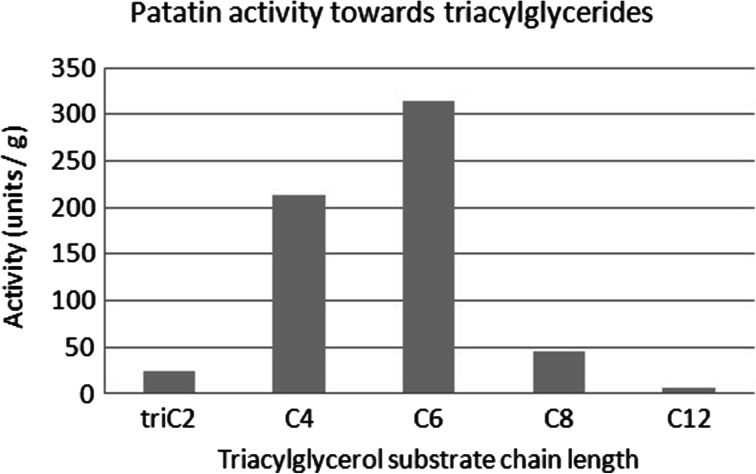
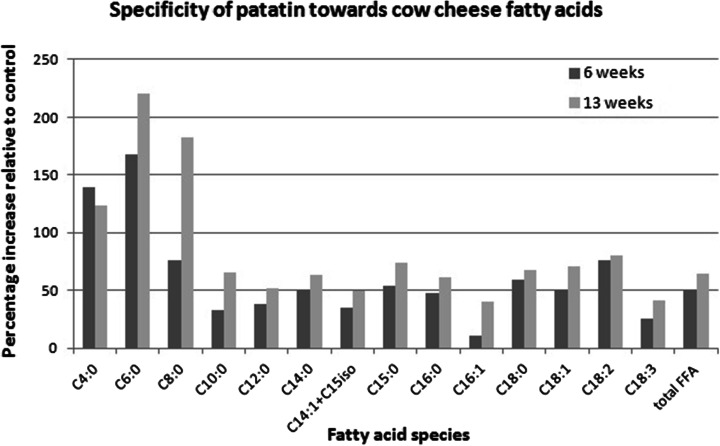
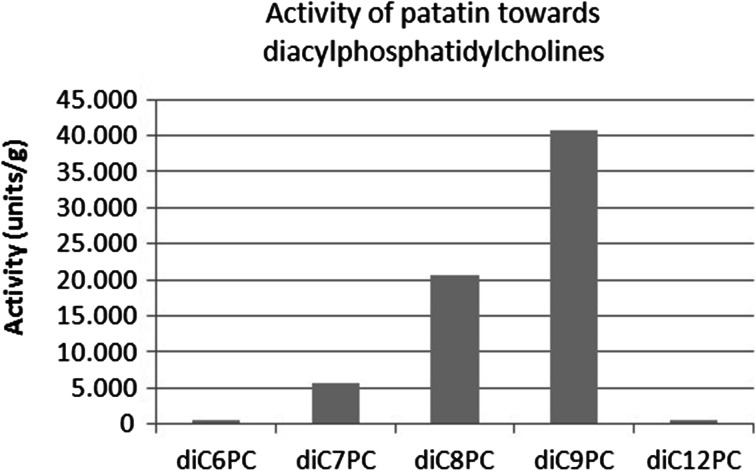
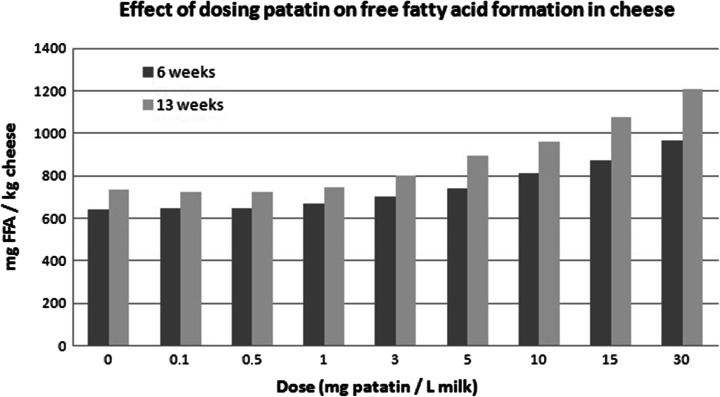
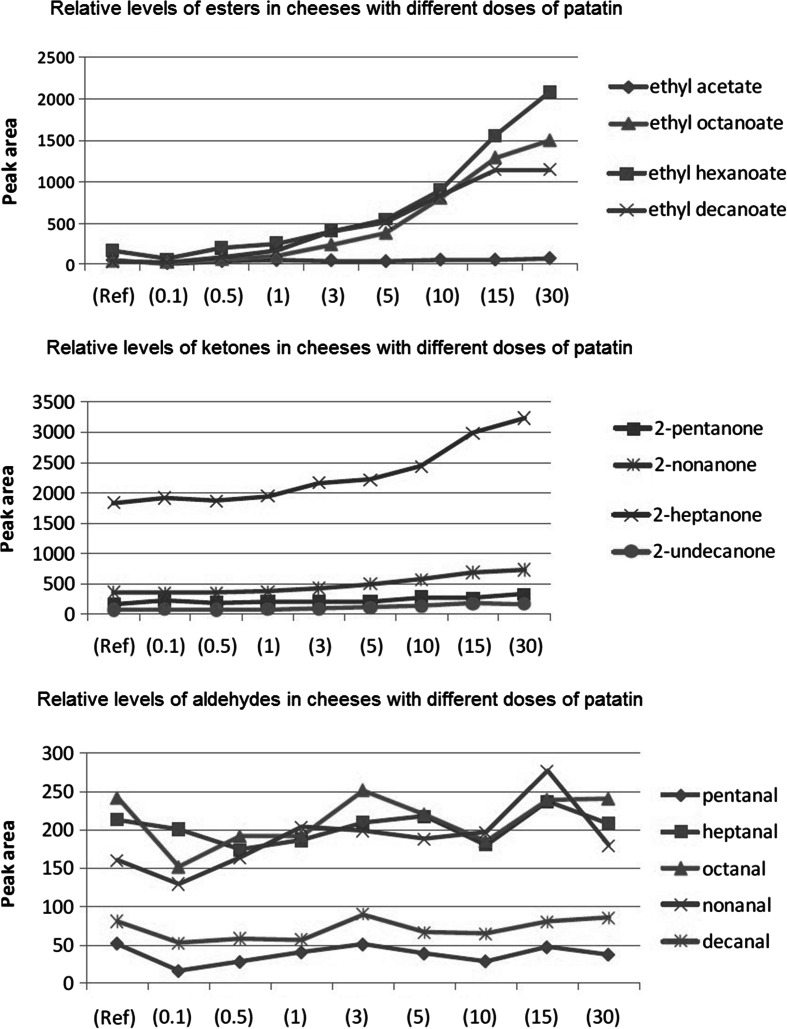
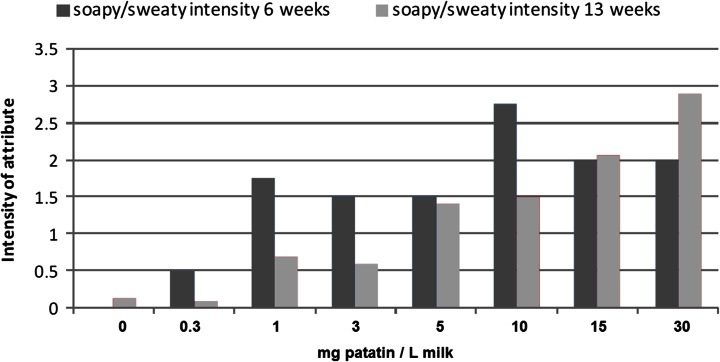
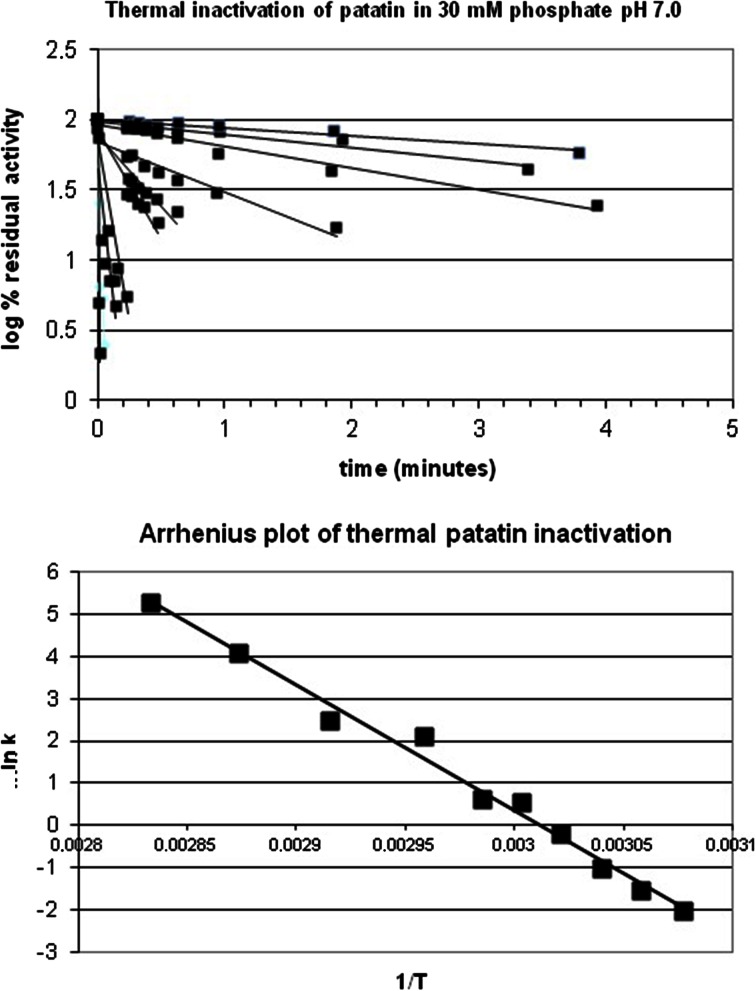
Verification
Claims the paper makes
The claims and statistics of this paper haven’t been checked yet.
Run the check — free, no account needed. It reads the open-access text and checks the sources it cites.
Claims other papers make about this one
Each is checked against this paper’s own text: does it say what the citing paper says it does?
The cited source says what the claim attributes to it.
In the citing paper
“Short chain fatty acids play a significant function directly in creating aroma in many ripened cheeses (Delgado et al. 2011; Spelbrink et al. 2015).”
From Optimizing the acceleration of Cheddar cheese ripening using response surface methodology by microbial protease without altering its quality features (2021) · cites this paper as Spelbrink et al. 2015
Self-check
Percentages, sums and reported differences re-computed from the paper’s own numbers.
The self-check needs the paper’s full text.
Citations
Cites
Lipolysis and free fatty acid catabolism in cheese: a review of current knowledge
Collins, Y. F., McSweeney, P. L. H., & Wilkinson, M. G. (2003) · International Dairy Journal · doi:10.1016/s0958-6946(03)00109-2 · Cited by 800
de Jong, C., & Badings, H. T. (1990) · Journal of High Resolution Chromatography · doi:10.1002/jhrc.1240130204 · Cited by 321
Rydel, T. J., Williams, J. M., Krieger, E. K., Moshiri, F., Stallings, W. C., Brown, S. M., Pershing, J. C., Purcell, J. P., & Alibhai, M. F. (2003) · Biochemistry · doi:10.1021/bi027156r · Cited by 297
Kinetic Parameters for the Thermal Inactivation of Quality-Related Enzymes in Carrots and Potatoes
Anthon, G. E., & Barrett, D. M. (2002) · Journal of Agricultural and Food Chemistry · doi:10.1021/jf011698i · Cited by 220
A MAJOR SOLUBLE GLYCOPROTEIN OF POTATO TUBERS
Racusen, D., & Foote, M. W. (1980) · Journal of Food Biochemistry · doi:10.1111/j.1745-4514.1980.tb00876.x · Cited by 190
GALLIARD, T. (1971) · Biochemical Journal · doi:10.1042/bj1210379 · Cited by 171
Lipolysis and Metabolism of Fatty Acids in Cheese
Thierry, A., Collins, Y. F., Mukdsi, M. C. A., McSweeney, P. L. H., Wilkinson, M. G., & Spinnler, H.-É. (2017) · Elsevier eBooks · doi:10.1016/b978-0-12-417012-4.00017-x · Cited by 153
Cloning, expression, purification and characterization of patatin, a novel phospholipase A
Hirschberg, H. J. H. B., Simons, J. F. A., Dekker, N., et al. (2001) · European Journal of Biochemistry · doi:10.1046/j.0014-2956.2001.02411.x · Cited by 140
van Koningsveld, G. A., Walstra, P., Voragen, A. G. J., et al. (2006) · Journal of Agricultural and Food Chemistry · doi:10.1021/jf061278z · Cited by 88
(2003) · CRC Press eBooks · doi:10.1201/9780203486207 · Cited by 83
Use of methylumbeliferyl-derivative substrates for lipase activity characterization
Prim, N., Sánchez, M., Ruiz, C., Pastor, F. I. J., & Díaz, P. (2003) · Journal of Molecular Catalysis B Enzymatic · doi:10.1016/s1381-1177(03)00048-1 · Cited by 81
Angelita Gambuti, B., Rinaldi, A., & Luigi Moio, B. (2012) · European Food Research and Technology · doi:10.1007/s00217-012-1791-y · Cited by 73
Alting, A. C., Pouvreau, L. A. M., Giuseppin, M. L. F., & van Nieuwenhuijzen, N. H. (2011) · Elsevier eBooks · doi:10.1533/9780857093639.316 · Cited by 66
Self-citationIsolation and Characterization of Patatin Isoforms
Pots, A. M., Gruppen, H., Hessing, M., van Boekel, M. A. J. S., & Voragen, A. G. J. (1999) · Journal of Agricultural and Food Chemistry · doi:10.1021/jf981180n · Cited by 64
The use of lamb rennet paste in traditional sheep milk cheese production
Addis, M., Piredda, G., & Pirisi, A. (2008) · Small Ruminant Research · doi:10.1016/j.smallrumres.2008.07.002 · Cited by 58
A high-throughput cheese manufacturing model for effective cheese starter culture screening
Bachmann, H., Kruijswijk, Z., Douwe Molenaar, B., Kleerebezem, M., & Vlieg, J. E. T. V. H. (2009) · Journal of Dairy Science · doi:10.3168/jds.2009-2372 · Cited by 58
The Mesomorphic Phase Behavior of Lipid Bilayers
Lewis, R. N. A. H., & McElhaney, R. N. (2004) · CRC Press eBooks · doi:10.1201/9781420040203.ch2 · Cited by 53
Emulsifying properties of undenatured potato protein concentrate
Holm, F., & Eriksen, S. (1980) · International Journal of Food Science & Technology · doi:10.1111/j.1365-2621.1980.tb00920.x · Cited by 48
Lipases in dairy industry: A review
Jooyandeh, H., Kaur, A., & Minhas, K. S. (2009) · Cited by 47
Expanded bed adsorption for recovery of patatin from crude potato juice
Strætkvern, K. O., Schwarz, J., Wiesenborn, D. P., et al. (1998) · Bioseparation · doi:10.1023/a:1008161618599 · Cited by 35
Functional Properties of Whey‐Pea Protein Composite Blends in a Model System
Jackman, R. L., & Yada, R. Y. (1989) · Journal of Food Science · doi:10.1111/j.1365-2621.1989.tb05975.x · Cited by 35
Knorr, D. (1982) · Journal of Food Process Engineering · doi:10.1111/j.1745-4530.1982.tb00275.x · Cited by 34
Application of potato lipid acyl hydrolase for the synthesis of monoacylglycerols
Macrae, A. R., Visicchio, J. E., & Lanot, A. (1998) · Journal of the American Oil Chemists Society · doi:10.1007/s11746-998-0083-y · Cited by 30
Functional Properties of Whey‐Potato Protein Composite Blends in a Model System
Jackman, R. L., & Yada, R. Y. (1988) · Journal of Food Science · doi:10.1111/j.1365-2621.1988.tb09292.x · Cited by 30
Acceleration of cheese ripening
Upadhyay, V. K., & McSweeney, P. L. H. (2003) · Elsevier eBooks · doi:10.1533/9781855737075.3.419 · Cited by 27
Anderson, C. L., Pinsirodom, P., & Parkin, K. L. (2007) · Journal of Food Biochemistry · doi:10.1111/j.1745-4514.2002.tb00050.x · Cited by 21
Composition and activity of commercial triacylglycerol acylhydrolase preparations
Bjurlin, M. A., Bloomer, S., & Haas, M. J. (2001) · Journal of the American Oil Chemists Society · doi:10.1007/s11746-001-0236-9 · Cited by 17
Industrial Application of Lipases in Cheese Making: A review
El-Hofi, M. A., El-Tanboly, E.-S., & Abd‐Rabou, N. S. (2011) · Cited by 16
Research works printed but not linked: 3
- Harboe, M. (1994). Use of lipases in cheesemaking. Bulletin of the International Dairy Federation, No. 294, pp. 11–16.
- El Soda, M. (2003). Accelerated cheese ripening. In Encyclopedia of dairy sciences (pp. 327–329). Cornwall, Academic Press.
- in Food Chemicals Codex, Volume 1, Codex, Institute of Medicine (USA) Committee on Food Chemicals, National Academies Press, 1996, pp. 803–807.
Cited by
Alhelli, A. M., Mohammed, N. K., Khalil, E. S., & Hussin, A. S. M. (2021) · AMB Express · doi:10.1186/s13568-021-01205-9 · Cited by 23
Metadata
- Authors
- Spelbrink, R. E. J., Lensing, H., Egmond, M. R., & Giuseppin, M. L. F.
- Affiliations
- Averis Seeds (Netherlands) (NL)
- Utrecht University (NL)
- Corresponding author
- Spelbrink, Robin E. J.
- Venue
- Applied Biochemistry and Biotechnology
- Published
- 2015-03-27
- Volume
- 176
- Issue
- 1
- Pages
- 231-243
- ISSN
- 0273-2289 (ISSN-L)
- 1559-0291
- PMC
- PMC4439436
- OpenAlex
- W1995290689
- Cited by
- 39
- References
- 28
- Citations by year
- 2026: 5 · 2025: 2 · 2024: 7 · 2023: 4 · 2022: 5 · 2021: 5 · 2020: 4 · 2019: 2 · 2018: 3 · 2017: 1 · 2016: 1
- FWCI
- 0.72
- Type
- journal article
- Language
- en
- Open access
- hybrid
- doi.org
- Locations
- Applied Biochemistry and Biotechnology (publishedVersion, cc-by)
- PubMed Central (publishedVersion, cc-by)
- PubMed (publishedVersion)
- Utrecht University Repository (Utrecht University) (submittedVersion, other-oa)
- Topics
- Life Sciences › Biochemistry, Genetics and Molecular Biology › Molecular Biology › Enzyme Catalysis and Immobilization
- Life Sciences › Agricultural and Biological Sciences › Food Science › Proteins in Food Systems
- Life Sciences › Agricultural and Biological Sciences › Food Science › Food Chemistry and Fat Analysis
- Keywords
- patatin, short-chain fatty acids, cheese ripening, cheese flavor, milk fat, triglycerides, substrate specificity, curd, whey, thermal inactivation, Arrhenius kinetics, food emulsions
- MeSH terms
- Animals, Carboxylic Ester Hydrolases, Cattle, Cheese, Fatty Acids, Humans, Milk, Plant Proteins, Solanum tuberosum, Triglycerides
About these checks
Registry, retraction, Cites and statistics results are computed, not judged, with one exception: a printed reference that no index lists is read once by a model before it counts as a citation error. Claims are extracted by a model and kept only when their quote appears verbatim in the text; each cited source is then checked, with a model’s help, for whether it says what the claim relies on. Those verdicts can be wrong — read the claim’s quote and the cited source before relying on one.
Statistics and arithmetic are recomputed, not judged.
Confidence bands are shown only for fields calibrated on our annotated test set. None is calibrated yet, so no band is shown.
What counts as a claim ›How we measure confidence ›How we check this ›
Are you an author, or do you see a problem with this page? Request a review
