

A mixed-methods study of problematic social media use, attention dysregulation, and social media use motives
Open accessThe DOI matches its Crossref record; 80 of the 81 references it cites were found in a registry or an index; 28 of the 72 sources its claims cite were checked for support.
Abstract
Problematic social media use (PSMU) refers to excessive uncontrolled use of social media which impacts upon daily functioning (Blackwell et al., 2017). Self-regulation is central to the development and experience of PSMU, and conceptually interrelates with individual usage motivations (Reinecke et al., 2022). While there is a growing body of research on social media use motivations, how usage motivations and self-regulation combined influence PSMU is not well understood. There are also persistent questions around the effectiveness of addiction-based measures of PSMU. The quantitative component of this nested mixed-methods study (N = 607) employed hierarchical regression and structural equation modelling, principally identifying that impulsive social media usage mediates the pathway between perceived executive/attentional functioning and the Bergen Social Media Addiction Scale (BSMAS, Andreassen et al., 2012, 2016), a popular tool used to measure PSMU. In contrast, social-engagement motivations had a negative influence on the BSMAS. The qualitative component, comprising interview/open-ended questionnaire, explored individual experiences self-regulating social media use. Participants (N = 24) were recruited from the survey study, based on meeting screening criteria for executive dysfunction (Adult Self-Report ADHD Scale, Kessler et al., 2005), with sub-groups defined by top and bottom quartile BSMAS scores (evenly grouped). Thematic analysis found that most individuals with attention dysregulation, regardless of their BSMAS category, perceive self-regulation of social media use as highly challenging and effortful, describing broadly problematic relationship with social media. They also described rich combination of motivations and context of using social media, and strategies for managing use. This research questions the effectiveness of the BSMAS as a measure of general PSMU (lacking a formed self-regulation component), especially in individuals with attentional dysregulation. Future research investigating self-regulation strategies and focusing on characteristics of positive social media use is needed.
Overview
CoChat Summary
TL;DR
This nested mixed-methods study found that attention dysregulation predicts problematic social media use (PSMU) mainly through impulsive/habitual social media use, while social-connection motives negatively predict PSMU. Qualitative interviews with attention-dysregulated students suggested self-regulation of social media is highly effortful and that the BSMAS may not distinguish well between high and low problematic-use experiences.
Key findings
- In hierarchical regression (N = 607), attention dysregulation predicted BSMAS scores (β = 0.606, p < .001), but this dropped after adding usage motives (β = 0.105, p = .013); impulsive use was the strongest predictor (β = 0.715, p < .001), while social-connection motivation was negatively related (β = −0.081, p = .011) and engaged entertainment/information/stress-relief motives were not (β = −0.029, p = .466).
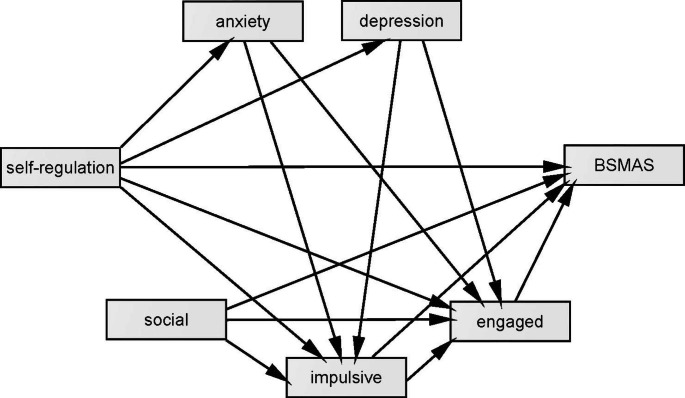
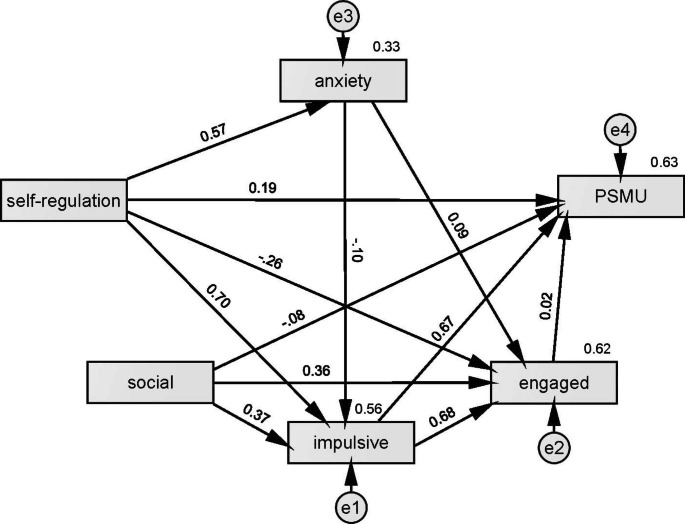
- SEM showed a significant indirect path from attention dysregulation to PSMU through impulsive use (B = 0.532, p = .001), and a direct attention→PSMU path (B = 0.186, p = .001); engaged use did not mediate attention→PSMU (B = −0.007, p = .602).
- Social-connection motives had a negative direct effect on PSMU (B = −0.076, p = .015) but also a positive indirect effect through impulsive use (B = 0.193, p = .001).
- Thematic analysis (N = 24) produced two themes and seven subthemes; most attention-dysregulated participants, regardless of high/low BSMAS category, described self-regulation as highly challenging and effortful, with similar experiences across BSMAS groups except for stronger urges in the high-BSMAS group.
Methods
- Nested mixed-methods design: quantitative survey of 607 first-year psychology students (age 17–58, M = 22.02, SD = 6.179; 475 cisgender women, 126 men, 4 non-binary, 2 undisclosed), using BSMAS, ASRS, DASS-21, and an ad-hoc 12-item social media motives measure.
- Quantitative analysis used exploratory factor analysis, hierarchical regression, confirmatory factor analysis, and structural equation modelling in SPSS/AMOS; final SEM fit was acceptable with caveats (χ²/df = 4.708, RMSEA = 0.078, TLI = 0.971, CFI = 0.994, CN = 336).
- Qualitative component recruited 24 participants (19 women, 5 men; age 18–31, M = 20.8, SD = 3.9) from the survey based on clinical ASRS score ≥5 and top/bottom BSMAS quartiles; 7 interviews and 17 open-ended questionnaires were analyzed using Braun and Clarke’s six-step thematic analysis.
Limitations
- The paper states that participants were first-year university psychology students, limiting generalizability beyond young people attending university, and that about 80% of both samples were women; it also notes possible COVID-19 lockdown effects on social media experiences during data collection.
- The paper states broader PSMU/SMA field limitations: addiction-based measures may be flawed, screening tools are prone to false positives, and the BSMAS lacks a defined self-regulation component; it also notes validity concerns in its own measurement model (e.g., AVE below 0.5 for BSMAS = 0.46, ASRS = 0.38, engaged use = 0.47, with discriminant validity issues).
- Evident from the text: the design is cross-sectional and self-report, the social media motives measure was ad-hoc, and the final SEM χ²/df exceeded the usual threshold of 3, so causal and measurement claims require caution and replication.
Model-written summary. Check it against the paper before relying on it.
Integrity signals
Registry
Cites
Statistics
Figures
Verification
Claims the paper makes
23 Valid · 1 Not valid · 30 Not checked · 62 Own results and interpretations
The cited sources support only part of this claim — read each source’s verdict below.
In the paper
“and with related areas of problematic internet and smartphone use (Cakmak & Gul, 2018; Demirtaş et al., 2020; Evren et al., 2018; Panagiotidi & Overton, 2020; Wang et al., 2017).”
§ A mixed-methods study of problematic social media use, attention dysregulation, and social media use motives > Problematic Social Media Use > Importance of self-regulation
What the sources say
- Partly supportedcites Cakmak & Gul, 2018 matched to “Factors Associated with Problematic İnternet Use among Children and Adolescents with Attention Deficit Hyperactivity Disorder” (2017) sourceExperimental — accuracy not yet measured
The Discussion (page unavailable) reports that problematic internet use was more frequent among children and adolescents with ADHD, supporting the internet-use portion. The paper does not report an association between ADHD and problematic smartphone use. (LLM, conf=0.88)
- Not checked — no full text of the sourcecites Demirtaş et al., 2020 matched to “Lifetime depressive and current social anxiety are associated with problematic internet use in adolescents with ADHD: a cross‐sectional study” (2021) source
- Not checked — no full text of the sourcecites Evren et al., 2018 matched to “Relationship of internet addiction severity with probable ADHD and difficulties in emotion regulation among young adults” (2018) source
plainstates an association- Asserted: passes — The authors put it forward as true.
- Checkable: passes — It can be checked against evidence.
- Load-bearing: unclear — It is unclear whether the paper’s conclusions depend on it.
- Based: passes — The paper gives a reason why it holds.
- Partly supported
Every source the paper cites for this claim was checked and supports it.
In the paper
“there are concerns with survey-based addiction screening tools, which tend to have low predictive value, especially where the prevalence of a particular disorder is low (Maraz et al., 2015)”
§ A mixed-methods study of problematic social media use, attention dysregulation, and social media use motives > Problematic Social Media Use
What the sources say
- Supportedcites Maraz et al., 2015 matched to “Commentary on: Are we overpathologizing everyday life? A tenable blueprint for behavioral addiction research: The diagnostic pitfalls of surveys: If you score positive on a test of addiction, you still have a good chance not to be addicted” (2015) source
The Examples section states that positive predictive value falls as disorder prevalence drops. The Conclusions and Future Recommendations section says that, for relatively rare disorders, a positive screening result is typically not useful for confirming the disorder because of false positives. (LLM, conf=0.93)
plain- Asserted: passes — The authors put it forward as true.
- Checkable: passes — It can be checked against evidence.
- Load-bearing: passes — The paper’s conclusions depend on it.
- Based: passes — The paper gives a reason why it holds.
- Supported
The cited sources support only part of this claim — read each source’s verdict below.
In the paper
“ADHD has been positively correlated with PSMU (Andreassen et al., 2016; Hussain & Griffiths, 2021; Merelle et al., 2017; Ra et al., 2018)”
§ A mixed-methods study of problematic social media use, attention dysregulation, and social media use motives > Problematic Social Media Use > Importance of self-regulation
What the sources say
- Supportedcites Andreassen et al., 2016 matched to “The relationship between addictive use of social media and video games and symptoms of psychiatric disorders: A large-scale cross-sectional study” (2016) source
The Results (p. 13) report a positive association between ADHD and addictive use of social media (β = .268). The ADHD discussion (p. 15) likewise states that ADHD was positively associated with addictive social networking. (LLM, conf=0.94)
- Supportedcites Hussain & Griffiths, 2021 matched to “The Associations between Problematic Social Networking Site Use and Sleep Quality, Attention-Deficit Hyperactivity Disorder, Depression, Anxiety and Stress” (2021) source
The Correlational Analysis reports a positive association between ADHD and social media addiction (r = .47, p < .01). The Discussion likewise states that SNS addiction was positively associated with ADHD. These passages support the attributed claim about problematic social media use. (LLM, conf=0.95)
- Not matchedcites Merelle et al., 2017
An author–year citation the paper’s reference list doesn’t settle. We don’t search these by name.
plainstates an association- Asserted: passes — The authors put it forward as true.
- Checkable: passes — It can be checked against evidence.
- Load-bearing: passes — The paper’s conclusions depend on it.
- Based: passes — The paper gives a reason why it holds.
- Supported
Every source the paper cites for this claim was checked and supports it.
In the paper
“van den Eijnden and colleagues (2018) distinguish between heavy social media use and addictive social media use.”
§ A mixed-methods study of problematic social media use, attention dysregulation, and social media use motives > Problematic Social Media Use
What the sources say
- Supportedcites van den Eijnden et al., 2018 matched to “The impact of heavy and disordered use of games and social media on adolescents’ psychological, social, and school functioning” (2018) source
The Introduction’s “Conceptualization of IGD and SMD” section distinguishes highly engaged (heavy), non-disordered behavior from disordered (addicted) behavior. The Conclusions likewise distinguish engaged social media use from symptoms of social media disorder. Page numbers are not provided in the excerpts. (LLM, conf=0.94)
plain- Asserted: passes — The authors put it forward as true.
- Checkable: passes — It can be checked against evidence.
- Load-bearing: unclear — It is unclear whether the paper’s conclusions depend on it.
- Based: passes — The paper gives a reason why it holds.
- Supported
Every source the paper cites for this claim was checked and supports it.
In the paper
“They found positive social outcomes, including the formation and development of friendships, for individuals in the heavy social media use group”
§ A mixed-methods study of problematic social media use, attention dysregulation, and social media use motives > Problematic Social Media Use
What the sources say
- Supportedcites van den Eijnden et al., 2018 matched to “The impact of heavy and disordered use of games and social media on adolescents’ psychological, social, and school functioning” (2018) source
The Discussion reports positive social effects of heavy social media use among adolescents and says frequent engagement can help develop and maintain social relations and friendships. This matches the attributed finding. (LLM, conf=0.94)
plainstates an association- Asserted: passes — The authors put it forward as true.
- Checkable: passes — It can be checked against evidence.
- Load-bearing: unclear — It is unclear whether the paper’s conclusions depend on it.
- Based: passes — The paper gives a reason why it holds.
- Supported
50 more claims · 5 with their cited sources checked
Create a free account to see all 116 claims and to verify the 1 reference still open.
- Probably not a substantial claim. 42
- It may state two separate claims as one. 30
Claims other papers make about this one
Each is checked against this paper’s own text: does it say what the citing paper says it does?
In the citing paper
“Social media use (SMU) has been associated with negative mental health outcomes and has been implicated in inhibitory attentional control deficits.”
From Investigating the links between objective social media use, attentional control, and psychological distress (2024) · cites this paper as Arness and Ollis, 2022
Self-check
Percentages, sums and reported differences re-computed from the paper’s own numbers.
Each contradiction between two passages listed here was confirmed by an independent check.
Rated minor: it would not touch a result — a value no result rests on, a p-value that stays on the same side of the significance level, or a conflict that is clerical, resolved elsewhere in the paper, or outside its own findings.
In the paper
§ A mixed-methods study of problematic social media use, attention dysregulation, and social media use motives > Results > Quantitative results
“DASS_A is the DASS depression scale; DASS_A is the DASS anxiety scale”
§ A mixed-methods study of problematic social media use, attention dysregulation, and social media use motives > Results > Quantitative results
“Figure: Fig. 2 Structural model predicting PSMU (BSMAS) from attention dysregulation (ASRS), mediated by social media use motives (social, engaged, and impulsive), and anxiety (DASS_A)”
Rated minor: it would not touch a result — a value no result rests on, a p-value that stays on the same side of the significance level, or a conflict that is clerical, resolved elsewhere in the paper, or outside its own findings.
In the paper
§ A mixed-methods study of problematic social media use, attention dysregulation, and social media use motives > Results > Quantitative results
“Finally, there was a multi-path mediation effect from attention to PSMU through anxiety and engagement.”
§ A mixed-methods study of problematic social media use, attention dysregulation, and social media use motives > Results > Quantitative results
“9. | attention→anxiety→impulsive→PSMU | | -0.045 | 0.014 | | | -0.069 | -0.022 | | 0.001”
Rated minor: it would not touch a result — a value no result rests on, a p-value that stays on the same side of the significance level, or a conflict that is clerical, resolved elsewhere in the paper, or outside its own findings.
In the paper
§ A mixed-methods study of problematic social media use, attention dysregulation, and social media use motives > Results > Qualitative results
“All participants voiced that a key purpose of their social media use was to connect with others”
§ A mixed-methods study of problematic social media use, attention dysregulation, and social media use motives > Results > Qualitative results
“| Connecting with Others | 29 | 9 | 9 |”
Citations
Cites
Using thematic analysis in psychology
Braun, V., & Clarke, V. (2006) · Qualitative Research in Psychology · doi:10.1191/1478088706qp063oa · Cited by 194,414
Diagnostic and Statistical Manual of Mental Disorders
American Psychiatric Association (2013) · doi:10.1176/appi.books.9780890425596 · Cited by 116,369
Evaluating Structural Equation Models with Unobservable Variables and Measurement Error
Fornell, C., & Larcker, D. F. (1981) · Journal of Marketing Research · doi:10.2307/3151312 · Cited by 109,314 · cited 1×
“Following Fornell and Larcker (1981), and Hair et al. (2010), convergent validity was problematic, with Average Variance Extracted (AVE) below the 0.5 threshold, for BSMAS (0.46), ASRS (0.38) and engaged usage motivation (0.47), while issues with discriminant validity were observed for DASS anxiety…”
BackgroundInfluentialEvaluating structural equation models with unobservable variables and measurement error
Fornell, C., & Larcker, D. F. (1981) · Journal of Marketing Research · doi:10.1177/002224378101800104 · Cited by 109,190
Podsakoff, P. M., MacKenzie, S. B., Lee, J.-Y., & Podsakoff, N. P. (2003) · Journal of Applied Psychology · doi:10.1037/0021-9010.88.5.879 · Cited by 82,194 · cited 1×
“Common Method Variance (CMV) is known to be both a measurement and design issue (Podsakoff et al. 2003; Spector 2006), especially present in cross-sectional surveys (Jordan & Troth, 2020).”
BackgroundSocial network sites: definition, history, and scholarship
boyd, D. M., & Ellison, N. B. (2007) · Journal of Computer-Mediated Communication · doi:10.1111/j.1083-6101.2007.00393.x · Cited by 16,251
Accounting for common method variance in cross-sectional research designs
Lindell, M. K., & Whitney, D. J. (2001) · Journal of Applied Psychology · doi:10.1037/0021-9010.86.1.114 · Cited by 8,490
Using Self-Report Assessment Methods to Explore Facets of Mindfulness
Baer, R. A., Smith, G. T., Hopkins, J., Krietemeyer, J., & Toney, L. (2006) · Assessment · doi:10.1177/1073191105283504 · Cited by 7,511 · cited 2×
“We confirmed no signifi - cant CMV using Lindell and Whitney’s ( 2001) approach, selecting a marker variable (the describing subscale of the Five Factor Mindfulness Questionnaire, Baer et al., 2006) according to recommendations of Simmering et al. (2015).”
Method(1995) · Cited by 6,909
Henry, J. D., & Crawford, J. R. (2005) · British Journal of Clinical Psychology · doi:10.1348/014466505x29657 · Cited by 5,801
Research works printed but not linked: 1
- Mérelle S Kleiboer A Schotanus M Cluitmans TL Waardenburg CM Kramer D van Rooij A Which health-related problems are associated with problematic video-gaming or social media use in adolescents? Clinical Neuropsychiatry: journal of treatments evaluation 2017 14 1 11 19
Cited by
Firth, J., Torous, J., López‐Gil, J. F., Linardon, J., Milton, A., Lambert, J., Smith, L., Jarić, I., Fabian, H., Vancampfort, D., et al. (2024) · World Psychiatry · doi:10.1002/wps.21188 · Cited by 80
“For instance, the ability to successfully self-regulate engagement can be challenging when users are in a “ trance ” or “ mindlessly scrolling ” 42 .”
BackgroundInfluentialThorell, L. B., Autenrieth, M., Riccardi, A., Burén, J., & Nutley, S. B. (2024) · Frontiers in Psychology · doi:10.3389/fpsyg.2024.1437109 · Cited by 40
“…sharing (Schivinski et al., 2020; Tang et al., 2022) and self-status (Süral et al., 2019; Kircaburun et al., 2020), but not with information seeking (Süral et al., 2019; Brailovskaia et al., 2020; Kircaburun et al., 2020; Ponnusamy et al., 2020; Stockdale and Coyne, 2020; Arness and Ollis, 2022).”
BackgroundResultInfluentialZhang, L., Bu, P., & Liu, H. (2022) · Nursing Open · doi:10.1002/nop2.1480 · Cited by 16
“The three sub- scales have excellent validity and internal consistency: depression (ɑ = .97), anxiety (ɑ = .92) and stress (ɑ = .95) (Arness & Ollis, 2022), and the test– retest validity of depression, anxiety and stress reported by Samani and Jokar in Iran were 0.80, 0.76 and 0.77 (Zakeri et al.,…”
BackgroundInfluentialJones, C. N., Rudaizky, D., Mahalingham, T., & Clarke, P. J. F. (2024) · Social Science & Medicine · doi:10.1016/j.socscimed.2024.117400 · Cited by 15
Social Media Use Motives: An Influential Factor in User Behavior and User Health Profiles
Ewing, C. R., Nienstedt, C., Wright, R. R., & Chambers, S. (2023) · Psi Chi Journal of Psychological Research · doi:10.24839/2325-7342.jn28.4.275 · Cited by 26
“However, once again, it is important to note that some studies in this area of research have identified no clear relationship between problematic social media use, wellbeing, and motivations such as entertainment and information seeking (Arness & Ollis, 2022).”
BackgroundChao, M., Sun, W., Liu, J., Ding, J., & Zhu, Y. (2024) · Journal of Computer Assisted Learning · doi:10.1111/jcal.13111 · Cited by 21
von Fedak, V., & Langlais, M. R. (2024) · Psi Chi Journal of Psychological Research · doi:10.24839/2325-7342.jn29.2.129 · Cited by 13
“A mixedmethods study with social connection motivations showed a negative direct effect on problematic social media use, with a positive indirect effect on problematic social media use through impulsive use (Arness & Ollis, 2022).”
Ma, X., Liu, Q., & Zhang, W. (2025) · Frontiers in Psychology · doi:10.3389/fpsyg.2025.1579509 · Cited by 28
Relationship between Social Networking Addiction and Academic Performance in Students of University
Alhrahsheh, R. R., & Majali, S. A. (2023) · International Journal of Instruction · doi:10.29333/iji.2023.16241a · Cited by 13
Identifying consumer-based digital content marketing consumption motives: a qualitative study
Gupta, S., & Dutt, R. (2024) · Journal of Advances in Management Research · doi:10.1108/jamr-08-2023-0218 · Cited by 14
Spiritual Mindfulness-Based Intervention for Nomophobia: A Randomized Controlled trial
Safaria, T., Arini, D. P., & Saputra, N. E. (2023) · Islamic Guidance and Counseling Journal · doi:10.25217/0020236404400 · Cited by 11
“…negative impacts of unhealthy phone usage have given rise to internet addiction (James et al., 2023), social media addiction (Kim et al., 2009; Arness & Ollis, 2022; Boniel-Nissim et al., 2022), problematic phone usage (Wang et al., 2015; Muench & Muench, 2020), phubbing (Tomczyk & Lizde,…”
BackgroundInclusive Recommender Systems: Addressing Needs of Users with ADHD
Khan, S., Iqbal, M., Knijnenburg, B. P., & Dixon, E. (2026) · ACM Transactions on Recommender Systems · doi:10.1145/3769427 · Cited by 10
Xiaodi, M., Li, B., Nie, H., Ding, W., He, R., He, W., & Liu, W. (2025) · Scientific Reports · doi:10.1038/s41598-025-24317-9 · Cited by 4
“To make up for the lack of real-life social interaction, individuals may turn to social media to seek emotional support and a sense of belonging, thus forming an alternative social compensation mechanism 51 .”
How does social media use affect employee voice behaviour?
Zhao, G. (2024) · Journal of Psychology in Africa · doi:10.1080/14330237.2024.2362117 · Cited by 4
“Overall, the impact of social media on employee voice is complex and multifaceted (Arness & Ollis, 2023; Blackwell et al., 2017; Brooks, 2015; van Zoonen et al., 2016; Verduyn et al., 2015).”
Ding, J., Liu, Z., & Chao, M. (2025) · Journal of Psychiatric Research · doi:10.1016/j.jpsychires.2025.07.009 · Cited by 9
Difficulty in Attention Switching and Its Neural Basis in Problematic Smartphone Use
Kobayashi, N., Jitoku, D., Hamamura, T., Honjo, M., Yamaguchi, Y., Shimizu, M., Takagi, S., Fujino, J., Sugihara, G., & Takahashi, H. (2025) · Brain Sciences · doi:10.3390/brainsci15101100 · Cited by 2
“Individuals with reduced attentional control may find it harder to disengage once they begin using their device, leading to extended screen time that continues beyond intended bedtimes [26].”
Gupta, S., & Dutt, R. (2025) · Global Business Review · doi:10.1177/09721509251391522 · Cited by 3
Learning self-regulation: an important soft skill for AYAs
Bhave, S., Jacob, J. S., Soni, N., Joshi, S., Mota, J., & Sovani, A. V. (2023) · Journal of Pediatrics & Neonatal Care · doi:10.15406/jpnc.2023.13.00530 · Cited by 2
Impulsive buying in buyer–seller service encounters
Ali, F., Tauni, M. Z., Butt, A. H., Ali, A. J., & Yuan, J. (2024) · International Journal of Consumer Studies · doi:10.1111/ijcs.13068 · Cited by 2
Faulhaber, M. E. (2023) · doi:10.31274/td-20240617-356 · Cited by 4
Efectos de la adicción a redes sociales en la atención ejecutiva: análisis conductual y neurológico
De León Rivas, J. M. (2024) · Revista Académica Sociedad del Conocimiento Cunzac · doi:10.46780/sociedadcunzac.v4i1.120 · Cited by 1
Yuniar, A. D., Danu, R. T., Roziqin, A., & Syahri, M. (2024) · Atlantic Journal of Communication · doi:10.1080/15456870.2024.2433531 · Cited by 5
“In this research, the use of social media to relieve stress and entertainment had the highest percentage, while in others, the consistent use led to stress and even anxiety (Arness & Ollis, 2022).”
Stojković, I. B., Mentus, T., Jelić, M. M., Filipović, B., & Veselinović, M. (2026) · Frontiers in Psychology · doi:10.3389/fpsyg.2026.1643702 · Cited by 2
Big tech, the state, or you? Who is responsible for generative AI addiction?
Stahl, B. C., Ali, R., Hitcham, L., Liebherr, M., Murray, R., Vallejos, E. P., & Yankouskaya, A. (2026) · Behaviour and Information Technology · doi:10.1080/0144929x.2026.2663509 · Cited by 3
Li, Y., Lie, L., Zhou, L., & Qiu, Y. (2026) · Frontiers in Public Health · doi:10.3389/fpubh.2026.1803931 · Cited by 1
“…Edition), However, an increasing number of researchers believe that it shares similar characteristics with other non-substance addictions, including excessive use, withdrawal symptoms, and functional impairment (13), and therefore consider it a potential behavioral addiction for research (14, 15).”
What motivates users to keep WhatsApp statuses: a scale development study
Pattusamy, M., & Chopdar, P. K. (2023) · Asia Pacific Journal of Marketing and Logistics · doi:10.1108/apjml-06-2023-0529 · Cited by 2
The relationship between ADHD, OCD, and problematic social media use
Hawi, N. S., Samaha, M., & Shaffu, E. (2026) · Acta Psychologica · doi:10.1016/j.actpsy.2026.107134
Wang, Y., Zhang, L., Elhai, J. D., Montag, C., Lau, J. T. F., & Yang, H. (2025) · doi:10.2196/preprints.77981
Fear of Missing Out and Problematic Social Media Use: A Literature Review
Tantiani, F. F., & Tri Atika Melya., B. (2025) · KnE Social Sciences · doi:10.18502/kss.v10i25.19916 · Cited by 2
“PSMU impacts mental health and well-being, such as headaches, neck pain, poor sleep, irritability, anxiety, and loneliness (10).”
Niteesh, K. R., & Pooja, T. S. (2025) · Asia-Pacific Signal and Information Processing Association Annual Summit and Conference (APSIPA ASC) · doi:10.1109/apsipaasc65261.2025.11249107
Hayes, N. L., Anderson, C. A., & Anderson, C. A. (2025) · De Gruyter eBooks · doi:10.1515/9783111292144-011
Adeniyi, A., Ekpe, M. P., Obi, P. A., Abubakar, S., Kigbu, A., Harris, I., & Lot-Linus, C. (2025) · Springer eBooks · doi:10.1007/978-3-031-97581-3_19
El Modo de Uso de Redes Sociales Causa Afectaciones en la Atención
Rodríguez, S. V., Valeria Peña de la, O., & Moreira, J. S. (2026) · PsicoInnova · doi:10.54376/9xggzc31
Götzfried, A., & Heitmayer, M. (2026) · Computers in Human Behavior Artificial Humans · doi:10.1016/j.chbah.2026.100255 · Cited by 8
Demirkol, S., & Kayım, F. (2026) · Çukurova Üniversitesi Sosyal Bilimler Enstitüsü Dergisi · doi:10.35379/cusosbil.1598579
Effortful control and addictive internet use in children: The key role of activation control
Takahashi, M., Adachi, M., Mori, H., Shinkawa, H., & Nakamura, K. (2026) · Computers in Human Behavior Reports · doi:10.1016/j.chbr.2026.101110
Danielsen, H. E., Finserås, T. R., Bøe, T., Hjetland, G. J., Andersen, A. I. O., Colman, I., & Skogen, J. C. (2026) · BMC Public Health · doi:10.1186/s12889-026-27631-7
“Research has reported an association between problematic social media use and ADHD symptoms (e.g. [3, 7, 17, 22]).”
InfluentialMolnar, R.-I., Sandu, C., Marchean, H., Butiu, O. R., & Mihai, A. (2026) · Romanian Journal of Psychiatry & Psychotherapy · doi:10.37897/rjpp.2026.1.6
“Modeling studies demonstrated deficits in cognitive shifting and self-regulation [73,75].”
Çelik, A. A., Altındağ, E., & Balcıoğlu, Y. S. (2026) · Telematics and Informatics Reports · doi:10.1016/j.teler.2026.100339
Molnar, R.-I., Sandu, C., Butiu, O.-R., Marchean, H., Molnar, D.-V.-N., & Mihai, A. (2026) · Diseases · doi:10.3390/diseases14060189
Lyon, R. E., Wanstall, E. A., Toplak, M. E., & Williams, T. S. (2026) · Child Neuropsychology · doi:10.1080/09297049.2026.2681663
Road rage in the digital age: social media, sleep, and aggressive driving
Serrano, D. M., & Williams, P. S. (2026) · Transportation Research Part F Traffic Psychology and Behaviour · doi:10.1016/j.trf.2026.103719 · Cited by 1
Ning, P., DeWitt, D., Chin, H. L., Hu, Y., & Wang, H. (2026) · Education + Training · doi:10.1108/et-11-2025-1023
Adolescents' perspectives on self-regulation and digital media use
Shutzman, B., & Gershy, N. (2026) · Frontiers in Developmental Psychology · doi:10.3389/fdpys.2026.1744398
Zhang, C., Wang, T., Song, Y., Meng, X., Zhang, C., Qi, Z., He, X., & Xiang, M.-Q. (2026) · Journal of Exercise Science & Fitness · doi:10.1016/j.jesf.2026.200502
Altın, R., & Ak, N. Y. (2026) · Current Psychology · doi:10.1007/s12144-026-09958-x
“…increased Internet addiction (Çimşir & Akdoğan, 2024), while attentional and self-regulatory difficulties have been found to predict problematic online behavior through impulsive and habitual use; notably, social-connection motives did not operate as comparable risk factors (Arness & Ollis, 2023).”
Sisí, C., Pallesen, S., & Fernández-Martín, M. P. (2026) · Journal of Behavioral Addictions · doi:10.1556/2006.2025.00576
Metadata
- Authors
- Arness, D. C., & Ollis, T.
- Affiliations
- Western Sydney University (AU)
- Corresponding author
- Arness, David Caelum
- ORCID
- Arness, David Caelum
- Venue
- Current Psychology
- Published
- 2022-08-08
- Volume
- 42
- Issue
- 28
- Pages
- 24379-24398
- ISSN
- 1046-1310 (ISSN-L)
- 1936-4733
- PMC
- PMC9358364
- OpenAlex
- W4290700206
- Cited by
- 52
- References
- 77
- Citations by year
- 2026: 21 · 2025: 13 · 2024: 10 · 2023: 7 · 2022: 1
- FWCI
- 11.15
- Type
- journal article
- Language
- en
- Open access
- hybrid
- doi.org
- Licence
- cc-by
- creativecommons.org/licenses/by/4.0 (tdm)
- creativecommons.org/licenses/by/4.0 (vor)
- Locations
- Current Psychology (publishedVersion, cc-by)
- PubMed Central (publishedVersion, cc-by)
- PubMed (publishedVersion)
- Funders
- Western Sydney University
- Topics
- Social Sciences › Sociology and Political Science › Impact of Technology on Adolescents
- Social Sciences › Psychology › Clinical Psychology › Sexuality, Behavior, and Technology
- Social Sciences › Communication › Digital Media and Philosophy
- Keywords
- social media addiction, self-regulation, motivations for social media use, Bergen Social Media Addiction Scale, executive dysfunction, attention deficit hyperactivity disorder, self-regulation strategies
About these checks
Registry, retraction, Cites and statistics results are computed, not judged, with one exception: a printed reference that no index lists is read once by a model before it counts as a citation error. Claims are extracted by a model and kept only when their quote appears verbatim in the text; each cited source is then checked, with a model’s help, for whether it says what the claim relies on. Those verdicts can be wrong — read the claim’s quote and the cited source before relying on one.
The claim verdicts this report counts are experimental: their accuracy is not yet measured.
A language model drew the claims from the paper on 2026-10-10, under version 3 of the claim definition (model deepseek-v4.1-flash, prompt extract-v3).
A second model labelled each claim on 2026-10-10 (model jev-1.13-20260917, definition revision gold-guideline-v0.2).
Cited sources are checked with a language model’s help (gpt-6-sol).
Statistics and arithmetic are recomputed, not judged.
Confidence bands are shown only for fields calibrated on our annotated test set. None is calibrated yet, so no band is shown.
What counts as a claim ›How we measure confidence ›How we check this ›
Are you an author, or do you see a problem with this page? Request a review
Data sources
Bibliographic data: Semantic Scholar, OpenAlex, Crossref.
Contains information from the Semantic Scholar Academic Graph Datasets, made available under the ODC Attribution License (ODC-BY 1.0).
Semantic Scholar’s data is described in: Kinney, R., et al. (2023). The Semantic Scholar Open Data Platform. arXiv:2301.10140.
