

Physiological Roles of β-amyloid in Regulating Synaptic Function: Implications for AD Pathophysiology
Open accessThe DOI matches its Crossref record; 253 of the 257 references it cites were found in a registry or an index.
Abstract
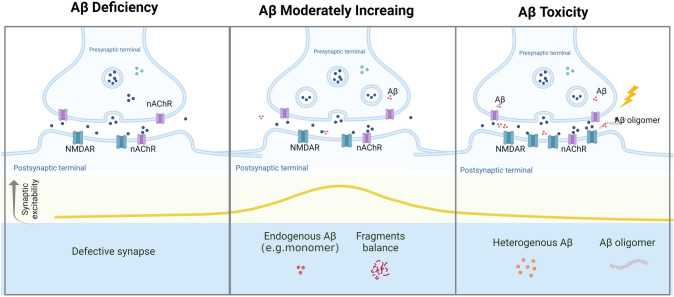
The physiological functions of endogenous amyloid-β (Aβ), which plays important role in the pathology of Alzheimer's disease (AD), have not been paid enough attention. Here, we review the multiple physiological effects of Aβ, particularly in regulating synaptic transmission, and the possible mechanisms, in order to decipher the real characters of Aβ under both physiological and pathological conditions. Some worthy studies have shown that the deprivation of endogenous Aβ gives rise to synaptic dysfunction and cognitive deficiency, while the moderate elevation of this peptide enhances long term potentiation and leads to neuronal hyperexcitability. In this review, we provide a new view for understanding the role of Aβ in AD pathophysiology from the perspective of physiological meaning.
Overview
The claims and statistics of this paper haven’t been checked yet.
Free: it reads the open-access text and checks the first 5 claims that cite a source we can check. Create a free account to check every claim.
Integrity signals
Registry
Cites
Statistics
Figures
Verification
Claims the paper makes
The claims and statistics of this paper haven’t been checked yet.
Free: it reads the open-access text and checks the first 5 claims that cite a source we can check. Create a free account to check every claim.
Claims other papers make about this one
Each is checked against this paper’s own text: does it say what the citing paper says it does?
In the citing paper
“growing evidence indicates that a normal level of Aβ peptides may play a key role in the maintenance of synaptic function and cognition.368,369”
From Amyloid β-based therapy for Alzheimer’s disease: Challenges, successes and future (2023) · cites this paper as [369]
In the citing paper
“Although Aβ aggregates, especially the soluble oligomeric species impair synaptic plasticity by inhibition of LTP and induction of LTD”
From Amyloid β-based therapy for Alzheimer’s disease: Challenges, successes and future (2023) · cites this paper as [369]
Self-check
Percentages, sums and reported differences re-computed from the paper’s own numbers.
The self-check needs the paper’s full text.
Citations
Cites
1 retracted
Wang, H.-Y., Trocmé, C., Stucky, A., Shah, S. M., Kvasic, J., Khan, A., Morain, P., Guignot, I., Bouguen, E., Deschet, K., et al. (2017) · Alzheimer s Research & Therapy · doi:10.1186/s13195-017-0280-8 · Cited by 15
RetractedAmyloid oligomers exacerbate tau pathology in a mouse model of tauopathy
Selenica, M.-L. B., Brownlow, M., Jimenez, J. P., Lee, D. C., Pena, G., Dickey, C. A., Gordon, M. N., & Morgan, D. (2013) · Neurodegenerative Diseases · doi:10.1159/000337230 · Cited by 10,359
Terry, R. D., Masliah, E., Salmon, D. P., Butters, N., DeTeresa, R., Hill, R., Hansen, L. A., & Katzman, R. (1991) · Annals of Neurology · doi:10.1002/ana.410300410 · Cited by 4,397 · cited 2×
“As early as 1991, it was recognized that synaptic loss is a factor correlated with the cognitive deficit in AD [12] and an important cytopathological feature of cognitive decline [13].”
BackgroundWalsh, D. M., Klyubin, I., Fadeeva, J. V., Cullen, W. K., Anwyl, R., Wolfe, M. S., Rowan, M. J., & Selkoe, D. J. (2002) · Nature · doi:10.1038/416535a · Cited by 4,291
Vassar, R., Bennett, B. D., Babu-Khan, S., Kahn, S., Mendiaz, E. A., Denis, P., Teplow, D. B., Ross, S., Amarante, P., Loeloff, R., et al. (1999) · Science · doi:10.1126/science.286.5440.735 · Cited by 3,876
Clinical and biomarker changes in dominantly inherited Alzheimer's disease
Bateman, R. J., Xiong, C., Benzinger, T. L. S., Fagan, A. M., Goate, A., Fox, N. C., Marcus, D. S., Cairns, N. J., Xie, X., Blazey, T. M., et al. (2012) · New England Journal of Medicine · doi:10.1056/nejmoa1202753 · Cited by 3,814 · cited 2×
“Population studies have shown that Aβ deposition does not increase all the time, while CSF Aβ42 is significantly negatively correlated with disease progression [139].”
BackgroundShankar, G. M., Li, S., Mehta, T. H., Garcia-Munoz, A., Shepardson, N. E., Smith, I., Brett, F. M., Farrell, M. A., Rowan, M. J., Lemere, C. A., et al. (2008) · Nature Medicine · doi:10.1038/nm1782 · Cited by 3,685
Diffusible, nonfibrillar ligands derived from Aβ 1–42 are potent central nervous system neurotoxins
Lambert, M. P., Barlow, A. K., Chromy, B. A., Edwards, C., Freed, R., Liosatos, M., Morgan, T. E., Rozovsky, I., Trommer, B., Viola, K. L., et al. (1998) · Proceedings of the National Academy of Sciences · doi:10.1073/pnas.95.11.6448 · Cited by 3,506
Phases of Aβ-deposition in the human brain and its relevance for the development of AD
Thal, D. R., Rüb, U., Orantes, M., & Braak, H. (2002) · Neurology · doi:10.1212/wnl.58.12.1791 · Cited by 3,490 · cited 1×
“In AD brains, the Aβ deposits first appear in the neocortex, followed by allocortical regions, diencephalic nuclei, the striatum, and the cholinergic nuclei of the basal forebrain [60]; the entorhinal cortex is one of the most vulnerable regions [61].”
BackgroundKnopman, D. S., Amieva, H., Petersen, R. C., Chételat, G., Holtzman, D. M., Hyman, B. T., Nixon, R. A., & Jones, D. T. (2021) · Nature Reviews Disease Primers · doi:10.1038/s41572-021-00269-y · Cited by 2,606 · cited 1×
“Alzheimer’s disease (AD) is an irreversible neurodegenerative disorder and the most common cause of dementia [1, 2], www.”
Background
Cited by
Amyloid β-based therapy for Alzheimer’s disease: Challenges, successes and future
Zhang, Y., Chen, H., Li, R., Sterling, K., & Song, W. (2023) · Signal Transduction and Targeted Therapy · doi:10.1038/s41392-023-01484-7 · Cited by 988
“Although Aβ aggregates, especially the soluble oligomeric species impair synaptic plasticity by inhibition of LTP and induction of LTD, growing evidence indicates that a normal level of Aβ peptides may play a key role in the maintenance of synaptic function and cognition.(368,369) It has been shown that the KLVFF (16~…”
BackgroundLim, D. W., Lee, J., Lee, C.-H., & Kim, Y. T. (2024) · International Journal of Molecular Sciences · doi:10.3390/ijms252011223 · Cited by 77
“However, the abnormal accumulation of A β leads to the formation of A β oligomers and subsequently A β plaques [26].”
BackgroundLiu, Y., Guttman, L. C., Dawson, V. L., & Dawson, T. M. (2024) · Biochemical Pharmacology · doi:10.1016/j.bcp.2024.116174 · Cited by 73
Alzheimer’s disease and drug delivery across the blood–brain barrier: approaches and challenges
Iqbal, I., Saqib, F., Mubarak, Z., Latif, M. F., Wahid, M., Nasir, B., Shahzad, H., Sharifi-Rad, J., & Mubarak, M. S. (2024) · European Journal of Medical Research · doi:10.1186/s40001-024-01915-3 · Cited by 60
“These cognitive issues are not so obvious and may only be noticeable to close family and friends, as the brain is not able to repair the damage and loss of nerve cells caused by AD, which results in minor changes in thinking ability [20].”
BackgroundBashir, B., Gulati, M., Vishwas, S., Gupta, G., Dhanasekaran, M., Paudel, K. R., Chellappan, D. K., Anand, K., Negi, P., Singh, P. K., et al. (2025) · Ageing Research Reviews · doi:10.1016/j.arr.2025.102689 · Cited by 48
Metadata
- Authors
- Cai, W., Li, L., Sang, S., Pan, X., & Zhong, C.
- Affiliations
- Fudan University (CN)
- Nanchang University (CN)
- Shanghai Medical College of Fudan University (CN)
- Corresponding author
- Pan, Xiaoli
- Zhong, Chunjiu
- Venue
- Neuroscience Bulletin
- Published
- 2022-11-28
- Volume
- 39
- Issue
- 8
- Pages
- 1289-1308
- ISSN
- 1995-8218 (ISSN-L)
- 1673-7067
- PMC
- PMC10387033
- OpenAlex
- W4310089621
- Cited by
- 83
- References
- 257
- Citations by year
- 2026: 23 · 2025: 24 · 2024: 24 · 2023: 12
- FWCI
- 2.06
- Type
- journal article
- Language
- en
- Open access
- hybrid
- doi.org
- Licence
- cc-by
- creativecommons.org/licenses/by/4.0 (tdm)
- creativecommons.org/licenses/by/4.0 (vor)
- Locations
- Neuroscience Bulletin (publishedVersion, cc-by)
- PubMed Central (publishedVersion, cc-by)
- PubMed (publishedVersion)
- Funders
- National Natural Science Foundation of China (82171411, 82171408, 91332201, 81600930, 81901081, 81870822)
- Natural Science Foundation of Fujian Province (2020CXB049)
- National Key Research and Development Program of China (2016YFC1306403)
- Topics
- Life Sciences › Neuroscience › Cellular and Molecular Neuroscience › Alzheimer's disease research and treatments
- Life Sciences › Neuroscience › Cellular and Molecular Neuroscience › Neuroscience and Neuropharmacology Research
- Life Sciences › Neuroscience › Neurology › Neuroinflammation and Neurodegeneration Mechanisms
- Keywords
- amyloid-beta, Alzheimer's disease, synaptic function, synaptic transmission, synaptic dysfunction, long-term potentiation, neuronal hyperexcitability, cognitive impairment
- MeSH terms
- Alzheimer Disease, Hippocampus, Humans, Synaptic Transmission, Amyloid beta-Peptides, Long-Term Potentiation
About these checks
Registry, retraction, Cites and statistics results are computed, not judged, with one exception: a printed reference that no index lists is read once by a model before it counts as a citation error. Claims are extracted by a model and kept only when their quote appears verbatim in the text; each cited source is then checked, with a model’s help, for whether it says what the claim relies on. Those verdicts can be wrong — read the claim’s quote and the cited source before relying on one.
Statistics and arithmetic are recomputed, not judged.
Confidence bands are shown only for fields calibrated on our annotated test set. None is calibrated yet, so no band is shown.
What counts as a claim ›How we measure confidence ›How we check this ›
Are you an author, or do you see a problem with this page? Request a review
How to cite
Cite CoChat for the checks on this page, and the paper for its own findings.
- This page
- CoChat. (2026). Citation check: Physiological Roles of β-amyloid in Regulating Synaptic Function: Implications for AD Pathophysiology. https://app.cochat.ai/papers/10.1007/s12264-022-00985-9
- The paper
- Cai, W., Li, L., Sang, S., Pan, X., & Zhong, C. (2023). Physiological Roles of β-amyloid in Regulating Synaptic Function: Implications for AD Pathophysiology. Neuroscience Bulletin. https://doi.org/10.1007/s12264-022-00985-9
Data sources
Bibliographic data: Semantic Scholar, OpenAlex, Crossref.
Contains information from the Semantic Scholar Academic Graph Datasets, made available under the ODC Attribution License (ODC-BY 1.0).
Semantic Scholar’s data is described in: Kinney, R., et al. (2023). The Semantic Scholar Open Data Platform. arXiv:2301.10140.
