

Multi-isotopic study of diet and mobility in the northeastern Nile Delta
Open accessThe DOI matches its Crossref record; 117 of the 118 references it cites were found in a registry or an index, and 1 are not checked yet; none of the 160 sources its claims cite is checked for support yet.
Abstract
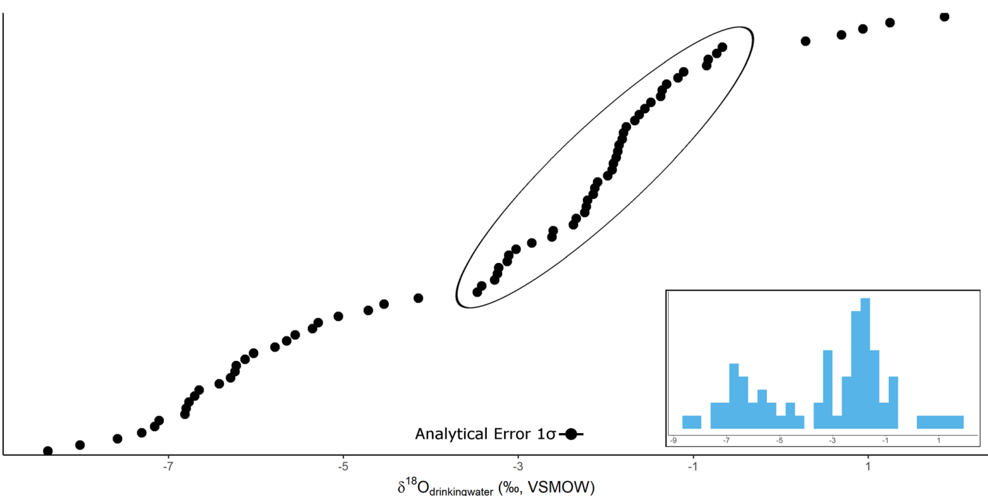
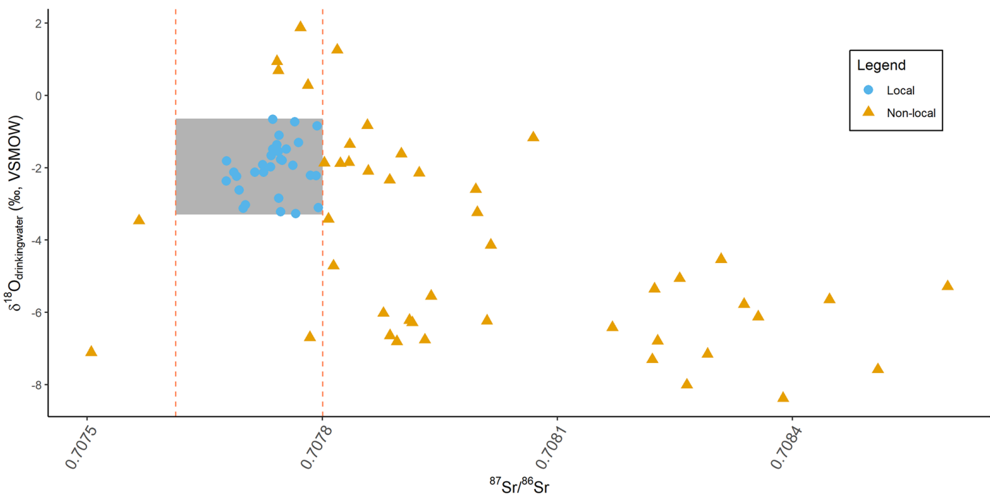
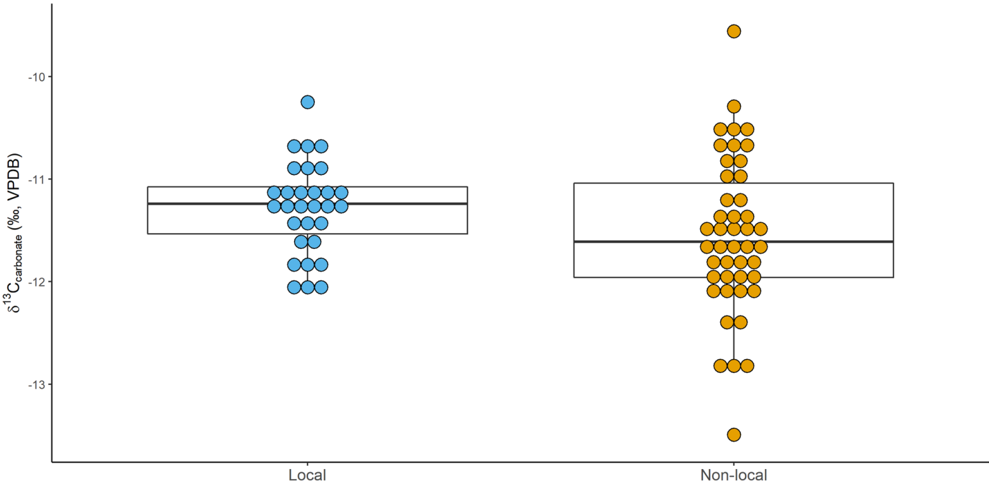
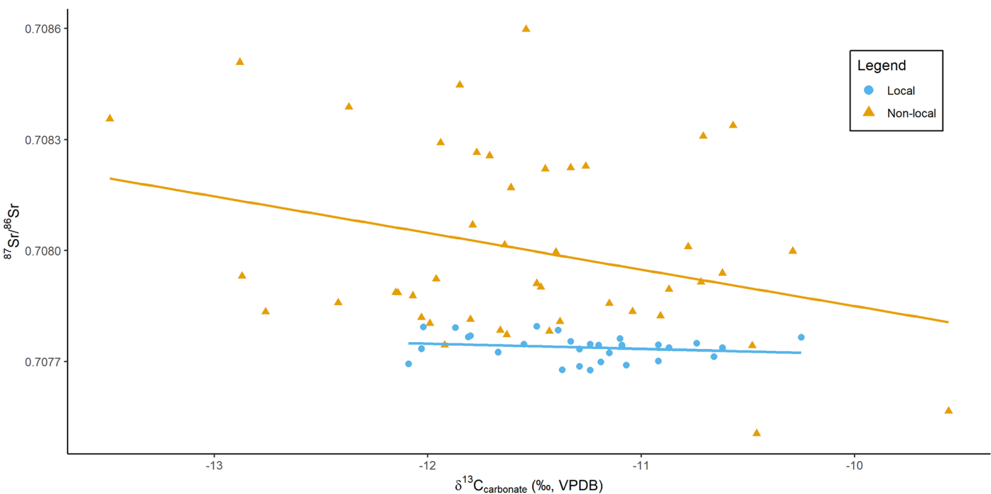
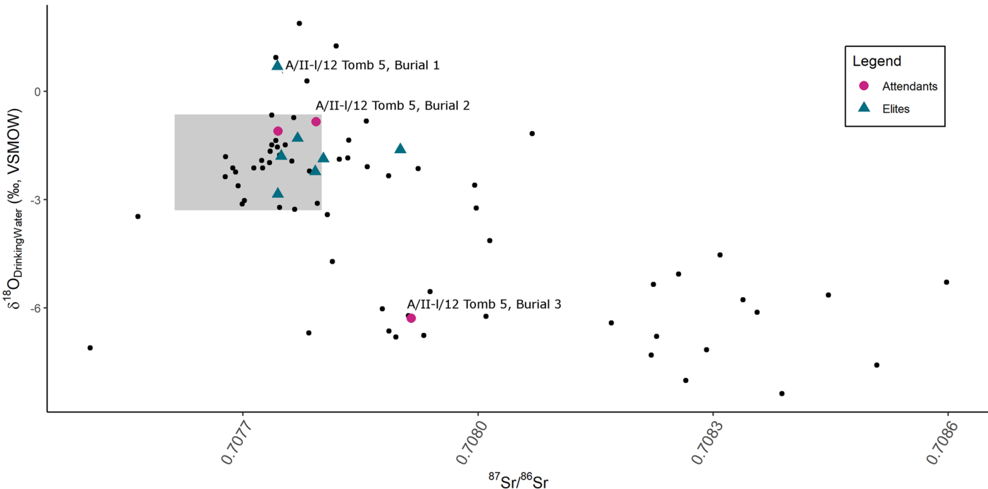
The origin of the Hyksos dynasty (c. 1638–1530 BCE) is thought to be rooted in the Near East given the architectural features and burial customs present at the site of Tell el-Dab c a, identified as the capital of Hyksos rule in the Eastern Delta of Egypt. We expand previous 87 Sr/86 Sr research on the site’s cemetery assemblage using a multi-isotopic methodology: oxygen (δ 18 O) and carbon (δ 13 C carb) stable isotopes from the carbonate portion of tooth enamel (n = 75), along with collagen (δ 13 C coll, δ 15 N) analysis of dentine and bone (n = 31). Pairing δ 18 O with previous 87 Sr/86 Sr data identifies 60% of the cohort as non-locals (45/75). Although there were a greater proportion of non-local females (24/30, 80%) compared to males (10/20, 50%), there were no significant differences between the sexes in δ 13 C carb or δ 18 O carb values. There were no spatial patterns regarding the three cemetery sites, nor any observable patterns regarding where non-locals were interred in the largest excavated cemetery, Area A/II. Both first-generation immigrants and individuals from the northeastern Nile Delta were buried following elite Asiatic burial customs, suggesting continuation of foreign burial culture. All collagen showed poor preservation; δ 13 C coll and δ 15 N analysis were not possible. δ 13 C carb showed no significant difference between locals and non-local diet, although non-locals at Tell el-Dab c a did eat a broader variety of foods as a group, suggested by a wider δ 13 C carb range (− 13.5 to − 9.6‰ in non-locals compared to locals’ − 12.1 to − 10.3‰). If there is a difference in food culture between immigrants and native Egyptians, it was not observable using isotopic analyses.
Checked 2026-11-27 · 1 reference not checked yet
Overview
CoChat Summary
TL;DR
This multi-isotopic study of 75 individuals from Tell el-Dabʿa combined enamel δ¹⁸O and δ¹³C_carb with previously published ⁸⁷Sr/⁸⁶Sr to identify non-locals and compare diet. It found 60% non-local, more non-local females and pre-Hyksos individuals, but no significant dietary differences between locals and non-locals; collagen was too poorly preserved for δ¹³C_coll/δ¹⁵N analysis.
Key findings
- Pairing δ¹⁸O with previous ⁸⁷Sr/⁸⁶Sr identified 60% of the cohort as non-locals (45/75); there were more female non-locals (24/30, 80%) than male non-locals (10/20, 50%), though the sex difference was not significant (χ²(1, n = 50) = 3.68, p = 0.055).
- Non-locals were significantly more common in the pre-Hyksos period (27/35, 77%) than in the Hyksos period (14/32, 44%), χ²(1, n = 67) = 6.51, p = 0.011.
- There were no spatial patterns across the three cemetery areas or within Area A/II, and no significant sex differences in δ¹³C_carb or δ¹⁸O_carb values. Locals and non-locals did not differ significantly in mean δ¹³C_carb (t(74) = 1.883, p = 0.064), but non-locals had a wider range (−13.5 to −9.6‰) than locals (−12.1 to −10.3‰).
- All collagen showed poor preservation, so δ¹³C_coll and δ¹⁵N analysis were not possible. Among elite/attendant burials, four of seven elite burials showed local isotopic values, and both first-generation immigrants and individuals from the northeastern Nile Delta were buried following elite Asiatic burial customs.
Methods
- Enamel carbonate from 75 individuals excavated from Tell el-Dabʿa cemeteries A/I (n = 1), A/II (n = 66), and F/I (n = 8) was analyzed for δ¹³C and δ¹⁸O; collagen δ¹³C and δ¹⁵N from dentine and bone was attempted for n = 31 but no collagen survived or was too poorly preserved.
- δ¹⁸O_carb values were converted to drinking water (δ¹⁸O_dw) using Daux et al.’s Equation 6 and paired with previously published ⁸⁷Sr/⁸⁶Sr data; locality was assigned using local ⁸⁷Sr/⁸⁶Sr values and the median δ¹⁸O cluster.
- Statistical analysis used R, Shapiro-Wilk tests, Welch two-sample t tests or Kruskal-Wallis tests, chi-squared tests, and linear regression; sample size prevented a generalized logistic regression model including both sex and time period.
Limitations
- Paper-stated: collagen preservation was too poor for δ¹³C_coll and δ¹⁵N dietary analysis; using the group median to assign locality is not ideal; modern precipitation and groundwater values did not align with archaeological human values; the elite/attendant subsample is small; area sample sizes are highly unequal; and lack of a biospheric map plus equifinality makes the δ¹³C–⁸⁷Sr/⁸⁶Sr relationship difficult to interpret.
- Evident from the text: FTIR was not included for preservation assessment, and the small sample sizes for Area A/I (n = 1) and Area F/I (n = 8) limit area-specific comparisons.
Model-written summary. Check it against the paper before relying on it.
Integrity signals
Registry
Cites
Statistics
Figures
Verification
Claims the paper makes
0 Valid · 5 Not valid · 90 Not checked · 104 Own results and interpretations
A result the paper reports from its own data — it cites no other source for it, so there is none to check. The quote shows it is in the paper.
In the paper
“δ 13 C carb showed no significant difference between locals and non-local diet”
§ Multi-isotopic study of diet and mobility in the northeastern Nile Delta > Abstract
plainn = 75- Asserted: passes — The authors put it forward as true.
- Checkable: passes — It can be checked against evidence.
- Load-bearing: unclear — It is unclear whether the paper’s conclusions depend on it.
- Based: passes — The paper gives a reason why it holds.
A result the paper reports from its own data — it cites no other source for it, so there is none to check. The quote shows it is in the paper.
In the paper
“Pairing δ 18 O with previous 87 Sr/ 86 Sr data identifies 60% of the cohort as non-locals (45/75).”
§ Multi-isotopic study of diet and mobility in the northeastern Nile Delta > Abstract
plainstates an associationn = 75- Asserted: passes — The authors put it forward as true.
- Checkable: passes — It can be checked against evidence.
- Load-bearing: passes — The paper’s conclusions depend on it.
- Based: passes — The paper gives a reason why it holds.
A result the paper reports from its own data — it cites no other source for it, so there is none to check. The quote shows it is in the paper.
In the paper
“nor any observable patterns regarding where non-locals were interred in the largest excavated cemetery, Area A/II.”
§ Multi-isotopic study of diet and mobility in the northeastern Nile Delta > Abstract
plain- Asserted: passes — The authors put it forward as true.
- Checkable: passes — It can be checked against evidence.
- Load-bearing: unclear — It is unclear whether the paper’s conclusions depend on it.
- Based: passes — The paper gives a reason why it holds.
A result the paper reports from its own data — it cites no other source for it, so there is none to check. The quote shows it is in the paper.
In the paper
“Although there were a greater proportion of non-local females (24/30, 80%) compared to males (10/20, 50%)”
§ Multi-isotopic study of diet and mobility in the northeastern Nile Delta > Abstract
plainstates an association- Asserted: passes — The authors put it forward as true.
- Checkable: passes — It can be checked against evidence.
- Load-bearing: unclear — It is unclear whether the paper’s conclusions depend on it.
- Based: passes — The paper gives a reason why it holds.
A result the paper reports from its own data — it cites no other source for it, so there is none to check. The quote shows it is in the paper.
In the paper
“a wider δ 13 C carb range (-13.5 to -9.6‰ in non-locals compared to locals' -12.1 to -10.3‰)”
§ Multi-isotopic study of diet and mobility in the northeastern Nile Delta > Abstract
plainstates an association- Asserted: passes — The authors put it forward as true.
- Checkable: passes — It can be checked against evidence.
- Load-bearing: passes — The paper’s conclusions depend on it.
- Based: passes — The paper gives a reason why it holds.
75 more claims
Create a free account to see all 199 claims and to verify the 94 references still open.
- It may state two separate claims as one. 65
- Probably not a substantial claim. 80
Statistics that don’t add up
Each reported p-value recomputed from its test statistic and degrees of freedom, each partial η² from its F, and each ratio, mean difference or B printed with a p checked against its own confidence interval.
Rated minor: it would not touch a result — a value no result rests on, a p-value that stays on the same side of the significance level, or a conflict that is clerical, resolved elsewhere in the paper, or outside its own findings.
In the paper
“t(73) = 0.455, p = 0.6611”
§ Multi-isotopic study of diet and mobility in the northeastern Nile Delta > Results
Reported p = .6611 · recomputed p = .650
Statistics recomputed
Every reported test result, recomputed from its test statistic and degrees of freedom. A result shows as not adding up only once an independent check has confirmed it.
- Doesn’t add upt(73) = 0.455reported p = .6611 · recomputed p = .650
“t(73) = 0.455, p = .6611”
- Not confirmedt(49) = 0.675reported p = .504 · recomputed p = .503
“t(49) = 0.675, p = .504”
- Consistentt(66) = -3.66reported p < .001 · recomputed p < .001
“t(66) = -3.66,p < .001”
- Consistentt(74) = 1.883reported p = .064 · recomputed p = .064
“t(74) = 1.883, p = .064”
- Consistentt(73) = -3.04reported p = .003 · recomputed p = .003
“t(73) = -3.04,p = .003”
Self-check
Percentages, sums and reported differences re-computed from the paper’s own numbers.
Each contradiction between two passages listed here was confirmed by an independent check.
Rated major: it would touch a result — a value a result rests on, reported and recomputed p-values on opposite sides of the significance level, two passages that conflict with no sign which is right, or a cited work retracted before this paper was published.
In the paper
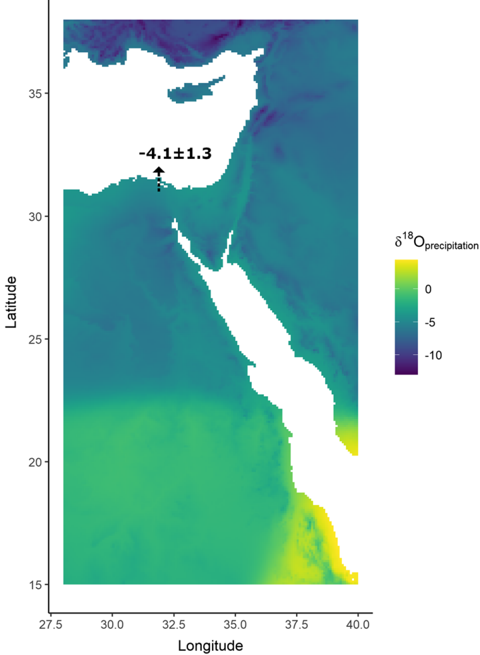
“The modern δ 18 O value of the Nile, measured in Cairo, is + 2.8‰ (Cockerton et al. 2013), which is believed to have shifted significantly since the 1960s due to the building of the Aswan High Dam.Paleoclimatologists cannot state empirically the shift in values this has caused but some estimate the Nile River was 4‰ lower before the damming, which would place the northern Nile water around -2.8‰”
§ Multi-isotopic study of diet and mobility in the northeastern Nile Delta > Stable isotope background
Reported -2.8 · recomputed -1.2
Rated major: it would touch a result — a value a result rests on, reported and recomputed p-values on opposite sides of the significance level, two passages that conflict with no sign which is right, or a cited work retracted before this paper was published.
In the paper
§ Multi-isotopic study of diet and mobility in the northeastern Nile Delta > Conclusion
“| Pre-Hyksos | -11.6 | 0.6 | -13.5 | -10.3 | -11.6 | 28.2 | 1.7 | 25.3 | 31.4 | 28.6 | 37 | | Hyksos | -11.2 | 0.5 | -12.2 | -9.6 | -11.1 | 28.5 | 1.5 | 25.5 | 31.2 | 29.1 | 30 |”
§ Multi-isotopic study of diet and mobility in the northeastern Nile Delta > Results
“There was a significantly greater proportion of non-locals during the pre-Hyksos occupation of Tell el-Dab c a (27/35 or 77%) compared to the Hyksos time period (14/32 or 44%), χ 2 (1, n = 67) = 6.51, p = 0.011.”
Rated minor: it would not touch a result — a value no result rests on, a p-value that stays on the same side of the significance level, or a conflict that is clerical, resolved elsewhere in the paper, or outside its own findings.
In the paper
§ Multi-isotopic study of diet and mobility in the northeastern Nile Delta > Results
“The individuals sampled were excavated from three areas of the site: A/I (n = 1), A/II (n = 66), and F/I (n = 8).”
§ Multi-isotopic study of diet and mobility in the northeastern Nile Delta > Discussion
“However, with only seven individuals total from the area available for analysis during this research project, we are wary of assigning any cultural significance to this pattern.”
Citations
Cites
Influence of diet on the distribution of carbon isotopes in animals
DeNiro, M. J., & Epstein, S. (1978) · Geochimica et Cosmochimica Acta · doi:10.1016/0016-7037(78)90199-0 · Cited by 4,879
Minagawa, M., & Wada, E. (1984) · Geochimica et Cosmochimica Acta · doi:10.1016/0016-7037(84)90204-7 · Cited by 4,127
Nitrogen and carbon isotopic composition of bone collagen from marine and terrestrial animals
Schoeninger, M. J., & DeNiro, M. J. (1984) · Geochimica et Cosmochimica Acta · doi:10.1016/0016-7037(84)90091-7 · Cited by 2,057
New Method of Collagen Extraction for Radiocarbon Dating
LONGIN, R. (1971) · Nature · doi:10.1038/230241a0 · Cited by 1,813
Tieszen, L. L., Boutton, T. W., Tesdahl, K. G., & Slade, N. A. (1983) · Oecologia · doi:10.1007/bf00379558 · Cited by 1,776
Brief communication: The London atlas of human tooth development and eruption
AlQahtani, S. J., Hector, M. P., & Liversidge, H. M. (2010) · American Journal of Physical Anthropology · doi:10.1002/ajpa.21258 · Cited by 1,523
Ambrose, S. H., & Norr, L. (1993) · Prehistoric Human Bone · doi:10.1007/978-3-662-02894-0_1 · Cited by 1,453
Improved Collagen Extraction by Modified Longin Method
Brown, T. A., Nelson, D. E., Vogel, J. S., & Southon, J. R. (1988) · Radiocarbon · doi:10.1017/s0033822200044118 · Cited by 1,076
Longinelli, A. (1984) · Geochimica et Cosmochimica Acta · doi:10.1016/0016-7037(84)90259-x · Cited by 1,041
Hillson, S. (1996) · Cambridge University Press eBooks · doi:10.1017/cbo9781139170697 · Cited by 1,017
Research works printed but not linked: 38
- Ablamowicz R, Debowska J, Jucha M (2004) The graves of Tell el- Farkha (seasons 2001-2002). In: Hendrickx S, Friedman RF, Ciałowicz KM, Chłodnicki M (eds) Egypt at Its Origins: Studies in Memory of Barbara Adams: Proceedings of the International Conference" Origin of the State, Predynastic and Early Dynastic Egypt," Krakow, 28 August-1st September 2002. Peeters Publishers, Leuven, Belgium, pp 399-420
- Al-Gamal S, El-Sayed S, Atta E (2018) Exploring surface-and ground- water interactions in East Delta Aquifer using conventional and non- conventional techniques. Journal of Applied Geology and Geophysics 6(2):48-58
- Allen JP, Ḥeḳanakhte (2002) The Heqanakht Papyri. Metropolitan Museum of Art New York. New York City, New York
- Bader B (2013) Cultural mixing in Egyptian archaeology: the 'Hyksos' as a case study. Arch Rev Cambridge 28:257-286
- Bader B (2020) Tell el-Dab c a XXIV: The Late Middle Kingdom Settlement of Area A/II A Holistic Study of Non-élite Inhabitants at Tell el-Dab c a, vol 1. Austrian Academy of Sciences, Vienna, Austria
- Baines J (1996) Contextualizing Egyptian representations of society and ethnicity. Eisenbrauns, Winona Lake, Indiana
- Bietak M (1979) Avaris and Piramesse: archaeological exploration in the eastern Nile Delta. In: Proceedings of the British Academy London, United Kingdom. Oxford Press, pp 225-289
- Bietak M (1989) Servant burials in the Middle Bronze Age culture of the eastern Nile Delta. In: Bietak M (ed) Eretz-Israel: Archaeological, Historical and Geographical Studies, vol 20. Israel Exploration Society, pp 30-43
- Bietak M (1996) Avaris, The Capital of the Hyksos and Residence of the Early 18th Dynasty. Recent Excavations. London. The British Museum Press, London, United Kingdom
- Bietak M (1997) The Center of Hyksos Rule: Avaris (Tell el-Daba). In: Oren ED (ed) The Hyksos: New Historical and Archaeological Perspectives. University Museum Symposium Series, Philadelphia, Pennsylvania
- Bietak M (2002) Relative and absolute chronology of the Middle Bronze Age: comments on the present state of research. In: Bietak M (ed) The Middle Bronze Age in the Levant, Proceedings of an International Conference on MB II A Ceramic Materials in Vienna 24th -26th of January 2001, Contributions to the Chronology of the Eastern Mediterranean 3. Vienna, Austria. Austrian Academy of Science, Vienna, Austria, pp 30-42
- (ed) The Middle Bronze Age in the Levant, Proceedings of an International Conference on MB II A Ceramic Materials in Vienna 24th - 26th of January 2001, Contributions to the Chronology of the Eastern Mediterranean 3. Vienna, Austria. Austrian Academy of Science, Vienna, Austria, pp 30-42
- Bietak M (2009) Near Eastern sanctuaries in the eastern Nile Delta. Baal, Hors-Série 6:209-228
- Bietak M (2010a) From where came the Hyksos and where did they go? In: Marée M (ed) The Second Intermediate Period (Thirteenth - Seventeenth Dynasties). Uitgeveru Peeters and Departement Oosterse Studies, Leuvan, Belgium, pp 139-181
- Bietak M (2010b) Houses, palaces and development of social structure in Avaris Part I. In: Bietak M, Czerny E, Forstner-Müller I (eds) Cities and Urbanism, International Workshop in November 2006 at the Austrian Academy of Sciences Vienna, Austrian Academy of Sciences, vol 60. Vienna, Austria, pp 11-68
- Bietak M (2011) The aftermath of the Hyksos in Avaris. In: Sela-Sheffy R, Toury G (eds) Culture Contacts And The Making Of Cultures. Tel Aviv University, Tel Aviv, Israel, pp 19-65
- Bowen GJ, West JB, Miller CC, Zhao L, Zhang T (2013) IsoMAP: Isoscapes Modeling. Prediction, Analysis and version 1.0
- Brickley M, McKinley JI (eds) (2004) Guidelines to the Standards for Recording Human Remains vol IFA Paper No. 7, IFA Technical Paper no, vol 7. BABAO, Reading, UK
- Buikstra JE, Ubelaker DH (1994) Standards for data collection from human skeletal remains. Arkansas Archaeological Survey, Fayetteville
- Castel G, Soukiassian G, Pouit G (1999) Gebel Zeit. In: Bard KA (ed) Encyclopedia of the Archaeology of Ancient Egypt. Routledge, London, UK, pp 334-338
- Cohen SL (2018) Canaanites, chronologies, and connections: the rela- tionship of Middle Bronze IIA Canaan to Middle Kingdom Egypt. Brill, Leiden, Netherlands
- Czerny E (2001) Ein Früher Beleg Für ḥwt-w rt Auf Einem Siegelabdruck Aus Tell El-Dab a. Ägypten und Levante/Egypt and the Levant 11:13-26
- Darby WJ, Ghalioungui P, Grivetti L (1977) Food: the gift of Osiris. Academic Press, London, United Kingdom
- David AR (1999) Handbook to life in ancient Egypt. Oxford University Press, Oxford, United Kingdom
- Fuller DQ, Murray M-A, Stevens CJ, Nixon S (eds) Archaeology of African Plant Use. Routledge, Walnut Creek, California, pp 141-149
- Fuller DQ (2014) Agricultural innovation and state collapse in Meroitic Nubia. In: Stevens CJ, Nixon S, Murray M-A, Fuller DQ (eds) Archaeology of African plant use. UCL Institute of Archaeology Publications, London, pp 165-177
- Harrington N, Draycott CM, Stamatopoulou M (2016) The Eighteenth Dynasty Egyptian banquet: ideals and realities. In: Catherine Mary Draycott MS (ed) Dining and Death: Interdisciplinary Perspectives on the "Funerary Banquet" in Ancient Art. Burial and Belief. Peeters, Leuven, Belgium, pp 129-172
- Hoefs J (2009) Stable Isotope Geochemistry, 6th edn. Springer-Verlag, Berlin, Germany
- Kemp BJ, Samuel D, Luff R (1994) Food for an Egyptian city: Tell el- Amarna. In: Luff RM (ed) Rowley-Conwy P (eds) Whither environ- mental archaeology? vol 38. Oxbow, Oxford, United Kingdom, pp 133-170
- Murray M-A (2000) Fruits, vegetables, pulses, and condiments. In: Nicholson PT, Shaw I (eds) Ancient Egyptian Materials and Technology. Cambridge University Press, Cambridge, UK, pp 609-655
- O'Connor D (1997) The Hyksos Period in Egypt. In: Oren E (ed) The Hyksos: New historical and archaeological perspectives, The University Museum, vol 96. University of Pennsylvania, Philadelphia, Pennsylvania, pp 45-67
- Philip G (1989) Metal weapons of the Early and Middle Bronze Ages in Syria-Palestine vol 526. BAR, Oxford, United Kingdom
- Philip G (1995) Warrior burials in the ancient Near-Eastern Bronze Age: the evidence from Mesopotamia, western Iran and Syria-Palestine. In: Campbell S, Green A (eds) The Archaeology of Death in the Ancient Near East. Oxbow Books, Oxford, UK, pp 140-154
- Redford DB (1970) The Hyksos invasion in history and tradition. Orientalia 39:1-51
- Schiestl R (2008) Tomb Types and Layout of a Middle Bronze IIA cemetery at Tell el-Dab c a, area F/I: Egyptian and Non-Egyptian features. In: Bietak M, Czerny E (eds) The Bronze Age in the Lebanon: Studies on the Archaeology and Chronology of Lebanon, Syria and Egypt, Contributions to the Chronology of the Eastern Mediterranean, Austrian Academy of Sciences, vol 17. Vienna, Austria, pp 243-256
- Sharp ZD (2017) Principles of Stable Isotope Geochemistry, Second Edition. Published Online. https://doi.org/10.5072/FK2GB24S9F · doi:10.5072/fk2gb24s9f
- Wapnish P (1997) Middle Bronze equid burials at Tell Jemmeh and a reexamination of a purportedly Hyksos practice. In: Oren E (ed) The Hyksos: New historical and archaeological perspectives. University of Pennsylvania Museum, Philadelphia, Pennsylvania, pp 335-367
- Winkler E-M, Wilfing H (1991) Tell El-Dab c a IV: Anthropologische Untersuchungen an den Skelettresten der Kampagnen 1966-1969, 1975-80, 1985. Austrian Academy of Sciences, Vienna, Austria
Cited by
Stark, R. J., Ciesielska, J. A., & Obłuski, A. (2023) · Archaeometry · doi:10.1111/arcm.12845 · Cited by 12
Global compilation of bioavailable strontium isotope data
Stantis, C., Willmes, M., Corre, M. L., James, H. F., Kafino, C. V., Verostick, K. A., Paris, E. H., Bank, J., Bowen, G. J., Salesse, K., et al. (2026) · Scientific Data · doi:10.1038/s41597-026-06643-3 · Cited by 9
Self-citationHuisman, H. D. J. (2025) · Journal of Archaeological Science · doi:10.1016/j.jas.2025.106332 · Cited by 9
Windows into the past: recent scientific techniques in dental analysis
Forshaw, R. (2024) · BDJ · doi:10.1038/s41415-024-7053-0 · Cited by 8
Larson, K., Arnold, E. R., & Hardin, J. W. (2022) · Quaternary International · doi:10.1016/j.quaint.2022.03.022 · Cited by 5
Isotopes in Archeology: Perspectives on Post-Mortem Alteration and Climate Change
Simonetti, A., & Buzon, M. R. (2025) · Geosciences · doi:10.3390/geosciences15080307 · Cited by 4
The people of Avaris: Intra-regional biodistance analysis using dental non-metric traits
Maaranen, N., Zakrzewski, S., Kharobi, A., Stantis, C., Prell, S., Bietak, M., & Schutkowski, H. (2021) · ePrints Soton (University of Southampton) · Cited by 3
Self-citationMaaranen, N., Stantis, C., Kharobi, A., Zakrzewski, S., Schutkowski, H., & Doumet‐Serhal, C. (2023) · American Journal of Biological Anthropology · doi:10.1002/ajpa.24831 · Cited by 2
Self-citationLandscape and resource management in Bronze Age Nubia
Schrader, S. A., & Buzon, M. (2024) · Contributions to the archaeology of Egypt, Nubia and the Levant · doi:10.13173/9783447121378 · Cited by 2
Institut, Ö. A. (2023) · doi:10.1553/oeai.report2022 · Cited by 2
Ciesielska, J. A., Scott, E., & Roberts, P. (2025) · Archaeometry · doi:10.1111/arcm.70055 · Cited by 1
Multilingualism, Society, and Population Contact in Ancient Egypt (3100–1000 BC)
García, J. C. M. (2025) · Springer handbooks in languages and linguistics. · doi:10.1007/978-981-96-4729-3_8
Kharobi, A., Maaranen, N., Stantis, C., Zakrzewski, S., & Schutkowski, H. (2021) · Contributions to the archaeology of Egypt, Nubia and the Levant · doi:10.13173/9783447117371.477
Self-citationDelving into history: how the latest advances in dental analysis can unlock the secrets of the past
Forshaw, R. (2025) · Research Explorer (The University of Manchester)
Capasso, G., Sperduti, A., Ahmed, H. I., Cipriani, A., Bondioli, L., Nava, A., Lugli, F., & Manzo, A. C. T. (2026) · Scientific Reports · doi:10.1038/s41598-026-37691-9
Österreichisches Archäologisches Institut Jahresbericht 2021
Institut, Ö. A. (2022) · doi:10.1553/oeai.report2021
Creatures of the Water and Their Impact on Human Lives
Recht, L., & Tsouparopoulou, C. (2024) · Themes in contemporary archaeology · doi:10.1007/978-3-031-73643-8_1
Metadata
- Authors
- Stantis, C., Kharobi, A., Maaranen, N., Macpherson, C., Bietak, M., Prell, S., & Schutkowski, H.
- Affiliations
- Smithsonian Institution (US)
- Université de Bordeaux (FR)
- Bournemouth University (GB)
- Durham University (GB)
- Austrian Academy of Sciences (AT)
- Corresponding author
- Stantis, Chris
- ORCID
- Venue
- Archaeological and Anthropological Sciences
- Published
- 2021-06
- Volume
- 13
- Issue
- 6
- Pages
- 105
- ISSN
- 1866-9557 (ISSN-L)
- 1866-9565
- OpenAlex
- W3166603704
- Semantic Scholar
- df2b7e8aa060994190c009bfe5feff6f3313585c
- Cited by
- 17
- References
- 115
- Citations by year
- 2026: 2 · 2025: 5 · 2024: 3 · 2023: 3 · 2022: 2 · 2021: 2
- FWCI
- 4.38
- Type
- journal article
- Language
- en
- Open access
- hybrid
- doi.org
- Licence
- cc-by
- creativecommons.org/licenses/by/4.0 (tdm)
- creativecommons.org/licenses/by/4.0 (vor)
- Locations
- Archaeological and Anthropological Sciences (publishedVersion, cc-by)
- Durham Research Online (Durham University) (publishedVersion, cc-by-nd)
- Durham Research Online (Durham University) (acceptedVersion, cc-by)
- Bournemouth University Research Online (Bournemouth University) (submittedVersion, cc-by)
- Funders
- H2020 European Research Council (668640)
- Topics
- Social Sciences › Archeology › Archaeology and ancient environmental studies
- Social Sciences › Arts and Humanities › Archeology (arts and humanities) › Ancient Egypt and Archaeology
- Social Sciences › Arts and Humanities › Archeology (arts and humanities) › Forensic Anthropology and Bioarchaeology Studies
- Keywords
- Tell el-Dabca, strontium isotope analysis, oxygen isotopes, carbon isotopes, dental enamel, collagen isotopes, diet, mobility, immigration, ancient Egypt, cemetery burials
About these checks
Registry, retraction, Cites and statistics results are computed, not judged, with one exception: a printed reference that no index lists is read once by a model before it counts as a citation error. Claims are extracted by a model and kept only when their quote appears verbatim in the text; each cited source is then checked, with a model’s help, for whether it says what the claim relies on. Those verdicts can be wrong — read the claim’s quote and the cited source before relying on one.
A language model drew the claims from the paper on 2026-11-27, under version 3 of the claim definition (model deepseek-v4.1-flash, prompt extract-v3).
A second model labelled each claim on 2026-11-27 (model jev-1.13-20260917, definition revision gold-guideline-v0.2).
Statistics and arithmetic are recomputed, not judged.
Confidence bands are shown only for fields calibrated on our annotated test set. None is calibrated yet, so no band is shown.
What counts as a claim ›How we measure confidence ›How we check this ›
Are you an author, or do you see a problem with this page? Request a review
Data sources
Bibliographic data: Semantic Scholar, OpenAlex, Crossref.
Contains information from the Semantic Scholar Academic Graph Datasets, made available under the ODC Attribution License (ODC-BY 1.0).
Semantic Scholar’s data is described in: Kinney, R., et al. (2023). The Semantic Scholar Open Data Platform. arXiv:2301.10140.
