

The DOI matches its Crossref record; 4 of the 4 references it cites were found in a registry or an index.
The research we don’t need will persist until we dismantle the systems that sustain it
Abstract
The educational technology field is at a critical juncture, facing the dual pressures of rapid technological advancement and a pressing need for research that genuinely addresses educational challenges. Despite increasing awareness of these issues, a significant amount of educational technology research remains entrenched in superficial or trend-driven inquiries, failing to tackle deeper, systemic issues. This paper critically examines the historical and institutional forces sustaining what we term “the research we don’t need,” and argues for a transformative shift toward “the research we need.” Such research must prioritize depth, long-term impact, and relevance over mere novelty or ease of publication. We outline how entrenched practices, including academic publishing standards, tenure and promotion metrics, and funding structures, contribute to a cycle that rewards superficial research. To disrupt this cycle, we propose actionable strategies to foster a research ecosystem that values substantive contributions and advocates for systemic change. Ultimately, we urge scholars, institutions, and professional organizations to embrace a collective responsibility to redefine research priorities holistically. By doing so, we can foster a field that meaningfully impacts educators, learners, and society. This is not merely a call for incremental improvements; it is a challenge to realign the field’s fundamental purpose toward more impactful, responsible, and enduring scholarship.
Overview
The claims and statistics of this paper haven’t been checked yet.
Run the check — free, no account needed. It reads the open-access text and checks the sources it cites.
Integrity signals
Registry
Cites
Statistics
Figures
Verification
Claims the paper makes
The claims and statistics of this paper haven’t been checked yet.
Run the check — free, no account needed. It reads the open-access text and checks the sources it cites.
Claims other papers make about this one
Each is checked against this paper’s own text: does it say what the citing paper says it does?
In the citing paper
“These shifts incentivize research that is safe, short-term and likely to generate high citation counts, while discouraging riskier, long-term or niche projects4,68,73,74.”
From Prevalence and severity of mental health problems in early-career researchers: a systematic review and meta-analysis (2026) · cites this paper as [74]
Self-check
Percentages, sums and reported differences re-computed from the paper’s own numbers.
The self-check needs the paper’s full text.
Citations
Cites
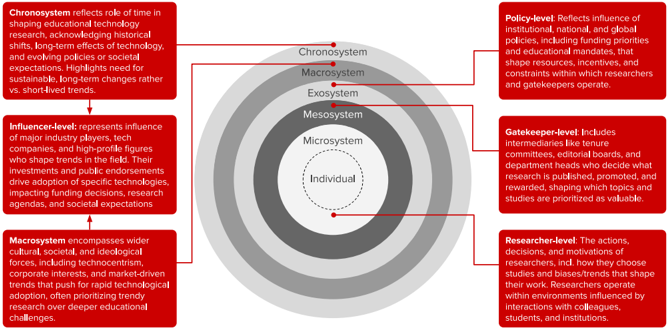
The Ecology of Human Development: Experiments by Nature and Design
Bronfenbrenner, U. (1979) · Harvard University Press eBooks · doi:10.4159/9780674028845 · Cited by 26,084
Bernard, R. M., Abrami, P. C., Lou, Y., Borokhovski, E., Wade, A., Wozney, L., Wallet, P. A., Fiset, M., & Huang, B. (2004) · Review of Educational Research · doi:10.3102/00346543074003379 · Cited by 1,761
The oligopoly of academic publishers in the digital era
Larivière, V., Haustein, S., & Mongeon, P. (2015) · PLOS ONE · doi:10.1371/journal.pone.0127502 · Cited by 1,240 · cited 2×
“As a multi-billion dollar industry, academic publishing holds some of the highest profit margins in the world, with certain large publishers reporting profit margins upwards of 30–40% annually (Larivière et al., 2015).”
The strain on scientific publishing
Hanson, M. A., Barreiro, P. G., Crosetto, P., & Brockington, D. (2024) · Quantitative Science Studies · doi:10.1162/qss_a_00327 · Cited by 345
Research works printed but not linked: 67
- Alvesson, M., Gabriel, Y., & Paulsen, R. (2017). Return to meaning: A social science with something to say. Oxford University Press. · DOI
- Anderson, J. R., Corbett, A. T., Koedinger, K. R., & Pelletier, R. (1995). Cognitive tutors: Lessons learned. Journal of the Learning Sciences, 4(2), 167–207. https://doi.org/10.1207/s15327809jls0402_2 · DOI · Paper page
- Anderson, T. (2008). The theory and practice of online learning. Athabasca University. https://books.google.com/books?hl=en&lr=&id=RifNwzU3HR4C&oi=fnd&pg=PR11&dq=Anderson,+T.+(2008).+The+Theory+and+Practice+of+Online+Learning.+AU+Press&ots=Si7pJjIWps&sig=X0nkAq8aQvUUDadg9fOmWDdjhRQ
- Anderson, V., Elliott, C., & Callahan, J. L. (2021). Power, powerlessness, and journal ranking lists: The marginalization of fields of practice. Academy of Management Learning and Education, 20(1), 89–107. https://doi.org/10.5465/amle.2019.0037 · DOI
- Baturay, M. H. (2015). An overview of the world of MOOCs. Procedia—Social and Behavioral Sciences, 174, 427–433. https://doi.org/10.1016/j.sbspro.2015.01.685 · DOI · Paper page
- Bauwens, T., Reike, D., & Calisto-Friant, M. (2023). Science for sale? Why academic marketization is a problem and what sustainability research can do about it. Environmental Innovation and Societal Transitions, 48, Article 100749. · DOI
- Baydas, O., Kucuk, S., Yilmaz, R. M., Aydemir, M., & Goktas, Y. (2015). Educational technology research trends from 2002 to 2014. Scientometrics, 105(1), 709–725. https://doi.org/10.1007/s11192-015-1693-4 · DOI
- Bernardo, R. (2016). Bandwagons I, too, have known. Theoretical and Applied Genetics, 129, 2323–2332. · DOI
- Cheung, A. C. K., & Slavin, R. E. (2012). How features of educational technology applications affect student reading outcomes: A meta-analysis. Educational Research Review, 7(3), 198–215. https://doi.org/10.1016/j.edurev.2012.05.002 · DOI · Paper page
- Clarivate. (2023). Journal citation reports [Online database]. https://jcr.clarivate.com/
- Clark, R. E. (1989). Current progress and future directions for research in instructional technology. Educational Technology Research and Development, 37(1), 57–66. · DOI
- Cross, N. (2025). Designerly Ways of Knowing. In N. Cross (Ed.), Designerly Ways of Knowing and Thinking (pp. 1–14). Springer. https://doi.org/10.1007/978-1-4471-7541-4_1 · DOI
- Cumming, T. M., & Stradnová, I. (2012). The iPad as a pedagogical tool in special education: Promises and possibilities. Special Education Perspectives, 21(1), 34–46.
- Davidson, S. B., & Freire, J. (2008). Provenance and scientific workflows: Challenges and opportunities. In Proceedings of the 2008 ACM SIGMOD international conference on management of data (pp. 1345–1350). https://doi.org/10.1145/1376616.1376772 · DOI
- Davies, I. K. (1996). The management of learning. In D. Ely & T. Plomp (Eds.), Classic writings on instructional technology (pp. 45–54). Libraries Unlimited.
- Dedehayir, O., & Steinert, M. (2016). The hype cycle model: A review and future directions. Technological Forecasting and Social Change, 108, 28–41. · DOI · Paper page
- Ebben, M., & Murphy, J. S. (2014). Unpacking MOOC scholarly discourse: A review of nascent MOOC scholarship. Learning, Media and Technology, 39(3), 328–345. https://doi.org/10.1080/17439884.2013.878352 · DOI
- Edwards, M. A., & Roy, S. (2017). Academic research in the 21st Century: maintaining scientific integrity in a climate of perverse incentives and hypercompetition. Environmental Engineering Science, 34(1), 51–61. https://doi.org/10.1089/ees.2016.0223 · DOI · Paper page
- Fitzpatrick, K. (2011). Planned obsolescence: Publishing, technology, and the future of the academy. New York University Press. https://library.oapen.org/handle/20.500.12657/89411 · DOI
- Garrison, D. R., & Arbaugh, J. B. (2007). Researching the community of inquiry framework: Review, issues, and future directions. The Internet and Higher Education, 10(3), 157–172. · DOI · Paper page
- Hammond, M. (2020). What is an ecological approach and how can it assist in understanding ICT take-up? British Journal of Educational Technology, 51(3), 853–866. https://doi.org/10.1111/bjet.12889 · DOI
- Harvie, D., Lightfoot, G., Lilley, S., & Weir, K. (2013). Publisher, be damned! From price gouging to the open road. Prometheus. https://doi.org/10.1080/08109028.2014.891710 · DOI
- Haven, T., & Van Woudenberg, R. (2021). Explanations of research misconduct, and how they hang together. Journal for General Philosophy of Science, 52(4), 543–561. https://doi.org/10.1007/s10838-021-09555-5 · DOI
- Higgins, S., Beauchamp, G., & Miller, D. (2007). Reviewing the literature on interactive whiteboards. Learning, Media and Technology, 32(3), 213–225. https://doi.org/10.1080/17439880701511040 · DOI
- Honebein, P. C., & Reigeluth, C. M. (2021). To prove or improve, that is the question: The resurgence of comparative, confounded research between 2010 and 2019. Educational Technology Research and Development, 69(2), 465–496. https://doi.org/10.1007/s11423-021-09988-1 · DOI
- Honebein, P., & Reigeluth, C. M. (2020). The instructional theory framework appears lost. Isn’t it time we find it again? Revista de Educación a Distancia (RED), 20(64), 64.
- Howison, J., & Herbsleb, J. D. (2011). Scientific software production: Incentives and collaboration. In Proceedings of the ACM 2011 conference on computer supported cooperative work (pp 513–522). https://doi.org/10.1145/1958824.1958904 · DOI
- Ioannidis, J. P. A. (2005). Why most published research findings are false. PLoS Medicine, 2(8), e124. https://doi.org/10.1371/journal.pmed.0020124 · DOI · Paper page
- Javadpour, A., Ja’fari, F., Taleb, T., Shojafar, M., & Benzaïd, C. (2024). A comprehensive survey on cyber deception techniques to improve honeypot performance. Computers and Security, 140, 103792. · DOI
- Jonassen, D. H. (2000). Computers as mindtools for schools: Engaging critical thinking. Merrill.
- Jones, T. C., & Dugdale, D. (2002). The ABC bandwagon and the juggernaut of modernity. Accounting, Organizations and Society, 27(1–2), 121–163. · DOI
- Lachheb, A., & Watson, N. (2023). Introduction to the special section on design failure in learning design practice. International Journal of Designs for Learning, 14(1), 1. https://doi.org/10.14434/ijdl.v14i1.35893 · DOI
- Lincoln, Y. S., & Cannella, G. S. (2004). Dangerous discourses: Methodological conservatism and governmental regimes of truth. Qualitative Inquiry, 10(1), 5–14. https://doi.org/10.1177/1077800403259717 · DOI
- Lowther, D. L., Inan, F. A., Ross, S. M., & Strahl, J. D. (2012). Do one-to-one initiatives bridge the way to 21st century knowledge and skills? Journal of Educational Computing Research, 46(1), 1–30. https://doi.org/10.2190/EC.46.1.a · DOI
- Luckin, R. (2010). Re-designing learning contexts: Technology-rich, learner-centred ecologies. Routledge. https://www.taylorfrancis.com/books/mono/https://doi.org/10.4324/9780203854754/re-designing-learning-contexts-rosemary-luckin · DOI
- Mau, S. (2019). The metric society: On the quantification of the social. John Wiley & Sons. https://books.google.com/books?hl=en&lr=&id=nMaKDwAAQBAJ&oi=fnd&pg=PP2&dq=Mau,+2019&ots=LbFtguJj-_&sig=nGwsowuyCHaI54BtSfq_eMOjqgo
- McDonald, J. K., Yanchar, S. C., & Osguthorpe, R. T. (2005). Learning from programmed instruction: Examining implications for modern instructional technology. Educational Technology Research and Development, 53(2), 84–98. https://doi.org/10.1007/BF02504867 · DOI
- McKenney, S., & Reeves, T. (2025). Educational design research for relevant and robust scholarship. Journal of Computing in Higher Education. · DOI
- Morgan, D. L. (2023). Who is on the bandwagon? Core and periphery in mixed methods research. Journal of Mixed Methods Research, 17(2), 135–142. https://doi.org/10.1177/15586898221096319 · DOI
- Neff, M. W. (2020). How academic science gave its soul to the publishing industry. Issues in Science and Technology, 36(2), 35–43.
- Northcote, M., Mildenhall, P., Marshall, L., & Swan, P. (2010). Interactive whiteboards: Interactive or just whiteboards? Australasian Journal of Educational Technology, 26(4), 4. https://doi.org/10.14742/ajet.1067 · DOI
- Nosek, B. A., Spies, J. R., & Motyl, M. (2012). Scientific Utopia: II. Restructuring incentives and practices to promote truth over publishability. Perspectives on Psychological Science, 7(6), 615–631. https://doi.org/10.1177/1745691612459058 · DOI
- Papert, S. (1980). Mindstorms: Children, computers, and powerful ideas. Basic Books, Inc.
- Papert, S. (1988). A critique of technocentrism in thinking about the school of the future. In Children in the information Age (pp. 3–18). Elsevier. https://www.sciencedirect.com/science/article/pii/B9780080364643500065 · DOI
- Provos, N. (2004). A virtual honeypot framework. USENIX Security Symposium, 173(2004), 1–14.
- Puehringer, S., Rath, J., & Griesebner, T. (2021). The political economy of academic publishing: On the commodification of a public good. PLoS ONE, 16(6), e0253226. · DOI
- Reeves, T. C., & Lin, L. (2020). The research we have is not the research we need. Educational Technology Research and Development, 68(4), 1991–2001. https://doi.org/10.1007/s11423-020-09811-3 · DOI
- Reeves, T. C., & Oh, E. G. (2017). The goals and methods of educational technology research over a quarter century (1989–2014). Educational Technology Research and Development, 65(2), 325–339. https://doi.org/10.1007/s11423-016-9474-1 · DOI
- Reeves, T. C., & Reeves, P. M. (2015). Reorienting educational technology research from things to problems. Learning: Research and Practice, 1(1), 91–93. https://doi.org/10.1080/23735082.2015.1008120 · DOI
- Rogers, E. M. (1995). Lessons for guidelines from the diffusion of innovations. The Joint Commission Journal on Quality Improvement, 21(7), 324–328. · DOI · Paper page
- Siler, K. (2020). Demarcating spectrums of predatory publishing: Economic and institutional sources of academic legitimacy. Journal of the Association for Information Science and Technology, 71(11), 1386–1401. https://doi.org/10.1002/asi.24339 · DOI
- Skinner, B. F. (1961). Teaching machines. Scientific American, 205(5), 90–106. · DOI
- Slavin, R. E. (2020). How evidence-based reform will transform research and practice in education. Educational Psychologist, 55(1), 21–31. https://doi.org/10.1080/00461520.2019.1611432 · DOI · Paper page
- Smith, G. J., Schmidt, M. M., Edelen-Smith, P. J., & Cook, B. G. (2013). Pasteur’s quadrant as the bridge linking rigor with relevance. Exceptional Children, 79(2), 147–161. · DOI · Paper page
- Stanford, P. K. (2019). Unconceived alternatives and conservatism in science: The impact of professionalization, peer-review, and Big Science. Synthese, 196, 3915–3932. · DOI
- Stokes, P. D. (2005). Creativity from constraints: The psychology of breakthrough. Springer Publishing Company. https://books.google.com/books?hl=en&lr=&id=XkkmQo10ZVgC&oi=fnd&pg=PR7&dq=Stokes,+P.+D.+(2006).+Creativity+from+Constraints:+The+Psychology+of+Breakthrough.+Springer+Publishing+Company,+Inc.&ots=9iCI_FAGpx&sig=Q9a94J8oROlpHwVeZOBuUJf-0L4
- Strathern, M. (1997). ‘Improving ratings’: Audit in the British University system. European Review, 5(3), 305–321. · DOI · Paper page
- Suppes, P., & Morningstar, M. (1969). Computer-assisted instruction. Science, 166(3903), 343–350. https://doi.org/10.1126/science.166.3903.343 · DOI
- Teplitskiy, M., Peng, H., Blasco, A., & Lakhani, K. R. (2022). Is novel research worth doing? Evidence from peer review at 49 journals. Proceedings of the National Academy of Sciences, 119(47), e2118046119. https://doi.org/10.1073/pnas.2118046119 · DOI
- Tuchman, G. (2009). Wannabe U: Inside the corporate university. University of Chicago Press. https://books.google.com/books?hl=en&lr=&id=g-dOYdf27LYC&oi=fnd&pg=PP8&dq=Tuchman,+G.+(2009).+Wannabe+U:+Inside+the+Corporate+University.+University+of+Chicago+Press.&ots=YFU3Yap1cF&sig=cOPPphKeI6XY9VE-1iC2HmKq1A4
- Walby, K., & Lippert, R. K. (2019). Academic publishing and corporatization: Reflections on professionalism, profits, and peculiarities of today’s presses and journals. Publishing Research Quarterly, 35, 362–376. · DOI
- Warburton, S. (2009). Second Life in higher education: Assessing the potential for and the barriers to deploying virtual worlds in learning and teaching. British Journal of Educational Technology, 40(3), 414–426. https://doi.org/10.1111/j.1467-8535.2009.00952.x · DOI
- Ward, C., & Carrigan, M. (2009). Are all forms of scholarship considered equal? Contemporary Issues in Education Research, 2(2), 45–50.
- Watters, A. (2023). Teaching machines: The history of personalized learning. MIT Press. https://books.google.com/books?hl=en&lr=&id=kH52EAAAQBAJ&oi=fnd&pg=PA1&dq=Watters,+A.+(2020).+Teaching+Machines:+The+History+of+Personalized+Learning.&ots=NiUSlc3Fs1&sig=FRyd9IOqszKauvUpOgUKPClg6rk
- West, R. E., & Rich, P. J. (2012). Rigor, impact and prestige: A proposed framework for evaluating scholarly publications. Innovative Higher Education, 37, 359–371. · DOI
- Winn, W. (2003). Research methods and types of evidence for research in educational technology. Educational Psychology Review, 15(4), 367–373. https://doi.org/10.1023/A:1026131416764 · DOI
- Zimmerman, J., Forlizzi, J., & Evenson, S. (2007). Research through design as a method for interaction design research in HCI. In Proceedings of the SIGCHI Conference on Human Factors in Computing Systems (pp 493–502). https://doi.org/10.1145/1240624.1240704 · DOI
Cited by
Sorted by citations
Dreisoerner, A., Goetz, V., Frohnmayer, D., Tran, U. S., Voracek, M., & Nater, U. M. (2026) · Nature Human Behaviour · doi:10.1038/s41562-026-02505-5 · Cited by 2
Metadata
- Authors
- Schmidt, M., McDonald, J. K., & Moore, S.
- Venue
- Journal of Computing in Higher Education
- Published
- 2025-05-13
- Volume
- 37
- Issue
- 2
- Pages
- 507-542
- ISSN
- 1042-1726
- 1867-1233
- Cited by
- 5
- References
- 4
- Language
- en
About these checks
Registry, retraction, Cites and statistics results are computed, not judged, with one exception: a printed reference that no index lists is read once by a model before it counts as a citation error. Claims are extracted by a model and kept only when their quote appears verbatim in the text; each cited source is then checked, with a model’s help, for whether it says what the claim relies on. Those verdicts can be wrong — read the claim’s quote and the cited source before relying on one.
Statistics and arithmetic are recomputed, not judged.
Confidence bands are shown only for fields calibrated on our annotated test set. None is calibrated yet, so no band is shown.
What counts as a claim ›How we measure confidence ›How we check this ›
Are you an author, or do you see a problem with this page? Request a review
