

Coronavirus membrane-associated papain-like proteases induce autophagy through interacting with Beclin1 to negatively regulate antiviral innate immunity
Open accessThe DOI matches its Crossref record; 71 of the 71 references it cites were found in a registry or an index.
Abstract
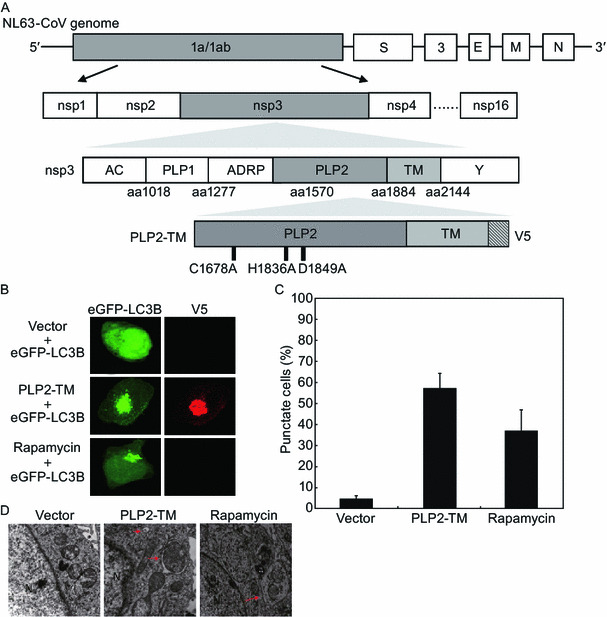
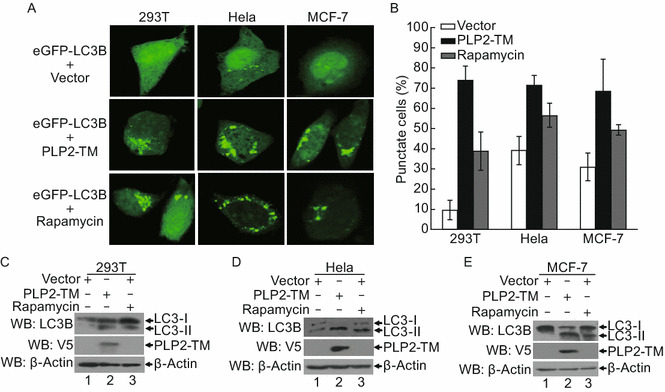
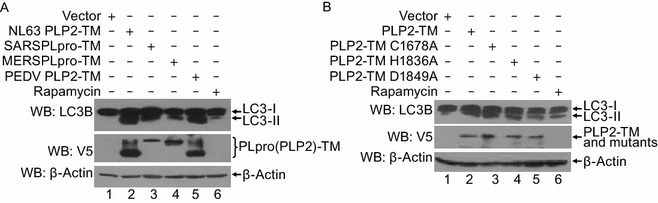
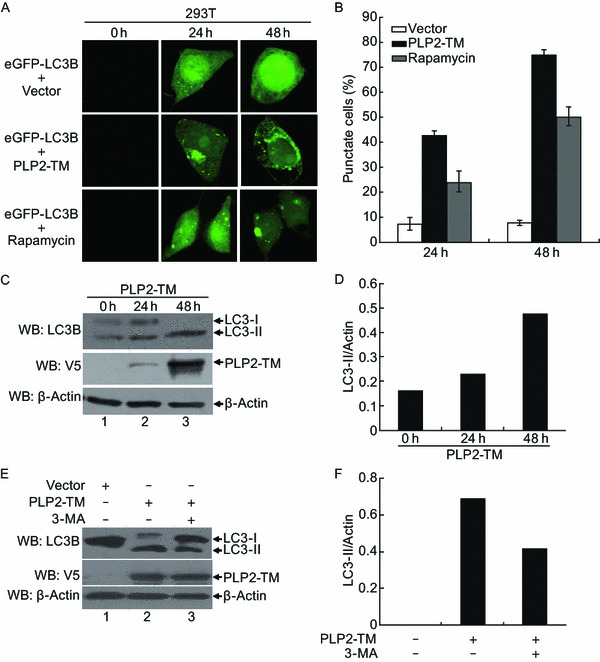
Autophagy plays important roles in modulating viral replication and antiviral immune response. Coronavirus infection is associated with the autophagic process, however, little is known about the mechanisms of autophagy induction and its contribution to coronavirus regulation of host innate responses. Here, we show that the membrane-associated papain-like protease PLP2 (PLP2-TM) of coronaviruses acts as a novel autophagy-inducing protein. Intriguingly, PLP2-TM induces incomplete autophagy process by increasing the accumulation of autophagosomes but blocking the fusion of autophagosomes with lysosomes. Furthermore, PLP2-TM interacts with the key autophagy regulators, LC3 and Beclin1, and promotes Beclin1 interaction with STING, the key regulator for antiviral IFN signaling. Finally, knockdown of Beclin1 partially reverses PLP2-TM's inhibitory effect on innate immunity which resulting in decreased coronavirus replication. These results suggested that coronavirus papain-like protease induces incomplete autophagy by interacting with Beclin1, which in turn modulates coronavirus replication and antiviral innate immunity.
Overview
The claims and statistics of this paper haven’t been checked yet.
Free: it reads the open-access text and checks the first 5 claims that cite a source we can check. Create a free account to check every claim.
Integrity signals
Registry
Cites
Statistics
Figures
Verification
Claims the paper makes
The claims and statistics of this paper haven’t been checked yet.
Free: it reads the open-access text and checks the first 5 claims that cite a source we can check. Create a free account to check every claim.
Claims other papers make about this one
Each is checked against this paper’s own text: does it say what the citing paper says it does?
In the citing paper
“(ii) the papain‐like protease domain of CoV‐NL63 binds BECN1 and STING1, thus hindering BECN1‐mediated autophagosome formation and inhibiting IFN production (Devaraj et al, 2007; Chen et al, 2014)”
From Autophagy in major human diseases (2021) · cites this paper as Chen et al, 2014
Self-check
Percentages, sums and reported differences re-computed from the paper’s own numbers.
The self-check needs the paper’s full text.
Citations
Cites
LC3, a mammalian homologue of yeast Apg8p, is localized in autophagosome membranes after processing.
Kabeya, Y., Mizushima, N., Ueno, T., Yamamoto, A., Kirisako, T., Noda, T., Kominami, E., Ohsumi, Y., & Yoshimori, T. (2000) · The EMBO Journal · doi:10.1093/emboj/19.21.5720 · Cited by 6,605
Pankiv, S., Clausen, T. H., Lamark, T., Brech, A., Bruun, J.-A., Outzen, H., Øvervatn, A., Bjørkøy, G., & Johansen, T. (2007) · Journal of Biological Chemistry · doi:10.1074/jbc.m702824200 · Cited by 4,578 · cited 1×
“To answer this question, we measured the protein levels of a wellcharacterized autophagic substrate, p62/SQSTM1, which binds to LC3 and is specifically degraded as a result of complete autophagic flux (Bjorkoy et al., 2005; Pankiv et 5A ).”
BackgroundMethods in Mammalian Autophagy Research
Mizushima, N., Yoshimori, T., & Levine, B. (2010) · Cell · doi:10.1016/j.cell.2010.01.028 · Cited by 4,497
Autophagy and Viruses: Adversaries or Allies?
Dong, X., & Levine, B. (2013) · Journal of Innate Immunity · doi:10.1159/000346388 · Cited by 4,430
Guidelines for the use and interpretation of assays for monitoring autophagy
Klionsky, D. J., Abdalla, F. C., Abeliovich, H., Abraham, R. T., Acevedo-Arozena, A., Adeli, K., Agholme, L., Agnello, M., Agostinis, P., Aguirre-Ghiso, J. A., et al. (2012) · Autophagy · doi:10.4161/auto.19496 · Cited by 4,330 · cited 4×
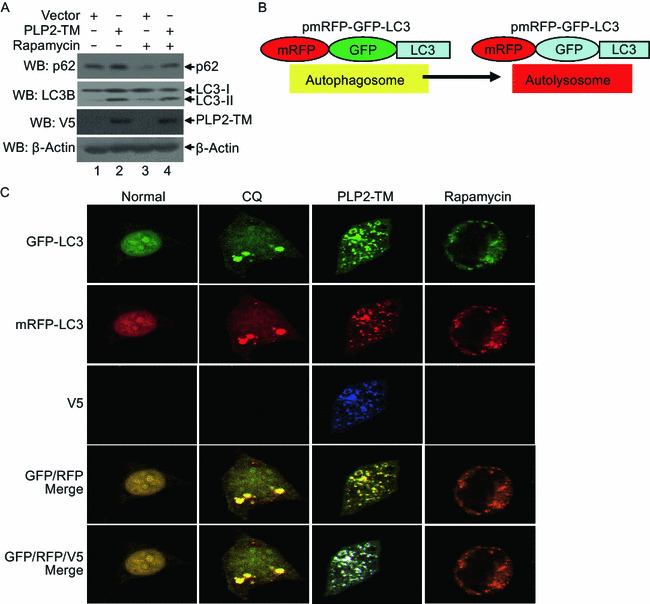
“To further clarify the mechanism by which PLP2-TM induces incomplete autophagy, we took advantage of a tandem-tagged fluorescent reporter, mRFP-GFP-LC3 (Ke and Chen, 2011; Kimura et al., 2007; Klionsky et al., 2012; Mizushima et al., 2010) (Fig.”
BackgroundMethodInfluentialAutophagy: cellular and molecular mechanisms
Glick, D., Barth, S., & Macleod, K. F. (2010) · The Journal of Pathology · doi:10.1002/path.2697 · Cited by 3,802
Autophagy in immunity and inflammation
Levine, B., Mizushima, N., & Virgin, H. W. (2011) · Nature · doi:10.1038/nature09782 · Cited by 3,289 · cited 2×
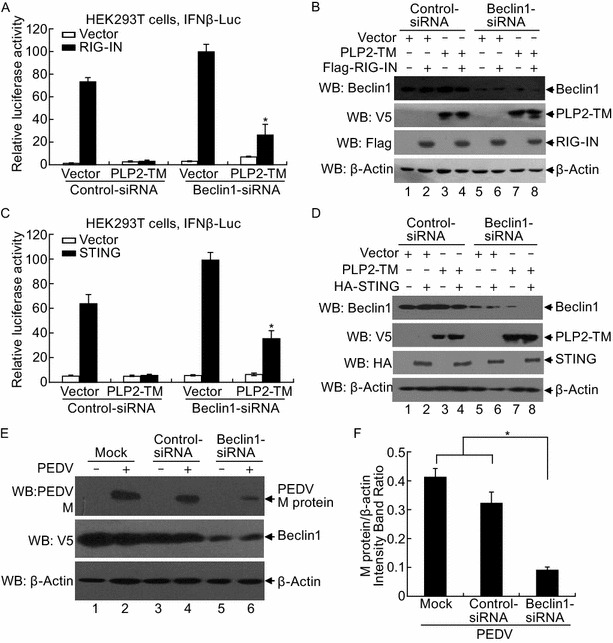
“components in regulating innate immunity (Levine et al., 2011), we determined whether Beclin1 is involved in the regulation of STING by PLP2-TM.”
BackgroundBjørkøy, G., Lamark, T., Brech, A., Outzen, H., Perander, M., Øvervatn, A., Stenmark, H., & Johansen, T. (2005) · The Journal of Cell Biology · doi:10.1083/jcb.200507002 · Cited by 3,276 · cited 1×
“To answer this question, we measured the protein levels of a wellcharacterized autophagic substrate, p62/SQSTM1, which binds to LC3 and is specifically degraded as a result of complete autophagic flux (Bjorkoy et al., 2005; Pankiv et 5A ).”
BackgroundThe AMPK signalling pathway coordinates cell growth, autophagy and metabolism
Mihaylova, M. M., & Shaw, R. J. (2011) · Nature Cell Biology · doi:10.1038/ncb2329 · Cited by 2,923 · cited 2×
“…that autophagy is involved in various physiologic and pathologic processes including cancer, cardiovascular disease, metabolism, viral infections and immune response, etc. (Deretic, 2012; Levine and Deretic, 2007; Mihaylova and Shaw, 2011; Shintani and Klionsky, 2004; Yang et al., 2011).”
BackgroundAutophagy in Human Health and Disease
Choi, A. M. K., Ryter, S. W., & Levine, B. (2013) · New England Journal of Medicine · doi:10.1056/nejmra1205406 · Cited by 2,583
Cited by
Items 101–138 of 138
Cursaro, I., Rossi, S., Butini, S., Gemma, S., Carullo, G., & Campiani, G. (2025) · Medicinal Research Reviews · doi:10.1002/med.70003 · Cited by 6
Mechanism, structural and functional insights into nidovirus-induced double-membrane vesicles
Wang, X., Chen, Y., Qi, C., Li, F., Zhang, Y., Zhou, J., Wu, H., Zhang, T., Qi, A., Ouyang, H., et al. (2024) · Frontiers in Immunology · doi:10.3389/fimmu.2024.1340332 · Cited by 6
Tehrani, A. S., Mirakabad, F. S. T., Abdollahifar, M.-A., Ghomi, S. M., Darabi, S., Forozesh, M., Rezaei-Tavirani, M., Mahmoudiasl, G.-R., Ahrabi, B., Azimzadeh, Z., et al. (2022) · The Tohoku Journal of Experimental Medicine · doi:10.1620/tjem.2022.j007 · Cited by 6
Xu, J., Li, H., Liu, P., Jiao, Z., Zhang, D., Su, Z., Niu, S., Zhang, J., Shi, Y., & Peng, G. (2026) · Advanced Science · doi:10.1002/advs.202521626 · Cited by 6
Feng, C., Huang, C., Shi, Y., Gao, X., Lü, Z., Tang, R., Qi, Q., Shen, Y., Li, G., Shi, Y. C., et al. (2023) · International Journal of Biological Macromolecules · doi:10.1016/j.ijbiomac.2023.127635 · Cited by 5
Porcine Hemagglutinating Encephalomyelitis Virus Triggers Neural Autophagy Independently of ULK1
Li, Z., Gao, F., Lan, Y., Guan, J., Zhang, J., Lu, H., Zhao, K., & He, W. (2021) · Journal of Virology · doi:10.1128/jvi.00851-21 · Cited by 5
Han, Y., Wang, C., Lu, K., Dong, X., Chang, Z., Zhang, R., Hou, Q., Wang, X., Xiao, S., Liu, H., et al. (2024) · Veterinary Microbiology · doi:10.1016/j.vetmic.2023.109972 · Cited by 5
Autophagy as an integral immune system component
Bueno, E., Wyatt, S., Duttenhefner, R., Asa, D., Dasanna, S., & Sinha, S. C. (2021) · Elsevier eBooks · doi:10.1016/b978-0-12-822003-0.00011-5 · Cited by 5
Yousefi, P., Tabibzadeh, A., Keyvani, H., Esghaei, M., Karampoor, S., Razizadeh, M. H., & Mousavizadeh, L. (2023) · Apmis · doi:10.1111/apm.13286 · Cited by 5
Mormile, R. (2021) · Expert Review of Cardiovascular Therapy · doi:10.1080/14779072.2021.1955352 · Cited by 5
Interaction between coronaviruses and the autophagic response
Yu, J., Ge, S., Li, J., Zhang, Y., Xu, J., Wang, Y., Liu, S., Yu, X., & Wang, Z. (2024) · Frontiers in Cellular and Infection Microbiology · doi:10.3389/fcimb.2024.1457617 · Cited by 4
Autophagy and coronavirus infection – a Trojan horse or Achilles heel?
Seiler, K., & Tschan, M. P. (2021) · Swiss Medical Weekly · doi:10.4414/smw.2021.20468 · Cited by 4
RNA as a source of biomarkers for amyotrophic lateral sclerosis
Kiaei, L., & Kiaei, M. (2021) · Metabolic Brain Disease · doi:10.1007/s11011-021-00738-z · Cited by 4
Boroumand‐Noughabi, S., Khoshnegah, Z., Jamehdar, S. A., Ayatollahi, H., Sheikhi, M., Rostami, M., & Keramati, M. R. (2022) · Medical Journal of the Islamic Republic of Iran · doi:10.47176/mjiri.36.99 · Cited by 3
Plant extracts modulate cellular stress to inhibit replication of mouse Coronavirus MHV-A59
Prieto, K., Arévalo, C., Lasso, P., Carlosama, C., Urueña, C. P., Fiorentino, S., & Barreto, A. (2023) · Heliyon · doi:10.1016/j.heliyon.2023.e23403 · Cited by 3
Zia, A., Sahebdel, F., Farkhondeh, T., Pourbagher‐Shahri, A. M., Samini, F., & Samarghandian, S. (2025) · Current Pharmaceutical Biotechnology · doi:10.2174/0113892010328697250210065420 · Cited by 3
Autophagy in emerging and highly concerned severe zoonotic infectious diseases
Qi, Y., Wang, L., Wu, S., Meng, C., Chu, Y., Yin, Y., & Jiao, H. (2026) · Frontiers in Immunology · doi:10.3389/fimmu.2026.1761571 · Cited by 2
Role of autophagy in antiviral innate immunity
Xie, J., Jiao, P., Wang, D., Shi, M., Yuan, C., Su, L., Zhang, G., Wang, Y., Ma, Z., Li, L., et al. (2026) · Cellular & Molecular Biology Letters · doi:10.1186/s11658-026-00871-6 · Cited by 2
Liu, C., & Yuan, X. (2026) · Virology · doi:10.1016/j.virol.2026.110913 · Cited by 2
Zheng, P., Yuan, W., Xiao, X., Xiong, K., Li, X., Holck, A. L., & Liu, R. (2020) · ES Food & Agroforestry · doi:10.30919/esfaf0012 · Cited by 2
A Balance Between Autophagy and Other Cell Death Modalities in Cancer
Gorbunova, A. S., Kopeina, G. S., & Zhivotovsky, B. (2022) · Methods in molecular biology · doi:10.1007/978-1-0716-2071-7_1 · Cited by 1
Molecular mechanisms of viral evasion from immune surveillance in autophagy
Gulimov, M. K., Игоревна, А. Ю., Сергеевич, С. А., Davydova, N. V., Зверев, В. В., & Свитич, О. А. (2020) · Immunologiya · doi:10.33029/0206-4952-2020-41-5-448-457 · Cited by 1
Induction of HSPA1A and Autophagy by SARS-CoV-2: Combined Potential Influence on Pregnancy Outcome
Witkin, A. M., & Witkin, S. S. (2021) · Heat shock proteins · doi:10.1007/7515_2021_39 · Cited by 1
Grosjean, I. (2020) · theses.fr (ABES) · doi:10.70675/e7f35c29z0285z4b5eza681z739d2c40bafa · Cited by 1
Adenovirus Evasion of Cell-Intrinsic Immunity
Burrage, A. M. (2016) · Loyola eCommons (Loyola University of Chicago)
The Importance of Autophagy Mechanism as a Novel Therapeutic Target in SARS-CoV-2
Şencan, S. (2021) · Malatya Turgut Özal University Institutional Repository
Meng, H., Zhou, J., Chen, X., Wang, M., Zheng, M., Li, Y., Han, Y., Chen, J., Han, J., Liang, J., et al. (2023) · doi:10.22541/au.167458073.32400363/v1
Self-citationInterplay between autophagy and coronavirus: autophagy mechanism
Elez-Burnjaković, N., Smajlović, A., & Tanasković, M. D. (2023) · Биомедицинска истраживања · doi:10.59137/bii202301298e
Can statins be applied for treating acute respiratory distress syndrome?
Zhou, G. (2023) · Frontiers in Medical Science Research · doi:10.25236/fmsr.2023.051002
Nanoparticles therapy: inspiration from the mechanism by which SARS-CoV-2 disrupts autophagy
Zhaojunli, W. A. N. G., Wang, Q., Ji, J., & Yuanyuan, Q. I. A. N. (2024) · Minerva Biotechnology and Biomolecular Research · doi:10.23736/s2724-542x.23.03013-4
Genetic Architecture of Host Proteins Involved in SARS-CoV
Khan, H., Hussain, F., Adnan, M., Nawaz, M. N., Khan, I. U., Younas, U., Nisar, M. F., Khan, I. A., Kalim, M., Shanyuan, C., et al. (2024) · BENTHAM SCIENCE PUBLISHERS eBooks · doi:10.2174/9789815274943124010008
Elucidating Phagophore Nucleation in the Autophagy Pathway of Saccharomyces cerevisiae
Hawkins, W. D. (2023) · Deep Blue (University of Michigan) · doi:10.7302/8482
Pathogenetic Predictors of Complications of the New Coronavirus Infection SARS-COV-2
Chepur, S. V., Nn, P., Chubar, O. V., Сергеевна, Б. Л., Litvinenko, I., Tjunin, M. A., Mjasnikova, I. A., & Пугач, В. А. (2025) · Biology Bulletin Reviews · doi:10.1134/s2079086425600110
Pinto, D. O., Sharif, S. A., Mensah, G. A., Cowen, M., Khatkar, P., Erickson, J. W., Branscome, H., Lattanze, T., DeMarino, C., Alem, F., et al. (2021) · Figshare · doi:10.6084/m9.figshare.14100568
Park, H., Ha, I. J., Jin, Y.-H., & Kwon, S. (2026) · Chinese Medicine · doi:10.1186/s13020-026-01388-y
Exploration of autophagy modulation in cancer and infectious diseases
Bestion, E. (2021) · theses.fr (ABES) · doi:10.70675/3663f1cdz2637z4b11za0afza7e39569a2fc
Wang, Y., Wang, M., Song, X., Liu, X., Yang, L., Ou, X., Sun, D., Yang, Q., Wu, Z., He, Y., et al. (2026) · Poultry Science · doi:10.1016/j.psj.2026.108119
Metadata
- Authors
- Chen, X., Wang, K., Xing, Y., Tu, J., Yang, X., Zhao, Q., Li, K., & Chen, Z.
- Affiliations
- Bengbu Medical College (CN)
- UNSW Sydney (AU)
- University of Tennessee Health Science Center (US)
- Corresponding author
- Chen, Zhongbin
- Venue
- Protein & Cell
- Publisher
- Oxford University Press (OUP)
- Published
- 2014-10-15
- Volume
- 5
- Issue
- 12
- Pages
- 912-927
- ISSN
- 1674-800X (ISSN-L)
- 1674-8018
- PMC
- PMC4259884
- OpenAlex
- W2046183696
- Cited by
- 130
- References
- 71
- Citations by year
- 2026: 4 · 2025: 3 · 2024: 10 · 2023: 13 · 2022: 25 · 2021: 32 · 2020: 27 · 2019: 3 · 2018: 4 · 2017: 5 · 2016: 2 · 2015: 2
- FWCI
- 2.27
- Type
- journal article
- Language
- en
- Open access
- gold
- doi.org
- Licence
- Locations
- Protein & Cell (publishedVersion, cc-by-nc)
- PubMed Central (publishedVersion, cc-by)
- PubMed (publishedVersion)
- Funders
- National Natural Science Foundation of China (81172799, 81273231, 81471947, 81102478)
- Topics
- Life Sciences › Biochemistry, Genetics and Molecular Biology › Cell Biology › Autophagy in Disease and Therapy
- Health Sciences › Medicine › Infectious Diseases › SARS-CoV-2 and COVID-19 Research
- Life Sciences › Immunology and Microbiology › Immunology › interferon and immune responses
- Keywords
- coronavirus, membrane-associated protease, autophagy, Beclin-1, STING, antiviral innate immunity, autophagosome-lysosome fusion, LC3, interferon signaling, viral replication, host-virus interaction
- MeSH terms
- Beclin-1, Coronavirus Papain-Like Proteases, STING Protein, Autophagy, Gene Expression Regulation, HeLa Cells, Humans, Immunity, Innate, Interferon-gamma, Lysosomes, Membrane Fusion, Membrane Proteins, Microtubule-Associated Proteins, Papain, Phagosomes, Virus Replication, Signal Transduction, RNA, Small Interfering, Apoptosis Regulatory Proteins, Host-Pathogen Interactions, Immune Evasion, HEK293 Cells, Coronavirus NL63, Human, MCF-7 Cells
About these checks
Registry, retraction, Cites and statistics results are computed, not judged, with one exception: a printed reference that no index lists is read once by a model before it counts as a citation error. Claims are extracted by a model and kept only when their quote appears verbatim in the text; each cited source is then checked, with a model’s help, for whether it says what the claim relies on. Those verdicts can be wrong — read the claim’s quote and the cited source before relying on one.
Statistics and arithmetic are recomputed, not judged.
Confidence bands are shown only for fields calibrated on our annotated test set. None is calibrated yet, so no band is shown.
What counts as a claim ›How we measure confidence ›How we check this ›
Are you an author, or do you see a problem with this page? Request a review
Data sources
Bibliographic data: Semantic Scholar, OpenAlex, Crossref.
Contains information from the Semantic Scholar Academic Graph Datasets, made available under the ODC Attribution License (ODC-BY 1.0).
Semantic Scholar’s data is described in: Kinney, R., et al. (2023). The Semantic Scholar Open Data Platform. arXiv:2301.10140.
