

Pharmacokinetics and Safety of iGlarLixi in Healthy Chinese Participants: Results of a Phase 1 Randomized Study
Open accessThe DOI matches its Crossref record; 27 of the 27 references it cites were found in a registry or an index.
Abstract
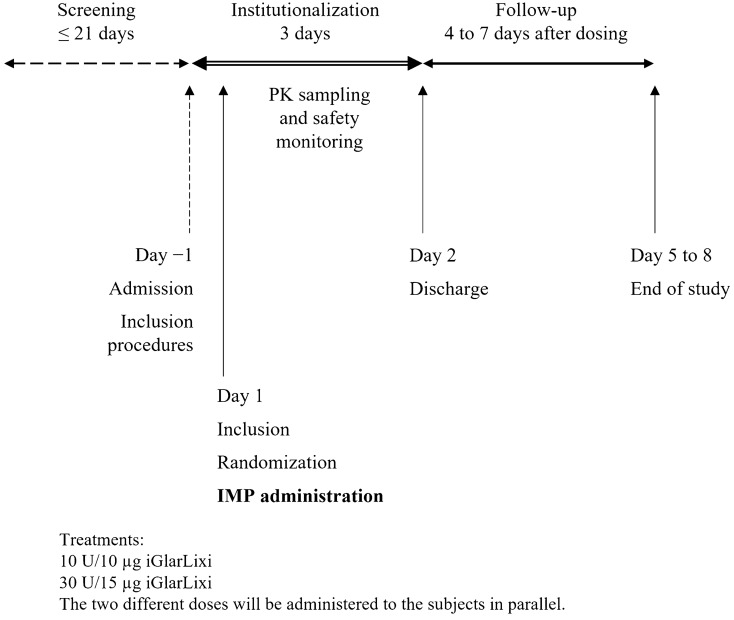
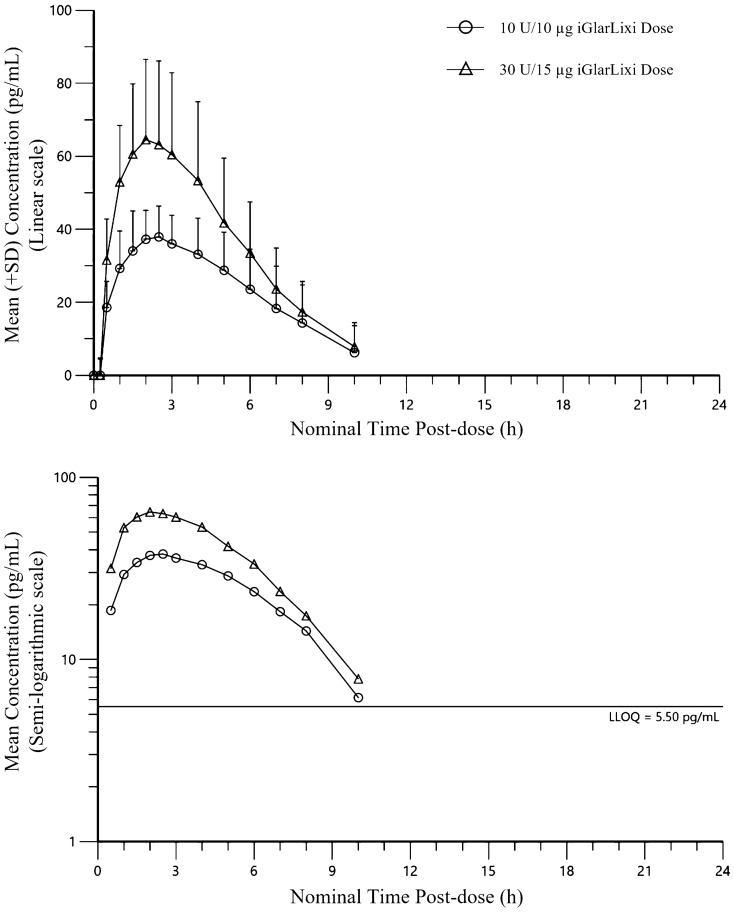
INTRODUCTION: The Chinese Diabetes Society recommends basal insulin and glucagon-like peptide-1 receptor agonists as an add-on therapy to first-line oral antihyperglycemic drugs for people with type 2 diabetes (T2D). Fixed-ratio combination of insulin glargine 100 U/ml (iGlar) and lixisenatide (iGlarLixi) is known to improve glycemic control in adults with T2D. However, the pharmacokinetics of iGlarLixi has not been evaluated in Chinese participants. The present study evaluated pharmacokinetics and safety of two iGlarLixi (10 U/10 μg and 30 U/15 μg) doses following single subcutaneous administration in healthy Chinese participants. METHODS: This was a Phase 1, single-center, open-label, parallel-group, randomized study in healthy Chinese adults who were randomized to receive a single dose of iGlarLixi with either 1:1 (10 U/10 μg) or 2:1 (30 U/15 μg) ratio of iGlar and lixisenatide. Primary objectives include assessment of pharmacokinetics of iGlar in iGlarLixi 30 U/15 μg group and the pharmacokinetics of lixisenatide in both the groups (iGlarLixi 10 U/10 μg and iGlarLixi 30 U/15 μg). Safety and tolerability were also assessed. RESULTS: of 3.25 and 2.00 h post-dose in both groups. The exposure increase was dose proportionate with a 1.5-fold increase in the lixisenatide dose. Adverse events observed were consistent with those previously reported with iGlar or lixisenatide. CONCLUSION: iGlarLixi administration resulted in early absorption of both iGlar and lixisenatide with a good tolerability profile in healthy Chinese participants. These results are consistent with the previously published data from other geographic regions. TRIAL REGISTRATION: U1111-1194-9411.
Overview
The claims and statistics of this paper haven’t been checked yet.
Free: it reads the open-access text and checks the first 5 claims that cite a source we can check. Create a free account to check every claim.
Integrity signals
Registry
Cites
Statistics
Figures
Verification
Claims the paper makes
The claims and statistics of this paper haven’t been checked yet.
Free: it reads the open-access text and checks the first 5 claims that cite a source we can check. Create a free account to check every claim.
Claims other papers make about this one
Each is checked against this paper’s own text: does it say what the citing paper says it does?
The cited source doesn’t support the claim as written.
In the citing paper
“The average half-life of lixisenatide is approximately 3–4 h.95”
From Glucagon-like peptide-1 receptor: mechanisms and advances in therapy (2024) · cites this paper as [95]
Checked by a reasoning model — may be wrong.
Experimental — accuracy not yet measured
Self-check
Percentages, sums and reported differences re-computed from the paper’s own numbers.
The self-check needs the paper’s full text.
Citations
Cites
Lepore, M., Pampanelli, S., Fanelli, C., Porcellati, F., Bartocci, L., Di Vincenzo, A., Cordoni, C., Costa, E., Brunetti, P., & Bolli, G. B. (2000) · Diabetes · doi:10.2337/diabetes.49.12.2142 · Cited by 818
Heinemann, L., Linkeschova, R., Rave, K., Hompesch, B., Sedlak, M., & Heise, T. (2000) · Diabetes Care · doi:10.2337/diacare.23.5.644 · Cited by 473
Rosenstock, J., Aronson, R., Grunberger, G., Hanefeld, M., Piatti, P., Serusclat, P., Cheng, X., Zhou, T., Niemoeller, E., Souhami, E., et al. (2016) · Diabetes Care · doi:10.2337/dc16-0917 · Cited by 272
Aroda, V. R., Rosenstock, J., Wysham, C., Unger, J., Bellido, D., González-Gálvez, G., Takami, A., Guo, H., Niemoeller, E., Souhami, E., et al. (2016) · Diabetes Care · doi:10.2337/dc16-1495 · Cited by 260
Lorenz, M., Pfeiffer, C., Steinsträßer, A., Becker, R. H. A., Rütten, H., Ruus, P., & Horowitz, M. (2013) · Regulatory Peptides · doi:10.1016/j.regpep.2013.04.001 · Cited by 149 · cited 1×
“cant regarding the insulinotropic effect and sustained delay in gastric emptying reported with lixisenatide [15, 16].”
BackgroundScholtz, H. E., Pretorius, S. G., Wessels, D. H., & Becker, R. H. A. (2005) · Diabetologia · doi:10.1007/s00125-005-1916-y · Cited by 126
Bolli, G. B., Hahn, A. D., Schmidt, R., Eisenblaetter, T., Dahmen, R., Heise, T., & Becker, R. H. A. (2012) · Diabetes Care · doi:10.2337/dc12-0270 · Cited by 113
Shiramoto, M., Eto, T., Irie, S., Fukuzaki, A., Teichert, L., Tillner, J., Takahashi, Y., Koyama, M., Dahmen, R., Heise, T., et al. (2015) · Diabetes, Obesity and Metabolism · doi:10.1111/dom.12415 · Cited by 95
Blonde, L., Rosenstock, J., Del Prato, S., Henry, R., Shehadeh, N., Frias, J., Niemoeller, E., Souhami, E., Ji, C., & Aroda, V. R. (2019) · Diabetes Care · doi:10.2337/dc19-1357 · Cited by 85
Rodbard, H. W., Gough, S. C. L., Lane, W. S., Korsholm, L., Bretler, D., & Handelsman, Y. (2013) · Endocrine Practice · doi:10.4158/ep13287.or · Cited by 60 · cited 1×
“Five participants in the iGlarLixi 10 U/10 lg group and eight in the iGlarLixi 30 U/15 lg group experienced hypoglycemia events, which may be expected with an insulin-containing treatment [31].”
BackgroundRaccah, D., Miossec, P., Esposito, V., Niemoeller, E., Cho, M., & Gerich, J. (2015) · Diabetes/Metabolism Research and Reviews · doi:10.1002/dmrr.2588 · Cited by 50
Lucidi, P., Porcellati, F., Rossetti, P., Candeloro, P., Andreoli, A. M., Cioli, P., Hahn, A. D., Schmidt, R., Bolli, G. B., & Fanelli, C. G. (2012) · Diabetes Care · doi:10.2337/dc12-0271 · Cited by 50 · cited 1×
“also reported similar results, indicating that M1 accounted for most ([90%) of the plasma insulin concentration and metabolic action in people with T2D after repeated daily subcutaneous dosing [23].”
ResultLixisenatide reduces postprandial hyperglycaemia via gastrostatic and insulinotropic effects
Becker, R. H. A., Stechl, J., Steinstraesser, A., Golor, G., & Pellissier, F. (2015) · Diabetes/Metabolism Research and Reviews · doi:10.1002/dmrr.2647 · Cited by 49 · cited 1×
“cant regarding the insulinotropic effect and sustained delay in gastric emptying reported with lixisenatide [15, 16].”
BackgroundTerauchi, Y., Nakama, T., Spranger, R., Amano, A., Inoue, T., & Niemoeller, E. (2020) · Diabetes Obesity and Metabolism · doi:10.1111/dom.14036 · Cited by 44
Watada, H., Takami, A., Spranger, R., Amano, A., Hashimoto, Y., & Niemoeller, E. (2020) · Diabetes Care · doi:10.2337/dc19-2452 · Cited by 38
Meneghini, L. F., Mauricio, D., Orsi, E., Lalic, N. M., Cali, A. M. G., Westerbacka, J., Stella, P., Candelas, D., Pilorget, V., Perfetti, R., et al. (2019) · Diabetes, Obesity and Metabolism · doi:10.1111/dom.13673 · Cited by 36 · cited 13×
“A combination of insulin glargine 100 U/ml (iGlar) and lixisenatide (iGlarLixi) improves the glycemic level through complimentary action and could offer an effective option for people with T2D There are no previously published data on the pharmacokinetic profile of iGlarLixi in Chinese participants.”
BackgroundInfluentialKaneto, H., Takami, A., Spranger, R., Amano, A., Watanabe, D., & Niemoeller, E. (2020) · Diabetes, Obesity and Metabolism · doi:10.1111/dom.14005 · Cited by 36
Yang, W., Dong, X., Li, Q., Cheng, Z., Yuan, G., Liu, M. R., Xiao, J., Gu, S., Niemoeller, E., Chen, L., et al. (2022) · Diabetes Obesity and Metabolism · doi:10.1111/dom.14722 · Cited by 36
Blonde, L., Anderson, J. E., Chava, P., & Dendy, J. A. (2018) · Current Medical Research and Opinion · doi:10.1080/03007995.2018.1541790 · Cited by 34
Yuan, X., Guo, X., Zhang, J., Dong, X., Lu, Y., Pang, W., Gu, S., Niemoeller, E., Lin, P., Nian, G., et al. (2022) · Diabetes Obesity and Metabolism · doi:10.1111/dom.14803 · Cited by 33
Odawara, M., Ohtani, T., & Kadowaki, T. (2012) · Diabetes Technology & Therapeutics · doi:10.1089/dia.2011.0220 · Cited by 26 · cited 13×
“A combination of insulin glargine 100 U/ml (iGlar) and lixisenatide (iGlarLixi) improves the glycemic level through complimentary action and could offer an effective option for people with T2D There are no previously published data on the pharmacokinetic profile of iGlarLixi in Chinese participants.”
BackgroundInfluentialHinnen, D., & Strong, J. L. (2018) · Diabetes Spectrum · doi:10.2337/ds17-0014 · Cited by 24 · cited 1×
“monly reported in previous studies with lixisenatide or iGlarLixi treatment [29, 30].”
ResultObesity, Type 2 Diabetes and Beta Cell Failure: An Asian Perspective
Saisho, Y. (2014) · Journal of Molecular and Genetic Medicine · doi:10.4172/1747-0862.s1-008 · Cited by 20 · cited 4×
“Eligible participants with a body mass index (BMI) between 19.0 and 27.9 kg/m2 were randomized to receive a single dose of iGlarLixi with either 1:1 (iGlarLixi 10 U/10 lg) or 2:1 (iGlarLixi 30 U/15 lg) ratio of iGlar and lixisenatide (Fig.”
BackgroundInfluentialCharacteristics of the pathophysiology of type 2 diabetes in Asians
Cho, Y. M. (2017) · Annals of Laparoscopic and Endoscopic Surgery · doi:10.21037/ales.2017.01.03 · Cited by 20
Hassanein, M., Malek, R., Shaltout, I., Sahay, R. K., Büyükbeşe, M. A., Djaballah, K., Pilorget, V., Coudert, M., & Sifri, S. A. (2023) · Diabetes & Metabolic Syndrome Clinical Research & Reviews · doi:10.1016/j.dsx.2023.102707 · Cited by 15 · cited 1×
“Moreover, low risk of hypoglycemia with iGlarLixi was also reported by people with T2D in special conditions such as fasting during the Ramadan period [32].”
BackgroundFeng, W., Wang, W., Meng, R., Wu, G., Zhang, M., Zhang, X., Yin, H., & Zhu, D. (2021) · BMJ Open Diabetes Research & Care · doi:10.1136/bmjdrc-2021-002290 · Cited by 13
Inoue, M., Lorenz, M., Muto, H., Wesch, R., & Hashimoto, Y. (2019) · Diabetes Obesity and Metabolism · doi:10.1111/dom.13757 · Cited by 8
Research works printed but not linked: 3
- International Diabetes Federation: IDF Diabetes Atlas, 10th edition. Brussels, Belgium, International Diabetes Federation, 2021: https://diabetesatlas.org/. Accessed on March 01, 2022.
- Diabetes Branch of Chinese Medical Association: Guidelines for the Prevention and Treatment of Type 2 Diabetes in China (2020 Edition). Chin J Endocrinol Metab. 2021;37:311–98.
- Terauchi Y Nakama T Spranger R Efficacy and safety of insulin glargine/lixisenatide fixed-ratio combination (iGlarLixi 1:1) in Japanese patients with type 2 diabetes mellitus inadequately controlled on oral antidiabetic drugs: a randomized, 26-week, open-label, multicentre study: the LixiLan JP-O2 randomized clinical trial Diabetes Obes Metab 2020 22 Suppl 4 14 23 10.1111/dom.14036 32291880 · DOI
Cited by
Glucagon-like peptide-1 receptor: mechanisms and advances in therapy
Zheng, Z., Zong, Y., Ma, Y., Tian, Y., Pang, Y., Zhang, C., & Gao, J. (2024) · Signal Transduction and Targeted Therapy · doi:10.1038/s41392-024-01931-z · Cited by 1,036
Yu, M. (2025) · Diabetes Obesity and Metabolism · doi:10.1111/dom.70192 · Cited by 1
“30 Subjects were randomised to receive a single dose of iGlarLixi in one of two formulations: either a 1:1 ratio (i.e., 10 units of Glargine + 10 mcg lixisenatide) or a 2:1 ratio (30 U and 15 mcg, respectively) of iGlar and lixisenatide. iGlarLixi administration resulted in early absorption of both…”
Metadata
- Authors
- Xie, P., He, X., Gao, X., Shuai, M., Schmider, W., Jiang, A., Yang, N., & Shi, A.
- Affiliations
- Chinese Academy of Medical Sciences & Peking Union Medical College (CN)
- Sanofi (China) (CN)
- Sanofi (Germany) (DE)
- Corresponding author
- Shi, Aixin
- Venue
- Diabetes Therapy
- Published
- 2023-06-17
- Volume
- 14
- Issue
- 8
- Pages
- 1387-1397
- ISSN
- 1869-6953 (ISSN-L)
- 1869-6961
- PMC
- PMC10299984
- OpenAlex
- W4381094640
- Cited by
- 2
- References
- 27
- Citations by year
- 2025: 1 · 2024: 1
- FWCI
- 0.41
- Type
- journal article
- Language
- en
- Open access
- gold
- doi.org
- Licence
- cc-by-nc
- creativecommons.org/licenses/by-nc/4.0 (tdm)
- creativecommons.org/licenses/by-nc/4.0 (vor)
- Locations
- Diabetes Therapy (publishedVersion, cc-by-nc)
- PubMed Central (publishedVersion, cc-by-nc)
- PubMed (publishedVersion)
- Funders
- Sanofi
- Topics
- Health Sciences › Medicine › Endocrinology, Diabetes and Metabolism › Diabetes Treatment and Management
- Health Sciences › Medicine › Endocrinology, Diabetes and Metabolism › Diabetes Management and Research
- Life Sciences › Pharmacology, Toxicology and Pharmaceutics › Pharmacology › Pharmacogenetics and Drug Metabolism
- Keywords
- iGlarLixi, insulin glargine, lixisenatide, fixed-ratio combination, pharmacokinetics, type 2 diabetes, Chinese population, subcutaneous administration, dose proportionality, drug safety and tolerability, basal insulin, GLP-1 receptor agonists
About these checks
Registry, retraction, Cites and statistics results are computed, not judged, with one exception: a printed reference that no index lists is read once by a model before it counts as a citation error. Claims are extracted by a model and kept only when their quote appears verbatim in the text; each cited source is then checked, with a model’s help, for whether it says what the claim relies on. Those verdicts can be wrong — read the claim’s quote and the cited source before relying on one.
Statistics and arithmetic are recomputed, not judged.
Confidence bands are shown only for fields calibrated on our annotated test set. None is calibrated yet, so no band is shown.
What counts as a claim ›How we measure confidence ›How we check this ›
Are you an author, or do you see a problem with this page? Request a review
Data sources
Bibliographic data: Semantic Scholar, OpenAlex, Crossref.
Contains information from the Semantic Scholar Academic Graph Datasets, made available under the ODC Attribution License (ODC-BY 1.0).
Semantic Scholar’s data is described in: Kinney, R., et al. (2023). The Semantic Scholar Open Data Platform. arXiv:2301.10140.
