

The effects of sex, age, season and habitat on diet of the red fox Vulpes vulpes in northeastern Poland
Open accessThe DOI matches its Crossref record; 46 of the 47 references it cites were found in a registry or an index; 14 of the 56 sources its claims cite were checked for support.
Abstract
The diet of the red fox Vulpes vulpes was investigated in five regions of northeastern Poland by stomach content analysis of 224 foxes collected from hunters. The red fox is expected to show the opportunistic feeding habits. Our study showed that foxes preyed mainly on wild prey, with strong domination of Microtus rodents, regardless of sex, age, month and habitat. Voles Microtus spp. were found in 73% of stomachs and constituted 47% of food volume consumed. Other food items were ungulate carrion (27% of volume), other mammals (11%), birds (9%), and plant material (4%). Sex- and age-specific differences in dietary diversity were found. Adult males and juvenile foxes had larger food niche breadths than adult females and their diets highly overlapped. Proportion of Microtus voles increased from autumn to late winter. Significant habitat differences between studied regions were found. There was a tendency among foxes to decrease consumption of voles with increasing percentage of forest cover. Based on our findings, red foxes in northeastern Poland can be recognized as a generalist predators, consuming easily accessible and abundant prey. However, high percentage of voles consumed regardless of age, sex, month, or habitats may indicate red fox specialization in preying on Microtus rodents.
Overview
CoChat Summary
TL;DR
The diet of red foxes in northeastern Poland was studied by stomach-content analysis of 224 foxes collected from hunters. Microtus voles dominated across sex, age, month, and habitat, but diet diversity varied by sex/age, season, and forest cover.
Key findings
- Microtus voles occurred in 72.7% of stomachs and made up 46.9% of diet by volume; ungulate carrion was second at 26.8% of volume, followed by other mammals (10.7%), birds (8.9%), plant material (3.6%), and other food (1.4%).
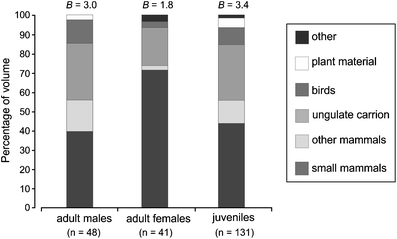
- Adult males and juveniles had broader food niche breadths (B = 3.0 and 3.4, respectively) than adult females (B = 1.8), and adult male–juvenile diets overlapped highly (α = 0.98). Sex differences increased during the breeding season (January–March; χ² = 37.6, df = 5, p < 0.0005) compared with the pre-breeding period (September–December; χ² = 23.2, df = 5, p < 0.0005).
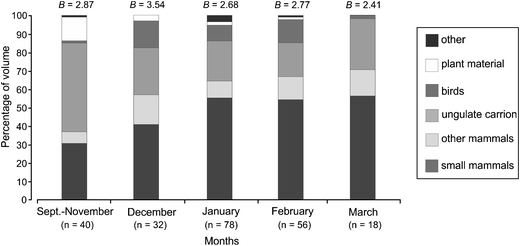
- Monthly diet differences were significant (χ² = 95.8, df = 20, p < 0.0005); the broadest food niche occurred in December (B = 3.54), vole consumption increased from autumn to late winter, and birds were hunted mainly in December–February.
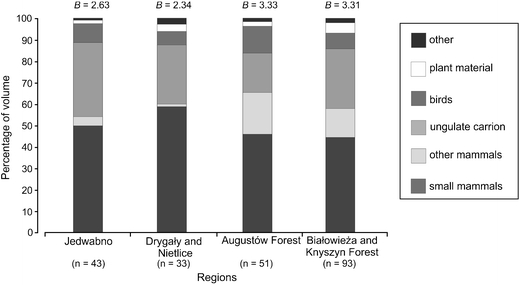
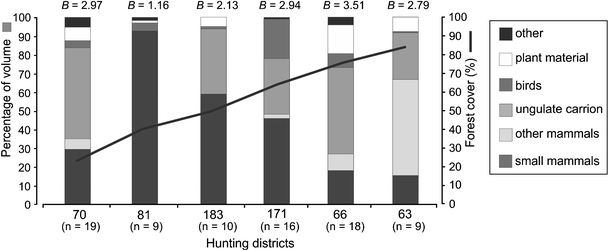
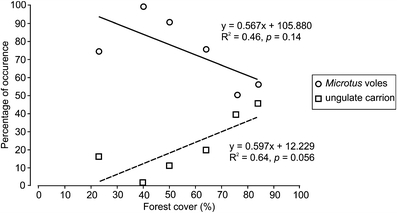
- Diet differed significantly between regions (χ² = 37.0, df = 15, p = 0.001) and hunting districts (χ² = 408.1, df = 25, p < 0.0005). Other mammals were higher in forest regions (13–19.8% of volume) than in less forested areas (1.2–3.9%); vole occurrence tended to decline and ungulate carrion to increase with forest cover, but these relationships were not significant (r² = 0.46, n = 6, p = 0.14 and r² = 0.64, n = 6, p = 0.056).
Methods
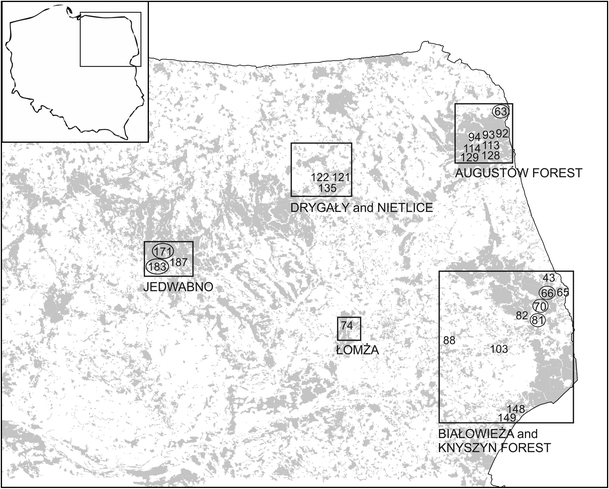
- Stomach contents were analyzed from 224 red foxes (of 282 collected, 79% contained food) collected from September 2002 to March 2003 in five regions of northeastern Poland during fox control operations for black grouse conservation. Foxes were sexed, weighed, measured, and aged as juveniles or adults using lower canine pulp cavity width on X-rays.
- Prey remains were identified to the lowest possible taxon and grouped into six food categories; diet was expressed as percentage of occurrence, percentage of volume, and percentage of biomass. Analyses compared age, sex, month, region, and hunting district using Pearson’s Chi-square, Kruskal–Wallis tests, Levins’ food niche breadth index, and Pianka’s dietary overlap index.
- Region 5 was excluded from regional comparisons because of low sample size, but its stomachs were used in other analyses. Habitat effects were examined in six hunting districts with detailed forest-cover data and sufficient stomach samples.
Limitations
- Stated in the paper: no food resource survey was conducted simultaneously; the relationships between forest cover and vole or ungulate carrion occurrence were not significant due to small sample size (n = 6); and region 5 was excluded from regional comparisons because of low sample numbers.
- Evident from the text: sampling was restricted to September 2002–March 2003 and to foxes collected by hunters during black grouse conservation operations, so spring and summer diet and possible hunter/control biases are not represented.
- Evident from the text: stomach contents reflect recent meals only, and the study did not measure prey availability directly, limiting inference about selectivity versus opportunism.
Model-written summary. Check it against the paper before relying on it.
Integrity signals
Registry
Cites
Statistics
Figures
Verification
Claims the paper makes
11 Valid · 2 Not valid · 24 Not checked · 67 Own results and interpretations
The sources with a verdict support this claim; the rest weren’t checked yet, have no full text we could read, or their verdicts aren’t rated yet.
In the paper
“Habitat type, by shaping variable prey availability, may strongly influence the diet of this medium-sized carnivore (Kolb and Hewson 1979; Leckie et al. 1998; Sidorovich et al. 2006).”
§ The effects of sex, age, season and habitat on diet of the red fox Vulpes vulpes in northeastern Poland > Introduction
What the sources say
- Supportedcites Kolb and Hewson 1979 matched to “Variation in the diet of foxes in Scotland” (1979) source
Section 6.1 (pp. 10–11) says that foods taken depend on habitat and that foxes adapt their diet to the abundance or availability of food across those habitats. Its examples of differing diets in agricultural, forested, moorland and highland areas support the citing sentence's hedged claim. (LLM, conf=0.94)
- Not checked — no full text of the sourcecites Leckie et al. 1998 matched to “Variation in the diet of red foxes on Scottish moorland in relation to prey abundance” (1998) source
- Not checked — no full text of the sourcecites Sidorovich et al. 2006 matched to “Variations in the diet and population density of the red fox Vulpes vulpes in the mixed woodlands of northern Belarus” (2006) source
hedgedstates a possible cause- Asserted: passes — The authors put it forward as true.
- Checkable: passes — It can be checked against evidence.
- Load-bearing: passes — The paper’s conclusions depend on it.
- Based: passes — The paper gives a reason why it holds.
- Supported
Every source the paper cites for this claim was checked and supports it.
In the paper
“In agricultural lands of western Poland, common voles constituted 93% of the total biomass consumed by red foxes (Goszczyński 1974), but in central Poland, where densities of small rodents were lower, a compensatory response was found between similar proportions of small mammals, birds, and hares consumed (Goszczyński 1986).”
§ The effects of sex, age, season and habitat on diet of the red fox Vulpes vulpes in northeastern Poland > Discussion
What the sources say
- Supportedcites Goszczyński 1986 matched to “Diet of foxes and martens in central Poland” (1986) source
The opening summary (p. 1) says common vole density was low in the central Poland study area, that foxes consumed small mammals, birds, and hares in similar proportions, and that consumption of birds and hares compensated for consumption of small mammals. Section 4.2 (p. 5) also reports negative correlations between small-mammal consumption and both hare and bird consumption. (LLM, conf=0.95)
plainstates a cause- Asserted: passes — The authors put it forward as true.
- Checkable: passes — It can be checked against evidence.
- Load-bearing: unclear — It is unclear whether the paper’s conclusions depend on it.
- Based: passes — The paper gives a reason why it holds.
- Supported
Every source the paper cites for this claim was checked and supports it.
In the paper
“According to Travaini et al. (1993), the reduction of the female home range size is a result of energetical and behavioral shifts due to breeding activity.”
§ The effects of sex, age, season and habitat on diet of the red fox Vulpes vulpes in northeastern Poland > Discussion
What the sources say
- Supportedcites Travaini et al. 1993 matched to “Home range and activity patterns of red fox Vulpes vulpes breeding females” (1993) source
The Results (p. 4) explicitly relate the reduction in female home range during breeding to energetic and behavioral factors associated with gestation, lactation, and cub rearing. The Results (p. 3) also report a breeding-season reduction in the one female tracked outside that season. (LLM, conf=0.93)
plainstates a cause- Asserted: passes — The authors put it forward as true.
- Checkable: passes — It can be checked against evidence.
- Load-bearing: unclear — It is unclear whether the paper’s conclusions depend on it.
- Based: passes — The paper gives a reason why it holds.
- Supported
A result the paper reports from its own data — it cites no other source for it, so there is none to check. The quote shows it is in the paper.
In the paper
“The broadest food niche (B = 3.54) occurred in the coldest month—December (Fig. 3).”
§ The effects of sex, age, season and habitat on diet of the red fox Vulpes vulpes in northeastern Poland > Results > Variation between months
plain- Asserted: passes — The authors put it forward as true.
- Checkable: passes — It can be checked against evidence.
- Load-bearing: unclear — It is unclear whether the paper’s conclusions depend on it.
- Based: passes — The paper gives a reason why it holds.
A result the paper reports from its own data — it cites no other source for it, so there is none to check. The quote shows it is in the paper.
In the paper
“Birds were hunted mainly during colder months—December, January, and February (Fig. 3).”
§ The effects of sex, age, season and habitat on diet of the red fox Vulpes vulpes in northeastern Poland > Results > Variation between months
plainstates an association- Asserted: passes — The authors put it forward as true.
- Checkable: passes — It can be checked against evidence.
- Load-bearing: unclear — It is unclear whether the paper’s conclusions depend on it.
- Based: passes — The paper gives a reason why it holds.
42 more claims
Create a free account to see all 104 claims and every source verdict.
- Probably not a substantial claim. 31
- It may state two separate claims as one. 35
- The quote only partly states this claim. 3
Claims other papers make about this one
Each is checked against this paper’s own text: does it say what the citing paper says it does?
The source backs part of the claim, not all of it — or backs it for a different population, condition or comparison.
In the citing paper
“It is unlikely that food-niche separation can explain sexual dimorphism in foxes; although adult males and juvenile foxes have been found to have a broader food-niche than adult females, their diets have a considerable overlap (Kidawa & Kowalczyk, 2011).”
From DEVELOPMENT OF BODY MASS AND SEXUAL SIZE DIMORPHISM IN DANISH RED FOXES (VULPES VULPES) (2018) · cites this paper as Kidawa & Kowalczyk, 2011
Experimental — accuracy not yet measured
Self-check
Percentages, sums and reported differences re-computed from the paper’s own numbers.
Each contradiction between two passages listed here was confirmed by an independent check.
Rated minor: it would not touch a result — a value no result rests on, a p-value that stays on the same side of the significance level, or a conflict that is clerical, resolved elsewhere in the paper, or outside its own findings.
In the paper
§ The effects of sex, age, season and habitat on diet of the red fox Vulpes vulpes in northeastern Poland > Results > Specific food items
“Other mammals, mainly brown hare and carnivores, were found in 12.7% of the stomachs examined”
§ The effects of sex, age, season and habitat on diet of the red fox Vulpes vulpes in northeastern Poland > Results > Specific food items
“| Total | 10.7 | 10.6 | 10.9 |”
Citations
Cites
Evolution in Changing Environments: Some Theoretical Explorations. (MPB-2)
LEVINS, R. (2020) · Princeton University Press eBooks · doi:10.2307/j.ctvx5wbbh · Cited by 3,383
The Structure of Lizard Communities
Pianka, E. R. (1973) · Annual Review of Ecology and Systematics · doi:10.1146/annurev.es.04.110173.000413 · Cited by 2,832
Predation in Vertebrate Communities
Jędrzejewska, B., & Jędrzejewski, W. (1998) · Ecological Studies · doi:10.1007/978-3-662-35364-6 · Cited by 473 · cited 1×
“Assuming that fox cubs were born in early April (Goszczyński 1995; Jędrzejewska and Jędrzejewski 1998), we categorized foxes from 6 to 12 months old as juveniles and individuals >1.5 years of age as adults.”
BackgroundInfluentialPredation in Vertebrate Communities: The Bialowieza Primeval Forest as a Case Study
Jędrzejewska, B., & Jędrzejewski, W. (1998) · Medical Entomology and Zoology · Cited by 453
Factors affecting carcass use by a guild of scavengers in European temperate woodland
Selva, N., Jędrzejewska, B., Jędrzejewski, W., & Wajrak, A. (2005) · Canadian Journal of Zoology · doi:10.1139/z05-158 · Cited by 343 · cited 3×
“important food resource for different carnivores (Sidorovich et al. 2000; Selva et al. 2005), especially when other resources are scarce (Jędrzejewski and Jędrzejewska 1992).”
BackgroundGenerality of the Size-Distance Relation in Models of Optimal Feeding
Schoener, T. W. (1979) · The American Naturalist · doi:10.1086/283537 · Cited by 309
Moors, P. J. (1980) · Oikos · doi:10.2307/3544175 · Cited by 271
The Impact of Predation on Boreal Tetraonids During Vole Cycles: An Experimental Study
Marcstrom, V., Kenward, R. E., & Engren, E. (1988) · The Journal of Animal Ecology · doi:10.2307/5097 · Cited by 259 · cited 2×
“Fox predation has been reported as an important factor shaping black grouse populations (Marcström et al. 1988; Lindström 1994b; Selås 1998), particularly during low densities of cycling vole populations (Marcström et al.”
BackgroundKILL RATES AND PREDATION BY WOLVES ON UNGULATE POPULATIONS IN BIAŁOWIEŻA PRIMEVAL FOREST (POLAND)
Jędrzejewski, W., Schmidt, K., Theuerkauf, J., Jędrzejewska, B., Selva, N., Zub, K., & Szymura, L. (2002) · Ecology · doi:10.1890/0012-9658(2002)083[1341:krapbw]2.0.co;2 · Cited by 221
Jędrzejewski, W., & Jędrzejewska, B. (1992) · Ecography · doi:10.1111/j.1600-0587.1992.tb00027.x · Cited by 186
Research works printed but not linked: 12
- Baltrunaite L Feeding habits, food niche overlap of red fox (Vulpes vulpes) and pine marten (Martes martes) in hilly moraine highland, Lithuania Ecologija 2001 2 27 31
- Beresiński W Panek M Kubiak S The condition of fox population in Poland in the end of the nineties (monitoring results) Zwierzyna drobna jako element bioróżnorodności środowiska przyrodniczego 2000 Włocławek Włocławskie Towarzystwo Naukowe 163 171
- Böhme G Zur Bestimmung quartarer Anuren Europas an Hand von Skelettelementen Wiss Z Humboldt Univ Berl Math-Naturwiss Reihe 1977 26 283 300
- Englund J Studies on food ecology of the red fox (Vulpes vulpes) in Sweden Viltrevy 1965 4 375 471
- Goszczyński J Methods of studying the food of predatory birds and mammals Wiad Ekol 1972 4 360 371
- Goszczyński J The effect of structural differentiation of ecological landscape on the predator–prey interactions Rozprawy naukowe i monografie SGGW-AR, Warszawa 1985 46 1 80
- Jędrzejewski W Nowak S Schmidt K Jędrzejewska B Wolf and lynx in Poland—the results of the monitoring in 2001 Kosmos 2002 51 491 499
- Kamieniarz R Panek M The condition of the small game (monitoring results 1999–2000) Łowiec Polski 2000 12 1 3
- Lindström J Tetraonids population studies—state of the art Ann Zool Fenn 1994 31 347 364
- Pucek Z Keys to vertebrates of Poland 1984 Warszawa Państw Wydaw Nauk
- Rutkowski L Key to identification of vascular plants in lowland Poland 2004 Warszawa Wydaw Nauk PWN
- Zawadzka D Zawadzki J Conservation of capercaillie and black grouse in forest ecosystems—fiction or reality? Stud Mater CEPL 2006 11 169 180
Cited by
Soe, E., Davison, J., Süld, K., Valdmann, H., Laurimaa, L., & Saarma, U. (2017) · Mammal Review · doi:10.1111/mam.12092 · Cited by 121
“…of foxes to exploit different resources is reflected in the variability of their recorded diets at local and regional scales, which show responses to season, habitat, and the abundance of prey species (Goldyn et al. 2003, Barton & Zalewski 2007, Dell’Arte et al. 2007, Kidawa & Kowalczyk 2011).”
Kurek, P., Kapusta, P., & Holeksa, J. (2013) · Ecological Research · doi:10.1007/s11284-013-1094-1 · Cited by 89
“…they feed mainly on voles and other small mammals (Goszczyński 1986; Kidawa and Kowalczyk 2011), so the fertility of the forest surrounding their burrows is not as important for them as the distance to open areas, where voles tend to occur in great numbers (Kidawa and Kowalczyk 2011; Kurek 2011).”
BackgroundTrophic niche overlap and wild ungulate consumption by red fox and wolf in a mountain area in Italy
Bassi, E., Donaggio, E., Marcon, A., Scandura, M., & Apollonio, M. (2012) · Mammalian Biology · doi:10.1016/j.mambio.2011.12.002 · Cited by 84
Scholz, C., Firozpoor, J., Kramer‐Schadt, S., Gras, P., Schulze, C., Kimmig, S. E., Voigt, C. C., & Ortmann, S. (2020) · Ecology and Evolution · doi:10.1002/ece3.6584 · Cited by 66
“In contrast to our results, Kidawa and Kowalczyk (2011) revealed sex-related diet preferences within adult red foxes.”
ResultHerrmann, D. C., Maksimov, P., Maksimov, A., et al. (2011) · Veterinary Parasitology · doi:10.1016/j.vetpar.2011.10.030 · Cited by 64
Kalisinska, E., Lisowski, P., & Kosik-Bogacka, D. I. (2012) · Biological Trace Element Research · doi:10.1007/s12011-011-9181-z · Cited by 54
“The fox diet in Poland is dominated by food of animal origin, up to >95% of eaten biomass; the share of rodents (mainly Microtus), dead animals (mostly ungulates) and birds are 59%, 27% and 9%, respectively [30].”
BackgroundNeedham, R. J., Odden, M., Lundstadsveen, S. K., & Wegge, P. (2014) · ACTA THERIOLOGICA · doi:10.1007/s13364-014-0188-7 · Cited by 70
Veronesi, F., Deak, G., & Diakou, Α. (2023) · Pathogens · doi:10.3390/pathogens12020178 · Cited by 60
“However, they may represent an excellent indicator for the circulation of food-borne parasites, being nonspecific predators/scavengers, and widespread, contributing to the maintenance of parasites’ life cycle in wild settings [22,23].”
Diet Composition of the Golden Jackal in an Area of Intensive Big Game Management
Lanszki, J., Kurys, A., Heltai, M., Csányi, S., & Ács, K. (2015) · Annales Zoologici Fennici · doi:10.5735/086.052.0403 · Cited by 60
“…of available viscera and carrion (from hunting, poaching, road kills, diseases and natural mortality) is also reflected in the fact that not only jackals, but also the red fox (Vulpes vulpes) consumes large amounts of these food resources (e.g. Lanszki & Heltai 2002, Kidawa & Kowalczyk 2011).”
BackgroundInfluentialWinter diet composition of the golden jackal (Canis aureus L., 1758) in Serbia
Ćirović, D., Penezić, A., Milenković, M., & Paunović, M. (2013) · Mammalian Biology · doi:10.1016/j.mambio.2013.11.003 · Cited by 55
Fear or food – abundance of red fox in relation to occurrence of lynx and wolf
Wikenros, C., Aronsson, M., Liberg, O., Jarnemo, A., Hansson, J., Wallgren, M., Sand, H., & Bergström, R. (2017) · Scientific Reports · doi:10.1038/s41598-017-08927-6 · Cited by 51
Diet and bite force in red foxes: ontogenetic and sex differences in an invasive carnivore
Forbes‐Harper, J. L., Crawford, H. M., Dundas, S. J., Warburton, N. M., Adams, P. J., Bateman, P. W., Calver, M. C., & Fleming, P. A. (2017) · Journal of Zoology · doi:10.1111/jzo.12463 · Cited by 41
“Journal of Zoology (2017) – ª 2017 The Zoological Society of London 7 This is mirrored by a study from rural Poland (Kidawa & Kowalczyk, 2011), which found that adult male foxes and juveniles had wider food niche breadths (and had a high degree of overlap) than did adult females.”
BackgroundRange expansion of the golden jackal (Canis aureus) into Poland: first records
Kowalczyk, R., Kołodziej‐Sobocińska, M., Ruczyńska, I., et al. (2015) · Mammal Research · doi:10.1007/s13364-015-0238-9 · Cited by 40
“Competition with native red foxes (Vulpes vulpes) and invasive raccoon dogs (Nyctereutes procyonoides), which inhabit similar habitats (open areas, wetlands, river valleys) and overlap in their food habits (rodents, carrion), as well as effects on rodents, brown hare and roe deer can probably be expected (Jędrzejewska…”
BackgroundSelf-citationFox dietary ecology as a tracer of human impact on Pleistocene ecosystems
Baumann, C., Bocherens, H., Drucker, D. G., & Conard, N. J. (2020) · PLoS ONE · doi:10.1371/journal.pone.0235692 · Cited by 43
Generalist carnivores can be effective biodiversity samplers of terrestrial vertebrates
Shao, X., Lu, Q., Liu, M., Xiong, M., Bu, H., Wang, D., Liu, S., Zhao, J., Li, S., & Yao, M. (2021) · Frontiers in Ecology and the Environment · doi:10.1002/fee.2407 · Cited by 41
Janko, C., Schröder, W., Linke, S., & Konig, A. S. (2012) · ACTA THERIOLOGICA · doi:10.1007/s13364-012-0074-0 · Cited by 48
“A characteristic of the red fox (Vulpes vulpes) is its ability to thrive in a wide spectrum of habitats, in essence due to its omnivorous diet and high adaptability (Macdonald 1983; Kidawa and Kowalczyk 2011).”
BackgroundThe influence of landscape features on nest predation rates of grassland‐breeding waders
Laidlaw, R. A., Smart, J., Smart, M. A., & Gill, J. A. (2015) · Ibis · doi:10.1111/ibi.12293 · Cited by 53
Mesopredator behavioral response to olfactory signals of an apex predator
Wikenros, C., Jarnemo, A., Frisén, M., Kuijper, D. P. J., & Schmidt, K. (2017) · Journal of Ethology · doi:10.1007/s10164-016-0504-6 · Cited by 50
“…lynx (Lynx lynx, hereafter ‘‘lynx’’) are competitors with a diet overlap consisting mainly of hares, rodents, birds, and roe deer (Capreolus capreolus) fawns (Jarnemo et al. 2004; Jarnemo and Liberg 2005; Odden et al. 2006; Panzacchi et al. 2008; Kidawa and Kowalczyk 2011; Krofel et al. 2011).”
BackgroundMother–offspring recognition in the domestic cat: Kittens recognize their own mother's call
Szenczi, P., Bánszegi, O., Urrutia, A., Faragó, T., & Hudson, R. (2016) · Developmental Psychobiology · doi:10.1002/dev.21402 · Cited by 41
Krajcarz, M. T., Krajcarz, M., & Bocherens, H. (2017) · Palaeogeography Palaeoclimatology Palaeoecology · doi:10.1016/j.palaeo.2017.11.044 · Cited by 40
Mullins, J., McDevitt, A. D., Kowalczyk, R., Ruczyńska, I., Górny, M., & Wójcik, J. M. (2014) · Acta Theriologica · doi:10.1007/s13364-014-0180-2 · Cited by 34
“We expected high rates of dispersal and weak genetic structure given the dispersal capabilities of the species and hypothesized that large continuous forests may be avoided during dispersal as foxes prefer to forage in mosaic or open habitats where their preferred prey, microtine voles, are more abundant (Jędrzejewska…”
BackgroundSelf-citationFood niche segregation between sympatric golden jackals and red foxes in central Bulgaria
Tsunoda, H., Raichev, E. G., Newman, C., Masuda, R., Georgiev, D. M., & Kaneko, Y. (2017) · Journal of Zoology · doi:10.1111/jzo.12464 · Cited by 36
The role of foxes in the Palaeolithic economies of the Swabian Jura (Germany)
Baumann, C., Wong, G. L., Starkovich, B. M., Münzel, S. C., & Conard, N. J. (2020) · Archaeological and Anthropological Sciences · doi:10.1007/s12520-020-01173-4 · Cited by 41
“Similar commensal behavior to large predators has been demonstrated among modern foxes (Hartová-Nentvichová et al. 2010; Kidawa and Kowalczyk 2011; Murdoch et al. 2010; Pulliaines 1993; Roth 2003; Wandeler and Lüps 1993; Wikenros et al. 2017).”
BackgroundThe prevalence and distribution of Alaria alata, a potential zoonotic parasite, in foxes in Ireland
Murphy, T. M., O’Connell, J., Berzano, M., Dold, C., Keegan, J. D., McCann, A., Murphy, D., & Holden, N. M. (2012) · Parasitology Research · doi:10.1007/s00436-012-2835-8 · Cited by 33
“The preferential habitat of foxes for foraging is open fields (Kidawa and Kowalczyk 2011).”
Dominance, gender, and season influence food patch use in a group-living, solitary foraging canid
Dorning, J., & Harris, S. (2017) · Behavioral Ecology · doi:10.1093/beheco/arx092 · Cited by 40
Handler, A. M., Lonsdorf, E. V., & Ardia, D. R. (2020) · Canadian Journal of Zoology · doi:10.1139/cjz-2019-0004 · Cited by 29
“The dominant food type is the most readily abundant food source (Kidawa and Kowalczyk 2011), which may vary by season (Cavallini and Lovari 1991).”
BackgroundDifferences in the diet and trophic niche of three sympatric carnivores in a marshland
Lanszki, Z., Horváth, G., Bende, Z., & Lanszki, J. (2019) · Mammal Research · doi:10.1007/s13364-019-00456-z · Cited by 33
A systematic review of sex differences in rough and tumble play across non-human mammals
Marley, C. L., Pollard, T. M., Barton, R. A., & Street, S. E. (2022) · Behavioral Ecology and Sociobiology · doi:10.1007/s00265-022-03260-z · Cited by 38
“Carnivora (carnivores) There is a large discrepancy in the energy requirements for male and female carnivorans, particularly in the breeding season, as females provide food for their young (Kidawa and Kowalczyk 2011).”
Background“The Fox and the Cat”: Sometimes they do not agree
Sogliani, D., & Mori, E. (2018) · Mammalian Biology · doi:10.1016/j.mambio.2018.07.003 · Cited by 30
Czernik, M., Kowalczyk, R., & Zalewski, A. (2016) · Mammal Research · doi:10.1007/s13364-016-0273-1 · Cited by 18
“…have shown a similar spatial and temporal flexibility of dietary composition and plasticity, in their capacity to adapt to changing abundances of food resources within the environment (Jędrzejewski and Jędrzejewska 1992; Lanszki et al. 1999, 2007; Borkowski et al. 2011; Kidawa and Kowalczyk 2011).”
BackgroundSelf-citationDietary niche partitioning among Magdalenian canids in southwestern Germany and Switzerland
Baumann, C., Starkovich, B. M., Drucker, D. G., Münzel, S. C., Conard, N. J., & Bocherens, H. (2019) · Quaternary Science Reviews · doi:10.1016/j.quascirev.2019.106032 · Cited by 28
SURVEY OFMYCOBACTERIUM AVIUMSUBSPECIESPARATUBERCULOSISIN ROAD-KILLED WILD CARNIVORES IN PORTUGAL
Matos, A. C., Figueira, L., Martins, M. H., et al. (2014) · Journal of Zoo and Wildlife Medicine · doi:10.1638/2014-0010.1 · Cited by 24
“The source of infection in carnivores is unknown, but the red foxes’ natural diet includes small mammals such as voles, rabbits, and ungulates.(3,16,30) In Europe, MAP has been previously reported in small mammals,(3,17) including rabbit populations in Portugal,(19) and in several wild ungulate species.”
BackgroundForaging ecology and spatial behaviour of the red fox (Vulpes vulpes) in a wet grassland ecosystem
Meisner, K., Sunde, P., Clausen, K. K., Clausen, P., Fælled, C. C., & Hoelgaard, M. (2014) · ACTA THERIOLOGICA · doi:10.1007/s13364-014-0178-9 · Cited by 34
“Microtus voles comprised the vast majority of ingested rodents, a pattern that is in good agreement with other studies of fox diet (Goszczynski 1974; Lanszki 2005; Sidorovich et al. 2006; Kidawa and Kowalczyk 2011).”
MethodResultIndividual foraging preferences are linked to innovativeness and personality in the great tit
Serrano‐Davies, E., O’Shea, W., & Quinn, J. L. (2017) · Behavioral Ecology and Sociobiology · doi:10.1007/s00265-017-2389-y · Cited by 24
Waggershauser, C. N., Taberlet, P., Coissac, É., Kortland, K., Hambly, C., & Lambin, X. (2022) · Ecology and Evolution · doi:10.1002/ece3.9029 · Cited by 27
“While badger DNA in the diet of fox followed a similar temporal pattern to that of dog (ranging between 1.14 and 4.65% FO), the overall low occurrences and inability to discard events of predation or scavenging, prevent further inference (Kidawa & Kowalczyk, 2011).”
BackgroundInfluentialPanek, M., & Budny, M. (2017) · Mammalian Biology · doi:10.1016/j.mambio.2016.09.002 · Cited by 21
Trace metals and micronutrients in bone tissues of the red fox Vulpes vulpes (L., 1758)
Łanocha-Arendarczyk, N., Kalisińska, E., Kosik-Bogacka, D. I., Budis, H., & Noga-Deren, K. (2012) · ACTA THERIOLOGICA · doi:10.1007/s13364-012-0073-1 · Cited by 28
“…1758), the domesticated dogCanis lupus familiaris (Linnaeus, 1758), the wild raccoon dog Nyctereutes procyonoides (Gray 1834), and the wolf Canis lupus (Linnaeus, 1758), are all common objects of ecotoxicological studies (Kalisinska et al. 2009; 2011; Millan et al. 2008; Shore et al. 2001).”
BackgroundPérez‐López, M., Rodríguez, F. S., Hernández‐Moreno, D., Rigueira, L., Fidalgo, L. E., & López-Beceiro, A. M. (2015) · Toxicological & Environmental Chemistry Reviews · doi:10.1080/02772248.2015.1107065 · Cited by 32
“Gender-related differences in the concentrations of metals may be a reflection of different feeding habits, different metal dynamics, or even different reproductive status (Burger 2007; Kidawa and Kowalczyk 2011; Mill an et al. 2008; Robillard et al. 2002).”
BackgroundScreening red foxes (Vulpes vulpes) for possible viral causes of encephalitis
Bourg, M., Nobach, D., Herzog, S., Lange-Herbst, H., Nesseler, A., Hamann, H.-P., Becker, S., Höper, D. W., Hoffmann, B., Eickmann, M., et al. (2016) · Virology Journal · doi:10.1186/s12985-016-0608-1 · Cited by 28
“Shrew remains in faeces of the red fox have regularly been found [48, 49].”
BackgroundScavenging on Ungulate Carcasses in a Mountain Forest Area in Northern Italy
Bassi, E., Battocchio, D., Marcon, A., Ståhlberg, S., & Apollonio, M. (2018) · Mammal Study · doi:10.3106/ms2016-0058 · Cited by 24
“As in other studies on ungulates carcasses, the red fox was the major scavenger (Cederlund and Lindström 1983; Cagnacci et al. 2003; Selva et al. 2005; Kidawa and Kowalczyk 2011; Wikenros et al. 2013, 2014), and seemed to use carcasses whenever possible.”
ResultOccurrence of ingested human litter in winter arctic foxes (Vulpes lagopus) from Svalbard, Norway
Hallanger, I. G., Ask, A., & Fuglei, E. (2022) · Environmental Pollution · doi:10.1016/j.envpol.2022.119099 · Cited by 20
Evolutionary relationships among life-history traits in Caninae (Mammalia: Carnivora)
Porto, L. M. V., Maestri, R., & Duarte, L. (2019) · Biological Journal of the Linnean Society · doi:10.1093/biolinnean/blz069 · Cited by 14
The best defence is not being there: avoidance of larger carnivores is not driven by risk intensity
Zalewska, K., Waggershauser, C. N., Kortland, K., & Lambin, X. (2021) · Journal of Zoology · doi:10.1111/jzo.12910 · Cited by 18
Ziętara, J., Wierzbowska, I. A., Gdula‐Argasińska, J., Gajda, A., & Laskowski, R. (2018) · Environmental Science and Pollution Research · doi:10.1007/s11356-018-3951-5 · Cited by 17
“Furthermore, in some species, including the red fox, females can present different food preferences than males (Kidawa and Kowalczyk 2011).”
BackgroundDiet and Feeding Habits of the Eurasian Otter (Lutra lutra): Experiences fromPost mortemAnalysis
Lanszki, J., Bauer-Haáz, É. A., Széles, G. L., & Heltai, M. (2015) · Mammal Study · doi:10.3106/041.040.0102 · Cited by 24
“…(Clavero et al. 2003; Raichev et al. 2013), and wet weight of individual food remains found in the samples (abbreviated hereafter as W; [total wet weight of a food item found in stomach or rectum samples]/[total wet weight of stomach or rectum contents] × 100) (Kidawa and Kowalczyk 2011).”
BackgroundInfluentialThe effect of highway on spatial distribution and daily activity of mammals
Naidenko, S. V., Chistopolova, M. D., Hernandez-Blanco, J. A., Erofeeva, M., & Rozhnov, V. V. (2021) · Transportation Research Part D Transport and Environment · doi:10.1016/j.trd.2021.102808 · Cited by 15
Castro, G., Teixeira, D., Ares-Pereira, G., Lima, C., Magalhães, A., Camarinha, C., Guillera‐Arroita, G., Fonseca, C. M. D., & Rosalino, L. M. (2022) · Forest Ecology and Management · doi:10.1016/j.foreco.2022.120293 · Cited by 16
Akrim, F., Mahmood, T., Nadeem, M. S., Dhendup, T., Fatima, H., & Andleeb, S. (2019) · Wildlife Biology · doi:10.2981/wlb.00440 · Cited by 20
“2006, Kidawa and Kowalczyk 2011).”
PREVALENCE OF ANTICOAGULANT RODENTICIDES IN FECES OF WILD RED FOXES (VULPES VULPES) IN NORWAY
Seljetun, K. O., Eliassen, E., Madslien, K., Viljugrein, H., Vindenes, V., Øiestad, E. L., & Moe, L. (2019) · Journal of Wildlife Diseases · doi:10.7589/2019-01-027 · Cited by 21
“Rodents dominate their diet, with 26-47% of consumed food volume (Contesse et al. 2004; Kidawa and Kowalczyk 2011).”
BackgroundRuiz‐Villar, H., Jubete, F., Revilla, E., Román, J., Urra, F., López‐Bao, J. V., & Palomares, F. (2021) · European Journal of Wildlife Research · doi:10.1007/s10344-021-01469-3 · Cited by 14
Vocal recognition of a nest-predator in black grouse
Policht, R., Hart, V., Goncharov, D., et al. (2019) · PeerJ · doi:10.7717/peerj.6533 · Cited by 13
O’Connor, J. M., Srivastava, S. K., Tindale, N. W., & Burnett, S. E. (2020) · Australian Journal of Zoology · doi:10.1071/zo19059 · Cited by 16
Many species of the Carnivora consume grass and other fibrous plant tissues
Franck, A. R., & Farid, A. (2020) · Belgian journal of zoology · doi:10.26496/bjz.2020.73 · Cited by 14
Jankowiak, Ł., & Tryjanowski, P. (2013) · TURKISH JOURNAL OF ZOOLOGY · doi:10.3906/zoo-1206-26 · Cited by 14
The Stone Marten and the Red Fox consumed predominantly fruits all year round: a case study
Lanszki, Z., Purger, J. J., Bocz, R., Szép, D., & Lanszki, J. (2019) · Acta Zoologica Academiae Scientiarum Hungaricae · doi:10.17109/azh.65.1.45.2019 · Cited by 10
“The importance of various food types in the feeding of foxes can change with geographic latitude too (Lloyd 1980, Kidawa & Kowalczyk 2011, DíazRuiz et al. 2013, Soe et al. 2017).”
BackgroundLilleeng, M. S., Hegland, S. J., Rydgren, K., & Moe, S. R. (2021) · Basic and Applied Ecology · doi:10.1016/j.baae.2021.06.006 · Cited by 11
Mycobacterium microti Infection in Red Foxes in France
Michelet, L., Richomme, C., Réveillaud, É., et al. (2021) · Microorganisms · doi:10.3390/microorganisms9061257 · Cited by 11
“One of the main preys of red foxes’ diet in Western Europe are field voles (Microtus agrestis) [25,26].”
BackgroundGambi, L., Ravaioli, V., Rossini, R., Tranquillo, V., Boscarino, A., Mattei, S., D’Incau, M., Tosi, G., Fiorentini, L., & Donato, A. D. (2022) · Animals · doi:10.3390/ani12233368 · Cited by 19
“Male foxes, and in particular adult ones, usually have a wider dietary diversity than females, which might mean more animal species hunted or scav‐ enged, thus a higher probability of infections with various Salmonella serotypes [50].”
BackgroundLanszki, J., Bende, Z., Nagyapáti, N., Lanszki, Z., & Pongrácz, P. (2023) · Ecology and Evolution · doi:10.1002/ece3.10033 · Cited by 11
“…(Artois & Gall, 1988; Weber, 1996), but the diet of young and adult foxes was similar once the young animals became independent of parental provisioning (Catling, 1988; Cavallini & Volpi, 1996; Balestrieri et al., 2011; Kolb & Hewson, 1980; exceptions, Kidawa & Kowalczyk, 2011; Lever, 1959).”
BackgroundTolnai, Z., Széll, Z., Marucci, G., Pozio, E., & Sréter, T. (2014) · Veterinary Parasitology · doi:10.1016/j.vetpar.2014.04.024 · Cited by 11
“In non-agricultural 173 areas, foxes are generalist predators due to the shortage of food resources, which increases 174 scavenging and cannibalism (Kidawa and Kowalczyk, 2011), favouring Trichinella spp. 175 Page 8 of 13 Ac ce pt ed M an us cr ip t 8 transmission (Pozio, 1998).”
Background“Reversed” intraguild predation: red fox cubs killed by pine marten
Brzeziński, M., Rodak, Ł., & Zalewski, A. (2014) · ACTA THERIOLOGICA · doi:10.1007/s13364-014-0179-8 · Cited by 14
“Both species have similar food niches, with rodents, birds and carcasses predominating in their diets (Goszczyński 1986; Storch et al. 1990; Jędrzejewska and Jędrzejewski 1998; Zalewski 2007).”
BackgroundFletcher, J. W. J., Tollington, S., Cox, R., Tolhurst, B. A., Newton, J., McGill, R. A. R., Cropper, P., Berry, N., Illa, K., & Scott, D. M. (2025) · Ecology and Evolution · doi:10.1002/ece3.70844 · Cited by 14
Krupińska, M., Antolová, D., Tołkacz, K., Szczepaniak, K. O., Strachecka, A., Goll, A., Nowicka, J., Baranowicz, K., Bajer, A., Behnke, J. M., et al. (2023) · Scientific Reports · doi:10.1038/s41598-022-23891-6 · Cited by 12
Pagh, S., Hansen, M. S., Jensen, B., Pertoldi, C., & Chriél, M. (2018) · Zoology and Ecology · doi:10.1080/21658005.2017.1409997 · Cited by 10
Urbán, P., Guimarães, N. F., & Bučko, J. (2020) · Folia oecologica · doi:10.2478/foecol-2020-0011 · Cited by 10
“rodents, carrion), what can represent direct impacts on rodents, brown hare and roe deer as presented with other predatory species all over the world (Lanszki and Heltai, 2002; Lanszki et al., 2006, 2016; Radović and Kovačić, 2010; Kidawa and Kowalczyk, 2011; Markov and Lanszki, 2012; Ćirović et al., 2014; Penezić and…”
BackgroundMisher, C., & Vanak, A. T. (2021) · Wildlife Biology · doi:10.2981/wlb.00781 · Cited by 10
“In more productive systems, red foxes tend to have a diet consisting mainly of small mammals (Jędrzejewski and Jędrzejewska 1992, Kidawa and Kowalczyk 2011).”
BackgroundNeospora caninum and Toxoplasma gondii antibodies in red foxes (Vulpes vulpes) in the Czech Republic
Bártová, E., Slezáková, R., Nágl, I., et al. (2015) · Annals of Agricultural and Environmental Medicine · doi:10.5604/12321966.1196858 · Cited by 10
“Kidawa and Kowalczyk [14] examined the stomachs of 224 foxes in Poland.”
BackgroundThe host age related occurrence of Alaria alata in wild canids in Latvia
Ozoliņa, Z., Bagrade, G., & Deksne, G. (2018) · Parasitology Research · doi:10.1007/s00436-018-6074-5 · Cited by 10
Waggershauser, C. N., Ruffino, L., Kortland, K., & Lambin, X. (2021) · Ecology and Evolution · doi:10.1002/ece3.7574 · Cited by 10
“Only two studies in Europe reported pine martens to occur in the diet of red foxes (Table 2): Kidawa and Kowalczyk (2011) analyzed 224 fox stomachs in Poland and reported one instance, resulting in a 0.5% FO of martens in the diet of foxes, while Sidorovich (2011) analyzed 4,175 scats in Belarus…”
BackgroundInfluentialCrenosoma vulpis in red foxes (Vulpes vulpes) in Northern Italy
Morandi, B., Bertaso, S., Conboy, G. A., Gustinelli, A., Galuppi, R., Tosi, G., & Poglayen, G. (2019) · Parasitology Research · doi:10.1007/s00436-019-06272-3 · Cited by 9
Mignino, J., Martinez, S. P.-F., Vidal, E. M. L., & Lucherini, M. (2023) · Historical Biology · doi:10.1080/08912963.2023.2183858 · Cited by 7
“Similarly, in European and North African contexts, the red fox ( Vulpes vulpes ) shows an opportunistic and generalist diet depending on seasonal environmental factors, size and age of predators (e.g. Kidawa and Kowalczyk 2011; Campmas et al. 2018; Lanszki et al. 2019).”
BackgroundGrains in the Diets of Medium-Sized Carnivores — A Case of Diplochory?
Kurek, P., & Holeksa, J. (2015) · Polish Journal of Ecology · doi:10.3161/15052249pje2015.63.2.012 · Cited by 7
Long-Term Changes in the Diet of the Red Fox in an Agricultural Area
Lanszki, J., Nagyapáti, N., & Kurys, A. (2018) · Mammal Study · doi:10.3106/ms2018-0048 · Cited by 10
“As an adaptive and opportunistic forager (Macdonald 1977), the diet composition is varied depending on latitude, habitat characteristics, and seasons (e.g., Kidawa and Kowalczyk 2011; Díaz-Ruiz et al. 2013; Soe et al. 2017).”
BackgroundEffects of sika deer density on the diet and population of red foxes
Seki, Y., Ito, M., Okuda, K., & Koganezawa, M. (2021) · European Journal of Wildlife Research · doi:10.1007/s10344-021-01475-5 · Cited by 8
Ishida, A., Takahashi, K., Uraguchi, K., & Oshida, T. (2014) · Mammal Study · doi:10.3106/041.039.0306 · Cited by 6
O’Connor, J. M., Burrows, D. M., Allen, B. L., & Burnett, S. E. (2019) · Australian Mammalogy · doi:10.1071/am19001 · Cited by 7
Rodrigues, C. W., & Roth, J. D. (2022) · doi:10.22541/au.166401365.55929874/v1 · Cited by 6
Flores-Ortega, J. R., Godínez-Domínguez, E., & González-Sansón, G. (2020) · Ciencias Marinas · doi:10.7773/cm.v46i2.3056 · Cited by 5
“However, no evidence of competition was observed given the generalistopportunistic strategy of these species and the dynamics of the community structure of both fishes and invertebrates, and for competition to exist, shared resources have to be limiting (Kidawa and Kowalczyk 2011).”
BackgroundForin-Wiart, M.-A. (2014) · theses.fr (ABES) · doi:10.70675/8424c388z7b59z41c5za2aez9260c8fe5d54 · Cited by 13
Orazi, V., Gallotta, L., Bassano, B., & Ferretti, F. (2025) · Animal Behaviour · doi:10.1016/j.anbehav.2025.123235 · Cited by 4
“Many studies indicate the key importance of carrion in fox diet, particularly in late winter and spring, in different ecosystems (Ferretti et al., 2021; Je ˛ drzejewski & Je ˛ drzejewska, 1992; Kidawa & Kowalczyk, 2011; Needham et al., 2014; Panzacchi et al., 2008).”
Koynova, T. V., Tsvetkov, R., & Natchev, N. D. (2023) · Natura Croatica · doi:10.20302/nc.2023.32.36 · Cited by 5
“This species occupies a variety of habitats and is characterized by high ecological plasticity (Voigt, 1987; Jedrzejewski & Jedrzejewska, 1992; Kidawa & Kowalczyk, 2011 ; Castañeda et al., 2022).”
Comparative analysis of the diet of members of the families Mustelidae and Canidae
Martsiv, M., & Dykyy, I. V. (2021) · Theriologia Ukrainica · doi:10.15407/tu2112 · Cited by 4
Ткаченко, К. Н. (2021) · Biology Bulletin · doi:10.1134/s106235902108029x · Cited by 4
“East (Abe, 1975; Misawa, 1979; data collected by the author) to Europe (Doncaster et al., 1990; Gołdyn et al., 2003; Jankowiak et al., 2008; Sidorovich et al., 2008, 2008a; Panzacchi et al., 2008; Kidawa and Kowalczyk, 2011; Drygala et al., 2013).”
BackgroundInfluentialBoukhdoud, L., Saliba, C., Parker, L. D., McInerney, N. R., Kahale, R., Saliba, I., Maldonado, J. E., & Kharrat, M. B. D. (2021) · Metabarcoding and Metagenomics · doi:10.3897/mbmg.5.70107 · Cited by 8
“In general, carnivores such as the red fox rely mostly on ungulate carrion and small mammals in winter due to the low availability of plant species (Kidawa and Kowalczyk 2011; Needham et al. 2014).”
BackgroundCranial variability of the Serbian red fox
Jojić, V., Porobić, J., & Ćirović, D. (2017) · Zoologischer Anzeiger · doi:10.1016/j.jcz.2017.02.001 · Cited by 7
Jacquot, M. (2013) · theses.fr (ABES) · doi:10.70675/e567841az4185z45f1z8897z05400f1f2740 · Cited by 17
First report of Crenosoma vulpis in Africa and Eucoleus aerophilus in Algeria
Mechouk, N., Deak, G., Ionică, A. M., Toma, C. G., Bouslama, Z., & Mihalca, A. D. (2023) · International Journal for Parasitology Parasites and Wildlife · doi:10.1016/j.ijppaw.2023.03.003 · Cited by 4
Butler, A. R., Evans, B. E., Mortelliti, A., & Moll, R. J. (2023) · Ecosphere · doi:10.1002/ecs2.4706 · Cited by 5
Seroprevalence of Mycobacterium avium Complex in Wild Mammals in the Iberian Peninsula
Matos, A. C., Figueira, L., Matos, M., Pinto, M. D. L., & Coelho, A. C. (2018) · Journal of the Hellenic Veterinary Medical Society · doi:10.12681/jhvms.15861 · Cited by 3
“Wild carnivores can also be infected after scavenging infected wild ruminants (Beard et al., 2001; Tanner et al., 2006; Kidawa and Kowalczyk, 2011), and MAC has previously been demonstrated in the Iberian Peninsula (Balseiro et al., 2011).”
Sidorovich, A. A., Sidorovich, V. E., Yanovskiy, A. A., & Solovej, I. A. (2015) · Zoology and Ecology · doi:10.1080/21658005.2014.997996 · Cited by 5
Hasegawa, A., Goto, Y., & Yamazaki, K. (2021) · Mammal Study · doi:10.3106/ms2020-0079 · Cited by 2
“…dog in Estonia were more likely to prey on birds compared to males from early spring to the mating season (Süld et al. 2014), and consistently the red fox (Vulpes vulpes) also showed strong sex differences in food habits during the breeding season (Molsher et al. 2000; Kidawa and Kowalczyk 2011).”
BackgroundWild red foxes (Vulpes vulpes) do not participate in SARS-CoV-2 circulation in Poland
Goll, A., Krupińska, M., Nowicka, J., Baranowicz, K., Rąbalski, Ł., Lass, A., Gorska, A., Sironen, T. A., Kant, R., & Grzybek, M. (2024) · One Health · doi:10.1016/j.onehlt.2024.100845 · Cited by 2
“The main food for the red fox is small rodents, mainly voles and mice [14].”
BackgroundImpacts of coyote colonization on coastal mammalian predators
Crosby, C., Schlacher, T. A., Kerwin, K., & Maslo, B. (2024) · Scientific Reports · doi:10.1038/s41598-024-68698-9 · Cited by 9
“Most of our focal species exhibit similar life histories, with heightened levels of movement in spring (breeding and rearing activities) and early fall (dispersal 80–82 ).”
Nishio, T., まゆら, 高., 裕之, 宇., 佐藤, 喜., & 久, 柳. (2013) · Institutional Repositories DataBase (IRDB) · doi:10.11238/mammalianscience.53.301 · Cited by 4
Response of wild rodents to red fox feces: implication for the echinococcus infection
Sasaki, R., OKUMA, I., & Asari, Y. (2023) · Journal of Veterinary Medical Science · doi:10.1292/jvms.22-0395 · Cited by 1
“multilocularis transmission from red foxes to rodents, the hypothesis was that rodents could direct contact red fox feces and forage for undigested seeds and plants within the feces because the red fox is omnivorous and undigested seeds and plants could be included in the feces [8, 33].”
BackgroundRodrigues, C. W., Wang, F., Halden, N. M., Yang, P., & Roth, J. D. (2024) · Journal of Zoology · doi:10.1111/jzo.13238 · Cited by 4
Zheng, D., Li, L., Gao, W., et al. (2024) · Ecology and Evolution · doi:10.1002/ece3.70724 · Cited by 1
Chen, J., Zhang, Z., Yu, M., Su, Y., Dai, R., Zhan, M., Zhang, X., Xu, H., Wei, Q., Fan, W., et al. (2025) · Global Ecology and Conservation · doi:10.1016/j.gecco.2025.e03714 · Cited by 3
Triay-Limonta, O., Paleo‐López, R., Stuardo, C. J., Ugarte, C. S., Valdivia, C. E., & Napolitano, C. (2025) · PeerJ · doi:10.7717/peerj.20150 · Cited by 1
“Future studies that consider the full annual cycle of fruit and prey availability will help to better understand these dynamics and their consequences for forest regeneration ( Kidawa & Kowalczyk, 2011 ; Villalobos, Buenrostro-Silva & Sánchez-de la Vega, 2014 ).”
Bagdonaitė, D. L., Rudaitytė-Lukošienė, E., Stirkė, V., Balčiauskas, L., Butkauskas, D., & Prakas, P. (2025) · Pathogens · doi:10.3390/pathogens14111086 · Cited by 2
“The combined pressure from generalist predators (like foxes and martens) and specialist predators (like weasels and owls) helps explain vole population fluctuations, with mustelids and owls acting as strong regulators in open landscapes, while foxes dominate predation in mixed habitats [46,48,49].”
Metadata
- Authors
- Kidawa, D., & Kowalczyk, R.
- Affiliations
- University of Gdańsk (PL)
- Mammal Research Institute (PL)
- Corresponding author
- Kidawa, Dorota
- Venue
- Acta Theriologica
- Published
- 2011-07
- Volume
- 56
- Issue
- 3
- Pages
- 209-218
- ISSN
- 0001-7051 (ISSN-L)
- 2190-3743
- PMC
- PMC3109248
- OpenAlex
- W1999897492
- Semantic Scholar
- 3ec86621520ced1dfb34e3a9788bb93452c50bc4
- Cited by
- 119
- References
- 47
- Citations by year
- 2026: 6 · 2025: 8 · 2024: 5 · 2023: 10 · 2022: 6 · 2021: 13 · 2020: 8 · 2019: 11 · 2018: 7 · 2017: 11 · 2016: 4 · 2015: 8 · 2014: 9 · 2013: 5 · 2012: 6
- FWCI
- 6.22
- Type
- journal article
- Language
- en
- Open access
- hybrid
- doi.org
- Licence
- Locations
- ACTA THERIOLOGICA (publishedVersion, cc-by-nc)
- Europe PMC (PubMed Central) (publishedVersion, cc-by-nc)
- PubMed Central (publishedVersion, cc-by-nc)
- PubMed (publishedVersion)
- Funders
- Instytut Biologii Ssaków Polskiej Akademii Nauk
- Topics
- Physical Sciences › Environmental Science › Ecology › Wildlife Ecology and Conservation
- Physical Sciences › Environmental Science › Ecology › Animal Ecology and Behavior Studies
- Physical Sciences › Environmental Science › Ecological Modeling › Species Distribution and Climate Change
- Keywords
- red fox, diet, stomach contents, Microtus voles, rodent prey, food niche breadth, sex differences, age differences, seasonal variation, habitat, forest cover, generalist predators, north-eastern Poland
About these checks
Registry, retraction, Cites and statistics results are computed, not judged, with one exception: a printed reference that no index lists is read once by a model before it counts as a citation error. Claims are extracted by a model and kept only when their quote appears verbatim in the text; each cited source is then checked, with a model’s help, for whether it says what the claim relies on. Those verdicts can be wrong — read the claim’s quote and the cited source before relying on one.
The claim verdicts this report counts are experimental: their accuracy is not yet measured.
A language model drew the claims from the paper on 2026-09-30, under version 3 of the claim definition (model deepseek-v4.1-flash, prompt extract-v3).
A second model labelled each claim on 2026-09-30 (model jev-1.13-20260917, definition revision gold-guideline-v0.2).
Cited sources are checked with a language model’s help (gpt-6-sol).
Statistics and arithmetic are recomputed, not judged.
Confidence bands are shown only for fields calibrated on our annotated test set. None is calibrated yet, so no band is shown.
What counts as a claim ›How we measure confidence ›How we check this ›
Are you an author, or do you see a problem with this page? Request a review
Data sources
Bibliographic data: Semantic Scholar, OpenAlex, Crossref.
Contains information from the Semantic Scholar Academic Graph Datasets, made available under the ODC Attribution License (ODC-BY 1.0).
Semantic Scholar’s data is described in: Kinney, R., et al. (2023). The Semantic Scholar Open Data Platform. arXiv:2301.10140.
