

Two-Year US Pharmacovigilance Report on Brodalumab
Open accessThe DOI matches its Crossref record; 16 of the 16 references it cites were found in a registry or an index.
Abstract
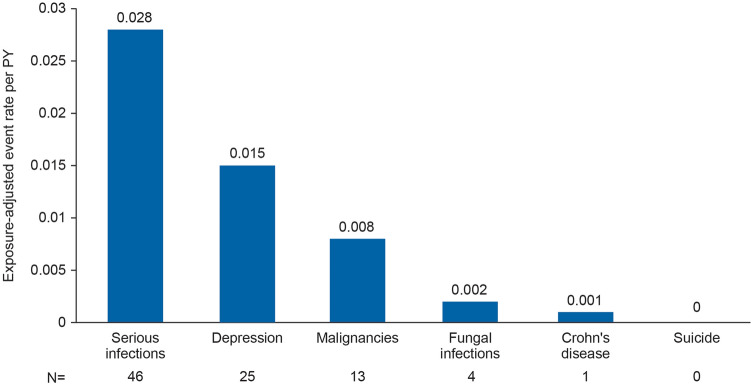
INTRODUCTION: Brodalumab is a human interleukin-17 receptor A antagonist indicated for the treatment of moderate-to-severe plaque psoriasis in adult patients who are candidates for systemic therapy or phototherapy and have failed to respond or have lost response to other systemic therapies. In the United States, brodalumab carries a boxed warning about suicidal ideation and behavior; however, no causal association was established between brodalumab and suicides reported during pivotal trials. We have previously reported results from an analysis of 1-year pharmacovigilance data in patients in the United States who took brodalumab, in which the most commonly reported adverse event was psoriasis flare. There were no completed suicides, suicide attempts, or serious fungal infections. Here, we provide a 2-year US pharmacovigilance report. METHODS: This analysis summarizes pharmacovigilance data reported to Ortho Dermatologics by US patients and healthcare providers from August 15, 2017, through August 14, 2019. The most common adverse events listed in the brodalumab package insert (incidence ≥ 1%; arthralgia, headache, fatigue, diarrhea, oropharyngeal pain, nausea, myalgia, injection-site reactions, influenza, neutropenia, and tinea infections) and adverse events of special interest are reported. RESULTS: Data were collected from 2677 patients in the United States who took brodalumab, with an estimated exposure of 1656 patient-years. Arthralgia was the most commonly reported adverse event (73 events; 0.04 events per patient-year). No suicide attempts or completed suicides were reported; there were 25 reports of depression. There were 46 serious infections and no serious fungal infections. One event of Crohn's disease was reported, which led to discontinuation. There were 13 malignancies, with none deemed related to brodalumab. CONCLUSIONS: This pharmacovigilance report supports the safety profile of brodalumab previously reported from long-term analyses of clinical trials and 1-year pharmacovigilance data.
Overview
The claims and statistics of this paper haven’t been checked yet.
Free: it reads the open-access text and checks the first 5 claims that cite a source we can check. Create a free account to check every claim.
Integrity signals
Registry
Cites
Statistics
Figures
Verification
Claims the paper makes
The claims and statistics of this paper haven’t been checked yet.
Free: it reads the open-access text and checks the first 5 claims that cite a source we can check. Create a free account to check every claim.
Self-check
Percentages, sums and reported differences re-computed from the paper’s own numbers.
The self-check needs the paper’s full text.
Citations
Cites
Brodalumab, an Anti–Interleukin-17–Receptor Antibody for Psoriasis
Papp, K. A., Leonardi, C., Menter, A., Ortonne, J.-P., Krueger, J. G., Kricorian, G., Aras, G., Li, J., Russell, C. B., Thompson, E. H. Z., et al. (2012) · New England Journal of Medicine · doi:10.1056/nejmoa1109017 · Cited by 941
Self-citationPhase 3 Studies Comparing Brodalumab with Ustekinumab in Psoriasis
Lebwohl, M., Strober, B., Menter, A., Gordon, K., Weglowska, J., Puig, L., Papp, K., Spelman, L., Toth, D., Kerdel, F., et al. (2015) · New England Journal of Medicine · doi:10.1056/nejmoa1503824 · Cited by 828
Self-citationPapp, K. A., Reich, K., Paul, C., Blauvelt, A., Baran, W., Bolduc, C., Toth, D., Langley, R. G., Cather, J., Gottlieb, A. B., et al. (2016) · British Journal of Dermatology · doi:10.1111/bjd.14493 · Cited by 470
Psoriasis: Which therapy for which patient
Kaushik, S. B., & Lebwohl, M. G. (2019) · Journal of the American Academy of Dermatology · doi:10.1016/j.jaad.2018.06.057 · Cited by 368
Self-citationBlauvelt, A., Reich, K., Tsai, T.-F., Tyring, S., Vanaclocha, F., Kingo, K., Ziv, M., Pinter, A., Vender, R., Hugot, S., et al. (2017) · Journal of the American Academy of Dermatology · doi:10.1016/j.jaad.2016.08.008 · Cited by 312
Psoriasis: Which therapy for which patient
Kaushik, S. B., & Lebwohl, M. G. (2019) · Journal of the American Academy of Dermatology · doi:10.1016/j.jaad.2018.06.056 · Cited by 268
Self-citationReich, K., Pinter, A., Lacour, J. P., Ferrandiz, C., Micali, G., French, L. E., Lomaga, M., Dutronc, Y., Henneges, C., Wilhelm, S., et al. (2017) · British Journal of Dermatology · doi:10.1111/bjd.15666 · Cited by 192
Blauvelt, A., Papp, K., Gottlieb, A., Jarell, A., Reich, K., Maari, C., Gordon, K. B., Ferris, L. K., Langley, R. G., Tada, Y., et al. (2020) · British Journal of Dermatology · doi:10.1111/bjd.18851 · Cited by 175
Self-citationBai, F., Li, G. G., Liu, Q., Niu, X., Li, R., & Ma, H. (2019) · Journal of Immunology Research · doi:10.1155/2019/2546161 · Cited by 174 · cited 1×
“Another meta-analysis that included brodalumab as well as other IL-17, IL-12/23, and IL23 antagonists reported that brodalumab 210 mg ranked fourth out of 13 dosage options for short-term risk of AEs and eleventh out of 13 dosage options for short-term risk of serious AEs [13].”
BackgroundChoosing First-Line Biologic Treatment for Moderate-to-Severe Psoriasis: What Does the Evidence Say?
Amin, M., No, D. J., Egeberg, A., & Wu, J. J. (2017) · American Journal of Clinical Dermatology · doi:10.1007/s40257-017-0328-3 · Cited by 90
Self-citation
Cited by
Hassamal, S. (2023) · Frontiers in Psychiatry · doi:10.3389/fpsyt.2023.1130989 · Cited by 578
“A thorough investigation later revealed there was no causal link between Brodalumab and suicidal behaviors (74).”
BackgroundZafiriou, E., Daponte, A., Siokas, V., Tsigalou, C., Dardiotis, E., & Bogdanos, D. P. (2021) · Frontiers in Immunology · doi:10.3389/fimmu.2021.699848 · Cited by 82
A Review of the Safety of Interleukin-17A Inhibitor Secukinumab
Eshwar, V., Kamath, A., Shastry, R., Shenoy, A. K., & Kamath, P. (2022) · Pharmaceuticals · doi:10.3390/ph15111365 · Cited by 64
“Brodalumab has a black box warning for suicidal tendencies, although studies did not identify a causal link between the two; however, depression has been identified as an adverse event [133,134].”
BackgroundWang, J., Wang, C., Liu, L., Hong, S., Ru, Y., Sun, X., Chen, J., Zhang, M., Lin, N., Li, B., et al. (2023) · Frontiers in Immunology · doi:10.3389/fimmu.2023.993057 · Cited by 52
“Brodalumab, which was codeveloped by AstraZeneca and Amgen, caused occasional suicidal ideation or behavioral events in patients during 2015, but a recent study showed no link between brodalumab and suicide (73).”
BackgroundRompoti, N., Politou, M., Stefanaki, I., Vavouli, C., Papoutsaki, M., Neofotistou, A., Rigopoulos, D., Stratigos, A., & Nicolaidou, E. (2022) · Journal of the European Academy of Dermatology and Venereology · doi:10.1111/jdv.18825 · Cited by 36
Galluzzo, M., Caldarola, G., SIMONE, C. D., Bernardini, N., Moretta, G., Pallotta, S., Botti, E., Campione, E., Pirrò, F., Potenza, C., et al. (2021) · Expert Opinion on Biological Therapy · doi:10.1080/14712598.2021.1941862 · Cited by 30
Reich, K., Iversen, L., Puig, L., Lambert, J., Mrowietz, U., Saday, K. K., & Warren, R. B. (2022) · Journal of the European Academy of Dermatology and Venereology · doi:10.1111/jdv.18068 · Cited by 25
Brodalumab: 5-Year US Pharmacovigilance Report
Lebwohl, M., Koo, J. Y. M., Armstrong, A. W., Strober, B. E., Martin, G., Rawnsley, N. N., Goehring, E. L., & Jacobson, A. A. (2024) · Dermatology and Therapy · doi:10.1007/s13555-024-01162-8 · Cited by 21
“Detailed medical histories, previous psoriatic therapies, time intervals between previous therapy and brodalumab initiation, and AE dates were either missing or not included in pharmacovigilance reports [5].”
BackgroundSelf-citationThree‐year U.S. pharmacovigilance report of brodalumab
Lebwohl, M., Leonardi, C. L., Armstrong, A. W., Rawnsley, N. N., Alexander, B., Goehring, E. L., Kerdel, F. A., & Jacobson, A. A. (2021) · Dermatologic Therapy · doi:10.1111/dth.15105 · Cited by 19
“One case of Crohn's disease was previously diagnosed in a patient who exhibited symptoms before initiating brodalumab.(7) Malignancy rates from a long-term clinical trial study and 1- and 2-year U.”
BackgroundMethodSelf-citationBrodalumab: 4-Year US Pharmacovigilance Report
Lebwohl, M., Koo, J. Y. M., Leonardi, C. L., Armstrong, A. W., Rawnsley, N. N., Goehring, E. L., & Jacobson, A. A. (2023) · Journal of Drugs in Dermatology · doi:10.36849/jdd.7344 · Cited by 19
Self-citationYeung, J., Bunce, P. E., Lynde, C. W., Turchin, I., & Vender, R. B. (2022) · Journal of Cutaneous Medicine and Surgery · doi:10.1177/12034754221111111 · Cited by 18
Risk for incident suicidality among psoriasis patients: a systematic review and meta-analysis
Hung, W., Tung, T., Wang, T.-Y., Liao, S., & Chi, C. (2022) · Archives of Dermatological Research · doi:10.1007/s00403-022-02377-5 · Cited by 13
Brodalumab: Seven-Year US Pharmacovigilance Report
Lebwohl, M., Koo, J. Y. M., Armstrong, A. W., Strober, B. E., Yoon, S. H., Rawnsley, N. N., Goehring, E. L., & Jacobson, A. A. (2025) · Dermatology and Therapy · doi:10.1007/s13555-025-01497-w · Cited by 7
Self-citationBattista, T., Picone, V., Noto, M., Potestio, L., Ruggiero, A., Martora, F., Megna, M., & Genco, L. (2024) · Expert Opinion on Drug Safety · doi:10.1080/14740338.2024.2392007 · Cited by 7
“Of 25 patients experiencing ISRs, 15 maintained brodalumab treatment and 1 discontinued [67].”
Brodalumab: Six-Year US Pharmacovigilance Report
Lebwohl, M., Koo, J. Y. M., Armstrong, A. W., Strober, B. E., Yoon, S. H., Rawnsley, N. N., Goehring, E. L., Mangin, G. D., & Jacobson, A. A. (2024) · Dermatology and Therapy · doi:10.1007/s13555-024-01304-y · Cited by 7
Self-citationMastorino, L., Dapavo, P., Burzi, L., Rosset, F., di Corteranzo, I. G., Leo, F., Verrone, A., Stroppiana, E., Ortoncelli, M., Ribero, S., et al. (2024) · International Journal of Dermatology · doi:10.1111/ijd.17038 · Cited by 6
Lin, Z., Yu, X., Yang, M., Xu, J., & Zhong, J. (2026) · Frontiers in Pharmacology · doi:10.3389/fphar.2025.1714173 · Cited by 5
Caso, F., Saviano, A., Marigliano, N., Casillo, G. M., Peluso, M., Ciccone, M., Creazzola, S. S., D’Agostino, T., Mansour, A. A., Tasso, M., et al. (2025) · Expert Review of Clinical Immunology · doi:10.1080/1744666x.2025.2522950 · Cited by 4
“On the other hand, a 2021 two-year pharmacovigilance showed the absence of association between brodalumab and suicide [131,132].”
Real-world Evidence of Brodalumab Safety for the Treatment of Psoriasis
Lebwohl, M., Song, E. J., Bhutani, T., Green, L., & Jacobson, A. A. (2025) · Journal of Psoriasis and Psoriatic Arthritis · doi:10.1177/24755303251382878 · Cited by 2
Self-citationYamane, M., Hayashi, H., & Aoyama, Y. (2022) · Case Reports in Dermatology · doi:10.1159/000523802 · Cited by 2
Emerging treatment options for psoriatic arthritis
Azuaga, A., Ramírez, J., Bassas, M., & Cañete, J. D. D. (2023) · Revista Colombiana de Reumatología (English Edition) · doi:10.1016/j.rcreue.2023.02.003 · Cited by 1
IL-17 Class of Biologic Agents in Psoriatic Disease
Soung, J., Stetkevich, S. A., & Ishizuka, M. (2022) · Updates in clinical dermatology · doi:10.1007/978-3-030-92938-1_4
Wang, J., Wang, C., Liu, L., Hong, S., Ru, Y., Sun, X., Chen, J., Zhang, M., Lin, N., Li, B., et al. (2023) · doi:10.3389/fimmu.2023.993057.s004
Metadata
- Authors
- Lebwohl, M., Leonardi, C., Wu, J. J., Armstrong, A., Rawnsley, N., Merchant, M., Alexander, B., & Jacobson, A.
- Affiliations
- Icahn School of Medicine at Mount Sinai (US)
- Saint Louis University (US)
- Dermatology Research and Education Foundation (US)
- University of Southern California (US)
- Bausch Health (United States) (US)
- Corresponding author
- Lebwohl, Mark
- Venue
- Dermatology and Therapy
- Published
- 2020-12-18
- Volume
- 11
- Issue
- 1
- Pages
- 173-180
- ISSN
- 2190-9172 (ISSN-L)
- 2193-8210
- PMC
- PMC7859129
- OpenAlex
- W3113634853
- Cited by
- 24
- References
- 16
- Citations by year
- 2026: 1 · 2025: 3 · 2024: 4 · 2023: 5 · 2022: 8 · 2021: 3
- FWCI
- 1.40
- Type
- journal article
- Language
- en
- Open access
- gold
- doi.org
- Licence
- cc-by-nc
- creativecommons.org/licenses/by-nc/4.0 (tdm)
- creativecommons.org/licenses/by-nc/4.0 (vor)
- Locations
- Dermatology and Therapy (publishedVersion, cc-by-nc)
- PubMed Central (publishedVersion, cc-by-nc)
- PubMed (publishedVersion)
- Funders
- Ortho Dermatologics
- Bausch Health
- Topics
- Life Sciences › Immunology and Microbiology › Immunology › Psoriasis: Treatment and Pathogenesis
- Life Sciences › Pharmacology, Toxicology and Pharmaceutics › Toxicology › Pharmacovigilance and Adverse Drug Reactions
- Health Sciences › Medicine › Pharmacology (medical) › Drug-Induced Adverse Reactions
- Keywords
- brodalumab, pharmacovigilance, adverse drug reactions, plaque psoriasis, suicide risk, psoriasis flare, joint pain, serious infections, Crohn's disease, cancer, drug safety
About these checks
Registry, retraction, Cites and statistics results are computed, not judged, with one exception: a printed reference that no index lists is read once by a model before it counts as a citation error. Claims are extracted by a model and kept only when their quote appears verbatim in the text; each cited source is then checked, with a model’s help, for whether it says what the claim relies on. Those verdicts can be wrong — read the claim’s quote and the cited source before relying on one.
Statistics and arithmetic are recomputed, not judged.
Confidence bands are shown only for fields calibrated on our annotated test set. None is calibrated yet, so no band is shown.
What counts as a claim ›How we measure confidence ›How we check this ›
Are you an author, or do you see a problem with this page? Request a review
Data sources
Bibliographic data: Semantic Scholar, OpenAlex, Crossref.
Contains information from the Semantic Scholar Academic Graph Datasets, made available under the ODC Attribution License (ODC-BY 1.0).
Semantic Scholar’s data is described in: Kinney, R., et al. (2023). The Semantic Scholar Open Data Platform. arXiv:2301.10140.
