

The DOI matches its Crossref record; 58 of the 59 references it cites were found in a registry or an index.
Increasing precision of clinical diagnosis of Alzheimer’s disease using a combined algorithm incorporating clinical and novel biomarker data
Open accessAbstract
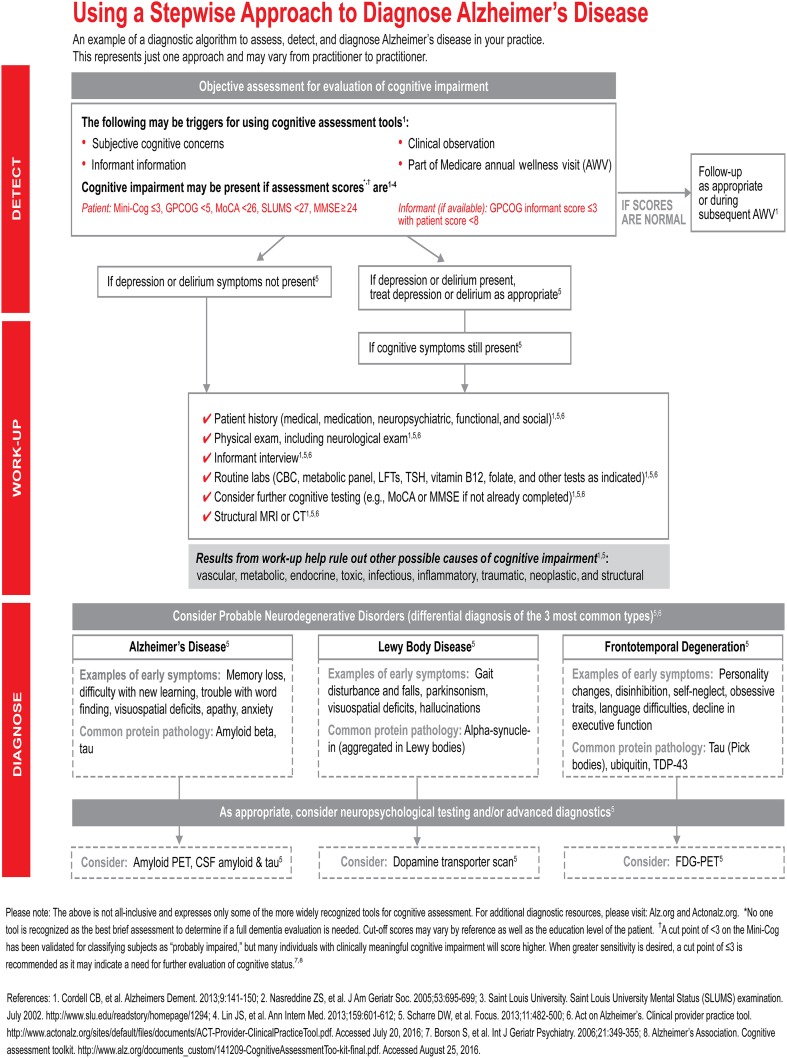
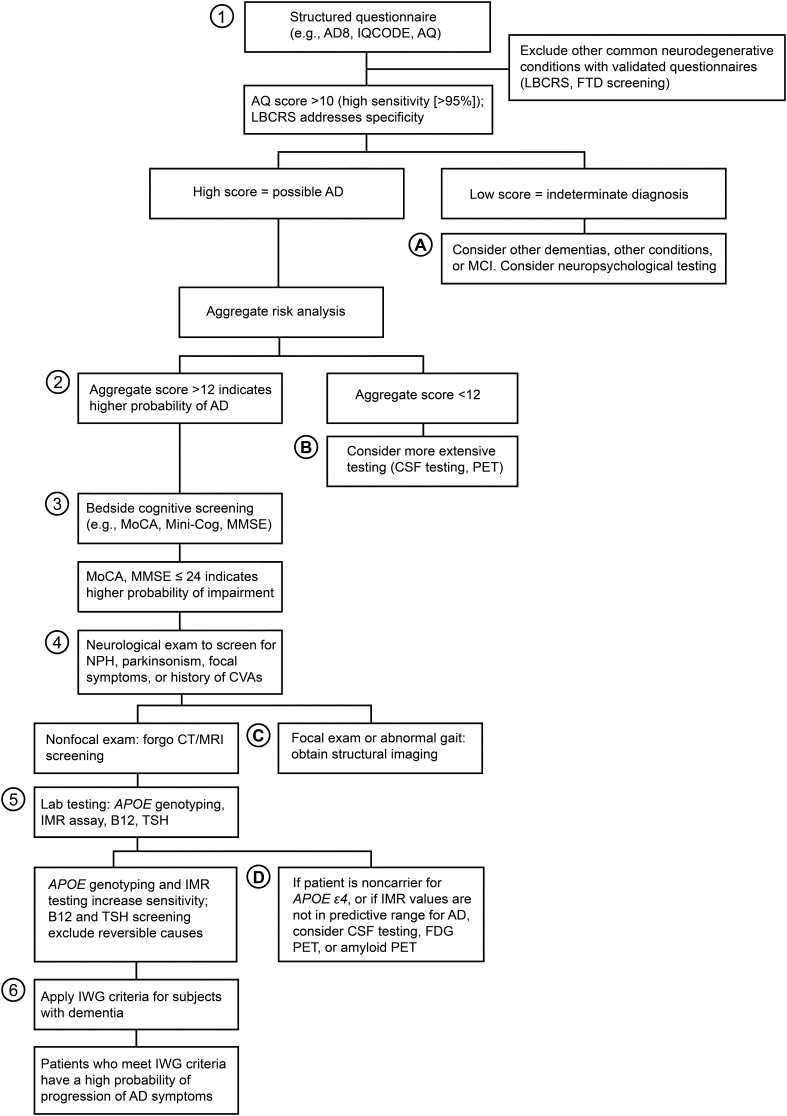
Establishing the in vivo diagnosis of Alzheimer’s disease (AD) or other dementias relies on clinical criteria; however, the accuracy of these criteria can be limited. The diagnostic accuracy is 77% for a clinical diagnosis of AD, even among experts. We performed a review through PubMed of articles related to specific diagnostic modalities, including APOE genotyping, cerebrospinal fluid (CSF) testing, fludeoxyglucose F 18 positron emission tomography (PET), amyloid PET, tau PET, computed tomography (CT), single-photon emission CT, magnetic resonance imaging (MRI), and B12 and thyroid-stimulating hormone screening, to determine the specificity and sensitivity of each test used in the clinical diagnosis of AD. We added a novel immunomagnetic reduction assay that provides ultrasensitivity for analyzing the levels of plasma tau and beta amyloid 42 (Aβ 42 ). The sensitivity and specificity of the current diagnostic approach (structural CT or MRI with screening labs) remain low for clinical detection of AD and are primarily used to exclude other conditions. Because of limited diagnostic capabilities, physicians do not feel comfortable or skilled in rendering a clinical diagnosis of AD. Compounding this problem is the fact that inexpensive, minimally invasive diagnostic tests do not yet exist. Biomarkers (obtained through CSF testing or PET imaging), which are not routinely incorporated in clinical practice, correlate well with pathologic changes. While PET is particularly costly and difficult to assess, CSF measures of tau and beta amyloid are not costly, and these tests may be worthwhile when the tiered approach proposed here warrants further testing. There is a need for developing bloodborne biomarkers that can aid in the clinical diagnosis of AD. Here we present a streamlined questionnaire-enriched, biomarker-enriched approach that is more cost-effective than the current diagnosis of exclusion and is designed to increase clinical confidence for a diagnosis of dementia due to AD.
Overview
The claims and statistics of this paper haven’t been checked yet.
Run the check — free, no account needed. It reads the open-access text and checks the sources it cites.
Integrity signals
Registry
Cites
Statistics
Figures
Verification
Claims the paper makes
The claims and statistics of this paper haven’t been checked yet.
Run the check — free, no account needed. It reads the open-access text and checks the sources it cites.
Claims other papers make about this one
Each is checked against this paper’s own text: does it say what the citing paper says it does?
The cited source says what the claim attributes to it.
In the citing paper
“In a clinical imaging/pathology series of 57 individuals clinically diagnosed with AD, 13 (23%) had no or sparse beta amyloid (Ab) plaques at autopsy.”
From Concordance of Clinical Alzheimer Diagnosis and Neuropathological Features at Autopsy (2020) · cites this paper as [7]
The cited source says what the claim attributes to it.
In the citing paper
“The study concluded that diagnostic accuracy of clinical AD is variable, even among experts (7).”
From Concordance of Clinical Alzheimer Diagnosis and Neuropathological Features at Autopsy (2020) · cites this paper as [7]
Self-check
Percentages, sums and reported differences re-computed from the paper’s own numbers.
The self-check needs the paper’s full text.
Citations
Cites
Folstein, M. F., Folstein, S. E., & McHugh, P. R. (1975) · Journal of Psychiatric Research · doi:10.1016/0022-3956(75)90026-6 · Cited by 88,282
McKhann, G., Drachman, D., Folstein, M., Katzman, R., Price, D., & Stadlan, E. M. (1984) · Neurology · doi:10.1212/wnl.34.7.939 · Cited by 27,915
The Montreal Cognitive Assessment, MoCA: a brief screening tool for mild cognitive impairment
Nasreddine, Z. S., Phillips, N. A., Bédirian, V., Charbonneau, S., Whitehead, V., Collin, I., Cummings, J. L., & Chertkow, H. (2005) · Journal of the American Geriatrics Society · doi:10.1111/j.1532-5415.2005.53221.x · Cited by 25,553 · cited 11×
“AD8 Ascertain Dementia 8-Item Informant Questionnaire, AQ Alzheimer’s Questionnaire, CSF cerebrospinal fluid, CT computed tomography, FDG fludeoxyglucose F 18, FTD frontotemporal dementia, IMR immunomagnetic reduction, IQCODE Informant Questionnaire on Cognitive Decline in the Elderly, IWG International Working Group,…”
MethodInfluentialHirono, N., Mori, E., Ikejiri, Y., Imamura, T., Shimomura, T., Hashimoto, M., Yamashita, H., & Ikeda, M. (1997) · PubMed · Cited by 21,012
Kok, J. S., Berg, I. J., & Scherder, E. J. A. (2013) · Dementia and Geriatric Cognitive Disorders Extra · doi:10.1159/000353441 · Cited by 20,589
Older Adults' Reasons for Using Technology while Aging in Place
Peek, S. T. M., Luijkx, K. G., Rijnaard, M. D., Nieboer, M. E., van der Voort, C. S., Aarts, S., van Hoof, J., Vrijhoef, H. J., & Wouters, E. (2015) · Gerontology · doi:10.1159/000430949 · Cited by 19,852
Sensitivity and False Alarm Rate of a Fall Sensor in Long-Term Fall Detection in the Elderly
Kangas, M., Korpelainen, R., Vikman, I., Nyberg, L., & Jämsä, T. J. (2014) · Gerontology · doi:10.1159/000362720 · Cited by 19,007
McKhann, G. M., Knopman, D. S., Chertkow, H., Hyman, B. T., Jack, C. R., Kawas, C. H., Klunk, W. E., Koroshetz, W. J., Manly, J. J., Mayeux, R., et al. (2011) · Alzheimer's & Dementia · doi:10.1016/j.jalz.2011.03.005 · Cited by 18,657 · cited 5×
“The current practice guideline is to incorporate structural imaging as part of the diagnostic evaluation for AD [2, 3] to exclude other conditions.”
BackgroundMethodInfluentialAlbert, M. S., DeKosky, S. T., Dickson, D., Dubois, B., Feldman, H. H., Fox, N. C., Gamst, A., Holtzman, D. M., Jagust, W. J., Petersen, R. C., et al. (2011) · Alzheimer's & Dementia · doi:10.1016/j.jalz.2011.03.008 · Cited by 10,152
Corder, E. H., Saunders, A. M., Strittmatter, W. J., Schmechel, D. E., Gaskell, P. C., Small, G. W., Roses, A. D., Haines, J. L., & Pericak-Vance, M. A. (1993) · Science · doi:10.1126/science.8346443 · Cited by 9,429 · cited 1×
“The lifetime risk for developing AD for a patient who is homozygotic for the APOE e4 is 91%, and the lifetime risk for a patient who is heterozygotic for APOE e4 is 47% [37].”
Background
Research works printed but not linked: 1
- Lue LF, Sabbagh MN, Chiu MJ, Leung N, Snyder N, Schmitz C et al. Plasma levels of Ab40, Ab42, and tau measured by ultra-sensitive immunomagnetic reduction assays identified probable Alzheimer’s dementia: Findings from two cohorts. Front Neurosci (in Press).
Cited by
Sorted by citations
Items 101–107 of 107
Levin, L., McDonough, R. S., Cheatle, M., Kaafarani, H. M. A., Korjian, S., & Kuntz, R. E. (2026) · International Journal of Technology Assessment in Health Care · doi:10.1017/s0266462326103596
“An accurate diagnosis can take years (7), and a diagnosis based on clinical criteria is reached 70 – 80 percent of the time (8).”
Deep brain stimulation in Alzheimer's disease
Majeed, Z., Majeed, J., Ponce, F. A., Mahanti, H., Decourt, B., Burke, A. D., & Sabbagh, M. N. (2026) · Journal of Alzheimer s Disease Reports · doi:10.1177/25424823261441166
“44 Without con fi rmation from amyloid-β or tau biomarkers, or consideration of genetic markers like APOE ɛ 4, patient heterogeneity in pathology and disease stage may alter treatment outcomes.”
Self-citationKloppenburg-Lagendijk, M., Nyendaal, C. V., Verberk, I. M. W., van Harten, A. C., Ferket-Franken, W., Teunissen, C. E., Hempenius, L., & Verwey, N. A. (2026) · Journal of Alzheimer s Disease · doi:10.1177/13872877261469893
“2 – 4 The incorporation of biomarkers is suggested to increase the precision of clinical diagnosis of AD.”
AI-Enabled Modeling for Alzheimer’s Disease Risk Prediction and Validation
Li, P., & Wang, Y. (2026) · Revista de Neurología · doi:10.31083/rn49220
“Early diagnosis of AD remains challenging, as traditional diagnostic meth-ods primarily rely on clinical symptoms and imaging examinations, which often lack sensitivity in the early stages [3].”
AI-aided neuroimaging for the diagnosis of Alzheimer's disease: A concise review of recent studies
Lee, Y., Nadalin, P., Onemli, E., Hadad, R., Yu, F., Greenbaum, L., Greenbaum, A., & Ahn, J. (2026) · Heliyon · doi:10.1016/j.heliyon.2026.e45308
Surhan, A., Oad, J., Kumar, B., Memon, S. N., Essrani, C., Muhammad, F., Kashif, S. N., Abbas, S. M. I., Ameen, T. B., Sauleh, A., et al. (2026) · The Egyptian Journal of Neurology Psychiatry and Neurosurgery · doi:10.1186/s41983-026-01263-5
“Similarly, patients with comparable biomarker profiles may still show different therapeutic outcomes because of differences in disease stage, concomitant pathology, cognitive reserve, and overall molecular heterogeneity [205, 211].”
Zhang, Y., Li, L., Ouyang, H., Zhao, Z., Mei, X., & Qiu, C. (2026) · Frontiers in Psychiatry · doi:10.3389/fpsyt.2026.1954419
Metadata
- Authors
- Sabbagh, M. N., Lue, L.-F., Fayard, D., & Shi, J.
- Affiliations
- Barrow Neurological Institute (US)
- Arizona State University (US)
- Corresponding author
- Sabbagh, Marwan N.
- Venue
- Neurology and Therapy
- Published
- 2017-07
- Volume
- 6
- Issue
- S1
- Pages
- 83-95
- ISSN
- 2193-6536 (ISSN-L)
- 2193-8253
- PMC
- PMC5520815
- OpenAlex
- W2737462298
- Cited by
- 107
- References
- 59
- Citations by year
- 2026: 10 · 2025: 12 · 2024: 20 · 2023: 9 · 2022: 11 · 2021: 19 · 2020: 12 · 2019: 6 · 2018: 5 · 2017: 2
- FWCI
- 1.04
- Type
- journal article
- Language
- en
- Open access
- gold
- doi.org
- Licence
- cc-by-nc
- Locations
- Neurology and Therapy (publishedVersion, cc-by-nc)
- PubMed Central (publishedVersion, cc-by-nc)
- PubMed (publishedVersion)
- Arizona State University Library Digital Repository (Arizona State University) (submittedVersion, cc-by)
- Funders
- Barrow Neurological Foundation (NIA P30 AG019610)
- National Institute on Aging (AG019610, P30AG019610)
- Topics
- Health Sciences › Medicine › Psychiatry and Mental health › Dementia and Cognitive Impairment Research
- Life Sciences › Neuroscience › Cellular and Molecular Neuroscience › Alzheimer's disease research and treatments
- Health Sciences › Medicine › Clinical Neurology › Cerebrospinal fluid and hydrocephalus
- Keywords
- Alzheimer's disease, diagnosis, diagnostic accuracy, biomarkers, cerebrospinal fluid, amyloid PET, tau PET, FDG-PET, APOE genotyping, plasma tau, amyloid-beta 42, blood-based biomarkers, dementia, sensitivity and specificity
About these checks
Registry, retraction, Cites and statistics results are computed, not judged, with one exception: a printed reference that no index lists is read once by a model before it counts as a citation error. Claims are extracted by a model and kept only when their quote appears verbatim in the text; each cited source is then checked, with a model’s help, for whether it says what the claim relies on. Those verdicts can be wrong — read the claim’s quote and the cited source before relying on one.
Statistics and arithmetic are recomputed, not judged.
Confidence bands are shown only for fields calibrated on our annotated test set. None is calibrated yet, so no band is shown.
What counts as a claim ›How we measure confidence ›How we check this ›
Are you an author, or do you see a problem with this page? Request a review
