

The Diagnosis and Management of Pudendal Neuralgia
Open accessThe DOI matches its Crossref record; 44 of the 44 references it cites were found in a registry or an index; none of the 61 sources its claims cite is checked for support yet.
Abstract
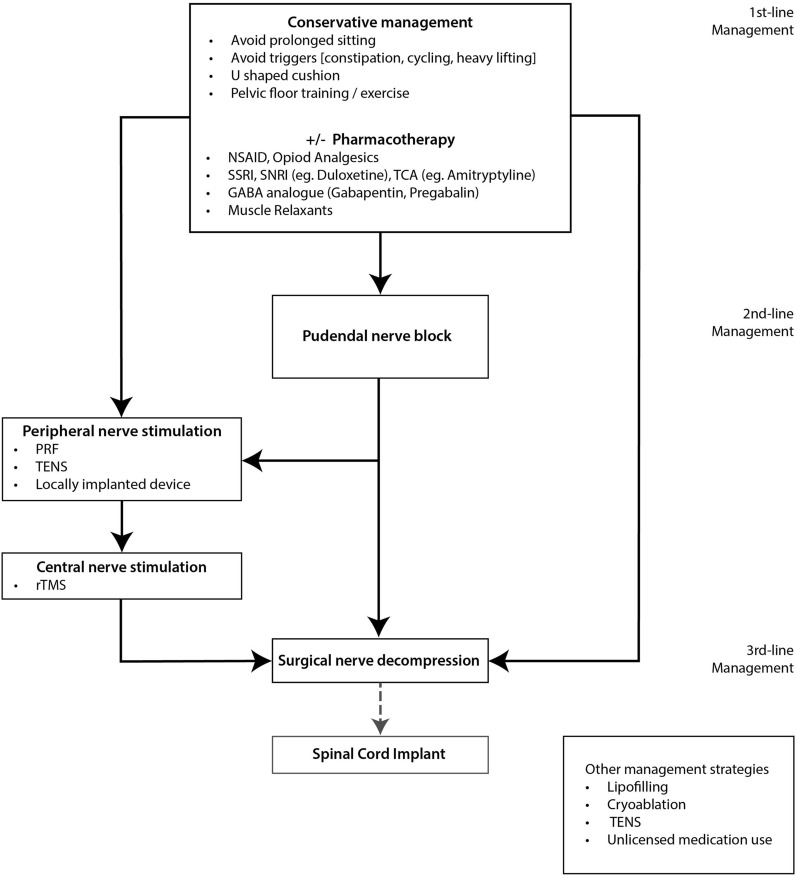
INTRODUCTION: Pudendal neuralgia (PN) is a chronic neuropathic pain syndrome affecting the pudendal nerve, often presenting with perineal or pelvic pain exacerbated by sitting. The aim of this systematic review was to summarize the existing knowledge on the diagnosis and management of PN. METHODS: A PubMed database search identified 475 articles, of which 35 met the inclusion criteria. Nine studies focused on diagnostic strategies, and 26 on management. RESULTS: Diagnosis of PN is largely clinical, with the Nantes criteria providing a widely adopted framework. Imaging modalities such as MRI and MR neurography, along with neurophysiological tests including quantitative sensory testing, have been explored as adjuncts, though their roles remain limited. Pudendal nerve blocks are both diagnostic and therapeutic, with response rates up to 94%. Management follows a stepwise approach, beginning with conservative therapies and progressing to nerve blocks, and extending to neuromodulation or surgery when necessary. Pulsed radiofrequency and nerve stimulation techniques demonstrate promising results, with reported pain reduction in up to 95% of refractory cases, though long-term durability remains uncertain. Surgical decompression remains the most common operative option, with several techniques described. CONCLUSIONS: Despite the established recognition of PN, there is a paucity of high-quality comparative studies and randomized controlled trials assessing diagnostic accuracy and treatment efficacy. Current evidence suggests conservative measures and nerve blocks are sufficient for most patients, with stimulation techniques and decompression surgery reserved for refractory cases. Emerging modalities may offer future therapeutic options, but require validation in larger cohorts.
Overview
CoChat Summary
TL;DR
This systematic review of 35 studies summarizes the diagnosis and management of pudendal neuralgia, concluding that diagnosis is primarily clinical using the Nantes criteria and management follows a stepwise path from conservative therapy and nerve blocks to stimulation or surgery. Evidence is heterogeneous, with few RCTs and limited validation of most diagnostic and advanced therapeutic options.
Key findings
- Diagnosis is largely clinical, with the Nantes criteria widely adopted; imaging and neurophysiological tests are adjuncts with limited roles. Reported sensitivities include ultrasound 80% (8/10 patients), color duplex ultrasound 90% sensitivity and 67% specificity (60/67 nerves), MR neurography 65% (90/139 nerves), and MRI 78% (454/580 patients); thermal QST showed lower cold detection thresholds in suspected PN at some sites, while warm detection thresholds were not significantly different.
- Pudendal nerve blocks are both diagnostic and therapeutic, with success rates of 68–94% for pain reduction. Examples include 62% positive response in Dickson et al., 81% fulfilling the fifth Nantes criterion in Vancaillie et al., and mean VAS reductions such as 9.05 to 3.31 at 24 months (Basol et al.), 6.13 to 2.14 at 6 weeks (Mamlouk et al.), and 8.06 to 2.90 at 3 months (Kastler et al.); a three-arm RCT by Labat et al. found no additional pain relief from adding corticosteroid.
- Nerve stimulation techniques, including pulsed radiofrequency, TENS, and implantable neurostimulators, show promising short-term relief in refractory cases, with reported pain reduction up to 95%. PRF studies reported VAS reductions such as 5.97 to 3.37 at 12 weeks (Wang and Song) and 9 to 1.9 at 1 year (Masala et al.); a TENS RCT reduced NRS from 9.44 to 4.25 versus 9.51 to 6.22 in controls, though long-term durability remains uncertain.
- Surgical decompression remains the main operative option, reserved for the 8–15% of patients for whom conservative measures or nerve blocks fail; transgluteal, laparoscopic, and robotic approaches all showed positive outcomes. Emerging therapies such as cryoablation, lipofilling, and topical treatments show early promise but evidence is limited to small cohorts.
Methods
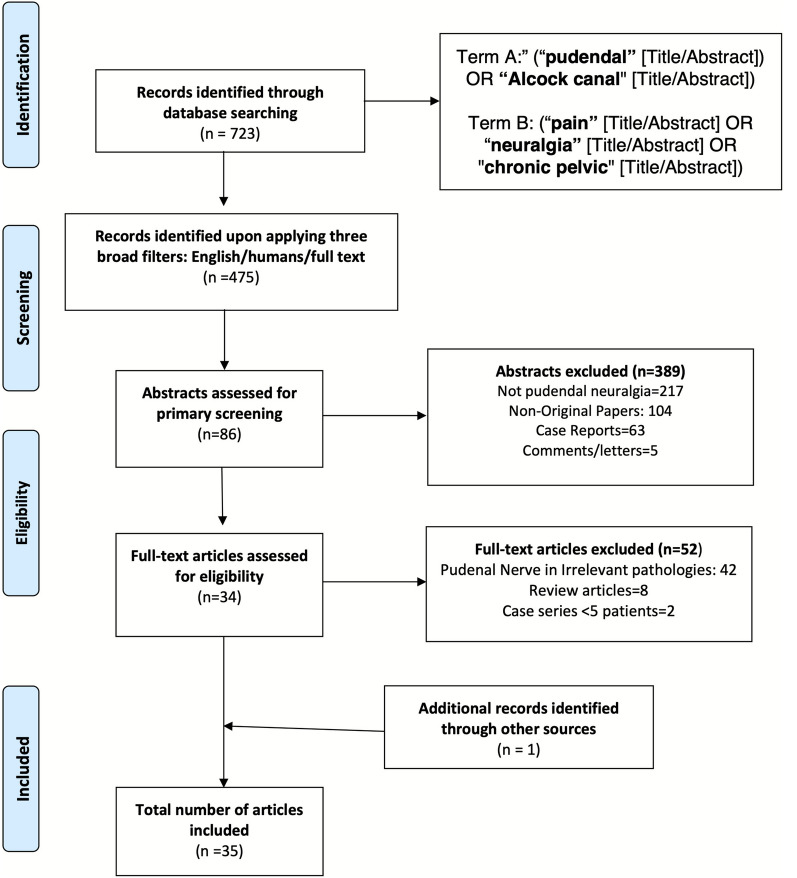
- PubMed was searched on December 3, 2024, using MeSH terms “pudendal” OR “Alcock canal” and “pain OR neuralgia OR chronic pelvic,” with filters for English, human participants, and full-text availability; reference lists were also reviewed. The search identified 475 articles, of which 35 met inclusion criteria (9 diagnostic, 26 management).
- Screening followed PRISMA guidelines; quality was assessed with the Jadad score for RCTs and the Newcastle–Ottawa scale for case–control and cohort studies; the review was registered in PROSPERO (CRD420251027007). Included study designs were 27 cohort studies, 3 case series, 3 RCTs, 1 open-label study, and 1 case–control study.
Limitations
- Stated: the review used a single database (PubMed), which may have led to omission of relevant studies indexed elsewhere.
- Stated and evident: the authors report a paucity of high-quality comparative studies and RCTs, heterogeneity across studies, and lack of standardized diagnostic validation; the Nantes criteria have lacked psychometric evaluation and assessment of sensitivity and specificity across populations. Evident from the text: many included studies are small, nonrandomized, or case series, and long-term durability of stimulation techniques remains uncertain.
Model-written summary. Check it against the paper before relying on it.
Integrity signals
Registry
Cites
Statistics
Figures
Verification
Claims the paper makes
0 Valid · 2 Not valid · 61 Not checked · 37 Own results and interpretations
In the paper
“Of these ten patients, US showed at least one of the above-described findings in eight patients (sensitivity 80%).”
§ The Diagnosis and Management of Pudendal Neuralgia > Results > Diagnosis
What the sources say
- Not checked yetcites [13] Tagliafico A, Bignotti B, Miguel Perez M, Reni L, Bodner G, Martinoli C. Contribution of ultrasound in the assessment of patients with suspect idiopathic pudendal nerve disease. Clin Neurophysiol. 2014;125(6):1278–84. 24368033 source
plainstates an associationn = 10- Asserted: passes — The authors put it forward as true.
- Checkable: passes — It can be checked against evidence.
- Load-bearing: passes — The paper’s conclusions depend on it.
- Based: passes — The paper gives a reason why it holds.
A result the paper states — it cites no source for it, so there is none to check. The quote shows it is in the paper.
In the paper
“there is little work looking at the sensitivity and specificity of imaging modalities”
§ The Diagnosis and Management of Pudendal Neuralgia > Discussion
plain- Asserted: passes — The authors put it forward as true.
- Checkable: passes — It can be checked against evidence.
- Load-bearing: passes — The paper’s conclusions depend on it.
- Based: passes — The paper gives a reason why it holds.
In the paper
“They reported that MRN identified positive findings suggestive of PN in 90 out of 139 nerves assessed, corresponding to a sensitivity of 65%.”
§ The Diagnosis and Management of Pudendal Neuralgia > Results > Diagnosis
What the sources say
- Not checked yetcites [15] Ly J, Scott K, Xi Y, Ashikyan O, Chhabra A. Role of 3 Tesla MR neurography and CT-guided injections for pudendal neuralgia: analysis of pain response. Pain Physician [Internet]. 2019 Jul;22(4):E333–44. Available from: https://pubmed.ncbi.nlm.nih.gov/31337177/. 31337177 source
plainstates an association- Asserted: passes — The authors put it forward as true.
- Checkable: passes — It can be checked against evidence.
- Load-bearing: unclear — It is unclear whether the paper’s conclusions depend on it.
- Based: passes — The paper gives a reason why it holds.
A result the paper states — it cites no source for it, so there is none to check. The quote shows it is in the paper.
In the paper
“it is notable that the papers identified shared a broad heterogeneity.”
§ The Diagnosis and Management of Pudendal Neuralgia > Discussion
plain- Asserted: passes — The authors put it forward as true.
- Checkable: passes — It can be checked against evidence.
- Load-bearing: passes — The paper’s conclusions depend on it.
- Based: passes — The paper gives a reason why it holds.
In the paper
“In the 16-patient pilot study, the average NPRS significantly decreased from 9.5 (range 7–10) to 3.5 (range 0–10) at 1 month, p = 0.003.”
§ The Diagnosis and Management of Pudendal Neuralgia > Results > Management
What the sources say
- Not checked yetcites [36] Jottard K, Bruyninx L, Bonnet P, Mathieu N, De Wachter S. Pilot study: pudendal neuromodulation combined with pudendal nerve release in case of chronic perineal pain syndrome. The ENTRAMI technique: early results. Int Urogynecol J [Internet]. 2021;32(10):2765–70. Available from: https://pubmed.ncbi.nlm.nih.gov/33048179/. 33048179 source
plainstates a cause- Asserted: passes — The authors put it forward as true.
- Checkable: passes — It can be checked against evidence.
- Load-bearing: unclear — It is unclear whether the paper’s conclusions depend on it.
- Based: passes — The paper gives a reason why it holds.
40 more claims
Create a free account to see all 100 claims and to verify the 60 references still open.
- It may state two separate claims as one. 48
- The quote only partly states this claim. 2
- Probably not a substantial claim. 10
Self-check
Percentages, sums and reported differences re-computed from the paper’s own numbers.
Each contradiction between two passages listed here was confirmed by an independent check.
Rated minor: it would not touch a result — a value no result rests on, a p-value that stays on the same side of the significance level, or a conflict that is clerical, resolved elsewhere in the paper, or outside its own findings.
In the paper
§ The Diagnosis and Management of Pudendal Neuralgia > Results > Management
“a 16-patient (two males, 14 females) pilot study in 2020 [36]”
§ The Diagnosis and Management of Pudendal Neuralgia > Results > Management
“Jottard et al. [36] (2021) | 16 patients (2: 14)”
Rated minor: it would not touch a result — a value no result rests on, a p-value that stays on the same side of the significance level, or a conflict that is clerical, resolved elsewhere in the paper, or outside its own findings.
In the paper
§ The Diagnosis and Management of Pudendal Neuralgia > Results > Management
“Ten were eligible for final follow-up, of which all 19 patients reported continued positive effects.”
§ The Diagnosis and Management of Pudendal Neuralgia > Results > Management
“Of the 20 patients, 19 reported for final follow-up (one was lost due to death by suicide).”
Rated minor: it would not touch a result — a value no result rests on, a p-value that stays on the same side of the significance level, or a conflict that is clerical, resolved elsewhere in the paper, or outside its own findings.
In the paper
§ The Diagnosis and Management of Pudendal Neuralgia > Results > Management
“Nine of these ten patients elected to have a permanent stimulator inserted post-initial phase of which seven of nine patients reported a maintained > 50% reduction in pain at the final follow-up.”
§ The Diagnosis and Management of Pudendal Neuralgia > Results > Management
“At last post-operative visit, 5/9 (55.6%) reported continued benefit with long-term Stimwave.”
Rated minor: it would not touch a result — a value no result rests on, a p-value that stays on the same side of the significance level, or a conflict that is clerical, resolved elsewhere in the paper, or outside its own findings.
In the paper
§ The Diagnosis and Management of Pudendal Neuralgia > Results > Management
“NIH-CPSI significantly decreased from 1.4 ± 0 to 2.8 ± 1.1 at 12 months, p < 0.05.”
§ The Diagnosis and Management of Pudendal Neuralgia > Results > Management
“Quality-of-life scores were 1.4 ± 0.4 pre-op and 2.8 ± 1.1 at 12 months.”
Rated minor: it would not touch a result — a value no result rests on, a p-value that stays on the same side of the significance level, or a conflict that is clerical, resolved elsewhere in the paper, or outside its own findings.
In the paper
§ The Diagnosis and Management of Pudendal Neuralgia > Results > Management
“Ruoss et al. [46] used a topical treatment of 0.5% amitriptyline with 0.03% estradiol in 376 women.”
§ The Diagnosis and Management of Pudendal Neuralgia > References
“Topical treatment of vulvodynia, dyspareunia and pudendal neuralgia: a single clinic audit of amitriptyline and oestriol in organogel.”
Citations
Cites
The PRISMA 2020 statement: An updated guideline for reporting systematic reviews
Page, M. J., McKenzie, J. E., Bossuyt, P. M., Boutron, I., Hoffmann, T. C., Mulrow, C. D., Shamseer, L., Tetzlaff, J. M., Akl, E. A., Brennan, S. E., et al. (2021) · BMJ · doi:10.1136/bmj.n71 · Cited by 108,283
Assessing the quality of reports of randomized clinical trials: Is blinding necessary?
Jadad, A. R., Moore, R. A., Carroll, D., Jenkinson, C., Reynolds, D. J. M., Gavaghan, D. J., & McQuay, H. J. (1996) · Controlled Clinical Trials · doi:10.1016/0197-2456(95)00134-4 · Cited by 17,582
Diagnostic criteria for pudendal neuralgia by pudendal nerve entrapment (Nantes criteria)
Labat, J., Riant, T., Robert, R., Amarenco, G., Lefaucheur, J., & Rigaud, J. (2008) · Neurourology and Urodynamics · doi:10.1002/nau.20505 · Cited by 500
Robert, R., Labat, J.-J., Bensignor, M., Glemain, P., Deschamps, C., Raoul, S., & Hamel, O. (2005) · European Urology · doi:10.1016/j.eururo.2004.09.003 · Cited by 222
Filler, A. G. (2009) · Neurosurgical FOCUS · doi:10.3171/foc.2009.26.2.e9 · Cited by 163
Pudendal neuralgia, a severe pain syndrome
Benson, J. T., & Griffis, K. (2005) · American Journal of Obstetrics and Gynecology · doi:10.1016/j.ajog.2005.01.051 · Cited by 90
Pudendal nerve decompression in perineology : a case series
Beco, J., Climov, D., & Bex, M. (2004) · BMC Surgery · doi:10.1186/1471-2482-4-15 · Cited by 81
Labat, J., Riant, T., Lassaux, A., Rioult, B., Rabischong, B., Khalfallah, M., Volteau, C., Leroi, A., & Ploteau, S. (2017) · BJOG: An International Journal of Obstetrics & Gynaecology · doi:10.1111/1471-0528.14222 · Cited by 77
PETERS, K. M., KILLINGER, K. A., JAEGER, C., & CHEN, C. (2015) · LUTS: Lower Urinary Tract Symptoms · doi:10.1111/luts.12066 · Cited by 71
Mauillon, J., Thoumas, D., Leroi, A. M., Freger, P., Michot, F., & Denis, P. (1999) · Diseases of the Colon & Rectum · doi:10.1007/bf02237125 · Cited by 64
Buffenoir, K., Rioult, B., Hamel, O., Labat, J.-J., Riant, T., & Robert, R. (2015) · Neurourology and Urodynamics · doi:10.1002/nau.22525 · Cited by 63
Response to Pudendal Nerve Block in Women with Pudendal Neuralgia
Vancaillie, T., Eggermont, J., Armstrong, G., Jarvis, S., Liu, J., & Beg, N. (2012) · Pain Medicine · doi:10.1111/j.1526-4637.2012.01343.x · Cited by 61
Percutaneous CT-guided cryoablation for the treatment of refractory pudendal neuralgia
Prologo, J. D., Lin, R. C., Williams, R., & Corn, D. (2015) · Skeletal Radiology · doi:10.1007/s00256-014-2075-3 · Cited by 57
Anatomy, Abdomen and Pelvis, Pudendal Nerve
Kinter, K. J., & Newton, B. W. (2020) · StatPearls · Cited by 53
CT-Guided Nerve Block for Pudendal Neuralgia: Diagnostic and Therapeutic Implications
Mamlouk, M. D., vanSonnenberg, E., & Dehkharghani, S. (2014) · American Journal of Roentgenology · doi:10.2214/ajr.13.11346 · Cited by 48
Erdogru, T., Avci, E., & Akand, M. (2014) · Surgical Endoscopy · doi:10.1007/s00464-013-3248-1 · Cited by 46
Spinosa, J., de Bisschop, E., Laurençon, J., Kuhn, G., Dubuisson, J., & Riederer, B. M. (2006) · PubMed · Cited by 41
Pudendal nerve and branch neuropathy: magnetic resonance neurography evaluation
Wadhwa, V., Hamid, A. S., Kumar, Y., Scott, K. M., & Chhabra, A. (2017) · Acta Radiologica · doi:10.1177/0284185116668213 · Cited by 40
Hodaj, H., Payen, J.-F., Hodaj, E., Dumolard, A., Maindet, C., Cracowski, J.-L., Delon-Martin, C., & Lefaucheur, J.-P. (2020) · Clinical Neurophysiology · doi:10.1016/j.clinph.2020.03.022 · Cited by 36
CT-Guided Percutaneous Pulse-Dose Radiofrequency for Pudendal Neuralgia
Masala, S., Calabria, E., Cuzzolino, A., Raguso, M., Morini, M., & Simonetti, G. (2014) · CardioVascular and Interventional Radiology · doi:10.1007/s00270-013-0679-y · Cited by 34
Pudendal Neuralgia: A New Option for Treatment? Preliminary Results on Feasibility and Efficacy
Venturi, M., Boccasanta, P., Lombardi, B., Brambilla, M., Contessini Avesani, E., & Vergani, C. (2015) · Pain Medicine · doi:10.1111/pme.12693 · Cited by 27
Laparoscopic transperitoneal pudendal nerve and artery release for pudendal entrapment syndrome
Bollens, R., Mjaess, G., Sarkis, J., Chemaly, A. K., Nemr, E., Daher, K., Semaan, A., Chebel, J. A., Absil, F., & Aoun, F. (2021) · Surgical Endoscopy · doi:10.1007/s00464-020-08092-4 · Cited by 26
Mollo, M., Bautrant, E., Rossi-Seignert, A.-K., Collet, S., Boyer, R., & Thiers-Bautrant, D. (2009) · Pain · doi:10.1016/j.pain.2009.01.019 · Cited by 25
Wang, C.-L., & Song, T. (2022) · Neuromodulation: Technology at the Neural Interface · doi:10.1111/ner.13401 · Cited by 25
Endoscopic transperineal pudendal nerve decompression: operative pudendoscopy
Beco, J., Seidel, L., & Albert, A. (2018) · Surgical Endoscopy · doi:10.1007/s00464-018-6239-4 · Cited by 24
Tagliafico, A., Bignotti, B., Miguel Perez, M., Reni, L., Bodner, G., & Martinoli, C. (2014) · Clinical Neurophysiology · doi:10.1016/j.clinph.2013.10.053 · Cited by 23
Dual Site Pudendal Nerve Infiltration: More than Just a Diagnostic Test?
Kastler, A. (2018) · Pain Physician · doi:10.36076/ppj.1.2018.83 · Cited by 23
Krijnen, E. A., Schweitzer, K. J., van Wijck, A. J. M., & Withagen, M. I. J. (2021) · Pain Practice · doi:10.1111/papr.12999 · Cited by 22
Ji, F., Zhou, S., Li, C., Zhang, Y., & Xu, H. (2021) · Neural Plasticity · doi:10.1155/2021/9961145 · Cited by 20
Pudendal Neuralgia: A Review of the Current Literature
Conic, R. R. Z., Kaur, P., & Kohan, L. R. (2025) · Current Pain and Headache Reports · doi:10.1007/s11916-024-01354-z · Cited by 19
Sacral Nerve Stimulation in Patients With Refractory Pudendal Neuralgia.
Guo, K.-K., Wang, L., Liu, F., Niu, J., Wang, C., You, S., Feng, Z., & Lu, G.-J. (2022) · PubMed · Cited by 18
Role of nerve block as a diagnostic tool in pudendal nerve entrapment
Dickson, E., Higgins, P., Sehgal, R., Gorissen, K., Jones, O., Cunningham, C., Hogan, A. M., & Lindsey, I. (2019) · ANZ Journal of Surgery · doi:10.1111/ans.15275 · Cited by 16
Eid, M. M., Rawash, M. F., Sharaf, M. A., & Eladl, H. M. (2021) · Clinical Rehabilitation · doi:10.1177/0269215521995338 · Cited by 16
Jottard, K., Bruyninx, L., Bonnet, P., Mathieu, N., & De Wachter, S. (2021) · International Urogynecology Journal · doi:10.1007/s00192-020-04565-1 · Cited by 15
Initial experience using a novel nerve stimulator for the management of pudendal neuralgia
Hoang Roberts, L., Vollstedt, A., Volin, J., McCartney, T., & Peters, K. M. (2021) · Neurourology and Urodynamics · doi:10.1002/nau.24735 · Cited by 14
Transvaginal pudendal nerve blocks in patients with pudendal neuralgia: 2-year follow-up results
Basol, G., Kale, A., Gurbuz, H., Gundogdu, E. C., Baydilli, K. N., & Usta, T. (2022) · Archives of Gynecology and Obstetrics · doi:10.1007/s00404-022-06621-1 · Cited by 13
Ruoss, C. M., Howard, E. A., Chan, K., Stevenson, P. G., & Vancaillie, T. (2021) · Australian and New Zealand Journal of Obstetrics and Gynaecology · doi:10.1111/ajo.13292 · Cited by 12
Impact of Treatment of Pudendal Neuralgia on Pain: A Systematic Review and Meta-Analysis
Andiman, S. E., Maron, J. S., Dandolu, V., Drugge, E. D., Cosgro, R. P., Vasey, M. M., Spaulding, G. C., Ricciardi, F., Yaskhi, G., Toal, C. A., et al. (2024) · International Urogynecology Journal · doi:10.1007/s00192-024-06004-x · Cited by 12
Jottard, K., Bruyninx, L., Bonnet, P., & De Wachter, S. (2020) · Neurourology and Urodynamics · doi:10.1002/nau.24462 · Cited by 11
First case-series of robot-assisted pudendal nerve release: technique and outcomes
Giulioni, C., Asimakopoulos, A. D., Annino, F., Garelli, G., Riviere, J., Piechaud-Kressmann, J., Vuong, N.-S., Lopez, L. H., Roche, J.-B., Rouffilange, J., et al. (2023) · Surgical Endoscopy · doi:10.1007/s00464-023-10096-9 · Cited by 9
Antolak, S. J. (2018) · Pain Physician · doi:10.36076/ppj.2018.2.e125 · Cited by 7
Chhabra, A. (2019) · Pain Physician · doi:10.36076/ppj/2019.22.e333 · Cited by 4
Magnetic resonance imaging of pudendal nerve: technique and results
PILONI, V., BERGAMASCO, M., CHIAPPERIN, A., MAZZUCCO, M., FELICI, T., ANDREATINI, J., NUCERA, N., & FREDDI, E. (2021) · Pelviperineology · doi:10.34057/ppj.2020.39.04.005 · Cited by 4
Beco, J., Seidel, L., & Albert, A. (2023) · Neurological Sciences · doi:10.1007/s10072-023-06663-6 · Cited by 3
Research works printed but not linked: 2
- Kaur J, Singh P, Leslie S. Pudendal nerve entrapment syndrome [Internet]. PubMed. Treasure Island: StatPearls Publishing; 2020. Available from: https://www.ncbi.nlm.nih.gov/books/NBK544272/. 31334992
- Soon-Sutton TL, Feloney MP, Antolak S. Pudendal Neuralgia [Internet]. PubMed. Treasure Island: StatPearls Publishing; 2020. Available from: https://www.ncbi.nlm.nih.gov/books/NBK562246/. 32965917
Cited by
Pelvic floor dysfunction—Gastrointestinal issues impacting the female athlete
Siracusa, C., & Lyons, M. (2026) · Elsevier eBooks · doi:10.1016/b978-0-443-32986-9.00010-2
Pudendal Nerve Entrapment Within Alcock’s Canal as a Compartment-Like Syndrome: A Systematic Review
Okoye, J., Mohammed, M. I. H., Subhedar, D., Mohamed, M. I. A., Shetty, S., & Ali, R. (2026) · Cureus · doi:10.7759/cureus.112846
Daou, S., Raad, A., Haber, J., Madi, R., Bollens, A., Waked, C., Bollens, R., Nemr, E., & Aoun, F. Y. (2026) · Research Square · doi:10.21203/rs.3.rs-10188890/v1
Guo, K.-K., Li, J., Meng, Y., Wang, L., Li, S., Lu, G.-J., & Sun, J.-J. (2026) · European Journal of Pain · doi:10.1002/ejp.70355
Doweir, A. M. (2026) · Journal of Musculoskeletal Surgery and Research · doi:10.25259/jmsr_362_2026
Metadata
- Authors
- Ahmed, M., Zavridis, P., Hadjiconstanti, D., & Zis, P.
- Affiliations
- European University Cyprus (CY)
- Nicosia General Hospital (CY)
- University of Cyprus (CY)
- Corresponding author
- Zis, Panagiotis
- Venue
- Pain and Therapy
- Published
- 2025-12-13
- Volume
- 15
- Issue
- 1
- Pages
- 97-129
- ISSN
- 2193-8237 (ISSN-L)
- 2193-651X
- PMC
- PMC12804544
- OpenAlex
- W4417298987
- Cited by
- 7
- References
- 44
- Citations by year
- 2026: 7
- FWCI
- 1.13
- Type
- journal article
- Language
- en
- Open access
- gold
- doi.org
- Licence
- cc-by-nc
- creativecommons.org/licenses/by-nc/4.0 (tdm)
- creativecommons.org/licenses/by-nc/4.0 (vor)
- Locations
- Pain and Therapy (publishedVersion, cc-by-nc)
- PubMed (publishedVersion)
- PubMed Central (publishedVersion, cc-by-nc)
- DOAJ (DOAJ: Directory of Open Access Journals) (submittedVersion, cc-by-sa)
- Topics
- Health Sciences › Medicine › Anesthesiology and Pain Medicine › Pain Management and Treatment
- Health Sciences › Medicine › Clinical Neurology › Peripheral Nerve Disorders
- Health Sciences › Medicine › Physiology (medical) › Pain Mechanisms and Treatments
- Keywords
- pudendal neuralgia, pudendal nerve, neuropathic pain, perineal pain, pudendal nerve block, pulsed radiofrequency, neuromodulation, neurostimulation, surgical decompression, conservative treatment, quantitative sensory testing, MR neurography
About these checks
Registry, retraction, Cites and statistics results are computed, not judged, with one exception: a printed reference that no index lists is read once by a model before it counts as a citation error. Claims are extracted by a model and kept only when their quote appears verbatim in the text; each cited source is then checked, with a model’s help, for whether it says what the claim relies on. Those verdicts can be wrong — read the claim’s quote and the cited source before relying on one.
A language model drew the claims from the paper on 2026-11-18, under version 3 of the claim definition (model deepseek-v4.1-flash, prompt extract-v3).
A second model labelled each claim on 2026-11-18 (model jev-1.13-20260917, definition revision gold-guideline-v0.2).
Statistics and arithmetic are recomputed, not judged.
Confidence bands are shown only for fields calibrated on our annotated test set. None is calibrated yet, so no band is shown.
What counts as a claim ›How we measure confidence ›How we check this ›
Are you an author, or do you see a problem with this page? Request a review
Data sources
Bibliographic data: Semantic Scholar, OpenAlex, Crossref.
Contains information from the Semantic Scholar Academic Graph Datasets, made available under the ODC Attribution License (ODC-BY 1.0).
Semantic Scholar’s data is described in: Kinney, R., et al. (2023). The Semantic Scholar Open Data Platform. arXiv:2301.10140.
