

Pediatric Drug Safety Signal Detection: A New Drug–Event Reference Set for Performance Testing of Data-Mining Methods and Systems
Open accessThe DOI matches its Crossref record; 58 of the 58 references it cites were found in a registry or an index.
Abstract
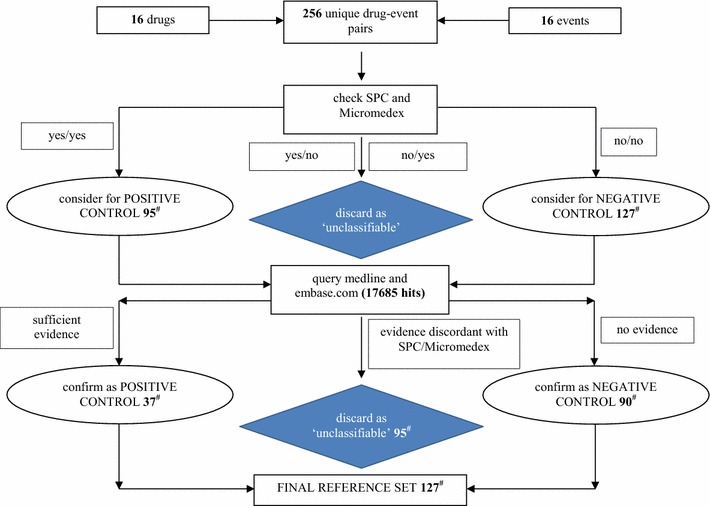
BACKGROUND: Better evidence regarding drug safety in the pediatric population might be generated from existing data sources such as spontaneous reporting systems and electronic healthcare records. The Global Research in Paediatrics (GRiP)-Network of Excellence aims to develop pediatric-specific methods that can be applied to these data sources. A reference set of positive and negative drug-event associations is required. OBJECTIVE: The aim of this study was to develop a pediatric-specific reference set of positive and negative drug-event associations. METHODS: Considering user patterns and expert opinion, 16 drugs that are used in individuals aged 0-18 years were selected and evaluated against 16 events, regarded as important safety outcomes. A cross-table of unique drug-event pairs was created. Each pair was classified as potential positive or negative control based on information from the drug's Summary of Product Characteristics and Micromedex. If both information sources consistently listed the event as an adverse event, the combination was reviewed as potential positive control. If both did not, the combination was evaluated as potential negative control. Further evaluation was based on published literature. RESULTS: Selected drugs include ibuprofen, flucloxacillin, domperidone, methylphenidate, montelukast, quinine, and cyproterone/ethinylestradiol. Selected events include bullous eruption, aplastic anemia, ventricular arrhythmia, sudden death, acute kidney injury, psychosis, and seizure. Altogether, 256 unique combinations were reviewed, yielding 37 positive (17 with evidence from the pediatric population and 20 with evidence from adults only) and 90 negative control pairs, with the remainder being unclassifiable. CONCLUSION: We propose a drug-event reference set that can be used to compare different signal detection methods in the pediatric population.
Overview
The claims and statistics of this paper haven’t been checked yet.
Free: it reads the open-access text and checks the first 5 claims that cite a source we can check. Create a free account to check every claim.
Integrity signals
Registry
Cites
Statistics
Figures
Verification
Claims the paper makes
The claims and statistics of this paper haven’t been checked yet.
Free: it reads the open-access text and checks the first 5 claims that cite a source we can check. Create a free account to check every claim.
Claims other papers make about this one
Each is checked against this paper’s own text: does it say what the citing paper says it does?
The check wasn’t confident either way, so it gives no verdict — never disputed.
In the citing paper
“This analysis recapitulates general trends in the enriched occurrence of specific classes of ADEs suggested by prior relevant research efforts11,27.”
From OnSIDES database: Extracting adverse drug events from drug labels using natural language processing models (2025) · cites this paper as [27]
Experimental — accuracy not yet measured
Self-check
Percentages, sums and reported differences re-computed from the paper’s own numbers.
The self-check needs the paper’s full text.
Citations
Cites
Statistical Methods in Diagnostic Medicine
Zhou, X., Obuchowski, N. A., & McClish, D. K. (2011) · Wiley Series in Probability and Statistics · doi:10.1002/9780470906514 · Cited by 1,784 · cited 1×
“Given that the composition of the lists of drugs and adverse events to be tested may have an extensive impact on performance assessment [35], we tried to ensure that the criteria and data sources that were utilized to create the reference set were independent of the data on which they will…”
MethodAndrews, A. M., Gerhardt, G. A., Daws, L. C., Shoaib, M., Mason, B. J., Heyser, C. J., De Lecea, L., Balster, R. L., Walsh, S., Dahmen, M. M., et al. (2010) · Encyclopedia of Psychopharmacology · doi:10.1007/978-3-540-68706-1_4410 · Cited by 322
Effects of nonsteroidal anti-inflammatory drugs on prostaglandins and renal function
Carmichael, J., & Shankel, S. W. (1985) · The American Journal of Medicine · doi:10.1016/0002-9343(85)90223-2 · Cited by 235 · cited 1×
“…[44, 45]; methylphenidate– psychosis [46, 47]; isotretinion–suicide [44, 45]; dom-peridone–ventricular arrhythmia [48]; domperidone–sudden death [49]; clarithromycin–QT prolongation [50]; quinine–QT prolongation [51, 52]; ibuprofen–anaphylaxis [53]; isoniazid–seizure [54]; and ibuprofen–AKI [55].”
Drug use in children: cohort study in three European countries
Sturkenboom, M. C. J. M., Verhamme, K. M. C., Nicolosi, A., Murray, M. L., Neubert, A., Caudri, D., Picelli, G., Sen, E. F., Giaquinto, C., Cantarutti, L., et al. (2008) · BMJ · doi:10.1136/bmj.a2245 · Cited by 234 · cited 1×
“Based on four criteria, four (primary) lists of drugs were created: we compiled drugs that are frequently prescribed in pediatrics (including off-label use), on an outpatient basis in high-income countries (as per papers and reports of use) [21, 22]; to allow for inpatient databases to be assessed, we included drugs t…”
MethodSelf-citationLindquist, M., St??hl, M., Bate, A., Edwards, I. R., & Meyboom, R. H. B. (2000) · Drug Safety · doi:10.2165/00002018-200023060-00004 · Cited by 230 · cited 1×
“Projects such as OMOP and EU-ADR have also created reference sets but none was targeted to pediatrics; in addition, the construct of these reference sets was different [19, 31–33].”
Unlicensed and Off-Label Drug Use in Children: Implications for Safety
Choonara, I., & Conroy, S. (2002) · Drug Safety · doi:10.2165/00002018-200225010-00001 · Cited by 224
Retinoic Acid and Affective Disorders: The Evidence for an Association
Bremner, J. D., Shearer, K. D., & McCaffery, P. J. (2012) · The Journal of Clinical Psychiatry · doi:10.4088/jcp.10r05993 · Cited by 195 · cited 2×
“…[42]; quinine–thrombocytopenia [43]; isotretinoin–psychosis [44, 45]; methylphenidate– psychosis [46, 47]; isotretinion–suicide [44, 45]; dom-peridone–ventricular arrhythmia [48]; domperidone–sudden death [49]; clarithromycin–QT prolongation [50]; quinine–QT prolongation [51,…”
The neurobiology of retinoic acid in affective disorders
Bremner, J. D., & McCaffery, P. (2008) · Progress in Neuro-Psychopharmacology and Biological Psychiatry · doi:10.1016/j.pnpbp.2007.07.001 · Cited by 177 · cited 2×
“…of 37 positive associations: quinine–aplastic anemia [41]; quinine–agranulocytosis [42]; quinine–thrombocytopenia [43]; isotretinoin–psychosis [44, 45]; methylphenidate– psychosis [46, 47]; isotretinion–suicide [44, 45]; dom-peridone–ventricular arrhythmia [48]; domperidone–sudden death [49];…”
Ross, R. G. (2006) · American Journal of Psychiatry · doi:10.1176/ajp.2006.163.7.1149 · Cited by 167 · cited 1×
“…anemia [41]; quinine–agranulocytosis [42]; quinine–thrombocytopenia [43]; isotretinoin–psychosis [44, 45]; methylphenidate– psychosis [46, 47]; isotretinion–suicide [44, 45]; dom-peridone–ventricular arrhythmia [48]; domperidone–sudden death [49]; clarithromycin–QT prolongation [50];…”
Defining a Reference Set to Support Methodological Research in Drug Safety
Ryan, P. B., Schuemie, M. J., Welebob, E. M., Duke, J. D., Valentine, S., & Hartzema, A. G. (2013) · Drug Safety · doi:10.1007/s40264-013-0097-8 · Cited by 160 · cited 2×
“In the current project, drugs and events were selected independently, unlike EU-ADR and OMOP [19, 20].”
Method
Cited by
Ziesenitz, V. C., Welzel, T., van Dyk, M., Saur, P., Gorenflo, M., & van den Anker, J. N. (2022) · Pediatric Drugs · doi:10.1007/s40272-022-00514-1 · Cited by 101
Fukazawa, C., Hinomura, Y., Kaneko, M., & Narukawa, M. (2018) · Pharmacoepidemiology and Drug Safety · doi:10.1002/pds.4672 · Cited by 57
Medication safety research by observational study design
Lao, K. S. J., Chui, C. S. L., Man, K. K. C., Lau, W. C. Y., Chan, E. W., & Wong, I. C. K. (2016) · International Journal of Clinical Pharmacy · doi:10.1007/s11096-016-0285-6 · Cited by 43
“In recent years, there has been significant methodological development in using spontaneous reporting databases [31, 32] or prescribing data alone [33].”
BackgroundSelf-citationThe State of Use and Utility of Negative Controls in Pharmacoepidemiologic Studies
Zafarí, Z., Park, J.-E., Shah, C. H., dosReis, S., Gorman, E. F., Hua, W., Ma, Y., & Tian, F. (2023) · American Journal of Epidemiology · doi:10.1093/aje/kwad201 · Cited by 28
Osokogu, O. U., Dodd, C. N., Pacurariu, A. C., Kaguelidou, F., Weibel, D. M., & Sturkenboom, M. (2016) · Drug Safety · doi:10.1007/s40264-016-0433-x · Cited by 19
Self-citationTanaka, Y., Chen, H. Y., Belloni, P., Gisladottir, U., Kefeli, J., Patterson, J., Srinivasan, A., Zietz, M., Sirdeshmukh, G., Berkowitz, J., et al. (2025) · Med · doi:10.1016/j.medj.2025.100642 · Cited by 17
Literature-Based Discovery of Confounding in Observational Clinical Data.
Malec, S. A., Wei, P., Xu, H., Bernstam, E. V., Myneni, S., & Cohen, T. (2016) · PubMed Central · Cited by 17
No population left behind: Improving paediatric drug safety using informatics and systems biology
Giangreco, N., Elias, J. E., & Tatonetti, N. P. (2021) · British Journal of Clinical Pharmacology · doi:10.1111/bcp.14705 · Cited by 19
“86 Our lab developed a machine-FIGURE 2 Three unsolved and critical research directions to enhance paediatric drug safety.”
BackgroundGiangreco, N. P., & Tatonetti, N. P. (2022) · Med · doi:10.1016/j.medj.2022.06.001 · Cited by 16
Koutkias, V. G. (2019) · Drug Safety · doi:10.1007/s40264-018-00793-z · Cited by 18
Ma, J., Yu, Q., Ding, W., Zhang, T., & Zhang, Y. (2020) · International Journal of Nursing Practice · doi:10.1111/ijn.12880 · Cited by 13
Wei, R., Jia, L., Yu, Y.-C., Nie, X.-L., Song, Z., Duanfang, F. A. N., Xie, Y., Peng, X., Zhao, Z., & Wang, X. (2019) · Expert Opinion on Drug Safety · doi:10.1080/14740338.2019.1604682 · Cited by 9
Rekha, B. H., Hisham, S. A., Wahab, I. A., Ali, N. M., Goh, K. W., & Ming, L. C. (2024) · BMC Medical Informatics and Decision Making · doi:10.1186/s12911-024-02801-y · Cited by 9
Masking by vaccines in pediatric drug safety signal detection in the EudraVigilance database
Dodd, C. N., Pacurariu, A. C., Osokogu, O. U., Weibel, D. M., Ferrajolo, C., Vo, D. H., Becker, B. F. H., Kors, J. A., & Sturkenboom, M. (2018) · Pharmacoepidemiology and Drug Safety · doi:10.1002/pds.4623 · Cited by 7
“For this approach, we used the GRiP pediatric‐specific drug‐event reference set for nonvaccines, which composes 256 unique DECs, 37 of which are classified as positive control pairs, 90 as negative control pairs, and the remainder unclassifiable.(20) We calculated standard”
MethodSelf-citationNorén, G. N., Donegan, K. L., Muñoz, M. A., Alshammari, T. M., Pratt, N. L., Candore, G., Morales, D. R., Rijnbeek, P. R., Bate, A., Postigo, R., et al. (2025) · Pharmacoepidemiology and Drug Safety · doi:10.1002/pds.70231 · Cited by 9
“There exist reference sets of corroborated adverse reactions [25–27] against which methods and datasets can be benchmarked, including for special populations [28].”
Pernus, Y. B., Nan, C., Verstraeten, T., Pedenko, M., Osokogu, O. U., Weibel, D. M., Sturkenboom, M., & Bonhoeffer, J. (2015) · Vaccine · doi:10.1016/j.vaccine.2015.10.013 · Cited by 6
Self-citationZhou, J., Xie, Y., Du, P., Chen, M., & Liu, X. (2025) · European Journal of Pharmacology · doi:10.1016/j.ejphar.2025.178103 · Cited by 5
Giangreco, N., & Tatonetti, N. P. (2021) · BioData Mining · doi:10.1186/s13040-021-00264-9 · Cited by 4
Chen, J., Huang, S., Chen, Y., Luo, C., & Li, Y. (2025) · Journal of Pain Research · doi:10.2147/jpr.s524809 · Cited by 3
Fukazawa, C., Hinomura, Y., Kaneko, M., & Narukawa, M. (2021) · Therapeutic Innovation & Regulatory Science · doi:10.1007/s43441-021-00265-0 · Cited by 3
Testing an informatics consulting service for systematic bias using negative control reference setsPreprint
Jackson, M., Gombar, S., Manickam, R., Brown, R., Tekumalla, R., Ballentine, P., & Low, Y. (2024) · Research Square · doi:10.21203/rs.3.rs-3694681/v1 · Cited by 3
Development of a Drug Safety Signal Detection Reference Set Using Japanese Safety Information
Ito, S., & Narukawa, M. (2024) · Therapeutic Innovation & Regulatory Science · doi:10.1007/s43441-024-00729-z · Cited by 2
Miyazaki, M., Sakai, T., Obara, T., & Mano, N. (2021) · Pharmacoepidemiology and Drug Safety · doi:10.1002/pds.5231 · Cited by 2
Balogh, O. M., Pétervári, M., Csernák, Á. M., Puhl, E., Horváth, A., Ferdinandy, P., & Ágg, B. (2026) · Briefings in Bioinformatics · doi:10.1093/bib/bbag463 · Cited by 1
Using existing data sources for assessment of vaccine safety: a focus on methods
Dodd, C. N. (2019) · EUR Research Repository (Erasmus University Rotterdam) · Cited by 2
How are we assessing the safety and quality use of medicines used by young people in Australia?
Bell, J., Wilson, A. J., Elshaug, A. G., & Nassar, N. (2017) · Journal of Paediatrics and Child Health · doi:10.1111/jpc.13567
Paediatric drug development : an opportunity for academia to close the gap
Bruyne, P. D. (2016) · Ghent University Academic Bibliography (Ghent University) · Cited by 2
An Age-Adjusted Disproportionality Measure for Pediatric Pharmacovigilance
Belloni, P., & Pizzolato, F. (2025) · Springer eBooks · doi:10.1007/978-3-031-64431-3_31 · Cited by 1
Giangreco, N., & Tatonetti, N. P. (2021) · Figshare · doi:10.6084/m9.figshare.15041053
Xu, J., Qian, C., Jingnan, X., Luying, Q., Chen, Y., & Yan, Z. (2026) · Medicine · doi:10.1097/md.0000000000049802
“[21,22] In contrast, adalimumab’s inverse association (0.42) diverges from registry-based–0.18 height SDS in JIA, likely due to residual disease-severity confounding.”
InfluentialA manufacturer-aware cross-system benchmark for pediatric pharmacovigilance signal concordance
Shi, J., Xia, J., Li, H., Zhang, S., & Shi, B. (2026) · Frontiers in Pharmacology · doi:10.3389/fphar.2026.1900271
“Pediatric reference sets and resources such as the Osokogu reference set and KidSIDES established important foundations for pediatric signal evaluation and pediatric-specific drug-effect discovery (Osokogu et al., 2015; Giangreco and Tatonetti, 2022).”
Metadata
- Authors
- Osokogu, O. U., Fregonese, F., Ferrajolo, C., Verhamme, K., de Bie, S., Jong, G. ’., Catapano, M., Weibel, D., Kaguelidou, F., Bramer, W. M., Hsia, Y., Wong, I. C. K., Gazarian, M., Bonhoeffer, J., & Sturkenboom, M.
- Affiliations
- Erasmus MC (NL)
- University of Padua (IT)
- University of Campania "Luigi Vanvitelli" (IT)
- St George's, University of London (GB)
- UCL School of Pharmacy (GB)
- UNSW Sydney (AU)
- University Children’s Hospital Basel (CH)
- Corresponding author
- Osokogu, Osemeke U.
- ORCID
- Venue
- Drug Safety
- Published
- 2015-02
- Volume
- 38
- Issue
- 2
- Pages
- 207-217
- ISSN
- 0114-5916 (ISSN-L)
- 1179-1942
- PMC
- PMC4328124
- OpenAlex
- W2022144328
- Cited by
- 31
- References
- 57
- Citations by year
- 2026: 2 · 2025: 5 · 2024: 4 · 2023: 1 · 2022: 2 · 2021: 4 · 2020: 2 · 2019: 3 · 2018: 2 · 2017: 1 · 2016: 4 · 2015: 1
- FWCI
- 2.11
- Type
- journal article
- Language
- en
- Open access
- hybrid
- doi.org
- Licence
- Locations
- Drug Safety (publishedVersion, cc-by-nc)
- Europe PMC (PubMed Central) (publishedVersion, cc-by-nc)
- PubMed Central (publishedVersion, cc-by-nc)
- PubMed (publishedVersion)
- EUR Research Repository (Erasmus University Rotterdam) (publishedVersion, other-oa)
- St George's Online Research Archive (St George's University of London) (acceptedVersion)
- EUR Research Repository (Erasmus University Rotterdam) (submittedVersion, other-oa)
- RePub (Erasmus University Rotterdam) (submittedVersion, other-oa)
- Archivio Istituzionale della Ricerca - Università degli Studi della Campania "Luigi Vanvitelli" (submittedVersion)
- Research Portal (Queen's University Belfast) (submittedVersion)
- RePub (Erasmus University Rotterdam) (submittedVersion)
- Funders
- Eli Lilly and Company
- Pfizer
- European Commission (261060)
- ZonMw (113201007)
- Topics
- Life Sciences › Pharmacology, Toxicology and Pharmaceutics › Toxicology › Pharmacovigilance and Adverse Drug Reactions
- Health Sciences › Medicine › Pediatrics, Perinatology and Child Health › Pharmaceutical studies and practices
- Health Sciences › Medicine › Epidemiology › Data-Driven Disease Surveillance
- Keywords
- drug safety in children, adverse drug reactions, signal detection, spontaneous reporting systems, electronic health records, adverse event classification, ibuprofen, methylphenidate, montelukast, quinine, bullous eruption, ventricular arrhythmias, sudden death, acute kidney injury, psychosis, seizures, aplastic anemia
- MeSH terms
- Adolescent, Child, Child, Preschool, Humans, Infant, Pediatrics, Databases, Factual, Adverse Drug Reaction Reporting Systems, Data Mining, Electronic Health Records, Drug-Related Side Effects and Adverse Reactions
About these checks
Registry, retraction, Cites and statistics results are computed, not judged, with one exception: a printed reference that no index lists is read once by a model before it counts as a citation error. Claims are extracted by a model and kept only when their quote appears verbatim in the text; each cited source is then checked, with a model’s help, for whether it says what the claim relies on. Those verdicts can be wrong — read the claim’s quote and the cited source before relying on one.
Statistics and arithmetic are recomputed, not judged.
Confidence bands are shown only for fields calibrated on our annotated test set. None is calibrated yet, so no band is shown.
What counts as a claim ›How we measure confidence ›How we check this ›
Are you an author, or do you see a problem with this page? Request a review
Data sources
Bibliographic data: Semantic Scholar, OpenAlex, Crossref.
Contains information from the Semantic Scholar Academic Graph Datasets, made available under the ODC Attribution License (ODC-BY 1.0).
Semantic Scholar’s data is described in: Kinney, R., et al. (2023). The Semantic Scholar Open Data Platform. arXiv:2301.10140.
