

Infigratinib: First Approval
Open accessThe DOI matches its Crossref record; 7 of the 7 references it cites were found in a registry or an index.
Abstract
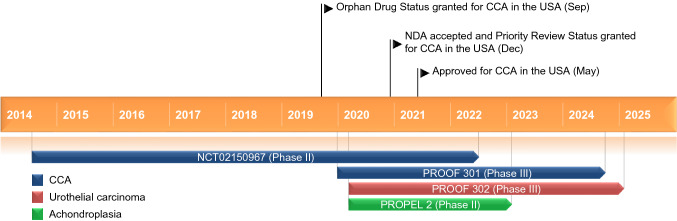
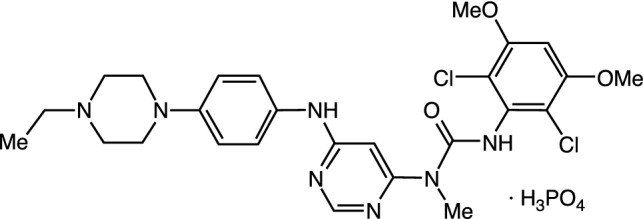
), a fibroblast growth factor receptor (FGFR)-specific tyrosine kinase inhibitor, is being co-developed by QED Therapeutics and Helsinn for the treatment of cholangiocarcinoma, urothelial carcinoma and other FGFR-driven conditions. Infigratinib was recently approved in the USA for the treatment of previously treated, unresectable locally advanced or metastatic cholangiocarcinoma with a FGFR2 fusion or other rearrangement as detected by a test approved by the US Food and Drug Administration. This article summarizes the milestones in the development of infigratinib leading to this first approval for advanced cholangiocarcinoma.
Overview
The claims and statistics of this paper haven’t been checked yet.
Free: it reads the open-access text and checks the first 5 claims that cite a source we can check. Create a free account to check every claim.
Integrity signals
Registry
Cites
Statistics
Figures
Verification
Claims the paper makes
The claims and statistics of this paper haven’t been checked yet.
Free: it reads the open-access text and checks the first 5 claims that cite a source we can check. Create a free account to check every claim.
Claims other papers make about this one
Each is checked against this paper’s own text: does it say what the citing paper says it does?
The source backs part of the claim, not all of it — or backs it for a different population, condition or comparison.
In the citing paper
“Several pan-FGFR inhibitors, such as futibatinib and infigratinib, are approved for treating FGFR-altered cancers.60,61”
From Paneth-like transition drives resistance to dual targeting of KRAS and EGFR in colorectal cancer (2026) · cites this paper as [61]
Experimental — accuracy not yet measured
Self-check
Percentages, sums and reported differences re-computed from the paper’s own numbers.
The self-check needs the paper’s full text.
Citations
Cites
Phase II Study of BGJ398 in Patients With FGFR-Altered Advanced Cholangiocarcinoma
Javle, M., Lowery, M., Shroff, R. T., Weiss, K. H., Springfeld, C., Borad, M. J., Ramanathan, R. K., Goyal, L., Sadeghi, S., Macarulla, T., et al. (2018) · Journal of Clinical Oncology · doi:10.1200/jco.2017.75.5009 · Cited by 693
Nogova, L., Sequist, L. V., Perez Garcia, J. M., Andre, F., Delord, J.-P., Hidalgo, M., Schellens, J. H. M., Cassier, P. A., Camidge, D. R., Schuler, M., et al. (2017) · Journal of Clinical Oncology · doi:10.1200/jco.2016.67.2048 · Cited by 432
Pal, S. K., Rosenberg, J. E., Hoffman-Censits, J. H., Berger, R., Quinn, D. I., Galsky, M. D., Wolf, J., Dittrich, C., Keam, B., Delord, J.-P., et al. (2018) · Cancer Discovery · doi:10.1158/2159-8290.cd-18-0229 · Cited by 258
Tyrosine kinase inhibitor NVP-BGJ398 functionally improves FGFR3-related dwarfism in mouse model
Komla-Ebri, D. S. K., Dambroise, E., Krämer, I., Benoist-Lasselin, C., Kaci, N., Gall, C. L., Martin, L., Busca, P., Barbault, F., Graus-Porta, D., et al. (2016) · Journal of Clinical Investigation · doi:10.1172/jci83926 · Cited by 120
Javle, M. M., Roychowdhury, S., Kelley, R. K., Sadeghi, S., Macarulla, T. M., Waldschmidt, D., Goyal, L., Borbath, I., El-Khoueiry, A. B., Yong, W. P., et al. (2021) · Journal of Clinical Oncology · doi:10.1200/jco.2021.39.3_suppl.265 · Cited by 85
Sequist, L. V. D., Cassier, P. A., Varga, A., Tabernero, J. M., Schellens, J. H. M., Delord, J., LoRusso, P. M., Camidge, D. R., Medina, M. H., Schüler, M., et al. (2014) · Cancer Research · doi:10.1158/1538-7445.am2014-ct326 · Cited by 78
Lyou, Y., Grivas, P. D., Rosenberg, J. E., Hoffman-Censits, J. H., Quinn, D. I., Petrylak, D. P., Galsky, M. D., Vaishampayan, U. N., Giorgi, U. D., Gupta, S. V., et al. (2020) · European Urology · doi:10.1016/j.eururo.2020.08.002 · Cited by 30
Research works printed but not linked: 1
- Reyes M Zamora C Andrews S A phase I, open-label, single-dose study to evaluate the excretion and mass balance, pharmacokinetics, and metabolism of [14C]-infigratinib (BGJ398) in healthy adult volunteers [abstract no. PIII-045] Clin Pharmacol Ther 2021 109 Suppl 1 S57
Cited by
Items 101–109 of 109
Tinengotinib, an arising option for FGFR inhibitor resistant cholangiocarcinoma
Voutsadakis, I. A. (2026) · Journal of Gastrointestinal Oncology · doi:10.21037/jgo-2026-0776
FGFR Alterations in Bladder Cancer—From Molecular Pathogenesis to Precision Oncology
Collins, K., & Cheng, L. (2026) · JAMA Oncology · doi:10.1001/jamaoncol.2026.4196
Assessment of the role of FGFR1-N546K mutations in neuroblastoma pathogenesis and treatment
Boland, J. (2026) · Kölner Universitäts PublikationsServer (Universität zu Köln)
Zhu, W., Guo, J., 颜玲, Lin, X., Chen, X., Song, X., Deng, W., Luo, Y., Tu, Z., Chen, Y., et al. (2026) · Journal of Medicinal Chemistry · doi:10.1021/acs.jmedchem.6c02574
The expansion of kinase drug discovery: new targets, platforms and indications
Sokolov, A. V., Fabbro, D., Knapp, S., & Schiöth, H. B. (2026) · Nature Reviews Drug Discovery · doi:10.1038/s41573-026-01551-y
Metadata
- Authors
- Kang, C.
- Affiliations
- Springer Nature (New Zealand) (NZ)
- Corresponding author
- Kang, Connie
- Venue
- Drugs
- Published
- 2021-07
- Volume
- 81
- Issue
- 11
- Pages
- 1355-1360
- ISSN
- 0012-6667 (ISSN-L)
- 1179-1950
- PMC
- PMC8610935
- OpenAlex
- W3186228217
- Semantic Scholar
- 8cac531a0298568213cb860fc37d21d0196edb8e
- Cited by
- 101
- References
- 7
- Citations by year
- 2026: 15 · 2025: 19 · 2024: 29 · 2023: 20 · 2022: 17 · 2021: 1
- FWCI
- 15.97
- Type
- journal article
- Language
- en
- Update notices
- correction (2021-11-24)
- Open access
- hybrid
- doi.org
- Licence
- cc-by-nc
- creativecommons.org/licenses/by-nc/4.0 (tdm)
- creativecommons.org/licenses/by-nc/4.0 (vor, 18 d)
- Locations
- Drugs (publishedVersion, cc-by-nc)
- PubMed Central (publishedVersion, cc-by-nc)
- PubMed (publishedVersion)
- Figshare (submittedVersion, cc-by-nc)
- Figshare
- Topics
- Health Sciences › Medicine › Surgery › Cholangiocarcinoma and Gallbladder Cancer Studies
- Life Sciences › Biochemistry, Genetics and Molecular Biology › Molecular Biology › Fibroblast Growth Factor Research
- Health Sciences › Medicine › Surgery › Pediatric Hepatobiliary Diseases and Treatments
- Keywords
- infigratinib, FGFR tyrosine kinase inhibitors, cholangiocarcinoma, FGFR2 fusion, drug approval, drug development milestones, urothelial carcinoma
- MeSH terms
- Antineoplastic Agents, Humans, Neoplasm Metastasis, Phenylurea Compounds, Pyrimidines, United States, United States Food and Drug Administration, Receptors, Fibroblast Growth Factor, Cholangiocarcinoma, Receptor, Fibroblast Growth Factor, Type 2
About these checks
Registry, retraction, Cites and statistics results are computed, not judged, with one exception: a printed reference that no index lists is read once by a model before it counts as a citation error. Claims are extracted by a model and kept only when their quote appears verbatim in the text; each cited source is then checked, with a model’s help, for whether it says what the claim relies on. Those verdicts can be wrong — read the claim’s quote and the cited source before relying on one.
Statistics and arithmetic are recomputed, not judged.
Confidence bands are shown only for fields calibrated on our annotated test set. None is calibrated yet, so no band is shown.
What counts as a claim ›How we measure confidence ›How we check this ›
Are you an author, or do you see a problem with this page? Request a review
Data sources
Bibliographic data: Semantic Scholar, OpenAlex, Crossref.
Contains information from the Semantic Scholar Academic Graph Datasets, made available under the ODC Attribution License (ODC-BY 1.0).
Semantic Scholar’s data is described in: Kinney, R., et al. (2023). The Semantic Scholar Open Data Platform. arXiv:2301.10140.
