

The DOI matches its Crossref record; 59 of the 60 references it cites were found in a registry or an index.
Socioeconomic Correlates of Sedentary Behavior in Adolescents: Systematic Review and Meta-Analysis
Open accessAbstract
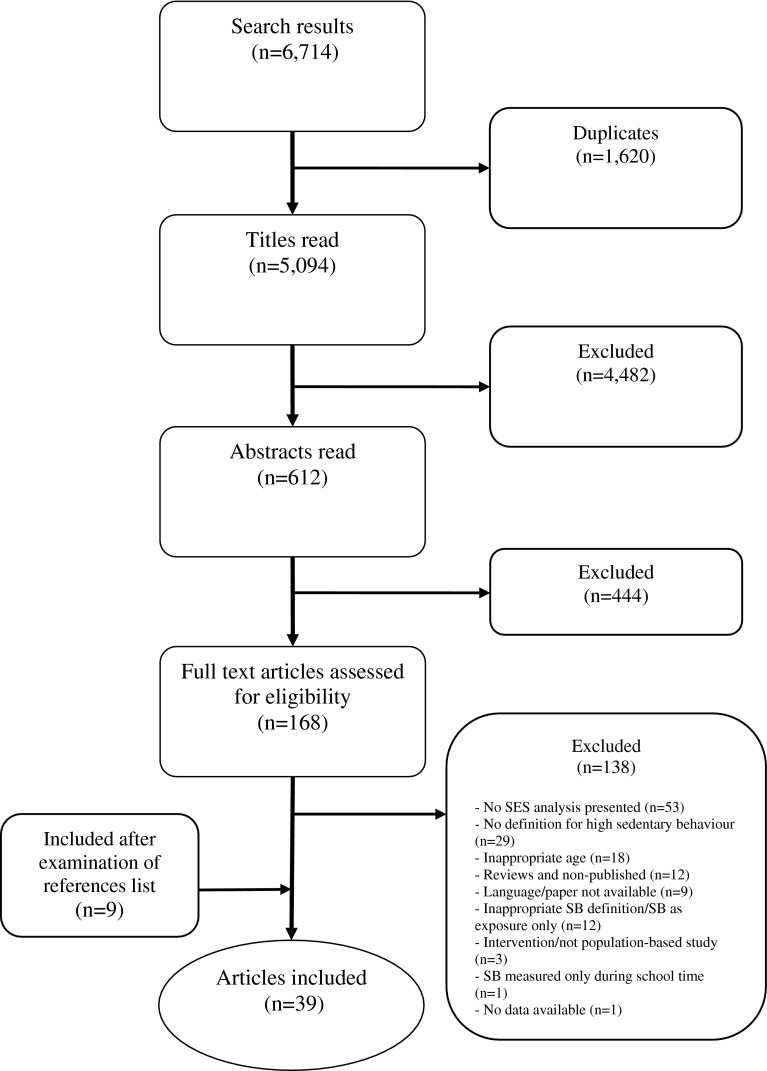
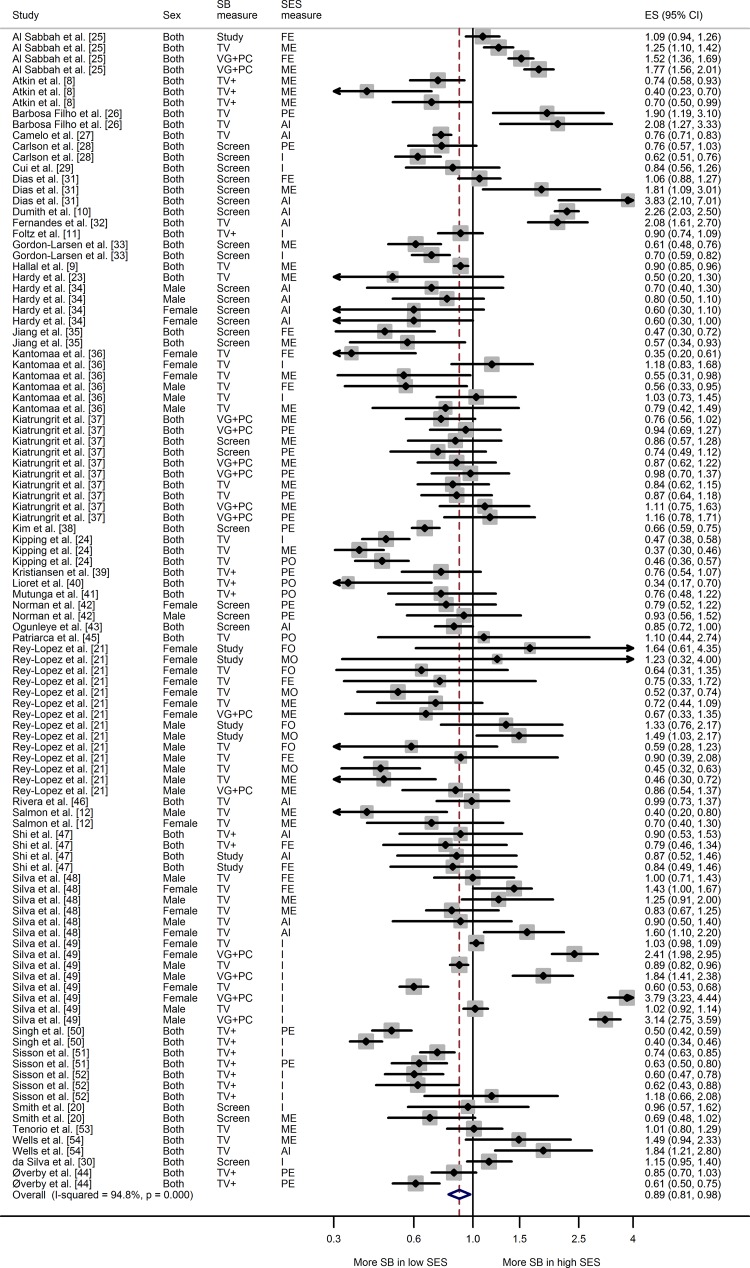
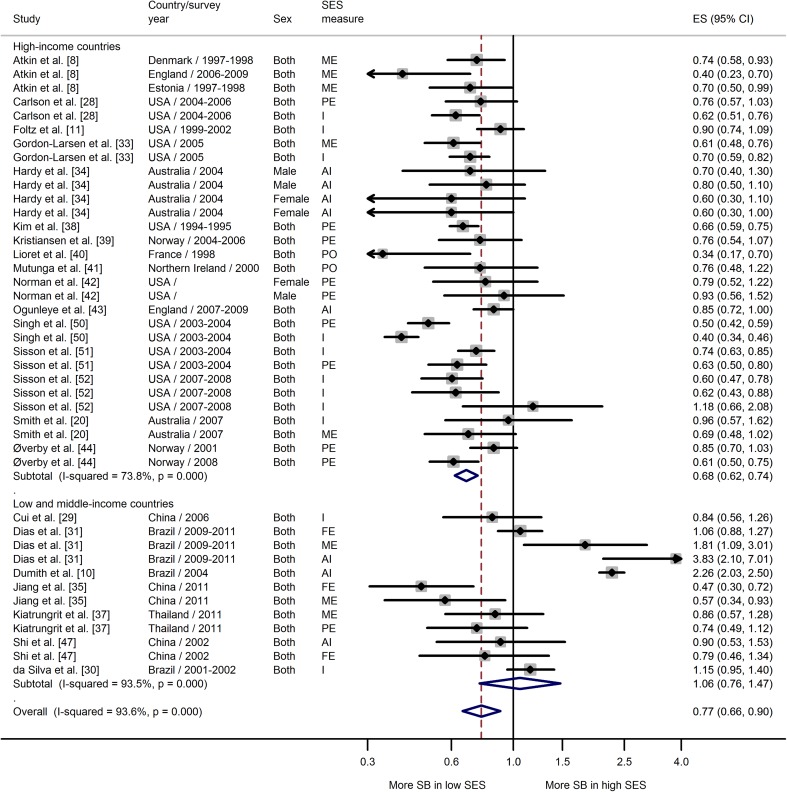
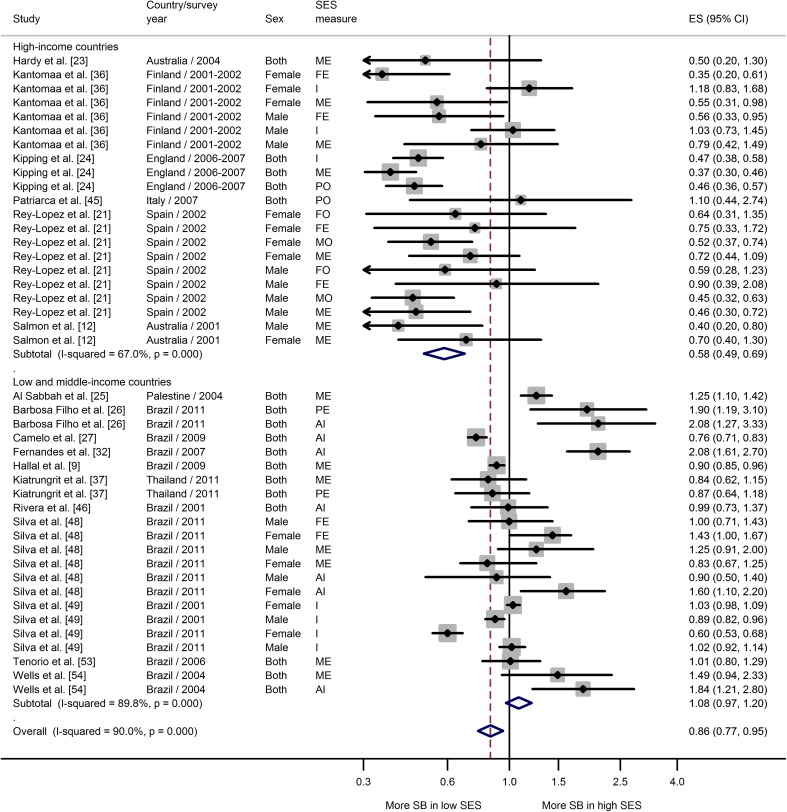
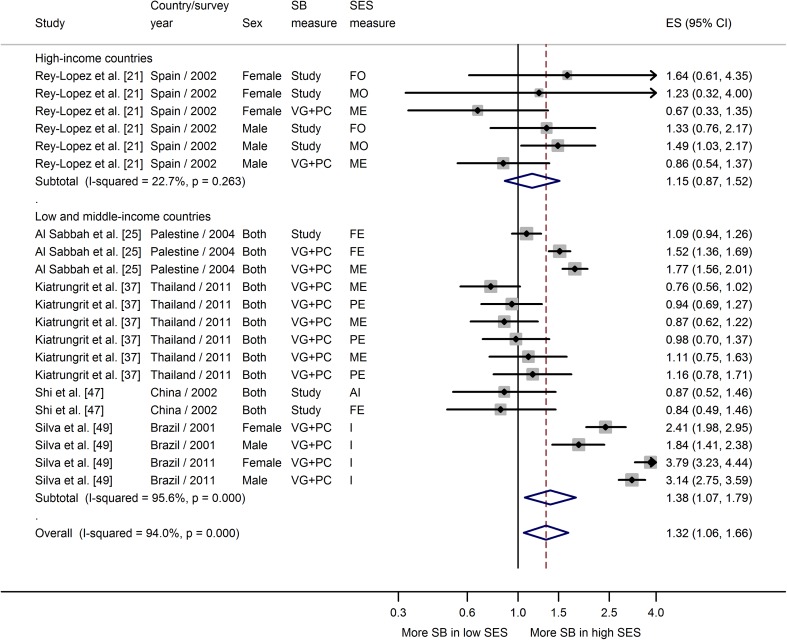
BACKGROUND: The body of evidence on associations between socioeconomic status (SES) and sedentary behaviors in adolescents is growing. OBJECTIVES: The overall aims of our study were to conduct a systematic review and meta-analysis of this evidence and to assess whether (1) the associations between SES and sedentary behavior are consistent in adolescents from low-middle-income and from high-income countries, (2) the associations vary by domain of sedentary behavior, and (3) the associations vary by SES measure. METHODS: We performed a systematic literature search to identify population-based studies that investigated the association between SES and sedentary behavior in adolescents (aged 10-19 years). Only studies that presented risk estimates were included. We conducted meta-analyses using random effects and univariate meta-regression and calculated pooled effect sizes (ES). RESULTS: Data from 39 studies were included; this provided 106 independent estimates for meta-analyses. Overall, there was an inverse association between SES and sedentary behavior (ES 0.89; 95 % confidence interval [CI] 0.81-0.98). However, the direction of the association varied: in high-income countries, SES was inversely associated with sedentary behavior (ES 0.67; 95 % CI 0.62-0.73), whereas in low-middle-income countries, there was a positive association between SES and sedentary behavior (ES 1.18; 95 % CI 1.04-1.34). In high-income countries, the associations were strongest for screen time (ES 0.68; 95 % CI 0.62-0.74) and television (TV) time (ES 0.58; 95 % CI 0.49-0.69), whereas in low-middle-income countries, the associations were strongest for 'other' screen time (i.e., computer, video, study time, but not including TV time) (ES 1.38; 95 % CI 1.07-1.79). All indicators of SES were negatively associated with sedentary behavior in high-income countries, but only resources (income and assets indexes) showed a significant positive association in low-middle-income countries. CONCLUSION: The associations between SES and sedentary behavior are different in high- and low-middle-income countries, and vary by domain of sedentary behavior. These findings suggest that different approaches may be required when developing intervention strategies for reducing sedentary behavior in adolescents in different parts of the world.
Overview
The claims and statistics of this paper haven’t been checked yet.
Run the check — free, no account needed. It reads the open-access text and checks the sources it cites.
Integrity signals
Registry
Cites
Statistics
Figures
Verification
Claims the paper makes
The claims and statistics of this paper haven’t been checked yet.
Run the check — free, no account needed. It reads the open-access text and checks the sources it cites.
Claims other papers make about this one
Each is checked against this paper’s own text: does it say what the citing paper says it does?
The source backs part of the claim, not all of it — or backs it for a different population, condition or comparison.
In the citing paper
“This may be particularly important for children and adolescents from low socioeconomic backgrounds, who typically engage in greater amounts of ST [48–51] and are also less likely to live in green neighbourhoods [52].”
From Psychological impacts of “screen time” and “green time” for children and adolescents: A systematic scoping review (2020) · cites this paper as [51]
Experimental — accuracy not yet measured
Self-check
Percentages, sums and reported differences re-computed from the paper’s own numbers.
The self-check needs the paper’s full text.
Citations
Cites
Preferred Reporting Items for Systematic Reviews and Meta-Analyses: the PRISMA statement
Moher, D., Liberati, A., Tetzlaff, J., Altman, D. G., & for the PRISMA Group (2009) · BMJ · doi:10.1136/bmj.b2535 · Cited by 83,823
Preferred reporting items for systematic reviews and meta-analyses: the PRISMA Statement.
(2009) · PubMed Central · Cited by 44,859
Indicators of socioeconomic position (part 1): Figure 1
Galobardes, B., Shaw, M., Lawlor, D. A., Lynch, J. W., & Smith, G. D. (2005) · Journal of Epidemiology & Community Health · doi:10.1136/jech.2004.023531 · Cited by 2,979
Socioeconomic Status in Health Research
Braveman, P., Cubbin, C., Egerter, S. A., Chideya, S., Marchi, K. S., Metzler, M. M., & Posner, S. F. (2005) · JAMA · doi:10.1001/jama.294.22.2879 · Cited by 2,360
Letter to the Editor: Standardized use of the terms “sedentary” and “sedentary behaviours”
Networ, S. B. R. (2012) · Applied Physiology, Nutrition, and Metabolism · doi:10.1139/h2012-024 · Cited by 1,873
Children, adolescents, and television.
Strasburger, V. (1990) · Pediatrics in review · doi:10.1542/peds.107.2.423 · Cited by 1,432
A Brief Review on Correlates of Physical Activity and Sedentariness in Youth
van der Horst, K., Chinapaw, M. J. M., Twisk, J. W. R., & van Mechelen, W. (2007) · Medicine & Science in Sports & Exercise · doi:10.1249/mss.0b013e318059bf35 · Cited by 1,259
Hilpert, M., Brockmeier, K., Dordel, S., Koch, B., Weiß, V., Ferrari, N., Tokarski, W., & Gräf, C. (2017) · Obesity Facts · doi:10.1159/000464105 · Cited by 1,185
Determinants of Adolescent Physical Activity and Inactivity Patterns
Gordon‐Larsen, P., McMurray, R. G., & Popkin, B. M. (2000) · PEDIATRICS · doi:10.1542/peds.105.6.e83 · Cited by 963
Indicators of socioeconomic position (part 2)
Galobardes, B., Shaw, M., Lawlor, D. A., Lynch, J. W., & Smith, G. D. (2006) · Journal of Epidemiology & Community Health · doi:10.1136/jech.2004.028092 · Cited by 649
Research works printed but not linked: 1
- Brazilian Institute of Geography and Statistics. Resultados gerais da amostra do Censo Demografico 2010. Rio de Janeiro: Brazilian Institute of Geography and Statistics; 2012.
Cited by
Sorted by citations
Items 101–158 of 158
Hao, Y., & Razman, R. (2022) · International Journal of Developmental Disabilities · doi:10.1080/20473869.2022.2133445 · Cited by 3
Kwon, S., Wehrmeister, F. C., Gonçalves, H., da Silva, B. G. C., & Menezes, A. M. B. (2023) · Children · doi:10.3390/children10020265 · Cited by 4
Living near the port area is associated with physical inactivity and sedentary behavior
Sperandio, E. F., Arantes, R. L., Chao, T. P., Romiti, M., Gagliardi, A. R. D. T., & Dourado, V. Z. (2017) · Sao Paulo Medical Journal · doi:10.1590/1516-3180.2016.0151121016 · Cited by 3
Padrões de comportamento sedentário em adolescentes de um município da região Nordeste do Brasil
Mendonça, G., Filho, A. ́., Barbosa, A. O., & Júnior, J. C. D. F. (2018) · Revista Brasileira de Atividade Física & Saúde · doi:10.12820/rbafs.23e0023 · Cited by 4
Janda, D., Gába, A., Ayala, A. M. C., Timperio, A. F., Andrýsková, L., Piler, P., & Arundell, L. (2024) · BMJ Open · doi:10.1136/bmjopen-2024-088907 · Cited by 2
Musilanga, N., Nasib, H., Mwakibolwa, A., Jackson, G., Shayo, F., Kijusya, K., Henry, S., Nhanga, C., Girukwigomba, S., Keshi, J., et al. (2025) · PLoS ONE · doi:10.1371/journal.pone.0314901 · Cited by 2
Temizarabacı, İ., Köse, G., Baş, M., & Nehring, I. (2025) · Children · doi:10.3390/children12060696 · Cited by 5
Richard, V., Lorthe, E., Dumont, R., Loizeau, A., Baysson, H., Zaballa, M.-E., Lamour, J., Barbe, R., Posfay-Barbe, K. M., Guessous, I., et al. (2025) · Scientific Reports · doi:10.1038/s41598-025-10190-z · Cited by 2
Zhou, P., Geng, X., Zhang, C., Li, T., Li, F., Cao, Y., Mao, D., Liu, Y., Wang, N., Li, K., et al. (2025) · BMC Public Health · doi:10.1186/s12889-025-24359-8 · Cited by 3
Does light physical activity reduce blood pressure responses to laboratory stressors?
Thomas, M. C., & Kamarck, T. W. (2023) · Psychophysiology · doi:10.1111/psyp.14294 · Cited by 2
Starks, K. S., Kamara, D., & Jacobsen, K. H. (2023) · Journal of School Health · doi:10.1111/josh.13402 · Cited by 4
Kim, J., Hwang, I.-W., Park, J.-H., Kim, Y., & Lee, J. M. (2023) · PLoS ONE · doi:10.1371/journal.pone.0294270 · Cited by 2
Richard, V., Lorthe, E., Dumont, R., Loizeau, A., Baysson, H., Schrempft, S., Zaballa, M.-E., Lamour, J., Barbe, R., Posfay-Barbe, K. M., et al. (2024) · BMC Public Health · doi:10.1186/s12889-024-20393-0 · Cited by 2
Wasnyo, Y. F., Tatah, L., Odunitan-Wayas, F. A., Mapa-Tassou, C., Luan, J., Micklesfield, L. K., Smith, J., Farr, C., Foley, L. S., Lambert, E. V., et al. (2024) · BMC Public Health · doi:10.1186/s12889-024-20683-7 · Cited by 2
Molina‐Cando, M. J., Ster, I. C., Escandón, S., Sánchez, R., Rodríguez, A., Chico, M. E., Vaca, M. G., Owen, C. G., Dyck, D. V., Cooper, P. J., et al. (2024) · PLoS ONE · doi:10.1371/journal.pone.0311165 · Cited by 3
van Duin, C., Sischka, P. E., Heinz, A., & Willems, H. E. (2024) · Applied Research in Quality of Life · doi:10.1007/s11482-024-10412-y · Cited by 3
Associação entre sedentarismo e nível socioeconômico em adolescentes
Carlos, F. D. M., de Sousa, P. H. A., Campos, C. G., Lamounier, J. A., Bila, W. C., & Romano, M. C. C. (2022) · Revista CUIDARTE · doi:10.15649/cuidarte.2082 · Cited by 2
Vincent, H. K., Bhavsar, P. H., & Bernier, A. V. (2023) · Clinical Pediatrics · doi:10.1177/00099228231165580 · Cited by 1
Lu, Z., Yu, L., Li, L., Li, N., Fan, K., Tian, H., Liu, L., Li, S., Zhou, Y., & Jiang, Y. (2025) · Journal of Health Psychology · doi:10.1177/13591053251336601 · Cited by 1
Richard, V., Lorthe, E., Dumont, R., Loizeau, A., Baysson, H., Zaballa, M.-E., Lamour, J., Nehme, M., Barbe, R., Posfay-Barbe, K. M., et al. (2025) · Swiss Medical Weekly · doi:10.57187/s.4247 · Cited by 1
Health literacy and screen use among 13-year-old students in Norway – A cross-sectional study
Waldum-Grevbo, K. S., Holen, S., & Sagatun, Å. (2025) · Scandinavian Journal of Public Health · doi:10.1177/14034948251358570 · Cited by 1
Kyan, A., & Takakura, M. (2025) · Environmental Health and Preventive Medicine · doi:10.1265/ehpm.25-00052 · Cited by 1
Lorentzen, C., Bauger, L., & Ambugo, E. A. (2025) · BMC Public Health · doi:10.1186/s12889-025-24697-7 · Cited by 1
Chaquila, J. A., & Pereyra‐Elías, R. (2026) · Scientific Reports · doi:10.1038/s41598-025-33914-7 · Cited by 2
Jang, W., Hong, M., Cheong, H.-K., & Oh, I.-H. (2026) · Acta Psychologica · doi:10.1016/j.actpsy.2025.106172 · Cited by 1
Tebar, W. R., Rosa, C. C., Exupério, I. N., Pinheiro, J. L., Beretta, V. S., Akimoto, A., da Silva, C. C. M., Ferrari, G., & Christófaro, D. G. D. (2024) · Public Health Nursing · doi:10.1111/phn.13289 · Cited by 1
Wang, X., Zhang, S., Zhao, Y., Meng, S., Wang, J., Wu, Z., & Ni, J. (2025) · Public Health · doi:10.1016/j.puhe.2025.105730 · Cited by 1
Shi, X. R., An, M. J., Chen, T. J., & Ma, J. (2021) · PubMed Central · doi:10.19723/j.issn.1671-167x.2021.02.013 · Cited by 1
Fletcher, R. (2021) · University of Huddersfield Repository (University of Huddersfield) · Cited by 1
Longitudinal effects of biopsychosocial variables on physical activity after menarche
dos Santos, M. L. B., Simões, T. B. D. S., Monteiro, L. A. D. C., Novaes, J. D. S., & Fernandes, H. M. (2021) · Minerva Pediatrics · doi:10.23736/s2724-5276.18.05062-4
Aptidão cardiorrespiratória em adolescentes de escolas públicas e particulares
Piola, T. S., Pacífico, A. B., Bozza, R., Campos, J. G., Silva, M. D., & de Campos, W. (2021) · Saúde e Desenvolvimento Humano · doi:10.18316/sdh.v9i2.7140
Федорович, Г. И., Игоревна, Г. Е., Алексеевич, М. Л., Михайлович, Ф. В., & Евгеньевич, П. В. (2014) · CyberDOI · doi:10.24411/1683-805x-2014-00038
Anwar, R. S., Dieny, F. F., Murbawani, E. A., & Fitranti, D. Y. (2023) · Jurnal Gizi Klinik Indonesia · doi:10.22146/ijcn.76302
Lacerda, A. M., de Oliveira, F. D. C., dos Santos, J. P. A., Cardoso, P. V. P., Araújo, M. C. P., Barbosa, R. E. C., Silva, R. R. V., de Paula, A. M. B., Silva, N. S. S. E., & Haikal, D. S. (2024) · Revista Eletrônica Acervo Saúde · doi:10.25248/reas.e15309.2024
Kyan, A., & Takakura, M. (2025) · Research Square · doi:10.21203/rs.3.rs-5854454/v1
Lopez, N. V., Herrera, K., Carter, J. A., Radom‐Aizik, S., Zheng, K., Palmer, S., & Cooper, D. M. (2025) · Journal of School Health · doi:10.1111/josh.70023
Temporal trend of sedentary behavior in adolescents: A 10-year analysis
Bezerra, J., Lima, R. A., Cantieri, F. P., Tassitano, R. M., Júnior, J. C. D. F., de Barros, M. V. G., & Soares, F. C. (2025) · Ciência & Saúde Coletiva · doi:10.1590/1413-812320242911.16342023
Rodrigues, É. C., Fróis, L. F., Tavares, N. D. F., Camargo, P. P., Mendonça, R. D. D., & Meireles, A. L. (2025) · BMC Public Health · doi:10.1186/s12889-025-22773-6 · Cited by 2
Kekäläinen, E., Rahkonen, O., Päivärinne, V., Nurminen, H., & Lallukka, T. M. (2025) · European Journal of Public Health · doi:10.1093/eurpub/ckaf152 · Cited by 1
Araújo, R. H. D. O., Werneck, A. O., Barboza, L. L. S., Ramírez‐Vélez, R., Martins, C. M. L., Tassitano, R. M., Silva, E. C. M., de Jesus, G. M., Matias, T. S., de Lima, L. R. A., et al. (2022) · Figshare · doi:10.6084/m9.figshare.19731750
Gonçalves, W. S. F., Byrne, R., de Lira, P. I. C., Viana, M. T., & Trost, S. G. (2022) · Figshare · doi:10.6084/m9.figshare.21383021
Araújo, R. H. D. O., Werneck, A. O., Barboza, L. L. S., Ramírez‐Vélez, R., Martins, C. M. L., Tassitano, R. M., Silva, E. C. M., de Jesus, G. M., Matias, T. S., de Lima, L. R. A., et al. (2022) · Figshare · doi:10.6084/m9.figshare.19731759
Araújo, R. H. D. O., Werneck, A. O., Barboza, L. L. S., Ramírez‐Vélez, R., Martins, C. M. L., Tassitano, R. M., Silva, E. C. M., de Jesus, G. M., Matias, T. S., de Lima, L. R. A., et al. (2022) · Figshare · doi:10.6084/m9.figshare.19731756
Araújo, R. H. D. O., Werneck, A. O., Barboza, L. L. S., Ramírez‐Vélez, R., Martins, C. M. L., Tassitano, R. M., Silva, E. C. M., de Jesus, G. M., Matias, T. S., de Lima, L. R. A., et al. (2022) · Figshare · doi:10.6084/m9.figshare.19731765
dos Santos, P. C., Salmon, J., Arundell, L., Lopes, M. V. V., & Silva, K. S. (2021) · Figshare · doi:10.6084/m9.figshare.16807865
Araújo, R. H. D. O., Werneck, A. O., Barboza, L. L. S., Ramírez‐Vélez, R., Martins, C. M. L., Tassitano, R. M., Silva, E. C. M., de Jesus, G. M., Matias, T. S., de Lima, L. R. A., et al. (2022) · Figshare · doi:10.6084/m9.figshare.19731753
Araújo, R. H. D. O., Werneck, A. O., Barboza, L. L. S., Ramírez‐Vélez, R., Martins, C. M. L., Tassitano, R. M., Silva, E. C. M., de Jesus, G. M., Matias, T. S., de Lima, L. R. A., et al. (2022) · Figshare · doi:10.6084/m9.figshare.19731762
Farangi, M. R., & Moorhouse, B. L. (2026) · International Journal of Early Childhood · doi:10.1007/s13158-026-00494-0
Brix, F., Demetrowitsch, T. J., Jensen‐Kroll, J., Roeder, N., Rohmann, N., Hasler, M., Kosch, R., Waschina, S., Szymczak, S., Schreiber, S., et al. (2026) · Social Science & Medicine · doi:10.1016/j.socscimed.2026.119454
Associations of food insecurity with physical activity and screen time in youth
Li, W., Chen, S., & Zhang, Y. (2026) · Discover Public Health · doi:10.1186/s12982-026-02400-4
de Freitas, M. C. M., da Costa, J. C., da Silva, D. R. P., Romanzini, C. L. P., Romanzini, M., & Ronque, Ê. R. V. (2026) · Ciência & Saúde Coletiva · doi:10.1590/1413-81232026315.08622024
ESTUDIO SOBRE EL USO SEDENTARIO DE PANTALLA Y SUS DETERMINANTES EN ALUMNADO VALENCIANO
Sanchis-Francés, L., & Valencia‐Peris, A. (2026) · Ensayos: Revista de la Facultad de Educación de Albacete · doi:10.18239/ensayos.v41i1.3692
Chong, K. H., Power, Z., Smith, T., Chimedtseren, N., Partridge, S. R., Novotny, R., & Okely, A. D. (2026) · Research Square · doi:10.21203/rs.3.rs-10386601/v1
Waterstrat, H., Grafe, N., Kieß, W., Merkenschlager, A., & Poulain, T. (2026) · Pediatric Reports · doi:10.3390/pediatric18040107
Tlessov, A., Courtney, M. G. R., Vassilova, M., & Kambatyrova, A. (2026) · Large-scale Assessments in Education · doi:10.1186/s40536-026-00328-4
Contextual, Family, and Individual Pathways from Screen Time to Oral Health
Rego, I. N., Baker, S. R., Rebelo, M. A. B., Vettore, M. V., & Vieira, J. M. R. (2026) · Journal of Dental Research · doi:10.1177/00220345261488353
Metadata
- Authors
- Mielke, G. I., Brown, W. J., Nunes, B. P., Silva, I. C. M., & Hallal, P. C.
- Affiliations
- The University of Queensland (AU)
- Universidade Federal de Pelotas (BR)
- Venue
- Sports Medicine
- Published
- 2016-06-03
- Volume
- 47
- Issue
- 1
- Pages
- 61-75
- ISSN
- 0112-1642 (ISSN-L)
- 1179-2035
- PMC
- PMC5215067
- OpenAlex
- W2412267073
- Cited by
- 158
- References
- 60
- Citations by year
- 2026: 11 · 2025: 19 · 2024: 17 · 2023: 14 · 2022: 23 · 2021: 23 · 2020: 19 · 2019: 9 · 2018: 7 · 2017: 15
- FWCI
- 1.21
- Type
- journal article
- Language
- en
- Open access
- hybrid
- doi.org
- Locations
- Sports Medicine (publishedVersion, cc-by)
- PubMed Central (publishedVersion, cc-by)
- PubMed (publishedVersion)
- Funders
- Universidade Federal de Pelotas
- Coordenação de Aperfeiçoamento de Pessoal de Nível Superior
- Topics
- Health Sciences › Medicine › Public Health, Environmental and Occupational Health › Physical Activity and Health
- Health Sciences › Medicine › Public Health, Environmental and Occupational Health › Obesity, Physical Activity, Diet
- Social Sciences › Health › Health disparities and outcomes
- Keywords
- sedentary behavior, socioeconomic status, adolescents, screen time, television viewing, low-middle income countries, high-income countries, socioeconomic inequalities in health, physical activity, intervention strategies, educational attainment, parental education, parental income, household income, household assets, urban-rural residence, sex differences, age differences
- MeSH terms
- Adolescent, Computers, Humans, Income, Social Class, Socioeconomic Factors, Television, Sedentary Behavior
About these checks
Registry, retraction, Cites and statistics results are computed, not judged, with one exception: a printed reference that no index lists is read once by a model before it counts as a citation error. Claims are extracted by a model and kept only when their quote appears verbatim in the text; each cited source is then checked, with a model’s help, for whether it says what the claim relies on. Those verdicts can be wrong — read the claim’s quote and the cited source before relying on one.
Statistics and arithmetic are recomputed, not judged.
Confidence bands are shown only for fields calibrated on our annotated test set. None is calibrated yet, so no band is shown.
What counts as a claim ›How we measure confidence ›How we check this ›
Are you an author, or do you see a problem with this page? Request a review
