

Comparison of weightlifting, traditional resistance training and plyometrics on strength, power and speed: a systematic review with meta-analysis.
Open accessThe DOI matches its Crossref record; 96 of the 100 references it cites were found in a registry or an index, and 4 are not checked yet; 5 of the 103 sources its claims cite were checked for support.
Abstract
Background: Weightlifting training (WLT) is commonly used to improve strength, power and speed in athletes. However, to date, WLT studies have either not compared training effects against those of other training methods, or been limited by small sample sizes, which are issues that can be resolved by pooling studies in a meta-analysis. Therefore, the objective of this systematic review with meta-analysis was to evaluate the effects of WLT compared with traditional resistance training (TRT), plyometric training (PLYO) and/or control (CON) on strength, power and speed. Methods: The systematic review included peer-reviewed articles that employed a WLT intervention, a comparison group (i.e. TRT, PLYO, CON), and a measure of strength, power and/or speed. Means and standard deviations of outcomes were converted to Hedges’ g effect sizes using an inverse variance random-effects model to generate a weighted mean effect size (ES). Results: Sixteen studies were included in the analysis, comprising 427 participants. Data indicated that when compared with TRT, WLT resulted in greater improvements in weightlifting load lifted (4 studies, p = 0.02, g = 1.35; 95% CI 0.20–2.51) and countermovement jump (CMJ) height (9 studies, p = 0.00, g = 0.95; 95% CI 0.04–1.87). There was also a large effect in terms of linear sprint speed (4 studies, p = 0.13, g = 1.04; 95% CI − 0.03 to 2.39) and change of direction speed (CODS) (2 studies, p = 0.36, g = 1.21; 95% CI − 1.41 to 3.83); however, this was not significant. Interpretation of these findings should acknowledge the high heterogeneity across the included studies and potential risk of bias. WLT and PLYO resulted in similar improvements in speed, power and strength as demonstrated by negligible to moderate, non-significant effects in favour of WLT for improvements in linear sprint speed (4 studies, p = 0.35, g = 0.20; 95% CI − 0.23 to 0.63), CODS (3 studies, p = 0.52, g = 0.17; 95% CI − 0.35 to 0.68), CMJ (6 studies, p = 0.09, g = 0.31; 95% CI − 0.05 to 0.67), squat jump performance (5 studies, p = 0.08, g = 0.34; 95% CI − 0.04 to 0.73) and strength (4 studies, p = 0.20, g = 0.69; 95% CI − 0.37 to 1.75). Conclusion: Overall, these findings support the notion that if the training goal is to improve strength, power and speed, supplementary weightlifting training may be advantageous for athletic development. Whilst WLT and PLYO may result in similar improvements, WLT can elicit additional benefits above that of TRT, resulting in greater improvements in weightlifting and jumping performance.
Verified 2026-10-05 · 4 references not checked yet
Overview
CoChat Summary
TL;DR
This systematic review with meta-analysis found that weightlifting training (WLT) may improve strength, power and speed, with additional benefits over traditional resistance training (TRT) for weightlifting load lifted and countermovement jump (CMJ) height. WLT and plyometric training (PLYO) produced broadly similar improvements across strength, jump, sprint and change-of-direction speed outcomes.
Key findings
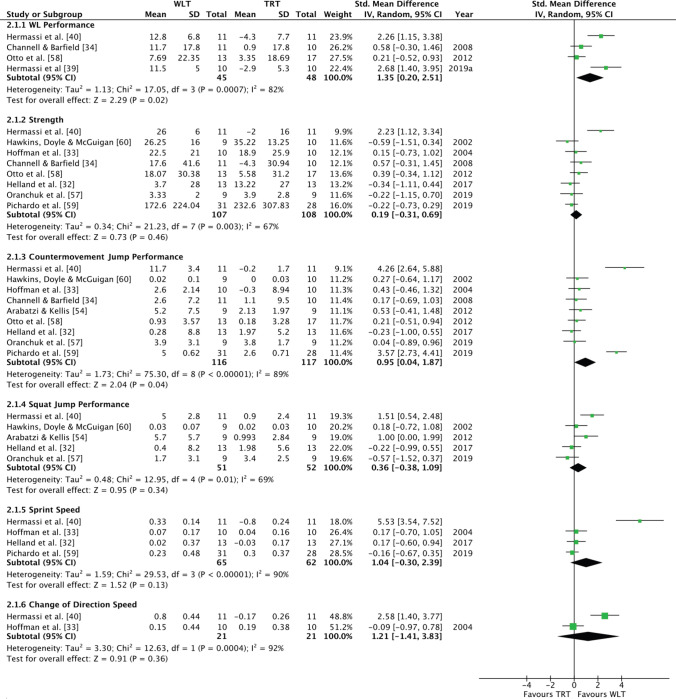
- Across 16 studies and 427 participants, WLT versus TRT produced greater improvements in weightlifting load lifted (4 studies, p = 0.02, g = 1.35; 95% CI 0.20–2.51) and CMJ height (9 studies, p = 0.00, g = 0.95; 95% CI 0.04–1.87).
- WLT versus TRT showed large but non-significant effects for linear sprint speed (4 studies, p = 0.13, g = 1.04; 95% CI −0.03 to 2.39) and change of direction speed (CODS) (2 studies, p = 0.36, g = 1.21; 95% CI −1.41 to 3.83), and no significant effect for strength (8 studies, p = 0.46, g = 0.19; 95% CI −0.31 to 0.69) or squat jump (SJ) (5 studies, p = 0.34, g = 0.36; 95% CI −0.38 to 1.09).
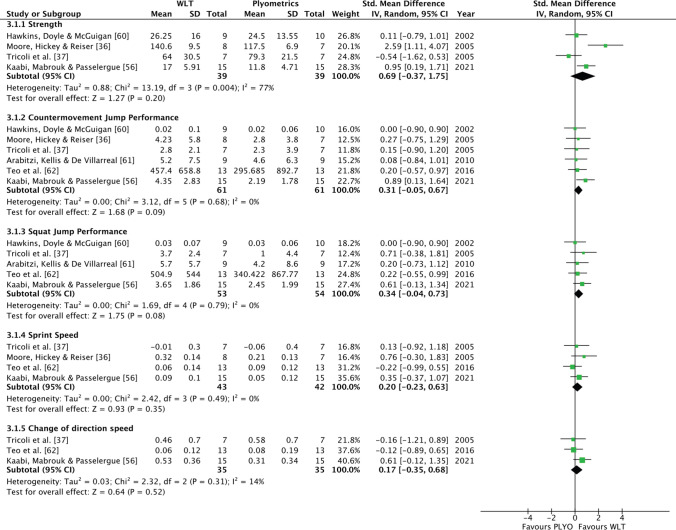
- WLT versus PLYO resulted in similar improvements, with negligible-to-moderate non-significant effects in favour of WLT for linear sprint speed (4 studies, p = 0.35, g = 0.20; 95% CI −0.23 to 0.63), CODS (3 studies, p = 0.52, g = 0.17; 95% CI −0.35 to 0.68), CMJ (6 studies, p = 0.09, g = 0.31; 95% CI −0.05 to 0.67), SJ (5 studies, p = 0.08, g = 0.34; 95% CI −0.04 to 0.73) and strength (4 studies, p = 0.20, g = 0.69; 95% CI −0.37 to 1.75).
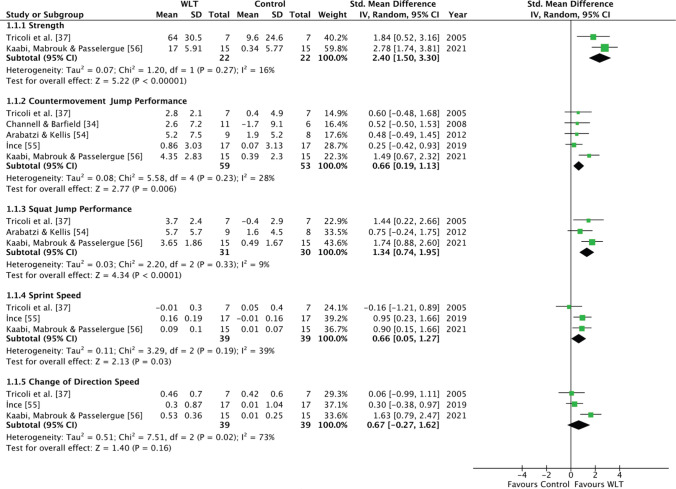
- WLT versus control showed large significant effects for strength (2 studies, p < 0.001, g = 2.40; 95% CI 1.50–3.30) and SJ (3 studies, p < 0.001, g = 1.34; 95% CI 0.74–1.95), and moderate significant effects for CMJ (5 studies, p = 0.006, g = 0.66; 95% CI 0.19–1.13) and sprint speed (3 studies, p = 0.03, g = 0.66; 95% CI 0.05–1.27).
Methods
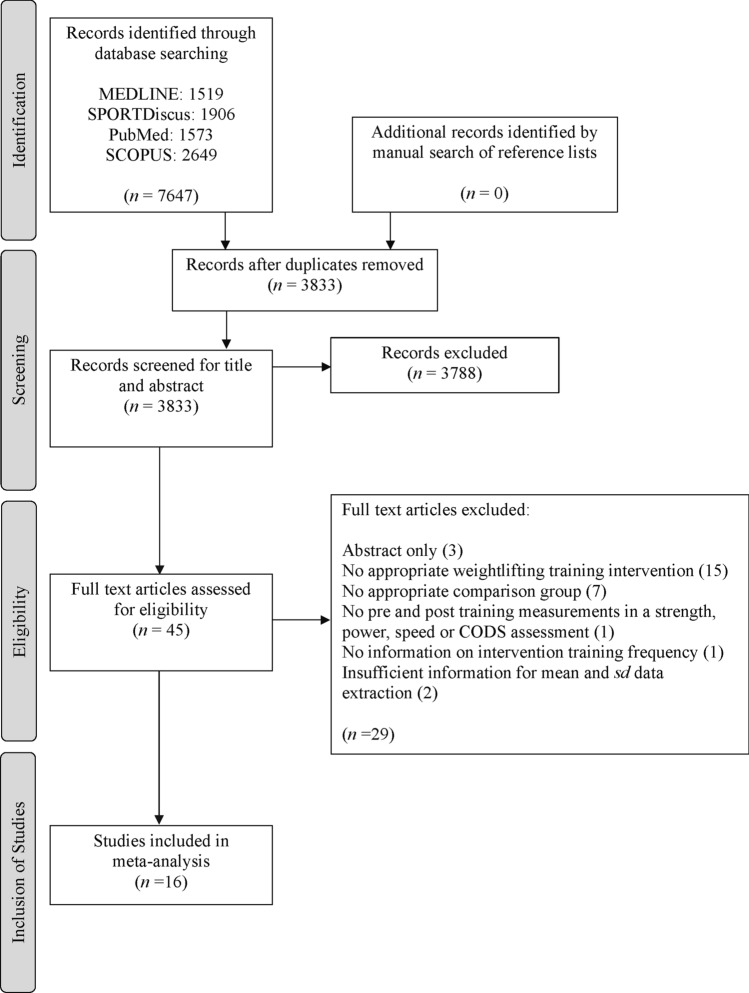
- Systematic review with meta-analysis conducted according to PRISMA 2020; four databases (MEDLINE, SPORTDiscus, PubMed, SCOPUS) were searched on 5 April 2021 for peer-reviewed studies with a WLT intervention, a TRT/PLYO/control comparison, and pre–post measures of strength, power, speed or CODS.
- Sixteen studies comprising 427 participants met inclusion criteria; WLT interventions required more than one weightlifting exercise per week and at least one per training session, with no intervention-duration exclusions.
- Means and standard deviations were converted to Hedges’ g effect sizes using an inverse-variance random-effects model (DerSimonian and Laird) in RevMan 5.4; heterogeneity was assessed with χ² and I², prediction intervals were calculated, and study quality was assessed with TESTEX.
Limitations
- The paper states high heterogeneity across included studies, particularly in WLT versus TRT comparisons (I² = 67–92% for most variables), and notes that sensitivity analysis removing fair-quality studies did not complement the primary WLT versus TRT conclusions for all outcomes.
- The paper states that most studies had small sample sizes, there were no limits on population age, maturity or sex, and training interventions lacked exclusivity because WLT programmes often included accessory strength work and some TRT programmes included kettlebell or ballistic exercises.
- The paper also acknowledges single-reviewer screening, while the text makes evident additional constraints: most participants were male, many studies were short-term (median 8 weeks; range 6–28), and several comparisons pooled only 2–5 studies.
Model-written summary. Check it against the paper before relying on it.
Integrity signals
Registry
Cites
Statistics
Figures
Verification
Claims the paper makes
5 Valid · 0 Not valid · 54 Not checked · 120 Own results and interpretations
The cited sources support only part of this claim — read each source’s verdict below.
In the paper
“This notion is supported by research that has shown SJ height to be the strongest correlate (r = 0.64) with weightlifting performance when compared with CMJ height and IMTP variables [71].”
§ Comparison of Weightlifting, Traditional Resistance Training and Plyometrics on Strength, Power and Speed: A Systematic Review with Meta-Analysis > Discussion > Weightlifting Training Versus Control Group
What the sources say
- Partly supportedcites [71] Travis SK Goodin JR Beckham GK Bazyler CD Identifying a test to monitor weightlifting performance in competitive male and female weightlifters Sports 2018 6 2 46 10.3390/sports6020046 PMC6026842 29910350 sourceExperimental — accuracy not yet measured
The Results (§3.1–3.2; page unavailable) show that squat jump height had the strongest reported correlation with Sinclair Total among the measures compared. But r = 0.642 is the countermovement jump height correlation in men, not the squat jump height correlation; the latter was r = 0.686 in men and r = 0.487 in women. (LLM, conf=0.91)
plainstates an association- Asserted: passes — The authors put it forward as true.
- Checkable: passes — It can be checked against evidence.
- Load-bearing: passes — The paper’s conclusions depend on it.
- Based: passes — The paper gives a reason why it holds.
- Partly supported
The cited sources support only part of this claim — read each source’s verdict below.
In the paper
“Since adaptations are dependent on the particular training stress applied, it is likely that the lack of exposure to high velocity movements and dissimilar accentuated regions of force in TRT alone do not provide an adequate stimulus to elicit improvements in weightlifting performance [76].”
§ Comparison of Weightlifting, Traditional Resistance Training and Plyometrics on Strength, Power and Speed: A Systematic Review with Meta-Analysis > Discussion > Weightlifting Training Versus Traditional Resistance Training
What the sources say
- Partly supportedcites [76] Behm D Sale D Velocity specificity of resistance training Sports Med 1993 15 6 374 388 10.2165/00007256-199315060-00003 8341872 sourceExperimental — accuracy not yet measured
Split into 2 atoms — 1 confirmed, 1 partially supported, 0 disputed, 0 misattributed, 0 unverifiable. Expand the claim to see per-atom verdicts.
hedgedstates a possible cause- Asserted: passes — The authors put it forward as true.
- Checkable: passes — It can be checked against evidence.
- Load-bearing: passes — The paper’s conclusions depend on it.
- Based: passes — The paper gives a reason why it holds.
- Partly supported
A result the paper reports from its own data — it cites no other source for it, so there is none to check. The quote shows it is in the paper.
In the paper
“change of direction speed (CODS) (2 studies, p = 0.36, g = 1.21; 95% CI − 1.41 to 3.83)”
§ Comparison of Weightlifting, Traditional Resistance Training and Plyometrics on Strength, Power and Speed: A Systematic Review with Meta-Analysis > Abstract > Results
plain- Asserted: passes — The authors put it forward as true.
- Checkable: passes — It can be checked against evidence.
- Load-bearing: unclear — It is unclear whether the paper’s conclusions depend on it.
- Based: passes — The paper gives a reason why it holds.
A result the paper reports from its own data — it cites no other source for it, so there is none to check. The quote shows it is in the paper.
In the paper
“CMJ (6 studies, p = 0.09, g = 0.31; 95% CI − 0.05 to 0.67)”
§ Comparison of Weightlifting, Traditional Resistance Training and Plyometrics on Strength, Power and Speed: A Systematic Review with Meta-Analysis > Abstract > Results
plain- Asserted: passes — The authors put it forward as true.
- Checkable: passes — It can be checked against evidence.
- Load-bearing: passes — The paper’s conclusions depend on it.
- Based: passes — The paper gives a reason why it holds.
A result the paper reports from its own data — it cites no other source for it, so there is none to check. The quote shows it is in the paper.
In the paper
“Sixteen studies were included in the analysis, comprising 427 participants.”
- Also stated in: § Study Characteristics · plain
“Following all screening processes, a total of 16 studies comprising 427 participants met the inclusion criteria and were used for the meta-analysis (Fig. 1).”
§ Comparison of Weightlifting, Traditional Resistance Training and Plyometrics on Strength, Power and Speed: A Systematic Review with Meta-Analysis > Abstract > Results
plainn = 427- Asserted: passes — The authors put it forward as true.
- Checkable: passes — It can be checked against evidence.
- Load-bearing: passes — The paper’s conclusions depend on it.
- Based: passes — The paper gives a reason why it holds.
- Also stated in: § Study Characteristics · plain
88 more claims
Create a free account to see all 179 claims and to verify the 98 references still open.
- It may state two separate claims as one. 48
- Probably not a substantial claim. 50
Claims other papers make about this one
Each is checked against this paper’s own text: does it say what the citing paper says it does?
In the citing paper
“There were insufficient data to determine if eccentric flywheel RT (67), Nordic hamstring RT (68), Olympic-style weightlifting (69), and unstable surface RT (70) impacted strength compared with CTRL.”
In the citing paper
“There were insufficient data to determine whether home-based RT (63) and Olympic-style weightlifting (69) impacted power compared with CTRL.”
In the citing paper
“Compared with CTRL, there were insufficient data to determine whether standard RT (48,69,161), eccentric flywheel RT (162), and velocity-based RT (66) impacted running performance compared with CTRL.”
In the citing paper
“There were insufficient data to determine if running performance was affected by eccentric flywheel RT versus standard RT (85), Olympic-style weightlifting versus standard RT (69), set structure (109), or concurrent training (123).”
In the citing paper
“In comparisons between distinct RTx, there were insufficient data to determine if agility was affected by Olympic-style weightlifting (69).”
1 more claim about this paper
Create a free account to see every claim other papers make about this one.
Self-check
Percentages, sums and reported differences re-computed from the paper’s own numbers.
Each contradiction between two passages listed here was confirmed by an independent check.
Rated minor: it would not touch a result — a value no result rests on, a p-value that stays on the same side of the significance level, or a conflict that is clerical, resolved elsewhere in the paper, or outside its own findings.
In the paper
§ Comparison of Weightlifting, Traditional Resistance Training and Plyometrics on Strength, Power and Speed: A Systematic Review with Meta-Analysis > Results > Description of Studies
“The authors of two studies failed to provide information on the training intensity prescription in relation to percentage of one repetition maximum (% 1RM) [33, 59].”
§ Comparison of Weightlifting, Traditional Resistance Training and Plyometrics on Strength, Power and Speed: A Systematic Review with Meta-Analysis > Results > Description of Studies
“WLT group: 4×/week; additional 2×/week speed and agility training; WL full lifts, WL derivatives and accessory strength; 2–5 sets of 3–10 reps; 80–95% 1RM. TRT group: 4×/week; additional 2×/week speed and agility training; squats, deadlifts, upper body pushing and pulling, calf raises, sit ups; 3–5 sets of 4–10 reps; 80–95% 1RM”
Rated minor: it would not touch a result — a value no result rests on, a p-value that stays on the same side of the significance level, or a conflict that is clerical, resolved elsewhere in the paper, or outside its own findings.
In the paper
“| Helland et al. [32] | 26, WLT group (13), free weight/TRT group (13) | 20.0 ± 3.0 | Male (n = 29) and female (n = 10),”
§ Comparison of Weightlifting, Traditional Resistance Training and Plyometrics on Strength, Power and Speed: A Systematic Review with Meta-Analysis > Results > Description of Studies
Reported 26 · recomputed 39
Rated minor: it would not touch a result — a value no result rests on, a p-value that stays on the same side of the significance level, or a conflict that is clerical, resolved elsewhere in the paper, or outside its own findings.
In the paper
“sprint speed (4 studies, p = 0.13, g = 1.04; 95% CI − 0.03 to 2.39)”
§ Comparison of Weightlifting, Traditional Resistance Training and Plyometrics on Strength, Power and Speed: A Systematic Review with Meta-Analysis > Abstract > Results
Reported 1.04 · recomputed 1.18
Citations
Cites
Measuring inconsistency in meta-analyses
Higgins, J. P. T., Thompson, S. G., Deeks, J. J., & Altman, D. G. (2003) · BMJ · doi:10.1136/bmj.327.7414.557 · Cited by 63,139
Meta-analysis in clinical trials
DerSimonian, R., & Laird, N. (1986) · Controlled Clinical Trials · doi:10.1016/0197-2456(86)90046-2 · Cited by 39,552
Borenstein, M., Hedges, L. V., Higgins, J. P. T., & Rothstein, H. R. (2009) · doi:10.1002/9780470743386 · Cited by 14,225
A basic introduction to fixed-effect and random-effects models for meta-analysis
Borenstein, M., Hedges, L. V., Higgins, J. P. T., & Rothstein, H. R. (2010) · Research Synthesis Methods · doi:10.1002/jrsm.12 · Cited by 6,793
Updating guidance for reporting systematic reviews: development of the PRISMA 2020 statement
Page, M. J., McKenzie, J. E., Bossuyt, P. M., Boutron, I., Hoffmann, T. C., Mulrow, C. D., Shamseer, L., Tetzlaff, J. M., & Moher, D. (2021) · Journal of Clinical Epidemiology · doi:10.1016/j.jclinepi.2021.02.003 · Cited by 3,490
An assessment of maturity from anthropometric measurements
MIRWALD, R. L., G. BAXTER-JONES, A. D., BAILEY, D. A., & BEUNEN, G. P. (2002) · Medicine & Science in Sports & Exercise · doi:10.1097/00005768-200204000-00020 · Cited by 2,319
Basics of meta‐analysis: I 2 is not an absolute measure of heterogeneity
Borenstein, M., Higgins, J. P. T., Hedges, L. V., & Rothstein, H. R. (2017) · Research Synthesis Methods · doi:10.1002/jrsm.1230 · Cited by 1,848
Aagaard, P., Simonsen, E. B., Andersen, J. L., Magnusson, P., & Dyhre-Poulsen, P. (2002) · Journal of Applied Physiology · doi:10.1152/japplphysiol.00283.2002 · Cited by 1,844
The Importance of Muscular Strength in Athletic Performance
Suchomel, T. J., Nimphius, S., & Stone, M. H. (2016) · Sports Medicine · doi:10.1007/s40279-016-0486-0 · Cited by 1,466
Risk factors for sports injuries — a methodological approach
Bahr, R., & Holme, I. (2003) · British Journal of Sports Medicine · doi:10.1136/bjsm.37.5.384 · Cited by 902 · cited 1×
“Furthermore, since reduced muscular strength, greater strength imbalances and slow sprint speeds are associated with increased musculoskeletal injury risk [11, 12], improvements in strength, power and speed are often desirable to help mitigate injury risk.”
Background
Research works printed but not linked: 10
- Hedges LV Olkin I Statistical methods for meta-analysis 2014 Cambridge Academic Press
- Cohen J Statistical power analysis for the behavioral sciences 1988 Hillsdale L. Erlbaum Associates
- Scherfenberg E Burns S Implementing hang cleans for the improvement of vertical jump in high school athletes J Exerc Physiol 2013 16 2 50 59
- Taylor S, Tweedie R. Trim and fill: a simple method of assessing publication bias in meta-analysis: U, Colorado preprint; 1998.
- Garhammer J Gregor R Propulsion forces as a function of intensity for weightlifting and vertical jumping J Appl Sport Sci Res 1992 6 3 129 134
- Garhammer J Biomechanical profiles of Olympic weightlifters J Appl Biomech 1985 1 2 122 130
- Baker D Using full acceleration and velocity-dependant exercises to enhance power training Strength Cond Coach 2007 15 2 16
- Garhammer J A Review of power output studies of olympic and powerlifting: methodology, performance J Strength Cond Res 1993 7 76 89
- Behm DG Neuromuscular implications and applications of resistance training J Strength Cond Res 1995 9 264 274
- McDonagh M Peterson K Raina P Chang S Shekelle P Avoiding bias in selecting studies 2013 Rockville Agency for Healthcare Research and Quality (US) 23487864
Cited by
Training Specificity for Athletes: Emphasis on Strength-Power Training: A Narrative Review
Stone, M. H., Hornsby, W. G., Suarez, D. G., Duca, M., & Pierce, K. C. (2022) · Journal of Functional Morphology and Kinesiology · doi:10.3390/jfmk7040102 · Cited by 142
Comfort, P., Haff, G. G., Suchomel, T. J., Soriano, M. A., Pierce, K. C., Hornsby, W. G., Haff, E. E., Sommerfield, L. M., Chavda, S., Morris, S. J., et al. (2023) · The Journal of Strength and Conditioning Research · doi:10.1519/jsc.0000000000004476 · Cited by 84
Self-citationWang, X., Lv, C., Qin, X., Ji, S., & Dong, D. (2023) · Frontiers in Physiology · doi:10.3389/fphys.2022.1061110 · Cited by 106
“However, does CT improve explosive power better than PLT? PLT and CT have better effects on the improvement of explosive power than TR (Behm et al., 2017; Pardos-Mainer et al., 2021; Morris et al., 2022).”
BackgroundCURRIER, B. S., D’SOUZA, A. C., SINGH, M. A. F., LOWISZ, C. V., RAWSON, E. S., SCHOENFELD, B. J., SMITH-RYAN, A. E., STEEN, J. P., THOMAS, G. A., TRIPLETT, N. T., et al. (2026) · Medicine & Science in Sports & Exercise · doi:10.1249/mss.0000000000003897 · Cited by 105
“Compared with CTRL, there were insufficient data to determine whether standard RT (48,69,161), eccentric flywheel RT (162), and velocity-based RT (66) impacted running performance compared with CTRL.”
Hung, C.-H., Su, C.-H., & Wang, D. (2025) · Life · doi:10.3390/life15040657 · Cited by 90
“Alternating heavy resistance and explosive HIIT drills can also amplify post-activation potentiation (PAP), boosting force output and acceleration [59].”
Makaruk, H., Starzak, M., Tarkowski, P., Sadowski, J., & Winchester, J. B. (2024) · Journal of Human Kinetics · doi:10.5114/jhk/185877 · Cited by 60
“This training method encompasses a wide range of tools, including free weights, machines, resistance bands, plyometrics, resisted sprint training, core stability exercises, and bodyweight exercises (Loturco et al., 2023b; Morris et al., 2022; Stone et al., 2000).”
MethodDeng, N., Soh, K. G., Abdullah, B., & Huang, D. (2023) · PeerJ · doi:10.7717/peerj.16638 · Cited by 50
Not Another Caffeine Effect on Sports Performance Study—Nothing New or More to Do?
Tallis, J. A., Guimarães‐Ferreira, L., & Clarke, N. D. (2022) · Nutrients · doi:10.3390/nu14214696 · Cited by 31
“Furthermore, in most cases, such approaches are not representative of more complex strength and power training regimes adopted by athletes [114].”
BackgroundDeng, N., Soh, K. G., Abdullah, B., Huang, D., Sun, H., & Xiao, W. (2023) · Frontiers in Physiology · doi:10.3389/fphys.2023.1234114 · Cited by 40
Suchomel, T. J., Techmanski, B. S., Kissick, C. R., & Comfort, P. (2023) · Journal of Functional Morphology and Kinesiology · doi:10.3390/jfmk8010035 · Cited by 19
“Researchers have concluded that weightlifting movements and their derivatives may provide greater strength, power, and speed adaptations compared to other methods of training [1], especially when added to traditional resistance training programs [2].”
BackgroundUnilateral plyometric training effectively reduces lower limb asymmetry in athletes: a meta-analysis
Sun, W., Li, H., Qu, L., Zhou, Y., Cao, X., Wang, K., & Ke, L. (2025) · Frontiers in Physiology · doi:10.3389/fphys.2025.1551523 · Cited by 25
Effects of Different Hangboard Training Intensities on Finger Grip Strength, Stamina, and Endurance
Devise, M., Lechaptois, C., Berton, É., & Vigouroux, L. (2022) · Frontiers in Sports and Active Living · doi:10.3389/fspor.2022.862782 · Cited by 27
“First, the 4-week training interval could be considered as short in comparison to non-climbing specific studies on force development which claim effects after 8 weeks (Morris et al., 2022).”
BackgroundPhysical and Physiological Characteristics of Elite CrossFit Athletes
Sauvé, B., Haugan, M., & Paulsen, G. (2024) · Sports · doi:10.3390/sports12060162 · Cited by 28
Putera, S. H. P., Setijono, H., Wiriawan, O., Nurhasan, N., Muhammad, H. N., Hariyanto, A., Sholikhah, A. M., & Pranoto, A. (2023) · Physical Education Theory and Methodology · doi:10.17309/tmfv.2023.1.06 · Cited by 33
Hu, Z., Liu, Y., Huang, K., Huang, H., Li, F., & Yuan, X. (2024) · Life · doi:10.3390/life14070908 · Cited by 22
Loturco, I., Zabaloy, S., Pereira, L. A., Moura, T. B. M. A., Mercer, V. P., Fernandes, V. M. C., Zając, A., Matusiński, A., Freitas, T. T., & Bishop, C. J. (2024) · Journal of Human Kinetics · doi:10.5114/jhk/182888 · Cited by 17
Ma, S., Xu, Y., & Xu, S. (2025) · Journal of Sports Science and Medicine · doi:10.52082/jssm.2025.236 · Cited by 27
“Plyometric training primarily enhances explosive power but may not sufficiently increase maximal muscle strength, which resistance training effectively promotes (Morris et al., 2022).”
Moreno-Azze, A., Lucas, E. P., Soñén, D. F., de la Fuente, F. P., & Miguel, D. F. (2023) · Sports · doi:10.3390/sports12010001 · Cited by 20
“In relation to injury prevention, plyometric training is considered a suitable type of exercise to work on muscular strength and especially lower limb power [43], thereby reducing asymmetries and, thus, the risk of injury [44].”
BackgroundInfluentialBerton, R. P. D. B., da Silva, D. D., dos Santos, M. L., Silva, C. M. P. E., & Tricoli, V. (2022) · PLoS ONE · doi:10.1371/journal.pone.0274962 · Cited by 17
Muller, M. R., Lemes, Í. R., Silva, M. S. D. C., Silva, N. S., Hernández, A. G. M., & Pinto, R. Z. (2023) · Physical Therapy in Sport · doi:10.1016/j.ptsp.2023.09.010 · Cited by 15
Yuan, Q., Deng, N., & Soh, K. G. (2025) · BMC Sports Science Medicine and Rehabilitation · doi:10.1186/s13102-025-01059-9 · Cited by 32
“Some researchers have recommended integrating weightlifting, plyometrics, and traditional resistance training into a periodized training plan [92].”
Rong, W., Soh, K. G., Samsudin, S., Zhao, Y., Wang, X., Zhang, X., & Cao, L. (2025) · BMC Sports Science Medicine and Rehabilitation · doi:10.1186/s13102-025-01249-5 · Cited by 21
Bu, X. (2022) · Journal of Environmental and Public Health · doi:10.1155/2022/5912231 · Cited by 10
“In order to clarify the level of punching power of the athlete, a comb-shaped shorttailed 18-mm resistive pressure-sensitive sensor was used and the sensor was fixed to the boxing glove, which in turn enabled the measurement of punching power [8].”
MethodAntunes, J. P., Oliveira, R. F. S., Reis, V. M., Romero, F., Moutão, J. M. R. P., & Brito, J. P. (2022) · Healthcare · doi:10.3390/healthcare10122499 · Cited by 13
“High-power outputs and the rate of force development expressed in weightlifting movements and derivatives [2], in conjunction with the motor control and coordination demands on the trunk and lower body muscles to stabilize and transmit forces [26], can effectively impact and compromise various aspects of an athlete’s…”
BackgroundCrenshaw, K., Zeppieri, G., Hung, C., Schmitfranz, T., McCall, P. C., Castellini, G., Gianola, S., & Pozzi, F. (2023) · International Journal of Sports Medicine · doi:10.1055/a-2161-4867 · Cited by 11
“Morris et al. [14] showed that different training regimens could impact sprint per - formance differently.”
BackgroundVelocity-Based Training With Weightlifting Derivatives: Barbell and System Velocity Comparisons
Suchomel, T. J., Kissick, C. R., Techmanski, B. S., Mann, J. B., & Comfort, P. (2024) · The Journal of Strength and Conditioning Research · doi:10.1519/jsc.0000000000004962 · Cited by 11
“Researchers have shown that training with weightlifting movements may produce superior strength-power adaptations compared with traditional resistance training exercises (1,22), jump training (22), and kettlebell training (23).”
Dong, K., Jeong, G.-Y., & Chun, B. (2022) · Applied Sciences · doi:10.3390/app13010446 · Cited by 12
“In a comparison of the effects of weightlifting resistance training and plyometric training on players’ speed abilities, the magnitude of the improvement was similar [23].”
Countermovement Jump Peak Power Changes with Age in Masters Weightlifters
Riemann, B. L., Johnson, M., Helms, M. K., Hatchett, A. G., Vondrasek, J. D., Watts, C. Q., & Huebner, M. (2024) · Sports · doi:10.3390/sports12090259 · Cited by 8
“This was an unexpected finding given the benefits of weightlifting on CMJ performance in young adults [64].”
BackgroundRicart-Luna, B., Domínguez‐Navarro, F., Gené‐Morales, J., Colado, J. C., Juesas, Á., Portes, R., & Chulvi‐Medrano, I. (2025) · Journal of Sports Sciences · doi:10.1080/02640414.2025.2469023 · Cited by 11
“Most of the existing literature also suggests non-significant differences between plyometric and weightlifting training (Berton et al., 2018; Morris et al., 2022), both proving more effective than moderate-load strength training in improving performance-related parameters or strength values…”
Does Maximum Strength Predict Rowing Performance in Elite Female Rowers?
Behm, S., Jacobs, M. W., & Schumann, M. (2025) · International Journal of Sports Physiology and Performance · doi:10.1123/ijspp.2024-0313 · Cited by 10
Abad, C. C. C., Lopes, M. W. R., Lara, J. P. R., Oliveira, A. J. S., da Silva, R. P. C., Facin, E. A., Izar, A. J., & Teixeira, F. G. (2022) · International Journal of Environmental Research and Public Health · doi:10.3390/ijerph192416420 · Cited by 10
“This finding is in agreement with recent meta-analytical studies suggesting that weightlifting and plyometric training are better strategies to improve jumping performance [81].”
ResultSudirman, R., Mashud, M., Benny Aprial, M., Tahapary, J. M., Gunawan, G., Samodra, Y. T. J., Wati, I. D. P., Suryadi, D., Arifin, R., & Nawir, N. (2023) · Retos · doi:10.47197/retos.v52.101330 · Cited by 7
“This approach results in a substantial improvement in explosive power compared to traditional weight training methods (Behm et al., 2017; Morris, Oliver, Pedley, Haff, & Lloyd, 2022; Pardos-Mainer, Lozano, Torrontegui-Duarte, Cartón-Llorente, & Roso-Moliner, 2021).”
ResultRyoo, H., Cho, S. K.-W., Oh, T., Kim, Y., & Suh, S. (2024) · Frontiers in Physiology · doi:10.3389/fphys.2024.1344340 · Cited by 9
Resistance Training before, during, and after COVID-19 Infection: What Have We Learned So Far?
Gentil, P., de Lira, C. A. B., Vieira, C. A., Ramírez‐Campillo, R., Haghighi, A. H., Clemente, F. M., & Souza, D. (2022) · International Journal of Environmental Research and Public Health · doi:10.3390/ijerph19106323 · Cited by 8
“For example, previous studies have shown that bodyweight exercises [66–68], stationary bike training [69], plyometric training [70], elastic band training [71–73], and even exercises with no external load [74–76] promote similar responses to traditional RT.”
BackgroundVigouroux, L., & Devise, M. (2024) · Bioengineering · doi:10.3390/bioengineering11010085 · Cited by 10
Thapa, R. K., Bagchi, A., Uysal, H. Ş., Talukdar, K., Afonso, J. R., & Ramírez‐Campillo, R. (2026) · Sports Medicine · doi:10.1007/s40279-026-02395-7 · Cited by 6
“These findings reinforce the fact that although ballistic training may improve 1RM strength, a combined training approach, such as complex training, can induce greater benefits compared with ballistic training alone, as suggested in previous studies [19, 75, 76].”
Warneke, K., Freundorfer, P., Plöschberger, G., Behm, D. G., Konrad, A., & Schmidt, T. (2024) · Frontiers in Physiology · doi:10.3389/fphys.2024.1372689 · Cited by 14
Chen, Y., Tulhongjiang, M., Ling, T., Feng, X., Mi, J., & Liu, R. (2025) · PeerJ · doi:10.7717/peerj.18971 · Cited by 12
Ozdamar, S., Agopyan, A., & Uzun, S. (2024) · Isokinetics and Exercise Science · doi:10.3233/ies-230001 · Cited by 7
Huang, J., Hortobágyi, T., Dos’Santos, T., Shi, Y., Que, Y., Lin, J., Su, Y., & Li, W. (2024) · PeerJ · doi:10.7717/peerj.18047 · Cited by 10
Statistical power analysis in exercise science
Uehata, A., & Rein, R. (2025) · Journal of Sports Sciences · doi:10.1080/02640414.2025.2571841 · Cited by 7
Wang, S., Zhen, J., & Xiao, T. (2025) · Frontiers in Physiology · doi:10.3389/fphys.2025.1637520 · Cited by 4
Zhang, F., Liu, Y., Liu, J., Єременко, О. А., & Shi, L. (2026) · Frontiers in Physiology · doi:10.3389/fphys.2026.1760239 · Cited by 11
Evidence-Driven Approaches to Developing Specific Strength in the First Pull: A Narrative Review
Joffe, S. A., Chavda, S., Sorensen, A., & Comfort, P. (2024) · Strength and conditioning journal · doi:10.1519/ssc.0000000000000874 · Cited by 3
Geisler, S., Havers, T., Isenmann, E., Schulze, J., Lourens, L. K., Nowak, J., Held, S., & Haff, G. G. (2023) · Journal of Sports Science and Medicine · doi:10.52082/jssm.2023.778 · Cited by 5
“This movement pattern may improve the transferability of training effects to the execution of jumps, sprints and change of direction performance in real sports scenarios (Garhammer and Gregor, 1992; Hori et al., 2008; Morris et al., 2022).”
BackgroundSelf-citationOrduña-Borraz, E., Mainer-Pardos, E., Marco-Contreras, L. A., & Lozano, D. (2024) · Sustainability · doi:10.3390/su16031182 · Cited by 4
Kinetics and Kinematics of the Push Press, Push Jerk, and Split Jerk
Soriano, M. A., Jiménez-Ormeño, E., Lake, J. P., McMahon, J. J., Gallo–Salazar, C., Mundy, P. D., & Comfort, P. (2024) · The Journal of Strength and Conditioning Research · doi:10.1519/jsc.0000000000004810 · Cited by 4
“It is well documented that using these weightlifting exercises can enhance athlete maximum force and power development (5,22,32,33).”
Longakit, J. C., Aque, F. J., Toring-Aque, L., Lobo, J., Ayubi, N., Mamon, R., Coming, L., Padilla, D. K., Mondido, C. A., Sinag, J. M. D., et al. (2025) · Pedagogy of Physical Culture and Sports · doi:10.15561/26649837.2025.0202 · Cited by 3
“Moreover, various studies indicate that athletes participating in plyometric training exhibit significant enhancements in explosive power, correlating with elevated performance levels in competitions [10, 11, 12].”
de Dios-Álvarez, V., Rey, E., Padrón-Cabo, A., & Castellano, J. (2025) · Journal of Sports Science and Medicine · doi:10.52082/jssm.2025.351 · Cited by 6
“Various resistance training methods have been employed to enhance athletic performance, including eccen-tric-overload training (EOT) (Morris et al., 2022).”
Analysis of Lumbar Joint Movement and Dynamics of Weightlifters
Xiao, L. (2025) · Applied Bionics and Biomechanics · doi:10.1155/abb/3678401 · Cited by 2
“Since the fi rst modern Olympic Games in 1896, weightlifting has been listed as an of fi cial competition event, and its position in sports competition is self-evident [1, 2].”
Maximizing Adaptations in Concurrent Training: An Umbrella Review of Meta-analyses
Held, S., Wolf, L., Rappelt, L., Bloch, W., Donath, L., Micke, F., Geisler, S., & Isenmann, E. (2026) · Sports Medicine · doi:10.1007/s40279-026-02401-y · Cited by 3
“Since power training demands the fastest possible muscular contractions, weightlifting training appears to be superior to traditional strength training in developing power [204].”
Villanueva-Guerrero, Ó., Travassos, B. F. R., Nobarı, H., Albalad-Aiguabella, R., & Mainer-Pardos, E. (2026) · Journal of Functional Morphology and Kinesiology · doi:10.3390/jfmk11020170 · Cited by 5
Roberts, M. D., Bamman, M. M., Hornberger, T. A., Mackey, A. L., Derave, W., Atherton, P. J., Phillips, S. M., Schoenfeld, B. J., Nader, G. A., Hecksteden, A., et al. (2026) · Journal of Applied Physiology · doi:10.1152/japplphysiol.00289.2026 · Cited by 3
Masters sprinters: Less is more
Rebollar, R. E., & Palacios, M. V. G. (2023) · Scientific Journal of Sport and Performance · doi:10.55860/tdfe8017 · Cited by 7
“Horizontal jumps (especially unilateral exercises) appear to provide 20-25% more peak power (especially in the ankles) and greater transfer to sprinting than vertical jumps, but they also generate greater joint stress and should therefore be limited (Suchomel et al., 2018; Morris et al., 2022; Lievens et al., 2021; Wa…”
BackgroundMashud, M., Aryadi, D., Wulandari, A., Suryadi, D., Suharto, T. H., Arini, I., Widiastuti, Samodra, Y. T. J., Sudirman, R., & Rahmat, A. (2024) · SPORT TK-Revista EuroAmericana de Ciencias del Deporte · doi:10.6018/sportk.573141 · Cited by 6
“Other speculative evidence is more convincing that inter-plyometric exercise and complex training are excellent for explosive power increases if both are compared to weight training (Behm et al., 2017; Morris et al., 2022; Pardos-Mainer et al., 2021).”
BackgroundVeršić, Š. (2023) · Studia sportiva · doi:10.5817/sts2023-1-4 · Cited by 4
Rader, E. P., McKinstry, K. A., & Baker, B. A. (2024) · Physiological Reports · doi:10.14814/phy2.70027 · Cited by 1
“Such SSCs are relevant since activities such as plyometrics have been promoted as a viable alternative to slower SSCs (such as in traditional resistance training) for inducing muscle adaptation (Grgic et al., 2021; MacDonald et al., 2012; Morris et al., 2022).”
BackgroundComment on: “Effects of Plyometric Training on Physical Performance: An Umbrella Review”
Ramírez‐Campillo, R., Afonso, J. R., Moran, J., Behm, D. G., & Granacher, U. (2023) · Sports Medicine - Open · doi:10.1186/s40798-023-00595-3 · Cited by 5
Analysis of Training Optimization Strategy Based on Adaptive Hierarchical Genetic Algorithm
Feng, X., Wen, J., & Fu, F. (2024) · International Conference on Computational Intelligence and Communication Networks (CICN) · doi:10.1109/cicn63059.2024.10847525 · Cited by 1
Plyometric Training in Musculoskeletal Disorders: A Scoping Review
Ballerini, S., Schneebeli, A., & New, K. J. (2025) · Clinical Journal of Sport Medicine · doi:10.1097/jsm.0000000000001375 · Cited by 2
Çar, B., Kurtoğlu, A., Atar, Ö., Türkmen, M., Eken, Ö., Söyler, M., & Aldhahi, M. I. (2025) · Scientific Reports · doi:10.1038/s41598-025-11429-5 · Cited by 1
Zhu, X., Luo, H., Xiang, C., Zhao, J., Liu, Y., Zhang, H., & Kamalden, T. F. T. (2025) · BMC Sports Science Medicine and Rehabilitation · doi:10.1186/s13102-025-01412-y · Cited by 5
“This improvement occurs because ST can increase the cross-sectional area of muscles, which directly enhances the capacity to generate strength [113].”
Roderick, K., Comfort, P., Suchomel, T. J., Swinton, P. A., & Schoenfeld, B. J. (2025) · The Journal of Strength and Conditioning Research · doi:10.1519/jsc.0000000000005304 · Cited by 1
Qu, W., Lu, D., Sun, X., Sun, J., He, J., Song, W., & Li, D. (2026) · BMC Sports Science Medicine and Rehabilitation · doi:10.1186/s13102-025-01403-z · Cited by 2
“Traditional resistance training (TRT) is a method that enhances muscle strength by counteracting external resistance [8], effectively improving neuromuscular adaptation or muscle cross-sectional area.”
Wood, T., Creaby, M. W., Nicholson, V., Cowley, N., Hebron, I., Schultz, L., Timmins, R. G., Brennan, T. R., & Weakley, J. J. S. (2026) · The Journal of Strength and Conditioning Research · doi:10.1519/jsc.0000000000005376 · Cited by 1
Pillitteri, G., Clemente, F. M., Moran, J., Oliveira, R., Silva, R. M., Sarmento, H., Puleo, G., Bongiovanni, T., Petrucci, M., Fernandez, A. R., et al. (2026) · International Journal of Sports Science & Coaching · doi:10.1177/17479541261441429 · Cited by 1
Virtual-Based Aquatic Plyometric Training: How it Effects Lower Extremity Muscle Strength?
Simanjuntak, V., Setiawan, E., Yanti, N., Isnaini, L. M. Y., & Winarno, M. E. (2023) · Central European Journal of Sport Sciences and Medicine · doi:10.18276/cej.2023.4-08 · Cited by 2
Cui, J., Liu, Y., He, F., & Bu, Y. (2024) · The Journal of Sports Medicine and Physical Fitness · doi:10.23736/s0022-4707.24.15819-7 · Cited by 6
Chivate, D., Chakkalathy, S., & Motimath, B. (2024) · Comparative Exercise Physiology · doi:10.1163/17552559-00001066 · Cited by 2
Samsudin, S., Salihan, S., & Kasim, M. F. M. (2025) · International Journal of Academic Research in Progressive Education and Development · doi:10.6007/ijarped/v14-i1/23408 · Cited by 5
The Effect of Load on Subphase Analysis During the Hang Pull
Meechan, D., McErlain‐Naylor, S. A., Phua, J. P., & Comfort, P. (2025) · The Journal of Strength and Conditioning Research · doi:10.1519/jsc.0000000000005121 · Cited by 1
Enhancing clarity and methodological rigor in umbrella reviews
Abdullah, A., Saeed, H., & Ahmad, M. H. (2024) · Annals of Medicine and Surgery · doi:10.1097/ms9.0000000000002536 · Cited by 4
Yılmaz, H. H., SEREN, K., & Atasever, G. (2023) · Akdeniz Spor Bilimleri Dergisi · doi:10.38021/asbid.1295985
Ebrahimi, S., Rostami, M. A., Gholami, M., Dickinson, J. W., Bakhshi, M., & Ahmadi, A. (2023) · Health Nexus · doi:10.61838/kman.hn.1.2.2
An association of speed performance with bone mineral density in national-level Kho-Kho players
Kalpana, K., Khanna, G. L., & Bhati, P. (2023) · Malaysian Journal of Movement Health & Exercise · doi:10.4103/mohe.mohe_23_23 · Cited by 2
Effect of Plyometrics on Bone Mineral Density in Young Adults: A Systematic Review and Meta-Analysis
Rodricks, N., Deccy, S., Louis, M. E. S., Quintero, D., Ramirez, J., & Paultre, K. J. (2024) · Translational Journal of the American College of Sports Medicine · doi:10.1249/tjx.0000000000000242 · Cited by 2
“In addition, jumping was shown to provide good strength benefits as previously documented in the literature (28,30).”
Kissick, C. R., Techmanski, B. S., Comfort, P., & Suchomel, T. J. (2024) · The Journal of Strength and Conditioning Research · doi:10.1519/jsc.0000000000005004
“Weightlifting movements (e.g., snatch and clean and jerk) and their derivatives have been shown to provide a superior strength-power stimulus compared with traditional resistance training (e.g., squats, presses, and pulls) (33), jump training (58), and kettlebell training (34).”
The Impact of Resistance Training on Mental Health: Neuropsychological and Behavioral Functioning
Hattabi, S., Fadhlaoui, H., Hammami, N., Forte, P. M., Sortwell, A., & Branquinho, L. (2024) · IntechOpen eBooks · doi:10.5772/intechopen.1008261 · Cited by 1
Effects of static and dynamic stretching techniques on muscle function
Nakamura, K., Nakano, S., & Tsuchikawa, D. (2025) · Journal of Physical Therapy Science · doi:10.1589/jpts.37.112
Syed, A. A. S., & James, J. D. M. (2025) · Physical Education Theory and Methodology · doi:10.17309/tmfv.2025.4.14
Ali, I., Shakir, L., Abrar, S. U., Ilyas, H., Khan, I., & Orakzai, S. (2025) · The Healer Journal of Physiotherapy and Rehabilitation Sciences · doi:10.55735/pmvprv35
Sakinepoor, A., Degens, H., Ghobadi, A., & Mazidi, M. (2025) · Journal of Bodywork and Movement Therapies · doi:10.1016/j.jbmt.2025.09.016
Sobko, I. N., Yefimenko, O., & Podmaryova, I. (2025) · Health-saving technologies rehabilitation and physical therapy · doi:10.58962/hstrpt.267
Tokay, B., & Görücü, A. (2026) · BMC Sports Science Medicine and Rehabilitation · doi:10.1186/s13102-026-01591-2
Moreno-Azze, A., López-Plaza, D., Miguel, D. F., & Gómez-Carmona, C. D. (2026) · The Journal of Strength and Conditioning Research · doi:10.1519/jsc.0000000000005419
Aldaz, D. G. A., Rodríguez, C. J. O., Chávez-Robles, T., & Rubio, R. J. F. (2026) · Revista Mexicana de Ciencias de la Cultura Física · doi:10.54167/rmccf.v6i12.2236
Zeng, Y., Wang, X., Soh, K. G., Ma, S., Zhao, Y., Rong, W., Zhang, X., & Wei, N. (2026) · Frontiers in Physiology · doi:10.3389/fphys.2026.1754825 · Cited by 1
The Effectiveness of Plyometric Training on Agility and Speed of U-15 Badminton Athletes
Nugroho, N. T., & Suratman, S. (2025) · COMPETITOR Jurnal Pendidikan Kepelatihan Olahraga · doi:10.26858/cpjok.v17i2.58 · Cited by 1
Li, G., Shen, Y., Lin, J., & Li, W. (2026) · BMC Sports Science Medicine and Rehabilitation · doi:10.1186/s13102-026-01567-2
“Resistance training has been proven as an effective strategy to enhance vertical jump performance in populations with varied training backgrounds [22, 35, 36].”
Tokay, B., Özbay, E., Erdağı, K., & Işık, B. (2026) · Turkish Journal of Kinesiology · doi:10.31459/turkjkin.1923135
High-Intensity Exercise Performance as a Complex Adaptive System: An Integrative Review
Alkasasbeh, W. J., Amawi, A. T., & Grivas, G. V. (2026) · Muscles · doi:10.3390/muscles5030053 · Cited by 1
“In addition to strength and power, resistance and plyometric training improve neuromuscular efficiency, allowing for more effective force production with reduced energy cost [2,103,111].”
The effects of 8-week wearable resistance training on neuromuscular adaptations in soccer players
Tang, B., Hou, M., & Yang, R. (2026) · Frontiers in Physiology · doi:10.3389/fphys.2026.1828654
Jalalimehr, H., & Molla, R. Y. (2026) · Sport Sciences for Health · doi:10.1007/s11332-026-01892-6
Zhang, Z., Liu, C., Liu, T., & Xie, Y. (2026) · PLoS ONE · doi:10.1371/journal.pone.0354592
“One possible explanation is that the sprinting and jumping components of HIICT provided more specific stimuli for rapid force production and high-velocity movement coordination. improve strength, power, and speed-related qualities [29,30].”
Murugan, S., Rajkumar, N. C. J., Mizushima, J., Rana, P., S., A., Thekkan, N., & Sanjaykumar, S. (2026) · Health sport rehabilitation · doi:10.58962/hsr.1394
Cui, J., He, F., & Liu, Y. (2026) · Complementary Therapies in Medicine · doi:10.1016/j.ctim.2026.103422
Triplett, N. T. (2026) · ACSMʼs Health & Fitness Journal · doi:10.1249/fit.0000000000001191
Bennett, H. (2026) · International Journal of Sports Science & Coaching · doi:10.1177/17479541261479440
Schlegel, P., & Bozděch, M. (2026) · Journal of Kinesiology and Exercise Sciences · doi:10.5604/01.3001.0055.9064
Hanusch, K., & Winteler, B. (2026) · MSK – Muskuloskelettale Physiotherapie · doi:10.1055/a-2878-1605 · Cited by 1
Metadata
- Authors
- Morris, S. J., Oliver, J. L., Pedley, J. S., Haff, G. G., & Lloyd, R. S.
- Affiliations
- Cardiff Metropolitan University (GB)
- Auckland University of Technology (NZ)
- Edith Cowan University (AU)
- Waikato Institute of Technology (NZ)
- Corresponding author
- Morris, Stephanie J.
- ORCID
- Morris, Stephanie J.
- Venue
- Sports Medicine
- Published
- 2022-01-13
- Volume
- 52
- Issue
- 7
- Pages
- 1533-1554
- ISSN
- 0112-1642 (ISSN-L)
- 1179-2035
- PMC
- PMC9213388
- OpenAlex
- W4206360360
- Cited by
- 103
- References
- 92
- Citations by year
- 2026: 27 · 2025: 25 · 2024: 23 · 2023: 19 · 2022: 9
- FWCI
- 4.17
- Type
- journal article
- Language
- en
- Open access
- hybrid
- doi.org
- Licence
- cc-by
- creativecommons.org/licenses/by/4.0 (tdm)
- creativecommons.org/licenses/by/4.0 (vor)
- Locations
- Sports Medicine (publishedVersion, cc-by)
- PubMed Central (publishedVersion, cc-by)
- PubMed (publishedVersion)
- University of Salford Institutional Repository (University of Salford) (submittedVersion, cc-by)
- Australasian Journal of Paramedicine (submittedVersion, cc-by)
- Figshare (submittedVersion, cc-by)
- Topics
- Health Sciences › Medicine › Orthopedics and Sports Medicine › Sports Performance and Training
- Health Sciences › Health Professions › Physical Therapy, Sports Therapy and Rehabilitation › Physical Education and Training Studies
- Health Sciences › Health Professions › Physical Therapy, Sports Therapy and Rehabilitation › Sports and Physical Education Research
- Keywords
- weightlifting training, traditional resistance training, plyometric training, muscle strength, power, sprint speed, change of direction speed, countermovement jump, training method comparison, effect size comparison, risk of bias, risk of bias assessment
- MeSH terms
- Humans, Weight Lifting, Muscle Strength, Athletic Performance, Resistance Training, Athletes, Plyometric Exercise
About these checks
Registry, retraction, Cites and statistics results are computed, not judged, with one exception: a printed reference that no index lists is read once by a model before it counts as a citation error. Claims are extracted by a model and kept only when their quote appears verbatim in the text; each cited source is then checked, with a model’s help, for whether it says what the claim relies on. Those verdicts can be wrong — read the claim’s quote and the cited source before relying on one.
The claim verdicts this report counts are experimental: their accuracy is not yet measured.
A language model drew the claims from the paper on 2026-10-05, under version 3 of the claim definition (model deepseek-v4.1-flash, prompt extract-v3).
A second model labelled each claim on 2026-10-05 (model jev-1.13-20260917, definition revision gold-guideline-v0.2).
Cited sources are checked with a language model’s help (gpt-6-sol).
Statistics and arithmetic are recomputed, not judged.
Confidence bands are shown only for fields calibrated on our annotated test set. None is calibrated yet, so no band is shown.
What counts as a claim ›How we measure confidence ›How we check this ›
Are you an author, or do you see a problem with this page? Request a review
Data sources
Bibliographic data: Semantic Scholar, OpenAlex, Crossref.
Contains information from the Semantic Scholar Academic Graph Datasets, made available under the ODC Attribution License (ODC-BY 1.0).
Semantic Scholar’s data is described in: Kinney, R., et al. (2023). The Semantic Scholar Open Data Platform. arXiv:2301.10140.
