

The DOI matches its Crossref record; 1 of the 1 references it cites were found in a registry or an index.
Evaluation of the antibacterial activity of Enamelast® and Fluor defender® fluoride varnishes against Streptococcus mutans biofilm: an in vitro study in primary teeth
Abstract
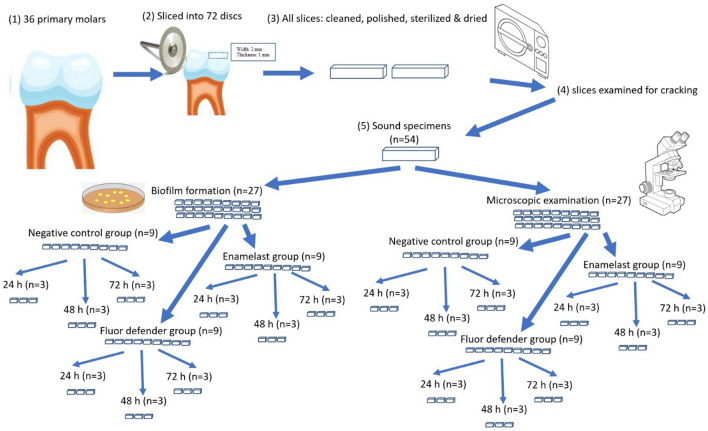
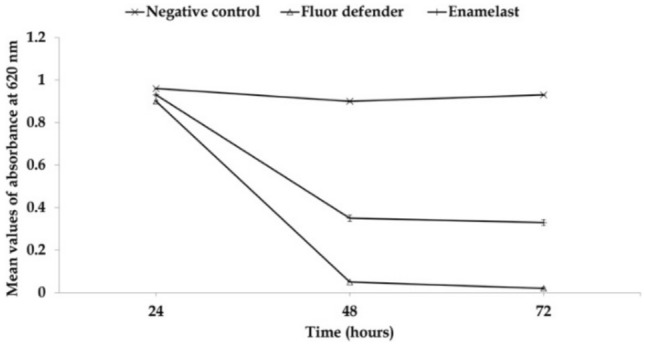
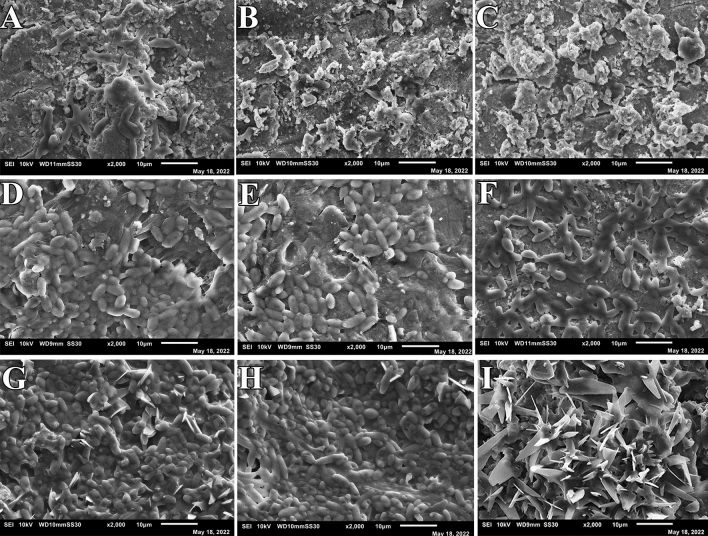
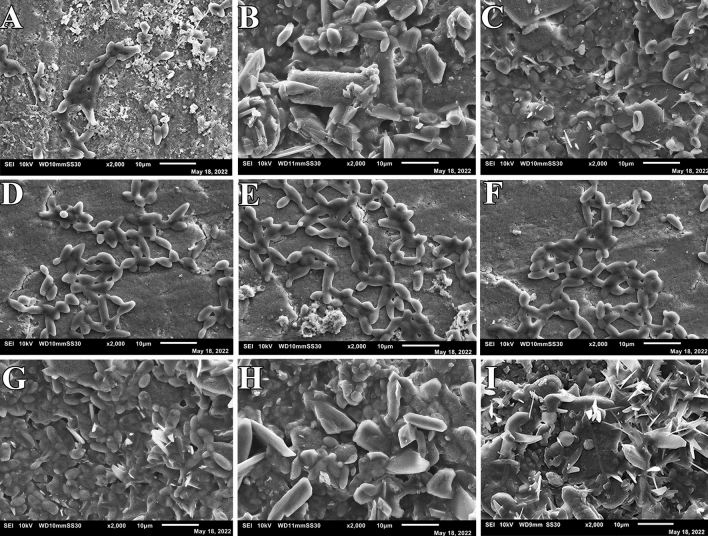
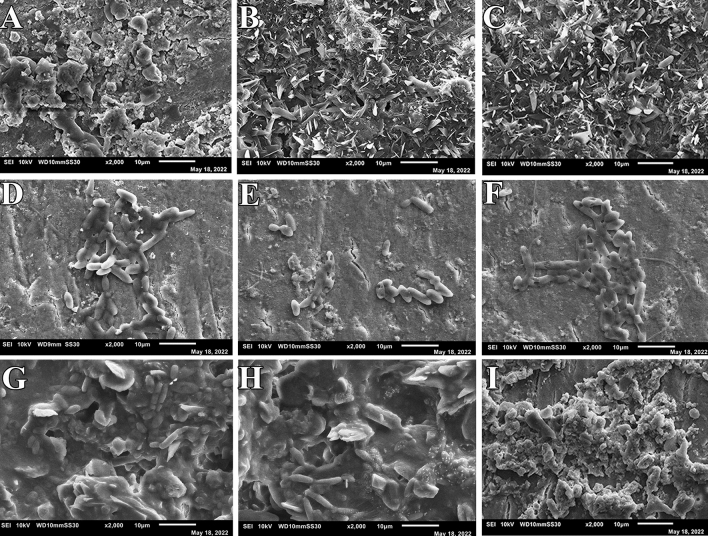
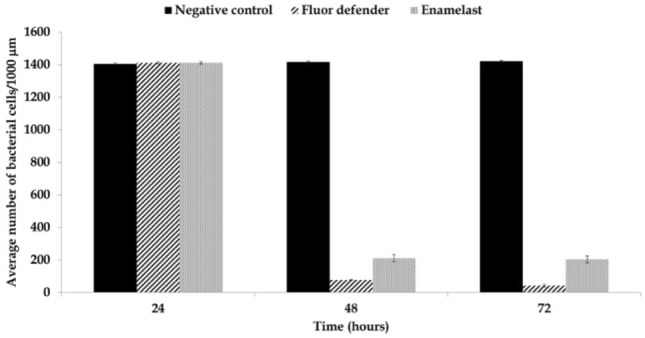
Purpose: The aim of the current work was to compare the antibacterial activity of Enamelast® and Fluor defender® fluoride varnish on biofilm generation by Streptococcus mutans on extracted primary teeth. Methods: Thirty-six primary molars were collected and sliced into seventy-two test model disks. All specimens were examined, and the cracked or broken ones were discarded. A total number of specimens (n = 54) were divided into two experimental analyses viz; biofilm formation (n = 27) and microscopic examination (n = 27). Specimens of each analysis were tested under different experimental conditions: a negative control group (n = 9), Fluor defender group (n = 9), and Enamelast group (n = 9). Following treatment, biofilms were generated by adherent Streptococcus mutans on the test model disks on three time intervals: 24 h (n = 3), 48 h (n = 3), and 72 h (n = 3) for each analysis. Then, for biofilm formation analysis, the biofilm was detected spectrophotometrically at 620 nm after being stained by crystal violet. For microscopical analysis, the surfaces of the test model disks were visualized by scanning electron microscopy (SEM), and each image was processed and analyzed using ImageJ software. Results: At 48 and 72 h, Enamelast® and Fluor defender®-treated group showed significantly (p < 0.001) slight adhered bacterial cells when compared with the negative control group as revealed by the absorbance and SEM. Compared with the Fluor defender®-treated group, the absorbance of the Enamelast®-treated group showed a significant (p < 0.001) increase by approximately 7- and 16.5-fold at 48 and 72 h, respectively. Similarly, SEM showed that the number of bacterial cells adhered to enamel surfaces in the Fluor defender®-treated group was significantly (p < 0.001) fewer than the Enamelast®-treated group by approximately 36.55% and 20.62% at 48 and 72 h after exposure, respectively. Conclusion: We conclude that the anti-biofilm activity of Fluor defender® against Streptococcus mutans was significantly (p < 0.001) greater than Enamelast® fluoride varnish. The use of Fluor defender® is encouraged as a preventive measure in children with the high risk of developing dental caries.
Overview
The claims and statistics of this paper haven’t been checked yet.
Run the check — free, no account needed. It reads the open-access text and checks the sources it cites.
Integrity signals
Registry
Cites
Statistics
Figures
Verification
Claims the paper makes
The claims and statistics of this paper haven’t been checked yet.
Run the check — free, no account needed. It reads the open-access text and checks the sources it cites.
Claims other papers make about this one
Each is checked against this paper’s own text: does it say what the citing paper says it does?
In the citing paper
“Matar et al.37 applied Fluor Defender and Enamelast to the enamel surfaces of primary teeth, subsequently detecting biofilm formation spectrophotometrically and observing it via scanning electron microscope (SEM) to examine the antibiofilm activity of both products.”
Self-check
Percentages, sums and reported differences re-computed from the paper’s own numbers.
The self-check needs the paper’s full text.
Citations
Cites
Erdem, A. P., Sepet, E., Kulekci, G., Trosola, S. C., & Guven, Y. (2012) · International Journal of Medical Sciences · doi:10.7150/ijms.3637 · Cited by 61
Research works printed but not linked: 54
- Al Dehailan L, Martinez-Mier EA, Lippert F. The effect of fluoride varnishes on caries lesions: an in vitro investigation. Clin Oral Invest. 2016;20:1655–62. https://doi.org/10.1007/s00784-015-1648-4. · DOI
- Anil S, Anand PS. Early childhood caries: Prevalence, risk factors, and prevention. Front Pediatr. 2017;5:157. https://doi.org/10.3389/fped.2017.00157. · DOI
- Baygin O, Tuzuner T, Kusgoz A, Senel AC, Tanriver M, Arslan I. Antibacterial effects of fluoride varnish compared with chlorhexidine plus fluoride in disabled children. Oral Health Prev Dent. 2014;12:373–82. https://doi.org/10.3290/j.ohpd.a32129. · DOI
- Bezerra SJC, Viana ÍEL, Aoki IV, Duarte S, Hara AT, Scaramucci T. In-vitro evaluation of the anti-cariogenic effect of a hybrid coating associated with encapsulated sodium fluoride and stannous chloride in nanoclays on enamel. J Appl Oral Sci. 2022;30. https://doi.org/10.1590/1678-7757-2021-0643. · DOI
- Bolis C, Härtli GP, Lendenmann U. Fluoride varnishes—is there a correlation between fluoride release and deposition on enamel. Oral Health Prev Dent. 2015;13:545–56.
- Bradshaw D, Marsh P, Hodgson R, Visser J. Effects of glucose and fluoride on competition and metabolism within in vitro dental bacterial communities and biofilms. Caries Res. 2002;36:81–6. https://doi.org/10.1159/000057864. · DOI · Paper page
- Byeon SM, Lee MH, Bae TS. The effect of different fluoride application methods on the remineralization of initial carious lesions. Restor Dent Endod. 2016;41:121–9. https://doi.org/10.5395/rde.2016.41.2.121. · DOI
- Cardoso C, De Castilho A, Salomão P, Costa E, Magalhães AC, Buzalaf MAR. Effect of xylitol varnishes on remineralization of artificial enamel caries lesions in vitro. J Dent. 2014;42:1495–501. https://doi.org/10.1016/j.jdent.2014.08.009. · DOI
- Carlsson J. Bacterial metabolism in dental biofilms. Adv Dent Res. 1997;11:75–80. https://doi.org/10.1177/08959374970110012001. · DOI
- Carvalho TS, Peters BG, Rios D, Magalhaes AC, Sampaio FC, Buzalaf MAR, Bönecker MJS. Fluoride varnishes with calcium glycerophosphate: fluoride release and effect on in vitro enamel demineralization. Braz Oral Res. 2015;29:1–6. https://doi.org/10.1590/1807-3107BOR-2015.vol29.0092. · DOI
- Ccahuana-Vásquez RA, Cury JAS. Mutans biofilm model to evaluate antimicrobial substances and enamel demineralization. Braz Oral Res. 2010;24:135–41. https://doi.org/10.1590/S1806-83242010000200002. · DOI · Paper page
- Cilurzo F, Minghetti P, Selmin F, Casiraghi A, Montanari L. Polymethacrylate salts as new low-swellable mucoadhesive materials. J Control Release. 2003;88:43–53. https://doi.org/10.1016/S0168-3659(02)00459-5. · DOI
- Çolak H, Dülgergil ÇT, Dalli M, Hamidi MM. Early childhood caries update: a review of causes, diagnoses, and treatments. J Nat Sci Biol Med. 2013;4:29. https://doi.org/10.4103/0976-9668.107257. · DOI
- Dang M-H, Jung J-E, Lee D-W, Song K-Y, Jeon J-G. Recovery of acid production in Streptococcus mutans biofilms after short-term fluoride treatment. Caries Res. 2016;50:363–71. https://doi.org/10.1159/000446408. · DOI
- Featherstone JD. Prevention and reversal of dental caries: role of low level fluoride. Commun Dent Oral Epidemiol. 1999;27:31–40. https://doi.org/10.1111/j.1600-0528.1999.tb01989.x. · DOI
- Fernández CE, Tenuta LMA, Zárate P, Cury JA. Insoluble NaF in Duraphat® may prolong fluoride reactivity of varnish retained on dental surfaces. Braz Dent J. 2014;25:160–4. https://doi.org/10.1590/0103-6440201302405. · DOI
- Folayan MO, El Tantawi M, Aly NM, Al-Batayneh OB, Schroth RJ, Castillo JL, Virtanen JI, Gaffar BO, Amalia R, Kemoli A. Association between early childhood caries and poverty in low and middle income countries. BMC Oral Health. 2020;20:1–8. https://doi.org/10.1186/s12903-019-0997-9. · DOI
- García-Godoy F, Hicks MJ. Maintaining the integrity of the enamel surface: the role of dental biofilm, saliva and preventive agents in enamel demineralization and remineralization. J Am Dent Assoc. 2008;139:25S–34S. https://doi.org/10.14219/jada.archive.2008.0352. · DOI
- Godoi FAd, Carlos NR, Bridi EC, Amaral FLBd, França FMG, Turssi CP, Kantovitz KR, Basting RT. Remineralizing effect of commercial fluoride varnishes on artificial enamel lesions. Braz Oral Res. 2019;33. https://doi.org/10.1590/1807-3107bor-2019.vol33.0044. · DOI · Paper page
- Hamada S, Koga T, Ooshima T. Virulence factors of Streptococcus mutans and dental caries prevention. J Dent Res. 1984;63:407–11. https://doi.org/10.1177/00220345840630031001. · DOI
- Hamada S, Slade HD. Biology, immunology, and cariogenicity of Streptococcus mutans. Microbiol Rev. 1980;44:331–84. https://doi.org/10.1128/mr.44.2.331-384.1980. · DOI
- Harding A, Zero D, Featherstone J, McCormack S, Shields C, Proskin H. Calcium fluoride formation on sound enamel using fluoride solutions with and without lactate. Caries Res. 1994;28:1–8. https://doi.org/10.1159/000261612. · DOI
- Jafri H, Khan MSA, Ahmad I. In vitro efficacy of eugenol in inhibiting single and mixed-biofilms of drug-resistant strains of Candida albicans and Streptococcus mutans. Phytomedicine. 2019;54:206–13. https://doi.org/10.1016/j.phymed.2018.10.005. · DOI
- Karpiński TM, Szkaradkiewicz AK. Microbiology of dental caries. J Biol Earth Sci. 2013;3:M21-24.
- Kulshrestha S, Khan S, Hasan S, Khan ME, Misba L, Khan AU. Calcium fluoride nanoparticles induced suppression of Streptococcus mutans biofilm: an in vitro and in vivo approach. Appl Microbiol Biotechnol. 2016;100:1901–14. https://doi.org/10.1007/s00253-015-7154-4. · DOI
- Latimer J, Munday JL, Buzza KM, Forbes S, Sreenivasan PK, McBain AJ. Antibacterial and anti-biofilm activity of mouthrinses containing cetylpyridinium chloride and sodium fluoride. BMC Microbiol. 2015;15:1–8. https://doi.org/10.1186/s12866-015-0501-x. · DOI
- Lee VA, Karthikeyan R, Rawls HR, Amaechi BT. Anti-cariogenic effect of a cetylpyridinium chloride-containing nanoemulsion. J Dent. 2010;38:742–9. https://doi.org/10.1016/j.jdent.2010.06.001. · DOI
- Lippert F, Lynch R. Comparison of Knoop and Vickers surface microhardness and transverse microradiography for the study of early caries lesion formation in human and bovine enamel. Arch Oral Biol. 2014;59:704–10. https://doi.org/10.1016/j.archoralbio.2014.04.005. · DOI
- Loesche WJ. Role of Streptococcus mutans in human dental decay. Microbiol Rev. 1986;50:353–80. https://doi.org/10.1128/mr.50.4.353-380.1986. · DOI
- Lotfy WA, Alkersh BM, Sabry SA, Ghozlan HA. Biosynthesis of silver nanoparticles by Aspergillus terreus: characterization, optimization, and biological activities. Front Bioeng Biotechnol. 2021;265. https://doi.org/10.3389/fbioe.2021.633468. · DOI
- Lotfy WA, Atalla RG, Sabra WA, El-Helow ER. Expression of extracellular polysaccharides and proteins by clinical isolates of Pseudomonas aeruginosa in response to environmental conditions. Int Microbiol. 2018;21:129–42. https://doi.org/10.1007/s10123-018-0010-5. · DOI
- Mohd Said SN, Ekambaram M, Yiu CK. Effect of different fluoride varnishes on remineralization of artificial enamel carious lesions. Int J Pediatr Dent. 2017;27:163–73. https://doi.org/10.1111/ipd.12243. · DOI
- Pandit S, Cai J-N, Jung J-E, Jeon J-G. Effect of 1-minute fluoride treatment on potential virulence and viability of a cariogenic biofilm. Caries Res. 2015;49:449–57. https://doi.org/10.1159/000434731. · DOI
- Pandit S, Kim H-J, Song K-Y, Jeon J-G. Relationship between fluoride concentration and activity against virulence factors and viability of a cariogenic biofilm: in vitro study. Caries Res. 2013;47:539–47. https://doi.org/10.1159/000348519. · DOI
- Philip N, Suneja B, Walsh L. Beyond Streptococcus mutans: clinical implications of the evolving dental caries aetiological paradigms and its associated microbiome. Br Dent J. 2018;224:219–25. https://doi.org/10.1038/sj.bdj.2018.81. · DOI
- Punathil S, Pulayath CV, Ismail SP, Bavabeedu SS, Moyin S, Uthappa R. Assessment of enamel surface microhardness with different fluoride varnishes—an in vitro study. J Contemp Dent Pract. 2018;19:1317–21. · DOI
- Rios D, Honório HM, Magalhães A, Delbem A, Machado MAAM, Silva SMBd, Buzalaf MAR. Effect of salivary stimulation on erosion of human and bovine enamel subjected or not to subsequent abrasion: an in situ/ex vivo study. Caries Res. 2006;40:218–223. https://doi.org/10.1159/000092229. · DOI
- Salma RS, Matar MA, Darwish SS, Elseoudy NA, Kandil MA, Mehelba MH, Lotfy WA. The antimicrobial effect of eugenol on lactobacilli isolated from children’s saliva compared to chlorhexidine (in-vitro study). Egypt Dent J. 2022;68:1141–8. https://doi.org/10.21608/edj.2022.110223.1900. · DOI
- Samaranayake L. Essential microbiology for dentistry-E-Book. 5th ed ed: Elsevier Health Sciences (2018).
- Schneider CA, Rasband WS, Eliceiri KW. NIH Image to ImageJ: 25 years of image analysis. Nat Methods. 2012;9:671–5. https://doi.org/10.1038/nmeth.2089. · DOI · Paper page
- Schwendicke F, Frencken JE, Bjørndal L, Maltz M, Manton DJ, Ricketts D, Van Landuyt K, Banerjee A, Campus G, Doméjean S. Managing carious lesions: consensus recommendations on carious tissue removal. Adv Dent Res. 2016;28:58–67. https://doi.org/10.1177/0022034516639271. · DOI
- Seow WK. Biological mechanisms of early childhood caries. Commun Dent Oral Epidemiol. 1998;26:8–27. https://doi.org/10.1111/j.1600-0528.1998.tb02090.x. · DOI
- Seppä L. Fluoride varnishes in caries prevention. Med Princ Pract. 2004;13:307–11. https://doi.org/10.1159/000080466. · DOI
- Shen P, Manton DJ, Cochrane NJ, Walker GD, Yuan Y, Reynolds C, Reynolds EC. Effect of added calcium phosphate on enamel remineralization by fluoride in a randomized controlled in situ trial. J Dent. 2011;39:518–25. https://doi.org/10.1016/j.jdent.2011.05.002. · DOI
- Souza JG, Rochel ID, Pereira AF, Silva TC, Rios D, Machado MAA, Buzalaf MA, Magalhães AC. Effects of experimental xylitol varnishes and solutions on bovine enamel erosion in vitro. J Oral Sci. 2010;52:553–9. https://doi.org/10.2334/josnusd.52.553. · DOI
- Stepanović S, Vuković D, Dakić I, Savić B, Švabić-Vlahović M. A modified microtiter-plate test for quantification of staphylococcal biofilm formation. J Microbiol Methods. 2000;40:175–9. https://doi.org/10.1016/S0167-7012(00)00122-6. · DOI
- Stephan RM, Miller BF. A quantitative method for evaluating physical and chemical agents which modify production of acids in bacterial plaques on human teeth. J Dent Res. 1943;22:45–51. https://doi.org/10.1177/00220345430220010601. · DOI
- Takahashi N, Nyvad B. Caries ecology revisited: microbial dynamics and the caries process. Caries Res. 2008;42:409–18. https://doi.org/10.1159/000159604. · DOI
- Ten Cate J, Featherstone J. Mechanistic aspects of the interactions between fluoride and dental enamel. Crit Rev Oral Biol Med. 1991;2:283–96. https://doi.org/10.1177/10454411910020030101. · DOI
- ten Cate JM. Biofilms, a new approach to the microbiology of dental plaque. Odontology. 2006;94:1–9. https://doi.org/10.1007/s10266-006-0063-3. · DOI
- Tenuta L, Zamataro C, Cury ADB, Tabchoury C, Cury J. Mechanism of fluoride dentifrice effect on enamel demineralization. Caries Res. 2009;43:278–85. https://doi.org/10.1159/000217860. · DOI
- Yadav S, Sachdev V, Malik M, Chopra R. Effect of three different compositions of topical fluoride varnishes with and without prior oral prophylaxis on Streptococcus mutans count in biofilm samples of children aged 2–8 years: a randomized controlled trial. J Indian Soc Pedodont Prev Dent. 2019;37:286. https://doi.org/10.4103/JISPPD.JISPPD_62_19. · DOI · Paper page
- Zero DT Dentifrices, mouthwashes, and remineralization/caries arrestment strategies. In: BMC Oral health, 2006. vol 1. BioMed Central, pp 1–13. https://doi.org/10.1186/1472-6831-6-S1-S9 · DOI
- Zhang M, He L, Exterkate R, Cheng L, Li J, Ten Cate J, Crielaard W, Deng D. Biofilm layers affect the treatment outcomes of NaF and nano-hydroxyapatite. J Dent Res. 2015;94:602–7. https://doi.org/10.1177/0022034514565644. · DOI
Cited by
Sorted by citations
Baidya, D., Pathivada, L., Garg, N., Karthik, K. M., Jain, A. K., & Bhyri, P. (2026) · International Journal of Clinical Pediatric Dentistry · doi:10.5005/jp-journals-10005-3470
Metadata
- Authors
- Matar, M. A., Darwish, S. S., Salma, R. S., & Lotfy, W. A.
- Venue
- European Archives of Paediatric Dentistry
- Published
- 2023-08-01
- Volume
- 24
- Issue
- 5
- Pages
- 549-558
- ISSN
- 1818-6300
- 1996-9805
- PMC
- PMC10600041
- Cited by
- 5
- References
- 1
- Language
- en
- Update notices
- correction (2023-12-23)
- Funders
- Arab Academy for Science, Technology & Maritime Transport
About these checks
Registry, retraction, Cites and statistics results are computed, not judged, with one exception: a printed reference that no index lists is read once by a model before it counts as a citation error. Claims are extracted by a model and kept only when their quote appears verbatim in the text; each cited source is then checked, with a model’s help, for whether it says what the claim relies on. Those verdicts can be wrong — read the claim’s quote and the cited source before relying on one.
Statistics and arithmetic are recomputed, not judged.
Confidence bands are shown only for fields calibrated on our annotated test set. None is calibrated yet, so no band is shown.
What counts as a claim ›How we measure confidence ›How we check this ›
Are you an author, or do you see a problem with this page? Request a review
