

The DOI matches its Crossref record; 82 of the 86 references it cites were found in a registry or an index.
An Educational System for Learning Search Algorithms and Automatically Assessing Student Performance
Open accessAbstract
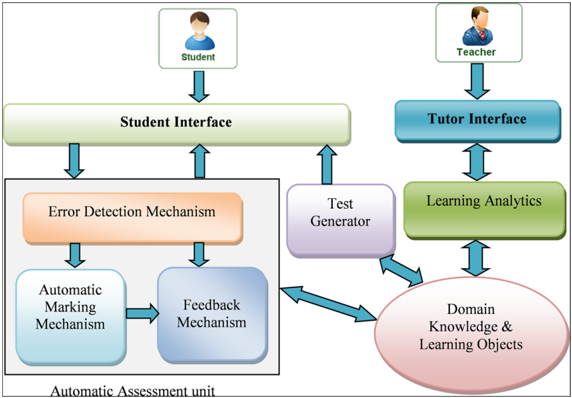
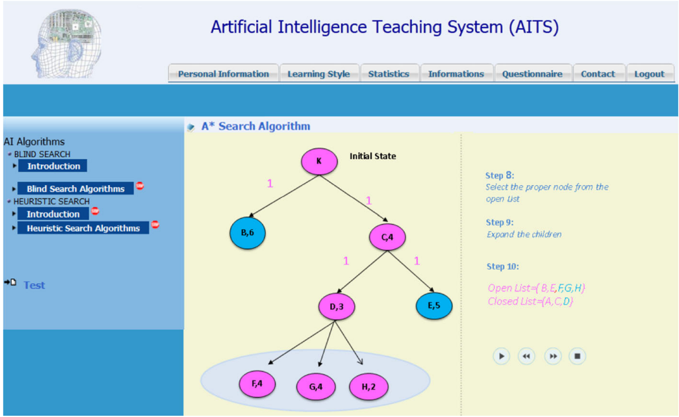
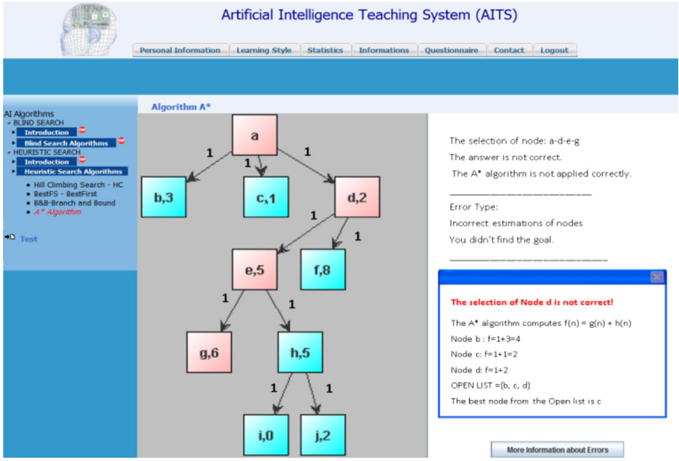
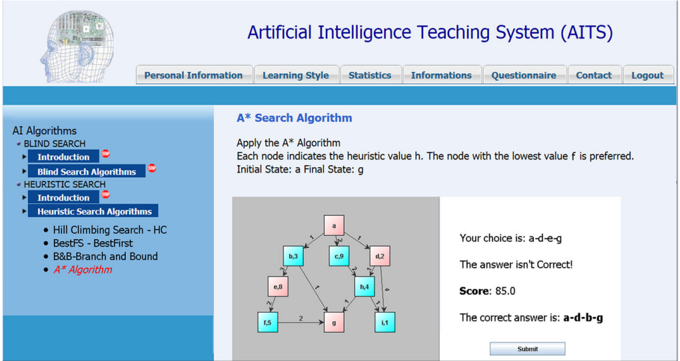
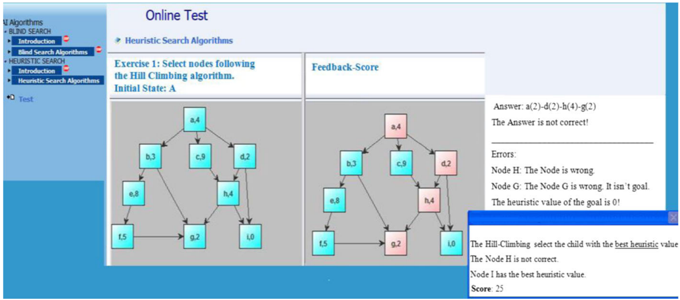
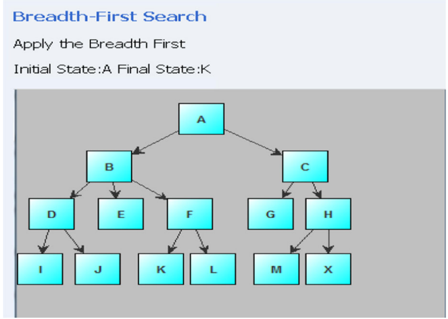
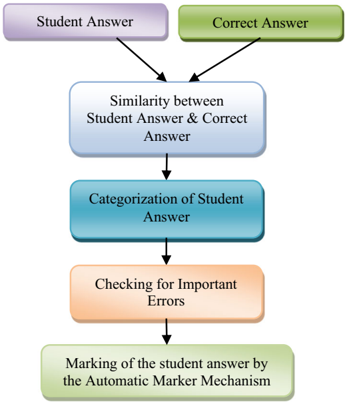
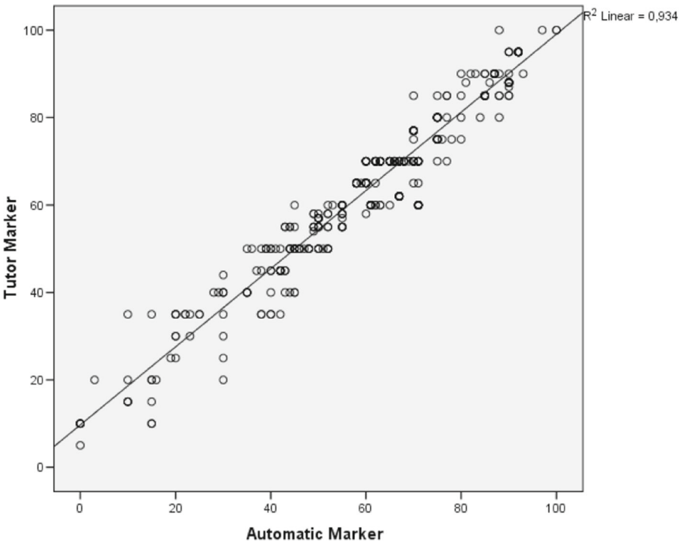
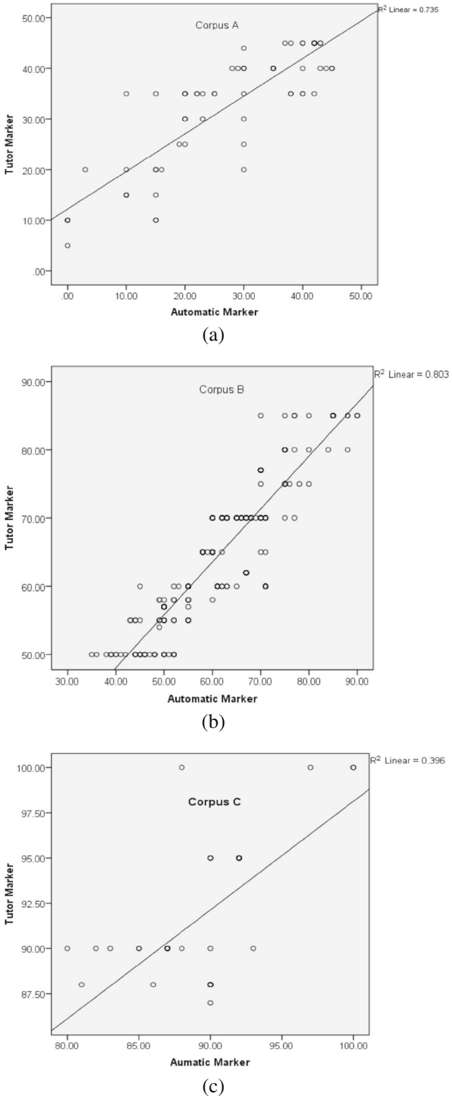
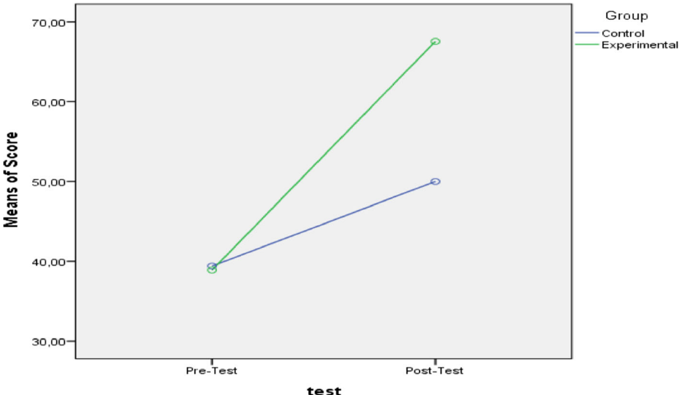
In this paper, first we present an educational system that assists students in learning and tutors in teaching search algorithms, an artificial intelligence topic. Learning is achieved through a wide range of learning activities. Algorithm visualizations demonstrate the operational functionality of algorithms according to the principles of active learning. So, a visualization process can stop and request from a student to specify the next step or explain the way that a decision was made by the algorithm. Similarly, interactive exercises assist students in learning to apply algorithms in a step-by-step interactive way. Students can apply an algorithm to an example case, specifying the algorithm’s steps interactively, with the system’s guidance and help, when necessary. Next, we present assessment approaches integrated in the system that aim to assist tutors in assessing the performance of students, reduce their marking task workload and provide immediate and meaningful feedback to students. Automatic assessment is achieved in four stages, which constitute a general assessment framework. First, the system calculates the similarity between the student’s and the correct answer using the edit distance metric. In the next stage, it identifies the type of the answer, based on an introduced answer categorization scheme related to completeness and accuracy of an answer, taking into account student carelessness too. Afterwards, the types of errors are identified, based on an introduced error categorization scheme. Finally, answer is automatically marked via an automated marker, based on its type, the edit distance and the type of errors made. To assess the learning effectiveness of the system an extended evaluation study was conducted in real class conditions. The experiment showed very encouraging results. Furthermore, to evaluate the performance of the assessment system, we compared the assessment mechanism against expert (human) tutors. A total of 400 students’ answers were assessed by three tutors and the results showed a very good agreement between the automatic assessment system and the tutors.
Overview
The claims and statistics of this paper haven’t been checked yet.
Run the check — free, no account needed. It reads the open-access text and checks the sources it cites.
Integrity signals
Registry
Cites
Statistics
Figures

Verification
Claims the paper makes
The claims and statistics of this paper haven’t been checked yet.
Run the check — free, no account needed. It reads the open-access text and checks the sources it cites.
Claims other papers make about this one
Each is checked against this paper’s own text: does it say what the citing paper says it does?
The source backs part of the claim, not all of it — or backs it for a different population, condition or comparison.
In the citing paper
“Grivokostopoulou et al. [42] use AI to evaluate students' performance in programing and automatically give them a grade on the task performed.”
From Artificial Intelligence for Student Assessment: A Systematic Review (2021) · cites this paper as [42]
Experimental — accuracy not yet measuredThe source backs part of the claim, not all of it — or backs it for a different population, condition or comparison.
In the citing paper
“When analyzing the result in relation to four levels related to student grades-very low, low, medium, good, and excellent-it was observed that the results were quite similar, only finding higher results as excellent by the teacher than by the AI.”
From Artificial Intelligence for Student Assessment: A Systematic Review (2021) · cites this paper as [42]
Experimental — accuracy not yet measuredThe cited source says what the claim attributes to it.
In the citing paper
“three of them determine the need to give early feedback as an essential aspect in the educational process [22,37,42]”
From Artificial Intelligence for Student Assessment: A Systematic Review (2021) · cites this paper as [42]
The cited source says what the claim attributes to it.
In the citing paper
“In the same way, Grivokostopoulou et al. [42] show how their AI system is suitable for student evaluation and grading, as it is similar to teacher evaluation.”
From Artificial Intelligence for Student Assessment: A Systematic Review (2021) · cites this paper as [42]
The cited source says what the claim attributes to it.
In the citing paper
“In general, the results were very similar and correlated with each other.”
From Artificial Intelligence for Student Assessment: A Systematic Review (2021) · cites this paper as [42]
1 more claim about this paper
Create a free account to see every claim other papers make about this one.
Self-check
Percentages, sums and reported differences re-computed from the paper’s own numbers.
The self-check needs the paper’s full text.
Citations
Cites
Coefficient Alpha and the Internal Structure of Tests
Cronbach, L. J. (1951) · Psychometrika · doi:10.1007/bf02310555 · Cited by 43,931
A Coefficient of Agreement for Nominal Scales
Cohen, J. (1960) · Educational and Psychological Measurement · doi:10.1177/001316446002000104 · Cited by 42,398
Binary Codes capable of currecting deletions, insertions, and reversals
Levenshtein, V. I. (1965) · Soviet physics. Doklady · Cited by 14,811
Hattie, J., & Timperley, H. (2007) · Review of Educational Research · doi:10.3102/003465430298487 · Cited by 12,905
(2005) · PubMed · Cited by 7,011
Nicol, D. J., & Macfarlane‐Dick, D. (2006) · Studies in Higher Education · doi:10.1080/03075070600572090 · Cited by 5,846
Spillane, J. P. (2004) · Educational Evaluation and Policy Analysis · doi:10.3102/01623737026002169 · Cited by 2,536
VanLEHN, K. (2011) · Educational Psychologist · doi:10.1080/00461520.2011.611369 · Cited by 2,323
Metacognition in Educational Theory and Practice
(1998) · Routledge eBooks · doi:10.4324/9781410602350 · Cited by 2,119
Self‐Explanations: How Students Study and Use Examples in Learning to Solve Problems
Chi, M. T. H., Bassok, M., Lewis, M. W., Reimann, P., & Glaser, R. (1989) · Cognitive Science · doi:10.1207/s15516709cog1302_1 · Cited by 1,714
Research works printed but not linked: 1
- Jenkins, T. (2002). On the difficulty of learning to program. In Proceedings of the 3rd Annual Conference of the LTSN Centre for Information and Computer Sciences (Vol. 4, pp. 53–58).
Cited by
Mousavinasab, E., Zarifsanaiey, N., R. Niakan Kalhori, S., Rakhshan, M., Keikha, L., & Ghazi Saeedi, M. (2021) · Interactive Learning Environments · doi:10.1080/10494820.2018.1558257 · Cited by 605
Artificial Intelligence for Student Assessment: A Systematic Review
González-Calatayud, V., Prendes-Espinosa, P., & Roig-Vila, R. (2021) · Applied Sciences · doi:10.3390/app11125467 · Cited by 503
Power to the Teachers: An Exploratory Review on Artificial Intelligence in Education
Lameras, P., & Arnab, S. (2021) · Information · doi:10.3390/info13010014 · Cited by 291
Hu, B., Gaurav, A., Choi, C., & Almomani, A. (2022) · International Journal on Semantic Web and Information Systems · doi:10.4018/ijswis.302895 · Cited by 87
What Do Turkish Pre-Service Teachers Think About Artificial Intelligence?
Haseski, H. İ. (2019) · International Journal of Computer Science Education in Schools · doi:10.21585/ijcses.v3i2.55 · Cited by 132
Metadata
- Authors
- Grivokostopoulou, F., Perikos, I., & Hatzilygeroudis, I.
- Affiliations
- University of Patras (GR)
- Corresponding author
- Hatzilygeroudis, Ioannis
- Venue
- International Journal of Artificial Intelligence in Education
- Publisher
- Elsevier BV
- Published
- 2017-03
- Volume
- 27
- Issue
- 1
- Pages
- 207-240
- ISSN
- 1560-4292 (ISSN-L)
- OpenAlex
- W2461804984
- Cited by
- 71
- References
- 86
- Citations by year
- 2026: 10 · 2025: 6 · 2024: 11 · 2023: 9 · 2022: 7 · 2021: 6 · 2020: 4 · 2019: 9 · 2018: 5 · 2017: 3
- FWCI
- 4.94
- Type
- journal article
- Language
- en
- Open access
- hybrid
- doi.org
- Licence
- cc-by-nc-nd
- www.elsevier.com/tdm/userlicense/1.0/ (tdm)
- www.elsevier.com/legal/tdmrep-license (tdm)
- creativecommons.org/licenses/by-nc-nd/4.0/ (vor, 3345 d)
- Locations
- International Journal of Artificial Intelligence in Education (publishedVersion, cc-by-nc-nd)
- Topics
- Physical Sciences › Computer Science › Artificial Intelligence › Intelligent Tutoring Systems and Adaptive Learning
- Physical Sciences › Computer Science › Information Systems › Educational Technology and Assessment
- Physical Sciences › Computer Science › Computer Science Applications › Teaching and Learning Programming
- Keywords
- search algorithms, algorithm visualization, interactive exercises, automated assessment, automated marking, edit distance, error classification, student feedback, artificial intelligence in education, active learning
About these checks
Registry, retraction, Cites and statistics results are computed, not judged, with one exception: a printed reference that no index lists is read once by a model before it counts as a citation error. Claims are extracted by a model and kept only when their quote appears verbatim in the text; each cited source is then checked, with a model’s help, for whether it says what the claim relies on. Those verdicts can be wrong — read the claim’s quote and the cited source before relying on one.
Statistics and arithmetic are recomputed, not judged.
Confidence bands are shown only for fields calibrated on our annotated test set. None is calibrated yet, so no band is shown.
What counts as a claim ›How we measure confidence ›How we check this ›
Are you an author, or do you see a problem with this page? Request a review
How to cite
Cite CoChat for the checks on this page, and the paper for its own findings.
- This page
- CoChat. (2026). Citation check: An Educational System for Learning Search Algorithms and Automatically Assessing Student Performance. https://app.cochat.ai/papers/10.1007/s40593-016-0116-x
- The paper
- Grivokostopoulou, F., Perikos, I., & Hatzilygeroudis, I. (2017). An Educational System for Learning Search Algorithms and Automatically Assessing Student Performance. International Journal of Artificial Intelligence in Education. https://doi.org/10.1007/s40593-016-0116-x
Data sources
Bibliographic data: Semantic Scholar, OpenAlex, Crossref.
Contains information from the Semantic Scholar Academic Graph Datasets, made available under the ODC Attribution License (ODC-BY 1.0).
Semantic Scholar’s data is described in: Kinney, R., et al. (2023). The Semantic Scholar Open Data Platform. arXiv:2301.10140.
