

The real-world safety profile of tirzepatide: pharmacovigilance analysis of the FDA Adverse Event Reporting System (FAERS) database
Open accessThe DOI matches its Crossref record; 30 of the 35 references it cites were found in a registry or an index, and 5 are not checked yet; 6 of the 11 sources its claims cite were checked for support.
Abstract
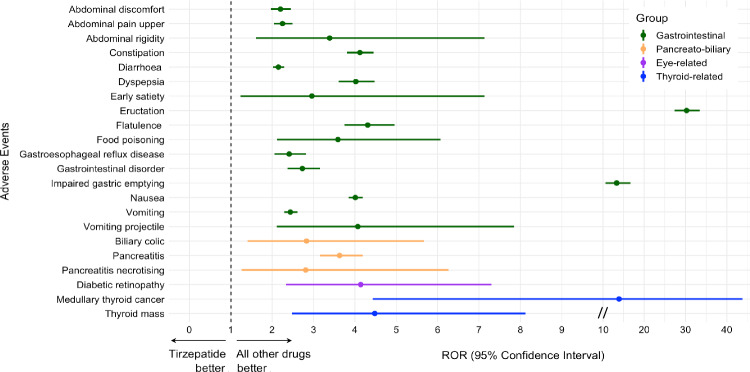
Purpose: Randomized controlled trials with tirzepatide (TZP) displayed unprecedented glucose and body weight lowering efficacy in individuals with type 2 diabetes and/or obesity and a safety profile similar to that of glucagon-like peptide-1 receptor agonists (GLP-1RA), mainly characterized by gastrointestinal (GI) adverse events (AE). Concerns on diabetic retinopathy, pancreato-biliary disorders, and medullary thyroid cancer were also addressed. We aimed to investigate whether the same safety issues emerged from the FDA Adverse Event Reporting System (FAERS) post-marketing surveillance database. Methods: OpenVigil 2.1-MedDRA-v24 and AERS Mine (data 2004Q1-2023Q3) were used to query the FAERS database. Reports of GI AE, diabetic retinopathy, pancreato-biliary disorders, and medullary thyroid cancer were investigated. The analysis was then filtered for age, gender, and designation as primary suspect. AE occurrence with TZP was compared to insulin, sodium-glucose cotransporter-2 inhibitors, metformin, and GLP-1RA. Results: Disproportionate reporting of GI [i.e., nausea (ROR 4.01, 95% CI 3.85–4.19)] and pancreato-biliary disorders [i.e., pancreatitis (ROR 3.63, 95% CI 3.15–4.19)], diabetic retinopathy (ROR 4.14, 95% CI 2.34–7.30), and medullary thyroid cancer (ROR 13.67, 95% CI 4.35–42.96) was detected. TZP exhibited a similar risk of GI AE and medullary thyroid cancer and a lower risk of most pancreato-biliary AE and diabetic retinopathy vs. GLP-1RA. Conclusions: TZP was associated with an increased risk of specific AE. However, its safety profile was similar to that of GLP-1RA, without increased risk of pancreato-biliary AE, diabetic retinopathy, and medullary thyroid cancer.
Verified 2026-10-05 · 5 references not checked yet
Overview
CoChat Summary
TL;DR
This FAERS pharmacovigilance analysis found disproportionate reporting of gastrointestinal, pancreato-biliary, diabetic retinopathy, and medullary thyroid cancer adverse events with tirzepatide. Overall, tirzepatide’s safety profile was similar to GLP-1 receptor agonists, with no increased risk of pancreatitis, diabetic retinopathy, or medullary thyroid cancer relative to that class.
Key findings
- Tirzepatide was associated with 20,409 reports related to 1,432 adverse events; 116 fulfilled Evans’ criteria, including 44 administration site/procedural complications, 20 gastrointestinal disorders, and 14 nutrition/metabolism disorders.
- Disproportionate gastrointestinal reporting included nausea (ROR 4.01, 95% CI 3.85–4.19), pancreatitis (ROR 3.63, 95% CI 3.15–4.19), impaired gastric emptying (ROR 13.3, 95% CI 10.7–16.7), and eructation (ROR 30.25, 95% CI 27.38–33.42).
- Positive signals were also detected for diabetic retinopathy (ROR 4.13, 95% CI 2.34–7.29) and medullary thyroid cancer (ROR 13.67, 95% CI 4.35–42.96), though the latter was based on only 3 events.
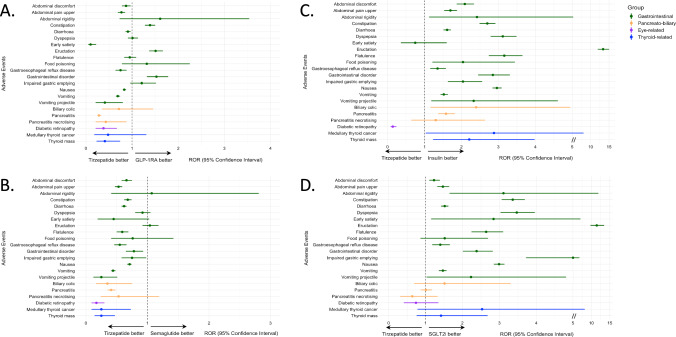
- Versus GLP-1RA as a class, tirzepatide showed similar risk of gastrointestinal adverse events and medullary thyroid cancer, and lower risk of most pancreato-biliary adverse events and diabetic retinopathy; it had lower risk of nausea and vomiting but greater risk of constipation, eructation, and gastrointestinal disorder.
Methods
- FAERS was queried using OpenVigil 2.1-MedDRA-v24 and AERSMine for data from 2004Q1 to 2023Q3.
- A positive disproportionality signal used Evans’ criteria: PRR ≥2, chi-squared ≥4, and ≥3 cases; reports were retrieved by MedDRA high level terms for gastrointestinal, pancreato-biliary, diabetic ophthalmic, and thyroid events.
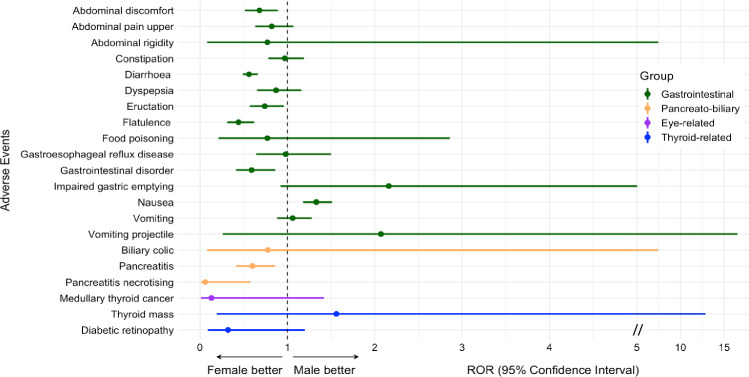
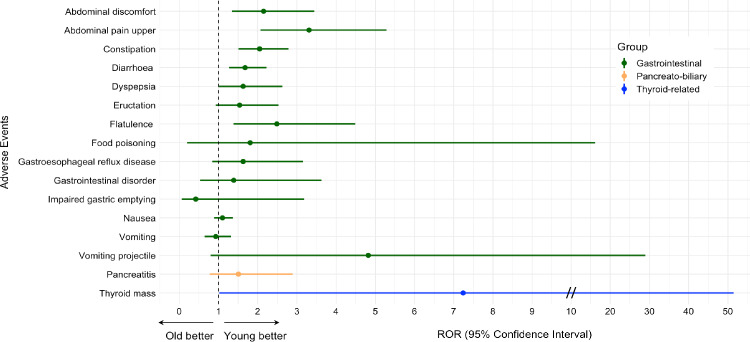
- Analyses compared tirzepatide with all other drugs, insulin, SGLT-2 inhibitors, metformin, and GLP-1RA, with filtering for age, gender, and primary suspect designation, plus sensitivity analyses excluding concomitant insulin or GLP-1RA use.
Limitations
- The paper states that FAERS contains spontaneous reports without necessarily implying cause-effect; reporters include healthcare professionals, patients, families, representatives, and manufacturers, which can lead to duplicates and incomplete reporting, with dose, indication, gender, and age often missing.
- The paper also states that reporting may be affected by public awareness, ethnicity, geography, and timing of approval/market introduction; oral versus injectable semaglutide and daily versus weekly exenatide could often not be distinguished; and data cover approximately the first 16 months of tirzepatide availability on the U.S. market.
- Evident from the text: gender was missing in approximately 2,900 reports and age in approximately 13,000 reports, and some key signals relied on very few events (12 diabetic retinopathy events; 3 medullary thyroid cancer events), limiting precision.
Model-written summary. Check it against the paper before relying on it.
Integrity signals
Registry
Cites
Statistics
Figures
Verification
Claims the paper makes
6 Valid · 0 Not valid · 6 Not checked · 43 Own results and interpretations
Every source the paper cites for this claim was checked and supports it.
In the paper
“Gasbjerg et al. showed that endogenous GIP, and not GLP-1, also induced gallbladder relaxation.”
§ The real-world safety profile of tirzepatide: pharmacovigilance analysis of the FDA Adverse Event Reporting System (FAERS) database > Conclusions
What the sources say
- Supportedcites [24] Gasbjerg LS, Helsted MM, Hartmann B, Sparre-Ulrich AH, Veedfald S, Stensen S et al (2020) GIP and GLP-1 receptor antagonism during a meal in healthy individuals. J Clin Endocrinol Metab 105(3):dgz175. 10.1210/clinem/dgz175 32077470 source
The Gallbladder volume section (pp. of Fig. 5 discussion) states that GIP(3-30)NH2 (GIP receptor blockade) raised gallbladder ejection fraction versus placebo, 'suggesting that endogenous GIP is involved in gallbladder relaxation', and that 'based on our present results, endogenous GLP-1 does not affect postprandial gallbladder volume'. The Results (Gallbladder and gastric motility) give the supporting numbers (higher maximal and bsAUC ejection fraction during GIP(3-30)NH2 vs exendin(9-39)NH2 and placebo), and the Abstract conclusion says 'only endogenous GIP affects gallbladder motility' in 12 healthy men. Both halves of the claim (GIP yes, GLP-1 no) are stated in our copy. (LLM, conf=0.92)
plainstates a cause- Asserted: passes — The authors put it forward as true.
- Checkable: passes — It can be checked against evidence.
- Load-bearing: passes — The paper’s conclusions depend on it.
- Based: passes — The paper gives a reason why it holds.
- Supported
Every source the paper cites for this claim was checked and supports it.
In the paper
“In line with data from the SURPASS program [3], nausea, diarrhoea, and vomiting were the most commonly reported GI AE”
§ The real-world safety profile of tirzepatide: pharmacovigilance analysis of the FDA Adverse Event Reporting System (FAERS) database > Conclusions
What the sources say
- Supportedcites [3] Patel H, Khunti K, Rodbard HW, Bajaj HS, Bray R, Kindracki Z et al (2024) Gastrointestinal adverse events and weight reduction in people with type 2 diabetes treated with tirzepatide in the SURPASS clinical trials. Diabetes Obes Metab 26:473–481. 10.1111/dom.15333 37853960 source
Section 3.2 (GI AEs and treatment discontinuation) states that nausea, diarrhoea and vomiting were the most frequently reported gastrointestinal adverse events with tirzepatide across SURPASS-1 to -5. This directly supports the cited claim. (LLM, conf=0.95)
plain- Asserted: passes — The authors put it forward as true.
- Checkable: passes — It can be checked against evidence.
- Load-bearing: passes — The paper’s conclusions depend on it.
- Based: passes — The paper gives a reason why it holds.
- Supported
Every source the paper cites for this claim was checked and supports it.
In the paper
“However, a higher expression of GIP receptor was found in tumor rather than normal tissue in rats and human specimens of medullary thyroid cancer”
§ The real-world safety profile of tirzepatide: pharmacovigilance analysis of the FDA Adverse Event Reporting System (FAERS) database > Conclusions
What the sources say
- Supportedcites [31] Regazzo D, Bertazza L, Galletta E, Barollo S, Mondin A, Zovato S et al (2022) The GIP/GIPR axis in medullary thyroid cancer: clinical and molecular findings. Endocr Relat Cancer 29(5):273–284. 10.1530/ERC-21-0258 35298396 source
The Abstract reports a high tumor-to-normal GIPR ratio in both human and rat medullary thyroid cancer. The “GIPR expression and clinical correlations” section also reports higher GIPR levels in most human tumor samples than in normal thyroid tissue. (LLM, conf=0.93)
plainstates an association- Asserted: passes — The authors put it forward as true.
- Checkable: passes — It can be checked against evidence.
- Load-bearing: passes — The paper’s conclusions depend on it.
- Based: passes — The paper gives a reason why it holds.
- Supported
Every source the paper cites for this claim was checked and supports it.
In the paper
“which are known to be associated with an increased yet small risk of gallbladder and biliary-related disorders both in patients treated for type 2 diabetes and obesity [22].”
§ The real-world safety profile of tirzepatide: pharmacovigilance analysis of the FDA Adverse Event Reporting System (FAERS) database > Conclusions
What the sources say
- Supportedcites [22] He L, Wang J, Ping F, Yang N, Huang J, Li Y et al (2022) Association of glucagon-like peptide-1 receptor agonist use with risk of gallbladder and biliary diseases: a systematic review and meta-analysis of randomized clinical trials. JAMA Intern Med 182:513–519. 10.1001/jamainternmed.2022.0338 35344001 PMC8961394 source
The Discussion reports increased gallbladder or biliary disease risk in trials treating diabetes and in trials treating patients for weight loss, with higher risk in the latter. It also describes the overall absolute increase as small: 27 additional cases per 10,000 people treated per year. (LLM, conf=0.94)
boostedstates an association- Asserted: passes — The authors put it forward as true.
- Checkable: passes — It can be checked against evidence.
- Load-bearing: passes — The paper’s conclusions depend on it.
- Based: passes — The paper gives a reason why it holds.
- Supported
Every source the paper cites for this claim was checked and supports it.
In the paper
“Instead, HbA1c reduction was associated with increased risk of diabetic retinopathy in a meta-regression of GLP-1RA cardiovascular outcome trials [27].”
§ The real-world safety profile of tirzepatide: pharmacovigilance analysis of the FDA Adverse Event Reporting System (FAERS) database > Conclusions
What the sources say
- Supportedcites [27] Bethel MA, Diaz R, Castellana N, Bhattacharya I, Gerstein HC, Lakshmanan MC (2021) HbA change and diabetic retinopathy during GLP-1 receptor agonist cardiovascular outcome trials: a meta-analysis and meta-regression. Diabetes Care 44:290–296. 10.2337/dc20-1815 33444163 PMC7783944 source
The Abstract CONCLUSIONS (Bethel et al. 2021, Diabetes Care) state verbatim that 'HbA1c reduction was significantly associated with increased retinopathy risk in meta-regression for GLP-1RA CVOTs.' The DATA SYNTHESIS and Results sections quantify this (univariate meta-regression slope = 0.77, P = 0.007; a 0.1% increase in HbA1c reduction associated with 6%, 14%, or 8% increased Ln(OR) for retinopathy at 3 months, 1 year, and overall follow-up), and the paper's Conclusions reiterate the significant meta-regression association regardless of follow-up period. The paraphrase matches the source in content, direction, method (meta-regression), and population (GLP-1RA CVOTs). (LLM, conf=0.95)
plainstates an association- Asserted: passes — The authors put it forward as true.
- Checkable: passes — It can be checked against evidence.
- Load-bearing: passes — The paper’s conclusions depend on it.
- Based: passes — The paper gives a reason why it holds.
- Supported
35 more claims
Create a free account to see all 55 claims and to verify the 5 references still open.
- It may state two separate claims as one. 13
- Probably not a substantial claim. 2
Claims other papers make about this one
Each is checked against this paper’s own text: does it say what the citing paper says it does?
The cited source says what the claim attributes to it.
In the citing paper
“Notably, data from the FDA Adverse Event Reporting System indicate a lower incidence of nausea and vomiting, potentially due to GIP receptor-mediated neuronal inhibition in the area postrema [149,150], whereas constipation appears more frequent, with the underlying mechanisms yet to be fully elucidated [151].”
From Nutrition and Physical Activity in Optimizing Weight Loss and Lean Mass Preservation in the Incretin-Based Medications Era: A Narrative Review (2025) · cites this paper as [149]
The cited source says what the claim attributes to it.
In the citing paper
“it is noteworthy that tirzepatide exhibits a safety profile comparable to that of GLP-1 RAs.”
From Nutrition and Physical Activity in Optimizing Weight Loss and Lean Mass Preservation in the Incretin-Based Medications Era: A Narrative Review (2025) · cites this paper as [149]
Self-check
Percentages, sums and reported differences re-computed from the paper’s own numbers.
Each contradiction between two passages listed here was confirmed by an independent check.
Rated minor: it would not touch a result — a value no result rests on, a p-value that stays on the same side of the significance level, or a conflict that is clerical, resolved elsewhere in the paper, or outside its own findings.
In the paper
§ The real-world safety profile of tirzepatide: pharmacovigilance analysis of the FDA Adverse Event Reporting System (FAERS) database > Abstract > Results
“diabetic retinopathy (ROR 4.14, 95% CI 2.34–7.30)”
§ The real-world safety profile of tirzepatide: pharmacovigilance analysis of the FDA Adverse Event Reporting System (FAERS) database > Results > Tirzepatide vs. all other drugs
““diabetic retinopathy” (ROR 4.13, 95% CI 2.34–7.29)”
Citations
Cites
Semaglutide and Cardiovascular Outcomes in Patients with Type 2 Diabetes
Marso, S. P., Bain, S. C., Consoli, A., Eliaschewitz, F. G., Jódar, E., Leiter, L. A., Lingvay, I., Rosenstock, J., Seufert, J., Warren, M. L., et al. (2016) · New England Journal of Medicine · doi:10.1056/nejmoa1607141 · Cited by 6,900 · cited 1×
“Being an incretin-based medication, TZP inherited GLP-1RA-related concerns of diabetic retinopathy worsening, which peaked especially following the dissemination of the SUSTAIN-6 trial results with subcutaneous semaglutide [25].”
BackgroundTirzepatide versus Semaglutide Once Weekly in Patients with Type 2 Diabetes
Frías, J. P., Davies, M. J., Rosenstock, J., Pérez Manghi, F. C., Fernández Landó, L., Bergman, B. K., Liu, B., Cui, X., & Brown, K. (2021) · New England Journal of Medicine · doi:10.1056/nejmoa2107519 · Cited by 2,096
Evans, S. J. W., Waller, P. C., & Davis, S. (2001) · Pharmacoepidemiology and Drug Safety · doi:10.1002/pds.677 · Cited by 1,802 · cited 2×
“A positive signal of disproportionality was defined as a proportional reporting ratio (PRR) of 2 or greater, chi-squared of at least 4, and 3 or more cases according to Evans’ criteria [18].”
BackgroundMethodRosenstock, J., Wysham, C., Frías, J. P., Kaneko, S., Lee, C. J., Fernández Landó, L., Mao, H., Cui, X., Karanikas, C. A., & Thieu, V. T. (2021) · The Lancet · doi:10.1016/s0140-6736(21)01324-6 · Cited by 1,080
Del Prato, S., Kahn, S. E., Pavo, I., Weerakkody, G. J., Yang, Z., Doupis, J., Aizenberg, D., Wynne, A. G., Riesmeyer, J. S., Heine, R. J., et al. (2021) · The Lancet · doi:10.1016/s0140-6736(21)02188-7 · Cited by 684
9. Pharmacologic Approaches to Glycemic Treatment: Standards of Care in Diabetes—2024
American Diabetes Association Professional Practice Committee, ElSayed, N. A., Aleppo, G., Bannuru, R. R., Bruemmer, D., Collins, B. S., Ekhlaspour, L., Gaglia, J. L., Hilliard, M. E., Johnson, E. L., et al. (2024) · Diabetes Care · doi:10.2337/dc24-s009 · Cited by 662 · cited 1×
“In the latest version of the American Diabetes Association’s Standard of Medical Care in Diabetes, TZP has been listed among the most efficacious drugs for achieving glucose-and/or body weight (BW)-lowering [1].”
BackgroundLudvik, B., Giorgino, F., Jódar, E., Frias, J. P., Fernández Landó, L., Brown, K., Bray, R., & Rodríguez, Á. (2021) · The Lancet · doi:10.1016/s0140-6736(21)01443-4 · Cited by 639
Self-citationDahl, D., Onishi, Y., Norwood, P., Huh, R., Bray, R., Patel, H., & Rodríguez, Á. (2022) · JAMA · doi:10.1001/jama.2022.0078 · Cited by 597
He, L., Wang, J., Ping, F., Yang, N., Huang, J., Li, Y., Xu, L., Li, W., & Zhang, H. (2022) · JAMA Internal Medicine · doi:10.1001/jamainternmed.2022.0338 · Cited by 356
GLP-1 Receptor Agonists and the Risk of Thyroid Cancer
Bezin, J., Gouverneur, A., Pénichon, M., Mathieu, C., Garrel, R., Hillaire-Buys, D., Pariente, A., & Faillie, J.-L. (2023) · Diabetes Care · doi:10.2337/dc22-1148 · Cited by 320
Cited by
Lakhani, M., Kwan, A. T. H., Mihalache, A., Popovic, M. M., Nanji, K., Xie, J. S., Feo, A., Rabinovitch, D., Shor, R., Sadda, S., et al. (2025) · American Journal of Ophthalmology · doi:10.1016/j.ajo.2025.05.007 · Cited by 70
Anti-Diabetic Therapies and Cancer: From Bench to Bedside
Kounatidis, D. C., Vallianou, N. G., Karampela, Ι., Rebelos, E., Kouveletsou, M., Dalopoulos, V., Koufopoulos, P., Diakoumopoulou, E., Tentolouris, N., & Dalamaga, Μ. (2024) · Biomolecules · doi:10.3390/biom14111479 · Cited by 54
“The overall safety profile of tirzepatide appears to be similar to that of other GLP-1RAs, indicating that, apart from the potential increased risk of MTC, tirzepatide’s cancer risk seems aligned with established therapies in its class [336].”
Wang, M., Yang, Z., Yan, M., Shao, L., & Xiao, S. (2025) · Journal of Affective Disorders · doi:10.1016/j.jad.2025.119670 · Cited by 27
Sallam, M., Snygg, J., Ghandour, S. E., & Sallam, M. (2025) · Obesities · doi:10.3390/obesities5020026 · Cited by 21
Mechanisms and treatment of obesity-related hypertension—Part 2: Treatments
Parvanova, A. I., Abbate, M., Reseghetti, E., & Ruggenenti, P. L. (2025) · Clinical Kidney Journal · doi:10.1093/ckj/sfaf035 · Cited by 23
“Tirzepatide safety profile is similar to that of GLP-1RAs, primarily causing mild/moderate gastrointestinal AEs ( nausea, diarrhea, vomiting, and constipation) during dose escalation, which decrease over time and rarely lead to treatment discontinuation [78 , 161 , 179 , 180 ].”
Khani, M., Afsahi, R., Nasab, A. E., Bi’aragh, S. H., Rasouli, K., Ahangar, M. H., Soltani, A., & Pourahmad, R. (2025) · Diabetology & Metabolic Syndrome · doi:10.1186/s13098-025-01925-z · Cited by 23
“For instance, GLP-1 RAs and tirzepatide should be avoided by patients with a history of pancreatitis, medullary thyroid cancer, or MEN2 [45].”
Scheen, A. J. (2025) · Diabetes Obesity and Metabolism · doi:10.1111/dom.16453 · Cited by 25
“67,68 Nevertheless, clinicians must weigh benefits against potential risks and monitor patients treated with GLP-1RAs for adverse events, especially when these agents are used in different populations such as people with AUD.”
Barana, L., De Fano, M., Cavallo, M., Manco, M., Prete, D., Fanelli, C. G., Porcellati, F., & Pippi, R. (2025) · Nutrients · doi:10.3390/nu18010131 · Cited by 13
“…from the FDA Adverse Event Reporting System indicate a lower incidence of nausea and vomiting, potentially due to GIP receptor-mediated neuronal inhibition in the area postrema [149,150], whereas constipation appears more frequent, with the underlying mechanisms yet to be fully elucidated [151].”
Park, S. K., & Choi, J. H. (2025) · Journal of Clinical Medicine · doi:10.3390/jcm14217586 · Cited by 13
“Uncommon but serious adverse effects encompass pancreatitis, gallbladder pathology, acute kidney injury, hypoglycemia, severe hypersensitivity reactions, and a potential risk for thyroid C-cell neoplasia [139,140].”
Tirzepatide-Associated Colonic Ischemia
Bayless, D. R., Singh, J., Park, B. U., & Sweetser, S. R. (2024) · ACG Case Reports Journal · doi:10.14309/crj.0000000000001551 · Cited by 12
Singh, H., Natt, N. K., & Nim, D. K. (2025) · Expert Review of Endocrinology & Metabolism · doi:10.1080/17446651.2025.2459720 · Cited by 10
“The reported odds ratio (ROR) for tirzepatide was 4.14, which is lower than semaglutide but still suggests a significant risk [19].”
InfluentialFrom Current Therapeutics to Multitarget Ligands: A Review of Diabetes Pharmacological Treatments
Cabré, F., Centelles, J. J., & Cascante, M. (2025) · Pharmaceutics · doi:10.3390/pharmaceutics17091125 · Cited by 16
“Overall, the safety profile of tirzepatide appears consistent with that of GLP-1RAs, without a discernible increase in the aforementioned risks [122].”
Shi, Y., Yao, K., Zhao, J., Yue, Y., & Wu, H. (2025) · BMC Pharmacology and Toxicology · doi:10.1186/s40360-025-00877-4 · Cited by 12
“In a similar vein, the PRR technique indicates a significant signal when there are at least three reports, the PRR is two or higher, and the rank sum is four or more [10].”
Real-World Safety Concerns of Tirzepatide: A Retrospective Analysis of FAERS Data (2022–2025)
Almansour, H. A., Thaibah, H. A., Alfarhan, M., Al-Qahtani, S. A., Khardali, A., & Alshammari, T. M. (2025) · Healthcare · doi:10.3390/healthcare13182259 · Cited by 18
“A 2024 pharmacovigilance study noted a dose-dependent increase in GI adverse events among tirzepatide users, especially during the initiation and titration phases [37].”
Zhang, Z., Li, A., Zheng, J., Liang, Y., Ma, L., & Su, L. (2025) · Endocrine Connections · doi:10.1530/ec-25-0205 · Cited by 8
Güney, C. A., & Koç, H. A. (2025) · Clinical and Experimental Dermatology · doi:10.1093/ced/llaf427 · Cited by 10
Salama, L., & Sinn, L. (2025) · American Journal of Health-System Pharmacy · doi:10.1093/ajhp/zxaf053 · Cited by 9
A retrospective observational study on case reports of adverse drug reactions (ADRs) to tirzepatide
Huang, M., Liu, G., Zhang, C., Wang, Y., Liu, S., & Zhao, J. L. (2025) · Frontiers in Pharmacology · doi:10.3389/fphar.2025.1608657 · Cited by 12
The Sweet Side of Constipation: Colonic Motor Dysfunction in Diabetes Mellitus
De Fano, M., Baluganti, S., Manco, M., Porcellati, F., Fanelli, C. G., & Bassotti, G. (2025) · Nutrients · doi:10.3390/nu17193038 · Cited by 4
“Notably, recent data from the FAERS database exhibited a lower incidence of nausea and vomiting compared to GLP-1 RAs [75].”
Vyas, K. S., Gopinath, S., Dacso, M. M., Green, J. B., & Wyles, S. P. (2026) · Dermatologic Surgery · doi:10.1097/dss.0000000000005187 · Cited by 4
Colorado, M., Miranda, J. G., & Arias-Morales, C. E. (2025) · JCEM Case Reports · doi:10.1210/jcemcr/luaf195 · Cited by 3
“These studies, along with postmarketing surveillance [3], have largely established a safety profile characterized primarily by gastrointestinal adverse events.”
Improving our understanding of the biology of aging: findings from the Age-It Research Program
Chiti, F., Conti, F., Corda, D., Giorgino, F., Graziani, A., Passarino, G., Sandri, M., & di Fagagna, F. D. (2025) · The Journals of Gerontology Series B · doi:10.1093/geronb/gbaf197 · Cited by 5
“Age-It researchers have explored the real-world safety profile of tirzepatide by mining the Food and Drug Administration (FDA) Adverse Event Reporting System data-base (Caruso et al., 2024).”
Self-citationYu, H.-M., Huang, Y., Xiao, J., Zhang, L., Huang, H., Huang, L., Li, J., & Huang, X. (2025) · European Journal of Clinical Pharmacology · doi:10.1007/s00228-025-03842-6 · Cited by 2
“Currently available tools, such as OpenVigil FDA [9], AERSMine [10], FAERS Public Dashboard [11], and ADE-pedia [12], have made significant progress in addressing certain aspects of these challenges.”
Adverse effects and other aspects of drugs with incretin effect
Ballesteros-Pomar, M. D., & Lesmes, I. B. (2025) · Medicina Clínica (English Edition) · doi:10.1016/j.medcli.2025.107041 · Cited by 4
Zhou, Y., Zhou, B., Ke, X., & Ma, Y. (2025) · Acta Diabetologica · doi:10.1007/s00592-025-02571-7 · Cited by 2
Taha, M. M. E., Abdelwahab, S. İ., Oraibi, O., Madkhali, M. A., Alhazmi, A., Jeraiby, M., Abdullah, S. M., Farasani, A. M., Moshi, J. M., Khamjan, N. A., et al. (2025) · Naunyn-Schmiedeberg s Archives of Pharmacology · doi:10.1007/s00210-025-04574-1 · Cited by 3
“…focus areas, such as metabolic dysfunction-associated steatotic liver disease and patient-reported outcomes, suggests that the therapeutic scope of tirzepatideis rapidly evolving, potentially redefining its role in the management of myriad metabolic and inflammatory conditions (Caruso et al. 2024).”
The effects of incretins as a double-edged sword on cancer
Mavaddat, H., Fouladi, A., Peyrovinasab, A., Khayatan, I., Targhi, H. J., Fakhri, M., Andarzbakhsh, K., Büsselberg, D., Razavi, S. M., & Rezazadeh, A. (2025) · Molecular Biology Reports · doi:10.1007/s11033-025-11062-5 · Cited by 2
Jia, X., Liu, L., & Wang, P. (2025) · PLoS ONE · doi:10.1371/journal.pone.0333692 · Cited by 1
“OpenVigil 2.1 (https://openvigil.sourceforge.net/) [20,21] is a pharmacovigilance platform for extracting FAERS-related data, which has been widely used and verified [22–24].”
InfluentialA narrative review on tirzepatide’s therapeutic potential in glycemic control and cardioprotection
Thiriveedi, M., Domingo, F. S., Yates, H., Baddam, S., Beblawy, R. E., Nimmana, B., & Patel, S. (2025) · Annals of Medicine and Surgery · doi:10.1097/ms9.0000000000004055 · Cited by 8
Caponio, D., & Acucella, G. A. (2026) · Obesity Medicine · doi:10.1016/j.obmed.2026.100696 · Cited by 2
Deto, Y., Hasegawa, R., Ino, S., Shibata, S., Ohno, K., Itoh, T., Matsumoto, T., & Miki, T. (2026) · Case Reports in Endocrinology · doi:10.1155/crie/9628050 · Cited by 1
Guan, H., Jiang, H., Yuan, H., Sun, J., Xu, J., & Ji, L. (2025) · Diabetes Obesity and Metabolism · doi:10.1111/dom.70047 · Cited by 3
Li, D., Zhang, Y., Wang, Y. Q., Cheng, L., Zhou, X., Chen, J., Guo, F., Chen, Y. L., Chen, Y., Xuan, Z. X., et al. (2025) · Frontiers in Medicine · doi:10.3389/fmed.2025.1583093 · Cited by 2
王, 昌. (2025) · Advances in Clinical Medicine · doi:10.12677/acm.2025.15102816
Sleeve Gastrectomy and Abdominal Wall Hernias
Abedalqader, T., Belluzzi, A., & Ghanem, O. M. (2025) · Springer eBooks · doi:10.1007/978-3-031-77690-8_55-1
Hayat, I., Sattar, T., Shafiq, S., Ejaz, H. M., & Noor, M. H. (2025) · Developmental medico-life-sciences · doi:10.69750/dmls.02.010.0168
Adverse events associated with tirzepatide: a focus on subgroup-specific differences
Yu, Z., Qi, Y., Gan, Q., Wu, G., Zhang, X., Jiang, C., & Li, J. (2026) · BMC Pharmacology and Toxicology · doi:10.1186/s40360-026-01105-3 · Cited by 3
“Prior studies have employed spontaneous reporting databases for large-scale safety monitoring of tirzepa-tide [13–16], identifying novel adverse events.”
Shen, P., Peng, M., Kim, S. J., Joung, K.-I., & Kim, K. J. (2026) · PLoS ONE · doi:10.1371/journal.pone.0344289 · Cited by 2
“Unlike prior studies that primarily examined overall adverse events [12–16], this study provides a targeted pharma-covigilance analysis of tirzepatide-related GIAEs.”
Tirzepatide data: safety first is safety always!
Janić, M., Rabbani, S. A., El‐Tanani, M., Rangraze, I. R., Janež, A., Maggio, V., & Rizzo, M. (2026) · Expert Opinion on Drug Safety · doi:10.1080/14740338.2026.2681511
TIRZEPATIDA E OS RISCOS DO USO SEM PRESCRIÇÃO MÉDICA
Silva, B. E., Alves, N. D., Francelino, J. D. S., Spaziani, A. O., Eleutério, B. M. G., da Silva, F. S., Gonzaga, D. M. I. D. S., & Franco, R. F. (2026) · Revista de Geopolítica · doi:10.56238/revgeov17n6-005 · Cited by 1
Tirzepatide in type 1 diabetes: beyond mere weight loss
Panou, T., Gouveri, E., Popovic, D. S., & Παπάνας, Ν. (2026) · Expert Review of Clinical Pharmacology · doi:10.1080/17512433.2026.2685653
“Furthermore, in one study tirzepa-tide was associated with exacerbation of diabetic retinopathy and progression to proliferative diabetic retinopathy [61], but this was not confirmed in other works [62–64], while limited evidence even points to its protective effects [65,66].”
Liu, R., Xiang, Y., XiDan, H. U., Zhang, M., Wang, L., Liu, T., Wang, X., & Qian, B. (2026) · Frontiers in Endocrinology · doi:10.3389/fendo.2026.1786504
Polsky, S., Beck, E., Shah, A., Cengiz, D., & Garg, S. K. (2026) · Diabetes Technology & Therapeutics · doi:10.1177/15209156261468108
Ryszkiewicz, P., Baranowska‐Kuczko, M., Malinowska, B., & Schlicker, E. (2026) · Pharmacological Reports · doi:10.1007/s43440-026-00879-x · Cited by 1
He, W., Yi-di, S., Wang, X., He, S.-Y., Tao, X., Yuan, S.-X., Zhou, L., & Long, E.-W. (2026) · Frontiers in Pharmacology · doi:10.3389/fphar.2026.1889594
Liu, X., & Wang, W. (2026) · Diabetes Obesity and Metabolism · doi:10.1111/dom.71373
Wu, Y., Li, K., Wang, Y., Chen, Z., Shi, M., & Zhao, J. (2026) · Frontiers in Endocrinology · doi:10.3389/fendo.2026.1941948
Asiri, A., DANIELS, R., Najim, A., Razak, H. R. A., & Mokbel, K. (2026) · Diabetology · doi:10.3390/diabetology7100200
Metadata
- Authors
- Caruso, I., Di Gioia, L., Di Molfetta, S., Caporusso, M., Cignarelli, A., Sorice, G. P., Laviola, L., & Giorgino, F.
- Affiliations
- University of Bari Aldo Moro (IT)
- Corresponding author
- Giorgino, F.
- Venue
- Journal of Endocrinological Investigation
- Published
- 2024-08-14
- Volume
- 47
- Issue
- 11
- Pages
- 2671-2678
- ISSN
- 0391-4097 (ISSN-L)
- 1720-8386
- PMC
- PMC11473560
- OpenAlex
- W4401575552
- Cited by
- 49
- References
- 35
- Citations by year
- 2026: 15 · 2025: 32 · 2024: 2
- FWCI
- 11.60
- Type
- journal article
- Language
- en
- Open access
- hybrid
- doi.org
- Licence
- cc-by
- creativecommons.org/licenses/by/4.0 (tdm)
- creativecommons.org/licenses/by/4.0 (vor)
- Locations
- Journal of Endocrinological Investigation (publishedVersion, cc-by)
- PubMed Central (publishedVersion, cc-by)
- PubMed (publishedVersion)
- CINECA IRIS Institutional Research Information System (University of Bari Aldo Moro) (submittedVersion)
- Funders
- National Recovery and Resilience Plan, Investment PE8 – Project Age-It: “Ageing Well in an Ageing Society”.
- Università degli Studi di Bari Aldo Moro
- Topics
- Life Sciences › Pharmacology, Toxicology and Pharmaceutics › Toxicology › Pharmacovigilance and Adverse Drug Reactions
- Health Sciences › Medicine › Endocrinology, Diabetes and Metabolism › Diabetes Treatment and Management
- Health Sciences › Medicine › Pharmacology (medical) › Pharmacology and Obesity Treatment
- Keywords
- tirzepatide, drug safety, adverse events, type 2 diabetes, obesity, GLP-1 receptor agonists, gastrointestinal adverse effects, nausea, pancreatitis, diabetic retinopathy, medullary thyroid carcinoma, post-marketing surveillance, FDA Adverse Event Reporting System
- MeSH terms
- Adult, Aged, Diabetes Mellitus, Type 2, Female, Humans, Hypoglycemic Agents, Male, Middle Aged, Thyroid Neoplasms, United States, United States Food and Drug Administration, Databases, Factual, Adverse Drug Reaction Reporting Systems, Carcinoma, Neuroendocrine, Pharmacovigilance, Drug-Related Side Effects and Adverse Reactions
About these checks
Registry, retraction, Cites and statistics results are computed, not judged, with one exception: a printed reference that no index lists is read once by a model before it counts as a citation error. Claims are extracted by a model and kept only when their quote appears verbatim in the text; each cited source is then checked, with a model’s help, for whether it says what the claim relies on. Those verdicts can be wrong — read the claim’s quote and the cited source before relying on one.
The claim verdicts this report counts are experimental: their accuracy is not yet measured.
A language model drew the claims from the paper on 2026-10-05, under version 3 of the claim definition (model deepseek-v4.1-flash, prompt extract-v3).
A second model labelled each claim on 2026-10-05 (model jev-1.13-20260917, definition revision gold-guideline-v0.2).
Cited sources are checked with a language model’s help (qwen3.8-omni-flash and gpt-6-sol).
Statistics and arithmetic are recomputed, not judged.
Confidence bands are shown only for fields calibrated on our annotated test set. None is calibrated yet, so no band is shown.
What counts as a claim ›How we measure confidence ›How we check this ›
Are you an author, or do you see a problem with this page? Request a review
Data sources
Bibliographic data: Semantic Scholar, OpenAlex, Crossref.
Contains information from the Semantic Scholar Academic Graph Datasets, made available under the ODC Attribution License (ODC-BY 1.0).
Semantic Scholar’s data is described in: Kinney, R., et al. (2023). The Semantic Scholar Open Data Platform. arXiv:2301.10140.
