

A biologically inspired decision-making system for the autonomous adaptive behavior of social robots
Open accessThe DOI matches its Crossref record; 40 of the 40 references it cites were found in a registry or an index.
Abstract
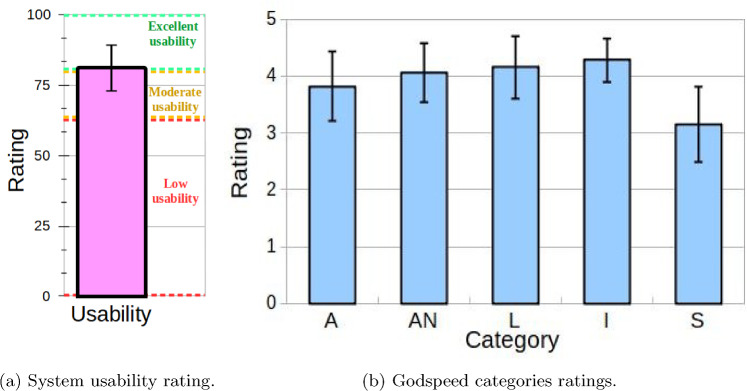
The decisions made by social robots while they fulfill their tasks have a strong influence on their performance. In these contexts, autonomous social robots must exhibit adaptive and social-based behavior to make appropriate decisions and operate correctly in complex and dynamic scenarios. This paper presents a Decision-Making System for social robots working on long-term interactions like cognitive stimulation or entertainment. The Decision-making System employs the robot’s sensors, user information, and a biologically inspired module to replicate how human behavior emerges in the robot. Besides, the system personalizes the interaction to maintain the users’ engagement while adapting to their features and preferences, overcoming possible interaction limitations. The system evaluation was in terms of usability, performance metrics, and user perceptions. We used the Mini social robot as the device where we integrated the architecture and carried out the experimentation. The usability evaluation consisted of 30 participants interacting with the autonomous robot in 30 min sessions. Then, 19 participants evaluated their perceptions of robot attributes of the Godspeed questionnaire by playing with the robot in 30 min sessions. The participants rated the Decision-making System with excellent usability (81.08 out of 100 points), perceiving the robot as intelligent (4.28 out of 5), animated (4.07 out of 5), and likable (4.16 out of 5). However, they also rated Mini as unsafe (security perceived as 3.15 out of 5), probably because users could not influence the robot’s decisions.
Overview
The claims and statistics of this paper haven’t been checked yet.
Free: it reads the open-access text and checks the first 5 claims that cite a source we can check. Create a free account to check every claim.
Integrity signals
Registry
Cites
Statistics
Figures
Verification
Claims the paper makes
The claims and statistics of this paper haven’t been checked yet.
Free: it reads the open-access text and checks the first 5 claims that cite a source we can check. Create a free account to check every claim.
Claims other papers make about this one
Each is checked against this paper’s own text: does it say what the citing paper says it does?
The cited source says what the claim attributes to it.
In the citing paper
“This was previously suggested by the developers of the MINI robot [23,24] regarding personalisation of human–robot interaction.”
Self-check
Percentages, sums and reported differences re-computed from the paper’s own numbers.
The self-check needs the paper’s full text.
Citations
Cites
Bartneck, C., Kulić, D., Croft, E., & Zoghbi, S. (2009) · International Journal of Social Robotics · doi:10.1007/s12369-008-0001-3 · Cited by 3,193
Handbook of Cognition and Emotion
(1999) · Wiley eBooks · doi:10.1002/0470013494 · Cited by 1,670
An ethological and emotional basis for human–robot interaction
Arkin, R. C., Fujita, M., Takagi, T., & Hasegawa, R. (2003) · Robotics and Autonomous Systems · doi:10.1016/s0921-8890(02)00375-5 · Cited by 278 · cited 2×
“[2] developed a pioneering motivational framework for the autonomous behavior of the social robot Aibo.”
BackgroundAllostasis, Homeostasis, and the Costs of Physiological Adaptation
(2004) · Cambridge University Press eBooks · doi:10.1017/cbo9781316257081 · Cited by 261
Homeostasis and soft robotics in the design of feeling machines
Man, K., & Damasio, A. (2019) · Nature Machine Intelligence · doi:10.1038/s42256-019-0103-7 · Cited by 172 · cited 1×
“For example, Man and Damasio [23] emulated a homeostatic model for social robots to exhibit autonomous and lively behavior.”
BackgroundMeta analysis of the usage of the Godspeed Questionnaire Series
Weiss, A., & Bartneck, C. (2015) · 2015 24th IEEE International Symposium on Robot and Human Interactive Communication (RO-MAN) · doi:10.1109/roman.2015.7333568 · Cited by 150 · cited 5×
“Although different interpretations can be made Evaluation method SUS [8] Godspeed [6] from the usability value obtained from the questionnaire, we use the one provided in [47] that maps each usability value in the 0-100 scale into a quality term.”
BackgroundMethodInfluentialMini: A New Social Robot for the Elderly
Salichs, M. A., Castro-González, Á., Salichs, E., Fernández-Rodicio, E., Maroto-Gómez, M., Gamboa-Montero, J. J., Marques-Villarroya, S., Castillo, J. C., Alonso-Martín, F., & Malfaz, M. (2020) · International Journal of Social Robotics · doi:10.1007/s12369-020-00687-0 · Cited by 145 · cited 2×
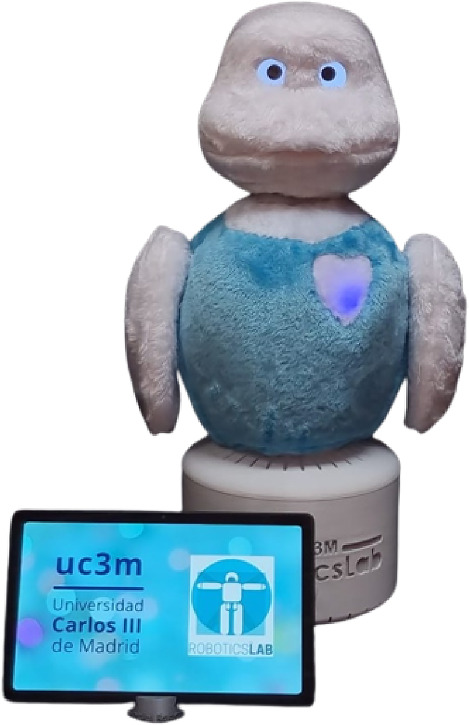
“The system was evaluated in two experiments integrating the DMS in the Mini social robot [35].”
BackgroundMethodSelf-citationFormosa, P. (2021) · Minds and Machines · doi:10.1007/s11023-021-09579-2 · Cited by 144 · cited 1×
“Social robots making autonomous decisions were devised to assist people in complex environments without a human controlling their behavior [14].”
BackgroundHong, A., Lunscher, N., Hu, T., Tsuboi, Y., Zhang, X., Franco dos Reis Alves, S., Nejat, G., & Benhabib, B. (2021) · IEEE Transactions on Cybernetics · doi:10.1109/tcyb.2020.2974688 · Cited by 119 · cited 3×
“Finally, Hong et al. [15] explored how affection influences the decision-making process in autonomous robots.”
BackgroundKe, C., Lou, V. W.-Q., Tan, K. C.-K., Wai, M. Y., & Chan, L. L. (2020) · International Journal of Medical Informatics · doi:10.1016/j.ijmedinf.2020.104241 · Cited by 107 · cited 1×
“Especially in long-term Human–Robot Interaction (HRI), maintaining the users’ engagement is essential for the robots to be accepted and employed in applications like entertainment, assistance, or cognitive stimulation therapies [16].”
BackgroundAdaptive optimization algorithm for nonlinear Markov jump systems with partial unknown dynamics
Fang, H., Zhu, G., Stojanovic, V., Nie, R., He, S., Luan, X., & Liu, F. (2021) · International Journal of Robust and Nonlinear Control · doi:10.1002/rnc.5350 · Cited by 102 · cited 1×
“As previous references state [12, 28, 41], generating dynamic behavior based on modeling natural phenomena has reported meaningful results in autonomous robots.”
BackgroundOptimal control of hydraulically driven parallel robot platform based on firefly algorithm
Nedić, N. N., Stojanović, V., & Djordjevic, V. (2015) · Nonlinear Dynamics · doi:10.1007/s11071-015-2252-5 · Cited by 95 · cited 1×
“As previous references state [12, 28, 41], generating dynamic behavior based on modeling natural phenomena has reported meaningful results in autonomous robots.”
BackgroundStojanović, V., & Nedić, N. N. (2015) · Journal of Optimization Theory and Applications · doi:10.1007/s10957-015-0706-z · Cited by 90 · cited 1×
“As previous references state [12, 28, 41], generating dynamic behavior based on modeling natural phenomena has reported meaningful results in autonomous robots.”
BackgroundAn Adaptive Robot Motivational System
Konidaris, G., & Barto, A. G. (2006) · Lecture notes in computer science · doi:10.1007/11840541_29 · Cited by 75 · cited 2×
“At a glance, it is possible to see that most of these works include motivation to urge behavior to reduce the robot’s deficits [2–5, 9, 19–23, 25, 27, 42].”
BackgroundPhysical and affective interaction between human and mental commit robot
Shibata, T., & Tanie, K. (2002) · Proceedings 2001 ICRA. IEEE International Conference on Robotics and Automation (Cat. No.01CH37164) · doi:10.1109/robot.2001.933010 · Cited by 73 · cited 1×
“In the late 1990s and early 2000s, the number of biologically inspired works describing how to endow social robots with autonomous behavior substantially grew [38, 40, 46].”
BackgroundMara, M., Appel, M., & Gnambs, T. (2022) · Zeitschrift für Psychologie · doi:10.1027/2151-2604/a000486 · Cited by 72
A Socially Adaptable Framework for Human-Robot Interaction
Tanevska, A., Rea, F., Sandini, G., Cañamero, L., & Sciutti, A. (2020) · Frontiers in Robotics and AI · doi:10.3389/frobt.2020.00121 · Cited by 61 · cited 1×
“[43] introduced its software architecture for social robots.”
Acceptance and Long-Term Use of a Social Robot by Elderly Users in a Domestic Environment
Piasek-Skupna, J., & Wieczorowska–Tobis, K. (2018) · Conference on Human System Interactions · doi:10.1109/hsi.2018.8431348 · Cited by 57
Olde Keizer, R. A. C. M., van Velsen, L., Moncharmont, M., Riche, B., Ammour, N., Del Signore, S., Zia, G., Hermens, H., & N’Dja, A. (2019) · Health and Technology · doi:10.1007/s12553-019-00320-9 · Cited by 57
Autonomous Agents and Ethical Decision-Making
Cervantes, J.-A., Rodríguez, L.-F., López, S., Ramos, F., & Robles, F. (2015) · Cognitive Computation · doi:10.1007/s12559-015-9362-8 · Cited by 54 · cited 2×
“[9] introduced a DMS for the intelligent autonomous behavior of social robots during HRI.”
BackgroundLewis, M., & Cañamero, L. D. (2016) · Adaptive Behavior · doi:10.1177/1059712316666331 · Cited by 46
A Motion System for Social and Animated Robots
Saldien, J., Vanderborght, B., Goris, K., Damme, M. V., & Lefeber, D. (2014) · International Journal of Advanced Robotic Systems · doi:10.5772/58402 · Cited by 37
Social Human-Robot Interaction: A New Cognitive and Affective Interaction-Oriented Architecture
Adam, C., Johal, W., Pellier, D., Fiorino, H., & Pesty, S. (2016) · Lecture notes in computer science · doi:10.1007/978-3-319-47437-3_25 · Cited by 37 · cited 3×
“Finally, only four works consider user preferences to adapt HRI, but all in short-lasting interactions [1, 15, 37, 42].”
BackgroundMethodMaroto-Gómez, M., Castro-González, Á., Castillo, J. C., Malfaz, M., & Salichs, M. Á. (2023) · User Modeling and User-Adapted Interaction · doi:10.1007/s11257-022-09321-2 · Cited by 37
Self-citationKhan, S., & Germak, C. (2018) · Future Internet · doi:10.3390/fi10100101 · Cited by 36
A Multidisciplinary Artificial Intelligence Model of an Affective Robot
Samani, H. A., & Saadatian, E. (2012) · International Journal of Advanced Robotic Systems · doi:10.5772/45662 · Cited by 35
Gómez, M. M., Castro‐González, Á., Castillo, J. C., Malfáz, M., & Salichs, M. A. (2018) · Sensors · doi:10.3390/s18082691 · Cited by 33 · cited 8×
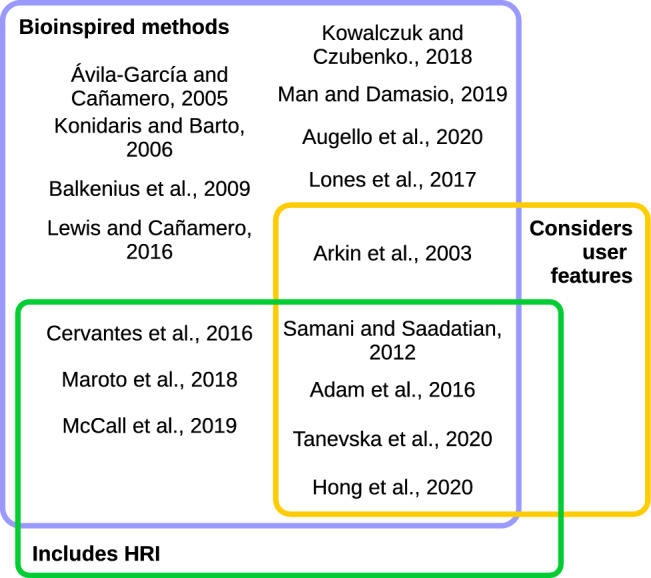
“This manuscript continues in “Related work” with a detailed review of DMSs based on biologically inspired concepts for autonomous social robots.”
BackgroundMethodInfluentialSelf-citationA Hormone-Driven Epigenetic Mechanism for Adaptation in Autonomous Robots
Lones, J., Lewis, M., & Cañamero, L. D. (2017) · IEEE Transactions on Cognitive and Developmental Systems · doi:10.1109/tcds.2017.2775620 · Cited by 28 · cited 1×
“One year later, Lones et al. [22] designed a homeostatic robot controller.”
BackgroundArtificial Motivation for Cognitive Software Agents
McCall, R. J., Franklin, S., Faghihi, U., Snaider, J., & Kugele, S. (2020) · Journal of Artificial General Intelligence · doi:10.2478/jagi-2020-0002 · Cited by 28 · cited 3×
“At a glance, it is possible to see that most of these works include motivation to urge behavior to reduce the robot’s deficits [2–5, 9, 19–23, 25, 27, 42].”
BackgroundUsability Evaluation of a Robotic System for Cognitive Testing
Nuovo, A. G. D., Varrasi, S., Conti, D., Bamsforth, J., Lucas, A. R., Soranzo, A., & McNamara, J. (2019) · ACM/IEEE International Conference on Human-Robot Interaction (HRI) · doi:10.1109/hri.2019.8673187 · Cited by 27
More Social and Emotional Behaviour May Lead to Poorer Perceptions of a Social Robot
Petisca, S., Dias, J., & Paiva, A. (2015) · Lecture notes in computer science · doi:10.1007/978-3-319-25554-5_52 · Cited by 23
Zou, J., Gauthier, S., Anzalone, S. M., Cohen, D., & Archambault, D. (2022) · Lecture notes in computer science · doi:10.1007/978-3-031-08645-8_26 · Cited by 19
Designing an Affective Cognitive Architecture for Human-Humanoid Interaction
Tanevska, A., Rea, F., Sandini, G., & Sciutti, A. (2018) · ACM/IEEE International Conference on Human-Robot Interaction (HRI) · doi:10.1145/3173386.3177035 · Cited by 18 · cited 2×
“Finally, only four works consider user preferences to adapt HRI, but all in short-lasting interactions [1, 15, 37, 42].”
BackgroundTowards Adaptation and Personalization in Task Based on Human-Robot Interaction
Tozadore, D. C., Valentini, J. P. H., Rodrigues, V. H., Vendrameto, F. M. L., Zavarizz, R. G., & Romero, R. A. F. (2018) · Latin American Robotics Symposium, Brazilian Symposium on Robotics and Workshop on Robotics in Education (LARS/SBR/WRE) · doi:10.1109/lars/sbr/wre.2018.00075 · Cited by 14 · cited 1×
“If the robot’s behavior adapts to the different situations and users, its performance is further improved [45].”
BackgroundAn Intelligent Decision-Making System for Autonomous Units Based on the Mind Model
Kowalczuk, Z., & Czubenko, M. (2018) · International Conference on Methods and Models in Automation and Robotics · doi:10.1109/mmar.2018.8486009 · Cited by 12 · cited 2×
“Regarding the influence of affection on decisions, a few works consider emotions in the decision-making process [1, 3, 5, 9, 15, 20, 37], although a few of them [2, 9, 20, 27, 42] modulate behavior depending on the robot’s emotional state.”
BackgroundTor-Carroggio, I., Segura, D., & Vilageliú, O. S. (2019) · Journal of Audiovisual Translation · doi:10.47476/jat.v2i2.77 · Cited by 10 · cited 1×
“We used the Spanish version [44] of the SUS questionnaire [8] for measuring the usability of the system (in this case, the robot controlled by our DMS).”
MethodRoesler, E., Steinhaeusser, S. C., Lugrin, B., & Onnasch, L. (2022) · Robotics · doi:10.3390/robotics12010003 · Cited by 9
Evaluating the Usability of New Software for Medication Management on a Social Robot
Broadbent, E., Walsh, R. M., Martini, N. D., Loveys, K., & Sutherland, C. J. (2020) · ACM/IEEE International Conference on Human-Robot Interaction (HRI) · doi:10.1145/3371382.3378320 · Cited by 8
An Artificial Soft Somatosensory System for a Cognitive Robot
Augello, A., Infantino, I., Gaglio, S., Maniscalco, U., Pilato, G., & Vella, F. (2020) · IEEE International Conference on Robotic Computing (IRC) · doi:10.1109/irc.2020.00058 · Cited by 3 · cited 2×
“[3] developed a motivational model to allow social robots to exhibit autonomous behavior.”
BackgroundThe autonomous social robot control based on the situation analysis
Kim, N., & Bodunkov, N. E. (2021) · Journal of Physics Conference Series · doi:10.1088/1742-6596/1958/1/012022 · Cited by 2 · cited 1×
“1 Systems Engineering and Automation, University Carlos III of Madrid, Butarque 15, 28911 Leganés, Madrid, Spain with humans require robust and adaptive decision-making to sustain the users’ attention correctly, keep them concentrated on the activity, and attain success [18].”
Background
Research works printed but not linked: 7
- Avila-Garcia O, Canamero L (2005) Hormonal modulation of perception in motivation-based action selection architectures. In: Proceedings of the Symposium on Agents that Want and Like, The Society for the Study of Artificial Intelligence and Simulation of Behaviour, pp 22–29
- Balkenius C, Morén J, Winberg S (2009) Interactions between motivation, emotion and attention: From biology to robotics. In: IEEE International Conference on Development and Learning
- Brooke J Sus: a retrospective J Usability Stud 2013 8 2 29 40
- Fernández Rodicio E (2021) Human-robot interaction architecture for interactive and lively social robots. PhD thesis, Systems Engineering and Automation
- Quigley M, Conley K, Gerkey B, et al (2009) Ros: an open-source robot operating system. In: ICRA workshop on open source software, Kobe, Japan, p 5
- Salichs San José E (2019) Ayuda a personas mayores con un robot social: estimulación cognitiva. https://doi org/101007/s12369-015-0319-6
- Velasquez J (1999) Building affective robots. Proceedings of Human Robotics
Cited by
Personalizing Activity Selection in Assistive Social Robots from Explicit and Implicit User Feedback
Gómez, M. M., Malfáz, M., Castillo, J. C., Castro‐González, Á., & Salichs, M. A. (2024) · International Journal of Social Robotics · doi:10.1007/s12369-024-01124-2 · Cited by 21
“In previous works [16, 18, 19], we developed decision-making architectures for autonomous social robots in cognitive stimulation and entertainment that make decisions by simulating an artificial biological state that drives motivated behavior.”
Self-citationde Wardt, J. P., Cayeux, E., Mihai, R., Macpherson, J., Annaiyappa, P., & Pirovolou, D. (2024) · SPE Journal · doi:10.2118/217754-ms · Cited by 19
Mahmoudi Asl, A., Toribio-Guzmán, J. M., Castro-González, Á., Malfaz, M., Salichs, M. A., & Franco Martín, M. (2024) · Sensors · doi:10.3390/s24227180 · Cited by 13
Self-citationAndriella, A., Falcone, G., & Rossi, S. (2025) · International Journal of Social Robotics · doi:10.1007/s12369-025-01280-z · Cited by 13
Gómez, M. M., Malfáz, M., Castro‐González, Á., Álvarez-Arias, S., & Salichs, M. A. (2024) · IEEE Access · doi:10.1109/access.2024.3508139 · Cited by 8
Self-citation
Metadata
- Authors
- Maroto-Gómez, M., Castro-González, Á., Malfaz, M., & Salichs, M. Á.
- Venue
- Complex & Intelligent Systems
- Published
- 2023-05-29
- Volume
- 9
- Issue
- 6
- Pages
- 6661-6679
- ISSN
- 2198-6053 (ISSN-L)
- 2199-4536
- PMC
- PMC10225289
- OpenAlex
- W4378627965
- Cited by
- 14
- References
- 40
- Citations by year
- 2026: 3 · 2025: 3 · 2024: 8
- FWCI
- 4.14
- Type
- journal article
- Language
- en
- Open access
- gold
- doi.org
- Licence
- cc-by
- creativecommons.org/licenses/by/4.0 (tdm)
- creativecommons.org/licenses/by/4.0 (vor)
- Locations
- Complex & Intelligent Systems (publishedVersion, cc-by)
- PubMed Central (publishedVersion, cc-by)
- PubMed (publishedVersion)
- e-Archivo (Carlos III University of Madrid) (submittedVersion, cc-by)
- DOAJ (DOAJ: Directory of Open Access Journals) (submittedVersion, cc-by-sa)
- Funders
- Ministerio de Ciencia, Innovación y Universidades
- Topics
- Social Sciences › Psychology › Social Psychology › Social Robot Interaction and HRI
- Physical Sciences › Computer Science › Artificial Intelligence › Speech and dialogue systems
- Physical Sciences › Computer Science › Artificial Intelligence › Psychiatry, Mental Health, Neuroscience
- Keywords
- social robots, decision-making systems, adaptive behavior, personalized interaction, user engagement, long-term human-robot interaction, cognitive stimulation, entertainment robots, usability evaluation, robot likability, perceived safety
About these checks
Registry, retraction, Cites and statistics results are computed, not judged, with one exception: a printed reference that no index lists is read once by a model before it counts as a citation error. Claims are extracted by a model and kept only when their quote appears verbatim in the text; each cited source is then checked, with a model’s help, for whether it says what the claim relies on. Those verdicts can be wrong — read the claim’s quote and the cited source before relying on one.
Statistics and arithmetic are recomputed, not judged.
Confidence bands are shown only for fields calibrated on our annotated test set. None is calibrated yet, so no band is shown.
What counts as a claim ›How we measure confidence ›How we check this ›
Are you an author, or do you see a problem with this page? Request a review
Data sources
Bibliographic data: Semantic Scholar, OpenAlex, Crossref.
Contains information from the Semantic Scholar Academic Graph Datasets, made available under the ODC Attribution License (ODC-BY 1.0).
Semantic Scholar’s data is described in: Kinney, R., et al. (2023). The Semantic Scholar Open Data Platform. arXiv:2301.10140.
