

An adaptive decision-making system supported on user preference predictions for human–robot interactive communication
Open accessThe DOI matches its Crossref record; 72 of the 72 references it cites were found in a registry or an index.
Abstract
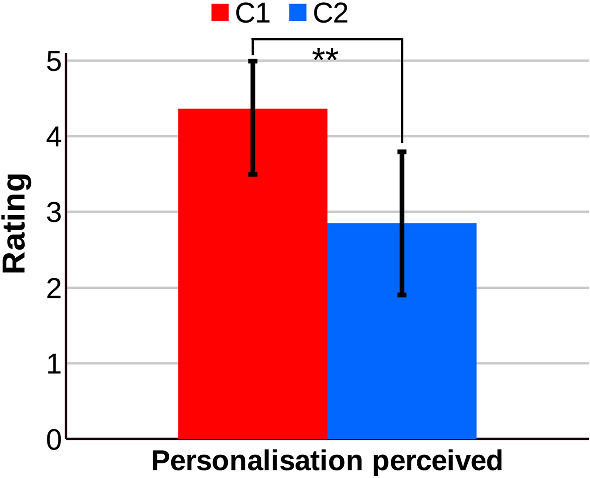
Adapting to dynamic environments is essential for artificial agents, especially those aiming to communicate with people interactively. In this context, a social robot that adapts its behaviour to different users and proactively suggests their favourite activities may produce a more successful interaction. In this work, we describe how the autonomous decision-making system embedded in our social robot Mini can produce a personalised interactive communication experience by considering the preferences of the user the robot interacts with. We compared the performance of Top Label as Class and Ranking by Pairwise Comparison, two promising algorithms in the area, to find the one that best predicts the user preferences. Although both algorithms provide robust results in preference prediction, we decided to integrate Ranking by Pairwise Comparison since it provides better estimations. The method proposed in this contribution allows the autonomous decision-making system of the robot to work on different modes, balancing activity exploration with the selection of the favourite entertaining activities. The operation of the preference learning system is shown in three real case studies where the decision-making system works differently depending on the user the robot is facing. Then, we conducted a human–robot interaction experiment to investigate whether the robot users perceive the personalised selection of activities more appropriate than selecting the activities at random. The results show how the study participants found the personalised activity selection more appropriate, improving their likeability towards the robot and how intelligent they perceive the system. query Please check the edit made in the article title.
Overview
The claims and statistics of this paper haven’t been checked yet.
Free: it reads the open-access text and checks the first 5 claims that cite a source we can check. Create a free account to check every claim.
Integrity signals
Registry
Cites
Statistics
Figures







Verification
Claims the paper makes
The claims and statistics of this paper haven’t been checked yet.
Free: it reads the open-access text and checks the first 5 claims that cite a source we can check. Create a free account to check every claim.
Claims other papers make about this one
Each is checked against this paper’s own text: does it say what the citing paper says it does?
The cited source says what the claim attributes to it.
In the citing paper
“This was previously suggested by the developers of the MINI robot [23,24] regarding personalisation of human–robot interaction.”
Self-check
Percentages, sums and reported differences re-computed from the paper’s own numbers.
The self-check needs the paper’s full text.
Citations
Cites
Breiman, L. (2001) · Machine Learning · doi:10.1023/a:1010933404324 · Cited by 133,538 · cited 3×
“Nonetheless, this survey does not contain any reference to LR in combination with random forest (Breiman 2001).”
BackgroundMethodIntroduction to Information Retrieval
Manning, C. D., Raghavan, P., & Schütze, H. (2008) · doi:10.1017/cbo9780511809071 · Cited by 11,288
Correlation Coefficients: Appropriate Use and Interpretation
Schober, P., Boer, C., & Schwarte, L. A. (2018) · Anesthesia & Analgesia · doi:10.1213/ane.0000000000002864 · Cited by 10,986 · cited 1×
“7 moderate, and weak otherwise (Corder and Foreman 2011; Schober et al. 2018).”
Bartneck, C., Kulić, D., Croft, E., & Zoghbi, S. (2009) · International Journal of Social Robotics · doi:10.1007/s12369-008-0001-3 · Cited by 3,193 · cited 1×
“Following the ad hoc questions, the second questionnaire consisted of the well-known Godspeed questionnaire (Bartneck et al. 2008), used for evaluating different attributes of social robots.”
MethodBobadilla, J., Ortega, F., Hernando, A., & Gutiérrez, A. (2013) · Knowledge-Based Systems · doi:10.1016/j.knosys.2013.03.012 · Cited by 3,158 · cited 1×
“LR applications range from information retrieval (Schütze et al. 2008) to search engines and recommender systems (Burke et al. 2011; Bobadilla et al. 2013).”
BackgroundDuan, Y., Edwards, J. S., & Dwivedi, Y. K. (2019) · International Journal of Information Management · doi:10.1016/j.ijinfomgt.2019.01.021 · Cited by 2,628 · cited 1×
“Autonomous decision-making is an emerging field that is gaining importance in applications such as military (Prelipcean et al. 2010; Goztepe 2015), economics (Parkes and Wellman 2015), or artificial intelligence (Duan et al. 2019).”
BackgroundImproved Use of Continuous Attributes in C4.5
Quinlan, J. R. (1996) · Journal of Artificial Intelligence Research · doi:10.1613/jair.279 · Cited by 1,846
The proof and measurement of association between two things
Spearman, C. (2010) · International Journal of Epidemiology · doi:10.1093/ije/dyq191 · Cited by 1,681 · cited 8×
“Table 2d shows the results obtained for Spearman’s ρ rank correlation.”
BackgroundMethodInfluentialSocial Robots for Long-Term Interaction: A Survey
Leite, I., Martinho, C., & Paiva, A. (2013) · International Journal of Social Robotics · doi:10.1007/s12369-013-0178-y · Cited by 871 · cited 1×
“AsLeiteetal.”
THE TREATMENT OF TIES IN RANKING PROBLEMS
KENDALL, M. G. (1945) · Biometrika · doi:10.1093/biomet/33.3.239 · Cited by 809 · cited 3×
“Kendall’s τ -b (Kendall 1945) developed this nonparametric measure of correlation between two rankingsπ andπ ′, like Eq.”
Method
Research works printed but not linked: 13
- Aiolli, F., Sperduti, A.: Learning preferences for multiclass problems. Adv. Neural Info. Process. Syst., pp 17–24 (2005)
- Brinker, K., Hüllermeier, E.: Case-based multilabel ranking. In: IJCAI, pp 702–707 (2007)
- Burke, R., Felfernig, A., Göker, M.H.: Recommender systems: an overview. Ai Mag. 32(3), 13–18 (2011)
- Chen, Y., Zhang, J., Guo, M., Cao, J.: Learning user preference from heterogeneous information for store-type recommendation. IEEE Trans. Serv. Comput. (2017)
- Cohen, W.W., Schapire, R.E., Singer, Y.: Learning to order things. Adv. Neural Info. Process. Syst., pp 451–457 (1998)
- Dery, L.: Multi-label ranking: Mining multi-label and label ranking data. arXiv preprint arXiv:210100583 (2021)
- Efron, B.: Student’s t-test under symmetry conditions. J. Am. Stat. Assoc. 64(328), 1278–1302 (1969)
- Goztepe, K.: New directions in military and security studies: artificial intelligence and military decision making process. Int. J. Info. Security Sci. 4(2), 69–80 (2015)
- Olaronke, I., Oluwaseun, O., Rhoda, I.: State of the art: a study of human-robot interaction in healthcare. Int. J. Info. Eng. Elect. Bus. 9(3), 43 (2017)
- Prelipcean, G., Boscoianu, M., Moisescu, F.: New ideas on the artificial intelligence support in military applications. In: Proceedings of the 9th WSEAS international conference on Artificial intelligence, knowledge engineering and data bases, World Scientific and Engineering Academy and Society (WSEAS), pp 34–39 (2010)
- Woodworth, B., Ferrari, F., Zosa, T.E., Riek, L.D.: Preference learning in assistive robotics: Observational repeated inverse reinforcement learning. In: Machine learning for healthcare conference, PMLR, pp 420–439 (2018)
- You, R., Zhang, Z., Wang, Z., Dai, S., Mamitsuka, H., Zhu, S.: Attentionxml: label tree-based attention-aware deep model for high-performance extreme multi-label text classification. Adv. Neural Info. Process. Syst. 32, 5820–5830 (2019)
- Zheng, Z., Zha, H., Zhang, T., Chapelle, O., Chen, K., Sun, G.: A general boosting method and its application to learning ranking functions for web search. Adv. Neural Info. Process. Syst., pp 1697–1704 (2008)
Cited by
Remote Sensing Image Classification: A Comprehensive Review and Applications
Mehmood, M., Shahzad, A., Zafar, B., Shabbir, A., & Ali, N. (2022) · Mathematical Problems in Engineering · doi:10.1155/2022/5880959 · Cited by 250
Gómez, M. M., Alonso-Martín, F., Malfáz, M., Castro‐González, Á., Castillo, J. C., & Salichs, M. A. (2023) · International Journal of Social Robotics · doi:10.1007/s12369-023-00977-3 · Cited by 84
Self-citationGenerative Artificial Intelligence: Fundamentals
Corchado, J. M., Sebastian López, F., V., J., Raul Garcia, S., & Chamoso, P. (2023) · ADCAIJ ADVANCES IN DISTRIBUTED COMPUTING AND ARTIFICIAL INTELLIGENCE JOURNAL · doi:10.14201/adcaij.31704 · Cited by 62
Chang, W.-C., & Hasanzadeh, S. (2025) · Advanced Engineering Informatics · doi:10.1016/j.aei.2025.103110 · Cited by 25
Llama 2: Early Adopters' Utilization of Meta's New Open-Source Pretrained ModelPreprint
Roumeliotis, K. I., Tselikas, N. D., & Nasiopoulos, D. Κ. (2023) · Preprints.org · doi:10.20944/preprints202307.2142.v1 · Cited by 40
Metadata
- Authors
- Maroto-Gómez, M., Castro-González, Á., Castillo, J. C., Malfaz, M., & Salichs, M. Á.
- Affiliations
- Universidad Carlos III de Madrid (ES)
- ORCID
- Venue
- User Modeling and User-Adapted Interaction
- Published
- 2022-04-09
- Volume
- 33
- Issue
- 2
- Pages
- 359-403
- ISSN
- 0924-1868 (ISSN-L)
- 1573-1391
- PMC
- PMC8994572
- OpenAlex
- W4224292998
- Cited by
- 37
- References
- 72
- Citations by year
- 2026: 6 · 2025: 9 · 2024: 10 · 2023: 9 · 2022: 3
- FWCI
- 7.32
- Type
- journal article
- Language
- en
- Open access
- hybrid
- doi.org
- Licence
- cc-by
- creativecommons.org/licenses/by/4.0 (tdm)
- creativecommons.org/licenses/by/4.0 (vor)
- Locations
- User Modeling and User-Adapted Interaction (publishedVersion, cc-by)
- PubMed Central (publishedVersion, cc-by)
- PubMed (publishedVersion)
- e-Archivo (Carlos III University of Madrid) (submittedVersion, cc-by)
- e-Archivo (Carlos III University of Madrid) (submittedVersion, cc-by-nc-nd)
- Funders
- Ministerio de Ciencia, Innovación y Universidades
- Topics
- Social Sciences › Psychology › Social Psychology › Social Robot Interaction and HRI
- Physical Sciences › Computer Science › Information Systems › Recommender Systems and Techniques
- Physical Sciences › Computer Science › Artificial Intelligence › Speech and dialogue systems
- Keywords
- user preference prediction, social robots, human-robot interaction, adaptive decision-making, preference learning, robot likeability, small robots
About these checks
Registry, retraction, Cites and statistics results are computed, not judged, with one exception: a printed reference that no index lists is read once by a model before it counts as a citation error. Claims are extracted by a model and kept only when their quote appears verbatim in the text; each cited source is then checked, with a model’s help, for whether it says what the claim relies on. Those verdicts can be wrong — read the claim’s quote and the cited source before relying on one.
Statistics and arithmetic are recomputed, not judged.
Confidence bands are shown only for fields calibrated on our annotated test set. None is calibrated yet, so no band is shown.
What counts as a claim ›How we measure confidence ›How we check this ›
Are you an author, or do you see a problem with this page? Request a review
How to cite
Cite CoChat for the checks on this page, and the paper for its own findings.
- This page
- CoChat. (2026). Citation check: An adaptive decision-making system supported on user preference predictions for human–robot interactive communication. https://app.cochat.ai/papers/10.1007/s11257-022-09321-2
- The paper
- Maroto-Gómez, M., Castro-González, Á., Castillo, J. C., Malfaz, M., & Salichs, M. Á. (2023). An adaptive decision-making system supported on user preference predictions for human–robot interactive communication. User Modeling and User-Adapted Interaction. https://doi.org/10.1007/s11257-022-09321-2
Data sources
Bibliographic data: Semantic Scholar, OpenAlex, Crossref.
Contains information from the Semantic Scholar Academic Graph Datasets, made available under the ODC Attribution License (ODC-BY 1.0).
Semantic Scholar’s data is described in: Kinney, R., et al. (2023). The Semantic Scholar Open Data Platform. arXiv:2301.10140.
