

Estimation of carbon sequestration in reclaimed coalmine degraded land dominated by Albizia lebbeck, Dalbergia sissoo and Bambusa arundinacea plantation: a case study from Jharia Coalfields, India
Open accessThe DOI matches its Crossref record; 81 of the 81 references it cites were found in a registry or an index.
Abstract
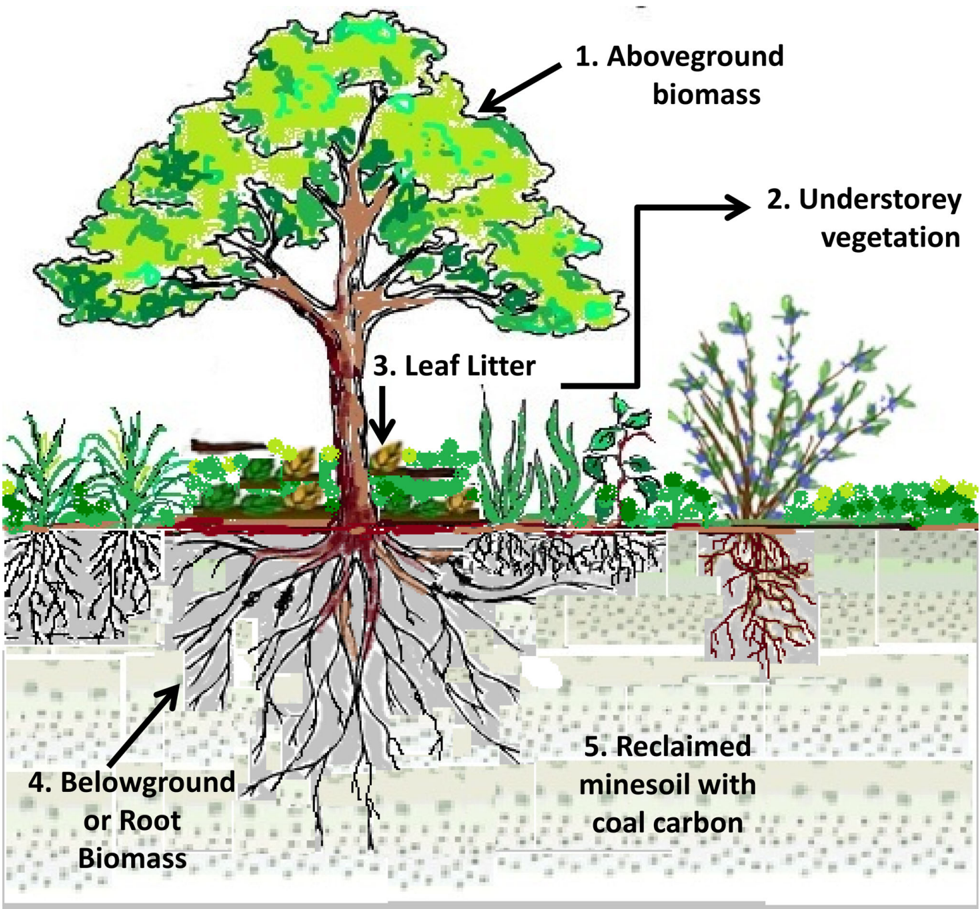
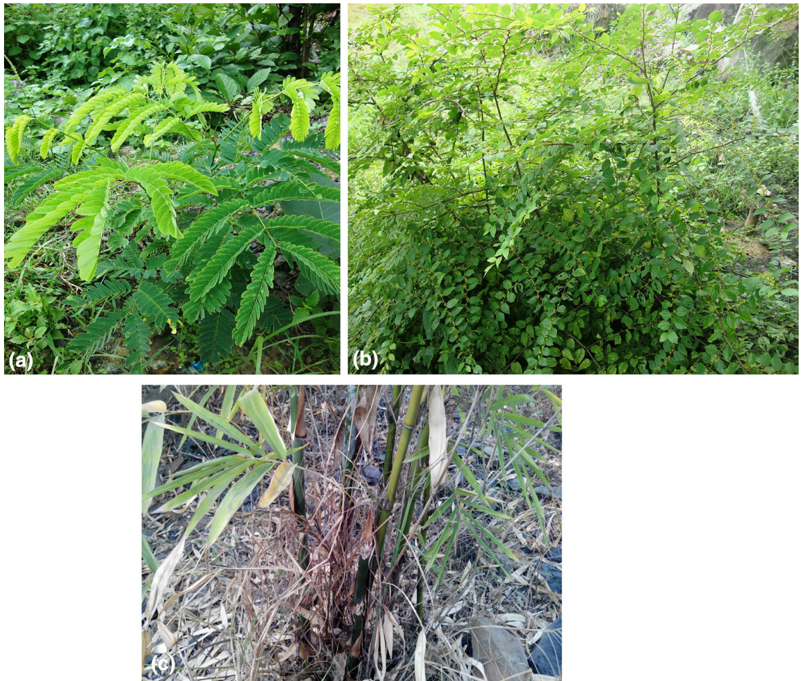
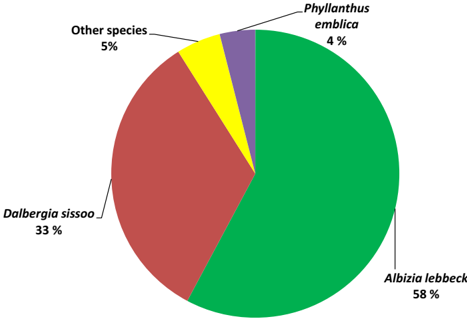
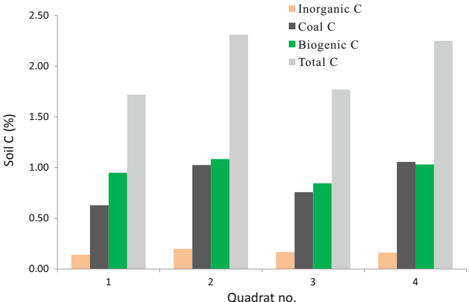
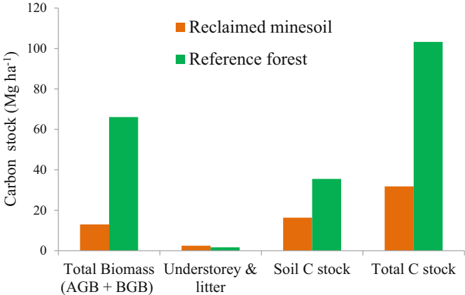
Reclaimed mined lands provide an excellent opportunity to sequester carbon and combat global warming. Carbon sequestration on reclaimed sites depend on age of reclamation, composition of species, geomining conditions (soil characteristics) and prevailing climate. The aims of the present study were to calculate carbon (C)—stock of biomass of 4 years old plantation (dominated by Albizia lebbeck , Dalbergia sissoo and Bambusa arundinacea ), understorey vegetation and litter, soil organic carbon in reclaimed minesoil (RMS) and compare with reference forest site. Allometric equation was used for the estimation of biomass C stock and found 13.0 Mg C ha −1 ( A lebbeck 7.8 Mg C ha −1 , D sissoo 3.5 Mg C ha −1 and B. arundincea 1.2 Mg C ha −1 ), while stock of understorey vegetation was 0.98 Mg C ha −1 . In RMS, C stock was 16.3 Mg C ha −1 , out of which inorganic C contributed 1.7 g kg −1 (8 % of total soil C), Coal C 8.7 g kg −1 (43 % of total soil C) and biogenic C 9.8 g kg −1 (49 % of total soil C). Total C stock in reclaimed site was calculated as 30.3 Mg C ha −1 (equivalent to 111 Mg CO 2 ha −1 ). The study concluded that (i) coal C is responsible for overestimation of C stock in RMS (ii) Maximun C stock stored in aboveground biomass component and (iii) reclaimed mined lands will take approximately 17 years to reach the level of C stock of reference forest site in dry tropical climate.
Overview
The claims and statistics of this paper haven’t been checked yet.
Free: it reads the open-access text and checks the first 5 claims that cite a source we can check. Create a free account to check every claim.
Integrity signals
Registry
Cites
Statistics
Figures
Verification
Claims the paper makes
The claims and statistics of this paper haven’t been checked yet.
Free: it reads the open-access text and checks the first 5 claims that cite a source we can check. Create a free account to check every claim.
Claims other papers make about this one
Each is checked against this paper’s own text: does it say what the citing paper says it does?
The check wasn’t confident either way, so it gives no verdict — never disputed.
In the citing paper
“Labile pool has a residence time of years to a few decades while the recalcitrant carbon pool can remain in the soil for hundreds to thousands of years [37].”
From Eco-Restoration of Coal Mine Spoil: Biochar Application and Carbon Sequestration for Achieving UN Sustainable Development Goals 13 and 15 (2021) · cites this paper as [37]
Experimental — accuracy not yet measured
Self-check
Percentages, sums and reported differences re-computed from the paper’s own numbers.
The self-check needs the paper’s full text.
Citations
Cites
Total Carbon, Organic Carbon, and Organic Matter
Nelson, D. W., & Sommers, L. E. (1996) · SSSA Book Series · doi:10.2136/sssabookser5.3.c34 · Cited by 10,491 · cited 1×
“Soil organic carbon was estimated by rapid dichromate oxidation technique (Nelson and Sommers 1996), available nitrogen by the alkaline potassium permanganate method (Subbiah and Asija 1956), available phosphorus by Bray’s method (Bray and Kurtz 1966).”
MethodSoil Carbon Sequestration Impacts on Global Climate Change and Food Security
Lal, R. (2004) · Science · doi:10.1126/science.1097396 · Cited by 8,376 · cited 1×
“The total soil carbon content is considered as a key component of minesoil quality and its storage in reclaimed soil is recognized promising measure for mitigating global climate change through carbon sequestration (Lal 2004, 2005).”
BackgroundDETERMINATION OF TOTAL, ORGANIC, AND AVAILABLE FORMS OF PHOSPHORUS IN SOILS
BRAY, R. H., & KURTZ, L. T. (1945) · Soil Science · doi:10.1097/00010694-194501000-00006 · Cited by 7,795 · cited 1×
“Soil organic carbon was estimated by rapid dichromate oxidation technique (Nelson and Sommers 1996), available nitrogen by the alkaline potassium permanganate method (Subbiah and Asija 1956), available phosphorus by Bray’s method (Bray and Kurtz 1966).”
MethodBiogeochemistry: an Analysis of Global Change
(1991) · Elsevier eBooks · doi:10.1016/c2012-0-01654-7 · Cited by 3,443
Mclean, E. O. (1982) · Agronomy Monographs · doi:10.2134/agronmonogr9.2.2ed.c12 · Cited by 3,310
Soil carbon sequestration and land‐use change: processes and potential
Post, W. M., & Kwon, K. C. (2000) · Global Change Biology · doi:10.1046/j.1365-2486.2000.00308.x · Cited by 2,602 · cited 1×
“Post and Kwon (2000) also reported a higher average C accumulation of 0.34 Mg C ha-1 year-1 (at the top 30 cm soil in tropical to temperate forest) than permanent grasslands (0.74 Mg ha-1 year-1 tropical dry lands to cool temperate ecoregion) which is lower than the RMS.”
InfluentialRoot biomass allocation in the world's upland forests
Cairns, M. A., Brown, S., Helmer, E. H., & Baumgardner, G. A. (1997) · Oecologia · doi:10.1007/s004420050201 · Cited by 1,622 · cited 3×
“The use of constant factor may over/under estimate the total C stock (Cairns et al. 1997).”
BackgroundMethodInfluentialEstimating biomass and biomass change of tropical forests: A primer
Brown, S. (1997) · Medical Entomology and Zoology · Cited by 1,320
Biomass Estimation Methods for Tropical Forests with Applications to Forest Inventory Data
Brown, S., Gillespie, A. J. R., & Lugo, A. E. (1989) · Forest Science · doi:10.1093/forestscience/35.4.881 · Cited by 1,279 · cited 7×
“…the tree biomass are: (a) regression equations or allometric equations which provide estimates of biomass per tree based on three main climatic zones, regardless of species; and (b) the conversion of wood volume to biomass density using biomass expansion factors (Brown et al. 1989; Brown 1997).”
BackgroundMethodInfluentialAndrews, S. S., Karlen, D. L., & Mitchell, J. P. (2002) · Agriculture, Ecosystems & Environment · doi:10.1016/s0167-8809(01)00174-8 · Cited by 1,277 · cited 2×
“Nitrogen accumulation is controlled by organic carbon input and N fixation, while phosphorus content is determined by the organic matter, pH of the soil substrate and weathering process (Andrews et al. 2002).”
Background
Research works printed but not linked: 7
- Burger JA (2004) Restoring forests on mined land in the Appalachi- ans: results and outcomes of a 20-year research program. In: Barnhisel RI (ed) Proceedings of a joint conference of American Society of Mining and Reclamation. 21 st annual national conference, 25th West Virginia surface mine drainage task force symposium Morgantown, WV, p 260
- Chandra D (1992) Jharia coalfield. Geological Society of India, Bangalore, pp 1-11
- Coppin NJ, Bradshaw AD (1982) Quarry reclamation. Mining Journal Books, London, pp 8-17
- IPCC (2000) Special report on land use, land use change, and forestry, summary for policy makers. Intergovernmental Panel on Climate Change, Cambridge University Press, Cambridge
- IPCC (2006) IPCC Guidelines for national greenhouse gas invento- ries. Intergovernmental Panel on Climate Change, NGGIP Publications, IGES, Japan
- Jacinthe PA, Lal R, Ebinger M (2004) Carbon sequestration in reclaimed mined lands. In: Proceedings of the second annual carbon sequestration conference, 5-8 May, Alexandria, VA
- Subbiah BV, Asija GL (1956) A rapid procedure for the determina- tion of available nitrogen in soils. Curr Sci 25:259-260
Cited by
Jinger, D., Kaushal, R., Kumar, R., Paramesh, V., Verma, A., Shukla, M., Chavan, S. B., Kakade, V. D., Dobhal, S., Uthappa, A. R., et al. (2023) · Frontiers in Ecology and Evolution · doi:10.3389/fevo.2023.1088796 · Cited by 143
“…and Bambusa arundinacea Planting of saplings in 30 cm × 30 cm × 30 cm pit with the addition of topsoil with weathered overburden material in 1:4 ratio Das and Maiti (2016) Jharia Coal mines Albizia lebbeck and Dalbergia sissoo accumulation 85% of the natural forest carbon pool after 8 years…”
BackgroundAhirwal, J., Maiti, S. K., & Singh, A. K. (2017) · Science of The Total Environment · doi:10.1016/j.scitotenv.2017.01.043 · Cited by 121
Self-citationAhirwal, J., & Maiti, S. K. (2018) · CATENA · doi:10.1016/j.catena.2018.03.026 · Cited by 117
Self-citationRaj, D., Chowdhury, A., & Maiti, S. K. (2017) · Human and Ecological Risk Assessment An International Journal · doi:10.1080/10807039.2016.1278519 · Cited by 117
Self-citationAhirwal, J., & Maiti, S. K. (2017) · Journal of Environmental Management · doi:10.1016/j.jenvman.2017.07.003 · Cited by 82
Self-citation
Metadata
- Authors
- Das, R., & Maiti, S. K.
- Affiliations
- Indian Institute of Technology Dhanbad (IN)
- Corresponding author
- Maiti, Subodh Kumar
- ORCID
- Maiti, Subodh Kumar
- Venue
- International Journal of Coal Science & Technology
- Published
- 2016-06
- Volume
- 3
- Issue
- 2
- Pages
- 246-266
- ISSN
- 2095-8293 (ISSN-L)
- 2198-7823
- OpenAlex
- W2470454035
- Cited by
- 41
- References
- 81
- Citations by year
- 2026: 5 · 2025: 4 · 2024: 8 · 2023: 2 · 2022: 5 · 2021: 4 · 2020: 4 · 2019: 1 · 2018: 4 · 2017: 3 · 2016: 1
- FWCI
- 2.59
- Type
- journal article
- Language
- en
- Open access
- diamond
- doi.org
- Locations
- International Journal of Coal Science & Technology (publishedVersion, cc-by)
- Greater South Information System
- Funders
- Bharat Coking Coal Limited (BCCL) (ISM/CONS/Link up No 486 page 44/2015)
- Topics
- Life Sciences › Agricultural and Biological Sciences › Forestry › Forest ecology and management
- Life Sciences › Agricultural and Biological Sciences › Soil Science › Soil Carbon and Nitrogen Dynamics
- Life Sciences › Agricultural and Biological Sciences › Forestry › Forest, Soil, and Plant Ecology in China
- Keywords
- carbon sequestration, Albizia lebbeck, Dalbergia sissoo, Bambusa arundinacea, aboveground carbon, soil organic carbon, understory vegetation, litter carbon, allometric equations, Jharia coalfield
About these checks
Registry, retraction, Cites and statistics results are computed, not judged, with one exception: a printed reference that no index lists is read once by a model before it counts as a citation error. Claims are extracted by a model and kept only when their quote appears verbatim in the text; each cited source is then checked, with a model’s help, for whether it says what the claim relies on. Those verdicts can be wrong — read the claim’s quote and the cited source before relying on one.
Statistics and arithmetic are recomputed, not judged.
Confidence bands are shown only for fields calibrated on our annotated test set. None is calibrated yet, so no band is shown.
What counts as a claim ›How we measure confidence ›How we check this ›
Are you an author, or do you see a problem with this page? Request a review
Data sources
Bibliographic data: Semantic Scholar, OpenAlex, Crossref.
Contains information from the Semantic Scholar Academic Graph Datasets, made available under the ODC Attribution License (ODC-BY 1.0).
Semantic Scholar’s data is described in: Kinney, R., et al. (2023). The Semantic Scholar Open Data Platform. arXiv:2301.10140.
