

Epistemic decentering in education for responsibility: revisiting the theory and practice of educational integrity
Open accessThe DOI matches its Crossref record; 61 of the 61 references it cites were found in a registry or an index.
Abstract
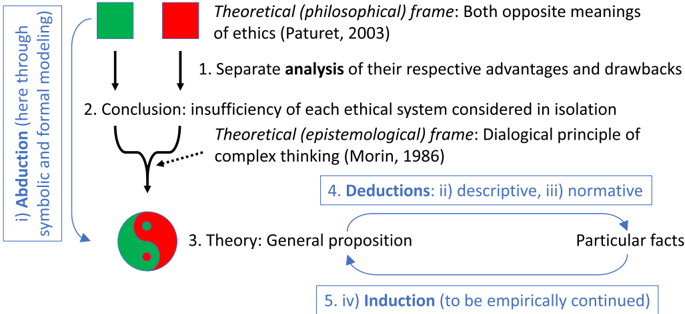
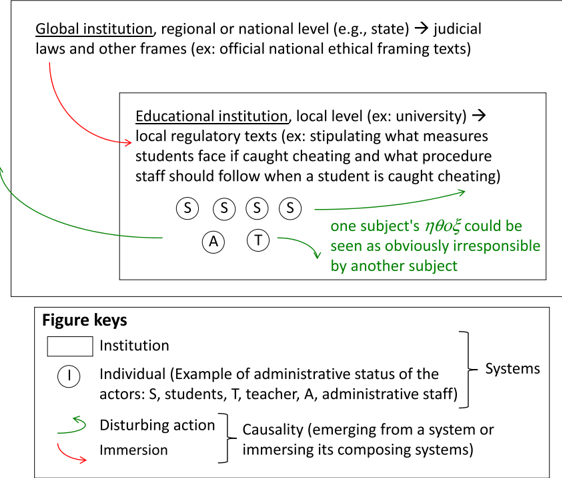
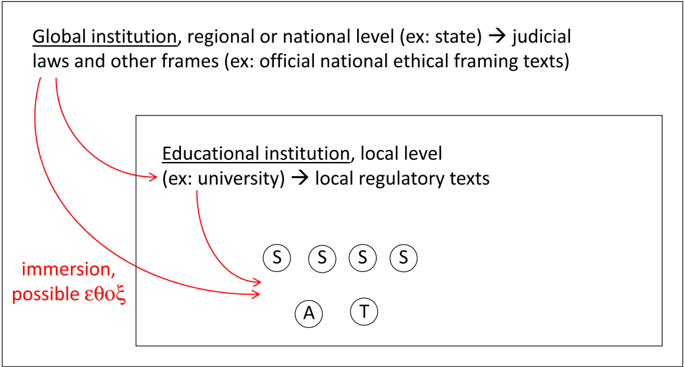
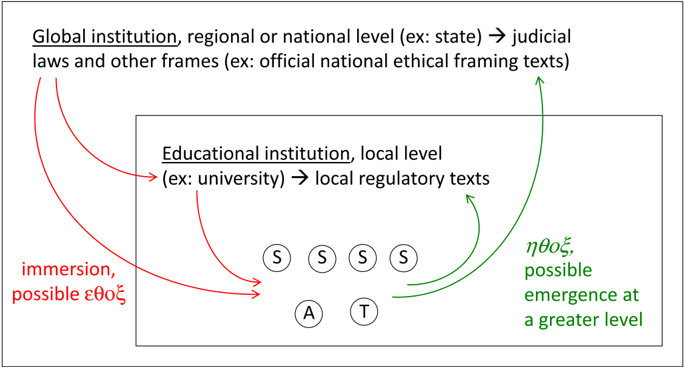
There is no consensus on definitions of educational or academic integrity, and their philosophical relationship with the notion of responsibility is complex. Here, we aim to i) disentangle these three notions. We lean on a philosophical framework of ethics and our method involves different kinds of reasoning and the modeling of complex thinking. We combine this frame with a three-level epistemic dimension to allow us ii) to model the psycho-epistemic (level 1), epistemological (level 2), and phenomenological (ground 0) ways in which subjects interact with their own norms and knowledge and with those of the surrounding institutions. Finally, iii) we also aim to propose concrete educational means by which to implement educational integrity. Our theoretical findings lead us i) to consider responsibility as a process that consists of establishing a dialogical relationship between one’s inner and outer worlds, which relies on an epistemic decentering. Based on this, we argue that education for responsibility founds a new, expanded definition of educational integrity. Moreover, ii) empirical evidence suggests that this model can be operationalized by psychological indicators such as critical and complex thinking, cognitive flexibility, contextual relativism, and decentering, all of which are skills that can be fostered in spite of simplifying thinking, dogmatism, naive epistemology (and dualism) and cognitive fusion, respectively. It points to iii) the benefits of an educational approach in which subjects are encouraged to practice different types of meditation and to feel free to break institutional rules. Therefore, promoting educational integrity may require methods that lie beyond the obvious choices. After discussing the scope and limitations of our results, we propose a new research agenda for educational integrity, which could ground a field of research broader than just academic integrity, but complementary to it.
Overview
The claims and statistics of this paper haven’t been checked yet.
Free: it reads the open-access text and checks the first 5 claims that cite a source we can check. Create a free account to check every claim.
Integrity signals
Registry
Cites
Statistics
Figures
Verification
Claims the paper makes
The claims and statistics of this paper haven’t been checked yet.
Free: it reads the open-access text and checks the first 5 claims that cite a source we can check. Create a free account to check every claim.
Claims other papers make about this one
Each is checked against this paper’s own text: does it say what the citing paper says it does?
The source backs part of the claim, not all of it — or backs it for a different population, condition or comparison.
In the citing paper
“Traditionally linked to plagiarism and cheating (Macfarlane et al., 2014), it lacks a universally accepted definition in the AI era (Hagège, 2023).”
From Academic Integrity and Students’ Ethical Use of ChatGPT in Higher Education (2026) · cites this paper as Hagège, 2023
Experimental — accuracy not yet measuredThe cited source says what the claim attributes to it.
In the citing paper
“There is no universal definition of academic integrity (Hagège, 2023).”
From Purpose before policy: academic integrity, generative AI, and rhetorical stance (2026) · cites this paper as Hagège, 2023
Self-check
Percentages, sums and reported differences re-computed from the paper’s own numbers.
The self-check needs the paper’s full text.
Citations
Cites
Self-determination theory: A macrotheory of human motivation, development, and health
Deci, E. L., & Ryan, R. M. (2008) · Canadian Psychology / Psychologie canadienne · doi:10.1037/a0012801 · Cited by 6,664 · cited 1×
“Indeed, self-determination is widely regarded in psychology research as a fundamental factor in optimal human functioning and motivation, where autonomy is seen as a basic psychological need that should be favored by education (Deci and Ryan 2008).”
BackgroundForms of Intellectual and Ethical Development in the College Years; A Scheme
Perry, W. G. (1970) · Cited by 5,521
Studies of independence and conformity: I. A minority of one against a unanimous majority
Asch, S. E. (1956) · Psychological Monographs: General and Applied · doi:10.1037/h0093718 · Cited by 4,267
Shapiro, S. L., Carlson, L. E., Astin, J. A., & Freedman, B. (2006) · Journal of Clinical Psychology · doi:10.1002/jclp.20237 · Cited by 4,002 · cited 1×
“The most widely-known set of meditation techniques are those of secular mindfulness meditation, which promotes self-knowing and behavioral regulation while also, more broadly, fostering cognitive defusion and decentering (Blackledge and Hayes 2001; Shapiro et al. 2006).”
BackgroundAttention regulation and monitoring in meditation
Lutz, A., Slagter, H. A., Dunne, J. D., & Davidson, R. J. (2008) · Trends in Cognitive Sciences · doi:10.1016/j.tics.2008.01.005 · Cited by 2,659
Meditation, mindfulness and cognitive flexibility
Moore, A., & Malinowski, P. (2009) · Consciousness and Cognition · doi:10.1016/j.concog.2008.12.008 · Cited by 1,220
Some Conditions of Obedience and Disobedience to Authority
Milgram, S. (1965) · Human Relations · doi:10.1177/001872676501800105 · Cited by 1,141
The psychological effects of meditation: a meta-analysis
Sedlmeier, P., Eberth, J., Schwarz, M., Zimmermann, D., Haarig, F., Jaeger, S., & Kunze, S. (2012) · Psychological Bulletin · doi:10.1037/a0028168 · Cited by 910 · cited 1×
“2022), cognitive flexibility (Moore and Malinowski 2009), connection with others (Sedlmeier et al. 2012; Seppala et al. 2014), and non-dual awareness (Hanley et al.”
BackgroundCritical thinking in education: a review
Pithers, R. T., & Soden, R. (2000) · Educational Research · doi:10.1080/001318800440579 · Cited by 810
Fresco, D. M., Moore, M. T., van Dulmen, M. H. M., Segal, Z. V., Ma, S. H., Teasdale, J. D., & Williams, J. M. G. (2007) · Behavior Therapy · doi:10.1016/j.beth.2006.08.003 · Cited by 810
Research works printed but not linked: 23
- Barry ES (2006) Can paraphrasing practice help students define plagiarism? College Stud J 40(2):377-384
- Beaufort S, Caussidier C, Hagège H, Hausberger B, Hausberger T, Molinatti G (2015) Robert JP (2015) Organiser un débat en classe sur une question scientifique socialement vive : pourquoi et comment ? Bull Pédag Trim APBG 1:85-104
- Diamond C (2001) Integrity. In: Becker LC, Becker CB (eds) Encyclopedia of ethics, 2nd edn. Routledge, New York, pp 863-866
- Division of mental health (1993) Life skills education for children and adolescents in schools. WHO, Genève
- Favre D (2007) Transformer la violence des élèves. Dunod, Paris
- Hagège H, Dartnell C, Sallantin J (2007) Positivism against constructivism: a network game to learn epistemology. In:
- Takeda V, Suzuki E (eds) Discovery science 2007 vol4755. LCNS, Springer, Heidelberg, pp 91-103
- Hagège H (2022) Educational Mindfulness-based Ethics of Responsibility (MBER) Program. Wise intentions, consciousness and reflexivities. Wiley, New York
- Hess R (1998) La pratique du journal : l'enquête au quotidien. Tétraèdre, Paris
- Jamieson S, Howard R (2019) Rethinking the relationship between plagiarism and academic integrity. Int J Tech High Ed 16(2):69-85
- Jorro A (2005) Réflexivité et auto-évaluation dans les pratiques enseignantes. Rev Mes Éval En Éduc 27:33-47 Hagège International Journal for Educational Integrity (2023) 19:18
- Leblanc S (2007) Concepts et méthodes pour valoriser l'activité professionnelle au sein de la formation initiale et con- tinue des enseignants. Form Prat D'enseignement En Quest 6:11-33
- Morin E (1986) La méthode : Tome 3, La connaissance de la connaissance. Seuil, Paris Morin E (2014) La méthode : Tome 6, Ethique. Points, Paris
- Morin E (2014) La méthode : Tome 6, Ethique. Points, Paris
- Myers D (2009) Social psychology. McGraw-Hill Publishing Company, New York
- Orange C (1997) Problèmes et modélisation en biologie. Presses Universitaires de France, Paris
- Paturet J-B (2003) De la responsabilité en éducation. Erès, Paris
- Pettit P (2001) Institutions. In: Becker LC, Becker CB (eds) Encyclopedia of ethics, 2nd edn. Routledge, New York, pp 858-863
- Polk KL, Schoendorff B (2014) The ACT matrix: a new approach to building psychological flexibility across settings and populations. New Harbinger Publications, Oakland
- Swaner LE (2005) Educating for personal and social responsibility: a review of the literature. Lib Educ 91:14-21
- Turrisi PA (1990) Peirce's logic of discovery: abduction and the universal categories. Trans CS Peirce Soc 26(4):465-497
- Villano M (2006) Fighting plagiarism: taking the work out of homework. T.H.E. J 33(15):24-30
- Zimmerman MJ (2001) Responsibility. In: Becker LC, Becker CB (eds) Encyclopedia of ethics, 2nd edn. Routledge, New York, pp 1486-1492
Cited by
Balalle, H., & Pannilage, S. (2025) · Social Sciences & Humanities Open · doi:10.1016/j.ssaho.2025.101299 · Cited by 137
What do we mean by academic integrity?
Andrés Mejía, D., & Garcés-Flórez, M. F. (2025) · International Journal for Educational Integrity · doi:10.1007/s40979-024-00176-1 · Cited by 50
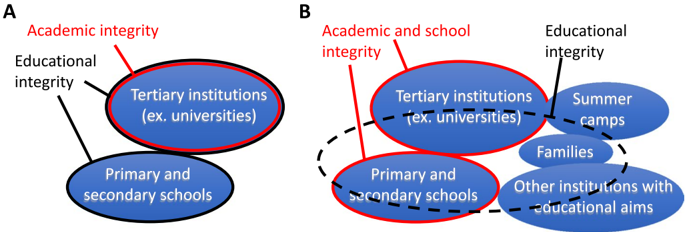
“Some authors distinguish educational integrity from academic integrity: institutions associated with academic practice would only include universities whereas any educational institutions would be associated with educational practice (e.g. Hagège 2023).”
InfluentialTeaching responsible creativity: a path to ethical innovation
Rebecchi, K., Lubart, T., & Hagège, H. (2024) · Discover Education · doi:10.1007/s44217-024-00164-0 · Cited by 40
“…generous as regard to the corresponding intention),’’flexibility’’ (the quality, character, or fact of being open-minded, and cognitively flexible [67], “positive” (constructive rather than negative critical thinking [73] and attitude of being solution-oriented rather than problem-oriented),…”
InfluentialSelf-citationAbbas, A., Azar, B. B., Mahrishi, M., Núñez, J. L. M., & Mishra, D. (2025) · Equilibrium Quarterly Journal of Economics and Economic Policy · doi:10.24136/eq.3551 · Cited by 21
“AI in learning analytics evaluates data sets, providing information on student performance, behavior, and learning patterns, potentially improving educational interventions and student retention (Hagège, 2023; Drugova et al. , 2022; Salifu et al. , 2024).”
Academic Integrity and Students’ Ethical Use of ChatGPT in Higher Education
Shishakly, R., & Nachouki, M. (2026) · Journal of Information Technology Education: Research · doi:10.28945/5730 · Cited by 15
“Traditionally linked to plagiarism and cheating (Macfarlane et al., 2014), it lacks a universally accepted definition in the AI era (Hagège, 2023).”
Purpose before policy: academic integrity, generative AI, and rhetorical stance
Taylor, T. B., & LaCroix, T. (2026) · Higher Education · doi:10.1007/s10734-026-01706-1 · Cited by 3
Theilla, M., & Weil-Lotan, D. (2024) · BMC Nursing · doi:10.1186/s12912-024-02220-4 · Cited by 4
“This quality is vital for the identification and critical assessment of their knowledge and convictions [11].”
BackgroundCollege Students’ Epistemic Cognition, Epistemic Emotion, and Engagement: A Mediation AnalysisPreprint
Ma, K., & Hui, B.-H. (2023) · Research Square · doi:10.21203/rs.3.rs-3569325/v1 · Cited by 2
Vasilyeva, T. V. (2026) · Samara Journal of Science · doi:10.55355/snv2026151302
Гребенникова, В. В., Васильева, Т. В., & Комарова, Е. В. (2026) · Вестник педагогических наук. · doi:10.62257/2687-1661-2026-7-6-14
Васильева, Т. В. (2026) · Sovremennyj učënyj. · doi:10.58224/2541-8459-2026-7-184-192
Abhishek, N. A., Nayak, K. M., Divyashree, M. S., & Jain, U. (2026) · Frontiers of digital education. · doi:10.1007/s44366-026-0102-2
“The concept draws on theories of epistemic agency and responsibility, which emphasize learners’ obligations to justify knowledge claims and take ownership of epistemic outcomes (Hagège, 2023; Nieminen & Ketonen, 2024).”
Grebennikova, V. M., Vasilyeva, T. V., & Nikitina, N. I. (2026) · Man and Education · doi:10.54884/1815-7041-2026-87-2-16-27
Metadata
- Authors
- Hagège, H.
- Affiliations
- Education et Diversités en espaces Francophones (FR)
- Corresponding author
- Hagège, Hélène
- ORCID
- Hagège, Hélène
- Venue
- International Journal for Educational Integrity
- Published
- 2023-09-15
- Volume
- 19
- Issue
- 1
- Pages
- 18
- ISSN
- 1833-2595 (ISSN-L)
- OpenAlex
- W4386729275
- Cited by
- 12
- References
- 61
- Citations by year
- 2026: 6 · 2025: 3 · 2024: 2 · 2023: 1
- FWCI
- 3.01
- Type
- journal article
- Language
- en
- Open access
- gold
- doi.org
- Licence
- cc-by
- creativecommons.org/licenses/by/4.0 (tdm)
- creativecommons.org/licenses/by/4.0 (vor)
- Locations
- International Journal for Educational Integrity (publishedVersion, cc-by)
- HAL (submittedVersion)
- DOAJ (DOAJ: Directory of Open Access Journals) (submittedVersion, cc-by-sa)
- Topics
- Social Sciences › Education › Academic integrity and plagiarism
- Social Sciences › Arts and Humanities › Philosophy › Education, Philosophy, and Society
- Social Sciences › Business, Management and Accounting › Organizational Behavior and Human Resource Management › Ethics in Business and Education
- Keywords
- educational integrity, academic integrity, responsibility, critical thinking, complex thinking, cognitive flexibility, cognitive fusion, dogmatism, meditation, institutional rules, dialogical relationship, epistemology
About these checks
Registry, retraction, Cites and statistics results are computed, not judged, with one exception: a printed reference that no index lists is read once by a model before it counts as a citation error. Claims are extracted by a model and kept only when their quote appears verbatim in the text; each cited source is then checked, with a model’s help, for whether it says what the claim relies on. Those verdicts can be wrong — read the claim’s quote and the cited source before relying on one.
Statistics and arithmetic are recomputed, not judged.
Confidence bands are shown only for fields calibrated on our annotated test set. None is calibrated yet, so no band is shown.
What counts as a claim ›How we measure confidence ›How we check this ›
Are you an author, or do you see a problem with this page? Request a review
Data sources
Bibliographic data: Semantic Scholar, OpenAlex, Crossref.
Contains information from the Semantic Scholar Academic Graph Datasets, made available under the ODC Attribution License (ODC-BY 1.0).
Semantic Scholar’s data is described in: Kinney, R., et al. (2023). The Semantic Scholar Open Data Platform. arXiv:2301.10140.
