

The DOI matches its Crossref record; 48 of the 49 references it cites were found in a registry or an index.
Problematic Mobile Phone Use and Addiction Across Generations: the Roles of Psychopathological Symptoms and Smartphone Use
Open accessAbstract
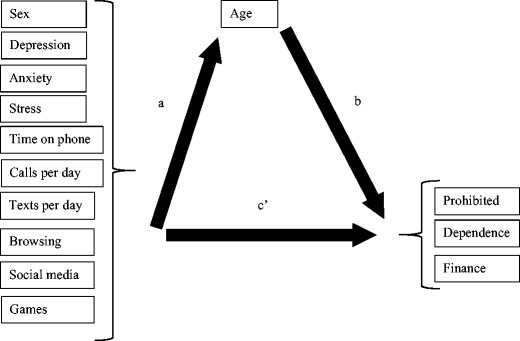
Contemporary technological advances have led to a significant increase in using mobile technologies. Recent research has pointed to potential problems as a consequence of mobile overuse, including addiction, financial problems, dangerous use (i.e. whilst driving) and prohibited use (i.e. use in forbidden areas). The aim of this study is to extend previous findings regarding the predictive power of psychopathological symptoms (depression, anxiety and stress), mobile phone use (i.e. calls, SMS, time spent on the phone, as well as the engagement in specific smartphone activities) across Generations X and Y on problematic mobile phone use in a sample of 273 adults. Findings revealed prohibited use and dependence were predicted by calls/day, time on the phone and using social media. Only for dependent mobile phone use (rather than prohibited), stress appeared as significant. Using social media and anxiety significantly predicted belonging to Generation Y, with calls per day predicted belonging to Generation X. This finding suggests Generation Y are more likely to use asynchronous social media-based communication, whereas Generation X engage more in synchronous communication. The findings have implications for prevention and awareness-raising efforts of possibly problematic mobile phone use for educators, parents and individuals, particularly including dependence and prohibited use.
Overview
The claims and statistics of this paper haven’t been checked yet.
Run the check — free, no account needed. It reads the open-access text and checks the sources it cites.
Integrity signals
Registry
Cites
Statistics
Figures
Verification
Claims the paper makes
The claims and statistics of this paper haven’t been checked yet.
Run the check — free, no account needed. It reads the open-access text and checks the sources it cites.
Claims other papers make about this one
Each is checked against this paper’s own text: does it say what the citing paper says it does?
The source backs part of the claim, not all of it — or backs it for a different population, condition or comparison.
In the citing paper
“Using mobile phones is understood as leading to alterations in everyday life habits and perceptions of reality, which can be associated with negative outcomes, such as impaired social interactions, social isolation, as well as both somatic and mental health problems, including anxiety, depression, and stress [85,87].”
From Social networking sites and addiction: Ten lessons learned (2017) · cites this paper as [87]
Experimental — accuracy not yet measured
Self-check
Percentages, sums and reported differences re-computed from the paper’s own numbers.
The self-check needs the paper’s full text.
Citations
Cites
Diagnostic and Statistical Manual of Mental Disorders
American Psychiatric Association (2013) · doi:10.1176/appi.books.9780890425596 · Cited by 116,369
The Hospital Anxiety and Depression Scale
Zigmond, A. S., & Snaith, R. P. (1983) · Acta Psychiatrica Scandinavica · doi:10.1111/j.1600-0447.1983.tb09716.x · Cited by 47,139
Depression and quality of life in older persons: A review
Sivertsen, H., Bjørkløf, G. H., Engedal, K., Selbæk, G., & Helvik, A.-S. (2015) · Dementia and Geriatric Cognitive Disorders · doi:10.1159/000437299 · Cited by 14,152
Diagnostic and Statistical Manual of Mental Disorders(DSM)
Leong, F. T. L. (2008) · Sage eBooks · doi:10.4135/9781412963978.n182 · Cited by 10,861
(1995) · Cited by 6,909
Alone together: why we expect more from technology and less from each other
Fernández Pedemonte, D. (2011) · Choice Reviews Online · doi:10.5860/choice.48-7239 · Cited by 4,608
Motivational, emotional, and behavioral correlates of fear of missing out
Przybylski, A. K., Murayama, K., DeHaan, C. R., & Gladwell, V. (2013) · Computers in Human Behavior · doi:10.1016/j.chb.2013.02.014 · Cited by 3,932
A “components” model of addiction within a biopsychosocial framework
Griffiths, M. (2005) · Journal of Substance Use · doi:10.1080/14659890500114359 · Cited by 3,088
Kardefelt-Winther, D. (2014) · Computers in Human Behavior · doi:10.1016/j.chb.2013.10.059 · Cited by 2,519
The Smartphone addiction scale: development and validation of a short version for adolescents
Kwon, M., Kim, D.-J., Cho, H., & Yang, S. (2013) · PLoS ONE · doi:10.1371/journal.pone.0083558 · Cited by 2,177
Research works printed but not linked: 3
- Bedford, A., & Foulds, G. A. (1978). Delusions symptoms states inventory: state of anxiety and depression (manual). Berkshire: NFER.
- Gafni, R., & Geri, N. (2013). Generation Y vs Generation X: differences in smartphone adaptation. In Y. Eshet-Alkalai, A. Caspi, S. Eden, N. Geri, Y. Kalman, & Y. Yair (Eds.), Proceedings of the Chais Conference on Instructional Technologies Research 2013: learning in the technological era (pp. 18–23). Raanana: Open University of Israel.
- Muthén, L. K., & Muthén, B. O. (2011). Mplus user’s guide (Sixth ed.). Los Angeles: Muthén & Muthén.
Cited by
Sorted by citations
Items 101–194 of 194
Carbon nanotube/graphene composites as thermal interface materials for electronic devices
Wang, X., Zhao, L., & Liu, J. (2019) · Fullerenes Nanotubes and Carbon Nanostructures · doi:10.1080/1536383x.2019.1660647 · Cited by 8
Problematic mobile phone use. Review of literature
Demkow, M., & Jakubczyk, A. (2019) · Alcoholism and Drug Addiction · doi:10.5114/ain.2019.91003 · Cited by 9
Lin, H., Chen, I.-Y., Lu, S.-Y., Tseng, Y.-H., & Lin, J. (2022) · Open Geosciences · doi:10.1515/geo-2022-0358 · Cited by 8
Continued Usage and Dependency of Smartphones
Rosaline, S., & Johnson, S. (2019) · International Journal of Cyber Behavior Psychology and Learning · doi:10.4018/ijcbpl.2020010104 · Cited by 10
Nawaz, S., Bhowmik, J., Linden, T., & Mitchell, M. (2024) · Entertainment Computing · doi:10.1016/j.entcom.2024.100906 · Cited by 18
Long, J., Liu, Y., Wang, Y., Pottié, A., Cornil, A., Deleuze, J., Wu, Q., Chen, S., Ma, Y., Wang, Q., et al. (2023) · The Journal of Nervous and Mental Disease · doi:10.1097/nmd.0000000000001738 · Cited by 9
Sánchez‐Villena, A. R., Domínguez-Lara, S., Aranda, M., Gutiérrez, V. F., & Domingo, M. G. (2021) · African journal of rhetoric · doi:10.21134/haaj.v21i2.572 · Cited by 11
Pourafshari, R., Rezapour, T., Rafei, P., & Hatami, J. (2022) · Journal of Affective Disorders Reports · doi:10.1016/j.jadr.2022.100436 · Cited by 11
Αρμακόλας, Σ. Ι., Lora, C., & Waligóra, A. (2024) · Advances in Mobile Learning Educational Research · doi:10.25082/amler.2024.01.002 · Cited by 12
Dong, J., Li, Y., Qu, Y., Xu, C., & Ji, H. (2024) · International Journal of Mental Health and Addiction · doi:10.1007/s11469-024-01295-z · Cited by 7
Impact of excessive phone usage on hand functions and incidence of hand disorders
Athar, M., Hashmi, J., Saleem, M. M., Azam, J., Umar, S. A., & Eljack, M. M. F. (2025) · Annals of Medicine and Surgery · doi:10.1097/ms9.0000000000003143 · Cited by 6
The role of FOMO on psychological well-being with nomophobia as a mediator among college students
Wibowo, A., & Safaria, T. (2025) · Current Psychology · doi:10.1007/s12144-025-07636-y · Cited by 7
The Biopsychosocial Impact of Abusive Use of Digital Media
Martins, G. D. G., Caricati, V. V., BARBUGLI, B. C., Ribeiro, C. M. D. S., Lobato, F. B. H., Scatena, A., Lessa, R. T., de MICHELI, D., & Andrade, A. L. M. (2021) · Springer eBooks · doi:10.1007/978-3-030-62855-0_33 · Cited by 6
García, S. C., Ventisca, M. D.-B., & Cerezo, M. G. (2023) · Social Sciences · doi:10.3390/socsci12030164 · Cited by 10
Xie, Y., & Luo, S. (2024) · BMC Psychiatry · doi:10.1186/s12888-024-06073-8 · Cited by 9
Woodward, K., & Kanjo, E. (2018) · ACM International Joint Conference on Pervasive and Ubiquitous Computing (UbiComp) · doi:10.1145/3267305.3274112 · Cited by 6
Self-citationYÜCEL, E. E., & Ünsalver, B. Ö. (2019) · The European Research Journal · doi:10.18621/eurj.538377 · Cited by 6
Sun, Z., Zhou, Y. H., Zhang, Y., Gui, B., & Liu, Z. (2021) · JMIR Formative Research · doi:10.2196/31089 · Cited by 5
A systematic review on relationship between stress and problematic smartphone use
Wong, B. Y., Yeo, K. J., & Handayani, L. (2022) · International Journal of Public Health Science (IJPHS) · doi:10.11591/ijphs.v11i3.22191 · Cited by 5
Mun, I. B., & Lee, S. (2023) · The Social Science Journal · doi:10.1080/03623319.2023.2165229 · Cited by 5
Othman, M. K., & Amin, M. Y. B. M. (2022) · International Journal of Public Health Science (IJPHS) · doi:10.11591/ijphs.v11i1.21240 · Cited by 6
Rodríguez–Torrico, P., Gutiérrez, S. S. M., & Jiménez, N. (2023) · Computers in the Schools · doi:10.1080/07380569.2023.2168146 · Cited by 5
Internet Addiction and Phone Dependence: Measurements, Influencing factors, and Effects
Hu, J. (2023) · Journal of Education Humanities and Social Sciences · doi:10.54097/ehss.v8i.4326 · Cited by 4
The Relationship between Sleep Quality and Smartphone Addiction among Adolescents
Kurudirek, F., Baş, N. G., & Arıkan, D. (2024) · Sağlık Bilimleri Üniversitesi Hemşirelik Dergisi · doi:10.48071/sbuhemsirelik.1385723 · Cited by 3
Mun, I. B., & Lee, S. (2025) · Children and Youth Services Review · doi:10.1016/j.childyouth.2025.108293 · Cited by 3
Problematic Mobile Phone Use and Risky Behaviors Among College Students in Peru
Ramos‐Diaz, J., Jiang, Q., Sandoval, R. R., & Griffiths, M. D. (2020) · International Conference on Informatics, Multimedia, Cyber and Information System (ICIMCIS) · doi:10.1109/icimcis51567.2020.9354318 · Cited by 3
Kadınlarda kompulsif çevrimiçi satın alma davranışı ile dürtüsellik ilişkisi
Namlı, Z., Tamam, L., Demirkol, M. E., Karaytuğ, M. O., & ÖZBAY, A. (2022) · Journal of Dependence · doi:10.51982/bagimli.1143636 · Cited by 3
Sisson, A. D., & Whalen, E. (2022) · Consumer Behavior in Tourism and Hospitality · doi:10.1108/cbth-03-2022-0051 · Cited by 3
Parenting invalidante e dipendenze tecnologiche: il ruolo del controllo psicologico genitoriale
Gugliandolo, M. C., Verrastro, V., & Liga, F. (2019) · MALTRATTAMENTO E ABUSO ALL INFANZIA · doi:10.3280/mal2019-003005 · Cited by 3
Müller, A., Trotzke, P., & Steins‐Loeber, S. (2019) · Suchttherapie · doi:10.1055/a-1018-7250 · Cited by 3
Cyber intimate partner aggression in adulthood: the role of insecure attachment and self-control
Booth, N., Derefaka, G., Khan, R., & Brewer, G. (2023) · Journal of Criminal Psychology · doi:10.1108/jcp-03-2023-0015
Islam, M. R., Ahmed, O., Naher, L., & Islam, M. N. (2025) · Addictive Behaviors Reports · doi:10.1016/j.abrep.2025.100599 · Cited by 3
Smartphones through children’s eyes: perceived benefits and educational considerations
Gaztañaga, M., Mondragón, N. I., Fernández, I. L., & Munitis, A. E. (2025) · Frontiers in Psychology · doi:10.3389/fpsyg.2025.1596595 · Cited by 11
Kahraman, S. (2025) · Psychological Reports · doi:10.1177/00332941251358214 · Cited by 5
A Conceptual Analysis of Technology Usage and Work–Family Interface Among Millennials in India
Dash, S. (2025) · Vikalpa The Journal for Decision Makers · doi:10.1177/02560909251314252 · Cited by 2
Evaluating the Quality of Light Emitted by Smartphone Displays
Piechota, N., Skarżyński, K., & Kubiak, K. (2025) · Applied Sciences · doi:10.3390/app15116119 · Cited by 2
Smartphone addiction and creativity in Chinese undergraduates: a moderated mediation model analysis
Li, C., & Xie, H. (2025) · Frontiers in Psychiatry · doi:10.3389/fpsyt.2025.1570547 · Cited by 2
Jafarzadeh, M., Cheshmi, M., Kolagari, M. R., Madadi, R., & Jafari, J. S. (2020) · Journal of Occupational Health and Epidemiology · doi:10.52547/johe.9.4.206 · Cited by 2
Girousse, E., & Vuillerme, N. (2022) · JMIR Research Protocols · doi:10.2196/38785 · Cited by 2
Hossain, S. Q., & Ahmed, S. I. (2020) · Advances in intelligent systems and computing · doi:10.1007/978-3-030-63092-8_6 · Cited by 6
DEMİR, Ç. (2023) · the Journal of Academic Social Sciences · doi:10.29228/asos.68226 · Cited by 1
Park, H. J. (2025) · Current Psychology · doi:10.1007/s12144-025-07328-7 · Cited by 1
Baber, P., & Baber, R. (2026) · BMC Psychology · doi:10.1186/s40359-026-04143-y · Cited by 1
Nawaz, S., Linden, T., Mitchell, M., & Bhowmik, J. (2026) · Social Sciences & Humanities Open · doi:10.1016/j.ssaho.2026.102569 · Cited by 3
Boredom and Phubbing; A Multiple Mediation Model
Şengül, H. (2026) · Journal of Technology in Behavioral Science · doi:10.1007/s41347-026-00606-6 · Cited by 1
Floris, M., & Gentili, C. (2026) · PLOS mental health. · doi:10.1371/journal.pmen.0000524 · Cited by 2
Yıldız, K., Ağaoğlu, P. M., Dineri, Y., Beyoğlu, E., Erdoğan, A., & Okyay, R. A. (2019) · Kocaeli Medical Journal · doi:10.5505/ktd.2019.23500 · Cited by 2
EFEKTIVITAS INTERVENSI UNTUK MENGURANGI KECANDUAN SMARTPHONE PADA ANAK USIA DINI
Rachmat, I. F. (2023) · Jurnal Jendela Bunda Program Studi PG-PAUD Universitas Muhammadiyah Cirebon · doi:10.32534/jjb.v10i1.3890 · Cited by 1
Rao, S. R., Gupta, V., Ambike, A. A., Adarkar, S. A., Mhatre, P. P., Saraf, P. H., Raul, S. K., Paranjape, R., Dedhia, K., Inamdar, G., et al. (2023) · International Journal of Community Medicine and Public Health · doi:10.18203/2394-6040.ijcmph20233104 · Cited by 1
Pérez, A. L. J., Ramírez-Hernández, L. I., & Urbina, G. N. R. (2023) · African journal of rhetoric · doi:10.21134/haaj.v23i2.843 · Cited by 1
Relationship between Smartphone Use and Sleep Quality of Universitas Prima Indonesia Students
Wau, R. P. P., Wienaldi, W., & Dharma, S. H. (2024) · International Journal of Social health · doi:10.58860/ijsh.v3i1.146 · Cited by 1
Al-Mohaimeed, A., Alharbi, M., Mahmood, F. M., & Mahmud, I. (2022) · Journal of Psychology in Africa · doi:10.1080/14330237.2022.2027630 · Cited by 2
Rao, S. R., Gupta, V., Ambike, A. A., Adarkar, S. A., Mhatre, P. P., Saraf, P. H., Raul, S. K., Paranjape, R., Dedhia, K., Inamdar, G., et al. (2023) · medRxiv · doi:10.1101/2023.02.15.23286001 · Cited by 1
Indication of Smartphone Addiction in Adolescents in the City of Surabaya
Fauzi, A. (2020) · International Journal of Nursing Care · doi:10.37506/ijonc.v8i1.8038
The Prevalence of Problematic Mobile Phone Use amongst EFL Learners in Turkey
Özer, Ö. (2021) · Kastamonu Eğitim Dergisi · doi:10.24106/kefdergi.808548
Amole, T. G., Agoyi, O., & Tsiga-Ahmed, F. I. (2021) · Annals of African Medical Research · doi:10.4081/aamr.2020.142 · Cited by 2
Smartphone usage pattern for science teachers: The case of Zimbabwe
Manyeredzi, T. (2021) · International Journal of Research and Innovation in Social Science · doi:10.47772/ijriss.2021.5934
Identifying and prioritizing risk factors involved in motorcyclists' traffic accidents in Tehran
Kavousi, A., Moradi, A. R., Ameri, P., Amjadian, M., & Vaziri, M. (2021) · Archives of Trauma Research · doi:10.4103/atr.atr_14_21
An Empirical Evaluation on Nomophobia: Mobile Phone Dependence Among Medical Students
Rana, V., & Sharma, S. (2022) · Algorithms for intelligent systems · doi:10.1007/978-981-16-7136-4_26
overview on health illness caused by usage of smart electronic gadgets among the student’s community
Umadevi, S., & Yuvaraj, P. (2022) · International Journal of Health Sciences · doi:10.53730/ijhs.v6ns2.7499 · Cited by 1
Fathi, A., Rahnemo, S. S., & Aghazadeh, R. (2022) · ranian Journal of Health Education and Health Promotion · doi:10.52547/ijhehp.10.2.7
HANIPAH, R. S. A., Rohaizad, N. A. A., & NADIN, M. I. (2021) · Universiti Malaysia Terengganu Journal of Undergraduate Research · doi:10.46754/umtjur.v3i1.192
Factors affecting phubbing of students in the context of COVID-19
Duc, A., & Nguyen, T. D. (2022) · Tay Nguyen Journal of Science · doi:10.31276/vmostjossh.64(3).27-36 · Cited by 3
Youth Teachers Program in Information Technology Management
Sunu, I. G. K. A. (2022) · Jurnal Pedagogi dan Pembelajaran · doi:10.23887/jp2.v5i3.53014
Regulaciones antitrust para Silicon Valley
Komissarov, S. (2022) · doi:10.35537/10915/152006
The Effect of Online Touchpoints on Utility Customers’ Experience
Majid, N. A., Asshidin, N. H. N., Esa, E., Surbaini, K. N., Zahari, A. R., Abdullah, A. E., Ismail, S. F., & Maarop, M. A. (2023) · doi:10.15405/epfe.23081.47
New Digital Inequality: The Detox of Mobile Phone Addictions Among the Adolescents in China
Zhang, Y., & Ge, W. (2024) · International Journal of Business Administration · doi:10.5430/ijba.v15n1p10
Impact of Self-reported Leisure Internet Usage on Social Interactions
Doshi, D., Sukhabogi, J. R., Kumari, V. B. P. S., & Reddy, Y. P. (2024) · Journal of Datta Meghe Institute of Medical Sciences University · doi:10.4103/jdmimsu.jdmimsu_159_23
Arsić, B., & Gajić, A. (2024) · Zbornik radova Filozofskog fakulteta u Pristini · doi:10.5937/zrffp54-45852
Nagel, A. (2024) · Zeitschrift für Bildungsforschung · doi:10.1007/s35834-024-00417-w
Das Smartphone als ständiger Begleiter
Kohler, S. A., & Fauth‐Bühler, M. (2024) · SUCHT - Zeitschrift für Wissenschaft und Praxis / Journal of Addiction Research and Practice · doi:10.1024/0939-5911/a000876
Çorak, T. (2024) · Journal of Dependence · doi:10.51982/bagimli.1453176
Personality Traits and Smartphone Addiction
Pauline, I., Daniel, T., Nabawanuka, B., Herbert, M., & Katsomyo, E. (2025) · Advances in human and social aspects of technology book series · doi:10.4018/979-8-3693-8804-4.ch010
Students and Smartphone Usage: Influencing Factors
Afzali, F. M., Rastegari, E., & Ning, W. (2025) · ACM Southeast Regional Conference (ACMSE) · doi:10.1145/3696673.3723072 · Cited by 2
Teknostress pada ASN Generasi X: Sebuah Studi Fenomenologi
Sureni, S., & Mone Stepanus, A. (2025) · Jurnal Locus Penelitian dan Pengabdian · doi:10.58344/locus.v4i6.4106
Exploring the Interplay Between Nomophobia, Sleep Quality, and Quality of Life in the Digital Age
Pathak, V. N., Kour, B., & Anjalee, K. M. (2025) · IGI Global eBooks · doi:10.4018/979-8-3373-5661-7.ch007
Problemli Mobil Telefon Kullanımının Açıklamasında Yalnızlık ve Ertelemenin Rolü
Sarı, S. (2025) · Ahi Evran Üniversitesi Kırşehir Eğitim Fakültesi Dergisi · doi:10.29299/kefad.1520390
Xu, Y., Yuan, L., Xu, J., & Xia, C. (2025) · BMC Public Health · doi:10.1186/s12889-025-25982-1
Li, D.-L., Wang, S., Zhang, D., Yang, R., Hu, J., Xue, Y., Huang, X., Wan, Y., Pan, C.-W., Fang, J., et al. (2023) · Figshare · doi:10.6084/m9.figshare.22609754
Zeidan, J., Hallit, S., Akel, M., Louragli, I., & Obeïd, S. (2021) · Figshare · doi:10.6084/m9.figshare.16590917
DEMİRKAZIK, Ç. N. V. (2025) · Yeni Medya Dergisi · doi:10.55609/yenimedya.1756379
Profiling problematic digital use in adolescence: A clustering analysis from clinical settings
Albayrak, Z. S., Ateş, B. Ö., Ballı, M., Sartekin, T. Ö., & Dağdeviren, C. K. (2026) · Current Psychology · doi:10.1007/s12144-026-09185-4 · Cited by 2
Bariyyah, Y. K., Homdijah, O. S., & Rochyadi, E. (2025) · Mimbar Ilmu · doi:10.23887/mi.v30i3.105565
Fear of Missing Out and Executive Functions: The Role of Self-regulation as a Mediator
Ghosal, A., Chukkali, S., Mukherjee, O., & Krishnamurthy, V. (2026) · Annals of Neurosciences · doi:10.1177/09727531261429764
Elshaikh, U., Rachdan, D., Al-Marri, K., Al-Qashoti, M., Al-Zoqari, H., Naqadan, A., Saeed, R. K. M., Rahim, H. F. A., & Shraim, M. (2026) · Preventive Medicine Reports · doi:10.1016/j.pmedr.2026.103486
-, R. D. D., & Santhi, P. (2026) · SDMIMD Journal of Management · doi:10.18311/sdmimd/2025/48958
Assessing mobile phone attachment: a psychometric study in the Portuguese young adult population
Leite, Ã., & Marôco, J. P. (2026) · Psicologia: Reflexão e Crítica · doi:10.1186/s41155-026-00400-6
Self-control and smartphone addiction: The mediating effect of regulatory focus
Çorak, T. (2026) · Klinik Psikoloji Dergisi · doi:10.57127/kpd.26024438.1891967
Su, S., Cousijn, J., Wiers, R. W. H. J., Murray, H., Schoenmakers, T. M., & Larsen, H. (2026) · Journal of Behavioral Addictions · doi:10.1556/2006.2025.00380 · Cited by 1
Stress across Generational Cohorts, from Silent Generation to Z Generation: A Systematic Review
Toma, R. G., & Bușu, C. (2026) · Proceedings of the ... International Conference on Business Excellence · doi:10.2478/picbe-2026-0411
Mancinelli, E., Sukhija, V. J., Carrera, S., Drosi, A., & Salcuni, S. (2026) · Current Psychology · doi:10.1007/s12144-026-09970-1
Gürmen, M. (2026) · Journal of Dependence · doi:10.51982/bagimli.620
Çevrim İçi Alışveriş Bağımlılığının Dürtüsellik ve Karar Verme Stilleri Bağlamında İncelenmesi
Babat, E. B., Dinç, Ş. N., Tanrıvermiş, İ., & Bekaroğlu, E. (2026) · Ayna Klinik Psikoloji Dergisi · doi:10.31682/ayna.1804198
Metadata
- Authors
- Kuss, D. J., Kanjo, E., Crook-Rumsey, M., Kibowski, F., Wang, G. Y., & Sumich, A.
- Affiliations
- Nottingham Trent University (GB)
- Auckland University of Technology (NZ)
- Corresponding author
- Kuss, Daria J.
- Venue
- Journal of Technology in Behavioral Science
- Published
- 2018-01-08
- Volume
- 3
- Issue
- 3
- Pages
- 141-149
- ISSN
- 2366-5963 (ISSN-L)
- PMC
- PMC6133055
- OpenAlex
- W2772395238
- Cited by
- 196
- References
- 49
- Citations by year
- 2026: 15 · 2025: 21 · 2024: 20 · 2023: 26 · 2022: 36 · 2021: 23 · 2020: 26 · 2019: 21 · 2018: 7
- FWCI
- 107.62
- Type
- book chapter
- Language
- en
- Open access
- hybrid
- doi.org
- Locations
- Journal of Technology in Behavioral Science (publishedVersion, cc-by)
- Europe PMC (PubMed Central) (publishedVersion, other-oa)
- PubMed Central (publishedVersion, cc-by)
- PubMed (publishedVersion)
- University of Southern Queensland ePrints (University of Southern Queensland) (acceptedVersion)
- Nottingham Trent University's Institutional Repository (Nottingham Trent Repository) (acceptedVersion)
- Tuwhera (Auckland University of Technology) (submittedVersion, cc-by)
- Funders
- British Academy (SG162119)
- Topics
- Social Sciences › Sociology and Political Science › Impact of Technology on Adolescents
- Social Sciences › Education › Child Development and Digital Technology
- Social Sciences › Psychology › Clinical Psychology › Sexuality, Behavior, and Technology
- Keywords
- problematic mobile phone use, mobile phone addiction, smartphone addiction, Generation X, millennials, psychiatric symptoms, depression, anxiety, stress, social media use, synchronous communication, asynchronous communication, mobile phone calls
About these checks
Registry, retraction, Cites and statistics results are computed, not judged, with one exception: a printed reference that no index lists is read once by a model before it counts as a citation error. Claims are extracted by a model and kept only when their quote appears verbatim in the text; each cited source is then checked, with a model’s help, for whether it says what the claim relies on. Those verdicts can be wrong — read the claim’s quote and the cited source before relying on one.
Statistics and arithmetic are recomputed, not judged.
Confidence bands are shown only for fields calibrated on our annotated test set. None is calibrated yet, so no band is shown.
What counts as a claim ›How we measure confidence ›How we check this ›
Are you an author, or do you see a problem with this page? Request a review
