

National Healthcare Economic Evaluation Guidelines: A Cross-Country Comparison
Open accessThe DOI matches its Crossref record; 42 of the 42 references it cites were found in a registry or an index.
Abstract
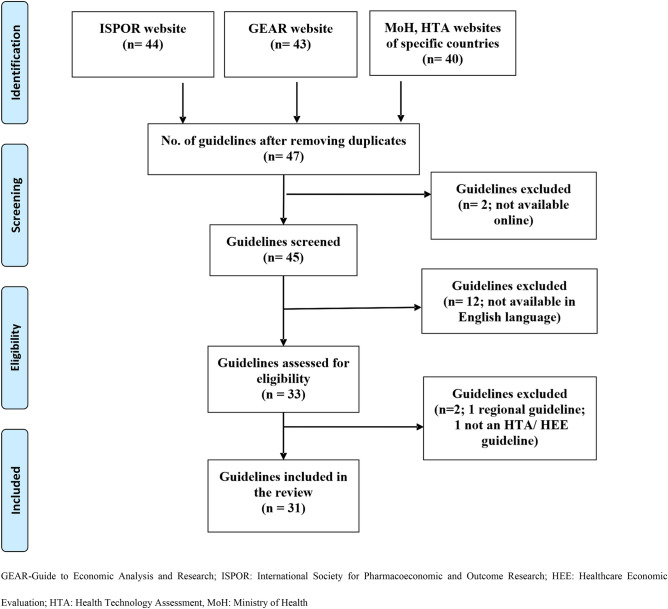
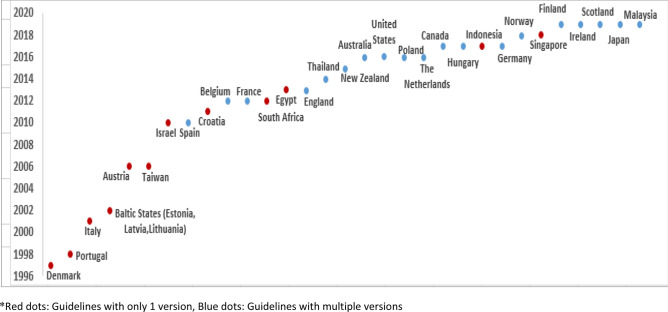
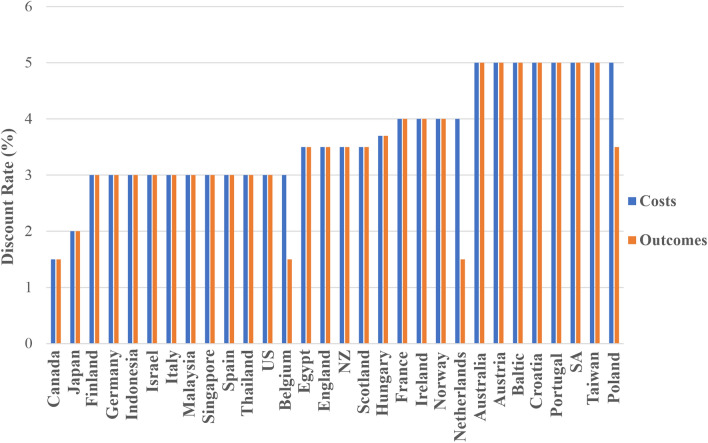
BACKGROUND AND OBJECTIVES: Globally, a number of countries have developed guidelines that describe the design and conduct of economic evaluations as part of health technology assessment (HTA) or pharmacoeconomic analysis for decision making. The current scoping review was undertaken with an objective to summarize the recommendations made on methods of economic evaluation by the national healthcare economic evaluation (HEE) guidelines. METHODOLOGY: A comprehensive search was undertaken in the website repositories of the International Society for Pharmacoeconomic and Outcomes Research (ISPOR) and Guide to Economic Analysis and Research (GEAR), and websites of national HTA agencies and ministries of health of individual countries. All guidelines in the English language were included in this review. Data were extracted with respect to general and methodological characteristics, and a descriptive analysis of recommendations made across the countries was undertaken. RESULTS: Overall, our review included 31 national HEE guidelines, published between 1997 and August 2020. Nearly half (45%) of the guidelines targeted the evaluation of pharmaceuticals. The nature of the guidelines was either mandatory (31%), recommendatory (42%), or voluntary (16%). There was a substantial consensus among the guidelines on several key principles, including type of economic evaluation (cost-utility analysis), time horizon of the analysis (long enough), health outcome measure (quality-adjusted life-years) and use of sensitivity analyses. The recommendations on study perspective, comparator, discount rate and type of costs to be included (particularly the inclusion of indirect costs) varied widely. CONCLUSION: Despite similarity in the overall processes, variation in several recommendations given by various national HEE guidelines was observed. This is perhaps unsurprising given the differences in the health systems and financing mechanisms, capacity of local researchers, and data availability. This review offers important lessons and a starting point for countries that are planning to develop their own HEE guidelines.
Overview
The claims and statistics of this paper haven’t been checked yet.
Free: it reads the open-access text and checks the first 5 claims that cite a source we can check. Create a free account to check every claim.
Integrity signals
Registry
Cites
Statistics
Figures
Verification
Claims the paper makes
The claims and statistics of this paper haven’t been checked yet.
Free: it reads the open-access text and checks the first 5 claims that cite a source we can check. Create a free account to check every claim.
Claims other papers make about this one
Each is checked against this paper’s own text: does it say what the citing paper says it does?
The cited source says what the claim attributes to it.
In the citing paper
“Current national guidelines on the design for economic evaluations vary and few recommend taking a societal perspective and including indirect costs [79]”
From The economic impact of retinal diseases for which gene therapy is emerging: a systematic literature review (2025) · cites this paper as [79]
Self-check
Percentages, sums and reported differences re-computed from the paper’s own numbers.
The self-check needs the paper’s full text.
Citations
Cites
Methods for the Economic Evaluation of Health Care Programmes
Drummond, M. E., Sculpher, M. J., Torrance, G. W., O’Brien, B. J., & Stoddart, G. L. (2005) · doi:10.1093/oso/9780198529446.001.0001 · Cited by 13,648
Methods for the economic evaluation of health care programmes
Wilson, S. H. (1987) · Journal of Epidemiology and Community Health · doi:10.1136/jech.41.4.355-a · Cited by 4,275
Consolidated Health Economic Evaluation Reporting Standards (CHEERS) statement
Husereau, D., Drummond, M., Petrou, S., Carswell, C., Moher, D., Greenberg, D., Augustovski, F., Briggs, A. H., Mauskopf, J., Loder, E., et al. (2013) · BMJ · doi:10.1136/bmj.f1049 · Cited by 1,776
Making choices in health: who guide to cost-effectiveness analysis
(2004) · Revista Española de Salud Pública · doi:10.1590/s1135-57272004000300012 · Cited by 1,259
Consolidated Health Economic Evaluation Reporting Standards (CHEERS) statement
Husereau, D., Drummond, M., Petrou, S., Carswell, C., Moher, D., Greenberg, D., Augustovski, F., Briggs, A. H., Mauskopf, J., & Loder, E. (2013) · International Journal of Technology Assessment in Health Care · doi:10.1017/s0266462313000160 · Cited by 573
Chang, A. Y., Cowling, K., Micah, A. E., Chapin, A., Chen, C. S., Ikilezi, G., Sadat, N., Tsakalos, G., Wu, J., Younker, T., et al. (2019) · The Lancet · doi:10.1016/s0140-6736(19)30841-4 · Cited by 520
Drummond, M. F., Schwartz, J. S., Jönsson, B., Luce, B. R., Neumann, P. J., Siebert, U., & Sullivan, S. D. (2008) · International Journal of Technology Assessment in Health Care · doi:10.1017/s0266462308080343 · Cited by 487 · cited 1×
“In order for policy decisions based on HTA evidence to be applied fairly, it is important that a uniform and transparent process is in place to ensure that all HTA evaluations are carried out according to rigorous standards of best practices [9].”
BackgroundThe Oxford Handbook of Health Economics
(2011) · Oxford University Press eBooks · doi:10.1093/oxfordhb/9780199238828.001.0001 · Cited by 463
Wilkinson, T., Sculpher, M. J., Claxton, K., Revill, P., Briggs, A., Cairns, J. A., Teerawattananon, Y., Asfaw, E., Lopert, R., Culyer, A. J., et al. (2016) · Value in Health · doi:10.1016/j.jval.2016.04.015 · Cited by 327 · cited 3×
“In the past two decades, we have witnessed a steady increase in the conduct of economic evaluations to inform health policy decisions [15]; however, fair policy decisions based on economic evidence require analysts to adhere to a uniform and transparent standard of practice [20].”
BackgroundHealth Economic Guidelines—Similarities, Differences and Some Implications
Hjelmgren, J., Berggren, F., & Andersson, F. (2001) · Value in Health · doi:10.1046/j.1524-4733.2001.43040.x · Cited by 322 · cited 1×
“With growing interest internationally in the use of HTA, new guidelines have been developed in Asian and African nations that have not been captured in earlier reviews [23, 24].”
BackgroundDevelopment and Validation of a Grading System for the Quality of Cost-Effectiveness Studies
Chiou, C.-F., Hay, J. W., Wallace, J. F., Bloom, B. S., Neumann, P. J., Sullivan, S. D., Yu, H.-T., Keeler, E. B., Henning, J. M., & Ofman, J. J. (2003) · Medical Care · doi:10.1097/00005650-200301000-00007 · Cited by 311
Spanish recommendations on economic evaluation of health technologies
López-Bastida, J., Oliva, J., Antoñanzas, F., García-Altés, A., Gisbert, R., Mar, J., & Puig-Junoy, J. (2010) · The European Journal of Health Economics · doi:10.1007/s10198-010-0244-4 · Cited by 240 · cited 4×
“While some of these guidelines specifically preferred PSA [37, 38, 41, 43, 47, 51, 53, 61], others suggested that PSA should be undertaken, although they did not make it mandatory [33, 40, 49, 56, 57, 59].”
BackgroundInfluentialPriority-setting for achieving universal health coverage
Chalkidou, K., Glassman, A., Marten, R., Vega, J., Teerawattananon, Y., Tritasavit, N., Gyansa-Lutterodt, M., Seiter, A., Kieny, M. P., Hofman, K., et al. (2016) · Bulletin of the World Health Organization · doi:10.2471/blt.15.155721 · Cited by 167
Health Care and Cost Containment in the European Union
(2019) · Routledge eBooks · doi:10.4324/9780429426971 · Cited by 158
Drummond, M., Brown, R. E., Fendrick, A. M., Fullerton, P., Neumann, P. J., Taylor, R. S., & Barbieri, M. (2003) · Value in Health · doi:10.1046/j.1524-4733.2003.64245.x · Cited by 150 · cited 2×
“Such guidelines may be either recommendatory or voluntary in nature [10, 13, 14].”
BackgroundHealth technology assessment and its influence on health-care priority setting
Oliver, A., Mossialos, E., & Robinson, R. (2004) · International Journal of Technology Assessment in Health Care · doi:10.1017/s026646230400073x · Cited by 148
The Members of the Italian Group for Pharmacoeconomic Studies, Capri, S., Ceci, A., Terranova, L., Merlo, D. F., & Mantovani, L. G. (2001) · Drug Information Journal · doi:10.1177/009286150103500122 · Cited by 144 · cited 7×
“While some national HEE guidelines recommended using a human capital approach (HCA) [34, 49, 50, 60, 61], others recommended the use of a friction cost approach (FCA) [37, 39, 44, 54, 62].”
BackgroundMethodInfluentialEconomic Evaluation in Global Perspective: A Bibliometric Analysis of the Recent Literature
Pitt, C., Goodman, C., & Hanson, K. (2016) · Health Economics · doi:10.1002/hec.3305 · Cited by 121 · cited 2×
“In the past two decades, we have witnessed a steady increase in the conduct of economic evaluations to inform health policy decisions [15]; however, fair policy decisions based on economic evidence require analysts to adhere to a uniform and transparent standard of practice [20].”
BackgroundInternational Network of Agencies for Health Technology Assessment
Culyer, A. J. (2014) · Cited by 99
Oortwijn, W., Mathijssen, J., & Banta, D. (2010) · Health Policy · doi:10.1016/j.healthpol.2009.12.008 · Cited by 96
EUnetHTA Joint Action 2, W. P. 7., Heintz, E., Gerber‐Grote, A., Ghabri, S., Hamers, F. F., Rupel, V. P., Erker, R. S., & Davidson, T. (2015) · PharmacoEconomics · doi:10.1007/s40273-015-0328-1 · Cited by 93 · cited 2×
“to describe and compare national HEE guidelines have been made, however the majority of these reviews focused on guidelines developed in European countries [13, 21, 22].”
BackgroundA Systematic Review of the State of Economic Evaluation for Health Care in India
Prinja, S., Chauhan, A. S., Angell, B. J., Gupta, I., & Jan, S. (2015) · Applied Health Economics and Health Policy · doi:10.1007/s40258-015-0201-6 · Cited by 89 · cited 2×
“The lack of common methodological standards often results in poor quality of economic evaluations, thus limiting their use in decision making [17, 18, 20].”
BackgroundSelf-citationLeelahavarong, P., Doungthipsirikul, S., Kumluang, S., Poonchai, A., Kittiratchakool, N., Chinnacom, D., Suchonwanich, N., & Tantivess, S. (2019) · International Journal of Technology Assessment in Health Care · doi:10.1017/s0266462319000321 · Cited by 89 · cited 1×
“For instance, Thailand, which has been a forerunner in the use of economic evidence, has integrated HTA into policy making, including its use for the development of health benefit packages and determining pharmaceutical reimbursement lists [84].”
BackgroundMathes, T., Jacobs, E., Morfeld, J.-C., & Pieper, D. (2013) · BMC Health Services Research · doi:10.1186/1472-6963-13-371 · Cited by 87 · cited 1×
“With growing interest internationally in the use of HTA, new guidelines have been developed in Asian and African nations that have not been captured in earlier reviews [23, 24].”
BackgroundAllen, N., Liberti, L. E., Walker, S., & Salek, S. (2017) · Frontiers in Pharmacology · doi:10.3389/fphar.2017.00384 · Cited by 87
Griffiths, U. K., Legood, R., & Pitt, C. (2016) · Health Economics · doi:10.1002/hec.3312 · Cited by 80
Recommendations for Reporting Pharmacoeconomic Evaluations in Egypt
Elsisi, G. H., Kaló, Z., Eldessouki, R., Elmahdawy, M., Saad, A., Ragab, S., Elshalakani, A., & Abaza, S. (2013) · Value in Health Regional Issues · doi:10.1016/j.vhri.2013.06.014 · Cited by 79
MAPPING OF HEALTH TECHNOLOGY ASSESSMENT IN SELECTED COUNTRIES
Oortwijn, W., Broos, P. H., Vondeling, H., Banta, D., & Todorova, L. (2013) · International Journal of Technology Assessment in Health Care · doi:10.1017/s0266462313000469 · Cited by 78
Santatiwongchai, B., Chantarastapornchit, V., Wilkinson, T., Thiboonboon, K., Rattanavipapong, W., Walker, D. G., Chalkidou, K., & Teerawattananon, Y. (2015) · PLoS ONE · doi:10.1371/journal.pone.0123853 · Cited by 62 · cited 2×
“The lack of common methodological standards often results in poor quality of economic evaluations, thus limiting their use in decision making [17, 18, 20].”
BackgroundReview of European guidelines for economic evaluation of medical technologies and pharmaceuticals
von der Schulenburg, J.-M. G., & Hoffmann, C. (2000) · The European Journal of Health Economics · doi:10.1007/s101980050002 · Cited by 52 · cited 1×
“to describe and compare national HEE guidelines have been made, however the majority of these reviews focused on guidelines developed in European countries [13, 21, 22].”
BackgroundCost containment in the EU: an overview
Mossialos, E. A., & Grand, J. L. (2019) · Routledge eBooks · doi:10.4324/9780429426971-1 · Cited by 47
Report from the Canadian Coordinating Office for Health Technology Assessment (CCOHTA)
(1995) · International Journal of Technology Assessment in Health Care · doi:10.1017/s0266462300009247 · Cited by 46
Guidelines for health technology assessment in Thailand (second edition)--the development process.
Chaikledkaew, U., & Kittrongsiri, K. (2014) · PubMed · Cited by 43
Mitton, C., Seixas, B. V., Peacock, S. J., Burgess, M., & Bryan, S. (2019) · Applied Health Economics and Health Policy · doi:10.1007/s40258-019-00488-1 · Cited by 38 · cited 1×
“Given the finite nature of healthcare resources, it is essential to inform resource allocation decisions through evidence-based mechanisms such as health technology assessment (HTA) [2].”
BackgroundLi, R., Hernández-Villafuerte, K., Towse, A., Vlad, I., & Chalkidou, K. (2016) · Health Systems & Reform · doi:10.1080/23288604.2015.1123338 · Cited by 37 · cited 1×
“The use of economic evidence for decision making is slowly gaining impetus in the Asian and African regions [83]; however, these countries are at an uneven pace of developing guidelines.”
BackgroundGuidelines for Pharmacoeconomic Studies: The Ways Forward
Drummond, M. (1994) · PharmacoEconomics · doi:10.2165/00019053-199406060-00002 · Cited by 36
Adeagbo, C. U., Rattanavipapong, W., Guinness, L., & Teerawattananon, Y. (2017) · Value in Health · doi:10.1016/j.jval.2017.10.003 · Cited by 36 · cited 2×
“These repositories were considered as they are the most comprehensive databases on HEE guidelines, which identify guidelines by undertaking online searches of databases such as Medline and Google Scholar [26].”
BackgroundMethodThe Danish Approach to Standards For Economic Evaluation Methodologies
Alban, A., Gyldmark, M., Pedersen, A. V., & Søgaard, J. (1997) · PharmacoEconomics · doi:10.2165/00019053-199712060-00003 · Cited by 35 · cited 5×
“While some national HEE guidelines recommended using a human capital approach (HCA) [34, 49, 50, 60, 61], others recommended the use of a friction cost approach (FCA) [37, 39, 44, 54, 62].”
BackgroundMethodInfluentialSkills of the Trade: The Tufts Cost-Effectiveness Analysis Registry
Thorat, T., Cangelosi, M. J., & Neumann, P. J. (2012) · Journal of Benefit-Cost Analysis · doi:10.1515/2152-2812.1114 · Cited by 34 · cited 1×
“Additionally, searching HEE-specific databases such as the Tufts CostEffectiveness Analysis Registry would not affect the yield of the present review since this registry archives only original cost per QALY studies (CUA) and excludes all methodological articles, including guidelines [88, 89].”
MethodGuidelines for Economic Evaluation of Pharmaceuticals in Korea
Bae, E.-Y. (2008) · Journal of Preventive Medicine and Public Health · doi:10.3961/jpmph.2008.41.2.80 · Cited by 31
Economic evaluations in European reimbursement submission guidelines: current status and comparisons
Bracco, A., & Krol, M. (2013) · Expert Review of Pharmacoeconomics & Outcomes Research · doi:10.1586/14737167.2013.837766 · Cited by 24 · cited 2×
“to describe and compare national HEE guidelines have been made, however the majority of these reviews focused on guidelines developed in European countries [13, 21, 22].”
BackgroundChernew, M. E., & May, D. (2011) · doi:10.1093/oxfordhb/9780199238828.013.0014 · Cited by 20 · cited 1×
“Increased demand for healthcare services as a result of demographic and epidemiological transition, and an accelerated introduction of new drugs and technologies has increased the pressure on healthcare budgets worldwide [1].”
Background
Research works printed but not linked: 5
- Kobelt G Health economics: an introduction to economic evaluation 2013 3 London Office of Health Economics
- Austria Walter E Zehetmayr S Guidelines on health economic evaluation, consensus paper 2006 Vienna Institute for Pharmacoeconomic Research
- Cleemput I, Neyt M, Van de Sande S, Thiry N. Belgian guidelines for economic evaluations and budget impact analyses: second edition. Brussels: Belgian Health Care Knowledge Centre (KCE); 2012. KCE Reports 183C.
- Canadian Agency for Drugs and Technologies in Health. Guidelines for the economic evaluation of health technologies: Canada. 4th ed. Ottawa: Canadian Agency for Drugs and Technologies in Health. 2017. https://www.cadth.ca/dv/guidelines-economic-evaluation-health-technologies-canada-4th-edition. Accessed 30 Dec 2020.
- National Institute for Health and Care Excellence [NICE]. Guide to the methods of technology appraisal 2013. London: NICE; 2013. https://www.nice.org.uk/process/pmg9/resources/guide-to-the-methods-of-technology-appraisal-2013-pdf-2007975843781. Accessed 9 July 2020. 27905712
Cited by
An overview of the perspectives used in health economic evaluations
Sittimart, M., Rattanavipapong, W., Mirelman, A. J., Hung, T. M., Dabak, S. V., Downey, L. E., Jit, M., Teerawattananon, Y., & Turner, H. C. (2024) · Cost Effectiveness and Resource Allocation · doi:10.1186/s12962-024-00552-1 · Cited by 192
“These are derived from a review of key texts [8, 12, 13], and recommendations from multiple international and national economic evaluation guidelines listed in the International Society for Pharmaco-economics and Outcomes Research (ISPOR) and Guide to Economic Analysis and Research (GEAR) websites…”
BackgroundMethodInfluentialSelf-citationShelmerdine, S. C., Arthurs, O. J., Denniston, A., & Sebire, N. J. (2021) · BMJ Health & Care Informatics · doi:10.1136/bmjhci-2021-100385 · Cited by 66
Sharma, D., Prinja, S., Aggarwal, A. K., Rajsekar, K., & Bahuguna, P. (2023) · The Lancet Regional Health - Southeast Asia · doi:10.1016/j.lansea.2023.100241 · Cited by 55
Self-citationValue Set for the EQ-5D-Y-3L in Hungary
Rencz, F., Ruzsa, G., Bató, A., Yang, Z., Finch, A. P., & Brodszky, V. (2022) · PharmacoEconomics · doi:10.1007/s40273-022-01190-2 · Cited by 42
Economic evaluation guidelines in low- and middle-income countries: a systematic review
Daccache, C., Rizk, R., Dahham, J., Evers, S., Hiligsmann, M., & Karam, R. (2021) · International Journal of Technology Assessment in Health Care · doi:10.1017/s0266462321000659 · Cited by 37
“failed to include Bhutan, Brazil, China, Colombia, Cuba, Mexico, and Russian Federation, in addition to Mercosur (18).”
Metadata
- Authors
- Sharma, D., Aggarwal, A. K., Downey, L. E., & Prinja, S.
- Affiliations
- Post Graduate Institute of Medical Education and Research (IN)
- Imperial College London (GB)
- Corresponding author
- Prinja, Shankar
- Venue
- PharmacoEconomics - Open
- Published
- 2021-01-10
- Volume
- 5
- Issue
- 3
- Pages
- 349-364
- ISSN
- 2509-4254 (ISSN-L)
- 2509-4262
- PMC
- PMC8333164
- OpenAlex
- W3118599774
- Cited by
- 114
- References
- 42
- Citations by year
- 2026: 21 · 2025: 27 · 2024: 23 · 2023: 24 · 2022: 15 · 2021: 4
- FWCI
- 3.23
- Type
- journal article
- Language
- en
- Open access
- gold
- doi.org
- Licence
- cc-by-nc
- creativecommons.org/licenses/by-nc/4.0 (tdm)
- creativecommons.org/licenses/by-nc/4.0 (vor)
- Locations
- PharmacoEconomics - Open (publishedVersion, cc-by-nc)
- PubMed Central (publishedVersion, cc-by-nc)
- PubMed (publishedVersion)
- RePEc: Research Papers in Economics (submittedVersion)
- Spiral (Imperial College London) (submittedVersion, cc-by-nc)
- Funders
- Indian Council of Medical Research
- Topics
- Social Sciences › Economics, Econometrics and Finance › Economics and Econometrics › Health Systems, Economic Evaluations, Quality of Life
- Social Sciences › Economics, Econometrics and Finance › Economics and Econometrics › Pharmaceutical Economics and Policy
- Social Sciences › Sociology and Political Science › Delphi Technique in Research
- Keywords
- economic evaluation guidelines, health technology assessment, pharmacoeconomic evaluation, national guidelines, cross-national comparison, cost-utility analysis, quality-adjusted life years, discount rate, indirect costs, sensitivity analysis, drug evaluation
About these checks
Registry, retraction, Cites and statistics results are computed, not judged, with one exception: a printed reference that no index lists is read once by a model before it counts as a citation error. Claims are extracted by a model and kept only when their quote appears verbatim in the text; each cited source is then checked, with a model’s help, for whether it says what the claim relies on. Those verdicts can be wrong — read the claim’s quote and the cited source before relying on one.
Statistics and arithmetic are recomputed, not judged.
Confidence bands are shown only for fields calibrated on our annotated test set. None is calibrated yet, so no band is shown.
What counts as a claim ›How we measure confidence ›How we check this ›
Are you an author, or do you see a problem with this page? Request a review
Data sources
Bibliographic data: Semantic Scholar, OpenAlex, Crossref.
Contains information from the Semantic Scholar Academic Graph Datasets, made available under the ODC Attribution License (ODC-BY 1.0).
Semantic Scholar’s data is described in: Kinney, R., et al. (2023). The Semantic Scholar Open Data Platform. arXiv:2301.10140.
