

Closed-mindedness and insulation in groupthink: their effects and the devil’s advocacy as a preventive measure
Open accessThe DOI matches its Crossref record; 55 of the 58 references it cites were found in a registry or an index; 3 of the 53 sources its claims cite were checked for support.
Abstract
This paper’s purpose is to clarify groupthink phenomena and to assess the devil’s advocacy as a groupthink prevention measure. An agent-based model is presented to formalize group closed-mindedness and insulation in a group decision making setting. The model was validated by showing that groupthink results in the decision with low quality and the group’s inability to explore more alternatives. Besides that, the devil’s advocacy also formulated in the model. The simulation results of different conditions of the devil’s advocacy support Janis’ suggestion to utilize the devil’s advocacy to alleviate groupthink. It is also found that the utilization of devil’s advocacy depends on the group’s condition and the desired amount of conflict to produce the best decision.
Overview
CoChat Summary
TL;DR
This paper formalizes groupthink’s closed-mindedness and insulation in an agent-based NK-landscape model and tests devil’s advocacy as a prevention measure. Simulations show groupthink lowers explored alternatives, decision fitness, and time to consensus, while devil’s advocacy helps mainly when the group is closed-minded or insulated.
Key findings
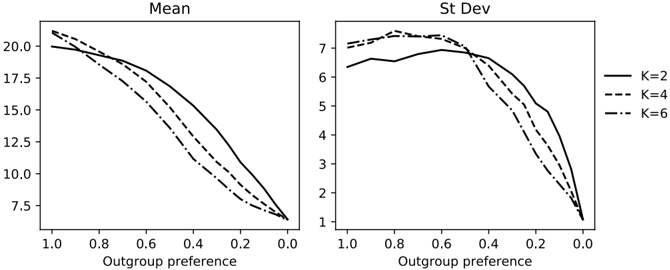
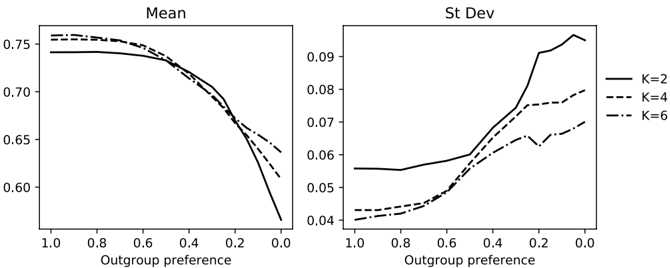
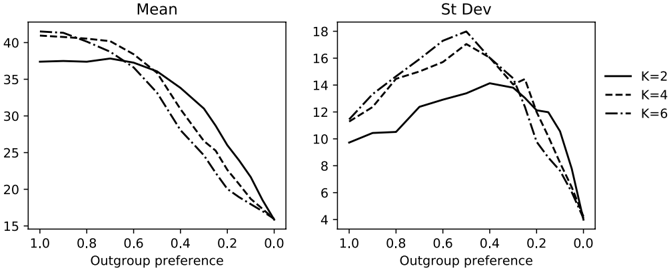
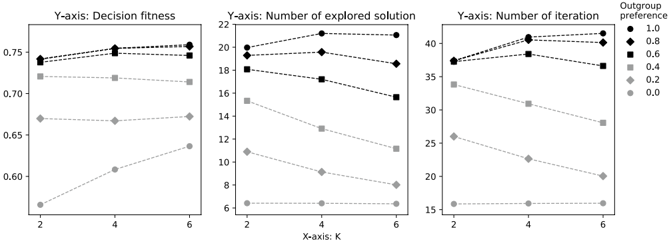
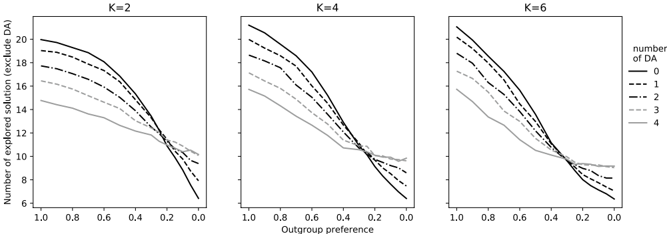
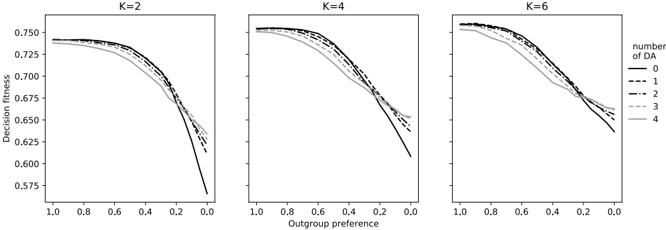
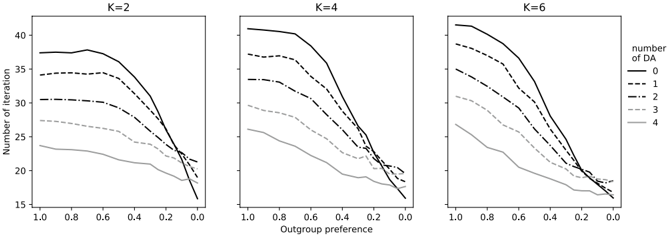
- Groupthink harmed decision making: as outgroup preference fell from 1.00 to 0.00, the number of explored solutions, decision fitness, and number of iterations decreased; insulation (0.00) had a stronger effect than closed-mindedness. At outgroup preference 0.00, decision fitness mean difference versus no groupthink was −0.1757 (K = 2), −0.1463 (K = 4), and −0.1225 (K = 6), all p ≤ 0.01.
- Devil’s advocacy improved outcomes when the group was susceptible to groupthink: at outgroup preference 0.00, adding 2 devil’s advocates raised decision fitness by +0.0553 (K = 2), +0.0340 (K = 4), and +0.0197 (K = 6); adding 4 raised it by +0.0682, +0.0453, and +0.0264, all p ≤ 0.01.
- Devil’s advocacy could hurt when there was no groupthink or high outgroup preference: at outgroup preference 0.60, 4 devil’s advocates lowered decision fitness by −0.0109 (K = 2), −0.0195 (K = 4), and −0.0218 (K = 6), p ≤ 0.01.
- In the insulated case, the maximum number of explored solutions was 2^(N−4) = 8, independent of K, because decision makers shared 4 loci as group knowledge.
Methods
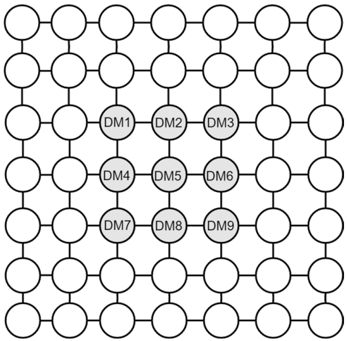
- Agent-based model: group decision making was abstracted as a search over an NK fitness landscape with N = 7 and K = 2, 4, 6; individuals were placed in a 7 × 7 lattice with 9 decision makers in the middle of 40 observers; outgroup preference varied from 1.00 to 0.00; devil’s advocate sets ranged from 0 to 4; each parameter combination was run 1000 times.
- Behaviors: normal agents learned from the best neighbor solution weighted by a solution preference function; devil’s advocates opposed ingroup solutions by assigning the least common value for each solution variable; consensus occurred when normal decision makers’ solutions had zero Hamming distance.
- Measurements and analysis: number of explored solutions, decision fitness, and number of iterations; t-tests of means compared conditions against no-groupthink (outgroup preference 1.00) and no-devil’s-advocate (DAdvocate 0) baselines.
Limitations
- The paper states that the outgroup preference parameter range was not derived from any empirical finding, so interpreting simulation results into real-world settings requires careful consideration.
- The paper states that the practicality of devil’s advocacy is limited: 1 to 4 devil’s advocates were assigned among 9 decision makers, and what counts as low or high depends on team size (e.g., for group size 5, low = 1 and high = 3).
- Evident from the text: validation is based on structural plausibility and behavioral consistency with prior findings, not empirical calibration or a human-subject experiment; the results are simulation-only.
Model-written summary. Check it against the paper before relying on it.
Integrity signals
Registry
Cites
Statistics
Figures
Verification
Claims the paper makes
3 Valid · 1 Not valid · 25 Not checked · 45 Own results and interpretations
The sources with a verdict support this claim; the rest weren’t checked yet, have no full text we could read, or their verdicts aren’t rated yet.
In the paper
“The solution space is adapted from the NK model [24] which is deemed suitable because it depicts the interdependent variables in managerial problems [5, 9, 15, 17].”
What the sources say
- Not checked — no full text of the sourcecites [5] 5. Billinger, S., Stieglitz, N., & Schumacher, T. R. (2010). Search on Rugged Landscapes: An Experimental Study . https ://doi.org/10.2139/ssrn.17117 43. source
- Supportedcites [9] 9. Carbone, G., & Giannoccaro, I. (2015). Model of human collective decision-making in complex environments. https ://doi.org/10.1140/epjb/e2015 -60609 -0. arXiv :1507.02139 . source
The Introduction (p. 1) describes managerial problems as involving multiple interdependent decision variables. The Model (p. 2) uses the NK model to represent interacting decision variables and calls the approach particularly suited to the problem studied. (LLM, conf=0.92)
- Not checked — no full text of the sourcecites [15] 15. Fleming, L., & Sorenson, O. (2001). Technology as a complex adaptive system: evidence from patent data. Research Policy , 30 (7), 1019-1039. https ://doi.org/10.1016/S0048 -7333(00)00135 -9. https :// www.scien cedir ect.com/scien ce/artic le/pii/S0048 73330 00013 59. source
- Not checked — no full text of the sourcecites [17] 17. Ganco, M. (2017). Nk model as a representation of innovative search. Research Policy , 46 (10), 17831800. https ://doi.org/10.1016/j.respo l.2017.08.009. http://www.scien cedir ect.com/scien ce/artic le/pii/ S0048 73331 73014 15. source
plain- Asserted: passes — The authors put it forward as true.
- Checkable: passes — It can be checked against evidence.
- Load-bearing: passes — The paper’s conclusions depend on it.
- Based: passes — The paper gives a reason why it holds.
The cited sources support only part of this claim — read each source’s verdict below.
In the paper
“The model has been proven to be useful to explain groupthink phenomena by confirming and clarifying existing findings based on assumptions on the micro level i.e. capturing emergent phenomena [6].”
What the sources say
- Partly supportedcites [6] 6. Bonabeau, E. (2002). Agent-based modeling: methods and techniques for simulating human systems. Proceedings of the National Academy of Sciences , 99 (suppl. 3), 7280-7287. https ://doi. org/10.1073/pnas.08208 0899. http://www.ncbi.nlm.nih.gov/pubme d/12011 407. <!-- image --> 1 3 sourceExperimental — accuracy not yet measured
The passage labeled Abstract (page not provided) says agent-based modeling can capture emergent group behavior from individual-level rules. It does not establish that the cited paper's model explains groupthink specifically or has been proven to confirm and clarify existing findings about it. (LLM, conf=0.85)
boostedstates a cause- Asserted: passes — The authors put it forward as true.
- Checkable: passes — It can be checked against evidence.
- Load-bearing: passes — The paper’s conclusions depend on it.
- Based: passes — The paper gives a reason why it holds.
- Partly supported
A result the paper reports from its own data — it cites no other source for it, so there is none to check. The quote shows it is in the paper.
In the paper
“It is also found that the utilization of devil's advocacy depends on the group's condition and the desired amount of conflict to produce the best decision.”
plainstates an association- Asserted: passes — The authors put it forward as true.
- Checkable: passes — It can be checked against evidence.
- Load-bearing: passes — The paper’s conclusions depend on it.
- Based: passes — The paper gives a reason why it holds.
- Rests on 4 assumptions not shown here.
A result the paper reports from its own data — it cites no other source for it, so there is none to check. The quote shows it is in the paper.
In the paper
“The operation of the low number of devil's advocates starts to yield a positive effect in relatively higher outgroup preference compared to the operation of the high number of devil's advocates.”
plainstates a cause- Asserted: passes — The authors put it forward as true.
- Checkable: passes — It can be checked against evidence.
- Load-bearing: passes — The paper’s conclusions depend on it.
- Based: passes — The paper gives a reason why it holds.
A result the paper reports from its own data — it cites no other source for it, so there is none to check. The quote shows it is in the paper.
In the paper
“the relationship between outgroup preference and the standard deviation is curvilinear.”
plainstates an association- Asserted: passes — The authors put it forward as true.
- Checkable: passes — It can be checked against evidence.
- Load-bearing: unclear — It is unclear whether the paper’s conclusions depend on it.
- Based: passes — The paper gives a reason why it holds.
41 more claims
Create a free account to see all 74 claims and every source verdict.
- It may state two separate claims as one. 13
- Probably not a substantial claim. 16
Citations
Cites
A Dynamic Theory of Organizational Knowledge Creation
Nonaka, I. (1994) · Organization Science · doi:10.1287/orsc.5.1.14 · Cited by 17,809 · cited 1×
“A workgroup, as an organization, has the group knowledge that is shared among group members as tacit or explicit knowledge [25, 31].”
BackgroundAgent-based modeling: Methods and techniques for simulating human systems
Bonabeau, E. (2002) · Proceedings of the National Academy of Sciences · doi:10.1073/pnas.082080899 · Cited by 4,500
The Psychology of Prejudice: Ingroup Love and Outgroup Hate?
Brewer, M. B. (1999) · Journal of Social Issues · doi:10.1111/0022-4537.00126 · Cited by 3,494
(1982) · Houghton Mifflin eBooks · Cited by 2,650
Towards a general theory of adaptive walks on rugged landscapes
Kauffman, S., & Levin, S. (1987) · Journal of Theoretical Biology · doi:10.1016/s0022-5193(87)80029-2 · Cited by 1,386
Hogg, M. A. (2016) · Peace Psychology Book Series · doi:10.1007/978-3-319-29869-6_1 · Cited by 1,338 · cited 3×
“Group closed-mindedness is the group members’ bias regarding information and knowledge from the outgroup members which motivated by the ingroup favoritism [20].”
BackgroundInfluentialTechnology as a complex adaptive system: evidence from patent data
Fleming, L., & Sorenson, O. (2001) · Research Policy · doi:10.1016/s0048-7333(00)00135-9 · Cited by 1,315 · cited 2×
“The proposed model is based on the abstraction of group decision making as a search over the NK landscape which is suitable because it captures the interdependent variables nature of managerial decision problems [5, 9, 15, 17] and relevant to decision making in the realistic situations [5, 17].”
BackgroundMethodSiggelkow, N., & Levinthal, D. A. (2003) · Organization Science · doi:10.1287/orsc.14.6.650.24870 · Cited by 953
Siggelkow, N., & Levinthal, D. A. (2003) · Organization Science · doi:10.1287/orsc.14.6.650.24840 · Cited by 950
Balancing Search and Stability: Interdependencies Among Elements of Organizational Design
Rivkin, J. W., & Siggelkow, N. (2003) · Management Science · doi:10.1287/mnsc.49.3.290.12740 · Cited by 900 · cited 1×
“NK model has been widely used in the agent-based models to study the complex adaptive systems (CAS) such as the organizational adaptation [38, 46] and the collective problem solving [18, 48, 51, 53].”
Method
Research works printed but not linked: 2
- 28. Lunenburg, F. (2012). Devil's advocacy and dialectical inquiry: Antidotes to groupthink. International Journal of Scholarly Academic Intellectual Diversity . <!-- image --> 1 3
- 40. Rose, J. D. (2011). Diverse perspectives on the groupthink theory-a literary review. Emerging Leadership Journeys , 4 (c), 37-57. http://www.regen t.edu/acad/globa l/publi catio ns/elj/vol4i ss1/Rose\_V4I1\_ pp37-57.pdf.
Cited by
Mahajan, S. L., Tanner, L., Ahmadia, G. N., Becker, H., DeMello, N., Fidler, R. Y., Harborne, A. R., Jagadish, A., Mills, M., Cairney, P., et al. (2023) · Biological Conservation · doi:10.1016/j.biocon.2023.110304 · Cited by 37
Is society caught up in a Death Spiral? Modeling societal demise and its reversal
Schippers, M. C., Ioannidis, J. P. A., & Luijks, M. (2024) · Frontiers in Sociology · doi:10.3389/fsoc.2024.1194597 · Cited by 33
Investigating ICT for team creativity: A team sensemaking perspective
Talat, A., Khan, S. N., Chaudary, S., & Neale, N. R. (2023) · IIMB Management Review · doi:10.1016/j.iimb.2023.03.004 · Cited by 8
Bullied: Exploring the concepts of territorialism and groupthink involvement in workplace bullying
Green, C., & Luong, A. D. (2023) · Nursing Open · doi:10.1002/nop2.1938 · Cited by 5
“Hence, the danger of groupthink is the inevitable bias that can contribute to both divisive and undermining conduct directed at others (Akhmad et al., 2021; Bang & Frith, 2017).”
BackgroundEnhancing design concept diversity: multi-persona prompting strategies for large language models
Feng, W. B., Hélie, S., & Panchal, J. H. (2025) · Design Science · doi:10.1017/dsj.2025.10037 · Cited by 8
“…is the combined result of unconscious preferences for minimizing cognitive effort and a subcon-scious inclination to avoid social resistance, which can lead to low-quality decisions and hinder the group ’ s ability to explore a broader range of alternatives (Fox 2019; Akhmad, Chang & Deguchi 2021).”
Metadata
- Authors
- Akhmad, M., Chang, S., & Deguchi, H.
- Affiliations
- Tokyo Institute of Technology (JP)
- Corresponding author
- Akhmad, Muqtafi
- Chang, Shuang
- Deguchi, Hiroshi
- Venue
- Journal of Computational Social Science
- Published
- 2020-09-18
- Volume
- 4
- Issue
- 2
- Pages
- 455-478
- ISSN
- 2432-2717 (ISSN-L)
- 2432-2725
- OpenAlex
- W3100691327
- Cited by
- 18
- References
- 58
- Citations by year
- 2026: 4 · 2025: 3 · 2024: 4 · 2023: 6 · 2022: 1
- FWCI
- 1.91
- Type
- journal article
- Language
- en
- Open access
- hybrid
- doi.org
- Licence
- cc-by
- creativecommons.org/licenses/by/4.0 (tdm)
- creativecommons.org/licenses/by/4.0 (vor)
- Locations
- Journal of Computational Social Science (publishedVersion, cc-by)
- RePEc: Research Papers in Economics (submittedVersion)
- Institutional Repositories DataBase (IRDB) (submittedVersion)
- Topics
- Social Sciences › Psychology › Social Psychology › Team Dynamics and Performance
- Social Sciences › Decision Sciences › Management Science and Operations Research › Leadership, Behavior, and Decision-Making Studies
- Social Sciences › Decision Sciences › General Decision Sciences › Decision-Making and Behavioral Economics
- Keywords
- groupthink, closed-mindedness, insulation, devil's advocacy, group decision making, agent-based modeling, decision quality, group conflict
About these checks
Registry, retraction, Cites and statistics results are computed, not judged, with one exception: a printed reference that no index lists is read once by a model before it counts as a citation error. Claims are extracted by a model and kept only when their quote appears verbatim in the text; each cited source is then checked, with a model’s help, for whether it says what the claim relies on. Those verdicts can be wrong — read the claim’s quote and the cited source before relying on one.
The claim verdicts this report counts are experimental: their accuracy is not yet measured.
A language model drew the claims from the paper on 2026-10-10, under version 3 of the claim definition (model deepseek-v4.1-flash, prompt extract-v3).
A second model labelled each claim on 2026-10-10 (model jev-1.13-20260917, definition revision gold-guideline-v0.2).
Cited sources are checked with a language model’s help (gpt-6-sol).
Statistics and arithmetic are recomputed, not judged.
Confidence bands are shown only for fields calibrated on our annotated test set. None is calibrated yet, so no band is shown.
What counts as a claim ›How we measure confidence ›How we check this ›
Are you an author, or do you see a problem with this page? Request a review
How to cite
Cite CoChat for the checks on this page, and the paper for its own findings.
- This page
- CoChat. (2026). Citation check: Closed-mindedness and insulation in groupthink: their effects and the devil’s advocacy as a preventive measure. https://app.cochat.ai/papers/10.1007/s42001-020-00083-8
- The paper
- Akhmad, M., Chang, S., & Deguchi, H. (2021). Closed-mindedness and insulation in groupthink: their effects and the devil’s advocacy as a preventive measure. Journal of Computational Social Science. https://doi.org/10.1007/s42001-020-00083-8
Data sources
Bibliographic data: Semantic Scholar, OpenAlex, Crossref.
Contains information from the Semantic Scholar Academic Graph Datasets, made available under the ODC Attribution License (ODC-BY 1.0).
Semantic Scholar’s data is described in: Kinney, R., et al. (2023). The Semantic Scholar Open Data Platform. arXiv:2301.10140.
