

Combined application of biochar with fertilizer promotes nitrogen uptake in maize by increasing nitrogen retention in soil
Open accessThe DOI matches its Crossref record; 55 of the 55 references it cites were found in a registry or an index.
Abstract
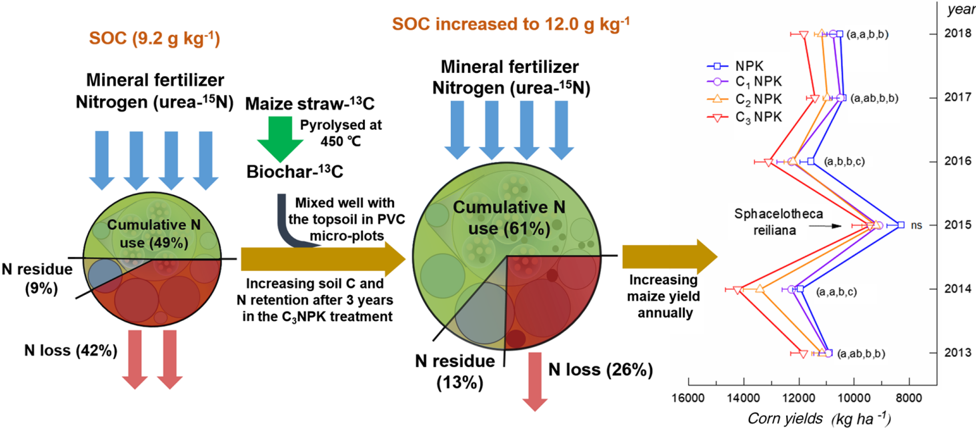
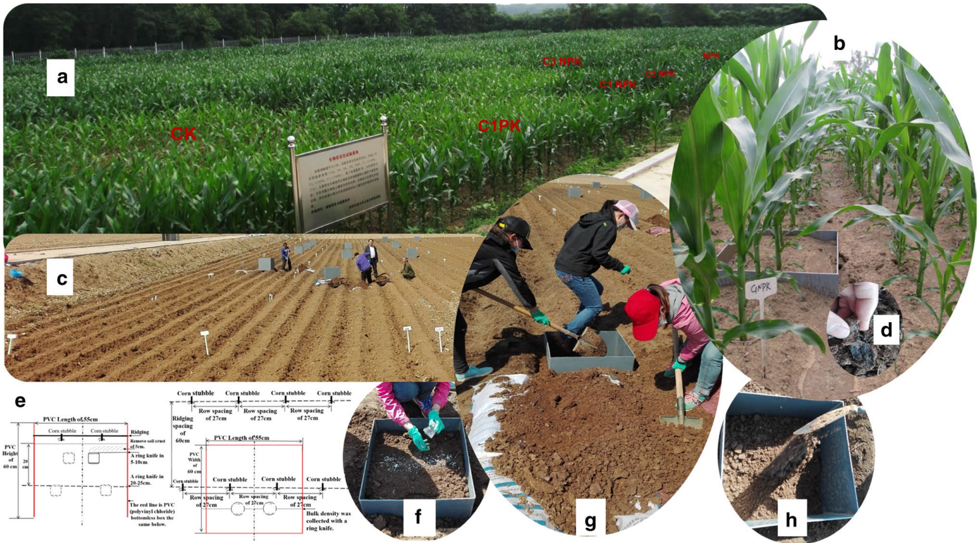
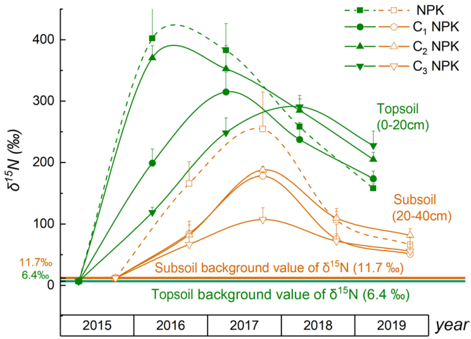
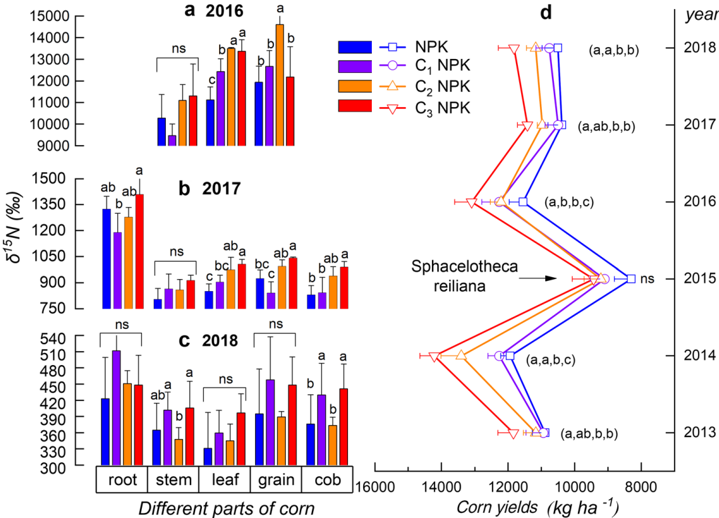
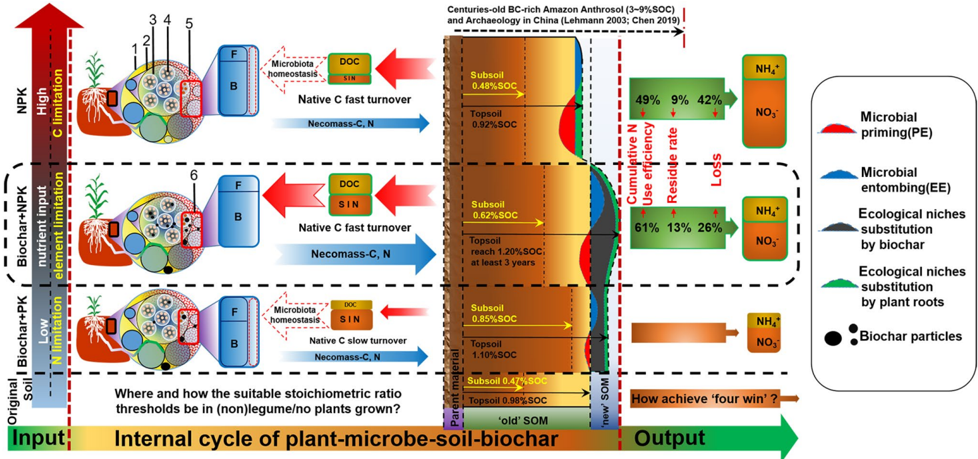
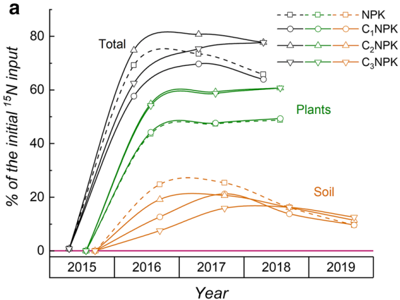
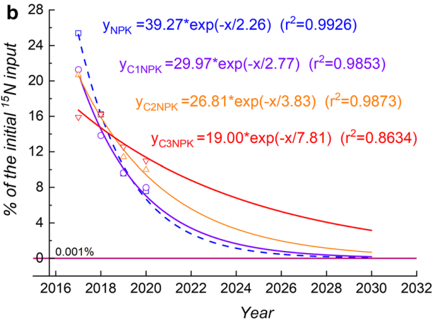
Combined application of biochar with fertilizers has been used to increase soil fertility and crop yield. However, the coupling mechanisms through which biochar improves crop yield at field scale and the time span over which biochar affects carbon and nitrogen transformation and crop yield are still little known. In this study, a long-term field trial (2013–2019) was performed in brown soil planting maize. Six treatments were designed: CK—control; NPK—application of chemical fertilizers; C 1 PK—low biochar without nitrogen fertilizer; C 1 NPK, C 2 NPK and C 3 NPK—biochar at 1.5, 3 and 6 t ha−1, respectively, combined with chemical fertilizers. Results showed that the δ 15 N value in the topsoil of 0–20 cm layer in the C 3 NPK treatment reached a peak of 291 ‰ at the third year (2018), and demonstrated a peak of 402 ‰ in the NPK treatment in the initial isotope trial in 2016. Synchronously, SOC was not affected until the third to fourth year after biochar addition, and resulted in a significant increase in total N of 2.4 kg N ha−1 in 2019 in C 3 NPK treatment. During the entire experiment, the 15 N recovery rates of 74–80% were observed highest in the C 2 NPK and C 3 NPK treatments, resulting in an annual increase in yields significantly. The lowest subsoil δ15 N values ranged from 66‰ to 107‰, and the 15 N residual rate would take 70 years for a complete decay to 0.001% in the C 3 NPK. Our findings suggest that biochar compound fertilizers can increase C stability and N retention in soil and improve N uptake by maize, while the loss of N was minimized. Biochars, therefore, may have an important potential for improving the agroecosystem and ecological balance. Graphic abstract
Overview
The claims and statistics of this paper haven’t been checked yet.
Free: it reads the open-access text and checks the first 5 claims that cite a source we can check. Create a free account to check every claim.
Integrity signals
Registry
Cites
Statistics
Figures
Verification
Claims the paper makes
The claims and statistics of this paper haven’t been checked yet.
Free: it reads the open-access text and checks the first 5 claims that cite a source we can check. Create a free account to check every claim.
Claims other papers make about this one
Each is checked against this paper’s own text: does it say what the citing paper says it does?
The cited source says what the claim attributes to it.
In the citing paper
“Biochar can also boost N uptake by maize, in which N recovery rates of 74 -80% were observed in treatments with 3 and 6 t ha -1 biochars combined with chemical fertilizers, resulting in a significant annual increase of maize yields (Peng et al. 2021).”
From Corn Cob and Corn Husk Biochars Enhance the Growth of Corn (Zea mays L.) in Fertilized Clay Loam Soil (2023) · cites this paper as Peng et al. 2021
Self-check
Percentages, sums and reported differences re-computed from the paper’s own numbers.
The self-check needs the paper’s full text.
Citations
Cites
The importance of anabolism in microbial control over soil carbon storage
Liang, C., Schimel, J. P., & Jastrow, J. D. (2017) · Nature Microbiology · doi:10.1038/nmicrobiol.2017.105 · Cited by 3,320
Lehmann, J., Pereira da Silva, J., Steiner, C., Nehls, T., Zech, W., & Glaser, B. (2003) · Plant and Soil · doi:10.1023/a:1022833116184 · Cited by 1,878
Quantitative assessment of microbial necromass contribution to soil organic matter
Liang, C., Amelung, W., Lehmann, J., & Kästner, M. (2019) · Global Change Biology · doi:10.1111/gcb.14781 · Cited by 1,843
Biochar mediated changes in soil quality and plant growth in a three year field trial
Jones, D. L., Rousk, J., Edwards-Jones, G., DeLuca, T. H., & Murphy, D. V. (2012) · Soil Biology and Biochemistry · doi:10.1016/j.soilbio.2011.10.012 · Cited by 937
Variable effects of nitrogen additions on the stability and turnover of soil carbon
Neff, J. C., Townsend, A. R., Gleixner, G., Lehman, S. J., Turnbull, J., & Bowman, W. D. (2002) · Nature · doi:10.1038/nature01136 · Cited by 804
Fate of soil‐applied black carbon: downward migration, leaching and soil respiration
MAJOR, J., LEHMANN, J., RONDON, M., & GOODALE, C. (2010) · Global Change Biology · doi:10.1111/j.1365-2486.2009.02044.x · Cited by 788
Long-term fate of nitrate fertilizer in agricultural soils
Sebilo, M., Mayer, B., Nicolardot, B., Pinay, G., & Mariotti, A. (2013) · Proceedings of the National Academy of Sciences · doi:10.1073/pnas.1305372110 · Cited by 695
Wang, C., Liu, D., & Bai, E. (2018) · Soil Biology and Biochemistry · doi:10.1016/j.soilbio.2018.02.003 · Cited by 689
Quilliam, R. S., Glanville, H. C., Wade, S. C., & Jones, D. L. (2013) · Soil Biology and Biochemistry · doi:10.1016/j.soilbio.2013.06.004 · Cited by 562
Past, present, and future of biochar
Chen, W., Meng, J., Han, X., Lan, Y., & Zhang, W. (2019) · Biochar · doi:10.1007/s42773-019-00008-3 · Cited by 552
Self-citationBiochar built soil carbon over a decade by stabilizing rhizodeposits
(Han) Weng, Z., Van Zwieten, L., Singh, B. P., Tavakkoli, E., Joseph, S., Macdonald, L. M., Rose, T. J., Rose, M. T., Kimber, S. W. L., Morris, S., et al. (2017) · Nature Climate Change · doi:10.1038/nclimate3276 · Cited by 388
Maize biochars accelerate short-term soil nitrogen dynamics in a loamy sand soil
Nelissen, V., Rütting, T., Huygens, D., Staelens, J., Ruysschaert, G., & Boeckx, P. (2012) · Soil Biology and Biochemistry · doi:10.1016/j.soilbio.2012.05.019 · Cited by 364
Biochar’s stability and effect on the content, composition and turnover of soil organic carbon
Han, L., Sun, K., Yang, Y., Xia, X., Li, F., Yang, Z., & Xing, B. (2020) · Geoderma · doi:10.1016/j.geoderma.2020.114184 · Cited by 355
Biochar bound urea boosts plant growth and reduces nitrogen leaching
Shi, W., Ju, Y., Bian, R., Li, L., Joseph, S., Mitchell, D. R. G., Munroe, P., Taherymoosavi, S., & Pan, G. (2020) · Science of The Total Environment · doi:10.1016/j.scitotenv.2019.134424 · Cited by 284
Zheng, H., Wang, X., Luo, X., Wang, Z., & Xing, B. (2018) · Science of The Total Environment · doi:10.1016/j.scitotenv.2017.08.166 · Cited by 277
Liu, Q., Liu, B., Zhang, Y., Hu, T., Lin, Z., Liu, G., Wang, X., Ma, J., Wang, H., Jin, H., et al. (2019) · Global Change Biology · doi:10.1111/gcb.14613 · Cited by 252
A scientometric review of biochar research in the past 20 years (1998–2018)
Wu, P., Ata-Ul-Karim, S. T., Singh, B. P., Wang, H., Wu, T., Liu, C., Fang, G., Zhou, D., Wang, Y., & Chen, W. (2019) · Biochar · doi:10.1007/s42773-019-00002-9 · Cited by 234
Microbial necromass on the rise: The growing focus on its role in soil organic matter development
Liang, C., Kästner, M., & Joergensen, R. G. (2020) · Soil Biology and Biochemistry · doi:10.1016/j.soilbio.2020.108000 · Cited by 213
Black carbon—possible source of highly aromatic components of soil humic acids
Haumaier, L., & Zech, W. (1995) · Organic Geochemistry · doi:10.1016/0146-6380(95)00003-w · Cited by 212
Rethinking sources of nitrogen to cereal crops
Yan, M., Pan, G., Lavallee, J. M., & Conant, R. T. (2020) · Global Change Biology · doi:10.1111/gcb.14908 · Cited by 202
The effects of short term, long term and reapplication of biochar on soil bacteria
Nguyen, T. T. N., Wallace, H. M., Xu, C.-Y., (Van) Zwieten, L., Weng, Z. H., Xu, Z., Che, R., Tahmasbian, I., Hu, H.-W., & Bai, S. H. (2018) · Science of The Total Environment · doi:10.1016/j.scitotenv.2018.04.278 · Cited by 175
Song, D., Tang, J., Xiang-yin, X., Zhang, S., Liang, G., Zhou, W., & Wang, X. (2017) · European Journal of Soil Biology · doi:10.1016/j.ejsobi.2017.11.003 · Cited by 152
Luo, Y., Zang, H., Yu, Z., Chen, Z., Gunina, A., Kuzyakov, Y. V., Xu, J. M., Zhang, K., & Brookes, P. C. (2016) · Soil Biology and Biochemistry · doi:10.1016/j.soilbio.2016.12.006 · Cited by 151
Li, S., Wang, S., Fan, M., Wu, Y., & Shangguan, Z. (2019) · Soil and Tillage Research · doi:10.1016/j.still.2019.104437 · Cited by 150
Feng, J., Wang, C., Lei, J., Yang, Y., Yan, Q., Zhou, X., Tao, X., Ning, D., Yuan, M., Qin, Y., et al. (2020) · Microbiome · doi:10.1186/s40168-019-0778-3 · Cited by 148
Stabilization of microbial residues in soil organic matter after two years of decomposition
Wang, C., Wang, X., Pei, G., Xia, Z., Peng, B., Sun, L., Wang, J., Gao, D., Chen, S.-D., Liu, D., et al. (2019) · Soil Biology and Biochemistry · doi:10.1016/j.soilbio.2019.107687 · Cited by 142
Yu, L., Yu, M., Lu, X., Tang, C., Liu, X., Brookes, P. C., & Xu, J. M. (2018) · The Science of The Total Environment · doi:10.1016/j.scitotenv.2018.06.018 · Cited by 131
Kopáček, J., Cosby, B. J., Evans, C., Hruška, J., Moldan, F., Oulehle, F., Šantrůčková, H., Tahovská, K., & Wright, R. F. (2013) · Biogeochemistry · doi:10.1007/s10533-013-9892-7 · Cited by 126
Weng, Z. H., ZWIETEN, L. V., Singh, B. P., Kimber, S. W. L., Morris, S., Cowie, A., & Macdonald, L. M. (2015) · Soil Biology and Biochemistry · doi:10.1016/j.soilbio.2015.08.005 · Cited by 113
Durenkamp, M., Luo, Y., & Brookes, P. C. (2010) · Soil Biology and Biochemistry · doi:10.1016/j.soilbio.2010.07.016 · Cited by 110
An, T., Schaeffer, S. M., Zhuang, J., Radosevich, M. A., Li, S., Li, H., Pei, J., & Wang, J. (2015) · Biology and Fertility of Soils · doi:10.1007/s00374-015-1006-3 · Cited by 108
Dorodnikov, M., Kuzyakov, Y. V., Fangmeier, A., & Wiesenberg, G. L. B. (2010) · Soil Biology and Biochemistry · doi:10.1016/j.soilbio.2010.11.026 · Cited by 106
Priming effect of maize residue and urea N on soil organic matter changes with time
Qiu, Q., Wu, L., Ouyang, Z., Li, B., Xu, Y., Wu, S., & Gregorich, E. G. (2015) · Applied Soil Ecology · doi:10.1016/j.apsoil.2015.11.016 · Cited by 106
Novak, J. M., Ippolito, J. A., Watts, D. W., Sigua, G. C., Ducey, T. F., & Johnson, M. G. (2019) · Biochar · doi:10.1007/s42773-019-00004-7 · Cited by 103
Short-lived effects of walnut shell biochar on soils and crop yields in a long-term field experiment
Griffin-LaHue, D., Wang, D., Parikh, S. J., & Scow, K. M. (2016) · Agriculture Ecosystems & Environment · doi:10.1016/j.agee.2016.11.002 · Cited by 103
Fiorentino, N., Sánchez-Monedero, M. A., Lehmann, J., Enders, A., Fagnano, M., & Cayuela, M. L. (2019) · Soil Biology and Biochemistry · doi:10.1016/j.soilbio.2019.01.005 · Cited by 95
Liang, B., Zhao, W., Yang, X., & Zhou, J. (2013) · Field Crops Research · doi:10.1016/j.fcr.2012.12.007 · Cited by 94
Biochar drives microbially-mediated rice production by increasing soil carbon
Nan, Q., Wang, C., Wang, H. E., Yi, Q., Liang, B., Xu, J., & Wu, W. (2019) · Journal of Hazardous Materials · doi:10.1016/j.jhazmat.2019.121680 · Cited by 89
He, X., Chi, Q., Cai, Z., Cheng, Y., Zhang, J., & Müller, C. (2019) · Soil Biology and Biochemistry · doi:10.1016/j.soilbio.2019.107666 · Cited by 87
Madari, B. E., Silva, M. A. S., Carvalho, M. T. D. M., Maia, A. D. H. N., Petter, F. A., Santos, J. L. S., Tsai, S. M., Leal, W. G. D. O., & Zeviani, W. M. (2017) · Geoderma · doi:10.1016/j.geoderma.2017.05.029 · Cited by 82
Li, S., Wang, S., & Shangguan, Z. (2019) · Agriculture Ecosystems & Environment · doi:10.1016/j.agee.2019.02.013 · Cited by 80
Jiang, X., Haddix, M. L., & Cotrufo, M. F. (2016) · Soil Biology and Biochemistry · doi:10.1016/j.soilbio.2016.05.020 · Cited by 79
Is the rate of mineralization of soil organic carbon under microbiological control?
Brookes, P. C., Chen, Y., Chen, L., Qiu, G., Luo, Y., & Xu, J. (2017) · Soil Biology and Biochemistry · doi:10.1016/j.soilbio.2017.05.003 · Cited by 77
Development of the straw biochar returning concept in China
Meng, J., He, T., Sanganyado, E., Lan, Y., Zhang, W., Han, X., & Chen, W. (2019) · Biochar · doi:10.1007/s42773-019-00019-0 · Cited by 75
Self-citationLi, J., Nie, M., & Pendall, E. G. (2020) · Geoderma · doi:10.1016/j.geoderma.2020.114201 · Cited by 70
Mukherjee, S., Weihermüller, L., Tappe, W., Hofmann, D., Köppchen, S., Laabs, V., Vereecken, H., & Burauel, P. (2016) · The Science of The Total Environment · doi:10.1016/j.scitotenv.2016.03.145 · Cited by 68
Oladele, S. O., Adeyemo, A. J., Adegaiye, A., & Awodun, M. A. (2019) · Biochar · doi:10.1007/s42773-019-00017-2 · Cited by 65
Microbial respiration of biochar- and digestate-based mixtures
Mukherjee, S., Weihermüller, L., Tappe, W., Vereecken, H., & Burauel, P. (2015) · Biology and Fertility of Soils · doi:10.1007/s00374-015-1060-x · Cited by 64
Nitrogen acquisition from mineral‐associated proteins by an ectomycorrhizal fungus
Wang, T., Tian, Z., Tunlid, A., & Persson, P. (2020) · New Phytologist · doi:10.1111/nph.16596 · Cited by 64
Mukherjee, S., Tappe, W., Weihermueller, L., Hofmann, D., Köppchen, S., Laabs, V., Schroeder, T., Vereecken, H., & Burauel, P. (2015) · The Science of The Total Environment · doi:10.1016/j.scitotenv.2015.11.111 · Cited by 62
Interactions between biochar and litter priming: A three-source 14C and δ13C partitioning study
Cui, J., Ge, T., Kuzyakov, Y., Nie, M., Fang, C., Tang, B., & Zhou, C. (2017) · Soil Biology and Biochemistry · doi:10.1016/j.soilbio.2016.10.014 · Cited by 51
Wang, L., Li, L., Cheng, K., Ji, C., Qian, Y., Bian, R., & Pan, G. (2018) · Environmental Science and Pollution Research · doi:10.1007/s11356-018-1245-6 · Cited by 48
Chen, K., Peng, J., Li, J., Yang, Q., Zhan, X., Liu, N., & Han, X. (2020) · Journal of Soils and Sediments · doi:10.1007/s11368-020-02693-1 · Cited by 44
Self-citationOxidation is Key for Black Carbon Surface Functionality and Nutrient Retention in Amazon Anthrosols
Liang, B., Wang, C., Solomon, D., Kinyangi, J. M., & Luizão, F. J. (2013) · British Journal of Environment and Climate Change · doi:10.9734/bjecc/2013/2267 · Cited by 18
Oxidation Is Key For Black Carbon Surface Functionality And Nutrient Retention In Amazon Anthrosols
Liang, B., Wang, C., Solomon, D., Kinyangi, J. M., Luizão, F. J., Wirick, S., Skjemstad, J. O., & Lehmann, J. C. (2013) · Zenodo (CERN European Organization for Nuclear Research) · doi:10.5281/zenodo.8105 · Cited by 12
Research works printed but not linked: 2
- He XX, Chi Q, Cai Z, Cheng Y, Zhang J, Müller C (2020) 15N tracing studies including plant N uptake processes provide new insights on gross N transformations in soil-plant systems. Soil Biol Biochem 141:107666. https://doi.org/10.1016/j.soilbio.2019.107666 · DOI
- Pan GX, Ding Y, Chen S, Sun J, Feng X, Zhang C, Marios D, Zheng J, Zhang X, Cheng K (2019) Exploring the nature of soil organic matter from humic substances isolation to SOMics of molecular assemblage. Adv Earth Sci 34(5):451-470. https:// doi. org/ 10. 11867/j. issn. 1001-8166. 2019. 05. 0451. (inChi nesew ithEn glish abstr act) · doi:10.11867/j.issn.1001-8166.2019.05.0451.(inchinesewithenglishabstract
Cited by
Role of biochar toward carbon neutrality
Wang, L., Deng, J., Yang, X., Hou, R., & Hou, D. (2023) · Carbon Research · doi:10.1007/s44246-023-00035-7 · Cited by 195
Biochar-based fertilizer effects on crop productivity: a meta-analysis
Melo, L. C. A., Lehmann, J. C., Carneiro, J. S. D. S., & Arbestain, M. C. (2022) · Plant and Soil · doi:10.1007/s11104-021-05276-2 · Cited by 154
Azeem, M., Sun, T., Jeyasundar, P. G. S. A., Han, R., Li, H., Abdelrahman, H. M., Shaheen, S. M., Zhu, Y., & Li, G. (2023) · Critical Reviews in Environmental Science and Technology · doi:10.1080/10643389.2023.2190333 · Cited by 91
“It also improves soil fertility (Peng et al., 2021) by optimizing soil physicochemical properties (Tomczyk et al., 2020) such as pH, cation exchange capacity (CEC), and water and nutrients retention (Ali et al., 2020; Azeem, Ali, Arockiam Jeyasundar, Li, et al., 2021; Hossain et al., 2020;…”
BackgroundBhattacharyya, P. N., Sandilya, S. P., Sarma, B., Pandey, A. K., Dutta, J., Mahanta, K., Lesueur, D., Nath, B. C., Borah, D., & Borgohain, D. J. (2024) · Journal of soil science and plant nutrition · doi:10.1007/s42729-024-01629-9 · Cited by 106
“It has been observed that biochar generated from pine bark wood is an effective carrier of Bradyrhizobium strains that has a prolonged shelf life of 1 year, and improves the yield to Azospirillum biofertilizer has increased its shelf life to 6 months at room temperature (Peng et al. 2021).”
Yan, B., Zhang, Y., Wang, Y., Rong, X., Peng, J., Fei, J., & Luo, G. (2023) · Chemosphere · doi:10.1016/j.chemosphere.2023.138293 · Cited by 96
Self-citation
Metadata
- Authors
- Peng, J., Han, X., Li, N., Chen, K., Yang, J., Zhan, X., Luo, P., & Liu, N.
- Affiliations
- Shenyang Agricultural University (CN)
- Corresponding author
- Han, Xiaori
- Venue
- Biochar
- Published
- 2021-03-22
- Volume
- 3
- Issue
- 3
- Pages
- 367-379
- ISSN
- 2524-7867 (ISSN-L)
- 2524-7972
- OpenAlex
- W3137470456
- Cited by
- 100
- References
- 55
- Citations by year
- 2026: 18 · 2025: 19 · 2024: 31 · 2023: 17 · 2022: 13 · 2021: 2
- FWCI
- 9.20
- Type
- journal article
- Language
- en
- Open access
- hybrid
- doi.org
- Licence
- cc-by
- creativecommons.org/licenses/by/4.0 (tdm)
- creativecommons.org/licenses/by/4.0 (vor)
- Locations
- Biochar (publishedVersion, cc-by)
- Funders
- Natural Science Foundation of China (31972511)
- National Key Research and Development Program of China (2018YFD0300308, 2017YFD0300700)
- Topics
- Life Sciences › Agricultural and Biological Sciences › Soil Science › Soil Carbon and Nitrogen Dynamics
- Life Sciences › Agricultural and Biological Sciences › Soil Science › Agricultural Science and Fertilization
- Life Sciences › Agricultural and Biological Sciences › Agronomy and Crop Science › Crop Yield and Soil Fertility
- Keywords
- maize, nitrogen uptake, nitrogen retention, 15N tracer, nitrogen recovery rate, soil organic carbon, brown soil, nitrogen loss, long-term field experiment, carbon stability
About these checks
Registry, retraction, Cites and statistics results are computed, not judged, with one exception: a printed reference that no index lists is read once by a model before it counts as a citation error. Claims are extracted by a model and kept only when their quote appears verbatim in the text; each cited source is then checked, with a model’s help, for whether it says what the claim relies on. Those verdicts can be wrong — read the claim’s quote and the cited source before relying on one.
Statistics and arithmetic are recomputed, not judged.
Confidence bands are shown only for fields calibrated on our annotated test set. None is calibrated yet, so no band is shown.
What counts as a claim ›How we measure confidence ›How we check this ›
Are you an author, or do you see a problem with this page? Request a review
Data sources
Bibliographic data: Semantic Scholar, OpenAlex, Crossref.
Contains information from the Semantic Scholar Academic Graph Datasets, made available under the ODC Attribution License (ODC-BY 1.0).
Semantic Scholar’s data is described in: Kinney, R., et al. (2023). The Semantic Scholar Open Data Platform. arXiv:2301.10140.
