

Data mining of scientific research on artificial intelligence in teaching and administration in higher education institutions: a bibliometrics analysis and recommendation for future research
Open accessThe DOI matches its Crossref record; 44 of the 45 references it cites were found in a registry or an index.
Abstract
Teaching and learning as well as administrative processes are still experiencing intensive changes with the rise of artificial intelligence (AI) technologies and its diverse application opportunities in the context of higher education. Therewith, the scientific interest in the topic in general, but also specific focal points rose as well. However, there is no structured overview on AI in teaching and administration processes in higher education institutions that allows to identify major research topics and trends, and concretizing peculiarities and develops recommendations for further action. To overcome this gap, this study seeks to systematize the current scientific discourse on AI in teaching and administration in higher education institutions. This study identified an (1) imbalance in research on AI in educational and administrative contexts, (2) an imbalance in disciplines and lack of interdisciplinary research, (3) inequalities in cross-national research activities, as well as (4) neglected research topics and paths. In this way, a comparative analysis between AI usage in administration and teaching and learning processes, a systematization of the state of research, an identification of research gaps as well as further research path on AI in higher education institutions are contributed to research.
Overview
The claims and statistics of this paper haven’t been checked yet.
Free: it reads the open-access text and checks the first 5 claims that cite a source we can check. Create a free account to check every claim.
Integrity signals
Registry
Cites
Statistics
Figures
Verification
Claims the paper makes
The claims and statistics of this paper haven’t been checked yet.
Free: it reads the open-access text and checks the first 5 claims that cite a source we can check. Create a free account to check every claim.
Claims other papers make about this one
Each is checked against this paper’s own text: does it say what the citing paper says it does?
The check wasn’t confident either way, so it gives no verdict — never disputed.
In the citing paper
“AI can help forecast the performance and outcomes of healthcare processes, such as patient satisfaction, safety, quality of care, and efficiency, using machine learning algorithms and clinical data. This can help identify best practices, monitor progress, and provide feedback and recommendations for improvement. 54”
From Artificial Intelligence and Decision-Making in Healthcare: A Thematic Analysis of a Systematic Review of Reviews (2024) · cites this paper as [54]
Experimental — accuracy not yet measured
Self-check
Percentages, sums and reported differences re-computed from the paper’s own numbers.
The self-check needs the paper’s full text.
Citations
Cites
bibliometrix: An R-tool for comprehensive science mapping analysis
Aria, M., & Cuccurullo, C. (2017) · Journal of Informetrics · doi:10.1016/j.joi.2017.08.007 · Cited by 23,235 · cited 1×
“Based on the Web of Science Analysis Results Tool and the R package “biblometrix” [17], a bibliometric analysis was performed to screen and classify the field.”
MethodFast unfolding of communities in large networks
Blondel, V. D., Guillaume, J.-L., Lambiotte, R., & Lefebvre, E. (2008) · Journal of Statistical Mechanics: Theory and Experiment · doi:10.1088/1742-5468/2008/10/p10008 · Cited by 21,424 · cited 1×
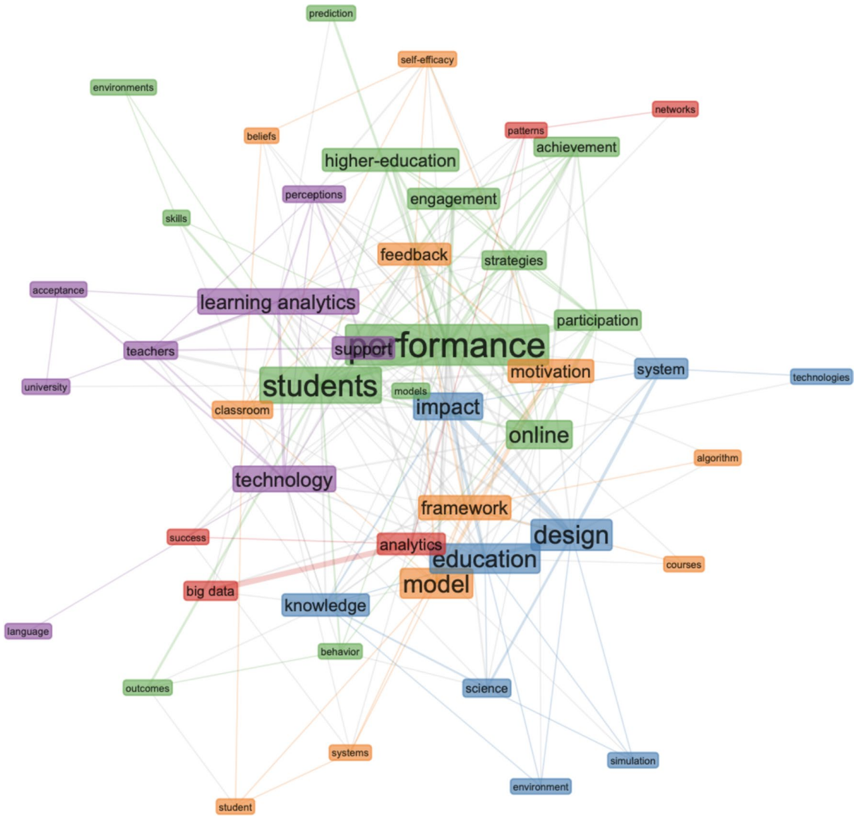
“The clustering follows the Louvain method [20]; isolated nodes are deleted and a minimum of two edges to a node was set as the default criterion to be incorporated into the network.”
MethodHow to conduct a bibliometric analysis: An overview and guidelines
Donthu, N., Kumar, S., Mukherjee, D., Pandey, N., & Lim, W. M. (2021) · Journal of Business Research · doi:10.1016/j.jbusres.2021.04.070 · Cited by 14,329 · cited 1×
“Among other things, this allowed us to find gaps in the literature and identify areas that have not been adequately studied but warrant further attention [21].”
BackgroundZawacki-Richter, O., Marín, V. I., Bond, M., & Gouverneur, F. (2019) · International Journal of Educational Technology in Higher Education · doi:10.1186/s41239-019-0171-0 · Cited by 7,242 · cited 1×
“Zawacki-Richter et al. [14] provided an overview of the research on AI applications in higher education through a systematic review and showed that most of the disciplines involved in AI in education research come from computer science and STEM.”
BackgroundAn algorithm for drawing general undirected graphs
Kamada, T., & Kawai, S. (1989) · Information Processing Letters · doi:10.1016/0020-0190(89)90102-6 · Cited by 2,698 · cited 1×
“The co-occurrence network analysis is based on Kamada and Kawai’s [19] network layout.”
MethodGusenbauer, M., & Haddaway, N. R. (2020) · Research Synthesis Methods · doi:10.1002/jrsm.1378 · Cited by 2,379
Exploring the impact of artificial intelligence on teaching and learning in higher education
Popenici, S. A. D., & Kerr, S. (2017) · Research and Practice in Technology Enhanced Learning · doi:10.1186/s41039-017-0062-8 · Cited by 2,019 · cited 1×
“We refer to AI in the context of higher education as “computing systems that are able to engage in human-line processes such as learning, adapting, synthesizing, self-correction, and the use of data for complex processing tasks” [12].”
Method(2016) · Open Research Online (The Open University) · Cited by 1,410
A Review of Artificial Intelligence (AI) in Education from 2010 to 2020
Zhai, X., Chu, X., Chai, C. S., Jong, M. S. Y., Istenic, A., Spector, M., Liu, J.-B., Yuan, J., & Li, Y. (2021) · Complexity · doi:10.1155/2021/8812542 · Cited by 1,364 · cited 1×
“This imbalance needs to be ameliorated in further research, as theoretical and empirical work is the foundation for the future implementation of AI in HEI processes [22].”
BackgroundRahwan, I., Cebrian, M., Obradovich, N., Bongard, J., Bonnefon, J.-F., Breazeal, C., Crandall, J. W., Christakis, N. A., Couzin, I. D., Jackson, M. O., et al. (2019) · Nature · doi:10.1038/s41586-019-1138-y · Cited by 1,364 · cited 1×
“These include AI-related ethics, fairness, and privacy issues [39–41].”
Background(2019) · Open Research Online (The Open University) · Cited by 1,004
Kebritchi, M., Lipschuetz, A., & Santiague, L. (2017) · Journal of Educational Technology Systems · doi:10.1177/0047239516661713 · Cited by 967
Mariani, M. M., Perez‐Vega, R., & Wirtz, J. (2022) · Psychology & Marketing · doi:10.1002/mar.21619 · Cited by 631 · cited 3×
“…studies that link computer science with humanities and social sciences will shape research on explainable and ethical AI to address challenges such as transparency and trust, enabling testing of AI systems for regulatory reasons, and adapting AI systems in response to unexpected behavior [31].”
BackgroundResultThe Chinese approach to artificial intelligence: an analysis of policy, ethics, and regulation
Roberts, H., Cowls, J., Morley, J., Taddeo, M., Wang, V., & Floridi, L. (2021) · AI & SOCIETY · doi:10.1007/s00146-020-00992-2 · Cited by 573 · cited 1×
“This is not surprising since China, in recent years, attributes very high importance to AI research and provides governmental support [45], with attention to AI in education [46, 47].”
BackgroundArtificial intelligence for education: Knowledge and its assessment in AI-enabled learning ecologies
Cope, B., Kalantzis, M., & Searsmith, D. (2021) · Educational Philosophy and Theory · doi:10.1080/00131857.2020.1728732 · Cited by 518 · cited 1×
“Essential insights from philosophy, for example, could increasingly bring to the fore the limitations of using AI as a substitute for a human teacher [29], as well as provide insights from ethical and epistemological perspectives [30].”
BackgroundChatbot for university related FAQs
Ranoliya, B. R., Raghuwanshi, N., & Singh, S. (2017) · 2017 International Conference on Advances in Computing, Communications and Informatics (ICACCI) · doi:10.1109/icacci.2017.8126057 · Cited by 425 · cited 1×
“…and appropriate student administration [24], student retention and increasing student enrollment [25], administrative support (e.g., assignment submission, course registration, examination schedule, scoring, graduation) [26], and supporting administrative staff by answering students’ FAQs [27].”
BackgroundHinojo-Lucena, F.-J., Aznar-Díaz, I., Cáceres-Reche, M.-P., & Romero-Rodríguez, J.-M. (2019) · Education Sciences · doi:10.3390/educsci9010051 · Cited by 400 · cited 1×
“Hinojo-Lucena et al. [13] conducted a bibliometric analysis on AI in HEI and observed that the literature on this subject is at an incipient stage and that the research on AI application in HEI has not been consolidated.”
BackgroundArtificial Intelligence Regulation: A framework for governance
de Almeida, P. G. R., dos Santos, C. D., & Farias, J. S. (2021) · Ethics and Information Technology · doi:10.1007/s10676-021-09593-z · Cited by 395
Over-optimization of academic publishing metrics: observing Goodhart's Law in action
Fire, M., & Guestrin, C. (2019) · GigaScience · doi:10.1093/gigascience/giz053 · Cited by 351 · cited 1×
“On the one hand, this goes hand in hand with a general increase in the number of research outputs due to the increasing number of outlets [43, 44].”
BackgroundAI Grand Challenges for Education
Woolf, B. P., Lane, H. C., Chaudhri, V. K., & Kolodner, J. L. (2013) · AI Magazine · doi:10.1609/aimag.v34i4.2490 · Cited by 230 · cited 1×
“Furthermore, these tools allow for the analysis of vast data sets of instructional behavior collected from databases, containing elements of learning, affect, motivation, or social interaction [5–7].”
BackgroundEthical issues in service robotics and artificial intelligence
Belk, R. (2021) · The Service Industries Journal · doi:10.1080/02642069.2020.1727892 · Cited by 228
Renz, A., & Hilbig, R. (2020) · International Journal of Educational Technology in Higher Education · doi:10.1186/s41239-020-00193-3 · Cited by 218 · cited 1×
“There is a lack of long-term observations of AI-enabled teaching in HEI [42].”
BackgroundSelf-citationScheel, L., Vladova, G., & Ullrich, A. (2022) · International Journal of Educational Technology in Higher Education · doi:10.1186/s41239-022-00350-w · Cited by 206 · cited 1×
“In the literature, factors such as learner characteristics [35, 36] and teacher competencies [37] have already been investigated, which are crucial for its long-term use and acceptance.”
BackgroundSelf-citationKalimullina, O., Tarman, B., & Stepanova, I. (2020) · Journal of Ethnic and Cultural Studies · doi:10.29333/ejecs/629 · Cited by 186 · cited 1×
“At the same time, these competencies are relevant, especially during and after the COVID crisis [32–34].”
BackgroundHien, H. T., Cuong, P.-N., Nam, L. N. H., Nhung, H. L. T. K., & Thang, L. D. (2018) · Proceedings of the Ninth International Symposium on Information and Communication Technology - SoICT 2018 · doi:10.1145/3287921.3287937 · Cited by 159 · cited 1×
“…and appropriate student administration [24], student retention and increasing student enrollment [25], administrative support (e.g., assignment submission, course registration, examination schedule, scoring, graduation) [26], and supporting administrative staff by answering students’ FAQs [27].”
BackgroundMarcinkowski, F., Kieslich, K., Starke, C., & Lünich, M. (2020) · Proceedings of the 2020 Conference on Fairness, Accountability, and Transparency · doi:10.1145/3351095.3372867 · Cited by 159
Vladova, G., Ullrich, A., Bender, B., & Gronau, N. (2021) · Frontiers in Psychology · doi:10.3389/fpsyg.2021.636086 · Cited by 156
Self-citationAccountable algorithms? The ethical implications of data-driven business models
Breidbach, C. F., & Maglio, P. (2020) · Journal of Service Management · doi:10.1108/josm-03-2019-0073 · Cited by 113
Schneider, K., Berens, J., Oster, S., & Burghoff, J. (2018) · RePEc: Research Papers in Economics · Cited by 108
Using institutional data to predict student course selections in higher education
Ognjanovic, I., Gasevic, D., & Dawson, S. (2016) · The Internet and Higher Education · doi:10.1016/j.iheduc.2015.12.002 · Cited by 95 · cited 1×
“…[10], answering service requests or inquiries from students to the secretariat [23], future course selection and appropriate student administration [24], student retention and increasing student enrollment [25], administrative support (e.g., assignment submission, course registration, examination…”
BackgroundRadanliev, P., Roure, D. D., & Walton, R. (2020) · Diabetes & Metabolic Syndrome Clinical Research & Reviews · doi:10.1016/j.dsx.2020.06.063 · Cited by 61 · cited 1×
“Although adopting a narrow focus is common practice and consistent with recent work [18, 31], see [58], future research should collect data from different databases.”
BackgroundAnalytical Competences of Teachers in Big Data in the Era of Digitalized Learning
López-Belmonte, J., Pozo-Sánchez, S., Fuentes-Cabrera, A., & Trujillo-Torres, J.-M. (2019) · Education Sciences · doi:10.3390/educsci9030177 · Cited by 60
Pu, H., Fan, M., Zhang, H., Bi-zhen, Y., Jin-jiao, L., Liu, C., Yan-ze, Z., & Rui, S. (2020) · Neural Computing and Applications · doi:10.1007/s00521-020-05045-9 · Cited by 49
Educational Technology Research: Contexts, Complexity and Challenges
Scanlon, E. (2021) · Journal of Interactive Media in Education · doi:10.5334/jime.580 · Cited by 49
Intelligent online English teaching system based on SVM algorithm and complex network
Fang, C. (2020) · Journal of Intelligent & Fuzzy Systems · doi:10.3233/jifs-189313 · Cited by 48
Berens, J., Schneider, K., Görtz, S., Oster, S., & Burghoff, J. (2018) · SSRN Electronic Journal · doi:10.2139/ssrn.3275433 · Cited by 44
Kant's doctrine of education and the problem of artificial intelligence
Kornilaev, L. Y. (2021) · Journal of Philosophy of Education · doi:10.1111/1467-9752.12608 · Cited by 30 · cited 1×
“Essential insights from philosophy, for example, could increasingly bring to the fore the limitations of using AI as a substitute for a human teacher [29], as well as provide insights from ethical and epistemological perspectives [30].”
BackgroundSelf-Taught Semisupervised Dictionary Learning With Nonnegative Constraint
Zhang, X., Liu, Q., Wang, D., Zhao, L., Gu, N., & Maybank, S. (2019) · IEEE Transactions on Industrial Informatics · doi:10.1109/tii.2019.2926778 · Cited by 29
Individualisation of Education in Terms of E‑learning: Experience and Prospects
Vainshtein, Y. V., Shershneva, V. A., Esin, R. V., & Noskov, M. V. (2019) · Journal of Siberian Federal University Humanities & Social Sciences · doi:10.17516/1997-1370-0481 · Cited by 27 · cited 2×
“Furthermore, these tools allow for the analysis of vast data sets of instructional behavior collected from databases, containing elements of learning, affect, motivation, or social interaction [5–7].”
BackgroundDigitalization of Educational Processes in Universities: Achievements and Problems
Popova, O. I., Gagarina, N., & Карх, Д. А. (2020) · International Scientific Conference "Digitalization of Education: History, Trends and Prospects" (DETP) · doi:10.2991/assehr.k.200509.131 · Cited by 21 · cited 1×
“At the same time, these competencies are relevant, especially during and after the COVID crisis [32–34].”
BackgroundBringing Abstract Academic Integrity and Ethical Concepts into Real-Life Situations
Kwong, T. F. N., Wong, E. Y. W., & Yue, K. K. M. (2017) · Technology Knowledge and Learning · doi:10.1007/s10758-017-9315-2 · Cited by 15
Personality Trait Detection Based on ASM Localization and Deep Learning
Fu, J., & Zhang, H. (2021) · Scientific Programming · doi:10.1155/2021/5675917 · Cited by 15
Feature Extraction and Learning Effect Analysis for MOOCs Users Based on Data Mining
Li, Y. (2018) · International Journal of Emerging Technologies in Learning (iJET) · doi:10.3991/ijet.v13i10.9456 · Cited by 12
Individualisation of Education in Terms of E‑learning: Experience and Prospects
Vainshtein, Y. V., Shershneva, V. A., Esin, R. V., et al. (2019) · SibFU Digital Repository (Siberian Federal University) · doi:10.17516/1997–1370–0481 · Cited by 6
Knowledge Analytics: A Constituent of Educational Analytics
Wang, S., & Wang, H. (2020) · International Journal of Business Analytics · doi:10.4018/ijban.2020100102 · Cited by 3
Research works printed but not linked: 12
- 2. Robinson R, Molenda M, Rezabek L. Facilitating Learning. In: Januszewski A, Molenda M, editors. Educational technology -a definition with commentary. 2nd ed. New York: Routledge; 2013. p. 27-60.
- 3. Gao PP, Nagel A, Biedermann H. Categorization of educational technologies as related to pedagogical practices. In: Tirri K, Toom A, editors. Pedagogy in basic and higher education. London: IntechOpen; 2020. p. 1-15.
- 11. Renz A, Krishnaraja S, Gronau E. Demystification of artificial intelligence in education-how much AI is really in the educational technol- ogy. Int J Learn Anal Artif Intell Educ. 2020;2:4-30.
- 25. Bhatnagar H. Artificial intelligence-a new horizon in Indian higher education. J Learn Teach Digit Age. 2020;5:30-4.
- 28. Whittaker M, et al. AI now report 2018. New York: AI Now Institute at New York University; 2018.
- 37. Vladova G, Scheel L, Ullrich A. Acceptance of digital learning in higher education-Whart role do teachers' competencies play?. In: Proceed- ings of the European Conference on Information Systems. 2022; https:// aisel. aisnet. org/ ecis2 022_ rp/ 168
- 44. Ware M, Mabe M. The STM report: An overview of scientific and scholarly journal publishing. In: DigitalCommons@University of Nebraska -Lincoln. 2015. https:// digit alcom mons. unl. edu/ cgi/ viewc ontent. cgi? artic le= 1008& conte xt= schol com. Accessed 13 Jun 2022.
- 46. Hao K. China has started a grand experiment in AI education. It could reshape how the world learns. MIT Technol Rev. 2019; https:// www. techn ology review. com/ 2019/ 08/ 02/ 131198/ china-squir rel-has-start ed-a-grand-exper iment-in-ai-educa tion-it-could-resha pe-how-the/. Accessed 13 Jun 2022.
- 50. Qian Y, Li C-X, Zou X-G, Feng X-B, Xiao M-H, Ding Y-Q. Research on predicting learning achievement in a flipped classroom based on MOOCs by big data analysis. Comput Appl Eng Educ. 2022;30:222-34.
- 52. Li M, An Z, Ren M. Student-centred webcast+ home-based learning model and investigation during the covid-19 epidemic. Intel Artif. 2020;23:51-65.
- 53. Ma N, Xin S, Du J-Y. A peer coaching-based professional development approach to improving the learning participation and learning design skills of in-service teachers. J Educ Technol Soc. 2018;21:291-304.
- 56. Yang AC, Chen IY, Flanagan B, Ogata H. Automatic generation of cloze items for repeated testing to improve reading comprehension. Educ Technol Soc. 2021;24:147-58.
Cited by
Bond, M., Khosravi, H., De Laat, M., Bergdahl, N., Negrea, V., Oxley, E., Pham, P., Chong, S. W., & Siemens, G. (2024) · International Journal of Educational Technology in Higher Education · doi:10.1186/s41239-023-00436-z · Cited by 852
“However, there remain many concerns about how institutions are storing and using teaching and learning data (see section below, Research Gaps ), and therefore further data regulations and a greater emphasis on ethical considerations are needed (Bear-man et al., 2023; Ullrich et al., 2022).”
BackgroundInfluentialKhosravi, M., Zare, Z., Mojtabaeian, S. M., & Izadi, R. (2024) · Health Services Research and Managerial Epidemiology · doi:10.1177/23333928241234863 · Cited by 265
“54 It is shown that ANNs have been effectively applied to forecast quality factors (responsiveness, security, and ef fi ciency) that affect the adoption of e-government services.”
MethodYenduri, G., Kaluri, R., Rajput, D. S., Lakshmanna, K., Gadekallu, T. R., Mahmud, M., & Brown, D. J. (2023) · IEEE Access · doi:10.1109/access.2023.3289496 · Cited by 95
“AI refers to the simulation of human intelligence in machines that are programmed to replicate human thought and behavior [49].”
BackgroundAI in higher education: A bibliometric analysis, synthesis, and a critique of research
Lachheb, A., Leung, J., Abramenka-Lachheb, V., & Sankaranarayanan, R. (2025) · The Internet and Higher Education · doi:10.1016/j.iheduc.2025.101021 · Cited by 36
Generative artificial intelligence in education: analysis of trends and prospects
Андреевна, П. Е., Леонидович, О. П., Gorlacheva, E. N., & Faizullin, R. V. (2024) · Vocational education and labour market · doi:10.52944/port.2024.58.3.001 · Cited by 55
Metadata
- Authors
- Ullrich, A., Vladova, G., Eigelshoven, F., & Renz, A.
- Affiliations
- University of Potsdam (DE)
- Weizenbaum Institute (DE)
- Corresponding author
- Ullrich, André
- Venue
- Discover Artificial Intelligence
- Published
- 2022-09-05
- Volume
- 2
- Issue
- 1
- ISSN
- 2731-0809 (ISSN-L)
- OpenAlex
- W4294681228
- Semantic Scholar
- 41c6cab89138576567b53e4262d9659b54dd7052
- Cited by
- 41
- References
- 44
- Citations by year
- 2026: 8 · 2025: 19 · 2024: 9 · 2023: 5
- FWCI
- 8.17
- Type
- journal article
- Language
- en
- Open access
- gold
- doi.org
- Licence
- cc-by
- creativecommons.org/licenses/by/4.0 (tdm)
- creativecommons.org/licenses/by/4.0 (vor)
- Locations
- Discover Artificial Intelligence (publishedVersion, cc-by)
- DOAJ (DOAJ: Directory of Open Access Journals) (submittedVersion, cc-by-sa)
- publish.UP (University of Potsdam) (submittedVersion, cc-by)
- Universität Potsdam (cc-by)
- Funders
- Bundesministerium für Bildung und Forschung (16DII127)
- Universität Potsdam
- Topics
- Social Sciences › Education › Artificial Intelligence in Education
- Social Sciences › Education › Digital Transformation of Higher Education
- Physical Sciences › Computer Science › Computer Science Applications › Online Learning and Analytics
- Keywords
- artificial intelligence in higher education, AI in teaching and learning, research trends, research gaps, interdisciplinary research, research topics
About these checks
Registry, retraction, Cites and statistics results are computed, not judged, with one exception: a printed reference that no index lists is read once by a model before it counts as a citation error. Claims are extracted by a model and kept only when their quote appears verbatim in the text; each cited source is then checked, with a model’s help, for whether it says what the claim relies on. Those verdicts can be wrong — read the claim’s quote and the cited source before relying on one.
Statistics and arithmetic are recomputed, not judged.
Confidence bands are shown only for fields calibrated on our annotated test set. None is calibrated yet, so no band is shown.
What counts as a claim ›How we measure confidence ›How we check this ›
Are you an author, or do you see a problem with this page? Request a review
Data sources
Bibliographic data: Semantic Scholar, OpenAlex, Crossref.
Contains information from the Semantic Scholar Academic Graph Datasets, made available under the ODC Attribution License (ODC-BY 1.0).
Semantic Scholar’s data is described in: Kinney, R., et al. (2023). The Semantic Scholar Open Data Platform. arXiv:2301.10140.
