

The DOI matches its Crossref record; 74 of the 74 references it cites were found in a registry or an index; 10 of the 64 sources its claims cite were checked for support.
Multinational machine learning investigation of whether generative AI interactions augment or substitute cognitive skills and study efficiency in global higher education
Open accessAbstract
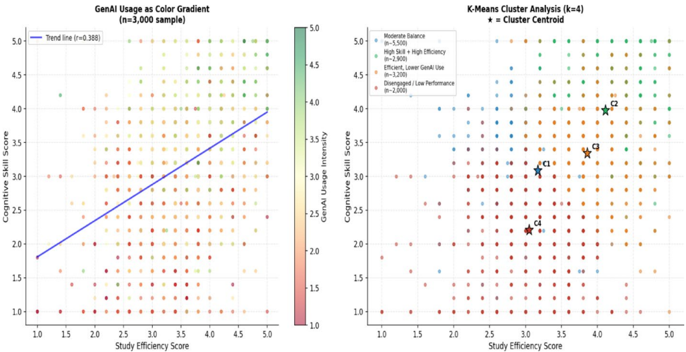
While GenAI has been rapidly integrated into higher education, little empirical evidence explains how specific usage patterns drive cognitive augmentation versus cognitive offloading remains limited, as most studies treat usage uniformly. This study fills that gap by examining how GenAI habits, metacognitive behaviour, and emotions jointly predict cognitive skills and study efficiency as a distinct outcome across a global context. A secondary analysis was conducted on a publicly available cross-sectional multinational survey dataset of N = 14,949 higher education students, drawn from an original sample of 22,963 respondents across 120 countries. A five-layer analytical framework was applied: (1) measurement model validation using Confirmatory Factor Analysis (CFA) and Fornell-Larcker criterion; (2) multivariate OLS regression was used to predict critical thinking gain; (3) benchmarking of four machine learning algorithm (Linear Regression, Random Forest, XGBoost and Gradient Boosting) was used on a stratified 70/30 train-test spilt; (4) SHapley Additive exPlanations (SHAP) analysis was used on best performing model; and (5) K-Mean clustering (k = 4) was used across the three dimensions space of Cognitive Skill, Study Efficiency, and GenAI Usage. Robustness was assessed through five-fold cross-validation, discipline-stratified and subgroup analysis. The best-performing machine learning models demonstrated moderate predictive performance, explaining 28.18% of the variance in Cognitive Skill and 30.00% of the variance in Study Efficiency. The SHAP analysis result shows that Self-testing Habits (SHAP = 0.128) was the single strongest predictor of cognitive skill development. GenAI Usage Frequency (SHAP = 0.184) was the dominant driver of Study Efficiency. Four empirically distinct students’ interaction profiles were identified: (1) Augmentor (high skill, high efficiency, highest GenAI use; n = 2900); (2) Optimiser (moderate balance; n = 5500); (3) Traditionalist (efficient with lower GenAI use; n = 3000); and Substitutor (disengaged, low performance; n = 2000). Institutional funding type was a significant predictor of gains in study efficiency. The study concluded that effective human-GenAI interaction is not a function of usage frequency alone but of interaction quality, task type, and metacognitive structure within which AI tools are embedded. The cognitive skill efficiency trade-off is real but avoidable: Augmentor-profile students demonstrate that high efficiency and high cognitive skill co-exist when GenAI use is intensive, structured, and metacognitively scaffolded. Higher education institutions must move beyond binary use/no-use policies toward evidence-based frameworks that promote generative, metacognitively embedded interaction to maximise cognitive augmentation and mitigate passive substitution.
Overview
CoChat Summary
TL;DR
This secondary analysis of a multinational survey (N = 14,949) finds that cognitive skill development in GenAI-assisted learning is driven mainly by metacognitive study habits, while study efficiency is driven mainly by GenAI usage frequency. The authors identify four learner profiles and conclude that the cognitive-skill/study-efficiency trade-off is not inevitable when intensive GenAI use is structured and metacognitively scaffolded.
Key findings
- Best-performing models explained 28.18% of variance in Cognitive Skill (Gradient Boosting R² = 0.2818) and 30.00% of variance in Study Efficiency (Gradient Boosting R² = 0.3000).
- SHAP analysis found Self-testing Habits (SHAP = 0.128) was the strongest predictor of cognitive skill development, followed by Study Notes via GenAI (SHAP = 0.120) and Active Learning (SHAP = 0.109); GenAI Usage Frequency (SHAP = 0.184) was the dominant driver of Study Efficiency.
- OLS predicting critical thinking gain found Academic Writing via GenAI was the strongest predictor (β = 0.170, p < 0.001), followed by Creative Writing (β = 0.129) and Confidence/Motivation (β = 0.101); Anxiety/Worry and Positive Affect were non-significant.
- K-means identified four profiles: Augmentors (high skill, high efficiency, highest GenAI use; n = 2,900), Optimisers (moderate balance; n = 5,500), Traditionalists (efficient with lower GenAI use; n = 3,000 in the abstract; ~3,200 in Table 8), and Substitutors (disengaged, low performance; n = 2,000). Institutional funding type was a significant predictor of study efficiency gains.
Methods
- Secondary analysis of a publicly available cross-sectional multinational survey dataset: final analytical sample N = 14,949 higher education students, drawn from an original sample of 22,963 respondents across 120 countries (65.1% retained).
- Five-layer analytical framework: (1) CFA and Fornell-Larcker validity testing; (2) multivariate OLS predicting critical thinking gain; (3) benchmarking of Linear Regression, Random Forest, XGBoost, and Gradient Boosting on a stratified 70/30 train-test split (training n = 9,548; test n = 4,092); (4) SHAP analysis on the best-performing model using a 500-participant test subset; and (5) K-means clustering (k = 4) across Cognitive Skill, Study Efficiency, and GenAI Usage.
- Robustness checks used five-fold cross-validation on the full modelling dataset (n = 13,640) and discipline-stratified subgroup models for STEM (n = 1,301) and Social Science (n = 6,025).
Limitations
- The paper states that cognitive skill development was measured through self-reported Likert items (Q29a–Q29e), a proxy measure; future research should use objective indicators such as GPA trajectories, standardised tests, or pre/post designs.
- The paper states that the findings are predictive associations, not causal evidence, and cannot rule out selection effects; longitudinal panel designs are needed. It also notes geographic imbalance in the sample and that no formal comparison between included and excluded participants was performed, so selection bias cannot be completely excluded.
- Evident from the text: the design is cross-sectional and used convenience sampling; cluster sizes are approximate and differ between the abstract and Table 8 for Traditionalists (n = 3,000 vs. ~3,200); the STEM subgroup is much smaller (n = 1,301) and shows lower predictive performance (R² = 0.144) than Social Science (R² = 0.241) or the full sample (R² = 0.282).
Model-written summary. Check it against the paper before relying on it.
Integrity signals
Registry
Cites
Statistics
Figures


Verification
Claims the paper makes
7 Valid · 1 Not valid · 44 Not checked · 89 Own results and interpretations
The cited sources support only part of this claim — read each source’s verdict below.
In the paper
“This suggests that iterative, feedback-oriented engagement with GenAI is positively associated with self-reported critical thinking development [9, 36].”
What the sources say
- Partly supportedcites [9] Chan S, Lo N, Wong A. Generative AI and Essay Writing: Impacts of Automated Feedback on Revision Performance and Engagement. Reflections. 2024;31(3):1249–84. https://eric.ed.gov/?id=EJ1459877. sourceExperimental — accuracy not yet measured
The Quantitative analysis reports that students receiving AI feedback had higher self-reported engagement and better revision scores. The Post-Experimental Questionnaire measures revision experiences, not critical-thinking development, and the paper does not establish the claimed association between iterative GenAI engagement and self-reported critical-thinking development. Pages are not available in our copy. (LLM, conf=0.83)
- Partly supportedcites [36] Mekheimer M. Generative AI-assisted feedback and EFL writing: a study on proficiency, revision frequency and writing quality. Discover Educ. 2025;4(1):170. https://doi.org/10.1007/s44217-025-00602-7. sourceExperimental — accuracy not yet measured
Section 6.2 reports that AI-feature use and revision frequency were positively associated with writing post-test scores. Section 5.5 says students recognized the need to evaluate feedback critically, but it does not report a positive association with self-reported critical thinking development. Page numbers were not available in our copy. (LLM, conf=0.84)
hedgedstates an association- Asserted: passes — The authors put it forward as true.
- Checkable: passes — It can be checked against evidence.
- Load-bearing: passes — The paper’s conclusions depend on it.
- Based: passes — The paper gives a reason why it holds.
- Rests on an assumption not shown here.
- Partly supported
The cited sources support only part of this claim — read each source’s verdict below.
In the paper
“While affective dimensions of human-GenAI interaction (anxiety, motivation, confidence, and frustration) have been discussed [32, 33], they are rarely incorporated as theoretically meaningful predictive pathways in quantitative models.”
What the sources say
- Not checked — no full text of the sourcecites [32] Lee S, Lee CH, Park G A nationwide study on generative AI knowledge, motivation, and emotional responses in predicting students’ perceived need for AI education. Telematics Inf. 2026. https://doi.org/10.1016/j.tele.2026.102372. source
- Partly supportedcites [33] Li X, Zhou T, Hu C, Liu H. The effects of the human-like features of generative AI on usage intention and the moderating role of information overload. Sci Rep. 2025;15(1):35077. https://doi.org/10.1038/s41598-025-18906-x. sourceExperimental — accuracy not yet measured
The cited portion of the sentence says these affective dimensions have been discussed. The paper’s ‘moderating effect of information overload’ section discusses anxiety and confidence in GenAI chatbot interactions, but our copy does not substantively discuss motivation or frustration; motivation appears only in a reference title. The subsequent claim that such dimensions are rarely modeled as predictive pathways is the citing authors’ own framing, not the portion attached to this citation. (LLM, conf=0.84)
plain- Asserted: passes — The authors put it forward as true.
- Checkable: passes — It can be checked against evidence.
- Load-bearing: passes — The paper’s conclusions depend on it.
- Based: passes — The paper gives a reason why it holds.
The cited sources support only part of this claim — read each source’s verdict below.
In the paper
“Lastly, predictive modelling of GenAI learning outcomes in the literature is dominated by regression and structural equation approaches [1, 52, 67]”
What the sources say
- Partly supportedcites [1] Abbas M, Jam FA, Khan TI. Is it harmful or helpful? Examining the causes and consequences of generative AI usage among university students. Int J educational Technol High Educ. 2024;21(1):10. https://doi.org/10.1186/s41239-024-00444-7. sourceExperimental — accuracy not yet measured
The Analyses and results (Study 2) section (p. 12) says the paper used partial least squares structural equation modeling to test hypotheses, including an academic-performance outcome reported in the Structural model section (p. 14). It therefore exemplifies one of the named approaches, but it does not establish that regression and structural equation approaches dominate the wider literature. (LLM, conf=0.84)
- Not checked — no full text of the sourcecites [52] Saihi A, Ben-Daya M, Hariga M, As’ ad R. A Structural equation modeling analysis of generative AI chatbots adoption among students and educators in higher education. Computers Education: Artif Intell. 2024;7:100274. https://doi.org/10.1016/j.caeai.2024.100274. source
- Partly supportedcites [67] Zeng D, Xu X, Zhu T, Li Y, Li Q. A two-step structural equation modeling and explainable machine learning framework for understanding university students’ adoption of generative AI: balancing intrinsic motivations and perceived risks. Front Psychol. 2026;17:1743722. https://doi.org/10.3389/fpsyg.2026.1743722. sourceExperimental — accuracy not yet measured
The Results and discussion sections on path analysis and ML model construction describe this paper’s use of structural equation modeling and regression algorithms. But they model students’ GenAI adoption and actual usage, not learning outcomes, and the copy does not establish that these approaches dominate the literature. (LLM, conf=0.81)
plain- Asserted: passes — The authors put it forward as true.
- Checkable: passes — It can be checked against evidence.
- Load-bearing: passes — The paper’s conclusions depend on it.
- Based: passes — The paper gives a reason why it holds.
- Partly supported
The sources with a verdict support this claim; the rest weren’t checked yet, have no full text we could read, or their verdicts aren’t rated yet.
In the paper
“It also reinforces concerns from cognitive offloading theory [18, 50] that frequent reliance on AI may bypass effortful processing if not properly structured.”
What the sources say
- Supportedcites [18] Gerlich M. AI tools in society: Impacts on cognitive offloading and the future of critical thinking. Societies. 2025;15(1):6. https://doi.org/10.3390/soc15010006. source
Section 4.7.1 reports that participants often relied on AI instead of engaging in deeper cognitive processes. Section 2.4 warns that heavy reliance can reduce cognitive effort and calls for a balanced approach to AI use, supporting the claim's qualification. (LLM, conf=0.91)
- Not checked — no full text of the sourcecites [50] Risko EF, Gilbert SJ. Cognitive offloading. Trends Cogn Sci. 2016;20(9):676–88. https://www.cell.com/trends/cognitive-sciences/abstract/S1364-6613(16)30098-5. source
hedgedstates a possible cause- Asserted: passes — The authors put it forward as true.
- Checkable: passes — It can be checked against evidence.
- Load-bearing: unclear — It is unclear whether the paper’s conclusions depend on it.
- Based: passes — The paper gives a reason why it holds.
- Supported
The cited sources that could be checked couldn’t confirm or dispute this claim.
In the paper
“This result aligned with Yan et al., [66], who show that self-regulation moderates the relationship between AI use and learning outcomes.”
What the sources say
- Could not verifycites [66] Yan L, Sha L, Zhao L, Li Y, Martinez-Maldonado R, Chen G, Gašević D. Practical and ethical challenges of large language models in education: A systematic scoping review. Br J Edu Technol. 2024;55(1):90–112. https://doi.org/10.1111/bjet.13370. sourceExperimental — accuracy not yet measured
The Transparency section discusses students’ evaluations of LLM systems and potential learning benefits, but not whether self-regulation changes the relationship between AI use and learning outcomes. Searches for “self-regulation,” the claimed moderation relationship, and related terms found no passage addressing that relationship in our copy; page numbers were unavailable. (LLM, conf=0.74)
plainstates an association- Asserted: passes — The authors put it forward as true.
- Checkable: passes — It can be checked against evidence.
- Load-bearing: passes — The paper’s conclusions depend on it.
- Based: passes — The paper gives a reason why it holds.
- Could not verify
71 more claims · 1 with their cited sources checked
Create a free account to see all 141 claims and to verify the 1 reference still open.
- Probably not a substantial claim. 42
- It may state two separate claims as one. 35
- The quote only partly states this claim. 1
Self-check
Percentages, sums and reported differences re-computed from the paper’s own numbers.
Each contradiction between two passages listed here was confirmed by an independent check.
Rated minor: it would not touch a result — a value no result rests on, a p-value that stays on the same side of the significance level, or a conflict that is clerical, resolved elsewhere in the paper, or outside its own findings.
In the paper
§ 3.5 Construct operationalisation · p. 8
“GenAI Interaction was operationalised through items Q18a-Q18h.”
§ 4 Data analysis and discussion · p. 10
“| GenAI Interaction | Q18a | 0.650 | 0.701 | 0.500 | 0.720 | | | Q18b | 0.761 | | | | | | Q18c | 0.670 | | | |”
Rated minor: it would not touch a result — a value no result rests on, a p-value that stays on the same side of the significance level, or a conflict that is clerical, resolved elsewhere in the paper, or outside its own findings.
In the paper
§ 4 Data analysis and discussion · p. 11
“Four empirically distinct interaction profiles emerge from Table 7; Fig. 2.”
§ 4 Data analysis and discussion · p. 11
“Table 8 K-means cluster profiles: cognitive skill vs. study efficiency trade-off (k = 4)”
Rated minor: it would not touch a result — a value no result rests on, a p-value that stays on the same side of the significance level, or a conflict that is clerical, resolved elsewhere in the paper, or outside its own findings.
In the paper
§ 4 Data analysis and discussion · p. 11
“The study revealed that in Table 5, Gradient Boosting achieves the best performance for Cognitive Skill prediction (R² = 0.2818), while in Table 6, Gradient Boosting and Random Forest were tied for Study Efficiency at (R² = 0.3000 and R² = 0.2995).”
§ 4 Data analysis and discussion · p. 11
“Table 5 Multiple Regression: Predictors of Critical Thinking Gain”
Rated minor: it would not touch a result — a value no result rests on, a p-value that stays on the same side of the significance level, or a conflict that is clerical, resolved elsewhere in the paper, or outside its own findings.
In the paper
§ 4 Data analysis and discussion · p. 9
“The AVE values are above 0.50.”
§ 4 Data analysis and discussion · p. 10
“| GenAI Interaction | Q18a | 0.650 | 0.701 | 0.500 | 0.720 |”
Rated minor: it would not touch a result — a value no result rests on, a p-value that stays on the same side of the significance level, or a conflict that is clerical, resolved elsewhere in the paper, or outside its own findings.
In the paper
§ 4 Data analysis and discussion · p. 13
“The results, presented in Table 10, reveal systematically lower R² for STEM students (R²=0.144) compared to Social Science students (R²=0.241) and the full sample (R²=0.282).”
§ 4 Data analysis and discussion · p. 13
“Table 11 Subgroup Robustness: Cognitive Skill Prediction by Academic Discipline”
Citations
Cites
Ryan, R. M., & Deci, E. L. (2000) · American Psychologist · doi:10.1037//0003-066x.55.1.68 · Cited by 54,599
Cognitive Load During Problem Solving: Effects on Learning
Sweller, J. (1988) · Cognitive Science · doi:10.1016/0364-0213(88)90023-7 · Cited by 11,048
ChatGPT for good? On opportunities and challenges of large language models for education
Kasneci, E., Sessler, K., Küchemann, S., Bannert, M., Dementieva, D., Fischer, F., Gasser, U., Groh, G., Günnemann, S., Hüllermeier, E., et al. (2023) · Learning and Individual Differences · doi:10.1016/j.lindif.2023.102274 · Cited by 7,326 · cited 1×
“Kasneci et al., [29] conducted a systematic review of LLM opportunities and barriers in education.”
Clark, A., & Chalmers, D. (1998) · Analysis · doi:10.1093/analys/58.1.7 · Cited by 6,333 · cited 1×
“According to Clark & Chalmer [10], cognitive processes are genuinely distributed across the brain, body and environment.”
Pekrun, R. (2006) · Educational Psychology Review · doi:10.1007/s10648-006-9029-9 · Cited by 5,566 · cited 3×
“Pek-run, [45] and Bandura [6] show how anxiety reduces study efficiency while self-efficacy improves effective GenAI use.”
A Conceptual Framework for Assessing Motivation and Self-Regulated Learning in College Students
Pintrich, P. R. (2004) · Educational Psychology Review · doi:10.1007/s10648-004-0006-x · Cited by 3,269 · cited 2×
“Pintrich, [46] extended the self-regulated framework to account for motivational and contextual dimensions of metacognitive behaviour.”
Chatting and cheating: Ensuring academic integrity in the era of ChatGPT
Cotton, D. R. E., Cotton, P. A., & Shipway, J. R. (2024) · Innovations in Education and Teaching International · doi:10.1080/14703297.2023.2190148 · Cited by 3,087 · cited 1×
“This is due to concerns of academic integrity, plagiarism detection and content reliability [12].”
Chatting and Cheating. Ensuring academic integrity in the era of ChatGPT
Cotton, D., Cotton, P., & Shipway, J. R. (2023) · doi:10.35542/osf.io/mrz8h · Cited by 3,079
Students’ voices on generative AI: perceptions, benefits, and challenges in higher education
Chan, C. K. Y., & Hu, W. (2023) · International Journal of Educational Technology in Higher Education · doi:10.1186/s41239-023-00411-8 · Cited by 2,301
What if the devil is my guardian angel: ChatGPT as a case study of using chatbots in education
Tlili, A., Shehata, B., Adarkwah, M. A., Bozkurt, A., Hickey, D. T., Huang, R., & Agyemang, B. (2023) · Smart Learning Environments · doi:10.1186/s40561-023-00237-x · Cited by 2,003 · cited 1×
“Tlili et al., [61] documented that within months of the release of ChatGPT to the public, universities were reporting a substantial and growing proportion of their student population using ChatGPT for academic purposes.”
Research works printed but not linked: 1
- Oyetade K, Zuva T. Advancing Equitable Education with Inclusive AI to Mitigate Bias and Enhance Teacher Literacy. Educational Process: Int J. 2025;14:e2025087. https://www.ceeol.com/search/article-detail?id=1338892.
Metadata
- Authors
- Bolatimi, O. S., Ricky-Okine, C., Bolatimi, F. E., Agbesi, C. C. M., Martey, F., Bolatimi, O. R., Peter, A., & Kwaku, E. O.
- Affiliations
- Koforidua Technical University (GH)
- Venue
- Discover Artificial Intelligence
- Published
- 2026-08-28
- Volume
- 6
- Issue
- 1
- ISSN
- 2731-0809 (ISSN-L)
- OpenAlex
- W7204577620
- Cited by
- 0
- References
- 65
- FWCI
- 0.00
- Type
- journal article
- Language
- en
- Open access
- gold
- doi.org
- Licence
- cc-by-nc-nd
- creativecommons.org/licenses/by-nc-nd/4.0 (tdm)
- creativecommons.org/licenses/by-nc-nd/4.0 (vor)
- Locations
- Discover Artificial Intelligence (publishedVersion, cc-by-nc-nd)
- DOAJ (DOAJ: Directory of Open Access Journals) (submittedVersion)
- Topics
- Social Sciences › Education › Artificial Intelligence in Education
- Health Sciences › Medicine › Health Informatics › Artificial Intelligence in Healthcare and Education
- Physical Sciences › Computer Science › Computer Science Applications › Online Learning and Analytics
- Keywords
- generative AI in higher education, cognitive enhancement, cognitive offloading, metacognition, learning efficiency, critical thinking, student interaction patterns, AI usage frequency, student engagement
About these checks
Registry, retraction, Cites and statistics results are computed, not judged, with one exception: a printed reference that no index lists is read once by a model before it counts as a citation error. Claims are extracted by a model and kept only when their quote appears verbatim in the text; each cited source is then checked, with a model’s help, for whether it says what the claim relies on. Those verdicts can be wrong — read the claim’s quote and the cited source before relying on one.
The claim verdicts this report counts are experimental: their accuracy is not yet measured.
A language model drew the claims from the paper on 2026-10-10, under version 3 of the claim definition (model deepseek-v4.1-flash, prompt extract-v3).
A second model labelled each claim on 2026-10-10 (model jev-1.13-20260917, definition revision gold-guideline-v0.2).
Cited sources are checked with a language model’s help (gpt-6-sol).
Statistics and arithmetic are recomputed, not judged.
Confidence bands are shown only for fields calibrated on our annotated test set. None is calibrated yet, so no band is shown.
What counts as a claim ›How we measure confidence ›How we check this ›
Are you an author, or do you see a problem with this page? Request a review
How to cite
Cite CoChat for the checks on this page, and the paper for its own findings.
- This page
- CoChat. (2026). Citation check: Multinational machine learning investigation of whether generative AI interactions augment or substitute cognitive skills and study efficiency in global higher education. https://app.cochat.ai/papers/10.1007/s44163-026-02082-6
- The paper
- Bolatimi, O. S., Ricky-Okine, C., Bolatimi, F. E., Agbesi, C. C. M., Martey, F., Bolatimi, O. R., Peter, A., & Kwaku, E. O. (2026). Multinational machine learning investigation of whether generative AI interactions augment or substitute cognitive skills and study efficiency in global higher education. Discover Artificial Intelligence. https://doi.org/10.1007/s44163-026-02082-6
Data sources
Bibliographic data: Semantic Scholar, OpenAlex, Crossref.
Contains information from the Semantic Scholar Academic Graph Datasets, made available under the ODC Attribution License (ODC-BY 1.0).
Semantic Scholar’s data is described in: Kinney, R., et al. (2023). The Semantic Scholar Open Data Platform. arXiv:2301.10140.
