

Multinational machine learning investigation of whether generative AI interactions augment or substitute cognitive skills and study efficiency in global higher education
Open accessThe DOI matches its Crossref record; 73 of the 74 references it cites were found in a registry or an index; 10 of the 64 sources its claims cite were checked for support.
Abstract
While GenAI has been rapidly integrated into higher education, little empirical evidence explains how specific usage patterns drive cognitive augmentation versus cognitive offloading remains limited, as most studies treat usage uniformly. This study fills that gap by examining how GenAI habits, metacognitive behaviour, and emotions jointly predict cognitive skills and study efficiency as a distinct outcome across a global context. A secondary analysis was conducted on a publicly available cross-sectional multinational survey dataset of N = 14,949 higher education students, drawn from an original sample of 22,963 respondents across 120 countries. A five-layer analytical framework was applied: (1) measurement model validation using Confirmatory Factor Analysis (CFA) and Fornell-Larcker criterion; (2) multivariate OLS regression was used to predict critical thinking gain; (3) benchmarking of four machine learning algorithm (Linear Regression, Random Forest, XGBoost and Gradient Boosting) was used on a stratified 70/30 train-test spilt; (4) SHapley Additive exPlanations (SHAP) analysis was used on best performing model; and (5) K-Mean clustering (k = 4) was used across the three dimensions space of Cognitive Skill, Study Efficiency, and GenAI Usage. Robustness was assessed through five-fold cross-validation, discipline-stratified and subgroup analysis. The best-performing machine learning models demonstrated moderate predictive performance, explaining 28.18% of the variance in Cognitive Skill and 30.00% of the variance in Study Efficiency. The SHAP analysis result shows that Self-testing Habits (SHAP = 0.128) was the single strongest predictor of cognitive skill development. GenAI Usage Frequency (SHAP = 0.184) was the dominant driver of Study Efficiency. Four empirically distinct students’ interaction profiles were identified: (1) Augmentor (high skill, high efficiency, highest GenAI use; n = 2900); (2) Optimiser (moderate balance; n = 5500); (3) Traditionalist (efficient with lower GenAI use; n = 3000); and Substitutor (disengaged, low performance; n = 2000). Institutional funding type was a significant predictor of gains in study efficiency. The study concluded that effective human-GenAI interaction is not a function of usage frequency alone but of interaction quality, task type, and metacognitive structure within which AI tools are embedded. The cognitive skill efficiency trade-off is real but avoidable: Augmentor-profile students demonstrate that high efficiency and high cognitive skill co-exist when GenAI use is intensive, structured, and metacognitively scaffolded. Higher education institutions must move beyond binary use/no-use policies toward evidence-based frameworks that promote generative, metacognitively embedded interaction to maximise cognitive augmentation and mitigate passive substitution.
Overview
CoChat Summary
TL;DR
This secondary analysis of a multinational survey (N = 14,949) finds that cognitive skill development in GenAI-assisted learning is driven mainly by metacognitive study habits, while study efficiency is driven mainly by GenAI usage frequency. The authors identify four learner profiles and conclude that the cognitive-skill/study-efficiency trade-off is not inevitable when intensive GenAI use is structured and metacognitively scaffolded.
Key findings
- Best-performing models explained 28.18% of variance in Cognitive Skill (Gradient Boosting R² = 0.2818) and 30.00% of variance in Study Efficiency (Gradient Boosting R² = 0.3000).
- SHAP analysis found Self-testing Habits (SHAP = 0.128) was the strongest predictor of cognitive skill development, followed by Study Notes via GenAI (SHAP = 0.120) and Active Learning (SHAP = 0.109); GenAI Usage Frequency (SHAP = 0.184) was the dominant driver of Study Efficiency.
- OLS predicting critical thinking gain found Academic Writing via GenAI was the strongest predictor (β = 0.170, p < 0.001), followed by Creative Writing (β = 0.129) and Confidence/Motivation (β = 0.101); Anxiety/Worry and Positive Affect were non-significant.
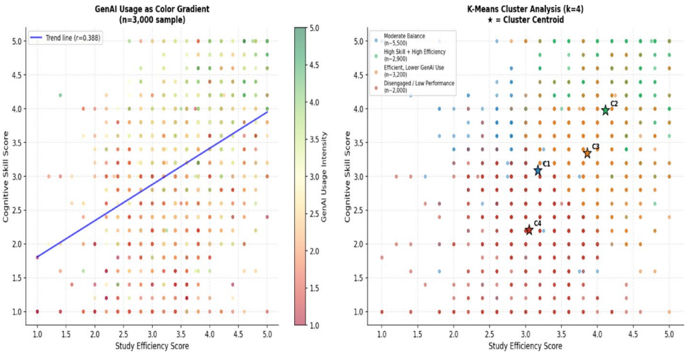
- K-means identified four profiles: Augmentors (high skill, high efficiency, highest GenAI use; n = 2,900), Optimisers (moderate balance; n = 5,500), Traditionalists (efficient with lower GenAI use; n = 3,000 in the abstract; ~3,200 in Table 8), and Substitutors (disengaged, low performance; n = 2,000). Institutional funding type was a significant predictor of study efficiency gains.
Methods
- Secondary analysis of a publicly available cross-sectional multinational survey dataset: final analytical sample N = 14,949 higher education students, drawn from an original sample of 22,963 respondents across 120 countries (65.1% retained).
- Five-layer analytical framework: (1) CFA and Fornell-Larcker validity testing; (2) multivariate OLS predicting critical thinking gain; (3) benchmarking of Linear Regression, Random Forest, XGBoost, and Gradient Boosting on a stratified 70/30 train-test split (training n = 9,548; test n = 4,092); (4) SHAP analysis on the best-performing model using a 500-participant test subset; and (5) K-means clustering (k = 4) across Cognitive Skill, Study Efficiency, and GenAI Usage.
- Robustness checks used five-fold cross-validation on the full modelling dataset (n = 13,640) and discipline-stratified subgroup models for STEM (n = 1,301) and Social Science (n = 6,025).
Limitations
- The paper states that cognitive skill development was measured through self-reported Likert items (Q29a–Q29e), a proxy measure; future research should use objective indicators such as GPA trajectories, standardised tests, or pre/post designs.
- The paper states that the findings are predictive associations, not causal evidence, and cannot rule out selection effects; longitudinal panel designs are needed. It also notes geographic imbalance in the sample and that no formal comparison between included and excluded participants was performed, so selection bias cannot be completely excluded.
- Evident from the text: the design is cross-sectional and used convenience sampling; cluster sizes are approximate and differ between the abstract and Table 8 for Traditionalists (n = 3,000 vs. ~3,200); the STEM subgroup is much smaller (n = 1,301) and shows lower predictive performance (R² = 0.144) than Social Science (R² = 0.241) or the full sample (R² = 0.282).
Model-written summary. Check it against the paper before relying on it.
Integrity signals
Registry
Cites
Statistics
Figures
Verification
Claims the paper makes
7 Valid · 1 Not valid · 44 Not checked · 89 Own results and interpretations
The cited sources support only part of this claim — read each source’s verdict below.
In the paper
“This suggests that iterative, feedback-oriented engagement with GenAI is positively associated with self-reported critical thinking development [9, 36].”
What the sources say
- Partly supportedcites [9] 9. Chan S, Lo N, Wong A. Generative AI and Essay Writing: Impacts of Automated Feedback on Revision Performance and Engagement. Reflections. 2024;31(3):1249-84. https://eric.ed.gov/?id=EJ1459877. sourceExperimental — accuracy not yet measured
The Quantitative analysis reports that students receiving AI feedback had higher self-reported engagement and better revision scores. The Post-Experimental Questionnaire measures revision experiences, not critical-thinking development, and the paper does not establish the claimed association between iterative GenAI engagement and self-reported critical-thinking development. Pages are not available in our copy. (LLM, conf=0.83)
- Partly supportedcites [36] 36. | Mekheimer M. Generative AI-assisted feedback and EFL writing: a study on proficiency, revision frequency and writing quality. Discover Educ. 2025;4(1):170. https://doi.org/10.1007/s44217-025-00602-7. Memon TD, Kwan P A collaborative model for integrating teacher and genai into future education. TechTrends. 2025. | | 37. sourceExperimental — accuracy not yet measured
Section 6.2 reports that AI-feature use and revision frequency were positively associated with writing post-test scores. Section 5.5 says students recognized the need to evaluate feedback critically, but it does not report a positive association with self-reported critical thinking development. Page numbers were not available in our copy. (LLM, conf=0.84)
hedgedstates an association- Asserted: passes — The authors put it forward as true.
- Checkable: passes — It can be checked against evidence.
- Load-bearing: passes — The paper’s conclusions depend on it.
- Based: passes — The paper gives a reason why it holds.
- Rests on an assumption not shown here.
- Partly supported
The cited sources support only part of this claim — read each source’s verdict below.
In the paper
“While affective dimensions of human-GenAI interaction (anxiety, motivation, confidence, and frustration) have been discussed [32, 33], they are rarely incorporated as theoretically meaningful predictive pathways in quantitative models.”
What the sources say
- Not checked — no full text of the sourcecites [32] Larsen DP. Planning education for long-term retention: the cognitive science and implementation of retrieval practice. In Seminars in Neurology. Thieme Med Publishers. 2018;38:449–56. https://doi.org/10.1055/s-0038-1666983. source
- Partly supportedcites [33] 33. | Li X, Zhou T, Hu C, Liu H. The effects of the human-like features of generative AI on usage intention and the moderating role of information overload. Sci Rep. 2025;15(1):35077. https://doi.org/10.1038/s41598-025-18906-x. | | sourceExperimental — accuracy not yet measured
The cited portion of the sentence says these affective dimensions have been discussed. The paper’s ‘moderating effect of information overload’ section discusses anxiety and confidence in GenAI chatbot interactions, but our copy does not substantively discuss motivation or frustration; motivation appears only in a reference title. The subsequent claim that such dimensions are rarely modeled as predictive pathways is the citing authors’ own framing, not the portion attached to this citation. (LLM, conf=0.84)
plain- Asserted: passes — The authors put it forward as true.
- Checkable: passes — It can be checked against evidence.
- Load-bearing: passes — The paper’s conclusions depend on it.
- Based: passes — The paper gives a reason why it holds.
The cited sources support only part of this claim — read each source’s verdict below.
In the paper
“Lastly, predictive modelling of GenAI learning outcomes in the literature is dominated by regression and structural equation approaches [1, 52, 67]”
What the sources say
- Partly supportedcites [1] 1. Abbas M, Jam FA, Khan TI. Is it harmful or helpful? Examining the causes and consequences of generative AI usage among university students. Int J educational Technol High Educ. 2024;21(1):10. https://doi.org/10.1186/s41239-024-00444-7. sourceExperimental — accuracy not yet measured
The Analyses and results (Study 2) section (p. 12) says the paper used partial least squares structural equation modeling to test hypotheses, including an academic-performance outcome reported in the Structural model section (p. 14). It therefore exemplifies one of the named approaches, but it does not establish that regression and structural equation approaches dominate the wider literature. (LLM, conf=0.84)
- Not checked — no full text of the sourcecites [52] 52. | Saihi A, Ben-Daya M, Hariga M, As' ad R. A Structural equation modeling analysis of generative AI chatbots adoption among students and educators in higher education. Computers Education: Artif Intell. 2024;7:100274. ht t ps : / / do i . or g/ 10 .1 01 6/ j . ca ea i . 20 24 . 10 02 74 . Educ. | | source
- Partly supportedcites [67] 67. | Zeng D, Xu X, Zhu T, Li Y, Li Q. A two-step structural equation modeling and explainable machine learning framework for understanding university students' adoption of generative AI: balancing intrinsic motivations and perceived risks. Front Psychol. 2026;17:1743722. https://doi.org/10.3389/fpsyg.2026.1743722. | sourceExperimental — accuracy not yet measured
The Results and discussion sections on path analysis and ML model construction describe this paper’s use of structural equation modeling and regression algorithms. But they model students’ GenAI adoption and actual usage, not learning outcomes, and the copy does not establish that these approaches dominate the literature. (LLM, conf=0.81)
plain- Asserted: passes — The authors put it forward as true.
- Checkable: passes — It can be checked against evidence.
- Load-bearing: passes — The paper’s conclusions depend on it.
- Based: passes — The paper gives a reason why it holds.
- Partly supported
The sources with a verdict support this claim; the rest weren’t checked yet, have no full text we could read, or their verdicts aren’t rated yet.
In the paper
“It also reinforces concerns from cognitive offloading theory [18, 50] that frequent reliance on AI may bypass effortful processing if not properly structured.”
What the sources say
- Supportedcites [18] 18. | Gerlich M. AI tools in society: Impacts on cognitive offloading and the future of critical thinking. Societies. 2025;15(1):6. https://doi.org/10.3390/soc15010006. | | | Greene JA, Bolick CM, Caprino AM, Deekens VM, McVea M, Yu S, Jackson WP. Fostering high-school students' self-regulated learning online and across academic domains. High School J. 2015;99(1):88-106. | | source
Section 4.7.1 reports that participants often relied on AI instead of engaging in deeper cognitive processes. Section 2.4 warns that heavy reliance can reduce cognitive effort and calls for a balanced approach to AI use, supporting the claim's qualification. (LLM, conf=0.91)
- Not checked — no full text of the sourcecites [50] matched to “Cognitive Offloading” (2016) source
hedgedstates a possible cause- Asserted: passes — The authors put it forward as true.
- Checkable: passes — It can be checked against evidence.
- Load-bearing: unclear — It is unclear whether the paper’s conclusions depend on it.
- Based: passes — The paper gives a reason why it holds.
- Supported
The cited sources that could be checked couldn’t confirm or dispute this claim.
In the paper
“This result aligned with Yan et al., [66], who show that self-regulation moderates the relationship between AI use and learning outcomes.”
What the sources say
- Could not verifycites [66] 66. | Yan L, Sha L, Zhao L, Li Y, Martinez-Maldonado R, Chen G, Gašević D. Practical and ethical challenges of large language models in education: A systematic scoping review. Br J Edu Technol. 2024;55(1):90-112. ht t ps : / / do i . or g/ 10 . 11 11 / bj et . 13 37 0. | | sourceExperimental — accuracy not yet measured
The Transparency section discusses students’ evaluations of LLM systems and potential learning benefits, but not whether self-regulation changes the relationship between AI use and learning outcomes. Searches for “self-regulation,” the claimed moderation relationship, and related terms found no passage addressing that relationship in our copy; page numbers were unavailable. (LLM, conf=0.74)
plainstates an association- Asserted: passes — The authors put it forward as true.
- Checkable: passes — It can be checked against evidence.
- Load-bearing: passes — The paper’s conclusions depend on it.
- Based: passes — The paper gives a reason why it holds.
- Could not verify
71 more claims · 1 with their cited sources checked
Create a free account to see all 141 claims and to verify the 1 reference still open.
- Probably not a substantial claim. 42
- It may state two separate claims as one. 35
- The quote only partly states this claim. 1
Self-check
Percentages, sums and reported differences re-computed from the paper’s own numbers.
Each contradiction between two passages listed here was confirmed by an independent check.
Rated minor: it would not touch a result — a value no result rests on, a p-value that stays on the same side of the significance level, or a conflict that is clerical, resolved elsewhere in the paper, or outside its own findings.
In the paper
§ 3.5 Construct operationalisation · p. 8
“GenAI Interaction was operationalised through items Q18a-Q18h.”
§ 4 Data analysis and discussion · p. 10
“| GenAI Interaction | Q18a | 0.650 | 0.701 | 0.500 | 0.720 | | | Q18b | 0.761 | | | | | | Q18c | 0.670 | | | |”
Rated minor: it would not touch a result — a value no result rests on, a p-value that stays on the same side of the significance level, or a conflict that is clerical, resolved elsewhere in the paper, or outside its own findings.
In the paper
§ 4 Data analysis and discussion · p. 11
“Four empirically distinct interaction profiles emerge from Table 7; Fig. 2.”
§ 4 Data analysis and discussion · p. 11
“Table 8 K-means cluster profiles: cognitive skill vs. study efficiency trade-off (k = 4)”
Rated minor: it would not touch a result — a value no result rests on, a p-value that stays on the same side of the significance level, or a conflict that is clerical, resolved elsewhere in the paper, or outside its own findings.
In the paper
§ 4 Data analysis and discussion · p. 11
“The study revealed that in Table 5, Gradient Boosting achieves the best performance for Cognitive Skill prediction (R² = 0.2818), while in Table 6, Gradient Boosting and Random Forest were tied for Study Efficiency at (R² = 0.3000 and R² = 0.2995).”
§ 4 Data analysis and discussion · p. 11
“Table 5 Multiple Regression: Predictors of Critical Thinking Gain”
Rated minor: it would not touch a result — a value no result rests on, a p-value that stays on the same side of the significance level, or a conflict that is clerical, resolved elsewhere in the paper, or outside its own findings.
In the paper
§ 4 Data analysis and discussion · p. 9
“The AVE values are above 0.50.”
§ 4 Data analysis and discussion · p. 10
“| GenAI Interaction | Q18a | 0.650 | 0.701 | 0.500 | 0.720 |”
Rated minor: it would not touch a result — a value no result rests on, a p-value that stays on the same side of the significance level, or a conflict that is clerical, resolved elsewhere in the paper, or outside its own findings.
In the paper
§ 4 Data analysis and discussion · p. 13
“The results, presented in Table 10, reveal systematically lower R² for STEM students (R²=0.144) compared to Social Science students (R²=0.241) and the full sample (R²=0.282).”
§ 4 Data analysis and discussion · p. 13
“Table 11 Subgroup Robustness: Cognitive Skill Prediction by Academic Discipline”
Citations
Cites
Ryan, R. M., & Deci, E. L. (2000) · American Psychologist · doi:10.1037//0003-066x.55.1.68 · Cited by 54,599
Cognitive Load During Problem Solving: Effects on Learning
Sweller, J. (1988) · Cognitive Science · doi:10.1016/0364-0213(88)90023-7 · Cited by 11,048 · cited 2×
“Sweller, [56] warned that improper tool use may reduce beneficial cognitive load.”
ChatGPT for good? On opportunities and challenges of large language models for education
Kasneci, E., Sessler, K., Küchemann, S., Bannert, M., Dementieva, D., Fischer, F., Gasser, U., Groh, G., Günnemann, S., Hüllermeier, E., et al. (2023) · Learning and Individual Differences · doi:10.1016/j.lindif.2023.102274 · Cited by 7,326 · cited 1×
“Kasneci et al., [29] conducted a systematic review of LLM opportunities and barriers in education.”
Clark, A., & Chalmers, D. (1998) · Analysis · doi:10.1093/analys/58.1.7 · Cited by 6,333 · cited 1×
“According to Clark & Chalmer [10], cognitive processes are genuinely distributed across the brain, body and environment.”
Pekrun, R. (2006) · Educational Psychology Review · doi:10.1007/s10648-006-9029-9 · Cited by 5,566 · cited 3×
“Pek-run, [45] and Bandura [6] show how anxiety reduces study efficiency while self-efficacy improves effective GenAI use.”
A Conceptual Framework for Assessing Motivation and Self-Regulated Learning in College Students
Pintrich, P. R. (2004) · Educational Psychology Review · doi:10.1007/s10648-004-0006-x · Cited by 3,269 · cited 2×
“Pintrich, [46] extended the self-regulated framework to account for motivational and contextual dimensions of metacognitive behaviour.”
Chatting and cheating: Ensuring academic integrity in the era of ChatGPT
Cotton, D. R. E., Cotton, P. A., & Shipway, J. R. (2024) · Innovations in Education and Teaching International · doi:10.1080/14703297.2023.2190148 · Cited by 3,087 · cited 1×
“This is due to concerns of academic integrity, plagiarism detection and content reliability [12].”
Chatting and Cheating. Ensuring academic integrity in the era of ChatGPT
Cotton, D., Cotton, P., & Shipway, J. R. (2023) · doi:10.35542/osf.io/mrz8h · Cited by 3,079
Students’ voices on generative AI: perceptions, benefits, and challenges in higher education
Chan, C. K. Y., & Hu, W. (2023) · International Journal of Educational Technology in Higher Education · doi:10.1186/s41239-023-00411-8 · Cited by 2,301
What if the devil is my guardian angel: ChatGPT as a case study of using chatbots in education
Tlili, A., Shehata, B., Adarkwah, M. A., Bozkurt, A., Hickey, D. T., Huang, R., & Agyemang, B. (2023) · Smart Learning Environments · doi:10.1186/s40561-023-00237-x · Cited by 2,003 · cited 1×
“Tlili et al., [61] documented that within months of the release of ChatGPT to the public, universities were reporting a substantial and growing proportion of their student population using ChatGPT for academic purposes.”
Risko, E. F., & Gilbert, S. J. (2016) · Trends in Cognitive Sciences · doi:10.1016/j.tics.2016.07.002 · Cited by 1,502 · cited 3×
“Risko and Gilbert, [50] described cognitive offloading as the use of external tools to reduce cognitive demands.”
Ethics of AI in Education: Towards a Community-Wide Framework
Holmes, W., Porayska-Pomsta, K., Holstein, K., Sutherland, E., Baker, T., Shum, S. B., Santos, O. C., Rodrigo, M. T., Cukurova, M., Bittencourt, I. I., et al. (2022) · International Journal of Artificial Intelligence in Education · doi:10.1007/s40593-021-00239-1 · Cited by 1,437 · cited 2×
“Holmes et al., [24] revealed that AI-amplified inequality, where students with stronger prior skills benefit more from AI.”
Practical and ethical challenges of large language models in education: A systematic scoping review
Yan, L., Sha, L., Zhao, L., Li, Y., Martinez‐Maldonado, R., Chen, G., Li, X., Jin, Y., & Gašević, D. (2024) · British Journal of Educational Technology · doi:10.1111/bjet.13370 · Cited by 1,435 · cited 2×
“This result aligned with Yan et al., [66], who show that self-regulation moderates the relationship between AI use and learning outcomes.”
AI Tools in Society: Impacts on Cognitive Offloading and the Future of Critical Thinking
Gerlich, M. (2025) · Societies · doi:10.3390/soc15010006 · Cited by 1,248 · cited 2×
“The concept of cognitive offloading, externalising mental effort to digital tools, has become a central concern, as excessive reliance on AI may bypass the “productive struggle” necessary to build the “cognitive musculature” required for independent problem-solving [18, 62, 48].”
AI Tools in Society: Impacts on Cognitive Offloading and the Future of Critical Thinking
Gerlich, M. (2025) · doi:10.2139/ssrn.5082524 · Cited by 1,238
New Technology and Digital Worlds: Analyzing Evidence of Equity in Access, Use, and Outcomes
Warschauer, M., & Matuchniak, T. (2010) · Review of Research in Education · doi:10.3102/0091732x09349791 · Cited by 1,047 · cited 2×
“The significance of institutional funding in predicting study efficiency points to a second-order digital divide [63].”
Song, C., & Song, Y. (2023) · Frontiers in Psychology · doi:10.3389/fpsyg.2023.1260843 · Cited by 717 · cited 1×
“Song and Song, [55] revealed that students using multi-turn and detailed prompts performed better in writing then student using simple prompts.”
McDonald, N., Johri, A., Ali, A., & Collier, A. H. (2025) · Computers in Human Behavior: Artificial Humans · doi:10.1016/j.chbah.2025.100121 · Cited by 682 · cited 1×
“The adoption of Generative AI (GenAI) tools in higher education has progressed at a pace that outstrips the empirical evidence base needed to guide institutional policy, pedagogical design, and student practice [34, 60].”
Skulmowski, A., & Xu, K. M. (2022) · Educational Psychology Review · doi:10.1007/s10648-021-09624-7 · Cited by 678 · cited 1×
“Secondly, while the theoretical tension between learning efficiency and deep cognitive development is well-recognised [13, 58, 59], no research or study has simultaneously operationalised and predicted both Study Efficiency and Cognitive Skill as separate outcome constructs within a single GenAI…”
Clark, A., & Chalmers, D. J. (1998) · Analysis · doi:10.1111/1467-8284.00096 · Cited by 672
Assigning AI: Seven Approaches for Students, with Prompts
Mollick, E., & Mollick, L. (2023) · arXiv · doi:10.48550/arxiv.2306.10052 · Cited by 586 · cited 2×
“This result extends Mollick & Mollick’s [38] conceptualisation of AI as a tutor or collaborator, which demonstrates that higher-order and generative tasks promote cognitive augmentation while lower-effort uses risk substitution.”
Abbas, M., Jam, F. A., & Khan, T. I. (2024) · International Journal of Educational Technology in Higher Education · doi:10.1186/s41239-024-00444-7 · Cited by 531 · cited 1×
“Lastly, predictive modelling of GenAI learning outcomes in the literature is dominated by regression and structural equation approaches [1, 52, 67], the application of multi-algorithm machine learning benchmarking combined with game-theoretic explainability frameworks such as SHAP, which is capable…”
Preparing teachers for the application of AI-powered technologies in foreign language education
Pokrivcakova, S. (2019) · Journal of Language and Cultural Education · doi:10.2478/jolace-2019-0025 · Cited by 489 · cited 1×
“Pokrivcakova, [47] concluded that technology-related anxiety suppressed engagement with digital learning, too and self-reported skills development in higher education.”
Activity Achievement Emotions and Academic Performance: A Meta-analysis
Camacho-Morles, J., Slemp, G. R., Pekrun, R., Loderer, K., Hou, H., & Oades, L. G. (2021) · Educational Psychology Review · doi:10.1007/s10648-020-09585-3 · Cited by 475 · cited 1×
“Camacho-Morles et al., [7] confirmed that enjoyment was the strongest positive predictor of academic performance, and anxiety is a significant negative predictor.”
McDonald, N., Johri, A., Ali, A., & Hingle, A. (2024) · arXiv · doi:10.48550/arxiv.2402.01659 · Cited by 375
How to cheat on your final paper: Assigning AI for student writing
Fyfe, P. (2023) · AI & SOCIETY · doi:10.1007/s00146-022-01397-z · Cited by 205 · cited 1×
“Fyfe, [17] distinguishes between evaluation and generative modes of AI-assisted writing.”
Kurtz, G., Amzalag, M., Shaked, N., Zaguri, Y., Kohen-Vacs, D., Gal, E., Zailer, G., & Barak-Medina, E. (2024) · Education Sciences · doi:10.3390/educsci14050503 · Cited by 181 · cited 1×
“Despite the rapid integration of GenAI into higher education [5, 22, 30, 37, 57, 65], the empirical literature contains a critical absence that this study directly addressed.”
Guleria, P., & Sood, M. (2023) · Education and Information Technologies · doi:10.1007/s10639-022-11221-2 · Cited by 178 · cited 1×
“…et al., [40] reported that SHAP-based explanations generated actionable recommendations for improving educational quality, whereas Guleria and Sood [20] showed that integrating ML with XAI supports educational decision-making by providing transparent predictions for student career guidance.”
Practical early prediction of students’ performance using machine learning and eXplainable AI
Jang, Y., Choi, S., Jung, H., & Kim, H. (2022) · Education and Information Technologies · doi:10.1007/s10639-022-11120-6 · Cited by 114 · cited 1×
“Jang et al., [26] demonstrated that ML models can effectively identify at-risk students at an early stage, enabling timely educational interventions.”
Prediction of Students’ Adaptability Using Explainable AI in Educational Machine Learning Models
Nnadi, L. C., Watanobe, Y., Rahman, M. M., & John-Otumu, A. M. (2024) · Applied Sciences · doi:10.3390/app14125141 · Cited by 108 · cited 1×
“…al., [42] further reported that explainable AI algorithms consistently identified key factors influencing students’ cognitive abilities, while Nnadi et al., [43] showed that integrating explainable AI techniques with ML models improved the interpretation of factors affecting student adaptability.”
Baig, M. I., & Yadegaridehkordi, E. (2025) · International Journal of Educational Technology in Higher Education · doi:10.1186/s41239-025-00506-4 · Cited by 106 · cited 1×
“Despite the rapid integration of GenAI into higher education [5, 22, 30, 37, 57, 65], the empirical literature contains a critical absence that this study directly addressed.”
The longitudinal trajectories of online engagement over a full program
Saqr, M., & López-Pernas, S. (2021) · Computers & Education · doi:10.1016/j.compedu.2021.104325 · Cited by 96 · cited 1×
“Saqr & Lopez-Pernas [53] and Jovanović et al. [28] concluded that these profiles are relatively stable over time and respond differently to pedagogical interventions.”
A review of machine learning methods used for educational data
Ersozlu, Z., Taheri, S., & Koch, I. (2024) · Education and Information Technologies · doi:10.1007/s10639-024-12704-0 · Cited by 96
Ba, S., Yang, L., Yan, Z., Looi, C. K., & Gašević, D. (2025) · Computers and Education Open · doi:10.1016/j.caeo.2025.100284 · Cited by 91
Mekheimer, M. (2025) · Discover Education · doi:10.1007/s44217-025-00602-7 · Cited by 88 · cited 2×
“This suggests that iterative, feedback-oriented engagement with GenAI is positively associated with self-reported critical thinking development [9, 36].”
Niu, T., Liu, T., Luo, Y. T., Pang, P. C., Huang, S., & Xiang, A. (2025) · Scientific Reports · doi:10.1038/s41598-025-12514-5 · Cited by 87 · cited 1×
“Niu et al., [42] further reported that explainable AI algorithms consistently identified key factors influencing students’ cognitive abilities, while Nnadi et al., [43] showed that integrating explainable AI techniques with ML models improved the interpretation of factors affecting student…”
Saihi, A., Ben-Daya, M., Hariga, M., & As'ad, R. (2024) · Computers and Education: Artificial Intelligence · doi:10.1016/j.caeai.2024.100274 · Cited by 75 · cited 1×
“Lastly, predictive modelling of GenAI learning outcomes in the literature is dominated by regression and structural equation approaches [1, 52, 67], the application of multi-algorithm machine learning benchmarking combined with game-theoretic explainability frameworks such as SHAP, which is capable…”
A Collaborative Model for Integrating Teacher and GenAI into Future Education
Memon, T. D., & Kwan, P. (2025) · TechTrends · doi:10.1007/s11528-025-01105-w · Cited by 74 · cited 1×
“Despite the rapid integration of GenAI into higher education [5, 22, 30, 37, 57, 65], the empirical literature contains a critical absence that this study directly addressed.”
Symeou, L., Louca, L., Kavadella, A., Mackay, J., Danidou, Y., & Raffay, V. (2025) · European Journal of Dental Education · doi:10.1111/eje.13069 · Cited by 60 · cited 1×
“The adoption of Generative AI (GenAI) tools in higher education has progressed at a pace that outstrips the empirical evidence base needed to guide institutional policy, pedagogical design, and student practice [34, 60].”
Knowledge-Empowered, Collaborative, and Co-Evolving AI Models: The Post-LLM Roadmap
Wu, F., Shen, T., Bäck, T., Chen, J., Huang, G., Jin, Y., Kuang, K., Li, M., Lu, C., Miao, J., et al. (2024) · Engineering · doi:10.1016/j.eng.2024.12.008 · Cited by 57 · cited 1×
“GenAI, such as Large Language Models (LLMs), act as “co-pilots” capable of generating complex content, solving problems, and providing instant feedback [4, 64].”
Rajendran, S., Chamundeswari, S., & Sinha, A. A. (2022) · Social Sciences & Humanities Open · doi:10.1016/j.ssaho.2022.100357 · Cited by 56 · cited 1×
“This implies that the relationship between GenAI usage, study habits and cognitive outcome is inherently non-linear but indicates moderate explanatory power, which is consistent with many educational psychology prediction studies [15, 49].”
Larsen, D. (2018) · Seminars in Neurology · doi:10.1055/s-0038-1666983 · Cited by 53 · cited 1×
“Larsen [31] and Ebersbach et al., [14] show that taking a retrieval test improves long-term retention more than restudying.”
Explainable AI in Education: Techniques and Qualitative Assessment
Gunasekara, S., & Saarela, M. (2025) · Applied Sciences · doi:10.3390/app15031239 · Cited by 53 · cited 1×
“Gunasekara and Saarela, [21] found that post hoc explainability techniques, particularly SHAP and LIME, substantially improved the interpretability of complex neural network models without compromising predictive performance.”
Fostering High-School Students’ Self-Regulated Learning Online and Across Academic Domains
Greene, J. A., Bolick, C. M., Caprino, A. M., Deekens, V. M., McVea, M., Yu, S. B., & Jackson, W. P. (2015) · The High School journal/The High school journal · doi:10.1353/hsj.2015.0019 · Cited by 50 · cited 1×
“Greene et al., [19] revealed that students with high metacognitive monitoring skills outperformed peers in a transfer task.”
Heil, J., Ifenthaler, D., Cooper, M., Mascia, M. L., Conti, R., & Penna, M. P. (2025) · Smart Learning Environments · doi:10.1186/s40561-025-00395-0 · Cited by 47 · cited 1×
“Despite the rapid integration of GenAI into higher education [5, 22, 30, 37, 57, 65], the empirical literature contains a critical absence that this study directly addressed.”
Ebersbach, M., Feierabend, M., & Nazari, K. B. B. (2020) · Applied Cognitive Psychology · doi:10.1002/acp.3639 · Cited by 45 · cited 2×
“Larsen [31] and Ebersbach et al., [14] show that taking a retrieval test improves long-term retention more than restudying.”
Yan, L.-X., Sha, L., Zhao, L.-X., et al. (2023) · arXiv.org · doi:10.48550/arxiv.2303.13379 · Cited by 42
Introducing meaning to clicks: Towards traced-measures of self-efficacy and cognitive load
Jovanović, J., Gašević, D., Pardo, A., Dawson, S., & Whitelock‐Wainwright, A. (2019) · International Conference on Learning Analytics and Knowledge (LAK) · doi:10.1145/3303772.3303782 · Cited by 35 · cited 1×
“Saqr & Lopez-Pernas [53] and Jovanović et al. [28] concluded that these profiles are relatively stable over time and respond differently to pedagogical interventions.”
Chan, S., Lo, N., & Wong, A. (2024) · rEFLections · doi:10.61508/refl.v31i3.277514 · Cited by 29 · cited 2×
“This suggests that iterative, feedback-oriented engagement with GenAI is positively associated with self-reported critical thinking development [9, 36].”
Application of explainable artificial intelligence approach to predict student learning outcomes
Sanfo, J.-B. M. B. (2024) · Journal of Computational Social Science · doi:10.1007/s42001-024-00344-w · Cited by 23 · cited 1×
“Sanfo, [54] found that ML algorithms accurately predicted student learning outcomes, with SHAP identifying local development, community involvement, school infrastructure, and teacher experience as the most influential predictors.”
Muhamedyev, R. I., Yakunin, K., Kuchin, Y. I., Сымагулов, А., Buldybayev, T., Murzakhmetov, S., & Abdurazakov, A. (2020) · Cogent Engineering · doi:10.1080/23311916.2020.1769349 · Cited by 22 · cited 1×
“Similarly, Muhamedyev et al., [40] reported that SHAP-based explanations generated actionable recommendations for improving educational quality, whereas Guleria and Sood [20] showed that integrating ML with XAI supports educational decision-making by providing transparent predictions for student…”
Beyond Cognitive Load Theory: Why Learning Needs More than Memory Management
Sortwell, A., Gkintoni, E., Díaz-García, J., Ellerton, P., Ferraz, R., & Hine, G. (2026) · Brain Sciences · doi:10.3390/brainsci16010109 · Cited by 20 · cited 1×
“Secondly, while the theoretical tension between learning efficiency and deep cognitive development is well-recognised [13, 58, 59], no research or study has simultaneously operationalised and predicted both Study Efficiency and Cognitive Skill as separate outcome constructs within a single GenAI…”
Artino, A. R., Simons, R. J., & Konopasky, A. (2022) · Innovation and change in professional education · doi:10.1007/978-3-030-85524-6_3 · Cited by 20
Shomotova, A., ElSayary, A., & Husain, S. (2026) · Education and Information Technologies · doi:10.1007/s10639-025-13832-x · Cited by 19 · cited 1×
“Despite the rapid integration of GenAI into higher education [5, 22, 30, 37, 57, 65], the empirical literature contains a critical absence that this study directly addressed.”
Ng, J., Tong, M., Tsang, E. Y. M., Chu, K., & Tsang, W. (2025) · SN Computer Science · doi:10.1007/s42979-025-04010-4 · Cited by 18 · cited 2×
“Recent studies suggest that students are increasingly adopting GenAI to optimise their study habits, reporting significant improvements in time management and immediate task performance [11, 41, 23].”
Xia, Q., Weng, X., Huang, W., Li, Y. K., Kin, C. W., & Chiu, T. K. F. (2025) · Education and Information Technologies · doi:10.1007/s10639-025-13812-1 · Cited by 14
Li, X., Zhou, T., Hu, C., & Liu, H. (2025) · Scientific Reports · doi:10.1038/s41598-025-18906-x · Cited by 13 · cited 1×
“While affective dimensions of human-GenAI interaction (anxiety, motivation, confidence, and frustration) have been discussed [32, 33], they are rarely incorporated as theoretically meaningful predictive pathways in quantitative models.”
A theoretical and empirical analysis of tensions between learning objects and constructivism
Dahl, J. E., & Mørch, A. (2025) · Education and Information Technologies · doi:10.1007/s10639-025-13636-z · Cited by 12 · cited 1×
“Secondly, while the theoretical tension between learning efficiency and deep cognitive development is well-recognised [13, 58, 59], no research or study has simultaneously operationalised and predicted both Study Efficiency and Cognitive Skill as separate outcome constructs within a single GenAI…”
Jiang, Z., & Zhang, Z. (2025) · Research Methods in Applied Linguistics · doi:10.1016/j.rmal.2025.100237 · Cited by 10
Wang, J. (2026) · Frontiers in Psychology · doi:10.3389/fpsyg.2026.1781101 · Cited by 10 · cited 1×
“The concept of cognitive offloading, externalising mental effort to digital tools, has become a central concern, as excessive reliance on AI may bypass the “productive struggle” necessary to build the “cognitive musculature” required for independent problem-solving [18, 62, 48].”
Exploring the Role of GenAI in Shaping Education
Hirpara, N., Weber, M., Szakonyi, A., Cardona, T., & Singh, D. (2025) · Lecture Notes in Computer Science · doi:10.1007/978-3-031-88881-6_10 · Cited by 9 · cited 1×
“Recent studies suggest that students are increasingly adopting GenAI to optimise their study habits, reporting significant improvements in time management and immediate task performance [11, 41, 23].”
Fang, L., & Zhou, X. (2025) · Evaluation Review · doi:10.1177/0193841x251411618 · Cited by 9 · cited 1×
“First, existing research treats GenAI interaction as a homogeneous construct measured through frequency or general usage metrics [16, 35].”
Msomi, A. M., & Behara, K. (2026) · Education Sciences · doi:10.3390/educsci16030442 · Cited by 8 · cited 1×
“Msomi and Behara, [39] show that students in selective institutions use AI for higher-order tasks due to a stronger instructional culture and not access differences.”
Zeng, D., Xu, X., Zhu, T., Li, Y., & Li, Q. (2026) · Frontiers in Psychology · doi:10.3389/fpsyg.2026.1743722 · Cited by 7 · cited 1×
“Lastly, predictive modelling of GenAI learning outcomes in the literature is dominated by regression and structural equation approaches [1, 52, 67], the application of multi-algorithm machine learning benchmarking combined with game-theoretic explainability frameworks such as SHAP, which is capable…”
Lee, S., Lee, C.-H., & Park, G. (2026) · Telematics and Informatics · doi:10.1016/j.tele.2026.102372 · Cited by 5 · cited 1×
“While affective dimensions of human-GenAI interaction (anxiety, motivation, confidence, and frustration) have been discussed [32, 33], they are rarely incorporated as theoretically meaningful predictive pathways in quantitative models.”
Cognitive Load in AI-Assisted vs Traditional Foreign Language Classroom: Mixed Methods Research
Ivanović, I. (2025) · Primenjena lingvistika u čast · doi:10.18485/dpls_plucast.2025.6.ch22 · Cited by 2
Mahy, T., & Li, H. (2026) · International Journal of Human–Computer Interaction · doi:10.1080/10447318.2026.2623216 · Cited by 2 · cited 1×
“First, existing research treats GenAI interaction as a homogeneous construct measured through frequency or general usage metrics [16, 35].”
Cobelli, N., Grimaldi, M., Ugolini, M. M., Maione, G., & De Cristofaro, C. (2026) · Springer Proceedings in Complexity · doi:10.1007/978-3-032-09062-1_1 · Cited by 1 · cited 1×
“Recent studies suggest that students are increasingly adopting GenAI to optimise their study habits, reporting significant improvements in time management and immediate task performance [11, 41, 23].”
Aristovnik, A., Ravšelj, D., Keržič, D., Tomaževič, N., Umek, L., Brezovar, N., & al, E. (2025) · Mendeley Data · doi:10.17632/nv2343nwsb.1 · Cited by 1
Memory in the Digital Age: Are We Offloading or Overloading
Pooja, K. M. (2025) · Future Education and Learning Spaces · doi:10.1007/978-981-96-9251-4_9 · Cited by 1
Aristovnik, A., Ravšelj, D., Keržič, D., Tomaževič, N., Umek, L., Brezovar, N., Kessler, S. H., Schäfer, M., & al, E. (2025) · LaCRIS (University of Lapland) · doi:10.17632/nv2343nwsb · Cited by 1
Research and Innovation Forum 2025 Vol2
(2026) · Springer proceedings in complexity · doi:10.1007/978-3-032-09062-1
Xia, Q., Weng, X., Huang, W., et al. (2026) · Education and Information Technologies · doi:10.1007/s10639-025-13878-x
Rajendran, S., Sinha, A., & Rajendran, C. (2022) · doi:10.2139/ssrn.4103352
Research works printed but not linked: 1
- Oyetade K, Zuva T. Advancing Equitable Education with Inclusive AI to Mitigate Bias and Enhance Teacher Literacy. Educational Process: Int J. 2025;14:e2025087. https://www.ceeol.com/search/article-detail?id=1338892.
Metadata
- Authors
- Bolatimi, O. S., Ricky-Okine, C., Bolatimi, F. E., Agbesi, C. C. M., Martey, F., Bolatimi, O. R., Peter, A., & Kwaku, E. O.
- Affiliations
- Koforidua Technical University (GH)
- Venue
- Discover Artificial Intelligence
- Published
- 2026-08-28
- Volume
- 6
- Issue
- 1
- ISSN
- 2731-0809 (ISSN-L)
- OpenAlex
- W7204577620
- Cited by
- 0
- References
- 65
- FWCI
- 0.00
- Type
- journal article
- Language
- en
- Open access
- gold
- doi.org
- Licence
- cc-by-nc-nd
- creativecommons.org/licenses/by-nc-nd/4.0 (tdm)
- creativecommons.org/licenses/by-nc-nd/4.0 (vor)
- Locations
- Discover Artificial Intelligence (publishedVersion, cc-by-nc-nd)
- DOAJ (DOAJ: Directory of Open Access Journals) (submittedVersion)
- Topics
- Social Sciences › Education › Artificial Intelligence in Education
- Health Sciences › Medicine › Health Informatics › Artificial Intelligence in Healthcare and Education
- Physical Sciences › Computer Science › Computer Science Applications › Online Learning and Analytics
- Keywords
- generative AI in higher education, cognitive enhancement, cognitive offloading, metacognition, learning efficiency, critical thinking, student interaction patterns, AI usage frequency, student engagement
About these checks
Registry, retraction, Cites and statistics results are computed, not judged, with one exception: a printed reference that no index lists is read once by a model before it counts as a citation error. Claims are extracted by a model and kept only when their quote appears verbatim in the text; each cited source is then checked, with a model’s help, for whether it says what the claim relies on. Those verdicts can be wrong — read the claim’s quote and the cited source before relying on one.
The claim verdicts this report counts are experimental: their accuracy is not yet measured.
A language model drew the claims from the paper on 2026-10-10, under version 3 of the claim definition (model deepseek-v4.1-flash, prompt extract-v3).
A second model labelled each claim on 2026-10-10 (model jev-1.13-20260917, definition revision gold-guideline-v0.2).
Cited sources are checked with a language model’s help (gpt-6-sol).
Statistics and arithmetic are recomputed, not judged.
Confidence bands are shown only for fields calibrated on our annotated test set. None is calibrated yet, so no band is shown.
What counts as a claim ›How we measure confidence ›How we check this ›
Are you an author, or do you see a problem with this page? Request a review
Data sources
Bibliographic data: Semantic Scholar, OpenAlex, Crossref.
Contains information from the Semantic Scholar Academic Graph Datasets, made available under the ODC Attribution License (ODC-BY 1.0).
Semantic Scholar’s data is described in: Kinney, R., et al. (2023). The Semantic Scholar Open Data Platform. arXiv:2301.10140.
