

AI-enabled curriculum analytics framework for aligning higher education with labour market skill demand
Open accessThe DOI matches its Crossref record; 34 of the 34 references it cites were found in a registry or an index; none of the 4 sources its claims cite is checked for support yet.
Abstract
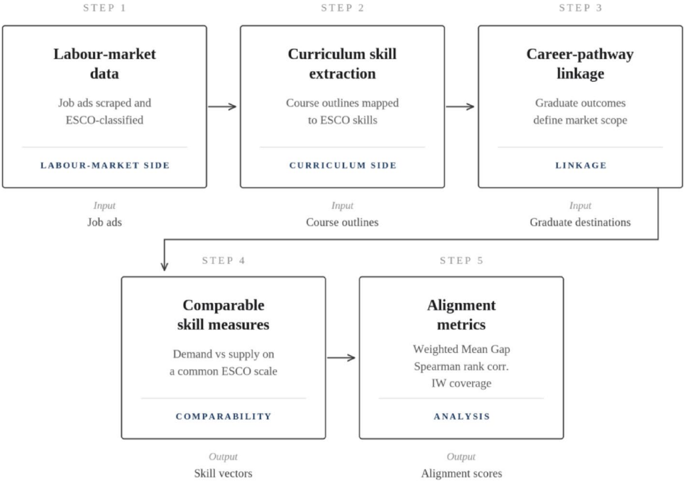
Universities face growing pressure to adapt curricula to rapidly changing skill demands shaped by digitalisation, artificial intelligence, and labour-market transformation. Yet curriculum review often remains periodic, internally driven, and only indirectly connected to large-scale evidence on emerging labour-market needs. This study develops the Curriculum Analytics Framework (CAF), an AI-enabled methodology for comparing the skills supplied by university curricula with the skills demanded in the labour market. The CAF integrates curriculum text analysis, online job vacancy data, data analytics, natural language processing, large language model-supported skill extraction, and the ESCO skills taxonomy to construct a common representation of curriculum skill supply and labour-market skill demand. The framework is demonstrated using a database of 43,522 job advertisements scraped from five major online vacancy platforms in Latvia and a bachelor-level study programme at the Stockholm School of Economics in Riga. It operationalises curriculum–labour-market alignment through three complementary metrics: the Weighted Mean Gap, which captures differences in skill intensity; Spearman rank correlation, which assesses similarity in skill prioritisation; and importance-weighted coverage, which evaluates whether high-demand labour-market skills are represented in the curriculum. The paper contributes to applied AI and skills analytics by integrating four elements into a transparent and reproducible curriculum-labour market alignment framework: an open ESCO-based occupational and skills taxonomy, LLM-assisted extraction and mapping of vacancy and curriculum texts, graduate-pathway-based occupational benchmarks, and three complementary alignment measures capturing skill intensity, coverage and rank-order prioritisation. The framework transforms heterogeneous education and labour-market texts into comparable skill profiles and provides interpretable evidence for curriculum review, labour-market intelligence and workforce development.
Overview
CoChat Summary
TL;DR
The paper develops the Curriculum Analytics Framework (CAF), an AI-enabled, ESCO-based methodology for comparing university curriculum skill supply with labour-market skill demand using job advertisements, curriculum texts, LLM-assisted extraction, and three alignment metrics. It demonstrates the framework on the SSE Riga BSc Economics and Business core curriculum and nine graduate-pathway occupational clusters in Latvia.
Key findings
- The CAF operationalises alignment through three complementary metrics: Weighted Mean Gap, Spearman rank correlation, and importance-weighted coverage; the case study shows alignment is multidimensional rather than reducible to one score.
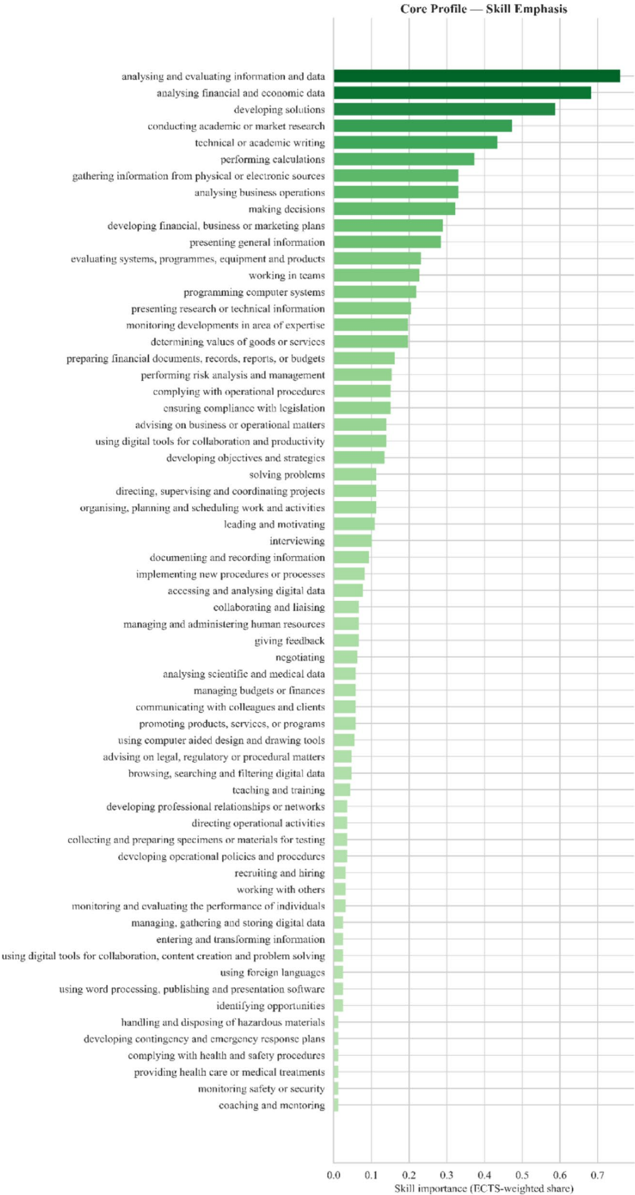
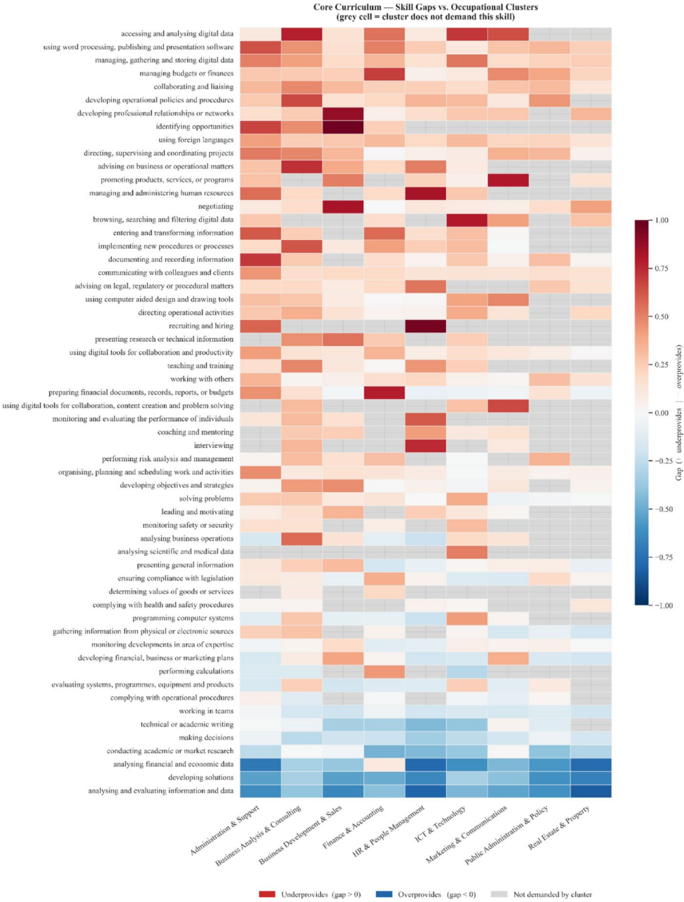
- In the SSE Riga case, the core curriculum covered 29 courses, 130 ECTS, and mapped to 63 ESCO Level 3 skill categories; the labour-market dataset contained 43,522 job advertisements, with 34,548 junior/mid-level advertisements after filtering and 4,629 advertisements corresponding to the nine occupational clusters.
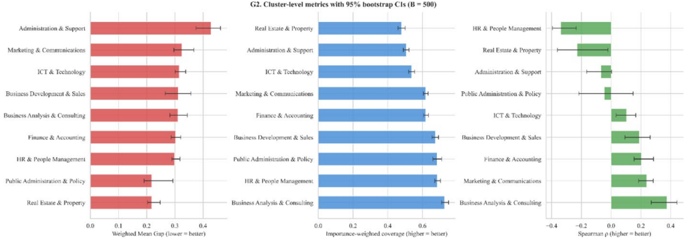
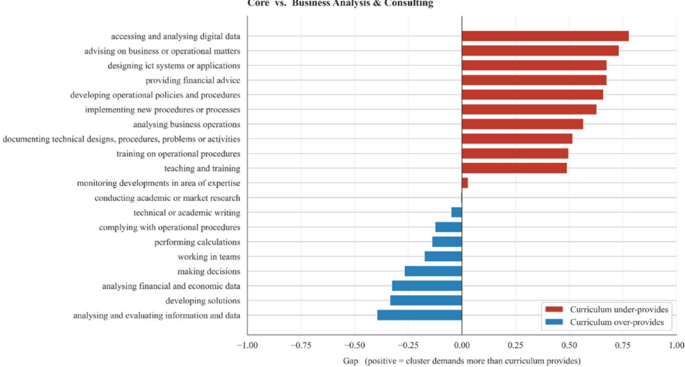
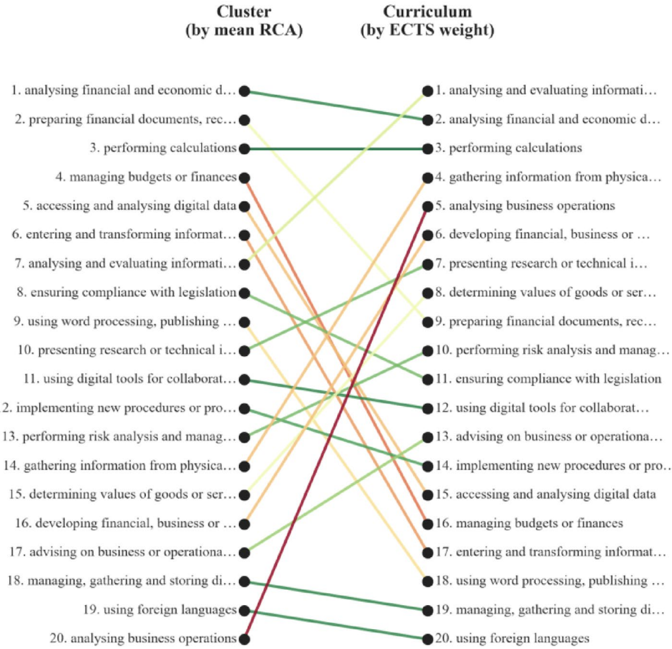
- Business Analysis and Consulting had the highest importance-weighted coverage (0.727) and strongest positive rank alignment; Real Estate and Property had the lowest coverage (0.479), followed by Administration and Support (0.506). Finance and Accounting, the largest graduate pathway at 48.2% of observed destinations, had modest positive Spearman correlation (+0.20 across 49 overlapping skills), while HR and People Management had negative rank alignment (−0.34 across 47 overlapping skills) despite relatively high coverage.
- Hold-out validation of AI-generated ESCO occupation classifications found 90.7% exact occupation agreement (147/162), 93.8% agreement at the 4-digit occupation-group level (152/162), and 97.5% agreement on position type (158/162; Cohen’s κ = 0.91).
Methods
- Design: The CAF combines curriculum text analysis, online job vacancy data, NLP, LLM-supported skill extraction and mapping, and the ESCO taxonomy; it links curriculum to labour-market demand through graduate-pathway-based occupational benchmarks and applies three alignment metrics.
- Data: Labour-market data were 43,522 scraped job advertisements from five major Latvian online vacancy platforms (June 2025–February 2026); curriculum data were official course outlines from the SSE Riga BSc Economics and Business programme, with the main analysis using 29 core courses and 130 ECTS. Occupational benchmarks came from the SSE Riga Placement Survey 2025, covering 113 responses from a cohort of 120 graduates, of which 85 had an observable current job destination and were used to construct nine occupational clusters.
- Analysis: Labour-market skill demand was measured using Revealed Comparative Advantage (RCA) with minimum frequency thresholds and log/max normalisation; curriculum skill supply was measured using an ECTS-weighted course-by-skill matrix; alignment was assessed with Weighted Mean Gap, Spearman rank correlation, and importance-weighted coverage, plus bootstrap, jackknife, and low-skill-advertisement sensitivity checks.
Limitations
- The paper states that curriculum data reflect intended rather than enacted curricula; job advertisements capture publicly expressed employer demand rather than complete job requirements; not all hiring occurs through public postings; and the analysis evaluates curriculum design, not individual graduate competence.
- The paper states that AI-assisted classification and mapping may contain residual errors: occupation classifications received hold-out validation, but advertisement-level skill extraction and ESCO skill mapping were not subject to a separate hold-out validation.
- Evident from the text: the empirical demonstration is a single programme at one institution in Latvia, the occupational clusters are researcher-defined analytical categories rather than official ESCO groupings, and the framework’s use of ESCO and LLM-based extraction carries known taxonomy-coverage and prompt/model-version sensitivity risks.
Model-written summary. Check it against the paper before relying on it.
Integrity signals
Registry
Cites
Statistics
Figures

Verification
Claims the paper makes
0 Valid · 5 Not valid · 2 Not checked · 191 Own results and interpretations
A result the paper reports from its own data — it cites no other source for it, so there is none to check. The quote shows it is in the paper.
In the paper
“The curriculum-side dataset differs from the labour-market dataset because it consists of a relatively small number of designed instructional units (one bachelor programme with 29 core courses) rather than a large set of observed market postings.”
§ AI-enabled curriculum analytics framework for aligning higher education with labour market skill demand > 3.5.2 Measuring curriculum skill supply
plainSingle case- Asserted: passes — The authors put it forward as true.
- Checkable: passes — It can be checked against evidence.
- Load-bearing: passes — The paper’s conclusions depend on it.
- Based: passes — The paper gives a reason why it holds.
A result the paper states — it cites no source for it, so there is none to check. The quote shows it is in the paper.
In the paper
“The original dataset did not include standardised occupational codes or taxonomically organised skill information.”
§ AI-enabled curriculum analytics framework for aligning higher education with labour market skill demand > 3.1 Labour-market data construction
plain- Asserted: passes — The authors put it forward as true.
- Checkable: passes — It can be checked against evidence.
- Load-bearing: passes — The paper’s conclusions depend on it.
- Based: passes — The paper gives a reason why it holds.
A result the paper reports from its own data — it cites no other source for it, so there is none to check. The quote shows it is in the paper.
In the paper
“Disagreements were concentrated in advertisements where the human coder considered the occupation unclear or the advertisement text insufficiently informative.”
§ AI-enabled curriculum analytics framework for aligning higher education with labour market skill demand > E2 Final hold-out validation of occupation classifications
plainstates an association- Asserted: passes — The authors put it forward as true.
- Checkable: passes — It can be checked against evidence.
- Load-bearing: passes — The paper’s conclusions depend on it.
- Based: passes — The paper gives a reason why it holds.
- Rests on an assumption not shown here.
A result the paper reports from its own data — it cites no other source for it, so there is none to check. The quote shows it is in the paper.
In the paper
“the negative Spearman correlation observed for HR and People Management is comparatively stable (-0.338 [-0.394, -0.235])”
§ AI-enabled curriculum analytics framework for aligning higher education with labour market skill demand > 4.3 Robustness checks
plainstates an association- Asserted: passes — The authors put it forward as true.
- Checkable: passes — It can be checked against evidence.
- Load-bearing: unclear — It is unclear whether the paper’s conclusions depend on it.
- Based: passes — The paper gives a reason why it holds.
A result the paper reports from its own data — it cites no other source for it, so there is none to check. The quote shows it is in the paper.
In the paper
“the strongest positive rank alignment is observed for Business Analysis and Consulting and Marketing and Communications”
§ AI-enabled curriculum analytics framework for aligning higher education with labour market skill demand > 4.2.3 Spearman rank correlation
plainstates an association- Asserted: passes — The authors put it forward as true.
- Checkable: passes — It can be checked against evidence.
- Load-bearing: unclear — It is unclear whether the paper’s conclusions depend on it.
- Based: passes — The paper gives a reason why it holds.
72 more claims
Create a free account to see all 198 claims and to verify the 4 references still open.
- Probably not a substantial claim. 91
- It may state two separate claims as one. 67
- The quote only partly states this claim. 2
Self-check
Percentages, sums and reported differences re-computed from the paper’s own numbers.
Each contradiction between two passages listed here was confirmed by an independent check.
Rated minor: it would not touch a result — a value no result rests on, a p-value that stays on the same side of the significance level, or a conflict that is clerical, resolved elsewhere in the paper, or outside its own findings.
In the paper
§ AI-enabled curriculum analytics framework for aligning higher education with labour market skill demand > 2 Background
“Börner et al. [12] linked course materials, job postings, and research outputs through a shared skill framework”
§ AI-enabled curriculum analytics framework for aligning higher education with labour market skill demand > References
“12. Hiltz BS, Victor BG, Perron BE. From job postings to curriculum decisions: using AI to generate workforce intelligence for MSW program planning.”
Rated minor: it would not touch a result — a value no result rests on, a p-value that stays on the same side of the significance level, or a conflict that is clerical, resolved elsewhere in the paper, or outside its own findings.
In the paper
§ AI-enabled curriculum analytics framework for aligning higher education with labour market skill demand > 3.7 Robustness checks
“the analysis is repeated after excluding advertisements with 5 or fewer mapped skills.”
§ AI-enabled curriculum analytics framework for aligning higher education with labour market skill demand > 4.3 Robustness checks
“the analysis is repeated after excluding job advertisements with fewer than five mapped skills.”
Rated minor: it would not touch a result — a value no result rests on, a p-value that stays on the same side of the significance level, or a conflict that is clerical, resolved elsewhere in the paper, or outside its own findings.
In the paper
§ AI-enabled curriculum analytics framework for aligning higher education with labour market skill demand > 2 Background
“bias related to educational background may persist in job-matching contexts [45].”
§ AI-enabled curriculum analytics framework for aligning higher education with labour market skill demand > References
“45. Romero & Ventura, 2020. In reference list should be: Romero C, Ventura S. Educational data mining and learning analytics: An updated survey.”
Citations
Cites
Skills, Tasks and Technologies: Implications for Employment and Earnings
Acemoglu, D., & Autor, D. (2011) · Handbook of Labor Economics · doi:10.1016/s0169-7218(11)02410-5 · Cited by 3,799
Educational data mining and learning analytics: An updated survey
Romero, C., & Ventura, S. (2020) · WIREs Data Mining and Knowledge Discovery · doi:10.1002/widm.1355 · Cited by 1,120
Do Recessions Accelerate Routine-Biased Technological Change? Evidence from Vacancy Postings
Hershbein, B., & Kahn, L. B. (2018) · American Economic Review · doi:10.1257/aer.20161570 · Cited by 573
Skill Requirements across Firms and Labor Markets: Evidence from Job Postings for Professionals
Deming, D., & Kahn, L. B. (2018) · Journal of Labor Economics · doi:10.1086/694106 · Cited by 508
The demand for AI skills in the labor market
Alekseeva, L., Azar, J., Giné, M., Samila, S., & Taska, B. (2021) · Labour Economics · doi:10.1016/j.labeco.2021.102002 · Cited by 414
Unpacking the polarization of workplace skills
Alabdulkareem, A., Frank, M. R., Sun, L., AlShebli, B., Hidalgo, C., & Rahwan, I. (2018) · Science Advances · doi:10.1126/sciadv.aao6030 · Cited by 200
Demand for AI skills in jobs: Evidence from online job postings
Squicciarini, M., & Nachtigall, H. (2021) · OECD science, technology and industry working papers · doi:10.1787/3ed32d94-en · Cited by 188
Börner, K., Scrivner, O., Gallant, M., Ma, S., Liu, X., Chewning, K., Wu, L., & Evans, J. A. (2018) · Proceedings of the National Academy of Sciences · doi:10.1073/pnas.1804247115 · Cited by 182
Artificial intelligence and the changing demand for skills in the labour market
Green, A. (2024) · OECD artificial intelligence papers · doi:10.1787/88684e36-en · Cited by 149
Chiarello, F., Fantoni, G., Hogarth, T., Giordano, V., Baltiņa, L., & Spada, I. (2021) · Technological Forecasting and Social Change · doi:10.1016/j.techfore.2021.121177 · Cited by 120
Research works printed but not linked: 1
- González J, Wageneer R. Tuning educational structures in Europe (2nd ed.); 2008. https://ehea.info/media.ehea.info/file/Tuning_project/93/4/Tuning-Universities-contribution-to-Bologna-Process_575934.pdf
Cited by
Still being checked.
Metadata
- Authors
- Varpina, Z., Kuzmina, A., Kraupsa, K., Bileskalne, L., & Culkstena, Z.
- Affiliations
- Stockholm School of Economics in Riga (LV)
- ORCID
- Varpina, Zane
- Venue
- Discover Artificial Intelligence
- Published
- 2026-10-28
- Volume
- 6
- Issue
- 1
- ISSN
- 2731-0809 (ISSN-L)
- OpenAlex
- W7224533376
- Semantic Scholar
- 49205cfd2327e1b7ba7476b1e8db58479ad297b4
- Cited by
- 0
- References
- 32
- FWCI
- 0.00
- Type
- journal article
- Language
- en
- Open access
- gold
- doi.org
- Licence
- cc-by
- creativecommons.org/licenses/by/4.0 (tdm)
- creativecommons.org/licenses/by/4.0 (vor)
- Locations
- Discover Artificial Intelligence (publishedVersion, cc-by)
- DOAJ (DOAJ: Directory of Open Access Journals) (submittedVersion)
- Funders
- Central Finance and Contracts Agency, Latvia (No. 1.2.1.2.i.2/1/24/A/CFLA/006)
- Topics
- Social Sciences › Education › Higher Education and Employability
- Physical Sciences › Computer Science › Information Systems › Information Systems Education and Curriculum Development
- Social Sciences › Business, Management and Accounting › Organizational Behavior and Human Resource Management › AI and HR Technologies
- Keywords
- skills supply and demand, large language models, skill extraction, curriculum review, higher education curriculum, workforce development, Latvia
About these checks
Registry, retraction, Cites and statistics results are computed, not judged, with one exception: a printed reference that no index lists is read once by a model before it counts as a citation error. Claims are extracted by a model and kept only when their quote appears verbatim in the text; each cited source is then checked, with a model’s help, for whether it says what the claim relies on. Those verdicts can be wrong — read the claim’s quote and the cited source before relying on one.
A language model drew the claims from the paper on 2026-11-20, under version 3 of the claim definition (model deepseek-v4.1-flash, prompt extract-v3).
A second model labelled each claim on 2026-11-20 (model jev-1.13-20260917, definition revision gold-guideline-v0.2).
Statistics and arithmetic are recomputed, not judged.
Confidence bands are shown only for fields calibrated on our annotated test set. None is calibrated yet, so no band is shown.
What counts as a claim ›How we measure confidence ›How we check this ›
Are you an author, or do you see a problem with this page? Request a review
How to cite
Cite CoChat for the checks on this page, and the paper for its own findings.
- This page
- CoChat. (2026). Citation check: AI-enabled curriculum analytics framework for aligning higher education with labour market skill demand. https://app.cochat.ai/papers/10.1007/s44163-026-02627-9
- The paper
- Varpina, Z., Kuzmina, A., Kraupsa, K., Bileskalne, L., & Culkstena, Z. (2026). AI-enabled curriculum analytics framework for aligning higher education with labour market skill demand. Discover Artificial Intelligence. https://doi.org/10.1007/s44163-026-02627-9
Data sources
Bibliographic data: Semantic Scholar, OpenAlex, Crossref.
Contains information from the Semantic Scholar Academic Graph Datasets, made available under the ODC Attribution License (ODC-BY 1.0).
Semantic Scholar’s data is described in: Kinney, R., et al. (2023). The Semantic Scholar Open Data Platform. arXiv:2301.10140.
