

The DOI matches its Crossref record.
High rate of sensitization to Kathon CG, detected by patch tests in patients with suspected allergic contact dermatitis
Open accessAbstract
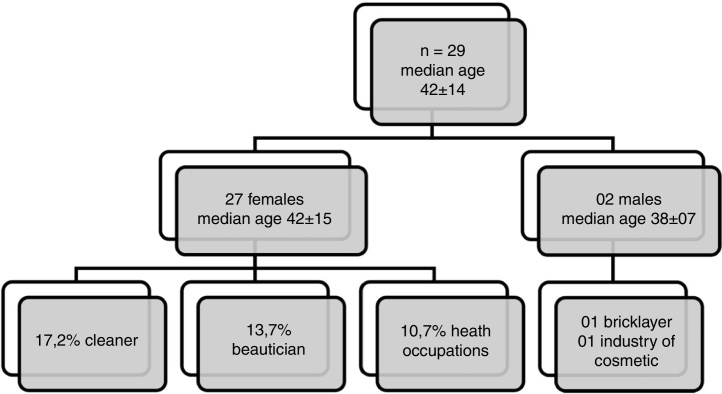
BACKGROUND: Kathon CG, a combination of methylchloroisothiazolinone and methylisothiazolinone, is widely used as preservative in cosmetics, as well in household cleaning products, industrial products such as paints and glues. It has emerged as an important sensitizing agent in allergic contact dermatitis. OBJECTIVES: This study evaluated the reactivity to this substance in patients subjected to patch tests at the Dermatology Institute in Bauru, São Paulo from 2015 to 2017 and its correlation with other preservatives, the professional activity and location of the lesions. METHODS: The patients were submitted to standard series of epicutaneous tests, standardized by the Brazilian Group Studies on Contact Dermatitis. RESULTS: Out the 267 patients tested, 192 presented positivity to at least one substance and 29 of the patients (15.10%) presented reaction to Kathon CG, with predominance of the female gender (n=27); main professional activity associated with Kathon CG sensibilization was cleaning (17.24%), followed by aesthetic areas (13.79%) and health care (10.34%). The most prevalent sensitizations among the substances tested were nickel sulphate (56.3%), followed by cobalt chloride (23.4%), neomycin (18.2%), potassium dichromate (17.7%), thimerosal (14.5%), formaldehyde (13.2%), paraphenylenediamine (9.3%), and fragrance mix (8.3%). STUDY LIMITATIONS: We do not have data from patients that were submitted to patch test a decade ago in order to confront to current data and establish whether or no sensitization to Kathon CG has increased. CONCLUSION: High positivity to Kathon CG corroborates the recent findings in the literature, suggesting more attention to concentration of this substance, used in cosmetics and products for domestic use.
Overview
The claims and statistics of this paper haven’t been checked yet.
Run the check — free, no account needed. It reads the open-access text and checks the sources it cites.
Integrity signals
Registry
Cites
Statistics
Figures

Verification
Claims the paper makes
The claims and statistics of this paper haven’t been checked yet.
Run the check — free, no account needed. It reads the open-access text and checks the sources it cites.
Claims other papers make about this one
Each is checked against this paper’s own text: does it say what the citing paper says it does?
The cited source says what the claim attributes to it.
In the citing paper
“The most common allergen mentioned in the study was nickel sulfate”
From Allergens Causing Allergic Contact Dermatitis in Cosmetic Products: A Systematic Review (2024) · cites this paper as [19]
The cited source says what the claim attributes to it.
In the citing paper
“Another allergen found in this review, cobalt chloride, was mentioned in four studies.”
From Allergens Causing Allergic Contact Dermatitis in Cosmetic Products: A Systematic Review (2024) · cites this paper as [19]
Self-check
Percentages, sums and reported differences re-computed from the paper’s own numbers.
The self-check needs the paper’s full text.
Citations
Cites
No references could be resolved yet.
Research works printed but not linked: 23
- Ayala, 1996, Statistical evaluation of the persistence of acquired hypersensitivity by standardized patch tests, Contact Dermatitis, 34, 354, 10.1111/j.1600-0536.1996.tb02222.x · DOI
- Grupo Brasileiro de Estudo em Dermatite de Contato. Estudo multicêntrico para elaboração de uma bateria padrão brasileira de teste de contato. An Bras Dermatol. 2000;75:147–56.
- Duarte, 1989, Utilização da bateria de testes epicutâneos preconizados pelo International Contact Dermatitis Research Group (ICDRG) em população não selecionada de São Paulo, An Bras Dermatol, 64, 207
- Serra Baldrich, 1995, Contact dermatitis: clinical review of 800 patients tested using the standard European series, Allergol Immunopathol (Madr), 23, 67
- Scherrer, 2014, Increasing trend of sensitization to Methylchloroisothiazolinone/Methylisothiazolinone (MCI/MI), An Bras Dermatol, 89, 527, 10.1590/abd1806-4841.20142852 · DOI
- Urwin, 2013, Methylchloroisothiazolinone and methylisothiazolinone contact allergy: a new epidemic, Contact Dermatitis, 68, 253, 10.1111/cod.12064 · DOI
- Geier, 2012, Recent increase in allergic reactions to methylchloroisothiazolinone/methylisothiazolinone: is methylisothiazolinone the culprit?, Contact Dermatitis, 67, 334, 10.1111/j.1600-0536.2012.02157.x · DOI
- Mowad, 2000, Methylchloroisothiazolinone revisited, Am J Contact Dermat, 11, 115, 10.1053/AC.2000.6344 · DOI
- Lundov, 2010, Prevalence and cause of methylisothiazolinone contact allergy, Contact Dermatitis, 63, 164, 10.1111/j.1600-0536.2010.01774.x · DOI
- Duarte, 2013, Patch test standard series recommended by the Brazilian Contact Dermatitis Study Group during the 2006–2011 period, An Bras Dermatol, 88, 1015, 10.1590/abd1806-4841.20132374 · DOI
- Duarte, 2000, Dermatite de contato, An Bras Dermatol, 75, 529
- Schnuch, 2011, Genetic factors in contact allergy – review and future goals, Contact Dermatitis, 64, 2, 10.1111/j.1600-0536.2010.01800.x · DOI
- Pónyai, 2016, Methylchloroisothiazolinone/methylisothiazolinone and methylisothiazolinone sensitivity in Hungary, Dermatol Res Pract, 2016, 4579071, 10.1155/2016/4579071 · DOI
- Lundov, 2011, Methylisothiazolinone contact allergy: a review, Br J Dermatol, 165, 1178, 10.1111/j.1365-2133.2011.10523.x · DOI
- Uter, 2012, Current patch test results with the European baseline series and extensions to it from the “European Surveillance System on Contact Allergy” network, 2007–2008, Contact Dermatitis, 67, 9, 10.1111/j.1600-0536.2012.02070.x · DOI
- García-Bravo, 2004, Estudio epidemiológico de la dermatitis alérgica de contacto em España (2001), Actas Dermo Sifiliogr, 95, 14, 10.1016/S0001-7310(04)79199-1 · DOI
- García Gavín, 2011, Epidemiología del eczema de contacto en España, Resultados de la Red Española de Vigilancia en Alergia de Contacto (REVAC) durante el año 2008, Actas Dermosifiliogr, 102, 98, 10.1016/j.ad.2010.10.015 · DOI
- Sampaio, 2008, Eczema ou Dermatite Eczematosa de Contato, Dermatologia, 189
- Mose, 2012, Occupational contact dermatitis in painters: an analysis of patch test data from the Danish Contact Dermatitis Group, Contact Dermatitis, 67, 293, 10.1111/j.1600-0536.2012.02074.x · DOI
- Statham, 2010, Concomitant contact allergy to methylchloroisothiazolinone/methylisothiazolinone and formaldehyde releasing preservatives, Contact Dermatitis, 62, 56, 10.1111/j.1600-0536.2009.01653.x · DOI
- Pontén, 2016, Concomitant contact allergies to formaldehyde, methylchloroisothiazolinone/methylisothiazolinone, methylisothiazolinone, and fragrance mixes I and II, Contact Dermatitis, 5, 285, 10.1111/cod.12598 · DOI
- Duarte, 2011, Allergic contact dermatitis in private practice: what are the main sensitizers?, Dermatitis, 22, 225, 10.2310/6620.2011.11009 · DOI
- Dinkloh, 2015, Contact sensitization in patients with suspected cosmetic intolerance: results of the IVDK 2006–2011, J Eur Acad Dermatol Venereol, 29, 1071, 10.1111/jdv.12750 · DOI
Cited by
Rathee, P., Sehrawat, R., Rathee, P., Khatkar, A., Akkol, E. K., Khatkar, S., Redhu, N., Türkcanoğlu, G., & Sobarzo-Sánchez, E. (2023) · Materials · doi:10.3390/ma16134793 · Cited by 101
Allergens Causing Allergic Contact Dermatitis in Cosmetic Products: A Systematic Review
Oktaviani, T., Widhiati, S., Kariosentono, H., Irawanto, M. E., & Oktavriana, T. (2024) · SKIN The Journal of Cutaneous Medicine · doi:10.25251/skin.8.6.1 · Cited by 3
Metadata
- Authors
- Silva, E. A., Bosco, M. R. M., Lozano, R. R., Latini, A. C. P., & Souza, V. N. B. D.
- Affiliations
- Instituto Lauro de Souza Lima (BR)
- Corresponding author
- Silva, Eliane Aparecida
- ORCID
- Venue
- Anais Brasileiros de Dermatologia
- Publisher
- Elsevier BV
- Published
- 2020-03
- Volume
- 95
- Issue
- 2
- Pages
- 194-199
- ISSN
- 0365-0596 (ISSN-L)
- PMC
- PMC7175102
- OpenAlex
- W3003981741
- Cited by
- 10
- References
- 0
- Citations by year
- 2026: 1 · 2025: 3 · 2024: 3 · 2023: 2 · 2022: 1
- FWCI
- 0.55
- Type
- journal article
- Language
- en
- Open access
- gold
- doi.org
- Licence
- Locations
- Anais Brasileiros de Dermatologia (publishedVersion, cc-by)
- PubMed Central (publishedVersion, cc-by)
- PubMed (publishedVersion)
- LA Referencia (Red Federada de Repositorios Institucionales de Publicaciones Científicas) (publishedVersion, other-oa)
- DOAJ (DOAJ: Directory of Open Access Journals) (submittedVersion, cc-by-sa)
- Topics
- Health Sciences › Medicine › Dermatology › Contact Dermatitis and Allergies
- Health Sciences › Medicine › Pharmacology (medical) › Drug-Induced Adverse Reactions
- Health Sciences › Medicine › Dermatology › Dermatology and Skin Diseases
- Keywords
- Kathon CG, methylchloroisothiazolinone, methylisothiazolinone, allergic contact dermatitis, sensitization, preservatives, patch testing, occupational exposure, cleaning agents, cosmetics, nickel sulfate, thimerosal, formaldehyde, fragrance mix
- MeSH terms
- Adult, Brazil, Cosmetics, Female, Humans, Male, Middle Aged, Patch Tests, Preservatives, Pharmaceutical, Retrospective Studies, Thiazoles, Logistic Models, Dermatitis, Allergic Contact, Statistics, Nonparametric
About these checks
Registry, retraction, Cites and statistics results are computed, not judged, with one exception: a printed reference that no index lists is read once by a model before it counts as a citation error. Claims are extracted by a model and kept only when their quote appears verbatim in the text; each cited source is then checked, with a model’s help, for whether it says what the claim relies on. Those verdicts can be wrong — read the claim’s quote and the cited source before relying on one.
Statistics and arithmetic are recomputed, not judged.
Confidence bands are shown only for fields calibrated on our annotated test set. None is calibrated yet, so no band is shown.
What counts as a claim ›How we measure confidence ›How we check this ›
Are you an author, or do you see a problem with this page? Request a review
How to cite
Cite CoChat for the checks on this page, and the paper for its own findings.
- This page
- CoChat. (2026). Citation check: High rate of sensitization to Kathon CG, detected by patch tests in patients with suspected allergic contact dermatitis. https://app.cochat.ai/papers/10.1016/j.abd.2019.09.026
- The paper
- Silva, E. A., Bosco, M. R. M., Lozano, R. R., Latini, A. C. P., & Souza, V. N. B. D. (2020). High rate of sensitization to Kathon CG, detected by patch tests in patients with suspected allergic contact dermatitis. Anais Brasileiros de Dermatologia. https://doi.org/10.1016/j.abd.2019.09.026
