

The DOI matches its Crossref record; 2 of the 2 references it cites were found in a registry or an index.
Port cybersecurity and threat: A structural model for prevention and policy development
Open accessAbstract
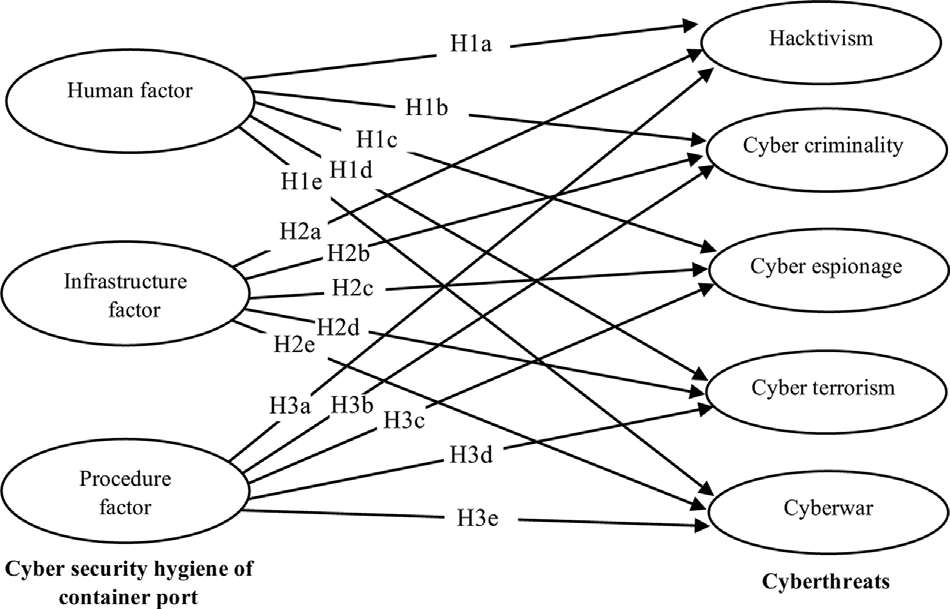
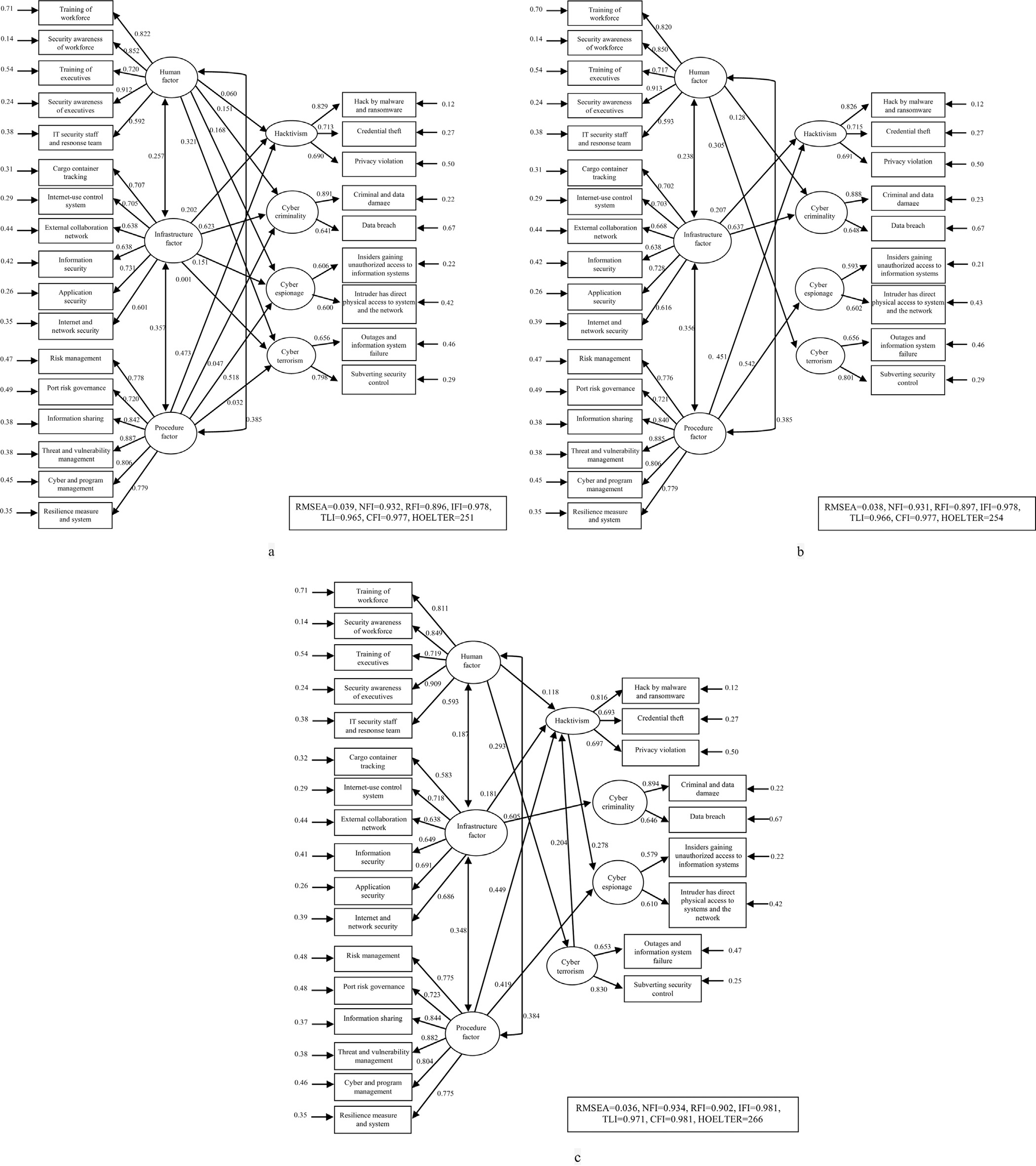
Most port operators have increasingly integrated cybertechnology into port activities to increase their competitiveness; unfortunately, this digitalization becomes the major vulnerability for the emerging cyberthreat. To help port policymakers develop cybersecurity measures, this study conceptualized and developed three dimensions of port cybersecurity hygiene (i.e. human, infrastructure, and procedure factors) and investigated the relationships between port cybersecurity hygiene and cyberthreats (i.e. hacktivism, cyber criminality, cyber espionage, cyber terrorism, and cyber war). A questionnaire survey was used to collect data from all international container port operators and shipping lines with branches in Thailand, and the proposed relationships were tested by structural equation modeling. The results indicated that container ports tended to encounter hacktivism when their human, infrastructure, and procedure factors were vulnerable. The weakness of the human factor could also lead to cyber terrorism, while the deficiency of the infrastructure factor could lead to cyber criminality. Moreover, container ports were likely to be harmed by cyber espionage if their procedure factor was poorly implemented. Hence, the provision of training and education to all port workers, including top executives, managers, and supervisors, are necessary to ensure a cyberthreat-awareness culture at all organizational levels. Improving cybersecurity equipment could prevent unauthorized access to port business data and keep important information secure, while the ISPS Code-based procedures and other preventive measures should be strictly implemented by container ports to reduce the risk of cyberthreats.
Overview
The claims and statistics of this paper haven’t been checked yet.
Run the check — free, no account needed. It reads the open-access text and checks the sources it cites.
Integrity signals
Registry
Cites
Statistics
Figures
Verification
Claims the paper makes
The claims and statistics of this paper haven’t been checked yet.
Run the check — free, no account needed. It reads the open-access text and checks the sources it cites.
Claims other papers make about this one
Each is checked against this paper’s own text: does it say what the citing paper says it does?
The source backs part of the claim, not all of it — or backs it for a different population, condition or comparison.
In the citing paper
“Human factors are indeed seen as a main threat to maritime cybersecurity (Park et al., 2019;Senarak, 2021;Tusher et al., 2022).”
From A BN driven FMEA approach to assess maritime cybersecurity risks (2023) · cites this paper as Senarak, 2021
Experimental — accuracy not yet measured
Self-check
Percentages, sums and reported differences re-computed from the paper’s own numbers.
The self-check needs the paper’s full text.
Citations
Cites
A review of cyber security risk assessment methods for SCADA systems
Cherdantseva, Y., Burnap, P., Blyth, A., Eden, P., Jones, K., Soulsby, H., & Stoddart, K. (2016) · Computers & Security · doi:10.1016/j.cose.2015.09.009 · Cited by 606
Cyber security risk assessment for SCADA and DCS networks
Ralston, P. A. S., Graham, J. H., & Hieb, J. L. (2007) · ISA Transactions · doi:10.1016/j.isatra.2007.04.003 · Cited by 267
Research works printed but not linked: 32
- Ahokas, 2017, Cybersecurity in ports: A conceptual approach, Hamburg International Conference of Logistics, 23
- Anderson, 1998, Structural equation modeling in practice: A review and recommendation two-step approach, Psychological Bulletin, 103, 411, 10.1037/0033-2909.103.3.411 · DOI · Paper page
- Barnes, 2005, Assurance of security in maritime supply chains: Conceptual issues of vulnerability and crisis management, Journal of International Management, 11, 519, 10.1016/j.intman.2005.09.008 · DOI
- Boiko, 2019, Information systems for supply chain management: Uncertainties, risks and cyber security, Procedia Computer Science, 149, 65, 10.1016/j.procs.2019.01.108 · DOI
- Chang, 2014, An analysis of safety and security risks in container shipping operations: A case study of Taiwan, Safety Science, 63, 168, 10.1016/j.ssci.2013.11.008 · DOI
- Chao, 2009, Critical factors affecting the adoption of container security service: The shippers’ perspective, International Journal of Production Economics, 122, 67, 10.1016/j.ijpe.2008.12.021 · DOI
- Cho, 2018, Maritime risk in seaport operation: A cross-country empirical analysis with theoretical foundations, The Asian Journal of Shipping and Logistics, 34, 240, 10.1016/j.ajsl.2018.09.010 · DOI
- Choong-Hee, 2019, The Enhanced Security Control model for critical infrastructures with the blocking prioritization process to cyber threats in power system, International Journal of Critical Infrastructure Protection, 26, 103
- Janssens-Maenhout, 2010, Contributing to shipping container security: Can passive sensors bring a solution?, Journal of Environmental Radioactivity, 101, 95, 10.1016/j.jenvrad.2009.09.002 · DOI
- John, 2014, An integrated fuzzy risk assessment for seaport operations, Safety Science, 68, 180, 10.1016/j.ssci.2014.04.001 · DOI
- Johnstone, 2015, Transportation security policymaking, Protecting Transportation, 143, 10.1016/B978-0-12-408101-7.00005-2 · DOI
- King, 2005, The security of merchant shipping, Marine Policy, 29, 235, 10.1016/j.marpol.2004.04.006 · DOI
- Lee, 2005, Higher supply chain security with lower cost: Lessons from total quality management, International Journal of Production Economics, 96, 289, 10.1016/j.ijpe.2003.06.003 · DOI
- Loh, 2014, Managing port-related supply chain disruptions: A conceptual paper, The Asian Journal of Shipping and Logistics, 30, 97, 10.1016/j.ajsl.2014.04.005 · DOI
- Mansouri, 2010, A policy making framework for resilient port infrastructure systems, Marine Policy, 34, 1125, 10.1016/j.marpol.2010.03.012 · DOI
- McLay, 2012, Multilevel, threshold-based policies for cargo container security screening systems, European Journal of Operational Research, 220, 522, 10.1016/j.ejor.2012.01.060 · DOI
- McNicholas, 2016, Vulnerabilities in the cargo supply chain, Maritime Security, 137, 10.1016/B978-0-12-803672-3.00005-4 · DOI
- Michel, 2014, Increasing X-ray image interpretation competency of cargo security screeners, International Journal of Industrial Ergonomics, 551, 10.1016/j.ergon.2014.03.007 · DOI
- Nykodym, 2004, The world's current legislative efforts against cyber crime, Computer Law & Security Review, 20, 390, 10.1016/S0267-3649(04)00070-6 · DOI
- Pallis, 2017, Port risk management in container terminals, Transportation Research Procedia, 25, 4411, 10.1016/j.trpro.2017.05.337 · DOI
- Papa, 2013, US and EU strategies for maritime transport security: A comparative perspective, Transport Policy, 28, 75, 10.1016/j.tranpol.2012.08.008 · DOI
- Platt, 2011, Still the fire-proof house? An analysis of Canada's cyber security strategy, International Journal: Canada's Journal of Global Policy Analysis, 67, 155
- Polatidis, 2018, Cyber-attack path discovery in a dynamic supply chain maritime risk management system, Computer Standards & Interfaces, 56, 74, 10.1016/j.csi.2017.09.006 · DOI
- Pounder, 2003, Governments act to improve security, Computers & Security, 22, 207, 10.1016/S0167-4048(03)00307-9 · DOI
- Roach, 2004, Initiatives to enhance maritime security at sea, Marine Policy, 28, 41, 10.1016/j.marpol.2003.10.010 · DOI
- Scholliers, 2016, Improving the security of containers in port related supply chains, Transportation Research Procedia, 14, 1374, 10.1016/j.trpro.2016.05.210 · DOI
- Shepherd, 2004, What is the digital era?, Social and Economic Transformation in the Digital Era, 18
- Tonn, 2019, Cyber risk and insurance for transportation infrastructure, Transport Policy, 79, 103, 10.1016/j.tranpol.2019.04.019 · DOI
- Tsai, 2006, Constructing a logistics tracking system for preventing smuggling risk of transit containers, Transportation Research Part A: Policy and Practice, 40, 526
- Windelberg, 2016, Objectives for managing cyber supply chain risk, International Journal of Critical Infrastructure Protection, 12, 4, 10.1016/j.ijcip.2015.11.003 · DOI
- Yang, 2014, A new risk quantification approach in port facility security assessment, Transportation Research Part A: Policy and Practice, 59, 72
- Yeo, 2013, Analysis of dynamic effects on seaports adopting port security policy, Transportation Research Part A: Policy and Practice, 49, 285
Cited by
Sorted by citations
A BN driven FMEA approach to assess maritime cybersecurity risks
Park, C., Kontovas, C., Yang, Z., & Chang, C.-H. (2023) · Ocean & Coastal Management · doi:10.1016/j.ocecoaman.2023.106480 · Cited by 98
Metadata
- Authors
- Senarak, C.
- Affiliations
- Kasetsart University (TH)
- Corresponding author
- Senarak, Chalermpong
- ORCID
- Senarak, Chalermpong
- Venue
- The Asian Journal of Shipping and Logistics
- Publisher
- Elsevier BV
- Published
- 2021-03
- Volume
- 37
- Issue
- 1
- Pages
- 20-36
- ISSN
- 2092-5212 (ISSN-L)
- OpenAlex
- W3035606274
- Cited by
- 94
- References
- 2
- Citations by year
- 2026: 24 · 2025: 16 · 2024: 13 · 2023: 11 · 2022: 17 · 2021: 13
- FWCI
- 6.94
- Type
- journal article
- Language
- en
- Open access
- gold
- doi.org
- Licence
- Locations
- The Asian Journal of Shipping and Logistics (publishedVersion, cc-by-nc-nd)
- DOAJ (DOAJ: Directory of Open Access Journals) (submittedVersion, cc-by-sa)
- Econstor (Econstor) (submittedVersion, cc-by-nc-nd)
- Topics
- Physical Sciences › Computer Science › Information Systems › Information and Cyber Security
- Social Sciences › Political Science and International Relations › Cybersecurity and Cyber Warfare Studies
- Physical Sciences › Engineering › Industrial and Manufacturing Engineering › Maritime Ports and Logistics
- Keywords
- cyber threats, container ports, human factors, infrastructure factors, procedural factors, hacktivism, cyber espionage, cyberterrorism, cyber warfare, ISPS Code, cybersecurity training, port operators, shipping lines
About these checks
Registry, retraction, Cites and statistics results are computed, not judged, with one exception: a printed reference that no index lists is read once by a model before it counts as a citation error. Claims are extracted by a model and kept only when their quote appears verbatim in the text; each cited source is then checked, with a model’s help, for whether it says what the claim relies on. Those verdicts can be wrong — read the claim’s quote and the cited source before relying on one.
Statistics and arithmetic are recomputed, not judged.
Confidence bands are shown only for fields calibrated on our annotated test set. None is calibrated yet, so no band is shown.
What counts as a claim ›How we measure confidence ›How we check this ›
Are you an author, or do you see a problem with this page? Request a review
How to cite
Cite CoChat for the checks on this page, and the paper for its own findings.
- This page
- CoChat. (2026). Citation check: Port cybersecurity and threat: A structural model for prevention and policy development. https://app.cochat.ai/papers/10.1016/j.ajsl.2020.05.001
- The paper
- Senarak, C. (2021). Port cybersecurity and threat: A structural model for prevention and policy development. The Asian Journal of Shipping and Logistics. https://doi.org/10.1016/j.ajsl.2020.05.001
