

The DOI matches its Crossref record.
Gibberellin-regulated protein allergy: Clinical features and cross-reactivity
Overview
The claims and statistics of this paper haven’t been checked yet.
Run the check — free, no account needed. It reads the open-access text and checks the sources it cites.
Integrity signals
Registry
Cites
Statistics
Figures
Verification
Claims the paper makes
The claims and statistics of this paper haven’t been checked yet.
Run the check — free, no account needed. It reads the open-access text and checks the sources it cites.
Claims other papers make about this one
Each is checked against this paper’s own text: does it say what the citing paper says it does?
In the citing paper
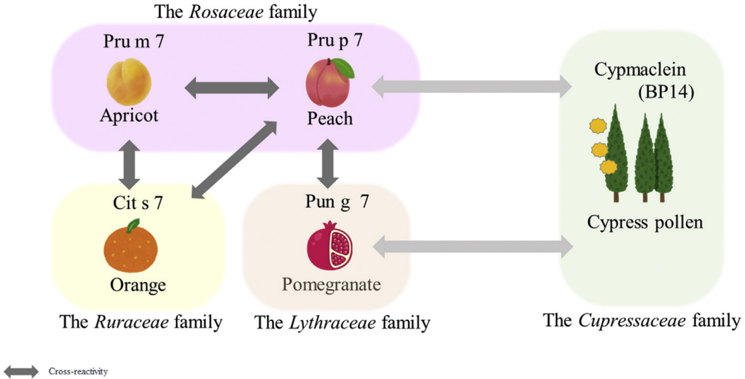
“Sensitization to Cup s 7 has been shown to cross-react with GRPs in foods, such as Pru p 7 in peaches and similar GRPs in oranges and other fruits [158].”
From Pollen–Food Allergy Syndrome: Allergens, Clinical Insights, Diagnostic and Therapeutic Challenges (2024) · cites this paper as [158]
In the citing paper
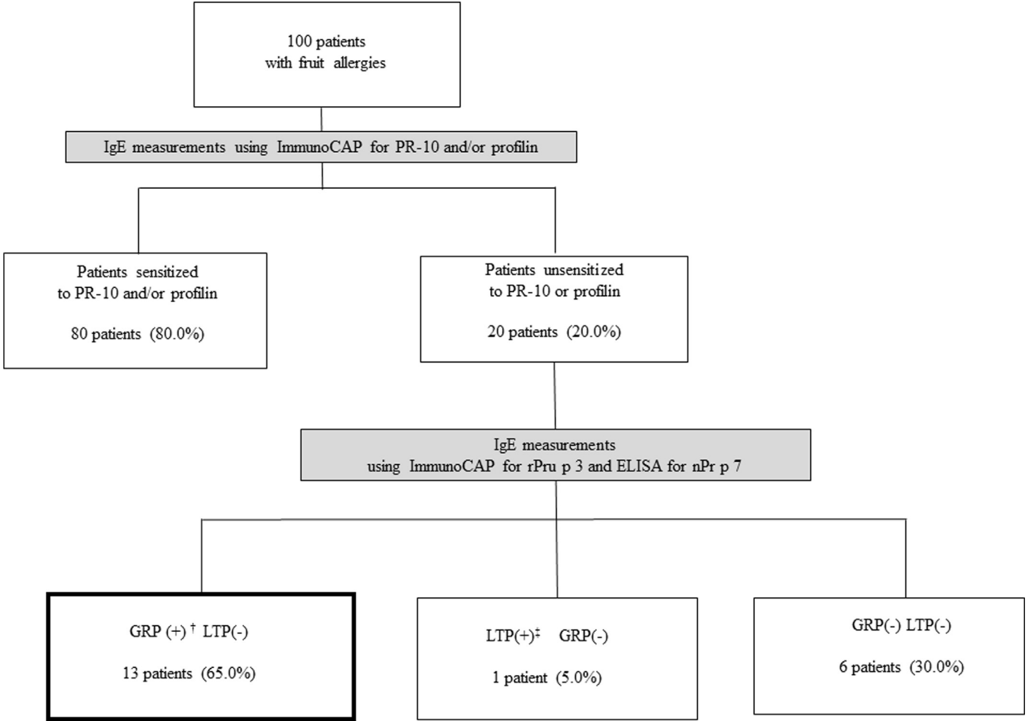
“A study from Japan observed that 65% of patients allergic to fruits were sensitized to GRPs [158].”
From Pollen–Food Allergy Syndrome: Allergens, Clinical Insights, Diagnostic and Therapeutic Challenges (2024) · cites this paper as [158]
In the citing paper
“While these reactions are typically mild and self-limiting, the heat and digestion stability of GRPs can lead to systemic symptoms, including gastrointestinal distress (nausea, vomiting, and abdominal pain), urticaria, and, in rare cases, anaphylaxis [158,163].”
From Pollen–Food Allergy Syndrome: Allergens, Clinical Insights, Diagnostic and Therapeutic Challenges (2024) · cites this paper as [158]
In the citing paper
“In pollens, GRP allergens seem to be confined to the Cupressaceae tree family, with key examples being Cup s 7 (cypress), Cry j 7 (Japanese cedar), and Jun a 7 (juniper) [118,158,163].”
From Pollen–Food Allergy Syndrome: Allergens, Clinical Insights, Diagnostic and Therapeutic Challenges (2024) · cites this paper as [158]
Self-check
Percentages, sums and reported differences re-computed from the paper’s own numbers.
The self-check needs the paper’s full text.
Citations
Cites
No references could be resolved yet.
Research works printed but not linked: 31
- Ma, 2003, A survey on the management of pollen-food allergy syndrome in allergy practices, J Allergy Clin Immunol, 112, 784, 10.1016/S0091-6749(03)02008-6 · DOI
- Valenta, 1996, Type 1 allergic reactions to plant-derived food: a consequence of primary sensitization to pollen allergens, J Allergy Clin Immunol, 97, 893, 10.1016/S0091-6749(96)80062-5 · DOI
- Amlot, 1987, Oral allergy syndrome (OAS): symptoms of IgE-mediated hypersensitivity to foods, Clin Allergy, 17, 33, 10.1111/j.1365-2222.1987.tb02317.x · DOI
- Fernández-Rivas, 2003, Clinically relevant peach allergy is related to peach lipid transfer protein, Pru p 3, in the Spanish population, J Allergy Clin Immunol, 112, 789, 10.1016/S0091-6749(03)02016-5 · DOI
- Asero, 2009, EpidemAAITO: features of food allergy in Italian adults attending allergy clinics: a multicentre study, Clin Exp Allergy, 39, 547, 10.1111/j.1365-2222.2008.03167.x · DOI
- Pastorello, 2010, Characterization of the T-cell epitopes of the major peach allergen Pru p 3, Int Arch Allergy Immunol, 153, 1, 10.1159/000301573 · DOI
- Mothes-Luksch, 2017, Pru p 3, a marker allergen for lipid transfer protein sensitization also in Central Europe, Allergy, 72, 1415, 10.1111/all.13151 · DOI
- Tuppo, 2013, Peamaclein—a new peach allergenic protein: similarities, differences and misleading features compared to Pru p 3, Clin Exp Allergy, 43, 128, 10.1111/cea.12028 · DOI
- Inomata, 2014, Identification of peamaclein as a marker allergen related to systemic reactions in peach allergy, Ann Allergy Asthma Immunol, 112, 175, 10.1016/j.anai.2013.11.003 · DOI
- Inomata, 2016, Eyelid edema as a predictive factor for sensitization to Pru p 7 in peach allergy, J Dermatol, 43, 900, 10.1111/1346-8138.13316 · DOI
- Inomata, 2017, J Dermatol, 44, 735, 10.1111/1346-8138.13795 · DOI
- Sénéchal, 2018, A new allergen family involved in pollen food-associated syndrome: snakin/gibberellin-regulated proteins, J Allergy Clin Immunol, 141, 411, 10.1016/j.jaci.2017.06.041 · DOI · Paper page
- Klingebiel, 2019, Pru p 7 sensitization is a predominant cause of severe, cypress pollen-associated peach allergy, Clin Exp Allergy, 49, 526, 10.1111/cea.13345 · DOI
- Tuppo, 2019, Isolation of cypress gibberellin-regulated protein: analysis of its structural features and IgE binding competition with homologous allergens, Mol Immunol, 114, 189, 10.1016/j.molimm.2019.07.023 · DOI
- Segura, 1999, Snakin-1, a peptide from potato that is active against plant pathogens, Mol Plant Microbe Interact, 12, 16, 10.1094/MPMI.1999.12.1.16 · DOI
- Nahirñak, 2019, Snakin-1 affects reactive oxygen species and ascorbic acid levels and hormone balance in potato, PLoS One, 14, e0214165, 10.1371/journal.pone.0214165 · DOI
- Aubert, 1998, Expression patterns of GASA genes in Arabidopsis thaliana: the GASA 4 gene is up-regulated by gibberellins in meristematic regions, Plant Mol Biol, 36, 871, 10.1023/A:1005938624418 · DOI
- Muhammad, 2019, A systematic in silico prediction of gibberellic acid stimulated GASA family members: a novel small peptide contributes to floral architecture and transcriptomic changes induced by external stimuli in rice, J Plant Physiol, 234, 117, 10.1016/j.jplph.2019.02.005 · DOI
- Hedden, 2015, A century of gibberellin research, J Plant Growth Regul, 34, 740, 10.1007/s00344-015-9546-1 · DOI
- Maeda, 2009, [Anaphylaxis due to peach with negative ImmunoCAP result to peach allergens, including rPru p 1, rPru p 3, AND rPru p 4: a report of two cases], Arerugi, 58, 140
- Inomata, 2017, Gibberellin-regulated protein in Japanese apricot is an allergen cross-reactive to Pru p 7, Immun Inflamm Dis, 5, 469, 10.1002/iid3.180 · DOI
- Tuppo, 2017, Pomegranate cultivars: identification of the New IgE-binding protein pommaclein and analysis of antioxidant variability, J Agric Food Chem, 65, 2702, 10.1021/acs.jafc.7b00092 · DOI
- Inomata, 2018, Identification of gibberellin-regulated protein as a new allergen in orange allergy, Clin Exp Allergy, 48, 1509, 10.1111/cea.13247 · DOI
- Tuppo, 2014, Structure, stability, and IgE binding of the peach allergen Peamaclein (Pru p 7), Biopolymers, 102, 416, 10.1002/bip.22530 · DOI
- Hotta, 2016, Case of food-dependent exercise-induced anaphylaxis due to peach with Pru p 7 sensitization, J Dermatol, 43, 222, 10.1111/1346-8138.13163 · DOI
- Muraro, 2018, The urgent need for a harmonized severity scoring system for acute allergic reactions, Allergy, 73, 1792, 10.1111/all.13408 · DOI
- Ahrazem, 2006, Orange germin-like glycoprotein Cit s 1: an equivocal allergen, Int Arch Allergy Immunol, 139, 96, 10.1159/000090384 · DOI
- Ahrazem, 2005, Lipid transfer proteins and allergy to oranges, Int Arch Allergy Immunol, 137, 201, 10.1159/000086332 · DOI
- López-Torrejón, 2005, Isolation, cloning and allergenic reactivity of natural profilin Cit s 2, a major orange allergen, Allergy, 60, 1424, 10.1111/j.1398-9995.2005.00903.x · DOI
- Shahali, 2012, Differential IgE sensitization to cypress pollen associated to a basic allergen of 14 kDa, FEBSJ, 279, 1445, 10.1111/j.1742-4658.2012.08536.x · DOI
- Tamburrini, 2005, Kiwellin, a novel protein from kiwi fruit. Purification, biochemical characterization and identification as an allergen*, Protein J, 24, 423, 10.1007/s10930-005-7638-7 · DOI
Cited by
Sorted by citations
Kato, Y., Morikawa, T., & Fujieda, S. (2025) · Allergology International · doi:10.1016/j.alit.2024.08.007 · Cited by 45
Pollen–Food Allergy Syndrome: Allergens, Clinical Insights, Diagnostic and Therapeutic Challenges
Haidar, L., Bănărescu, C. F., Uța, C., Moldovan, S. I., Zimbru, E.-L., Zimbru, R.-I., Ciurariu, E., Georgescu, M., & Panaitescu, C. (2024) · Applied Sciences · doi:10.3390/app15010066 · Cited by 21
Metadata
- Authors
- Inomata, N.
- Venue
- Allergology International
- Publisher
- Elsevier BV
- Published
- 2020-01
- Volume
- 69
- Issue
- 1
- Pages
- 11-18
- ISSN
- 1323-8930
- Cited by
- 65
- References
- 0
- Language
- en
- Licence
- Funders
- Japan Society for the Promotion of Science (26461663)
About these checks
Registry, retraction, Cites and statistics results are computed, not judged, with one exception: a printed reference that no index lists is read once by a model before it counts as a citation error. Claims are extracted by a model and kept only when their quote appears verbatim in the text; each cited source is then checked, with a model’s help, for whether it says what the claim relies on. Those verdicts can be wrong — read the claim’s quote and the cited source before relying on one.
Statistics and arithmetic are recomputed, not judged.
Confidence bands are shown only for fields calibrated on our annotated test set. None is calibrated yet, so no band is shown.
What counts as a claim ›How we measure confidence ›How we check this ›
Are you an author, or do you see a problem with this page? Request a review
