

The DOI matches its Crossref record; 37 of the 40 references it cites were found in a registry or an index; none of the 39 sources its claims cite is checked for support yet.
Prospective, multicenter study of P4HB (Phasix™) mesh for hernia repair in cohort at risk for complications: 3-Year follow-up
Open accessAbstract
BACKGROUND: This study represents a prospective, multicenter, open-label study to assess the safety, performance, and outcomes of poly-4-hydroxybutyrate (P4HB, Phasix™) mesh for primary ventral, primary incisional, or multiply-recurrent hernia in subjects at risk for complications. This study reports 3-year clinical outcomes. MATERIALS AND METHODS: P4HB mesh was implanted in 121 patients via retrorectus or onlay technique. Physical exam and/or quality of life surveys were completed at 1, 3, 6,12, 18, 24, and 36 months, with 5-year (60-month) follow-up ongoing. RESULTS: (±standard deviation). Comorbidities included: obesity (78.5%), active smokers (23.1%), COPD (28.1%), diabetes mellitus (33.1%), immunosuppression (8.3%), coronary artery disease (21.5%), chronic corticosteroid use (5.0%), hypo-albuminemia (2.5%), advanced age (5.0%), and renal insufficiency (0.8%). Hernias were repaired via retrorectus (n = 45, 37.2% with myofascial release (MR) or n = 43, 35.5% without MR), onlay (n = 8, 6.6% with MR or n = 24, 19.8% without MR), or not reported (n = 1, 0.8%). 82 patients (67.8%) completed 36-month follow-up. 17 patients (17.9% ± 0.4%) experienced hernia recurrence at 3 years, with n = 9 in the retrorectus group and n = 8 in the onlay group. SSI (n = 11) occurred in 9.3% ± 0.03% of patients. CONCLUSIONS: Long-term outcomes following ventral hernia repair with P4HB mesh demonstrate low recurrence rates at 3-year (36-month) postoperative time frame with no patients developing late mesh complications or requiring mesh removal. 5-year (60-month) follow-up is ongoing.
Overview
CoChat Summary
TL;DR
In this prospective, multicenter, open-label study, 121 patients at risk for complications underwent ventral hernia repair with P4HB (Phasix™) mesh. At 3 years, hernia recurrence was 17.9% (n = 17), SSI was 9.3% (n = 11), and no late mesh complications or mesh removals were reported.
Key findings
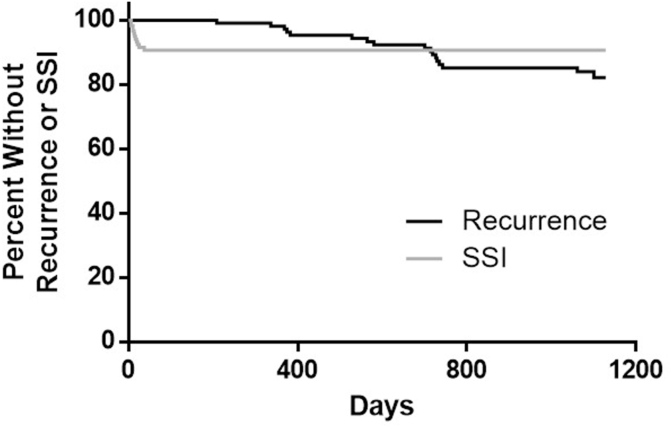
- At 36 months, 82/121 patients (67.8%) completed follow-up; hernia recurrence occurred in 17 patients (17.9% ± 0.4%), with n = 9 in the retrorectus group (12.6% ± 3.9%) and n = 8 in the onlay group (33.2% ± 10.7%).
- SSI occurred in 11 patients (9.3% ± 0.03%); all SSIs occurred within the first six weeks postimplantation, and there were no delayed wound infections. Seroma requiring intervention was 6.6% (n = 8), reoperation 11.6% (n = 14), and device-related adverse events 15.7% (n = 19).
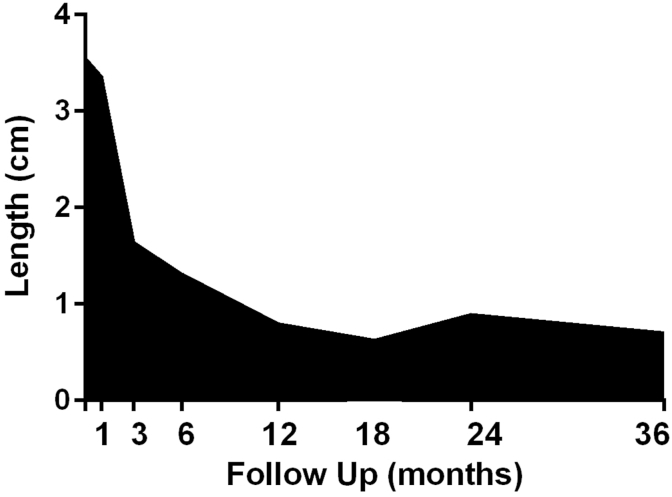
- Pain Visual Analogue Scale scores decreased from 3.55 preoperatively to 0.7 at 36 months. The authors report no patients developing late mesh complications or requiring mesh removal.
Methods
- Prospective, multicenter, open-label study at 16 U.S. sites, designed to treat 120 subjects; 139 met initial screening criteria (ITT), and 121 were implanted with P4HB mesh (mITT). Recruitment occurred October 2013–January 2015; registered as NCT01961687.
- Eligible patients were ≥18 years with primary ventral, primary incisional, or recurrent incisional hernia (not exceeding 3 recurrences), CDC Class I wound, 10–350 cm² defect, and one or more comorbidities (e.g., BMI 30–40 kg/m², active smoking, COPD, diabetes, immunosuppression, coronary artery disease, chronic corticosteroid use, hypo-albuminemia, advanced age, renal insufficiency). Open repair used retrorectus or onlay technique with or without myofascial release.
- Follow-up visits were scheduled at 1, 3, 6, 12, 18, 24, 36, and 60 months, with a telephone interview at 30 months. Primary endpoints were hernia recurrence and SSI; GraphPad Prism 6.01 was used, primary endpoints were expressed using Kaplan-Meier estimation due to loss to follow-up, and other outcomes used the mITT population.
Limitations
- The paper states there was no control group and all patients had Class I (clean) wounds, so the data cannot be directly compared to other biomaterials or other wound types; it also states this was a prospective, multicenter trial with long-term follow-up rather than a randomized controlled trial.
- The paper notes a higher degree of patient loss to follow-up than initially planned due to extension beyond the originally planned 2 years; 82/121 (67.8%) completed 36-month follow-up, with 55 withdrawals, 21 lost to follow-up after documented 3 attempts, and 11 missing.
- The text states subjects, investigators, and surgeons were not blinded to study treatment; this open-label design is evident as a limitation for subjective outcomes.
Model-written summary. Check it against the paper before relying on it.
Integrity signals
Registry
Cites
Statistics
Figures
Verification
Claims the paper makes
0 Valid · 0 Not valid · 29 Not checked · 39 Own results and interpretations
A result the paper reports from its own data — it cites no other source for it, so there is none to check. The quote shows it is in the paper.
In the paper
“Importantly, all SSIs occurred within the first six weeks postimplantation, and there were no delayed wound infections.”
§ Prospective, multicenter study of P4HB (Phasix™) mesh for hernia repair in cohort at risk for complications: 3-Year follow-up > Discussion
plain- Asserted: passes — The authors put it forward as true.
- Checkable: passes — It can be checked against evidence.
- Load-bearing: passes — The paper’s conclusions depend on it.
- Based: passes — The paper gives a reason why it holds.
A result the paper reports from its own data — it cites no other source for it, so there is none to check. The quote shows it is in the paper.
In the paper
“SSI (n = 11) occurred in 9.3% ± 0.03% of patients.”
- Also stated in: § Postoperative outcomes · plain
“SSI (n = 11, 9.3% ± 0.03%)”
§ Prospective, multicenter study of P4HB (Phasix™) mesh for hernia repair in cohort at risk for complications: 3-Year follow-up > Abstract > Results
plainn = 11- Asserted: passes — The authors put it forward as true.
- Checkable: passes — It can be checked against evidence.
- Load-bearing: passes — The paper’s conclusions depend on it.
- Based: passes — The paper gives a reason why it holds.
- Also stated in: § Postoperative outcomes · plain
A result the paper reports from its own data — it cites no other source for it, so there is none to check. The quote shows it is in the paper.
In the paper
“seroma requiring intervention (n = 8, 6.6%) were low.”
- Also stated in: § Postoperative outcomes · plain
“Seroma requiring intervention | 6.6% (n = 8)”
§ Prospective, multicenter study of P4HB (Phasix™) mesh for hernia repair in cohort at risk for complications: 3-Year follow-up > Results > Postoperative outcomes
plainn = 8- Asserted: passes — The authors put it forward as true.
- Checkable: passes — It can be checked against evidence.
- Load-bearing: unclear — It is unclear whether the paper’s conclusions depend on it.
- Based: passes — The paper gives a reason why it holds.
- Also stated in: § Postoperative outcomes · plain
A result the paper reports from its own data — it cites no other source for it, so there is none to check. The quote shows it is in the paper.
In the paper
“Patients averaged 5.3 ± 5.3 days (mean ± standard deviation) in the hospital”
§ Prospective, multicenter study of P4HB (Phasix™) mesh for hernia repair in cohort at risk for complications: 3-Year follow-up > Results > Postoperative outcomes
plain- Asserted: passes — The authors put it forward as true.
- Checkable: passes — It can be checked against evidence.
- Load-bearing: unclear — It is unclear whether the paper’s conclusions depend on it.
- Based: passes — The paper gives a reason why it holds.
A result the paper reports from its own data — it cites no other source for it, so there is none to check. The quote shows it is in the paper.
In the paper
“The results of the current study revealed 17.9% ± 0.4% hernia recurrence, 6.6% seroma, and 9.3% ± 0.03% SSI at 36 months.”
§ Prospective, multicenter study of P4HB (Phasix™) mesh for hernia repair in cohort at risk for complications: 3-Year follow-up > Discussion
plain- Asserted: passes — The authors put it forward as true.
- Checkable: passes — It can be checked against evidence.
- Load-bearing: passes — The paper’s conclusions depend on it.
- Based: passes — The paper gives a reason why it holds.
37 more claims
Create a free account to see all 68 claims and to verify the 38 references still open.
- It may state two separate claims as one. 11
- Probably not a substantial claim. 19
Claims other papers make about this one
Each is checked against this paper’s own text: does it say what the citing paper says it does?
In the citing paper
“Several studies have demonstrated that P4HB mesh is safe and effective on the short term even in contaminated fields, with acceptable rates of surgical site occurrences (SSOs) and surgical site infections (SSIs) [5, 6, 7].”
From Long‐Term Outcomes After Slowly Resorbable P4HB Mesh Implantation: A Multicenter Analysis From European Registry (2026) · cites this paper as [5]
In the citing paper
“The material is eliminated by the body in 12–18 months through hydrolytic enzymatic degradation after which tissue integrity must be maintained by the patient's own tissue regeneration [5, 6].”
From Long‐Term Outcomes After Slowly Resorbable P4HB Mesh Implantation: A Multicenter Analysis From European Registry (2026) · cites this paper as [5]
In the citing paper
“Reported recurrence rates vary between 5.7% and 31.7%, depending on patient selection, hernia complexity, and duration of follow‐up [5, 6].”
From Long‐Term Outcomes After Slowly Resorbable P4HB Mesh Implantation: A Multicenter Analysis From European Registry (2026) · cites this paper as [5]
Citations
Cites
Dindo, D., Demartines, N., & Clavien, P.-A. (2004) · Annals of Surgery · doi:10.1097/01.sla.0000133083.54934.ae · Cited by 31,378
Guideline for Prevention of Surgical Site Infection, 1999
Mangram, A. J., Horan, T. C., Pearson, M. L., Silver, L. C., & Jarvis, W. R. (1999) · Infection Control and Hospital Epidemiology · doi:10.1086/501620 · Cited by 4,638
Mangram, A. J., Horan, T. C., Pearson, M. L., Silver, L. C., & Jarvis, W. R. (1999) · PubMed · Cited by 2,783
A comparison of suture repair with mesh repair for incisional hernia.
Luijendijk, R. W., Hop, W. C. J., van den Tol, M. P., de Lange, D. C. D., Braaksma, M. M. J., IJzermans, J. N. M., Boelhouwer, R. U., de Vries, B. C., Salu, M. K. M., Wereldsma, J. C. J., et al. (2000) · New England Journal of Medicine · doi:10.1056/nejm200008103430603 · Cited by 1,508
Burger, J. W. A., Luijendijk, R. W., Hop, W. C. J., Halm, J. A., Verdaasdonk, E. G. G., & Jeekel, J. (2004) · Annals of Surgery · doi:10.1097/01.sla.0000141193.08524.e7 · Cited by 1,340
STROCSS 2019 Guideline: Strengthening the reporting of cohort studies in surgery
Agha, R., Abdall-Razak, A., Crossley, E., Dowlut, N., Iosifidis, C., Mathew, G., Beamishaj, Bashashati, M., Millham, F. H., Orgill, D. P., et al. (2019) · International Journal of Surgery · doi:10.1016/j.ijsu.2019.11.002 · Cited by 1,184
Long-term complications associated with prosthetic repair of incisional hernias
Leber, G. E. (1998) · Archives of Surgery · doi:10.1001/archsurg.133.4.378 · Cited by 714
Long-term recurrence and complications associated with elective incisional hernia repair.
Kokotovic, D., Bisgaard, T., & Helgstrand, F. (2016) · JAMA · doi:10.1001/jama.2016.15217 · Cited by 391
Jairam, A. P., Timmermans, L., Eker, H. H., Pierik, R. E. G. J. M., Klaveren, D. V., Steyerberg, E. W., Timman, R., van der Ham, A. C., Dawson, I., Charbon, J. A., et al. (2017) · The Lancet · doi:10.1016/s0140-6736(17)31332-6 · Cited by 330
Mesh location in open ventral hernia repair: a systematic review and network meta-analysis
Holihan, J. L., Nguyen, D. H., Nguyen, M. T., Mo, J., Kao, L. S., & Liang, M. K. (2016) · World Journal of Surgery · doi:10.1007/s00268-015-3252-9 · Cited by 314
Research works printed but not linked: 1
- Rosen, 2017, Multicenter, prospective, longitudinal study of the recurrence, surgical site infection, and quality of life after contaminated ventral hernia repair using biosynthetic absorbable mesh: the COBRA study, Ann. Surg., 265, 205, 10.1097/sla.0000000000001601 · DOI · Paper page
Cited by
Citric Acid: A Nexus Between Cellular Mechanisms and Biomaterial Innovations
Xu, H. F., Yan, S., Gerhard, E. M., Xie, D., Liu, X., Zhang, B., Shi, D., Ameer, G. A., & Yang, J. Y. (2024) · Advanced Materials · doi:10.1002/adma.202402871 · Cited by 76
Wang, H., Huddleston, S. E., Yang, J. Y., & Ameer, G. A. (2023) · Advanced Materials · doi:10.1002/adma.202306326 · Cited by 44
Incidence of formal and informal academic help-seeking in higher education.
Knapp, J. R., & Karabenick, S. A. (1988) · Journal of college student development · Cited by 44
Morales‐Conde, S., Hernández-Granados, P., Tallón‐Aguilar, L., Verdaguer-Tremolosa, M., & Cano, M. L. (2022) · Hernia · doi:10.1007/s10029-022-02668-w · Cited by 42
Roth, J. S., Anthone, G. J., Selzer, D. J., Poulose, B. K., Pierce, R. A., Bittner, J. G., Hope, W. W., Dunn, R. M., Martindale, R. G., Goldblatt, M. I., et al. (2022) · Journal of the American College of Surgeons · doi:10.1097/xcs.0000000000000363 · Cited by 40
Self-citation
Metadata
- Authors
- Roth, J. S., Anthone, G. J., Selzer, D. J., Poulose, B. K., Pierce, R. A., Bittner, J. G., Hope, W. W., Dunn, R. M., Martindale, R. G., Goldblatt, M. I., Earle, D. B., Romanelli, J. R., Mancini, G. J., Greenberg, J. A., Linn, J. G., Parra-Davila, E., Sandler, B. J., Deeken, C. R., Verbarg, J., Salluzzo, J. L., & Voeller, G. R.
- Affiliations
- University of Kentucky HealthCare (US)
- Methodist Hospital (US)
- Indiana University School of Medicine (US)
- The Ohio State University Wexner Medical Center (US)
- Vanderbilt University Medical Center (US)
- Saint Francis Hospital & Medical Center (US)
- New Hanover Regional Medical Center (US)
- University of Massachusetts Chan Medical School (US)
- Oregon Health & Science University (US)
- Medical College of Wisconsin (US)
- Baystate Medical Center (US)
- University of Tennessee Health Science Center (US)
- University of Wisconsin System (US)
- Endeavor Health (US)
- University of California San Diego (US)
- Virginia Commonwealth University (US)
- Corresponding author
- Roth, John Scott
- ORCID
- Venue
- Annals of Medicine and Surgery
- Published
- 2021-01
- Volume
- 61
- Pages
- 1-7
- ISSN
- 2049-0801 (ISSN-L)
- PMC
- PMC7750179
- OpenAlex
- W3112418201
- Semantic Scholar
- 76c3096455a41ccf5dd0c484ec611854cae2018d
- Cited by
- 40
- References
- 40
- Citations by year
- 2026: 5 · 2025: 3 · 2024: 7 · 2023: 7 · 2022: 8 · 2021: 9
- FWCI
- 5.34
- Type
- journal article
- Language
- en
- Open access
- gold
- doi.org
- Locations
- Annals of Medicine and Surgery (publishedVersion, cc-by)
- PubMed (publishedVersion)
- PubMed Central (publishedVersion, cc-by)
- The Journal of the American Medical Association (JAMA) Network (American Medical Association) (submittedVersion, other-oa)
- IUScholarWorks (Indiana University) (submittedVersion, cc-by)
- Purdue University Indianapolis (Indiana University) (submittedVersion, cc-by)
- Funders
- CR Bard/Becton Dickinsone
- Topics
- Health Sciences › Medicine › Surgery › Hernia repair and management
- Health Sciences › Medicine › Surgery › Stoma care and complications
- Health Sciences › Medicine › Surgery › Surgical Sutures and Adhesives
- Keywords
- ventral hernia repair, incisional hernia, hernia recurrence, surgical site infection, onlay technique, myofascial release, obesity, comorbidities, long-term outcomes, mesh complications
About these checks
Registry, retraction, Cites and statistics results are computed, not judged, with one exception: a printed reference that no index lists is read once by a model before it counts as a citation error. Claims are extracted by a model and kept only when their quote appears verbatim in the text; each cited source is then checked, with a model’s help, for whether it says what the claim relies on. Those verdicts can be wrong — read the claim’s quote and the cited source before relying on one.
A language model drew the claims from the paper on 2026-11-13, under version 3 of the claim definition (model deepseek-v4.1-flash, prompt extract-v3).
A second model labelled each claim on 2026-11-13 (model jev-1.13-20260917, definition revision gold-guideline-v0.2).
Statistics and arithmetic are recomputed, not judged.
Confidence bands are shown only for fields calibrated on our annotated test set. None is calibrated yet, so no band is shown.
What counts as a claim ›How we measure confidence ›How we check this ›
Are you an author, or do you see a problem with this page? Request a review
How to cite
Cite CoChat for the checks on this page, and the paper for its own findings.
- This page
- CoChat. (2026). Citation check: Prospective, multicenter study of P4HB (Phasix™) mesh for hernia repair in cohort at risk for complications: 3-Year follow-up. https://app.cochat.ai/papers/10.1016/j.amsu.2020.12.002
- The paper
- Roth, J. S., Anthone, G. J., Selzer, D. J., Poulose, B. K., Pierce, R. A., Bittner, J. G., Hope, W. W., Dunn, R. M., Martindale, R. G., Goldblatt, M. I., Earle, D. B., Romanelli, J. R., Mancini, G. J., Greenberg, J. A., Linn, J. G., Parra-Davila, E., Sandler, B. J., Deeken, C. R., Verbarg, J., . . . Voeller, G. R. (2021). Prospective, multicenter study of P4HB (Phasix™) mesh for hernia repair in cohort at risk for complications: 3-Year follow-up. Annals of Medicine and Surgery. https://doi.org/10.1016/j.amsu.2020.12.002
Data sources
Bibliographic data: Semantic Scholar, OpenAlex, Crossref.
Contains information from the Semantic Scholar Academic Graph Datasets, made available under the ODC Attribution License (ODC-BY 1.0).
Semantic Scholar’s data is described in: Kinney, R., et al. (2023). The Semantic Scholar Open Data Platform. arXiv:2301.10140.
