

The DOI matches its Crossref record; 68 of the 68 references it cites were found in a registry or an index.
Association between a functional interleukin 6 receptor genetic variant and risk of depression and psychosis in a population-based birth cohort
Open accessAbstract
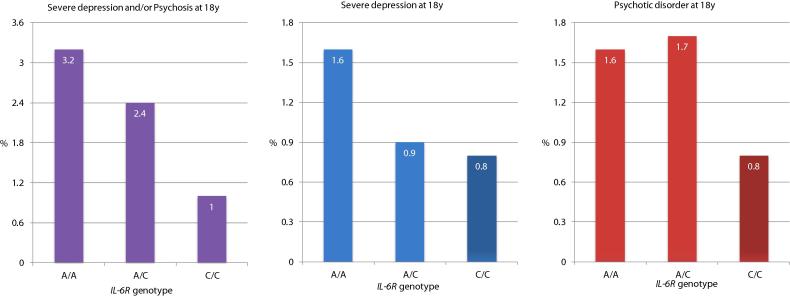
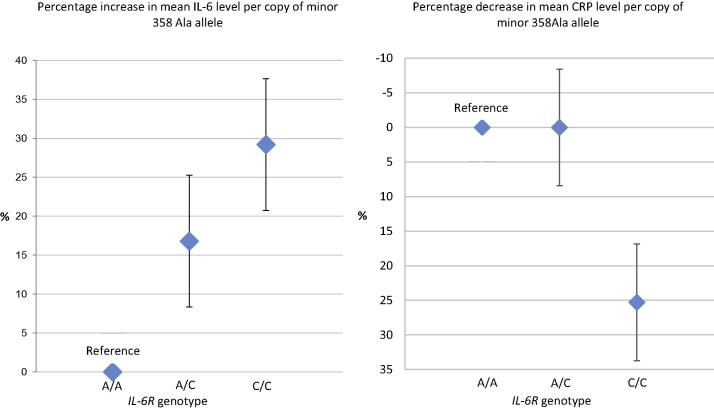
OBJECTIVE: Interleukin 6 (IL-6) levels are commonly elevated in patients with depression and psychosis and in people who are at risk of developing these disorders. A common, functional variant in the IL6R gene (IL6R Asp358Ala; rs2228145 A > C) is known to dampen down inflammation by impairing IL6R signaling. We have examined the association of Asp358Ala with diagnosis of depression and psychosis, serum IL-6, CRP levels, and a number of risk factors commonly linked with inflammation, depression or psychosis. We predicted that if IL-6 were related to depression/psychosis risk causally, rather than due to confounding, Asp358Ala would be associated with risk of these disorders, serum IL-6, CRP levels, but not with any of the confounders. METHOD: We used data from the population-based ALSPAC birth cohort. Serum IL-6 and CRP levels were measured at age 9 years. Psychotic disorder, ICD-10 diagnosis of severe depressive episode, and total depression score were assessed at age 18 years. IL6R Asp358Ala was genotyped using the Illumina HumanHap550 quad genome-wide SNP genotyping platform. Risk factors assessed include sex, body mass index, social class, ethnicity, maternal education, birth weight, gestational age, maternal post-natal depression, childhood psychological and behavioral problems, and total IQ score. RESULTS: ), consistent with an anti-inflammatory effect downstream of IL-6. Asp358Ala was not associated with total depression score. Asp358Ala was not associated with any of the other risk factors commonly linked with inflammation, depression or psychosis (all P > 0.20). CONCLUSIONS: The findings provide further evidence that the IL-6/IL6R pathways are involved in pathogenesis of severe depression and psychosis, and may be novel therapeutic targets. Previously reported associations between IL-6, depression and psychosis are unlikely to be fully explained by confounding. Based on a small number of cases, findings from the current study need replication in other samples.
Overview
The claims and statistics of this paper haven’t been checked yet.
Run the check — free, no account needed. It reads the open-access text and checks the sources it cites.
Integrity signals
Registry
Cites
Statistics
Figures
Verification
Claims the paper makes
The claims and statistics of this paper haven’t been checked yet.
Run the check — free, no account needed. It reads the open-access text and checks the sources it cites.
Claims other papers make about this one
Each is checked against this paper’s own text: does it say what the citing paper says it does?
In the citing paper
“Variants in the IL6R gene have been found to be associated with increased risk of coronary artery disease24, rheumatoid arthritis, atrial fibrillation, and abdominal aortic aneurysm, and with increased susceptibility to asthma, type 1 diabetes, and depression36,37.”
From Inflammageing: chronic inflammation in ageing, cardiovascular disease, and frailty (2018) · cites this paper as [36]
Self-check
Percentages, sums and reported differences re-computed from the paper’s own numbers.
The self-check needs the paper’s full text.
Citations
Cites
Diagnostic and Statistical Manual of Mental Disorders
Williams, J. B. W., & First, M. B. (2013) · Oxford University Press eBooks · doi:10.1093/acrefore/9780199975839.013.104 · Cited by 109,845
Diagnostic and Statistical Manual of Mental Disorders
(2012) · Springer eBooks · doi:10.1007/springerreference_121117 · Cited by 20,772
The Strengths and Difficulties Questionnaire: A research note
Goodman, R. (1997) · Journal of Child Psychology and Psychiatry · doi:10.1111/j.1469-7610.1997.tb01545.x · Cited by 14,908
Detection of Postnatal Depression: Development of the 10-item Edinburgh Postnatal Depression Scale
Cox, J. L., Holden, J. M., & Sagovsky, R. (1987) · British Journal of Psychiatry · doi:10.1192/bjp.150.6.782 · Cited by 14,183 · cited 1×
“Mother’s postnatal depression was measured by the self-report Edinburgh Postnatal Depression Scale administered at 8 weeks postpartum (Cox et al., 1987).”
MethodMolecular Mechanisms of Depression: Perspectives on New Treatment Strategies
Lang, U. E., & Borgwardt, S. (2013) · Cellular Physiology and Biochemistry · doi:10.1159/000350094 · Cited by 8,526
Biological insights from 108 schizophrenia-associated genetic loci
Schizophrenia Working Group of the Psychiatric Genomics Consortium (2014) · Nature · doi:10.1038/nature13595 · Cited by 7,577
From inflammation to sickness and depression: when the immune system subjugates the brain
Dantzer, R., O'Connor, J. C., Freund, G. G., Johnson, R. W., & Kelley, K. W. (2008) · Nature Reviews Neuroscience · doi:10.1038/nrn2297 · Cited by 7,395
Davey Smith, G., & Ebrahim, S. (2003) · International Journal of Epidemiology · doi:10.1093/ije/dyg070 · Cited by 5,882
A Meta-Analysis of Cytokines in Major Depression
Dowlati, Y., Herrmann, N., Swardfager, W., Liu, H., Sham, L., Reim, E. K., & Lanctôt, K. L. (2010) · Biological Psychiatry · doi:10.1016/j.biopsych.2009.09.033 · Cited by 4,729
C-Reactive Protein, Interleukin 6, and Risk of Developing Type 2 Diabetes Mellitus
Pradhan, A. D. (2001) · JAMA · doi:10.1001/jama.286.3.327 · Cited by 4,433 · cited 1×
“, 2008), diabetes mellitus (Pradhan et al., 2001), depression and psychosis (Khandaker et al.”
Background
Research works printed but not linked: 1
- Wechsler, D., Golombok, S., Rust, J., 1992. Weschler Intelligence Scale for Children (3rd Edition) (WISC–III UK). The Psychological Corporation.
Cited by
Sorted by citations
Inflammageing: chronic inflammation in ageing, cardiovascular disease, and frailty
Ferrucci, L., & Fabbri, E. (2018) · Nature Reviews Cardiology · doi:10.1038/s41569-018-0064-2 · Cited by 3,690
Role of Interleukin-6 in Depressive Disorder
Ting, E. Y.-C., Yang, A. C., & Tsai, S. (2020) · International Journal of Molecular Sciences · doi:10.3390/ijms21062194 · Cited by 404
“indicated that a common functional variant in the IL6R gene (IL6R Asp358Ala; rs2228145 A > C), which is able to decrease inflammation by impairing IL-6R signaling, is associated with depression risk [99].”
BackgroundImmune targets for therapeutic development in depression: towards precision medicine
Drevets, W. C., Wittenberg, G. M., Bullmore, E. T., & Manji, H. K. (2022) · Nature Reviews Drug Discovery · doi:10.1038/s41573-021-00368-1 · Cited by 348
Khandaker, G. M., Zuber, V., Rees, J. M. B., Carvalho, L. A., Mason, A. M., Foley, C. N., Gkatzionis, A., Jones, P. B., & Burgess, S. (2019) · Molecular Psychiatry · doi:10.1038/s41380-019-0395-3 · Cited by 287
Self-citationCytokine Alterations in Schizophrenia: An Updated Review
Momtazmanesh, S., Zare-Shahabadi, A., & Rezaei, N. (2019) · Frontiers in Psychiatry · doi:10.3389/fpsyt.2019.00892 · Cited by 277
“in 2018, finding a strong association between a genetic variant of IL-6 receptor relating to the levels of IL-6 and CRP and development of schizophrenia (119).”
Background
Metadata
- Authors
- Khandaker, G. M., Zammit, S., Burgess, S., Lewis, G., & Jones, P. B.
- Affiliations
- University of Cambridge (GB)
- University of Bristol (GB)
- University College London (GB)
- Corresponding author
- Khandaker, Golam M.
- Venue
- Brain, Behavior, and Immunity
- Publisher
- Elsevier BV
- Published
- 2018-03
- Volume
- 69
- Pages
- 264-272
- ISSN
- 0889-1591 (ISSN-L)
- PMC
- PMC5871397
- OpenAlex
- W2774979768
- Cited by
- 118
- References
- 67
- Citations by year
- 2026: 9 · 2025: 14 · 2024: 9 · 2023: 10 · 2022: 11 · 2021: 17 · 2020: 20 · 2019: 18 · 2018: 10
- FWCI
- 4.36
- Type
- journal article
- Language
- en
- Open access
- hybrid
- doi.org
- Licence
- Locations
- Brain Behavior and Immunity (publishedVersion, cc-by)
- PubMed Central (publishedVersion, cc-by)
- PubMed (publishedVersion)
- ORCA Online Research @Cardiff (Cardiff University) (acceptedVersion)
- Bristol Research (University of Bristol) (submittedVersion, cc-by)
- UCL Discovery (University College London) (submittedVersion)
- Apollo (University of Cambridge) (submittedVersion, cc-by)
- Apollo (cc-by)
- Funders
- Wellcome Trust (204623/Z/16/Z, 102215/2/13/2), 088869/Z/09/Z, 095844/Z/11/Z, 088869, 102215, /Z/11/Z, 100114, 102215/2/13/, 201486 /Z/16/Z, 80354, 201486, 100114/Z/12/Z, 095844)
- NIHR Bristol Biomedical Research Centre
- National Institute for Health and Care Research (NF-SI-0617-10113, NF-SI-0512-10165, RP-PG-0606-1335)
- British Heart Foundation (RG/13/13/30194)
- Academy of Medical Sciences (AMS-SGCL13-Khandaker, 80354)
- University of Bristol (102215/2/13/2, 201486/Z/16/Z)
- Medical Research Council (102215, ref: 102215/2/13/2, MR/L003120/1, 201486/Z/16/Z, 102215/2/13/2, MR/L010305/1, MC_PC_15018)
- Topics
- Life Sciences › Neuroscience › Biological Psychiatry › Tryptophan and brain disorders
- Life Sciences › Biochemistry, Genetics and Molecular Biology › Genetics › Genetic Associations and Epidemiology
- Life Sciences › Neuroscience › Behavioral Neuroscience › Stress Responses and Cortisol
- Keywords
- IL-6 receptor, rs2228145, depression, psychosis, interleukin-6, C-reactive protein, inflammation, genetic susceptibility, ALSPAC birth cohort, childhood risk factors, postpartum depression
- MeSH terms
- Adolescent, C-Reactive Protein, Child, Depressive Disorder, Female, Genotype, Humans, Male, Psychotic Disorders, Cohort Studies, Interleukin-6, Receptors, Interleukin-6, Genetic Predisposition to Disease, Polymorphism, Single Nucleotide
About these checks
Registry, retraction, Cites and statistics results are computed, not judged, with one exception: a printed reference that no index lists is read once by a model before it counts as a citation error. Claims are extracted by a model and kept only when their quote appears verbatim in the text; each cited source is then checked, with a model’s help, for whether it says what the claim relies on. Those verdicts can be wrong — read the claim’s quote and the cited source before relying on one.
Statistics and arithmetic are recomputed, not judged.
Confidence bands are shown only for fields calibrated on our annotated test set. None is calibrated yet, so no band is shown.
What counts as a claim ›How we measure confidence ›How we check this ›
Are you an author, or do you see a problem with this page? Request a review
