

The DOI matches its Crossref record; 92 of the 92 references it cites were found in a registry or an index.
Methylphenidate Normalizes Frontocingulate Underactivation During Error Processing in Attention-Deficit/Hyperactivity Disorder
Open accessAbstract
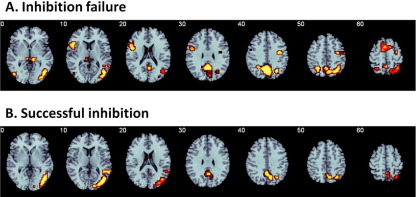
BACKGROUND: Children with attention-deficit/hyperactivity disorder (ADHD) have deficits in performance monitoring often improved with the indirect catecholamine agonist methylphenidate (MPH). We used functional magnetic resonance imaging to investigate the effects of single-dose MPH on activation of error processing brain areas in medication-naive boys with ADHD during a stop task that elicits 50% error rates. METHODS: Twelve medication-naive boys with ADHD were scanned twice, under either a single clinical dose of MPH or placebo, in a randomized, double-blind design while they performed an individually adjusted tracking stop task, designed to elicit 50% failures. Brain activation was compared within patients under either drug condition. To test for potential normalization effects of MPH, brain activation in ADHD patients under either drug condition was compared with that of 13 healthy age-matched boys. RESULTS: During failed inhibition, boys with ADHD under placebo relative to control subjects showed reduced brain activation in performance monitoring areas of dorsomedial and left ventrolateral prefrontal cortices, thalamus, cingulate, and parietal regions. MPH, relative to placebo, upregulated activation in these brain regions within patients and normalized all activation differences between patients and control subjects. During successful inhibition, MPH normalized reduced activation observed in patients under placebo compared with control subjects in parietotemporal and cerebellar regions. CONCLUSIONS: MPH normalized brain dysfunction in medication-naive ADHD boys relative to control subjects in typical brain areas of performance monitoring, comprising left ventrolateral and dorsomedial frontal and parietal cortices. This could underlie the amelioration of MPH of attention and academic performance in ADHD.
Overview
The claims and statistics of this paper haven’t been checked yet.
Run the check — free, no account needed. It reads the open-access text and checks the sources it cites.
Integrity signals
Registry
Cites
Statistics
Figures


Verification
Claims the paper makes
The claims and statistics of this paper haven’t been checked yet.
Run the check — free, no account needed. It reads the open-access text and checks the sources it cites.
Claims other papers make about this one
Each is checked against this paper’s own text: does it say what the citing paper says it does?
The source backs part of the claim, not all of it — or backs it for a different population, condition or comparison.
In the citing paper
“the cerebellum during attention, TD, and interference inhibition 4, 16, 18”
From Effects of stimulants on brain function in attention-deficit/hyperactivity disorder: a systematic review and meta-analysis (2014) · cites this paper as [18]
Experimental — accuracy not yet measuredThe source backs part of the claim, not all of it — or backs it for a different population, condition or comparison.
In the citing paper
“and striatum during reward and response inhibition 16, 18.”
From Effects of stimulants on brain function in attention-deficit/hyperactivity disorder: a systematic review and meta-analysis (2014) · cites this paper as [18]
Experimental — accuracy not yet measuredThe source backs part of the claim, not all of it — or backs it for a different population, condition or comparison.
In the citing paper
“Randomized placebo-controlled fMRI studies of acute methylphenidate effects in medication-naïve ADHD boys using whole-brain image analyses found increased activation in predominantly right, but also left, IFC during tasks of sustained attention, inhibition, and time discrimination (TD) 4, 16, 17, 18”
From Effects of stimulants on brain function in attention-deficit/hyperactivity disorder: a systematic review and meta-analysis (2014) · cites this paper as [18]
Experimental — accuracy not yet measuredThe cited source says what the claim attributes to it.
In the citing paper
“Ten datasets compared methylphenidate with placebo on brain function in medication-naïve patients in randomized controlled designs 4, 16, 17, 18”
From Effects of stimulants on brain function in attention-deficit/hyperactivity disorder: a systematic review and meta-analysis (2014) · cites this paper as [18]
The cited source says what the claim attributes to it.
In the citing paper
“in parietal regions during sustained attention, error monitoring, and interference inhibition 16, 17, 18”
From Effects of stimulants on brain function in attention-deficit/hyperactivity disorder: a systematic review and meta-analysis (2014) · cites this paper as [18]
The cited source says what the claim attributes to it.
In the citing paper
“While most fMRI studies found methylphenidate to have a positive effect on brain activation, only some studies observed performance improvement 18, 21, 24, 25, 26, 74, 75, likely reflecting the superior sensitivity of fMRI relative to behavior to detect pharmacologic effects or the relatively small subject numbers of fMRI studies, underpowered for performance effects.”
From Effects of stimulants on brain function in attention-deficit/hyperactivity disorder: a systematic review and meta-analysis (2014) · cites this paper as [18]
Self-check
Percentages, sums and reported differences re-computed from the paper’s own numbers.
The self-check needs the paper’s full text.
Citations
Cites
Diagnostic and Statistical Manual of Mental Disorders
Williams, J. B. W., & First, M. B. (2013) · Oxford University Press eBooks · doi:10.1093/acrefore/9780199975839.013.104 · Cited by 109,845
SMITH, S., & NICHOLS, T. (2009) · NeuroImage · doi:10.1016/j.neuroimage.2008.03.061 · Cited by 5,250
Holroyd, C. B., & Coles, M. G. H. (2002) · Psychological Review · doi:10.1037/0033-295x.109.4.679 · Cited by 4,027
Willcutt, E. G., Doyle, A. E., Nigg, J. T., Faraone, S. V., & Pennington, B. F. (2005) · Biological Psychiatry · doi:10.1016/j.biopsych.2005.02.006 · Cited by 3,568
The role of the medial frontal cortex in cognitive control
Ridderinkhof, K. R., Ullsperger, M., Crone, E. A., & Nieuwenhuis, S. (2004) · Science · doi:10.1126/science.1100301 · Cited by 2,974
Anterior Cingulate Conflict Monitoring and Adjustments in Control
Kerns, J. G., Cohen, J. D., MacDonald, A. W., Cho, R. Y., Stenger, V. A., & Carter, C. S. (2004) · Science · doi:10.1126/science.1089910 · Cited by 2,891
Mendelson, G. (1995) · Australian & New Zealand Journal of Psychiatry · doi:10.3109/00048679509064964 · Cited by 2,592
Misunderstanding analysis of covariance.
Miller, G. A., & Chapman, J. P. (2001) · Journal of Abnormal Psychology · doi:10.1037/0021-843x.110.1.40 · Cited by 2,136
Valid conjunction inference with the minimum statistic
Nichols, T. E., Brett, M., Andersson, J., Wager, T. D., & Poline, J. (2005) · NeuroImage · doi:10.1016/j.neuroimage.2004.12.005 · Cited by 1,854
Aron, A. R., & Poldrack, R. A. (2006) · The Journal of Neuroscience · doi:10.1523/jneurosci.4682-05.2006 · Cited by 1,630
Research works printed but not linked: 2
- Rubia, 2010, “Cool” inferior frontostriatal dysfunction in attention deficit hyperactivity disorder (ADHD) versus “hot” ventromedial orbitofronto-limbic dysfunction in conduct disorder: A review [published online ahead of print November 20]
- Rubia, 2010, Disorder-specific inferior frontal dysfunction in boys with pure attention-deficit/hyperactivity disorder compared to boys with pure CD during cognitive flexibility, Hum Brain Mapp, 31, 1823, 10.1002/hbm.20975 · DOI · Paper page
Cited by
Sorted by citations
Hart, H., Radua, J., Nakao, T., Mataix-Cols, D., & Rubia, K. (2013) · JAMA Psychiatry · doi:10.1001/jamapsychiatry.2013.277 · Cited by 764
Self-citationNeuroimaging of child abuse: a critical review
Hart, H., & Rubia, K. (2012) · Frontiers in Human Neuroscience · doi:10.3389/fnhum.2012.00052 · Cited by 660
Self-citationRubia, K. (2018) · Frontiers in Human Neuroscience · doi:10.3389/fnhum.2018.00100 · Cited by 384
“Thus, during cognitive control tasks, IFC was found to be disorder-specifically reduced compared to OCD patients in individual fMRI studies (Rubia et al., 2010a, 2011a), as well as in a comparative fMRI meta-analysis of cognitive control functions, including motor and interference inhibition and…”
Self-citationNoreika, V., Falter, C. M., & Rubia, K. (2013) · Neuropsychologia · doi:10.1016/j.neuropsychologia.2012.09.036 · Cited by 339
Self-citationRubia, K., Alegria, A. A., Cubillo, A. I., Smith, A. B., Brammer, M. J., & Radua, J. (2014) · Biological Psychiatry · doi:10.1016/j.biopsych.2013.10.016 · Cited by 315
Self-citation
Metadata
- Authors
- Rubia, K., Halari, R., Mohammad, A.-M., Taylor, E., & Brammer, M.
- Affiliations
- King's College London (GB)
- Corresponding author
- Rubia, Katya
- Venue
- Biological Psychiatry
- Publisher
- Elsevier BV
- Published
- 2011-08
- Volume
- 70
- Issue
- 3
- Pages
- 255-262
- ISSN
- 0006-3223 (ISSN-L)
- PMC
- PMC3139835
- OpenAlex
- W2050444644
- Cited by
- 171
- References
- 92
- Citations by year
- 2026: 7 · 2025: 7 · 2024: 8 · 2023: 7 · 2022: 5 · 2021: 10 · 2020: 8 · 2019: 5 · 2018: 8 · 2017: 14 · 2016: 12 · 2015: 14 · 2014: 19 · 2013: 20 · 2012: 25
- FWCI
- 14.53
- Type
- journal article
- Language
- en
- Open access
- hybrid
- doi.org
- Locations
- Biological Psychiatry (publishedVersion, cc-by)
- PubMed Central (publishedVersion, cc-by)
- PubMed (publishedVersion)
- Research Portal (King's College London) (submittedVersion)
- Funders
- Medical Research Council (G9900839)
- PPP Healthcare UK (1206/1140)
- Topics
- Health Sciences › Medicine › Psychiatry and Mental health › Attention Deficit Hyperactivity Disorder
- Life Sciences › Neuroscience › Cognitive Neuroscience › Neural and Behavioral Psychology Studies
- Life Sciences › Neuroscience › Cellular and Molecular Neuroscience › Neurotransmitter Receptor Influence on Behavior
- Keywords
- methylphenidate, attention deficit hyperactivity disorder, error processing, performance monitoring, ventrolateral prefrontal cortex, dorsomedial prefrontal cortex, stop-signal task, inhibition, catecholamine agonists
- MeSH terms
- Adolescent, Central Nervous System Stimulants, Attention, Attention Deficit Disorder with Hyperactivity, Child, Double-Blind Method, Frontal Lobe, Gyrus Cinguli, Humans, Magnetic Resonance Imaging, Male, Methylphenidate, Neuropsychological Tests, Psychomotor Performance
About these checks
Registry, retraction, Cites and statistics results are computed, not judged, with one exception: a printed reference that no index lists is read once by a model before it counts as a citation error. Claims are extracted by a model and kept only when their quote appears verbatim in the text; each cited source is then checked, with a model’s help, for whether it says what the claim relies on. Those verdicts can be wrong — read the claim’s quote and the cited source before relying on one.
Statistics and arithmetic are recomputed, not judged.
Confidence bands are shown only for fields calibrated on our annotated test set. None is calibrated yet, so no band is shown.
What counts as a claim ›How we measure confidence ›How we check this ›
Are you an author, or do you see a problem with this page? Request a review
